
What Happens to Your Body During Jet Lag and How It Resets
Jet lag is a systemic circadian rhythm disorder caused by rapid transmeridian travel, resulting in the acute temporal desynchronization of the central brain pacemaker from independent, nutrient-driven peripheral organ clocks. Achieving full resynchronization requires active chronobiological interventions - specifically targeted light exposure, destination-aligned meal timing, and precise melatonin administration - to systematically realign these divergent physiological oscillators. The severity of this disruption is highly directional, with eastward travel demanding a grueling phase advance that directly opposes the body's natural >24-hour intrinsic period.
The Nature of Circadian Desynchrony
Consider the experience of boarding a grueling, eleven-hour intercontinental flight from New York to Buenos Aires. Upon disembarking in Argentina, you will undoubtedly feel the physical stiffness, mild dehydration, and general travel fatigue associated with prolonged immobility and cabin pressurization. However, your biological clock remains perfectly intact because you have traveled due south, remaining within the same temporal longitude. Contrast this with a flight of identical duration from New York to Tokyo or London. Despite spending the exact same amount of time in the pressurized cabin, the cross-timezone traveler arrives in a state of profound biological chaos 12. The local environment demands wakefulness, high-level cognition, and active digestion, while the traveler's cellular biology insists it is the middle of the night. This everyday contrast highlights the fundamental nature of transmeridian travel: the physiological friction experienced is not merely a byproduct of aviation, but a profound temporal displacement of human biology.
For decades, the public and even some medical professionals have harbored fundamental misconceptions about this phenomenon. It is critical to explicitly debunk the myth that jet lag is simply synonymous with travel fatigue or acute sleep deprivation. Sleep regulation is governed by a two-process model: Process S (the homeostatic sleep drive) and Process C (the circadian drive) 2. Travel fatigue and sleep deprivation are primarily dysfunctions of Process S, representing an accumulation of sleep debt that can be resolved through extended, uninterrupted rest 23. Jet lag, conversely, is a dysfunction of Process C. It is classified as a distinct circadian rhythm sleep disorder, driven by an acute phase-shift mismatch between endogenous biological oscillators and exogenous zeitgebers (time-givers), primarily the environmental light-dark cycle 124.
Because of this physiological distinction, another pervasive myth must be discarded: the idea that jet lag can be cured by caffeine. Caffeine is merely an adenosine receptor antagonist that temporarily masks the accumulation of sleep pressure within the homeostatic Process S; it possesses virtually no ability to phase-shift the circadian clock of Process C 65. In fact, relying on caffeine - particularly during the biological evening of the new destination time zone - often severely exacerbates jet-lag-induced insomnia. By masking fatigue when the body actually needs to initiate a new sleep phase, caffeine prolongs the biological misalignment and delays the crucial adaptation process 656. To truly understand the pathology of jet lag and the scientific countermeasures required to resolve it, one must move beyond the illusion of a single "body clock" and examine the intricate, hierarchical network of physiological timing systems.
The Master Conductor and the Orchestra: Central vs. Peripheral Clocks
The human circadian system operates through a highly coordinated, multi-tiered hierarchy that is best understood through the analogy of a symphony orchestra. At the podium stands the "master conductor" - the Suprachiasmatic Nucleus (SCN). Located in the anterior hypothalamus, the SCN is a dense bilateral cluster of approximately 20,000 neurons that dictates the overall temporal rhythm of the mammalian body 2710. The conductor receives its sheet music directly from the environment: intrinsically photosensitive retinal ganglion cells (ipRGCs) in the eye detect ambient light levels and transmit this photic information via the retinohypothalamic tract directly to the SCN, allowing the central pacemaker to entrain to the solar day 7118.
However, the conductor does not generate the music alone; that requires the diverse instrumentation of the "orchestra." This orchestra consists of billions of autonomous "peripheral clocks" residing in nearly every organ, tissue, and cell in the human body - including the liver, heart, gut, pancreas, lungs, and skeletal muscle 91015. Just as a violinist and a percussionist play entirely different instruments, these peripheral clocks govern highly specific, localized transcriptomes. In the cardiovascular system, peripheral clocks regulate diurnal variations in blood pressure, endothelial function, and resting heart rate 1112. In the pancreas, they dictate the rhythmic secretion of insulin and glucagon; and in the liver, they manage lipid flux, glycogen synthesis, and xenobiotic detoxification 151113.
At the molecular level, both the SCN conductor and the peripheral orchestra are driven by the exact same genetic machinery: cell-autonomous transcription-translation feedback loops (TTFLs) 101114. In this interlocking loop, CLOCK and BMAL1 heterodimers activate the transcription of Period (PER) and Cryptochrome (CRY) genes. As PER and CRY proteins accumulate in the cytoplasm, they translocate back into the nucleus to inhibit the activity of CLOCK and BMAL1. This cyclic degradation and regeneration of proteins takes approximately 24 hours, forming the molecular ticking of the cellular clock 111415.
During a transmeridian flight, the master conductor is rapidly exposed to the new light-dark cycle of the destination and begins to shift its tempo, typically at a rate of 1 to 2 hours per day 2122. The peripheral orchestra, however, cannot "see" the light. These independent organs rely on secondary hormonal and neural signals from the SCN (such as cortisol and melatonin rhythms) as well as localized behavioral cues, predominantly feeding and physical activity, to adjust their TTFLs 1013.
Extensive 2023 and 2024 research into peripheral chronobiology has illuminated how severely these peripheral clocks lag behind the central pacemaker during travel. The liver and gastrointestinal tract, which operate as subsidiary oscillators entrained primarily by nutrient availability rather than photic input, adapt at vastly different rates than the SCN 81015. This systemic uncoupling results in profound internal desynchronization. A transcontinental traveler's brain may adjust to being in Paris within two or three days, but their pancreas and liver may continue to tick away on New York time, stubbornly resisting the phase shift 910. High-resolution multi-omics studies reveal that the gut microbiota itself exhibits endogenous diurnal oscillations, dictating the time-specific production of metabolites like short-chain fatty acids and bile acids. Consequently, the resynchronization of digestive physiology can trail the central brain's adjustment by several days, directly causing the prolonged malaise, ill-timed hunger, and gastrointestinal distress that characterize severe jet lag 1015.
Furthermore, biological aging exacerbates this uncoupling. A 2023 mathematical model of coupled central and peripheral oscillators demonstrated that aging attenuates the sympathetic pathway coupling from the SCN to peripheral tissues 23. This weakened signaling, combined with reduced light responsiveness in the central pacemaker due to factors like the yellowing of the ocular lens, means that older adults suffer from longer periods of internal organ desynchrony and slower overall recovery rates 2316.
Timelines of Organ-Specific Resynchronization
The temporal divergence among these physiological systems dictates the prolonged, multi-day timeline of jet lag recovery. Empirical observations and transcriptomic analyses yield the following established resynchronization rates across the body's systems:
| Physiological System | Primary Zeitgeber (Time-Giver) | Approximate Resynchronization Rate | Symptoms of Misalignment |
|---|---|---|---|
| Central Clock (SCN / Brain) | Environmental Light-Dark Cycle | ~1.0 to 1.5 hours per calendar day | Insomnia, daytime fatigue, cognitive brain fog, disrupted sleep architecture, mood fluctuations. 246 |
| Hepatic Clock (Liver) | Feeding-Fasting Cycle | ~0.5 to 1.0 hours per calendar day | Altered nutrient partitioning, prolonged recovery of lipid flux, metabolic inefficiency. 810 |
| Gastrointestinal Clock (Gut) | Feeding Timing / Microbiota | ~0.5 hours per calendar day | Nausea, constipation, diarrhea, ill-timed hunger hormones (ghrelin and leptin signaling). 2210 |
| Cardiovascular Clock (Heart) | Autonomic Tone / Activity | ~1.0 hours per calendar day | Altered diurnal blood pressure dips, variable resting heart rate, endothelial stress. 1112 |
| Skeletal Muscle | Physical Activity / Feeding | ~1.0 hours per calendar day | Reduced peak power output, impaired athletic recovery, daytime muscular weakness. 151726 |
Why is flying East worse than flying West?
A ubiquitous complaint among frequent international flyers is that traveling from North America to Europe, or Europe to Asia, is vastly more punishing than the return journey. This directional asymmetry is not a psychological artifact of vacation anticipation versus returning to work; it is a rigid, mathematical consequence of human chronobiology 11023.
The human circadian period - referred to mathematically as tau - does not run on a precise 24.0-hour schedule. When human subjects are isolated in highly controlled, windowless environments free of external time cues (free-running studies), their endogenous clocks reveal an intrinsic period averaging slightly longer than 24 hours, typically measuring between 24.1 and 24.3 hours 1021. Consequently, the human body possesses a natural, built-in propensity to delay its schedule. Left to its own devices, human biology drifts slightly later each day, a drift that is continuously corrected by morning sunlight in a normal environment 10.
This intrinsic preference dictates the body's response to travel. When traveling westward (for example, from London to New York, or from Frankfurt to Atlanta), the traveler is essentially "chasing the sun." The day is artificially lengthened, requiring the internal clock to execute a biological phase delay 14. Because the endogenous tau already exceeds 24 hours, phase-delaying aligns harmoniously with the clock's intrinsic mechanical preference 1023. The biological system simply leans into its natural tendency to extend the day, stay awake later, and sleep later.
Conversely, eastward travel (for example, from New York to London, or from London to Tokyo) artificially compresses the day. This forces the circadian system to execute a physiological phase advance 14. The body is suddenly demanded to sleep earlier and wake earlier, forcing the SCN to shorten its cycle in direct, mechanical opposition to its natural >24-hour drift 1023.
A comprehensive 2024 PRISMA-compliant systematic review by Ahmed and colleagues quantified this asymmetry by analyzing 23 robust chronobiological studies. The aggregated data yielded a definitive directional formula: westward travel allows for a relatively rapid circadian realignment of approximately 0.5 days per time zone crossed (which equates to roughly 2 hours of adjustment per calendar day). Eastward travel, fighting aggressively against the natural tau, restricts physiological adjustment to approximately 1 full day per time zone crossed 23.
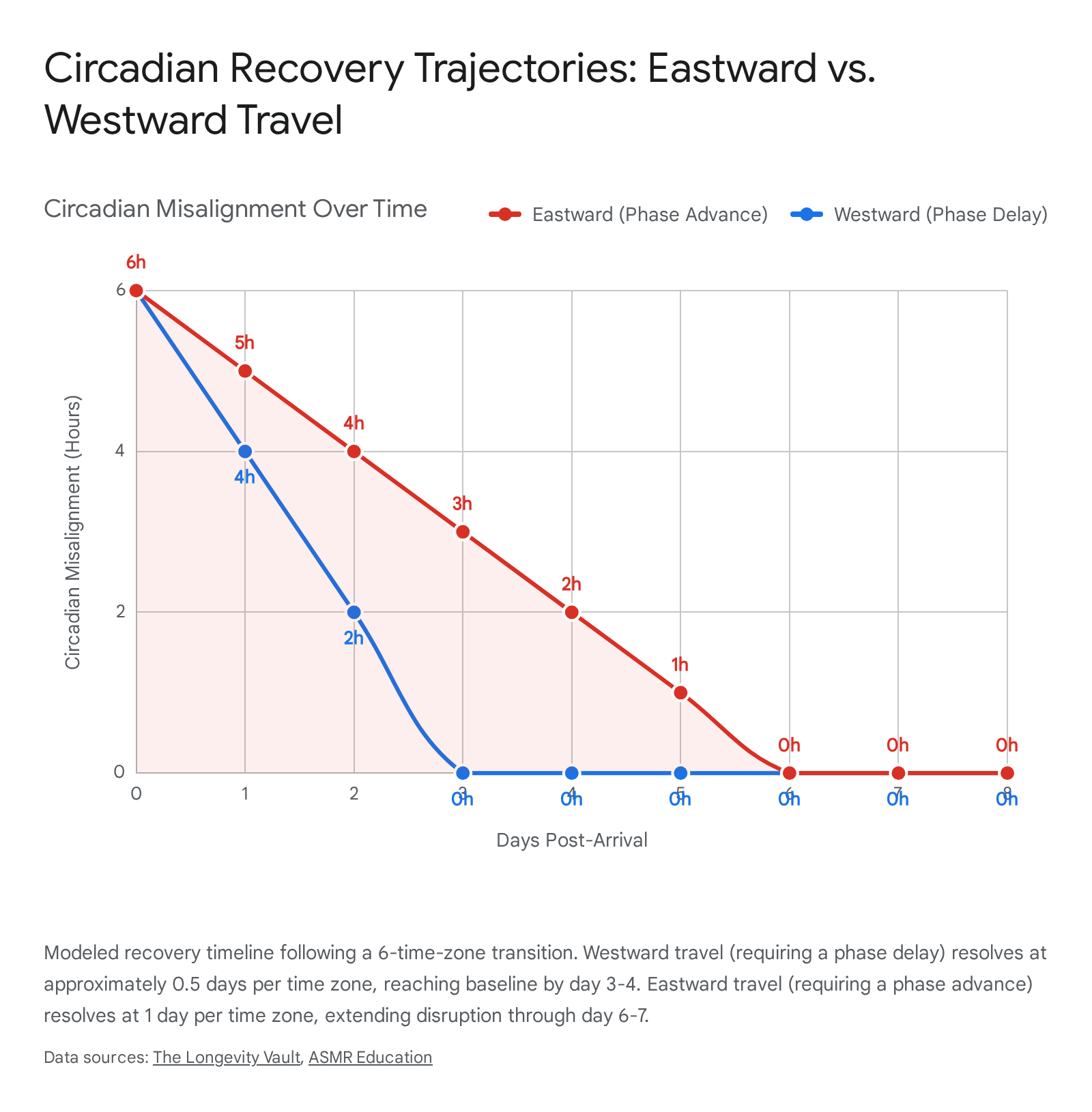
This formula illustrates why a flight from London to Tokyo - crossing 9 time zones eastward - can inflict physiological disruption lasting 9 to 11 days. A flight from New York to London (crossing 5 time zones eastward) will typically require 5 full days of recovery. However, the return trip from London to New York (crossing 5 time zones westward) requires merely 2.5 days to achieve baseline circadian realignment 2123. Advanced mathematical modeling using the Kuramoto framework of coupled oscillators demonstrates the precise mechanics of this delay. When forced to execute an eastward phase-advance, the SCN's cellular network is pushed into a specific region of "phase space" where intercellular coupling dynamics slow down dramatically. Westward phase delays completely bypass this slow-recovery region, allowing the oscillator network to maintain tight coupling while shifting 23. Furthermore, individuals whose specific genetic tau is furthest above the 24-hour mark experience an exponentially greater eastward disadvantage 23.
Directional Disruption: A Comparative Overview
| Variable | Westward Travel (e.g., Europe to USA) | Eastward Travel (e.g., USA to Europe) |
|---|---|---|
| Circadian Shift Required | Phase Delay (Lengthening the biological day) | Phase Advance (Compressing the biological day) |
| Alignment with Endogenous Tau | Synergistic (Supports the body's natural >24h drift) | Antagonistic (Fights against the body's intrinsic rhythm) |
| General Recovery Rate | ~0.5 days per time zone crossed | ~1.0 day per time zone crossed |
| Athletic Performance Impact | Deficits resolve by Day 5-6 (Post 6-zone shift) | Deficits persist well past Day 7 (Post 8-zone shift) |
| Cardiovascular Response | Transient increase in blood pressure | Transient decrease in blood pressure |
| Mental Health Correlates | Elevated risk of depressive symptoms | Elevated risk of anxiety and depression |
| Optimal Flight Strategy | Daytime flights; force wakefulness until local night | Overnight flights; maximize in-flight sleep |
Real-World Measurement: The 2023 Mega-Study on Sleep Architecture
Historically, the exact mechanics of jet lag recovery were mapped using small cohorts of specialists - such as astronauts or elite athletes - operating in highly controlled laboratory environments with continuous polysomnography. This methodology limited the generalizability of the findings to the everyday traveler. However, a landmark 2023 study by Willoughby, Chee, and colleagues at the National University of Singapore, published in Sleep Medicine, revolutionized the field by utilizing consumer wearable technology to conduct an unprecedented ecological analysis of transmeridian travel 181929.
The researchers analyzed over 1.5 million nights of objective, multi-sensor sleep data collected via the Oura Ring from 64,847 real-world trips crossing at least 1,000 kilometers, generated by 57,240 users across 35 countries 181930. This massive dataset uncovered a critical divergence in physiological recovery mechanics, specifically differentiating the recovery of sleep duration from the recovery of sleep timing.
The data proved that human sleep homeostatic mechanisms (Process S) are highly robust and resilient. Sleep duration is typically severely curtailed on the night immediately before travel due to anticipatory anxiety and early awakenings, and remains compromised during the transit phase 30. However, total sleep duration generally returns to within approximately 12 minutes of the individual's pre-travel baseline after just two days 3031.
In stark contrast, the intrinsic circadian factors governing sleep architecture - the macro-structure of light, deep, and rapid eye movement (REM) sleep - and sleep timing (the specific hours the body naturally initiates and terminates sleep) remained misaligned for dramatically longer periods. The study observed that sleep timing frequently failed to return to baseline even 15 days post-travel 3031. This perfectly underscores the chronobiological reality of desynchronosis: a traveler may rapidly catch up on their accumulated sleep debt, feeling physically rested, but the endogenous biological clock driving their sleep-wake phase and organ functionality remains stubbornly displaced.
The dataset also revealed profound regional and cultural differences in sleep variability, indicating that high weekday sleep variability and short baseline sleep duration in certain Asian countries correlate with distinct cultural coping mechanisms for sleep debt, complicating recovery from transmeridian travel 3132. Napping emerged as a common countermeasure, with over half of the participants logging naps exceeding 30 minutes to favorably impact same-day mood and next-day sleepiness scores, though researchers caution that ill-timed extended naps can further anchor the circadian rhythm to the home time zone 2933.
The Impact on Elite Athletic Physiology
The directional asymmetry of jet lag is vividly and quantifiably apparent in athletic performance metrics, where even micro-fluctuations in physiological alignment can dictate competitive outcomes. The cardiovascular and musculoskeletal systems are heavily regulated by the clock. In the heart alone, approximately 13% of genes and 8% of proteins exhibit rhythmic circadian oscillations, preparing the cardiovascular system for the anticipated energetic demands of the active phase 12.
A landmark chronobiological study by Lemmer et al. analyzed elite male athletes flying westward (Frankfurt to Atlanta, 6 time zones) versus eastward (Munich to Osaka, 8 time zones). Continuous ambulatory monitoring of blood pressure, heart rate, oral temperature, grip strength, and salivary cortisol/melatonin was conducted 2320. While physiological markers were acutely disrupted on the first day in both directions, the recovery trajectories diverged sharply. Cardiovascular markers, including altered blood pressure profiles (which notably increased after westward travel and decreased after eastward travel), resolved by day 5 following the westward flight. Conversely, physiological disruption persisted through day 7 and beyond following the eastward journey 2320.
Similarly, research by Fowler and colleagues measured specific team-sport metrics following 21 hours of long-haul travel across 8 time zones between Australia and Qatar. Testing included countermovement jumps, 20-meter sprints, and the Yo-Yo Intermittent Recovery (YYIR1) test 1735. The athletes suffered significantly worse subjective fatigue, marked motivation loss, and quantifiable reductions in maximal intermittent sprint performance following the eastward return journey compared to the westward outbound journey 1726. By day two post-arrival, 20-meter sprint times were significantly slower, and YYIR1 distance covered was drastically reduced in the eastward travel group 1726. The data strongly advises that sports organizations implementing chronobiology-informed scheduling must account for directionality, allowing a minimum of 72 to 96 hours of localized acclimatization before high-stakes competition, particularly after transmeridian transit toward the east 1736.
Occupational Hazards: Cognitive Function and Aviation Safety
In aviation and other mission-critical operations, the cognitive fatigue induced by jet lag and shift work is not merely a performance issue; it is a primary safety vulnerability. The U.S. Federal Aviation Administration (FAA) and NASA's Fatigue Countermeasures Laboratory have spent decades extensively monitoring, modeling, and regulating human performance in these high-stakes environments 21.
Air traffic controllers, for example, confront extreme circadian challenges. Faced with acute shortages, controllers often work prolonged, irregular shifts. A particularly exhausting schedule, known colloquially in the industry as a "rattler," compresses five shifts into a 4-day span, often forcing a controller to work a day shift followed immediately by a night shift on the same calendar date 22. A 2024 FAA scientific expert panel - spearheaded by prominent fatigue researchers Dr. Mark Rosekind, Dr. Erin Flynn-Evans, and Dr. Charles Czeisler - evaluated these air traffic control operations 23. The 114-page report concluded that this degree of circadian disruption, combined with chronic sleep loss, dramatically increases attentional failures, degrades working memory, and slows reaction times 2223. Spurred by a troubling increase in serious near-miss incidents at major U.S. airports, the report prompted the FAA to mandate stringent new scheduling policies in April 2024. The new directive requires 10 to 12 hours of off-duty rest between shifts, specifically mandating 12 consecutive hours of rest preceding midnight shifts, to mitigate the compounding, dangerous effects of homeostatic sleep debt and circadian misalignment 24.
For commercial flight crews operating ultra-long-range (ULR) flights - such as routes exceeding 16 hours from Auckland to Chicago - desynchronosis is an unavoidable occupational hazard 42. NASA and industry research demonstrates that pilots rarely achieve full circadian adaptation during short international layovers, meaning their internal clocks remain anchored to their domicile while operating in entirely displaced environments 42. To counter the acute cognitive decline experienced in the cockpit during these extended periods of wakefulness, the implementation of "Controlled Rest" (CR) has become a vital countermeasure. CR is a short, unscheduled, voluntary nap opportunity taken by a pilot on the flight deck 25. NASA studies demonstrate that a strategic 26- to 45-minute in-flight nap can improve subsequent pilot alertness by 54% and objective neurobehavioral performance by 34% 1125. Actigraphy data from commercial airline operations confirms that CR is utilized on nearly half of all long-haul flights, particularly during nighttime operations, with pilots successfully achieving an average of 31.7 minutes of restorative sleep during these brief opportunities 25.
Mental Health Implications of Circadian Disruption
The consequences of severe circadian desynchrony extend into psychological well-being. A growing body of evidence indicates a profound, bidirectional link between the circadian system and psychiatric resilience. The 2024 PRISMA review highlighted divergent mental health impacts based on the direction of travel. While both directions perturb mood and elevate systemic stress, eastward travel over extended or repeated itineraries is uniquely associated with an elevated risk of both anxiety and depression. Westward travel, by contrast, primarily correlates with isolated depressive symptoms 2344.
This vulnerability is particularly evident in populations subject to chronic jet lag. In a comprehensive study of 28 long-haul cabin crew members, researchers collected paired pre-trip and post-trip data using wrist actigraphy, validated psychological questionnaires, and urinary melatonin peak times as the objective marker of circadian phase 23. The analysis revealed a striking finding: depressed mood and pre-trip chronotype (specifically, evening chronotypes with longer intrinsic tau) were stronger predictors of the subjective severity of the jet lag experience than the objective, physiological shift of the melatonin phase 23. A combined psychological-physiological model was able to explain 53% of the variance in multidimensional jet lag symptoms, illustrating that the cognitive and emotional burden of desynchronosis is deeply intertwined with the molecular uncoupling of the biological clock 23. A scoping review of airline cabin crew health further corroborates this, finding that flight attendants operating long-haul international routes suffer from unsatisfactory sleep quality, elevated susceptibility to sleep disorders, and are at a significantly greater risk for clinical depression and anxiety compared to the general public 2646.
Do fasting or timed meals help?
The role of nutrition in circadian alignment has rapidly evolved from a fringe metabolic theory to a central, evidence-based pillar of jet lag mitigation. Because peripheral clocks in the liver, pancreas, and gastrointestinal tract are entrained primarily by nutrient availability and feeding-fasting cycles rather than by photic (light) input, the timing of meals acts as a powerful lever. By modulating food intake, travelers can force these stubborn peripheral organs into alignment with the new time zone 81015.
A critical concept in this domain is "eating jet lag" - the misalignment between the body's natural metabolic rhythms and actual food consumption. Just as social jet lag disrupts sleep architecture, consuming meals at biological midnight (as frequently occurs during long-haul flights when cabin crews serve meals based on departure time, or immediately after arrival at an odd hour) sends conflicting signals to the peripheral clocks. This uncouples the liver and gut from the central SCN pacemaker, accelerating metabolic dysfunction and exacerbating systemic jet lag symptoms 2748.
The 2024 Consensus on Fasting and Calibrated Uncertainty
When utilizing dietary manipulation as a countermeasure, it is essential to approach intermittent fasting with calibrated uncertainty. A 2024 international consensus panel convened to address the highly fractured terminology surrounding dietary restriction. The panel noted that terms like "intermittent fasting," "time-restricted eating," "alternate-day fasting," and "prolonged fasting" are frequently conflated in popular media, jet lag applications, and even clinical practice 2728. This lack of standardization leads to confusion regarding their specific physiological targets.
While severe caloric restriction (fasting for 16-24 hours) theoretically forces the body to deplete hepatic glycogen stores - thereby "priming" the liver clock for a rapid, aggressive phase reset upon re-feeding in the new time zone - the precise thresholds for duration, caloric load, and safety remain under continuous refinement by the scientific community 2850. The consensus panel strongly advised that individuals adopting extreme fasting strategies without understanding the physiological outcomes risk harmful implementation 28.
However, the efficacy of timed meals (chrono-modulation) without extreme fasting rests on much firmer scientific ground. A prominent 2023 study by Huang, Braun, and colleagues from Northwestern University and the Santa Fe Institute utilized complex mathematical modeling of coupled central and peripheral oscillators to test various dietary interventions for jet lag 1629. The model demonstrated that the single most effective dietary strategy to accelerate the adjustment of peripheral clocks is consuming a substantial, hearty breakfast aligned perfectly with the local morning of the destination time zone 1629.
Conversely, the study's models strongly advised against late-night eating, either on the aircraft prior to arrival or in the destination timezone. Consuming a heavy meal during the biological night introduces intense metabolic noise that severely impedes the synchronization of the TTFLs in the liver and gut, prolonging recovery 29. Integrating these findings with legacy protocols such as the Argonne Anti-Jet-Lag Diet, a modern, evidence-based dietary protocol for transmeridian travel dictates: 1. Fasting (or consuming only very light, non-caloric liquids) during the transit period, specifically when the flight hours correspond to the destination's nighttime 5029. 2. Breaking the fast with a high-protein, high-calorie meal precisely at the destination's standard breakfast hour. This distinct, heavy metabolic signal forces the hepatic clock to re-anchor to the local morning, significantly reducing peripheral recovery time by up to two days 1650.
Practical Protocols: Light and Melatonin
Combating jet lag effectively requires a proactive, multimodal approach. Passive reliance on time alone to heal the circadian divide results in days of lost occupational productivity, compromised athletic performance, and systemic physiological stress. Based on aerospace medical standards, robust chronobiology literature, and NASA fatigue management protocols, travelers must actively manipulate the two most potent zeitgebers available: light and melatonin 213031.
1. Strategic Light Management (The Phase Response Curve)
Light is the dominant synchronizer of the SCN master clock. However, light exposure is a double-edged sword; exposure to bright light at the wrong biological time will shift the internal clock in the exact wrong direction. This biphasic reaction is described by the Phase Response Curve (PRC), which maps how the circadian phase responds to light based on the core body temperature minimum (Tmin), which typically occurs 2 to 3 hours prior to natural wake time 14.
- Traveling East (Phase Advance): To advance the clock and compress the day, travelers must seek bright sunlight in the early biological morning of the destination (shortly after the biological Tmin), and strictly avoid bright light in the late evening 13154.
- Traveling West (Phase Delay): To delay the clock and extend the day, travelers must seek bright sunlight in the late biological afternoon and evening (prior to the biological Tmin), while strictly avoiding early morning light which would prematurely advance the clock 16.
2. Exogenous Melatonin Supplementation
Melatonin is an endogenous hormone secreted by the pineal gland that acts as the biochemical signal for darkness, naturally rising roughly two hours before habitual sleep onset 531. Exogenous melatonin administration is remarkably effective for combating jet lag, boasting a "Number Needed to Treat" (NNT) of just 2 - meaning 1 in 2 people who use it will experience a significant, measurable reduction in jet lag severity 315532.
The clinical application of melatonin for jet lag relies on a highly specific protocol that differs from its use as a standard sleep aid: * Precision Timing: The efficacy of melatonin for phase-shifting is entirely dependent on timing relative to the destination's dark period. It must be administered close to the target bedtime at the destination (e.g., 10:00 PM to midnight local time). Taking it at the wrong biological time can actively delay adaptation and cause severe daytime somnolence 3132. * Dosing (The 0.5mg vs. 5mg Paradox): Contrary to popular consumer belief, higher doses of melatonin do not yield greater circadian phase shifts. Peer-reviewed literature confirms that a low 0.5mg dose is virtually as effective as a 5.0mg dose for shifting the circadian clock 213132. The primary pharmacological difference is that a 5.0mg dose provides a much stronger immediate hypnotic (sleep-inducing) effect. Therefore, a high dose (3-5mg) is recommended for immediate sleep induction on the first few nights post-arrival, while low doses (0.5mg) are preferred if a traveler is attempting to shift their clock prior to departure without causing severe pre-flight drowsiness 315455. * Directional Importance: Due to the severe difficulty of forcing the body to phase advance, melatonin supplementation is universally recommended by chronobiologists for adult travelers crossing five or more time zones, particularly in the eastward direction 3132.
Bottom Line
Jet lag is not merely the accumulated fatigue of a long journey, but a profound temporal fracturing of the human biological system, wherein the brain's central pacemaker (the SCN) falls drastically out of sync with the independent, nutrient-driven clocks of peripheral organs like the liver, heart, and gut. Due to the human body's intrinsic >24-hour circadian cycle, eastward travel - which demands compressing the day in opposition to the body's natural drift - is significantly more physiologically punishing and takes roughly twice as long to recover from compared to westward travel. Overcoming this systemic desynchrony requires abandoning pervasive myths, such as treating jet lag purely with caffeine or sleep-bingeing. Instead, travelers and organizations must actively manipulate human biology by combining strategically timed light exposure, precise melatonin dosing aligned with the destination's bedtime, and rigid adherence to destination-aligned meal schedules - particularly leveraging a heavy morning breakfast while strictly avoiding late-night feeding - to aggressively bring the body's entire physiological orchestra back into unison.