
How Long Does It Take to Recover From Sleep Deprivation
Recovering from chronic sleep deprivation typically takes two to three weeks of consistently obtaining your full biological sleep requirement, not just a single weekend. While you might feel subjectively refreshed after one or two nights of extended rest, objective cognitive deficits and metabolic dysfunctions like insulin resistance linger much longer. Attempting to rapidly erase a severe sleep deficit by binge-sleeping on weekends provides some cardiovascular benefits but ultimately fails to undo the complex hormonal and neurobehavioral tolls of a sleep-restricted week.
The Anatomy of Accumulated Sleep Loss
In modern society, restricted sleep has become an inescapable byproduct of long working hours, remote digital connectivity, and social demands. According to data from the 2024 National Health Interview Survey (NHIS) conducted by the Centers for Disease Control and Prevention (CDC), 30.5% of adults in the United States sleep less than the recommended seven hours per night, representing a significant increase from 2020 12.
Sleep debt, clinically referred to as a sleep deficit, is defined as the cumulative difference between the amount of sleep an individual requires for optimal physiological functioning and the amount they actually obtain 345. When an adult who physiologically requires eight hours of sleep only obtains six hours over five consecutive workdays, they accumulate a sleep debt of ten hours. This deficit does not simply evaporate at the end of the week. It is rigorously logged by the body's neurochemical systems, fundamentally altering synaptic plasticity, hormone regulation, and cognitive throughput 4.
The Two-Process Model of Sleep Regulation
To understand why recovery takes so long, it is essential to understand how sleep pressure is generated and cleared. Sleep scientists rely on the "two-process model" to explain this regulation, involving Process S and Process C 678.
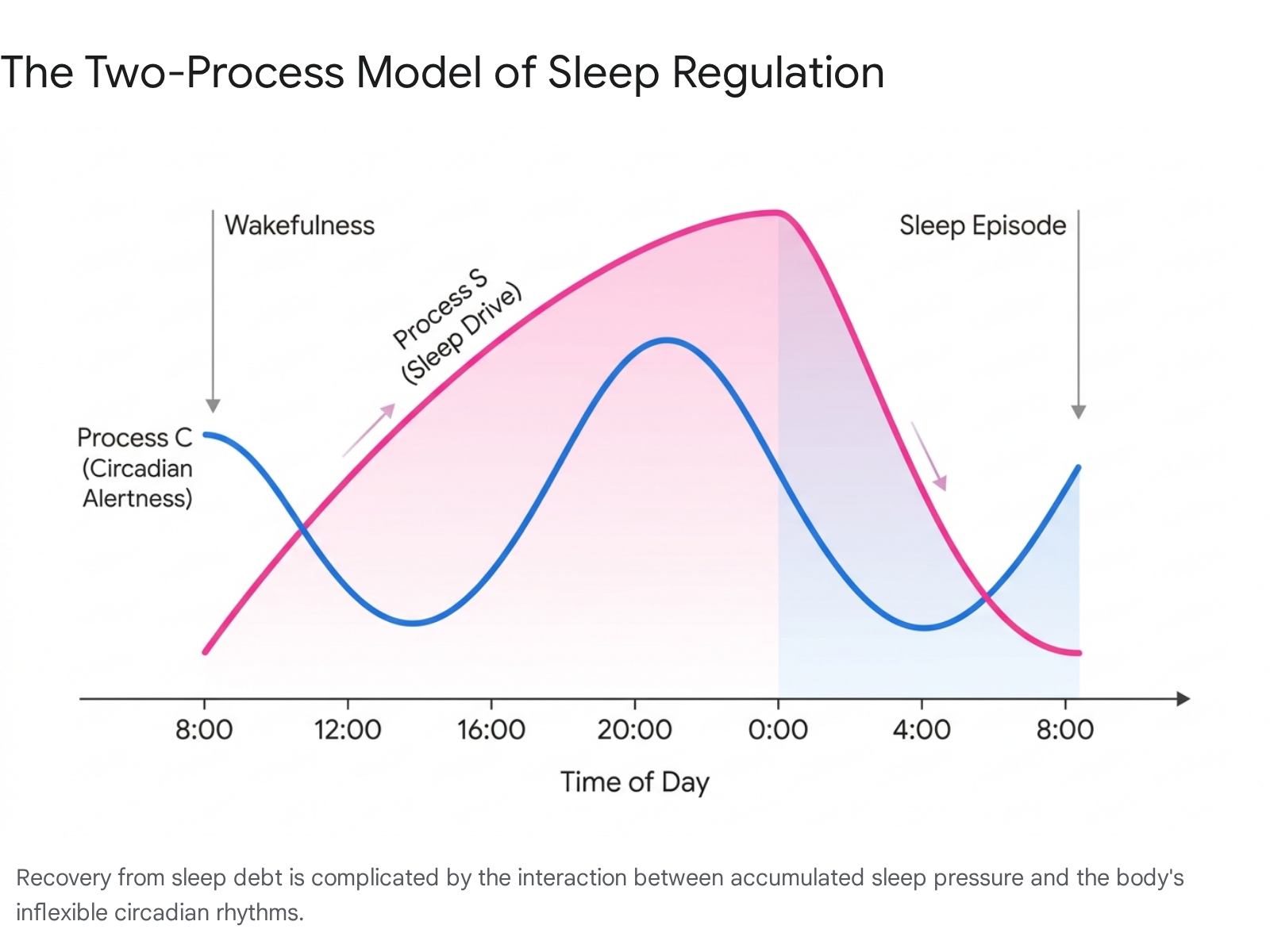
Process S represents the homeostatic sleep drive. It is directly tied to the duration of wakefulness. As the brain burns energy during waking hours, a neuromodulator called adenosine builds up in the basal forebrain 48. This accumulation creates biological "sleep pressure." The longer you stay awake, the stronger Process S becomes. During sleep, adenosine is cleared, and sleep pressure dissipates, primarily during deep, restorative slow-wave sleep (SWS) 489.
Process C represents the circadian pacemaker, the body's internal 24-hour clock located in the suprachiasmatic nucleus (SCN) of the hypothalamus 68. Process C regulates the timing of sleepiness and wakefulness independently of how long you have been awake. It drives the rhythmic release of hormones like cortisol, which promotes alertness in the morning, and melatonin, which promotes sleep onset in the evening 6810.
When attempting to recover from sleep debt, these two processes frequently collide. You may carry a massive homeostatic sleep debt (Process S), but if you attempt to sleep late into the afternoon to pay it off, your circadian rhythm (Process C) will begin pumping out wake-promoting signals, fragmenting your recovery sleep and limiting its restorative value 7811.
Acute vs. Chronic Sleep Deprivation
The recovery timeline depends heavily on the nature of the sleep loss.
Acute sleep deprivation occurs when a person experiences one or two nights of total or near-total sleep loss, such as pulling an all-nighter 1213. This creates a massive, immediate spike in homeostatic sleep pressure. While acute sleep deprivation produces profound immediate impairments, rapid recovery is possible. Research demonstrates that the performance deficits induced by a single night of total sleep deprivation can often be largely liquidated by a single extended recovery sleep of 8 to 10 hours 313.
Chronic partial sleep restriction is far more common and significantly harder to undo. It occurs when a person routinely sleeps fewer hours than they need over days, weeks, or months. In highly controlled laboratory studies, restricting sleep to four or six hours a night for two weeks yielded cognitive deficits comparable to a full 48 hours of total sleep deprivation 312. Unlike acute sleep debt, chronic sleep debt alters neurobehavioral functions and metabolic pathways in ways that require a prolonged, multi-day recovery protocol 313.
Subjective-Objective Dissociation: The Illusion of Recovery
One of the most dangerous aspects of recovering from chronic sleep debt is a clinical phenomenon known as "subjective-objective dissociation" 1415161718.
When individuals undergo continuous days of partial sleep restriction, their subjective feelings of sleepiness, fatigue, and poor mood tend to peak and plateau after a few days 313. People effectively become accustomed to feeling tired; their brain establishes a "new normal." However, objective measures of their cognitive performance - such as their reaction times, working memory, and sustained vigilant attention - do not plateau. Instead, objective performance continues to plummet progressively the longer the restriction continues 31219.
This disconnect persists well into the recovery phase. Studies have repeatedly shown that when chronically sleep-deprived individuals are given recovery sleep opportunities, their subjective mood and feelings of alertness return to baseline rapidly, often after just one or two nights 1320. Because they feel rested, individuals assume their sleep debt is entirely repaid.
Yet, objective clinical testing proves otherwise. A landmark study evaluating cognitive recovery following sleep deprivation found that while subjective sleepiness recovered on the very first day of recovery sleep, higher-order cognitive tasks and feelings of mental confusion required a minimum of two ordinary sleep opportunities to return to baseline 20. For chronic deprivation stretching over weeks, the gap between feeling fully recovered and actually being fully recovered stretches even wider.
Timeline 1: Cognitive and Neurological Restoration
The brain requires sleep to clear metabolic waste, consolidate memories, and restore synaptic plasticity. When recovering from chronic sleep debt, different cognitive domains recover at highly variable speeds, and higher-order functions are consistently the last to return to normal 3412.
The Slow Return of Complex Cognition
A revealing 2021 study published in PLOS One by researchers at Jagiellonian University provided a striking look at long-term cognitive recovery timelines. Participants were subjected to 10 days of partial sleep restriction, getting about one-third less sleep than their usual baseline. This deprivation phase was followed by a full seven days of unhindered recovery sleep 21.
The scientists tracked subjective alertness, continuous actigraphy (sensor-based body movement), electroencephalogram (EEG) brain activity, and various objective cognitive tasks 21. The results were sobering. After a full week of recovery sleep, the only metric that had fully returned to the pre-deprivation baseline was the participants' simple reaction speed 21. More complex behavioral, locomotor, and neurophysiological measures remained impaired. As the authors concluded, "the neurobehavioral consequences of chronic partial sleep deprivation cannot be overcome easily and last much longer than one expects" 21.
Similarly, data drawn from high-performing individuals confined in space-mission analogues demonstrates the compounding nature of sleep debt. When subjects' sleep was restricted to five hours on weekdays and eight hours on weekends over a six-week period, researchers found that cognitive performance deficits did not stabilize. Instead, accuracy across cognitive domains showed escalating declines as the cumulative sleep debt grew, indicating that brief weekend recovery windows were entirely insufficient to halt cognitive degradation 19.
Vulnerability and Your "Sleep History"
Research spearheaded by chronobiology pioneers like David Dinges has also revealed that an unresolved sleep debt leaves a neurological "scar" of vulnerability 3.
In a protocol tracking neurobehavioral dynamics, subjects underwent sleep restriction, followed by a period of partial recovery, and then underwent another round of sleep restriction. The study found that if the initial sleep debt was not completely cleared during the recovery phase, the cognitive decline during the second round of restriction was significantly faster and more severe 3.
This means that partial recovery creates a fragile neurological state. Unless the sleep debt is entirely repaid - which can take weeks of prioritizing 7 to 9 hours of sleep nightly - you remain highly vulnerable to even minor sleep losses in the future 422. Prior sleep history acts as a buffer; individuals who enter a period of sleep restriction fully rested suffer fewer deficits than those carrying unresolved debt 323.
| Cognitive / Subjective Domain | Typical Recovery Timeline (Following Chronic Debt) | Clinical Evidence Basis |
|---|---|---|
| Subjective Sleepiness | 1 to 2 days | Subjects report feeling refreshed and alert quickly, leading to "subjective-objective dissociation" and a false sense of full recovery 1320. |
| Simple Reaction Time | 3 to 7 days | Vigilant attention and basic motor responses stabilize after several days of extended 8 - 10 hour sleep opportunities 321. |
| High-Order Executive Function | 1 to 2+ weeks | Working memory, complex decision-making, and neurophysiological EEG patterns often remain impaired even after a full week of extra rest 2021. |
Timeline 2: Metabolic and Endocrine Recovery
While the brain dictates our subjective perception of recovery, sleep debt wreaks profound, quantifiable havoc on the body's endocrine system and metabolic health. The timeline to reverse these changes is alarming, and treating sleep as an afterthought has severe physiological consequences.
Insulin Resistance: "Temporary Diabetes"
Sleep heavily modulates glucose metabolism. In the first half of the night, the predominance of Slow Wave Sleep (SWS) is associated with a marked reduction in cerebral glucose uptake and a stabilization of peripheral glucose utilization 24. These effects reverse during the lighter sleep stages of the early morning. When sleep is restricted, this highly orchestrated nightly metabolic reset is disrupted, resulting in rapid metabolic deterioration 2425.
In highly controlled laboratory studies, healthy young men restricted to just four hours of sleep per night for one week experienced a 40% reduction in insulin sensitivity, measured via intravenous glucose tolerance testing 26. Their bodies required significantly more insulin to process the same amount of glucose, mirroring the metabolic profile of pre-diabetes, despite no changes in their diet or exercise routines 2627. Even a single night of restricted sleep (four hours) has been shown to acutely elevate insulin levels and induce measurable insulin resistance the following morning 27.
How long does it take to reverse this metabolic damage? For short, acute bouts of restriction, recovery can be remarkably swift. Researchers at the University of Chicago demonstrated that two nights of extended recovery sleep (averaging 10 hours in bed per night) following four nights of restricted sleep was sufficient to restore insulin sensitivity and the "disposition index" (a key marker of diabetes risk) back to normal baseline levels in healthy, lean men 28.
However, for individuals carrying weeks or months of chronic sleep debt, reversing tissue-specific insulin resistance - particularly in the liver and muscles - is vastly more complex. Chronic sleep deprivation leads to sustained elevation of cortisol (a stress hormone) in the late evening, which further promotes abdominal fat accumulation and blunts the body's insulin response 242930. Reversing this chronic metabolic dysregulation requires prolonged adherence to a healthy sleep routine stretching over weeks, not days 112225.
The Appetite Hormones: Ghrelin and Leptin
Sleep deprivation directly triggers weight gain through the dysregulation of two vital appetite hormones: ghrelin, which is released by the stomach to signal hunger, and leptin, which is released by fat cells to signal satiety 2931.
Studies show that recurrent partial sleep deprivation is associated with a 19% decrease in leptin levels and a concomitant, significant rise in ghrelin 2431. The result is an intense, hormonally driven craving for calorie-dense, carbohydrate-rich, and processed foods 29. The constant feeling of hunger is not a lack of willpower; it is a direct biochemical consequence of sleep restriction.
Reversing this endocrine imbalance requires restoring normal architecture across all sleep stages. Because the proportions of REM and Slow Wave Sleep are critical for hormonal repair, it can take several consecutive nights of unfragmented, high-quality sleep to normalize leptin and ghrelin secretion profiles 431.
The "Weekend Catch-Up Sleep" Paradox
Because chronic sleep deprivation is so heavily tied to the five-day work or school week, millions of people utilize Weekend Catch-up Sleep (WCS) as their primary recovery strategy. Epidemiological data indicates that extending sleep on days off is an incredibly common compensatory behavior worldwide 323334. But is it actually effective?
The scientific consensus is highly mixed, revealing a profound difference between how WCS impacts cardiovascular survival versus metabolic health.
The Potential Cardiovascular Benefits
In 2024, a massive observational study utilizing the UK Biobank database tracked 90,903 adults over an average 14-year follow-up period to assess the impact of WCS on heart health 32343536. Researchers equipped participants with wrist accelerometers to objectively measure sleep duration, bypassing the flaws of self-reported data. Nearly 22% of the cohort met the clinical criteria for sleep deprivation, obtaining less than seven hours a night 3536.
The findings, presented at the European Society of Cardiology Congress, offered encouraging news for weekend sleepers. Individuals who logged the most compensatory weekend sleep (ranging from 1.28 to 16 extra hours of sleep over the weekend) had a 20% lower risk of developing heart disease compared to those who logged the least amount of catch-up sleep 323435. The study's authors concluded that sufficient compensatory sleep acts as a valid biological mitigator against the cardiovascular strain of weekday sleep loss 3236.
There is also evidence of psychological benefits when WCS is applied in moderation. A 2025 study examining 1,877 teenagers found a "sweet spot" for weekend recovery. Teens who secured moderate catch-up sleep (defined as zero to two extra hours) exhibited fewer symptoms of anxiety. However, this benefit was highly dose-dependent; if they slept substantially more than two extra hours, the teenagers exhibited higher internalizing symptoms and signs of depression, likely due to massive circadian disruption 37.
The Metabolic and Circadian Detriments
While sleeping in on Saturdays may offer some protection to your heart and mood, it appears to actively punish your metabolism and circadian rhythm.
A landmark NIH-funded study conducted at the University of Colorado exposed healthy adults to a simulated workweek of restricted sleep (five hours a night), followed by a weekend of unrestricted catch-up sleep, and then a return to sleep restriction 11.
The results exposed the severe limitations of "yo-yo" sleeping. While the weekend recovery group did show a brief reduction in late-night snacking during the weekend, all metabolic benefits vanished the moment the workweek resumed. Ultimately, the WCS group gained an average of three pounds and experienced a 27% decrease in overall insulin sensitivity 11.
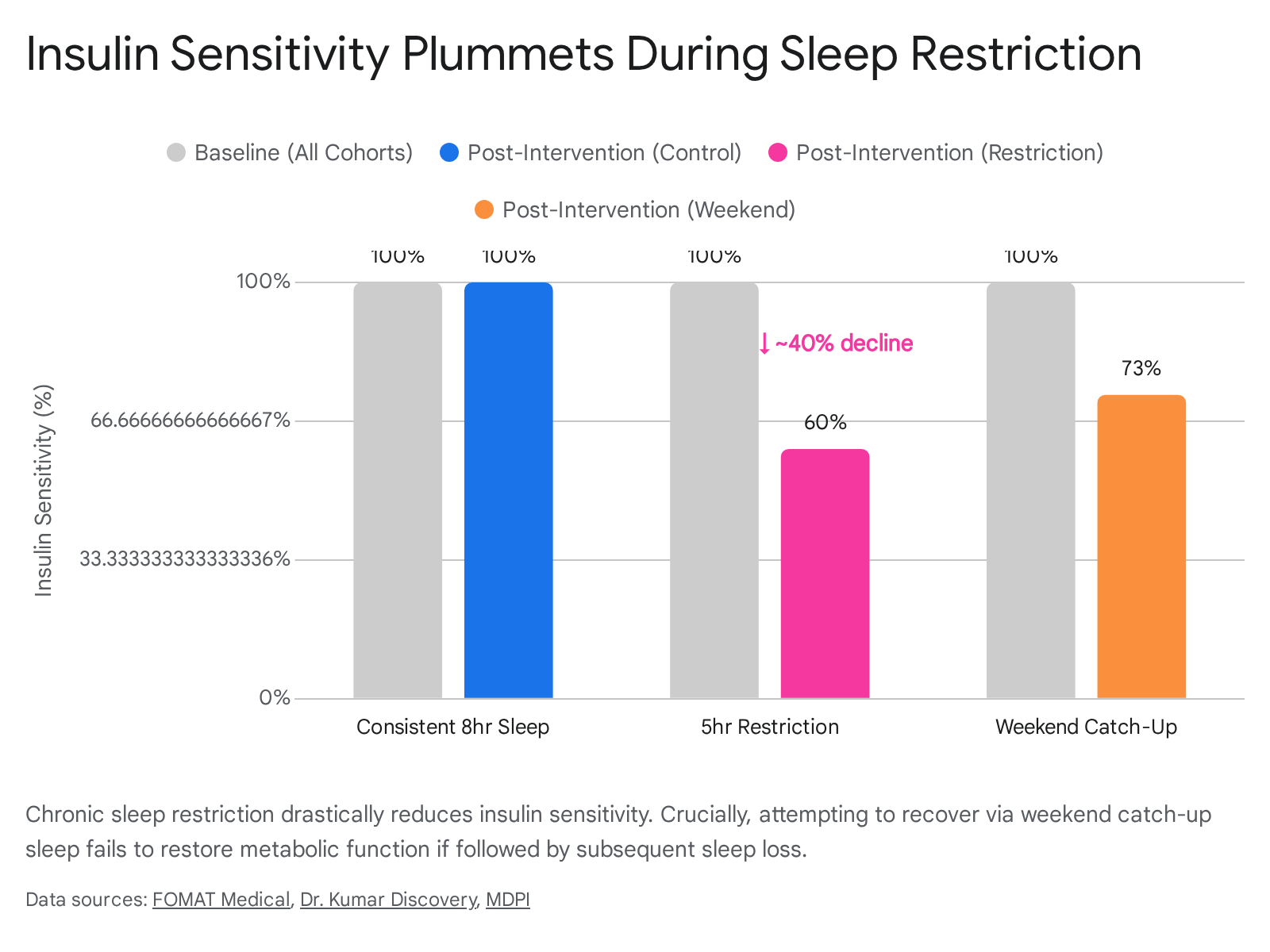
Shockingly, specific markers for liver and muscle insulin sensitivity actually became worse in the weekend recovery group than in a control group that simply stayed sleep-restricted continuously without a weekend break 11.
Why does this happen? Sleeping late on weekends violently shifts the circadian pacemaker (Process C), creating a phenomenon known as "social jetlag" 1138. When Monday arrives, the body's internal clock is misaligned with the alarm clock. Melatonin is still circulating when the person tries to wake up, compounding the physiological stress of the returning sleep restriction and triggering intense late-night snacking cycles 11.
Furthermore, the long-term protective effects of WCS remain heavily contested. A separate 2024 analysis, also utilizing UK Biobank accelerometer data for over 70,000 participants, found that extending sleep over the weekend was not associated with lower overall mortality or incident cardiovascular disease, directly contradicting some of the more optimistic literature 34. Given these conflicting large-scale studies, WCS should be viewed as a flawed, transient relief strategy rather than a genuine physiological cure.
Cultural Variations in Managing Sleep Pressure
The modern obsession with squeezing all necessary recovery into a single, monophasic (one block) eight-hour nocturnal window is a relatively recent, Western industrial construct. Looking globally and historically, alternative sleep patterns provide entirely different frameworks for managing sleep pressure and mitigating debt 394140.
Biphasic Sleep and the Restorative Siesta
In many Mediterranean, Latin American, and certain Asian cultures, sleep is historically structured as a biphasic pattern 3941. The traditional siesta incorporates a longer nighttime core sleep (e.g., 5 to 6 hours) paired with a robust 1-to-3 hour mid-afternoon sleep during the hottest part of the day 93941.
From a physiological chronobiology standpoint, a long siesta effectively clears a significant portion of homeostatic sleep pressure (Process S) halfway through the waking cycle 89. Unlike a quick 20-minute power nap, a full daytime core sleep contains at least one complete sleep cycle. After intense physical or mental exertion, a siesta allows the body to accumulate restorative Slow Wave Sleep, which releases growth hormone and actively regulates glucose levels before the evening 9.
Flexibility in Developing Nations and Indigenous Cultures
In pre-industrial societies and many developing nations, sleep is viewed much more fluidly. Among the Hadza people, a traditional hunter-gatherer society in Tanzania, sleep is highly flexible, often occurring in multiple shorter bouts (polyphasic sleep) dictated by environmental needs, threats, and daily activities rather than strict clock-time 39.
Interestingly, cross-cultural data tracking time-use apps reveals that nations like Japan and Singapore average some of the shortest nightly sleep durations in the world, often logging around 7.5 hours or less 40. Yet, despite seemingly carrying massive population-wide sleep debt, these populations simultaneously exhibit some of the lowest rates of obesity, Type 2 diabetes, and ischemic heart disease globally 40. In Japan, the cultural practice of inemuri - taking short, socially acceptable naps in public, on trains, or at the workplace - may serve as a crucial micro-recovery mechanism that helps blunt the physiological edge of their systemic short nocturnal sleep durations 3940.
Who is Carrying the Most Sleep Debt?
To fully grasp the scale of the recovery challenge, it is helpful to look at who is actually suffering from severe sleep restriction. According to the CDC's 2024 demographic breakdown, sleep deprivation and the ability to recover vary significantly across age, gender, and racial lines 12.
| Demographic Group | Short Sleep Duration (<7 hours) | Waking Up Well-Rested (Most/Every Day) | Trouble Staying Asleep |
|---|---|---|---|
| National Average | 30.5% | 54.8% | 18.1% |
| Men | 30.6% | 58.2% | 14.6% |
| Women | 30.4% | 51.7% | 21.4% |
| Ages 18 - 34 | 27.2% | 52.2% | 12.7% |
| Ages 50 - 64 | 34.5% | 54.5% | 22.3% |
| Asian (Non-Hispanic) | Lower relative prevalence | 61.5% | 9.2% |
| White (Non-Hispanic) | Average prevalence | 54.3% | 20.7% |
Data Source: 2024 National Health Interview Survey (NHIS), National Center for Health Statistics 2.
While men and women report similar rates of short sleep duration (around 30%), women consistently report higher rates of trouble falling and staying asleep, and are significantly less likely to wake up feeling well-rested compared to men 12. Furthermore, middle-aged adults (ages 50 to 64) carry the highest burden of raw sleep debt, with 34.5% failing to meet the 7-hour minimum threshold 12.
Evidence-Based Protocols for Erasing Sleep Debt
If weekend binge-sleeping is metabolically risky and subjective feelings of restfulness are deceitful, how long does it actually take to recover, and what is the optimal protocol?
Clinical guidelines and sleep science dictate that recovering from chronic sleep deprivation requires a methodical, sustained approach stretching over a minimum of two to three weeks 42223. Rather than viewing sleep as a bank account that can be paid off in a massive lump sum on Sunday morning, it must be treated as a delicate biological rhythm requiring careful stabilization.
1. The Strategy of Incremental Extension
The most evidence-based approach is to spread recovery across multiple nights. Rather than attempting to sleep 12 hours on a Saturday - which violently shifts the circadian clock and causes Sunday-night insomnia - experts recommend gradually adding 15 to 30 minutes, or at most one to two hours, of sleep per night to your baseline requirement 42223.
If your body naturally requires 8 hours, aim for 8.5 to 9 hours nightly during your recovery weeks. This extended sleep window allows the body to progressively discharge accumulated homeostatic pressure while organically restoring normal proportions of REM and Slow Wave Sleep, both of which are critical for metabolic repair and cognitive memory consolidation 4.
2. Prioritizing Circadian Consistency
Consistency is vastly more important than total compensatory volume. Establish a rigid sleep schedule by going to bed and waking up at the exact same time every day, including weekends 52223.
By locking in your wake time, you anchor Process C. The circadian pacemaker requires regular light exposure upon waking to keep hormone secretion properly aligned. Keeping the schedule stable eliminates social jetlag and provides physiological systems, from glucose metabolism to immune response, the stable environment they desperately need to normalize 222324.
3. Prophylactic "Banking" and Strategic Napping
While you cannot truly "bank" sleep infinitely, research indicates that paying down existing debt before a period of anticipated restriction is highly protective. In controlled studies, individuals who extended their sleep to ten hours nightly for a week prior to an intended sleep restriction phase demonstrated significantly less cognitive impairment and much faster recovery than those who entered the restriction phase with an existing sleep debt 323.
If extending nighttime sleep is impossible due to demanding work schedules, daytime naps can facilitate recovery, provided they are managed correctly. A brief 10- to 20-minute mid-afternoon nap can successfully increase alertness, working memory, and mental acuity without inducing sleep inertia - the profoundly groggy state caused by waking up abruptly from deep Slow Wave Sleep 541. When utilized properly, prophylactic afternoon naps have been shown to maintain beneficial effects on cognitive performance for up to 12 hours post-nap 3.
Bottom line
It takes significantly longer to recover from sleep debt than it does to accumulate it. While subjective feelings of fatigue and poor mood may resolve after just one or two nights of extended sleep, reversing profound metabolic damage - such as a 40% drop in insulin sensitivity - and fully restoring high-order cognitive function requires a minimum of two to three weeks of consistent, adequate rest. Binge-sleeping on weekends may offer some transient cardiovascular protection against the toll of a brutal workweek, but it cannot undo the broader physiological consequences of chronic sleep deprivation and often worsens circadian misalignment.