
What Happens During a Rolling Blackout Step by Step
A rolling blackout is a deliberate, temporary power outage rotated across different neighborhoods by utility companies to prevent a total, catastrophic collapse of the electrical grid. Grid operators trigger these controlled shutoffs as an absolute last resort when regional electricity demand dangerously exceeds the available energy supply. By strategically cutting power to small sections of the grid for short periods, operators can artificially lower demand to match the remaining supply, keeping the broader system stable and preventing weeks-long, uncontrolled blackouts.
The Physics of Grid Stability
To understand why a rolling blackout happens, one must look at the fundamental rule of electrical engineering at a macro scale: electricity consumption must perfectly match electricity production at every single second of the day 1. Because electricity is incredibly difficult to store efficiently at the scale of a national grid, the energy illuminating a light bulb must be generated at a power plant the exact moment the switch is flipped 1.
Grid operators manage this delicate balance by meticulously monitoring what is known as "grid frequency." In the United States, the alternating current (AC) power grid operates at a strict reference frequency of 60 Hertz, while in Europe and other parts of the world, the standard is 50 Hertz 12. Operators must keep this frequency incredibly stable, operating 24 hours a day within an unforgiving tolerance threshold of plus or minus 0.050 Hertz 2.
When the power generation across the system matches the aggregate demand of consumers, the frequency stays constant 1. However, if millions of people simultaneously turn on their air conditioners during a heatwave and demand suddenly exceeds supply, the physical generators on the grid - massive spinning turbines in coal, nuclear, and natural gas plants - face immense mechanical resistance. They absorb the extra energy demand by physically slowing down, causing the grid's utility frequency to drop 12.
Conversely, if there is a sudden drop in demand or a massive surge in generation, the turbines speed up, and the frequency increases 12. The kinetic energy of these massive, physically rotating synchronous generators provides a brief inertial response - a quick-response safety margin - but it is only a temporary buffer 1. If the frequency drops too far out of bounds, sensitive electrical equipment throughout the grid can be physically destroyed. To protect themselves, generators and transmission lines will automatically disconnect from the grid 1. If left unchecked, this triggers a cascading failure where power plants trip offline one by one, leading to an uncontrolled, system-wide blackout that can take days or weeks to recover from 123.
The Water Bucket Analogy
The complexities of grid management are often explained using the analogy of a massive, leaking bucket of water 46. In this scenario, central generation plants are hoses feeding water into the top of the bucket, representing the energy supply. Consumer demand - the homes, businesses, and factories drawing power - are differently sized holes at the bottom of the bucket, constantly draining the water out 4.
For the grid to remain stable, the water level must remain perfectly constant, staying within a margin of just a few millimeters 4. If the water level falls below that line, customers begin to lose power; if it rises above the line, the grid's infrastructure faces catastrophic damage 4. If a heatwave causes the holes at the bottom of the bucket to widen, water begins draining much faster than the hoses can refill it 46. When the hoses are already running at maximum capacity, the grid operator has only one option left to prevent the bucket from running dry: they must forcibly plug a few of the holes. A rolling blackout is the grid operator's emergency mechanism to temporarily stop the outflow in specific areas, forcing the water level to stabilize 456.
Categorizing Power Disruptions
While the general public often uses the term "blackout" as a blanket statement for any loss of electricity, grid operators and energy professionals strictly differentiate between three distinct types of power disruptions based on their cause, scope, and level of operational control.
| Disruption Type | Definition and Mechanism | Primary Triggers | Predictability and Control |
|---|---|---|---|
| Rolling Blackout | A complete, temporary loss of power intentionally scheduled and rotated across specific service areas by grid operators 97. | Severe supply shortages, peak demand spikes (extreme heat/cold), or widespread generation failure 311. | Highly controlled. Usually preplanned with some advance public warning, lasting 1 to 4 hours per cycle 697. |
| Brownout | An intentional or unintentional drop in electrical voltage by roughly 10% to 25%, while power technically remains on 78. | Used as an emergency load-reduction tactic before a blackout, or caused by overloaded local infrastructure 914. | Can be planned or spontaneous. Lights dim, and sensitive electronics or electric motors may run hot or malfunction 789. |
| Unplanned Blackout | A sudden, complete loss of power in a localized area resulting from physical damage or equipment failure 7815. | Severe weather (hurricanes, ice storms), vehicle accidents hitting poles, wildlife interference, or transformer blowouts 715. | Completely unpredictable. Uncontrolled duration, lasting from minutes to weeks depending on repair times 678. |
Understanding these distinctions is crucial because a brownout allows for some electrical flow at a diminished capacity, which can actually be more damaging to sensitive equipment than a clean blackout. Computer disk drives often suffer write failures when supplied with suboptimal voltage, and electric motors can overheat when forced to produce the same horsepower under a brownout's low-voltage conditions 78. Therefore, rolling blackouts, while highly disruptive, are a definitive action to protect both the grid's structural integrity and the consumer's connected hardware from chaotic, cascading failure 38.
Escalating Emergency Stages: The Countdown to Darkness
Rolling blackouts do not happen instantly or without warning. Regional Transmission Organizations (RTOs) and Independent System Operators (ISOs) - the centralized entities that act as the air traffic controllers of regional power grids - utilize highly structured, step-by-step emergency protocols when their forecasting models indicate trouble.
These crises often materialize when extreme weather patterns compound on each other. For example, a severe winter storm might simultaneously drive up heating demand while freezing natural gas wellheads and halting wind generation, or a summer heat dome might drive air conditioning use to record highs just as the sun sets and solar generation tapers off 916. When these supply-demand imbalances are forecasted, the operator begins moving through escalating warning stages.
Energy Emergency Alerts
Taking the Electric Reliability Council of Texas (ERCOT) as a primary example, grid operators utilize a three-level Energy Emergency Alert (EEA) system whenever the system's operating reserves drop dangerously low. ERCOT typically maintains thousands of megawatts of backup capacity, but when the margin of error shrinks, the emergency protocols are activated 101112.
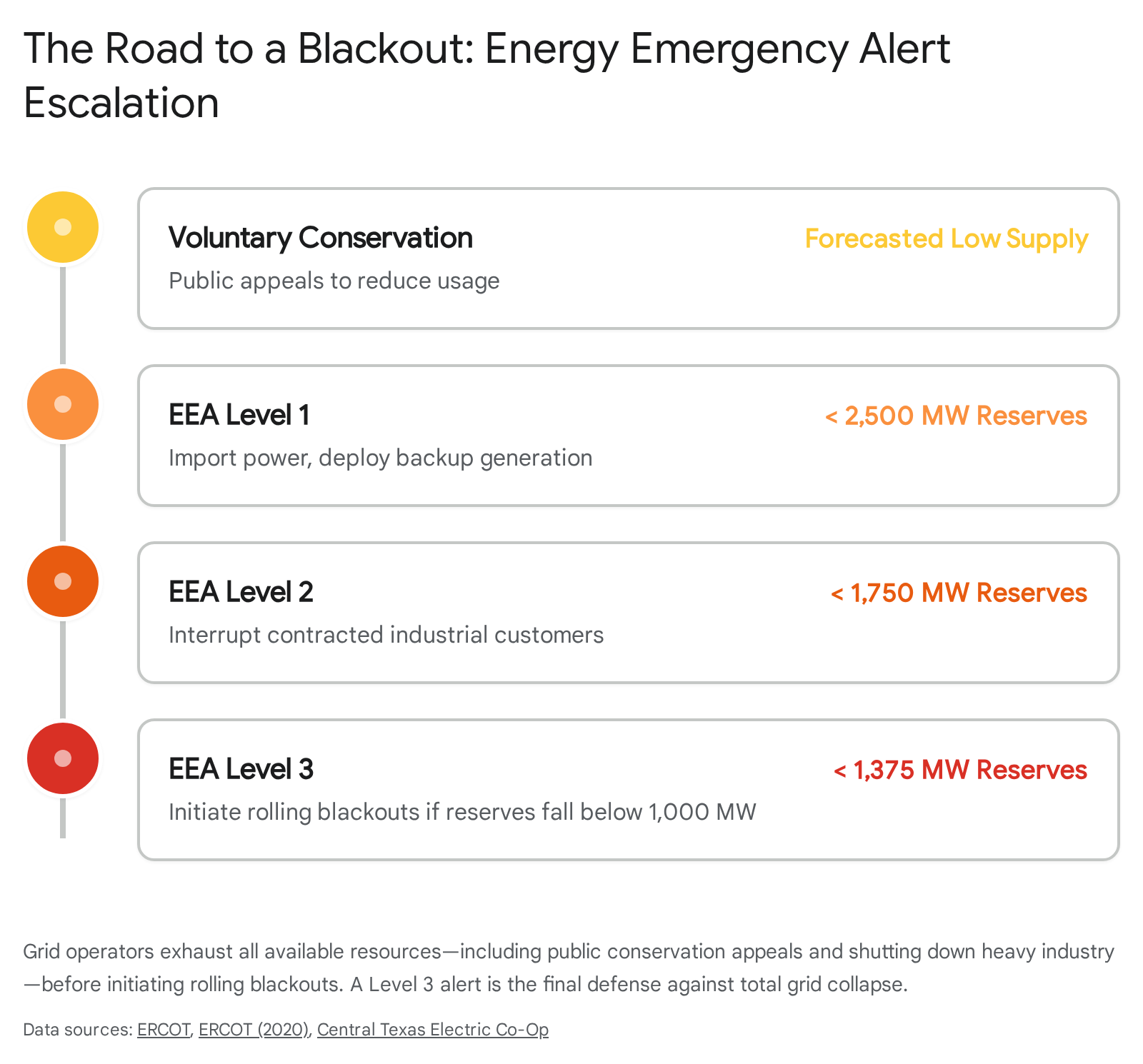
The first line of defense is voluntary conservation. ERCOT will issue a Voluntary Conservation Notice or Weather Watch, pleading with consumers and government agencies to safely reduce their energy footprint 13. If reserves continue to plunge below 2,500 Megawatts (MW) and are not expected to recover within 30 minutes, the grid enters EEA Level 1 1011. At this stage, the operator commands all available backup generation online, releasing any remaining reserves and attempting to import up to 1,220 MW from neighboring electrical grids 1012.
If conditions worsen and operating reserves fall below 1,750 MW, ERCOT triggers EEA Level 2 1121. This stage introduces involuntary measures, specifically targeting large industrial and commercial customers who have signed demand-response contracts. These heavy industrial users receive discounted electricity rates year-round in exchange for agreeing to have their facilities forcibly shut down during grid emergencies 1121.
The final threshold is EEA Level 3, which is declared if reserves drop to 1,375 MW 1121. If the grid continues to bleed power and reserves breach the absolute critical threshold of 1,000 MW with no immediate recovery in sight, the central grid operator officially commands transmission companies to reduce overall demand by executing rotating, rolling blackouts 1121.
Other grid operators follow highly similar frameworks. The California Independent System Operator (CAISO) issues "Flex Alerts" prior to triggering its own cascading EEA 1, 2, and 3 emergency stages 1415. Throughout these stages, operators are constantly engaging in a triage process, desperately searching for every available megawatt to stave off the final step of shedding load 14.
Executing the Blackout: How Neighborhoods Are Chosen
A crucial misconception is that the central grid operator - like CAISO or ERCOT - physically flips the switch to turn off power to a neighborhood. In reality, the central operator only performs the mathematical calculations 1216. They determine the exact number of megawatts that must be shed from the overarching grid to stabilize the frequency, and then issue binding directives to the local utility companies and distribution providers 1016.
These shedding obligations are divided proportionally based on annual studies. If a local utility company typically accounts for 15% of the state's total electrical load, they will be ordered to shed 15% of the required megawatt deficit during the emergency 210. It is entirely up to the local utility to decide which specific neighborhoods and feeders to cut to meet their quota 210.
The Decision Matrix and Critical Infrastructure
When the local utility receives the order to immediately drop a specific block of power (for example, "Shed 50 Megawatts"), they utilize Supervisory Control and Data Acquisition (SCADA) systems to remotely open breakers at local distribution substations 2. This instantly severs power to targeted circuits.
However, the selection of these circuits is carefully choreographed to avoid public safety disasters. Utilities maintain strict guidelines to exempt certain feeder lines from rolling blackouts, primarily those serving critical infrastructure. This protected class includes hospitals, emergency response dispatch centers, major medical facilities, and critical water or wastewater treatment plants 2911.
Interestingly, the electrical grid's interdependency means that natural gas pipeline pumping stations are also placed on the protected list 217. If the utility were to accidentally cut power to the gas pipeline pumps, the natural gas power plants relying on that fuel would fail, worsening the blackout in a destructive feedback loop 2. Because urban electrical circuits often snake through diverse commercial and residential areas, an entire residential neighborhood might be spared from a rolling blackout simply because their homes happen to share a primary distribution feeder line with a hospital, fire station, or industrial gas pump 211.
Conversely, densely populated residential neighborhoods and rural areas that lack critical infrastructure are frequently placed in the primary rotation blocks, making them highly susceptible to early load-shedding interventions 11.
Automated Frequency Relays
While utilities try to execute blackouts in a planned, rotational manner, the physics of the grid sometimes deteriorate faster than humans can react. To prevent the entire physical infrastructure from melting down, grid engineers install automated frequency relays across the system. These relays account for roughly 25% of the utility's load obligation 2. If the grid's frequency drops to a critical, specified level, these relays will automatically trip and drop massive amounts of load with zero human intervention. This is an absolute last-ditch effort to save the system; once these automated relays trip, they cannot be restored without express, high-level approval, and it indicates the grid is mere seconds away from total collapse 2.
The Rolling Phase: Cycles and Schedules
The defining feature of a rolling blackout is its rotational nature. The strategy is designed to equitably distribute the burden of the energy shortage so that no single neighborhood suffers for a devastatingly extended period 36.
Once a targeted block of neighborhoods has been without power for a predetermined timeframe, the utility will remotely open breakers for a second block of neighborhoods 2. Only after the second block has successfully shed its load off the grid will the utility close the breakers and restore power to the first block 2. This leap-frog method guarantees that the overall energy reduction required by the central operator is constantly maintained, but the victims of the outage are rotated to prevent food spoilage and minimize life-threatening exposure to extreme temperatures 23.
In the United States, utility guidelines typically dictate that each neighborhood experiences a blackout lasting roughly 40 minutes to two hours before the rotation moves to the next block 569. However, the success of the "roll" depends entirely on the severity of the crisis. During the catastrophic Winter Storm Uri in Texas in 2021, the required load reductions were so immense - reportedly reaching up to 40% of the total load - that utilities simply ran out of eligible circuits to rotate 2. With critical infrastructure protected and automatic relays tripped, utilities were forced to leave the remaining circuits offline for days on end, effectively transforming a rolling blackout into a stagnant, prolonged disaster 28.
Chronic Load Shedding: The South African Model
While rolling blackouts are viewed as extreme, rare emergencies in North America and Europe, they are a daily reality in countries suffering from chronic generation deficits and aging infrastructure. A prime example is South Africa, where the state-owned utility Eskom utilizes an institutionalized system of rolling blackouts known locally as "load shedding" 2718.
Because Eskom's generation shortfall is a daily operational reality rather than a sudden weather-induced shock, they have developed a highly regimented, eight-stage schedule to manage the grid 2718. The block scheduling system divides municipalities into distinct zones, rotating outages on 4-day or 8-day repeating cycles depending on the severity of the national deficit 19.
| Eskom Load Shedding Stage | National Megawatts Shed | Frequency and Impact on Consumers |
|---|---|---|
| Stage 1 | Up to 1,000 MW | Minor impact. Customers experience roughly three 2-hour outages over a four-day cycle 2718. |
| Stage 2 | Up to 2,000 MW | Noticeable impact. Doubles the frequency of Stage 1, resulting in roughly one 2-hour to 4-hour outage per day 181920. |
| Stage 3 & 4 | 3,000 MW to 4,000 MW | Severe disruption. Customers can expect to lose power for 8 hours a day, broken into two or three blocks, heavily impacting business operations 271819. |
| Stage 5 & 6 | 5,000 MW to 6,000 MW | Extreme crisis. Introduced during severe generation failures. Residents endure up to 12 hours without power daily, cycling on 4-hour blocks 27181920. |
| Stage 7 & 8 | 7,000 MW to 8,000 MW | Unprecedented emergency. Customers are left in the dark up to six times a day, totaling roughly 16 hours of lost power in a 24-hour period 271819. |
The economic toll of such severe rotational schedules is massive, costing the South African economy an estimated R500 million to R4 billion per day 19. This institutionalized model provides a stark look at how a grid operates when supply-side infrastructure fundamentally fails to meet baseline modern demand.
The Technical Process of Restoring Power
When the central grid operator determines that the overarching emergency has passed - either because peak demand has subsided or backup generation has finally come online - local utilities are given permission to begin fully restoring power. However, reviving a blacked-out grid is one of the most perilous and technically complex procedures in electrical engineering 2122.
If the blackout was widespread and resulted in total system collapse, operators must rely on "black-start" generators. These are specialized power plants, often hydroelectric facilities or highly resilient gas turbines, that have the rare capability to start themselves up without requiring external power from the grid 1722. Once a black-start generator is running, operators establish a tentative transmission path - essentially building a fragile backbone of electricity - to send power to other, larger generation plants (like nuclear or coal plants) that require external electricity to jumpstart their systems 1722.
The restoration process follows a strict hierarchy. After securing generation capacity and transmission corridors, power is funneled to local distribution substations 1523. From there, the utility re-energizes main distribution lines, followed by lateral taps branching into neighborhoods, and finally, the individual service lines connecting to transformers on residential streets 23. Grid operators often debate between a "build-down" strategy, where the entire high-voltage transmission system is energized before any consumer load is added, versus a "buildup" strategy, which creates small, stabilized electrical "islands" that are carefully synchronized and stitched together 1722.
The Danger of Cold Load Pickup
The most significant hurdle during the restoration phase is a volatile physical phenomenon known as Cold Load Pickup (CLPU) 2435. Re-energizing a neighborhood is not as simple as flipping a switch; doing so without mathematical precision can instantly crash the local grid again 24.
Under normal, everyday conditions, electricity usage in a neighborhood benefits from "load diversity." In any given hour, one house's air conditioner might be running, while the neighbor's unit has cycled off. A water heater down the street kicks on, while a refrigerator next door clicks off 3536. This random, asynchronous cycling ensures that only a fraction of the neighborhood's heavy appliances are drawing power at any exact millisecond, keeping the total demand relatively smooth and predictable 3536.
However, when a neighborhood is blacked out for an extended period, this load diversity is completely destroyed 3536. During the outage, every single house gradually reaches the same ambient temperature. The water in every single hot water heater cools down. Consequently, when the utility attempts to re-energize the circuit, every thermostat, refrigerator compressor, air conditioning unit, and heating element attempts to draw maximum startup power at the exact same instant 3536.
This synchronized startup causes an immediate, massive spike in electrical current known as inrush current. Field measurements have recorded Cold Load Pickup currents surging to more than seven times the normal, pre-outage load 35. This immense demand spike causes severe problems for the utility: 1. Nuisance Tripping: The massive current spike can trick the grid's protective relays into thinking there is a physical short-circuit fault on the line. The safety breakers will immediately trip, shutting the power right back off and resulting in a failed restoration 243537. 2. Infrastructure Stress: The immense surge of electricity causes localized voltage drops, overheats distribution transformers, and accelerates the degradation of aging grid equipment 35. 3. Grid Destabilization: If a utility attempts to restore too many large blocks of "cold load" simultaneously, the sudden shock of aggregate demand can drag the overarching grid frequency back down, potentially forcing the central operator to issue new emergency alerts 2136.
To mitigate Cold Load Pickup, utilities are forced to meticulously re-energize the grid in smaller, highly segmented fractions, waiting for the inrush current to stabilize before adding the next block 2435.
Protecting Home Appliances During Restoration
Because of the massive electrical surges and voltage fluctuations associated with Cold Load Pickup, utility companies and electricians heavily advise consumers to take preventative measures during a blackout to protect their homes 252627.
The primary recommendation is to physically unplug sensitive electronics immediately after the power goes out 2527. Devices containing delicate microprocessors - such as desktop computers, televisions, gaming consoles, and smart appliances - are highly vulnerable to the sudden burst of excess voltage that floods the lines the moment power is restored 2528. Even minor fluctuations can fry internal circuit boards, rendering expensive electronics useless 828. While surge protectors offer a vital layer of defense and are highly recommended for heavy items that cannot be easily unplugged, experts note that surge protectors degrade over time and may fail against a massive restoration spike 2526.
Furthermore, consumers are asked to assist the grid's recovery by flipping the breaker on their HVAC systems (heating and cooling) to the 'off' position during an outage 2428. Because HVAC compressors draw immense amounts of power, keeping them off directly combats the Cold Load Pickup problem for the utility 24. Residents should leave a single lamp switched on as a visual indicator 29. Once that light illuminates, signaling the return of power, homeowners should wait roughly 10 to 15 minutes before gradually plugging in devices and turning the HVAC system back on 2630. This critical waiting period allows the local distribution system to stabilize its voltage, preventing localized overloads and ensuring the lights stay on 2630.
Changing Grid Timelines in the Renewable Era
Looking to the future, the calculus of when and why rolling blackouts occur is rapidly shifting. According to rigorous assessments by the North American Electric Reliability Corporation (NERC), large swaths of the continent - particularly the Midcontinent Independent System Operator (MISO), Texas, New England, and the Pacific Northwest - face an elevated risk of supply shortfalls and rolling blackouts in the coming years 16443132.
Grid planners are currently fighting a multi-front battle. First, overall electricity demand is skyrocketing at a pace not seen in decades. Projections show peak demand increasing by 10 to 11 gigawatts year-over-year, driven heavily by the rapid expansion of artificial intelligence data centers, the electrification of the transportation sector, and increased residential air-conditioning use fueled by hotter global temperatures 163132. Second, climate-driven severe weather events - like prolonged heat domes, unexpected polar vortexes, and shifting El Niño/La Niña patterns - are severely straining aging transmission infrastructure, which was originally engineered for a much milder and more predictable climate 32333435.
The Complex Role of Renewables
The global transition toward renewable energy introduces both profound challenges and surprising resiliencies into the blackout equation. Policy-driven mandates and market economics have resulted in the rapid retirement of traditional, "dispatchable" power plants, primarily coal and natural gas units. NERC data notes the retirement of roughly 7.4 GW of fossil-fueled generation in recent years 16.
Some grid analysts and industry experts warn that prematurely retiring these heavy, spinning-mass generators before sufficient grid-scale battery storage is operational removes a vital safety net 164436. The primary concern is the intermittency of weather-dependent renewable energy sources (WD-RES). In regions heavily reliant on solar, operators face extreme risks during the early evening hours - often referred to as the "net load ramp." As the sun sets and solar output plummets to zero, residential demand for air conditioning and cooking remains near its peak 1637. If the remaining natural gas plants or wind turbines cannot ramp up fast enough to fill this massive, sudden void, the frequency drops, and rolling blackouts must be triggered 1637. Furthermore, grid operators must remain highly vigilant of inverter-based resources (IBRs), such as solar arrays, which have historically shown a vulnerability to unexpectedly tripping offline during minor grid disturbances, compounding the risk of a blackout .
However, emerging data suggests a more nuanced reality: while renewables introduce operational complexity, they are heavily mitigating blackout severity. A recent comprehensive study published in the journal Nature Energy, which analyzed U.S. blackout data from 2001 to 2020, concluded that power systems with higher penetrations of wind and solar do not experience a greater vulnerability to blackouts 38. In fact, when extreme weather caused outages, the blackouts in renewable-heavy grids were measurably less intense, resulting in fewer customers affected and shorter overall durations 38.
This resilience was on full display in Texas during the record-breaking heatwaves of 2023 and 2024. While the ERCOT grid was pushed to its absolute limits, it was the massive, record-level output of new solar generation that kept supply matched with soaring daytime demand 3337. Crucially, as solar tapered off in the evening, newly installed battery energy storage systems (BESS) discharged at record levels exactly during the critical net-load hours, successfully preventing emergency load reduction measures and staving off rolling outages 37.
To navigate this highly complex transition, grid operators are drastically altering their long-term planning timelines. CAISO, for instance, has recently expanded its transmission planning horizon from 10 years to 15 years to accommodate the massive lead times required for permitting and construction 39. Their recently drafted $4.8 billion transmission plan includes 31 major projects designed to integrate more than 30 GW of new solar generation while specifically deploying "grid-enhancing technologies" - like advanced, high-capacity conductors - to squeeze more power through existing corridors 3940.
Bottom line
A rolling blackout is a highly controlled, last-resort intervention ordered by central grid operators to prevent a total, catastrophic collapse of the power grid when electricity demand drastically outstrips supply. By rotating power cuts through distinct local neighborhoods in targeted blocks, utilities stabilize the overarching grid frequency while ensuring critical infrastructure like hospitals remains powered. While the rapid deployment of solar and battery storage is fundamentally altering how operators manage daily demand peaks, the compounding threats of extreme weather, surging data-center electricity use, and the retirement of legacy power plants guarantee that rolling blackouts will remain a vital, albeit disruptive, emergency tool for the foreseeable future.