
How a Nuclear Reactor Restarts
Restarting a nuclear reactor is a highly controlled, multi-stage process that transitions a power plant from a dormant state to generating massive amounts of electricity. It involves conducting exhaustive regulatory and mechanical checks, establishing a self-sustaining atomic chain reaction, managing the extreme thermal expansion of heavy industrial components, and carefully synchronizing the plant's steam turbine with the regional power grid. Rigorous physics-based safety systems ensure the reaction remains perfectly stable and controlled at every point in the sequence.
The Dawn of the Nuclear Renaissance
For decades, the narrative surrounding commercial nuclear energy in much of the world was one of managed decline. Reactors were being decommissioned due to aging infrastructure, shifting political landscapes, and an inability to compete financially with highly subsidized renewable energy and historically cheap natural gas 12. In countries like Germany, the phase-out was absolute, culminating in the permanent closure of its final three commercial reactors in April 2023 despite widespread debate over the loss of reliable energy during an ongoing European energy crisis 14.
Today, that global narrative is experiencing a dramatic reversal. The explosive growth of cloud computing, manufacturing onshoring, and artificial intelligence has created an almost insatiable demand for reliable electricity 367. AI data centers operate around the clock and require massive amounts of power to cool their servers and run complex machine-learning algorithms. Intermittent renewable sources like wind and solar, while crucial to decarbonization, only generate electricity when the wind blows or the sun shines 7. Grid operators increasingly recognize that maintaining reliability requires robust baseload power - energy that flows twenty-four hours a day, seven days a week, regardless of the weather 74.
This surging demand has sparked a historic pivot in energy infrastructure. Rather than solely attempting to build entirely new nuclear plants - a process that can take over a decade and cost tens of billions of dollars - policymakers, technology hyperscalers, and utility companies are actively looking to resurrect shuttered facilities 35.
High-Profile Restarts Driving the Industry
The most prominent example of this trend is playing out in Pennsylvania. In September 2024, Constellation Energy announced a massive twenty-year power purchase agreement with Microsoft to restart Unit 1 of the Three Mile Island nuclear plant 36. Unit 1, an 835-megawatt pressurized water reactor that operated safely for decades, was shut down in 2019 strictly for economic reasons 27. Crucially, Unit 1 operates entirely independently from Unit 2, which suffered a partial meltdown in 1979 and remains in the process of long-term decommissioning 37.
Constellation plans to invest roughly $1.6 billion to restore the facility, which will be renamed the Crane Clean Energy Center, with the goal of bringing it back online by 2027 389. The entirety of the plant's carbon-free electrical output will be funneled to the PJM Interconnection grid to offset the massive power consumption of Microsoft's regional data centers 47.
A similar revival is occurring in Michigan at the Palisades Nuclear Plant. Entergy shut down the 800-megawatt facility in May 2022 and sold it to Holtec International for decommissioning 1415. However, fueled by state support and a $1.5 billion loan from the U.S. Department of Energy, Holtec is currently working to restart the plant by late 2025 31011. If successful, Palisades will be the first nuclear power plant in United States history to be brought back into service after its operating license had been formally amended to reflect a permanent cessation of operations 18.
Globally, the push for restarts is equally urgent. Japan has been painstakingly bringing its nuclear fleet back online after the entire country's reactors were shut down following the 2011 Fukushima Daiichi disaster . In early 2026, the Tokyo Electric Power Company (TEPCO) successfully restarted Unit 6 at the Kashiwazaki-Kariwa complex - the world's largest nuclear power station by potential output 1222. The restart of this single ,1,356-megawatt reactor is expected to displace approximately 1.3 million tons of imported liquefied natural gas annually, fundamentally shifting the region's energy economics and stabilizing the grid for the greater Tokyo area .
| Facility Name | Location | Reactor Type & Capacity | Shutdown Date | Target Restart | Primary Catalyst |
|---|---|---|---|---|---|
| Crane Clean Energy Center (TMI Unit 1) | Pennsylvania, USA | PWR (835 MW) | 2019 | 2027 | Microsoft AI data center power purchase agreement 79. |
| Palisades Nuclear Plant | Michigan, USA | PWR (800 MW) | 2022 | 2025 | Federal/State funding; regional baseload manufacturing demand 1518. |
| Kashiwazaki-Kariwa Unit 6 | Niigata, Japan | BWR (1,356 MW) | 2012 | Early 2026 | National energy security; displacing expensive LNG imports 23. |
| Duane Arnold Energy Center | Iowa, USA | BWR (600 MW) | 2020 | TBD | Rising grid demand; preliminary regulatory steps taken by NextEra 1413. |
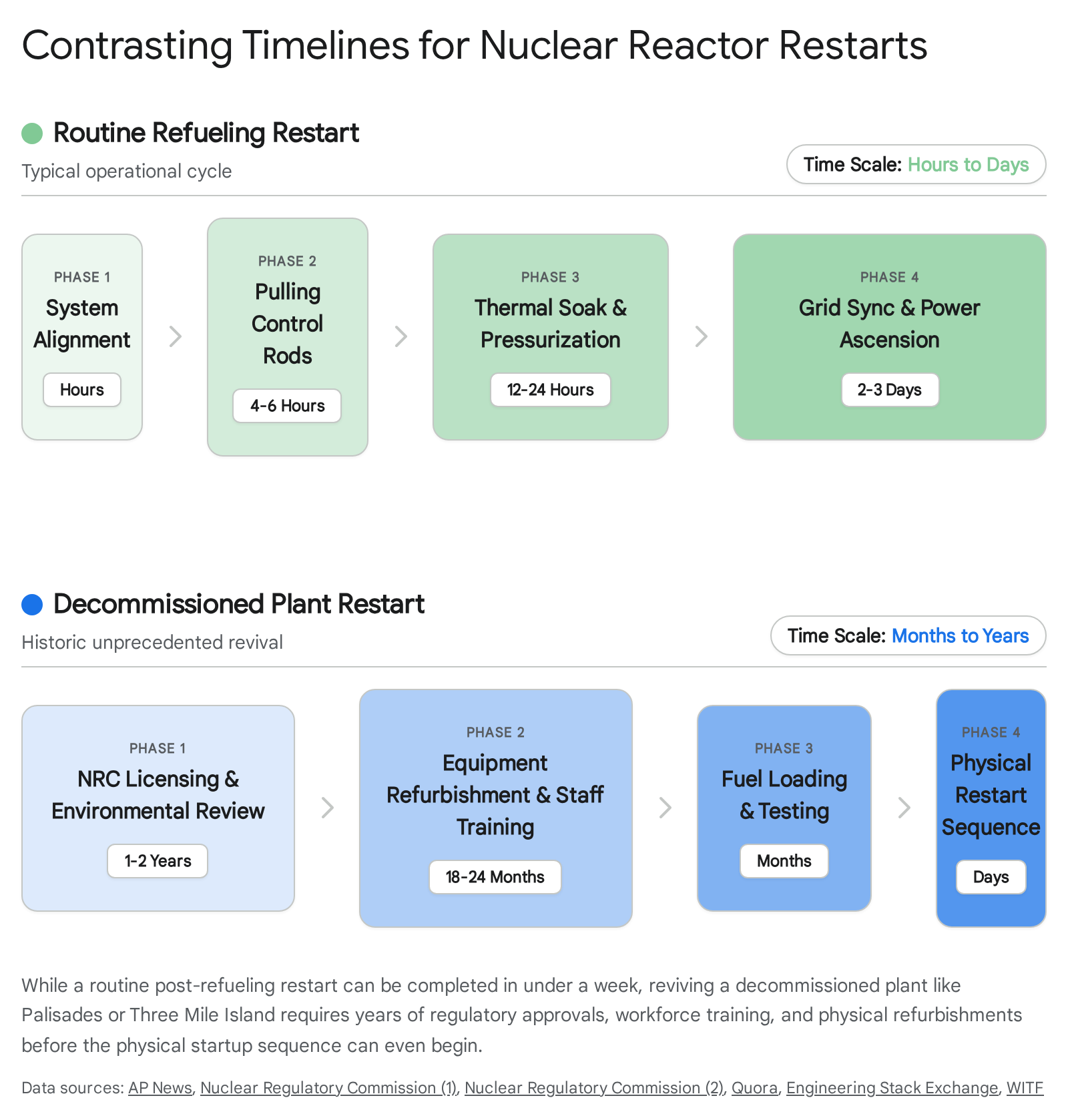
Whether a reactor has been offline for a thirty-day routine refueling outage or mothballed for five years, the fundamental physics and engineering procedures required to wake it up remain remarkably similar. However, the path to the control room looks vastly different depending on how long the atomic fire has been out.
The Regulatory Marathon: Reviving a Decommissioned Plant
For a facility like Palisades or the Crane Clean Energy Center, restarting is not a matter of simply walking into the control room and flipping a switch. Returning a decommissioned nuclear reactor to service is a first-of-a-kind regulatory endeavor that requires navigating a labyrinth of federal oversight, environmental reviews, and immense physical refurbishment 614.
When a plant like Palisades was shut down, its 10 CFR Part 50 operating license was not terminated, but it was legally amended to reflect a decommissioning status 14. The plant officially certified that it had permanently ceased operations and that all nuclear fuel had been permanently removed from the reactor vessel . To reverse this status, the operator must convince the U.S. Nuclear Regulatory Commission (NRC) that the facility is physically sound, adequately staffed, and legally compliant with modern safety standards .
The NRC oversees this unprecedented transition using a specialized framework outlined in Inspection Manual Chapter 2562 14. This guidance establishes the policies for transitioning a facility from decommissioning back to the active Reactor Oversight Process . A dedicated panel of senior NRC leaders conducts an independent assessment of the plant's readiness . The operator must systematically revise and submit massive volumes of documentation, including technical specifications, emergency evacuation plans, physical security plans, and quality assurance programs, essentially reverting them to their pre-shutdown operational state .
Simultaneously, the physical plant undergoes a grueling campaign of inspections and upgrades. Every major component must be assessed for degradation that may have occurred while sitting idle. At the Crane Clean Energy Center, Constellation Energy must meticulously inspect the steam generators, restore the main power transformers, revitalize the turbine deck, and ensure the cooling systems are pristine 3627.
Staffing presents an entirely separate challenge. A commercial nuclear plant requires hundreds of highly specialized professionals to operate. When a plant shuts down, that workforce disperses. To restart, the operator must recruit, hire, and rigorously train a new generation of licensed reactor operators, a process that relies heavily on advanced control room simulators and requires up to eighteen months of dedicated instruction 910.
Only when the NRC formally approves the restoration of the operating license, the equipment is deemed mechanically sound, and the workforce is certified, can the facility finally proceed to the physical steps of starting a nuclear reactor.
Phase 1: The Cold Shutdown State and Pre-Startup Preparations
Long before any power is generated, the reactor exists in a condition known as "cold shutdown." In this state, the nuclear chain reaction is completely extinguished 28. However, it is a common misconception that a shutdown nuclear reactor is entirely inert.
If a reactor was recently operating - such as during a routine refueling outage - the uranium fuel assemblies within the core continue to produce a substantial amount of heat 15. When uranium atoms split during normal operation, they create unstable radioactive byproducts, known as fission products 16. Even after the main chain reaction is halted, these fission products continue to undergo radioactive decay, releasing thermal energy 2831.
This phenomenon, known as decay heat, represents a small but highly consequential fraction of the heat produced during full-power operation 15. Because of decay heat, a nuclear reactor requires constant, active cooling even when it is turned off 28. Operators utilize a dedicated residual heat removal system, often referred to as shutdown cooling, to continuously circulate water through the core and carry this decay heat away to the ultimate heat sink, such as a cooling tower or a nearby body of water 15. Bringing a massive commercial reactor from full operating temperatures down to a true cold shutdown - where the primary coolant water is depressurized and cooled well below its standard boiling point - can take days or even weeks depending on the plant's recent power history 3133.
System Alignment and Checklists
The physical restart of the reactor begins with an exhaustive series of pre-startup checklists . Operators in the main control room, alongside technicians patrolling the miles of piping throughout the facility, meticulously verify the position of hundreds of valves and electrical switches . This process, known as a system alignment, ensures that all safety-related systems, emergency core cooling mechanisms, and balance-of-plant components are available and configured perfectly for operations .
During this pre-startup phase, the shutdown cooling systems are eventually secured . The massive main reactor coolant pumps are turned on, initially running at minimum speed, to establish the primary circulation of water through the reactor vessel . The chemistry of this water is carefully monitored and adjusted; it must be exceptionally pure to prevent corrosion of the fuel cladding and internal components under the extreme radiation and thermal conditions to come 35.
If the reactor is being started with a core containing entirely brand-new, fresh uranium fuel, the operators face a unique challenge. Fresh fuel is not highly radioactive and emits very few stray neutrons on its own 36. Because neutron detectors require a baseline signal to safely monitor the onset of the chain reaction, an artificial neutron source must be physically inserted into the core 36. This source is typically an assembly containing an alpha-emitting radioactive isotope mixed with beryllium 36. When the alpha particles strike the beryllium atoms, they force the release of free neutrons, providing the necessary "spark" to awaken the dormant reactor instrumentation 36.
Phase 2: The Physics of Waking Up the Core
With the systems aligned and the coolant flowing, the operators focus on the heart of the facility: the nuclear core. To generate heat, the reactor must transition from a "subcritical" state to a "critical" state 37.
In science fiction, the phrase "going critical" is frequently misused to imply an impending catastrophe or a runaway explosion 1638. In reality, criticality is the normal, desired operating condition of any commercial nuclear power plant 3717. To a reactor operator, achieving criticality is a cause for celebration 18.
The concept revolves around the mechanics of nuclear fission. Inside the reactor vessel, millions of ceramic pellets composed of enriched uranium dioxide are stacked inside long metal tubes, forming fuel assemblies 3541. When a free-floating neutron strikes the nucleus of a uranium-235 atom, the atom becomes unstable and violently splits apart 16. This fission event releases a massive amount of kinetic energy - which we perceive as heat - and ejects two or three new, highly energetic neutrons 1635.
What happens to those newly born neutrons dictates the state of the reactor: * Subcritical ($k_{eff} < 1$): The neutrons are either absorbed by non-fuel materials or leak out of the core before they can strike another uranium atom. The chain reaction dies out 3742. * Supercritical ($k_{eff} > 1$): Each fission leads to more than one subsequent fission. The neutron population, and therefore the heat output of the reactor, grows exponentially 3742. * Critical ($k_{eff} = 1$): A perfect state of equilibrium. Exactly one neutron from each fission event survives to cause exactly one additional fission. The chain reaction is self-sustaining, and the power output remains perfectly steady 163742.
The Delicate Art of Pulling Rods
To control this delicate balance, operators use control rods. These rods are constructed from materials known as "neutron poisons" - elements like boron, cadmium, silver, and indium that have a massive appetite for absorbing free neutrons without undergoing fission themselves 1619.
When the control rods are fully inserted into the fuel assemblies, they act like a massive sponge, soaking up so many neutrons that the chain reaction is starved and the reactor remains subcritical 1620. To start the reactor, the operators sitting at the control panels begin a highly formalized procedure known as a "pull sequence" .
Using precise electromechanical drives, the control rods are slowly and methodically withdrawn from the core, millimeters at a time 41. As the rods move upward, fewer neutrons are absorbed by the poison materials. More neutrons are allowed to bounce off the hydrogen atoms in the surrounding water coolant, a process known as moderation 1636. Moderation slows the incredibly fast neutrons down to an optimal speed - known as thermal energy - making them much more likely to be captured by a uranium-235 atom and trigger another fission event 163521.
The operators constantly monitor the Source Range Monitor (SRM) detectors, watching the neutron flux slowly climb . The goal is to carefully introduce a tiny amount of positive reactivity, coaxing the reactor into a slightly supercritical state so the neutron population can grow .
Prompt vs. Delayed Neutrons
The ability to control this process manually relies entirely on a quirk of nuclear physics: the existence of delayed neutrons.
When a uranium atom splits, the vast majority of the newly created neutrons - over 99 percent - are ejected instantly 3842. These are called "prompt neutrons" 3842. If a reactor relied solely on prompt neutrons to sustain the chain reaction, the time between fission generations would be measured in microseconds 3738. The power would spike so incredibly fast that no mechanical control rod system, and certainly no human operator, could react in time to control it 3738. A reactor reaching criticality on prompt neutrons alone is known as "prompt critical," a highly dangerous state intended only for nuclear weapons, not power plants 3842.
Fortunately, a small fraction of neutrons (less than one percent) are not released instantly during fission 42. Instead, they are emitted seconds or even tens of seconds later as the unstable fission products decay 3842. These are called "delayed neutrons" 3842. Commercial reactors are strictly engineered to be critical only with the contribution of these delayed neutrons 38. Because the reactor has to wait for these stragglers to maintain its equilibrium, the overall reaction is slowed down to a manageable human timescale, allowing operators to easily insert or withdraw rods to maintain perfect control 3842.
As the neutron flux reaches a predetermined level, the operators push the control rods back in slightly to arrest the growth of the reaction . The neutron population stabilizes. The control room officially logs the time and date: the reactor has achieved initial criticality .
At this exact moment, the reactor is technically "running," but it is generating virtually no usable heat 16. It is analogous to turning the key in a car's ignition: the engine is idling steadily, but the vehicle is not yet moving 2833. The next step is to step on the gas.
Phase 3: The Thermal Engine and Managing the Heat
With the nuclear fire safely lit and stabilized, the operators begin to raise the reactor's thermal power. It is during this phase that the esoteric world of atomic physics intersects with the brute-force mechanics of heavy industrial engineering. A nuclear power plant is, fundamentally, an incredibly sophisticated thermal engine 2247. The goal is to extract heat from the nuclear core and use it to perform mechanical work 2324.
To understand the immense challenges of this phase, one must understand how the plant is plumbed. The vast majority of reactors operating globally today are Light Water Reactors, falling into two main categories: Pressurized Water Reactors (PWRs) and Boiling Water Reactors (BWRs) 36.
In a PWR, the water that directly touches the radioactive nuclear core - the primary loop - is kept under immense pressure, typically around 150 times normal atmospheric pressure 3536. This extreme pressurization prevents the water from boiling, even as it absorbs the immense heat of fission and reaches temperatures exceeding 300°C (570°F) 3536. This superheated, highly pressurized primary water is pumped into a massive heat exchanger known as a steam generator 3536.
Inside the steam generator, the heat from the primary loop is transferred through thousands of thin metal tubes to a completely separate body of water - the secondary loop 3536. Because the secondary loop is kept at a lower pressure, this heat transfer causes the secondary water to rapidly boil into high-pressure steam 3536. This design provides a critical safety barrier: the water that actually spins the turbine never directly touches the nuclear fuel, preventing the spread of radioactivity into the broader power plant 3536.
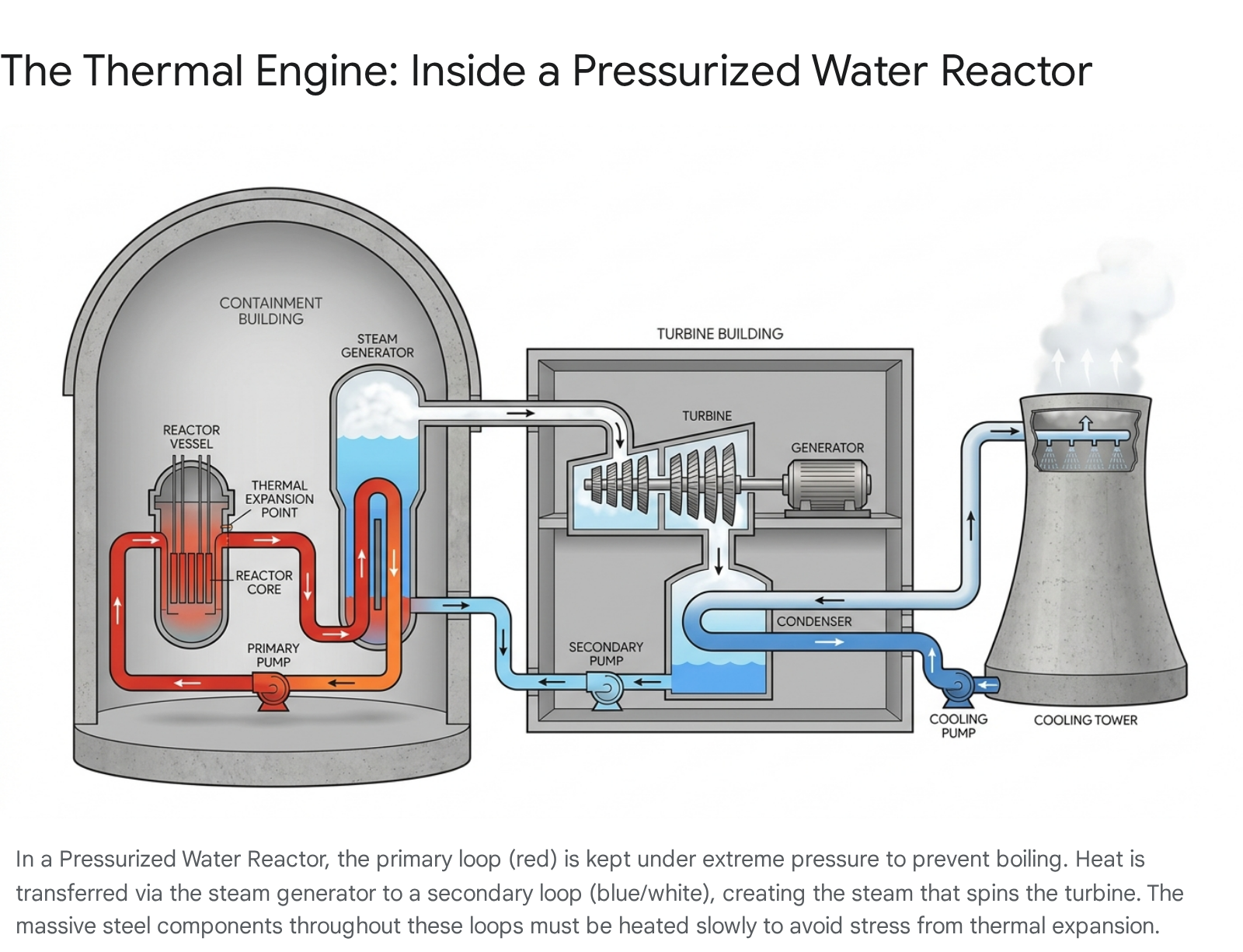
BWRs, such as the Kashiwazaki-Kariwa plant in Japan, operate on a slightly simpler thermodynamic cycle . They operate at a lower pressure, allowing the water in the primary circuit to boil directly into steam within the reactor pressure vessel itself 36. This steam is then piped straight to the turbine 3641.
The Threat of Thermal Expansion and Water Hammer
As the operators pull more control rods and the thermal power of the reactor climbs, the vast volume of water inside the plant begins to heat up rapidly 41. This introduces one of the most critical engineering constraints of the entire restart procedure: managing thermal expansion.
A nuclear power plant is constructed from thousands of tons of heavy industrial steel and exotic alloys 3536. Like all matter, these metal components physically expand as their temperature rises 22245025. The reactor pressure vessel, for example, features steel walls roughly thirty centimeters thick 52. If the water inside the vessel heats up too aggressively, the inner surface of the steel wall will expand much faster than the cooler outer surface 53. This differential expansion creates immense internal mechanical stress, which can warp precisely engineered components or induce microscopic cracking over time 2553.
To prevent structural damage, the heat-up process cannot be rushed 53. Reactor operators strictly adhere to heat-up rates dictated by metallurgical safety limits. The plant is brought up to temperature in deliberate stages, featuring prolonged "thermal soaks" 53. A soak involves pausing the temperature increase and holding the plant at an intermediate heat level for twelve to twenty-four hours 53. This allows the thermal energy to slowly and evenly conduct through the thick steel walls of the piping and the pressure vessel, equalizing the expansion stresses 53.
Simultaneously, the pressure in the primary system is meticulously increased in tandem with the temperature 53. This requires continuous operation of the pressurizer, a specialized vessel that uses internal electric heaters to maintain the immense compression required to keep the primary coolant in a liquid state 3622.
The secondary loop - the steam plant - presents an entirely different set of thermodynamic hazards during restart 53. As heat transfers across the steam generators, moisture and low-quality steam begin to form in the sprawling network of pipes leading to the turbine 53. If hot, high-velocity steam comes into contact with a large section of cold steel piping, the steam will rapidly shed its energy and condense back into liquid water 53.
This rapid phase change creates dense slugs of liquid traveling at the speed of steam, crashing violently into pipe bends and valves - a highly destructive phenomenon known as a water hammer 53. A severe water hammer can literally tear heavy industrial piping from its supports or severely damage the delicate blades of the steam turbine through moisture impingement 53. Therefore, the secondary steam plant must be warmed up at a similarly agonizing, cautious pace to ensure all piping is thoroughly heated and drained of liquid condensation before any substantial steam flow is permitted 53.
Phase 4: Power Ascension and Grid Synchronization
Once the primary loop has completed its thermal soaks and reached operating temperature and pressure, and the secondary steam plant is sufficiently warmed, the facility is finally ready to fulfill its primary purpose: generating electricity 53.
The high-pressure steam generated by the nuclear heat is initially bypassed around the main turbine directly into the main condenser . The condenser uses massive volumes of cooling water - drawn from a river, lake, ocean, or cooling tower - to rapidly cool the steam back into liquid water, creating a vacuum that helps pull more steam through the system 1535.
With the bypass valves open, the operators begin to slowly admit steam into the high-pressure section of the main turbine . The turbine, a massive rotating machine composed of thousands of precisely machined aerodynamic blades, begins to spin. As more steam is admitted, the turbine accelerates toward its designated operational speed .
The Critical Moment of Synchronization
The turbine shaft is directly coupled to an enormous electrical generator 26. As the turbine spins, it rotates massive electromagnets within the generator's copper coils, inducing an electrical current 26.
However, a nuclear power plant cannot simply push this electricity out to the grid at random. The generator's output must perfectly match the alternating current (AC) frequency of the regional power grid it is connecting to - strictly 60 Hertz in North America, or 50 Hertz in much of Europe and Asia .
Operators carefully monitor the rotational speed of the turbine and the phase angle of the generated electricity . When the frequency and phase of the plant's generator perfectly align with the massive, throbbing heartbeat of the external electrical grid, the operators execute a flawless "synchronization" . They close the massive main generator output breakers, physically connecting the nuclear plant to the regional transmission lines .
At the exact moment of synchronization, the reactor is typically operating at a relatively low power level - often around 15 percent of its maximum thermal capacity 26. The plant is now supplying clean electricity to the outside world, but the restart process is not yet complete.
Stepping Up to Maximum Power
The final phase is a grueling, highly monitored procedure known as "power ascension" . The goal is to bring the reactor safely up to 100 percent of its licensed thermal power 26.
To increase power, the operators must extract more heat from the core. In a PWR, this is typically done by withdrawing control rods further or by subtly diluting the concentration of neutron-absorbing boric acid dissolved in the primary coolant 3141. As the neutron flux increases, the fuel pellets burn hotter, generating more steam in the secondary loop 4126. The turbine control valves open wider, demanding more steam, which spins the generator harder and pushes progressively more megawatts onto the grid 26.
Power ascension is never a direct sprint to the finish line. The ascension is conducted in deliberate, pre-planned "plateaus" - often pausing at 25%, 50%, 75%, and 95% power .
At each plateau, a swarm of physicists, engineers, and technicians conduct a battery of rigorous tests . They confirm that the physical behavior of the reactor perfectly matches the sophisticated computational models created by core designers . They conduct radiation surveys throughout the facility to ensure shielding is intact . They monitor the massive steam turbine for any microscopic vibrations that could indicate an imbalance . In newly restarted plants or those with significant upgrades, these tests are critical for demonstrating compliance with NRC safety evaluations and ensuring no unexpected thermal anomalies exist .
If a test requires the reactor to be operated at 95 percent power, the results are meticulously gathered and extrapolated by engineers to verify that the plant will remain within its strict safety margins when pushed to its absolute limit . Only after every system is verified, every vibration monitored, and every regulatory requirement satisfied at the intermediate plateaus do the operators make the final push.
The reactor reaches 100 percent power. Assuming no major anomalies or scheduled maintenance interventions, it will remain at this continuous, steady-state output, generating carbon-free baseload electricity around the clock for the next eighteen to twenty-four months before the entire process must eventually be reversed for refueling 1826.
| Restart Phase | Estimated Timeline | Primary Engineering Constraint | Description |
|---|---|---|---|
| Phase 1: Cold State & Prep | Hours to Days | System Verification | Securing shutdown cooling; establishing primary coolant flow; aligning thousands of valves and verifying safety system operability . |
| Phase 2: Achieving Criticality | 4 to 6 Hours | Neutron Flux Monitoring | Withdrawing control rods to slowly initiate a self-sustaining chain reaction relying strictly on delayed neutrons 333842. |
| Phase 3: Thermal Heating | 12 to 24 Hours | Thermal Expansion | Executing "thermal soaks" to slowly heat thick steel components evenly, preventing material stress and avoiding destructive water hammer in steam pipes 3353. |
| Phase 4: Power Ascension | Days to Weeks | Physics & Vibration Testing | Synchronizing the generator to the regional grid frequency; increasing power in deliberate plateaus (e.g., 25%, 50%, 100%) to verify computational models . |
The Physics of Inherent Safety During Restart
Throughout the entirety of the restart sequence - from the first withdrawal of a control rod to the final push to 100 percent power - the reactor operators are backed by a profoundly robust, multi-layered safety architecture designed to prevent the atomic fire from ever running out of control 352052.
Modern commercial nuclear safety philosophy is rooted in the concept of defense-in-depth, utilizing multiple independent barriers to contain radiation 1535. The radioactive fission products are initially trapped within the solid ceramic matrix of the uranium fuel pellets 1535. These pellets are hermetically sealed inside highly durable zircaloy metal tubes (the cladding) 1535. The assemblies are submerged inside the massive steel reactor pressure vessel, which itself is housed within a reinforced, airtight concrete containment building capable of withstanding extreme internal pressures and external impacts, such as an airplane crash 153552.
However, the most elegant and crucial safety features governing a reactor restart are not physical walls, but rather "inherent safety" mechanisms 5227. These are safety features that rely on the unchangeable, immutable laws of physics to shut the reactor down without requiring any human intervention, electrical power, or computer software 52.
The Negative Temperature and Void Coefficients
The most vital inherent safety feature in a commercial Light Water Reactor is the negative temperature coefficient 5227. In a nuclear core, water serves a dual purpose: it acts as a coolant to carry heat away, and it acts as a "moderator" to slow down fast neutrons so they can successfully trigger fission 3652.
As the reactor's thermal power increases, the temperature of the water naturally rises 52. As water heats up, it physically expands and becomes less dense 27. Because the water is less dense, there are fewer hydrogen atoms packed tightly together to bounce against the fast neutrons 27. Consequently, moderation decreases, fewer neutrons are successfully slowed down, and the fission reaction rate inherently slows 5227.
If the reactor were to experience a sudden, uncontrolled spike in power, the water would heat up rapidly, instantly choking out its own nuclear fire by reducing the moderation required to sustain it 5227. This provides a powerful, physics-based negative feedback loop that keeps the reactor immensely stable during the delicate power ascension phase 4152.
Similarly, Boiling Water Reactors rely on a negative void coefficient 5227. If the water in the core boils too aggressively, it creates steam bubbles (voids) 2327. Steam is significantly less dense than liquid water, meaning steam bubbles provide almost no neutron moderation 27. The more steam that forms in the core, the fewer fissions occur, causing the reactor to automatically throttle its own power output downward without any action required by the operators 5227.
The SCRAM: Gravity's Ultimate Fail-Safe
Even with these inherent thermodynamic stabilizers, reactors are equipped with highly aggressive active safety systems. The most well-known is the Reactor Protection System, which is capable of instantly terminating the chain reaction through a procedure known as a SCRAM 3320.
During a restart, sensors continuously monitor dozens of critical parameters, including neutron flux, primary coolant pressure, and core temperature 15. If any parameter deviates even slightly beyond its highly conservative safety threshold, the system automatically triggers an emergency shutdown 15.
The primary SCRAM mechanism utilizes another inherent physical force: gravity 52. In many reactor designs, the heavy, neutron-absorbing control rods are suspended directly above the nuclear core by powerful electromagnets 52. If the plant loses electrical power, or if the safety computers detect an anomaly and deliberately cut the current to the magnets, the magnetic field vanishes 52. Gravity immediately pulls the massive rods down into the core 52. Within a matter of seconds, the rods absorb the vast majority of the free neutrons, terminating the chain reaction and dropping the reactor back into a subcritical state 1520.
Bottom line
Restarting a nuclear power plant is an immense triumph of applied physics, stringent regulatory oversight, and heavy industrial engineering. It requires bridging the microscopic reality of atomic fission with the macroscopic challenges of thermodynamics, carefully managing the extreme thermal expansion of heavy steel components to prevent catastrophic stress. While a routine post-refueling restart demands days of cautious, methodical temperature management and testing, the historic revivals of decommissioned plants like Palisades and Three Mile Island represent unprecedented, multi-year endeavors to restore massive infrastructure to perfect working order. Ultimately, whether driven by the surging energy demands of new artificial intelligence data centers or the global push for carbon-free baseload electricity, the restart process relies on the same strict procedures and inherent, physics-based safeguards that have governed the nuclear industry for decades.