
What Evidence Supports Apple Watch and Oura in 2026
In 2026, consumer wearables like the Apple Watch Series 11 and Oura Ring 5 have transitioned from basic fitness trackers into clinical-grade screening tools capable of detecting conditions like sleep apnea and hypertension.
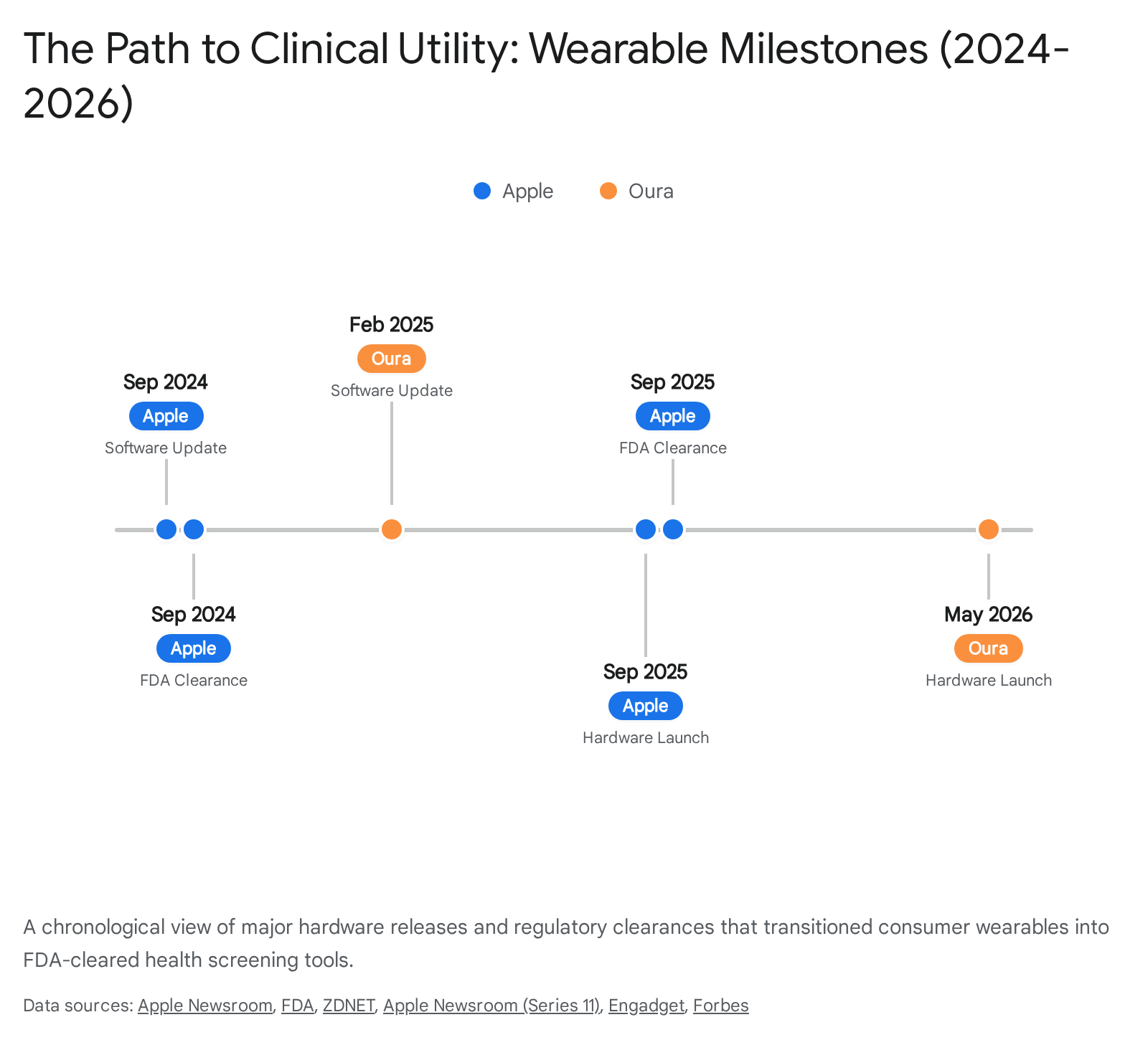
While rigorous independent evidence supports their accuracy in passively monitoring autonomic health, these devices are designed to flag potential issues for clinical follow-up rather than provide standalone medical diagnoses. The true value of this continuous data lies in its ability to drive measurable behavioral change when paired with evidence-based lifestyle interventions.
The Evolution of Digital Health Tracking
The global consumer wearable sector has reached a critical structural turning point in 2026. For the past decade, the market was dominated by wrist-worn smartwatches that primarily functioned as descriptive biometric scorecards - tracking raw daily step counts, capturing basic heart rates, and estimating calories burned 1. Today, the modern wearable is no longer a passive step counter; it functions as a continuous health interface 2. These always-on, sensor-based platforms capture physiological signals, interpret them through artificial intelligence, and translate them into actionable clinical insights 12.
Moving Beyond the Snapshot
This shift represents a transition from active health tracking - where users had to consciously log workouts or meals - to passive digital phenotyping. Continuous data collection running quietly in the background fills a crucial gap in modern healthcare: capturing the silent, intermittent development of chronic illnesses, such as sporadic heart arrhythmias, nocturnal dips in blood oxygen, or persistent cardiovascular strain 34.
Traditional healthcare tends to capture only snapshots of these metrics during brief clinic visits, often missing nuanced trends. Wearables tackle this by continuously collecting data on the body's signals, offering early warnings and guiding timely interventions 3. The acceleration of wearable adoption gained particular momentum over the last few years, transitioning remote health monitoring from a niche interest into essential infrastructure for managing chronic cardiovascular and respiratory diseases 5.
Overcoming the Hawthorne Effect
In traditional physical activity research, a significant challenge has been the "Hawthorne effect" - the phenomenon where individuals consciously or unconsciously modify their behavior because they know they are being observed in a clinical trial 6. Studies historically relied on one-week monitoring periods, which failed to capture genuine habitual variation 6.
The widespread adoption of devices like the Apple Watch and Oura Ring allows researchers to leverage data passively collected over months or years. Longitudinal data sets, such as those from the All of Us Research Program, demonstrate that extended wearable monitoring provides vastly improved accuracy for disease risk estimation, capturing signals of disease risk long before clinical symptoms present 6.
Navigating the 2026 Regulatory Landscape
As consumer devices estimate physiological measures typically associated with clinical care (like blood pressure, oxygen saturation, and heart rate variability), the line between a "wellness product" and a "regulated medical device" has blurred 45. Manufacturers of wellness products consciously make decisions to avoid their products being classified as medical devices to maintain speed in software iteration and avoid rigorous premarket clinical trials 5. However, regulatory bodies are tightening the definitions.
FDA General Wellness and Clinical Decision Support Updates
To address the rapidly evolving market, the U.S. Food and Drug Administration (FDA) released finalized updates to its "General Wellness: Policy for Low Risk Devices" and "Clinical Decision Support (CDS) Software" guidance on January 6, 2026 491067.
The updated 2026 guidance clarifies that non-invasive wearable products can remain classified as non-device general wellness products - and thus be exempt from premarket review - provided they meet strict criteria. The product's intended use must be limited solely to general wellness, and it must present a low risk to user safety 410. Crucially, a wearable estimating physiological parameters (like heart rate variability or blood pressure) remains a wellness device only if it: * Avoids diagnosis or treatment claims (e.g., curing, mitigating, or preventing disease) 410. * Does not substitute for clinical care or an FDA-authorized device 410. * Does not prompt users to take specific clinical actions, such as adjusting medication 410.
The risk of misclassification is extraordinarily high. In 2025, the FDA issued a Warning Letter to the wearable maker WHOOP, alleging that its "Blood Pressure Insights" feature crossed into medical device territory because it was marketed with "medical grade" insights and was intended for use in diagnosing disease 24. This enforcement led to a federal class-action lawsuit from consumers claiming they were misled about the product's capabilities, highlighting the severe commercial and legal ramifications of regulatory misalignment 28.
Furthermore, the 2026 CDS Software guidance placed a heightened focus on mitigating "automation bias" - ensuring that clinicians can independently evaluate an AI's recommendations rather than blindly trusting algorithmic outputs 7.
FDA Clearance vs. FDA Approval
When wearables do cross into medical territory, they typically seek FDA authorization. It is vital for both providers and patients to distinguish between "FDA Cleared" and "FDA Approved" 910.
Most wearable health features (like ECG apps or sleep apnea detection) reach the market via the 510(k) clearance pathway or the De Novo classification for novel, low- to moderate-risk devices. FDA Clearance under 510(k) requires demonstrating that the new device is "substantially equivalent" to an already legally marketed predicate device 910. This pathway often relies on bench testing and software validation rather than exhaustive clinical trials. Once cleared, devices are subject to Quality System Regulation (QSR) and medical device reporting (MDR) 9.
In contrast, FDA Approval (PMA) is a rigorous standard reserved for high-risk, Class III devices (like life-sustaining implants), requiring extensive clinical evidence of safety and efficacy 9. For clinicians, this means that while a cleared wearable feature is safe and reliably measures what it claims to measure, it is validated for screening and over-the-counter risk assessment, not as a standalone diagnostic substitute for clinical tests 10161118.
Global Standards and the App Store Mandate
Regulatory pressure is not limited to the United States. Under the European Medical Device Regulation (CE MDR), standards for product safety, clinical evidence, and post-market surveillance have become significantly stricter 19.
To enforce further transparency, Apple instituted a sweeping policy change: by early 2027, all apps distributed in the European Economic Area (EEA), the United Kingdom, and the United States via its App Store must explicitly declare whether they are a regulated medical device 1213. Developers must provide their regulatory status in App Store Connect, along with relevant safety information, and failure to comply will result in a freeze on app updates 1213.
Apple Watch Series 11: The Active Health Ecosystem
Released in September 2025, the Apple Watch Series 11 (alongside the Ultra 3) represents Apple's deepest push into preventative healthcare 1415. The device functions as a comprehensive triage center on the wrist, powered by the S11 System in Package (SiP) which enables advanced on-device AI calculations 1516.
Hardware and Sensing Capabilities
The Series 11 introduces 5G RedCap cellular connectivity, designed specifically for low-power wearables, allowing seamless data transmission without tethering to an iPhone 1516. The physical hardware features Ion-X glass with a ceramic coating that is twice as scratch-resistant as previous models, housed in a thin chassis available in polished titanium and aluminum 1525.
Notably, following software adjustments to circumvent patent disputes, Apple successfully re-enabled the blood oxygen (SpO2) sensor in watchOS 11.6.1 for the Series 11 launch, allowing the device to track critical nocturnal respiratory metrics alongside its established ECG capabilities 25. The battery life has been optimized to offer up to 24 hours of continuous use (or 38 hours in Low Power Mode), with fast charging yielding 8 hours of wear from a 15-minute charge 1525.
FDA-Cleared Hypertension Alerts
The most significant clinical addition to the Apple Watch ecosystem is the hypertension notification feature, which received FDA clearance shortly before the Series 11 launch 171819. Hypertension, often called the "silent killer," impacts over 1.3 billion people globally and is a leading modifiable risk factor for heart attacks, strokes, and kidney disease 2030.
Rather than utilizing an inflatable cuff, the Apple Watch uses its optical heart sensor to analyze how blood vessels respond to the beats of the heart - a technique known as pulse wave analysis 143021. The machine learning algorithm, trained on datasets from over 100,000 participants, works passively in the background 1730. It reviews data over a rolling 30-day period (requiring a minimum of 14 days of wear within that window) to build a profile of the user's vascular behavior 1430.
If the device detects patterns consistent with chronic high blood pressure, it issues an alert advising the user to log their blood pressure for a week using a traditional third-party cuff and to consult a physician 1921. The watch does not provide specific systolic or diastolic readings; it acts purely as an early warning system designed to catch undiagnosed cases 1617.
Sleep Apnea Detection
In September 2024, Apple received FDA De Novo clearance for its sleep apnea detection feature, making it an over-the-counter device to assess sleep apnea risk for users 18 and older who have not been previously diagnosed 112223. Sleep apnea goes undiagnosed in most cases, and if left untreated, significantly increases the risk of Type 2 diabetes and cardiac events 20.
Unlike clinical polysomnography, which directly measures airflow and brain waves, the Apple Watch uses its built-in accelerometer to monitor microscopic movements at the wrist associated with interruptions in normal respiratory patterns 111823. This proprietary metric, termed "Breathing Disturbances," is analyzed over 30 days 23. If the watch detects consistent signs of moderate-to-severe sleep apnea, it alerts the user and generates a PDF report containing three months of data for a clinician 202324. In the unprecedented clinical validation study backing the FDA clearance, every single participant flagged by the algorithm was confirmed to have at least mild sleep apnea 2324.
Fitness Tracking and Active Interventions
Despite its new clinical screening capabilities, the Apple Watch remains the superior device for active fitness tracking 253637. With built-in GPS, real-time visual pacing, live heart rate zones displayed on the screen, and an expansive ecosystem of third-party training apps (like Strava), the Apple Watch is highly optimized for moderate-to-vigorous physical activity (MVPA) 3726.
The introduction of the "Training Load" feature allows athletes to quantify their weekly and monthly exertion, while the new "Sleep Score" synthesizes nightly metrics into a single numerical interpretation of rest quality 152126. However, this active functionality demands frequent interaction and daily charging, which can sometimes disrupt continuous nighttime data collection 363739.
Oura Ring 5: Passive Recovery and Predictive Signals
Launched globally in late May 2026, the Oura Ring 5 takes a markedly different approach to health tracking, emphasizing passive, continuous data collection in a frictionless, screen-free form factor 14027.
Redesigned Architecture and Sensor Accuracy
The engineering hallmark of the Oura Ring 5 is its extreme miniaturization. The device is 40% smaller than the Gen 4 model, measuring an impressive 2.8mm thick and 6.09mm wide, making it virtually indistinguishable from a traditional wedding band 402742. Constructed from non-allergenic titanium with an extra-strong physical vapor deposition (PVD) scratch coating, it boasts an IP68 rating (waterproof to 100 meters) and requires charging only once every six to nine days 1264028.
The Oura Ring leverages a distinct structural advantage in biometric sensing. Arteries in the finger sit much closer to the surface than those at the wrist, producing a blood-volume-pulse signal that is up to 100 times stronger 144. The Ring 5 introduces a new sensing architecture with 12 stronger signal pathways, more powerful LEDs, and low-profile 0.7mm sensor domes designed for optimal skin contact across diverse finger structures and skin tones 27424529.
Independent validation strongly supports the ring's accuracy for resting metrics. A 2025 independent peer-reviewed study analyzing 536 nights of sleep data found that the Oura Ring 4 matched the medical gold standard (ECG) for overnight Heart Rate Variability (HRV) with a Concordance Correlation Coefficient (CCC) of 0.99 - making it the most validated consumer device for overnight HRV 44. Oura claims the Ring 5 hardware delivers an additional 12% improvement in overnight HRV accuracy and a 24% improvement in signal quality during movement 45.
Proactive Health Radar
With the Ring 5, Oura introduced "Health Radar," an expansion of its symptom-tracking software designed to surface biometric patterns before they become critical medical issues 272847.
The primary clinical focus of the radar is the tracking of "Blood Pressure Signals" 1424748. Cardiovascular strain is notoriously invisible during the day, obscured by stress, physical movement, and caffeine consumption 148. The Oura Ring solves this by monitoring blood pressure patterns during sleep. Normally, blood pressure should naturally drop or "dip" overnight. A persistent lack of nocturnal blood pressure reduction is a critical early indicator of cardiovascular risk that daytime readings often miss 148. Health Radar alerts members when their biometrics point to a persistent lack of this nighttime dip 12948.
Oura has paired this cardiovascular tracking with a "Nighttime Breathing" feature, providing a 30-day rolling view of sleep-related breathing disturbances, helping users spot potential sleep apnea 274229.
Contextualizing Women's Health
Historically, a major frustration with wearable recovery algorithms - including Oura's Readiness Score - was their failure to account for the natural hormonal fluctuations of the menstrual cycle 3050. During the luteal phase (the period after ovulation), variations in progesterone and estrogen naturally cause resting heart rates and body temperatures to rise, while HRV often dips 30.
Older algorithms interpreted these physiological shifts purely as signs of physical strain, illness, or poor recovery, unfairly penalizing women with low readiness scores for half of the month 305051. In 2025, Oura updated its algorithm to establish dynamic baselines that adjust according to cycle phases. By factoring in these cycle-dependent changes, the updated Readiness Score contextualizes biomarkers, preventing the wearable from interpreting natural physiological rhythms as pathological stress 3050.
Expanding into Clinical Pathways
The Oura Ring 5 is clearly positioning itself as a bridge between consumer wellness and clinical care. The software now includes "GLP-1 Insights," allowing users on medications like Wegovy or Zepbound to log doses, track side effects, and monitor how the drugs impact their resting heart rate and sleep patterns 274229.
Furthermore, Oura integrated a "Lab Uploads" feature, letting users import blood biomarker results directly into the app to compare clinical data against their daily biometric trends 274229. In a major move toward primary care, Oura partnered with Counsel Health, an AI-powered virtual care platform, allowing eligible users to ask health questions and connect directly with licensed physicians from within the app for triage following a Health Radar alert 12731.
Comparative Analysis: Ecosystems and Efficacy
Choosing between the Apple Watch Series 11, the Oura Ring 5, and specialized competitors like the Samsung Galaxy Watch or WHOOP requires balancing lifestyle friction with data needs.
Form Factor and Practicality
The Apple Watch operates as a miniature iPhone on the wrist. It vibrates with notifications, acts as a mobile wallet, and actively demands attention 3726. This makes it an excellent real-time coach during a run but a potential distraction during daily life. The Oura Ring is entirely passive; it collects data quietly and only reveals its insights when the user actively opens the smartphone app 3726. For users who experience anxiety from constant notifications, the ring's discreet form factor and multi-day battery life offer vastly superior compliance for long-term 24/7 tracking 3637.
Screening Efficacy Comparison
While Apple, Oura, and Samsung have all aggressively pursued clinical screening features, their methodologies differ significantly. The table below outlines how the leading devices compare in their approach to core health tracking in 2026.
| Feature Category | Apple Watch Series 11 / Ultra 3 | Oura Ring 5 | Samsung Galaxy Watch 7 / Ultra |
|---|---|---|---|
| Form Factor & Battery | Wrist-worn smartwatch / ~24 hrs 1525 | Finger-worn smart ring / 6 - 9 days 3928 | Wrist-worn smartwatch / ~40 hrs 16 |
| Primary Use Case | Active fitness, communication, on-demand ECG 3626 | Passive sleep tracking, long-term recovery trends 3626 | Broad ecosystem integration, fitness, Android focus 16 |
| Sensor Accuracy (Resting) | Good, susceptible to wrist motion artifacts 44 | Exceptional; digital artery yields cleaner signal (CCC 0.99) 144 | Good, utilizes BioActive sensor suite 16 |
| Sleep Apnea Detection | FDA Cleared (Monitors wrist motion over 30 days) 1122 | Not FDA cleared; tracks Nighttime Breathing trends 2742 | FDA Cleared (Monitors SpO2 drops over 2 nights) 16 |
| Blood Pressure Monitoring | FDA Cleared Hypertension Alerts (Pulse wave analysis) 1721 | Health Radar (Tracks nighttime dipping trends) 148 | Cuff-calibrated blood pressure measurement (Select markets) 16 |
| Fitness Tracking | Best-in-class; GPS, live pacing, robust 3rd-party apps 2537 | Basic tracking; limited accuracy for high-movement HIIT 3637 | Strong; detailed body composition analysis 16 |
| Cost Profile | $399+ (no ongoing subscription required) 3726 | $399+ ($5.99/mo or $69.99/yr subscription required) 2728 | $299+ (no ongoing subscription required) 16 |
(Note: In the European market, specialized software like Asleep's AppnoTrack has secured CE MDR certification to diagnose sleep apnea using only a smartphone microphone, boasting an 87% sensitivity rate compared to Apple's 66.3% weighted sensitivity, indicating that hardware-free diagnostics are rapidly emerging as formidable competitors to wearables 19.)
Do Wearables Actually Change Behavior?
The accumulation of biological data is only valuable if it leads to improved health outcomes. Critics often argue that wearables merely quantify existing habits without changing them. However, clinical evidence in 2026 suggests otherwise, provided the data is paired with the right behavioral frameworks.
Evidence from Randomized Controlled Trials (RCTs)
A comprehensive 2026 systematic review published in JMIR Formative Research evaluated the impact of multicomponent digital health interventions (DHIs) on physical activity in older adults. Analyzing 26 randomized controlled trials comprising over 4,100 participants, the study found that wearable interventions significantly improved moderate-to-vigorous physical activity (MVPA) by an average of 45.9 minutes per week and increased daily step counts by 822 steps 3254.
However, the data revealed a crucial limitation: wearables alone did not significantly reduce overall sedentary behavior 3254. To move the needle on deep-rooted lifestyle habits, passive tracking must be combined with active behavior change techniques 55. Studies indicate that integrating gamification, real-time feedback, and social nudges (e.g., competing with friends or sharing data with a health coach) dramatically increases adherence to healthy routines, driving physiological improvements like increased deep sleep duration and lowered resting heart rates 55333435.
Furthermore, targeted wearable interventions show high efficacy in clinical subsets. The "StopWatch" smoking relapse intervention trial, published in 2026, utilized smartwatches to passively detect smoking behavior and deliver "just-in-time adaptive interventions." By alerting participants in the moment, the wearable successfully reduced the automaticity of the smoking habit, increasing motivation to quit among participants 36.
The "Check Engine Light" Analogy
Clinicians and performance experts increasingly rely on the "check engine light" analogy to explain the true clinical utility of wearables 60613763. A device like the Oura Ring or Apple Watch continuously monitors vital signs, most notably Heart Rate Variability (HRV). HRV is a measurable biomarker that reflects autonomic flexibility - the balance between the sympathetic (fight or flight) and parasympathetic (rest and digest) branches of the nervous system 3865.
When a user's HRV plummets or their resting heart rate spikes, the wearable acts as a warning light 3765.
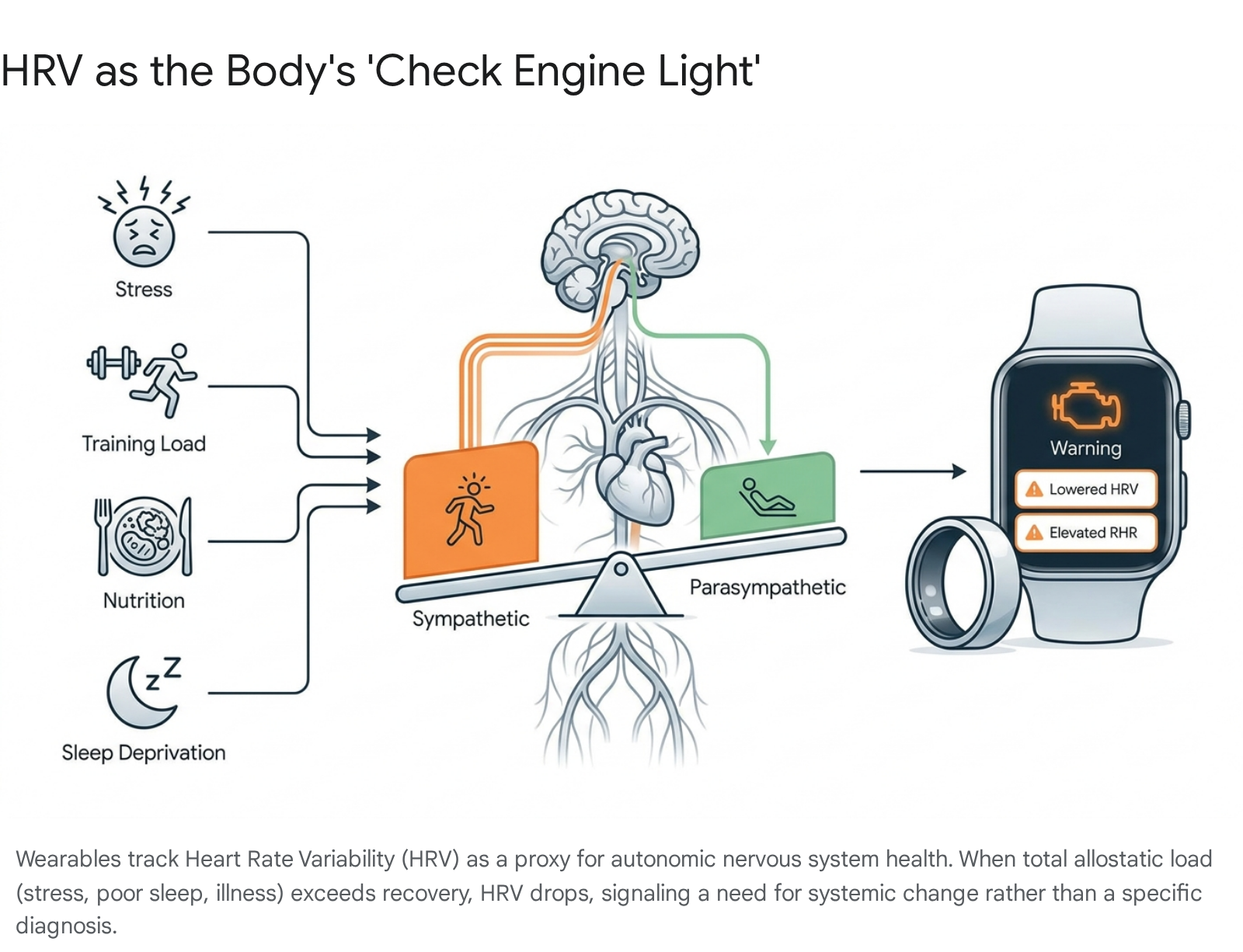
It does not diagnose the exact structural failure - it cannot explicitly tell the user if they are overtraining, incubating a virus, suffering from psychological stress, or experiencing the effects of late-night alcohol consumption 37. It simply indicates that the body's allostatic load (total stress) has exceeded its recovery capacity.
This early warning presents a profound opportunity for proactive, test-and-retest behavioral modification 63. By utilizing the data, users can run mini-experiments to see how interventions like sleep hygiene improvements or hydration immediately affect their autonomic flexibility 6063.
For example, clinical RCTs demonstrate that practices like slow, controlled breathwork (such as SKY Breathing) stimulate the vagus nerve and baroreceptors (pressure sensors in blood vessels), shifting the nervous system toward parasympathetic dominance 38. Wearable users tracking their RMSSD (a specific HRV metric) can observe tangible 10 to 15 percent baseline improvements following consistent breathwork, validating the behavioral intervention in real-time 38.
The Risks of Data Overload
However, the democratization of clinical data carries psychological risks. Performance educators warn of the "Cobra Effect" (or Goodhart's Law) in wearable technology, where chasing a specific metric - like trying to artificially maximize a daily HRV score - leads to hyper-fixation 63. This data anxiety can actively damage the very parasympathetic recovery the user is trying to achieve.
Furthermore, as emerging platforms like Orbiit use passive smartphone and wearable data to calculate a "Mental Health Similarity Score" to predict depressive behavior, the healthcare industry must remain cautious 4. While AI-guided, low-friction digital phenotyping shows immense promise for mental health interventions, experts warn that algorithms must not replace personalized human coaching and clinical oversight 4. Wearables are most effective when they operate in the background as a safety net, guiding behavior rather than dictating every daily decision.
Bottom line
Wearables in 2026 have successfully bridged the gap between basic fitness tracking and clinical-grade physiological screening. Both the Apple Watch Series 11 and the Oura Ring 5 leverage advanced sensors and FDA-cleared predictive algorithms to flag early signs of cardiovascular strain and sleep disorders, serving as vital "check engine lights" for users' health. However, these devices remain screening tools - not diagnostic replacements - and their true value is unlocked only when the data is used to drive consistent, preventative behavioral changes in partnership with clinical care.