
Clinical Accuracy of Consumer Wearable Health Devices
Introduction
The consumer wearable technology sector in 2026 represents a critical intersection of commercial electronics and clinical diagnostics. Historically reliant on simple accelerometry and rudimentary heart rate heuristics, the current generation of flagship devices - specifically the Apple Watch (Series 11 and Ultra 3), the Oura Ring (Generation 4), and the Whoop band (versions 5.0 and the medical-grade MG) - utilize high-fidelity photoplethysmography (PPG), multi-path sensors, and advanced machine learning algorithms. These devices operate under the premise that continuous, non-invasive physiological monitoring can provide actionable insights into metabolic health, cardiovascular resilience, and sleep architecture.
However, aggressive marketing claims frequently obscure the statistical reality of device performance. Independent, peer-reviewed validation studies conducted against clinical gold standards - such as polysomnography (PSG) for sleep and single-lead electrocardiography (ECG) for cardiac metrics - reveal significant disparities in accuracy. Device efficacy is not uniform; rather, it is highly contingent on the specific biological metric being measured, the anatomical placement of the hardware, the user's skin pigmentation, and the proprietary algorithms tasked with filtering motion artifacts. Furthermore, the regulatory landscape governing these devices has fractured. The United States Food and Drug Administration (FDA) and the European Union Medical Device Regulation (EU MDR) now strictly delineate general wellness algorithms from diagnostic software, forcing manufacturers to navigate complex compliance mandates as of early 2026.
This report provides an exhaustive evaluation of the clinical accuracy of the Apple Watch, Oura Ring, and Whoop devices. By analyzing recent empirical data, this research quantifies device performance across heart rate variability, sleep staging, cardiopulmonary biomarkers, and subclinical diagnostics, while examining the physiological limitations and regulatory frameworks that define the wearable health market in 2026.
Hardware Architectures and Photoplethysmography
The accuracy of any biometric wearable is fundamentally constrained by its physical hardware architecture, sampling frequency, and anatomical placement. All three devices evaluated rely on photoplethysmography, an optical sensing technique that emits specific light wavelengths - typically green, red, and near-infrared - into the dermal and subdermal tissue. The sensors measure the volumetric changes in blood circulation based on the degree of light absorption and reflection, converting these optical signals into cardiovascular data 12.
Wrist-Based Sensor Arrays
The Apple Watch operates as a comprehensive computing platform worn on the wrist. The Apple Watch Ultra 3 and Series 11 utilize an 11-sensor array that includes advanced optical heart sensors, an electrical heart sensor capable of generating an ECG, barometric altimeters, and skin temperature sensors 3. Its substantial processing power, driven by the S10 and S11 chipsets, allows for complex real-time algorithmic adjustments and deep integration into the Apple Health ecosystem 45. However, its wrist placement subjects the optical sensors to substantial motion artifacts. The sheer mass of the device, combined with the mobility of the wrist joint, creates physical displacement during daily activities, introducing signal noise that the algorithms must continuously filter 67. Furthermore, the power demands of a high-resolution display and cellular connectivity necessitate a battery life that rarely exceeds 24 to 36 hours, introducing data gaps if the user fails to charge the device daily 68.
The Whoop 5.0 and Whoop MG bands adopt a radically different architectural philosophy. Operating with a screenless design, the Whoop ecosystem dedicates 100 percent of its processing capability and battery life to continuous biometric data collection 9. The Whoop 5.0 features a significantly upgraded analog front end (AFE) with an improved signal-to-noise ratio in the photodiodes, synchronized with an inertial measurement unit (IMU) to enhance motion cancellation 10. Depending on the specific athletic profile, the device samples data continuously at rates between 25 Hz and 100 Hz, granting it the highest sampling frequency among consumer wearables 39. The Whoop MG variant integrates conductive electrode pads directly into the clasp, enabling on-demand single-lead ECG readings while maintaining the same 14-day battery life 1011. Because the band can be tightened securely and worn on the bicep via specialized apparel, Whoop mitigates much of the motion artifact that plagues standard wristwatches during high-intensity exercise 313.
Digital Artery Acquisition
The Oura Ring 4 circumvents the anatomical limitations of the wrist entirely by utilizing the digital arteries of the finger. The vascular structures in the fingers run significantly closer to the skin surface than the capillary beds at the wrist, resulting in a stronger, cleaner blood-volume-pulse signal 3614.
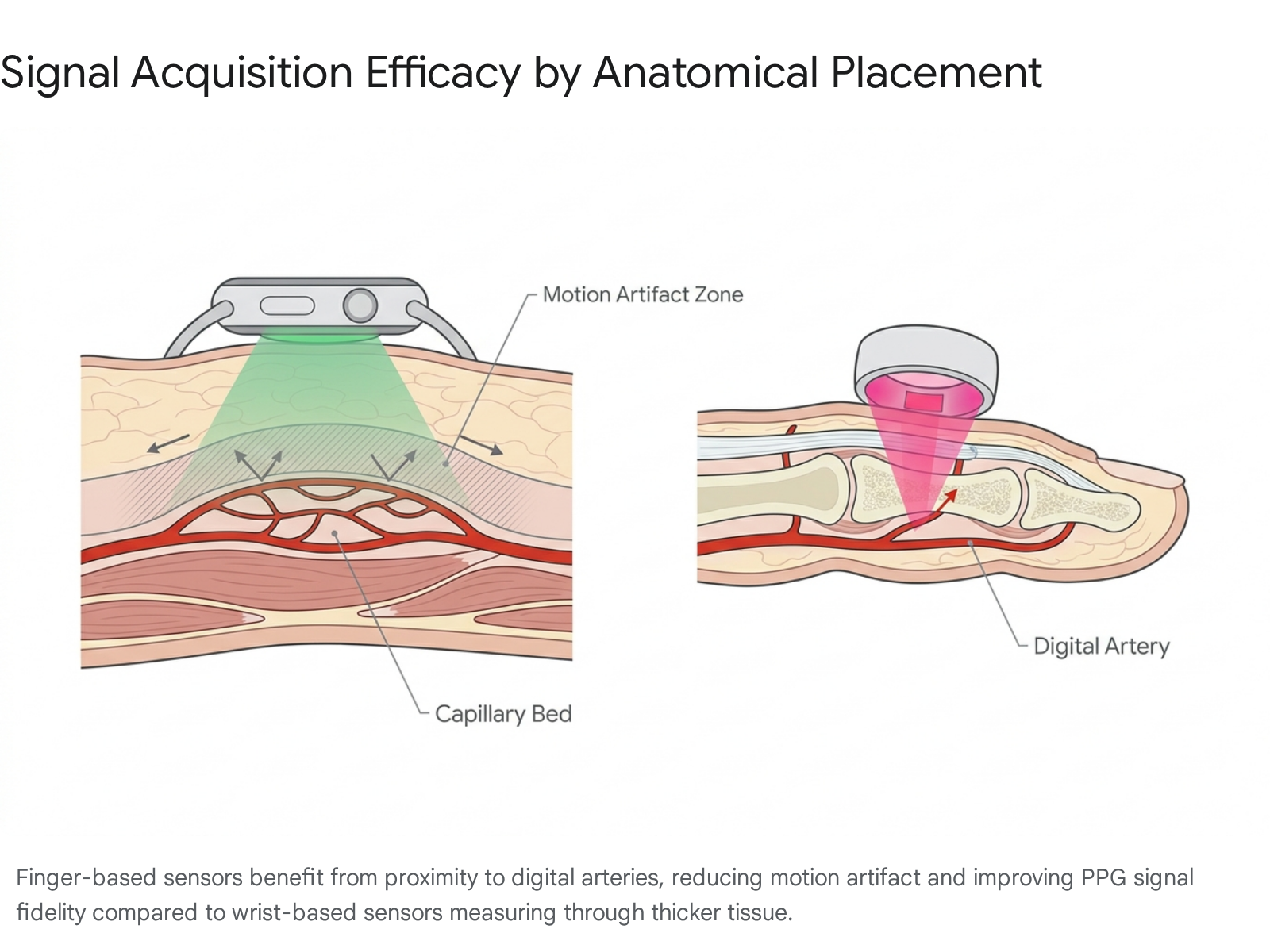
The Oura Ring 4 employs a sophisticated 18-path PPG system with three independent photodiodes. Rather than relying on a fixed sensor configuration, the device utilizes a "Smart Sensing" platform that dynamically selects the optimal optical pathway based on the user's specific finger physiology, current movement, and the physical rotation of the ring 151617.
This dynamic pathway selection yields an estimated 120 percent improvement in signal quality over the previous generation device 3. The ring form factor is inherently less susceptible to the biomechanical shocks associated with foot strikes and arm swings. However, because it lacks a display and features a much smaller battery, it relies entirely on its companion smartphone application for data processing and visualization, functioning purely as a passive collection node 4.
Heart Rate and Heart Rate Variability Performance
Heart rate variability (HRV) measures the minute fluctuations in the time intervals between consecutive heartbeats, serving as a direct proxy for autonomic nervous system function. High HRV generally indicates a state of parasympathetic dominance and physiological recovery, while low HRV suggests sympathetic stress, overtraining, or impending illness. Because HRV relies on measuring intervals in milliseconds, it demands exceptional sensor precision. The clinical accuracy of consumer wearables in tracking heart rate and HRV is heavily stratified by the user's physical state: devices that excel at rest frequently fail during intense movement, and vice versa.
Nocturnal and Resting Measurements
During sleep and periods of complete rest, motion artifacts are minimized, allowing optical sensors to capture their cleanest signals. Independent, peer-reviewed validation studies consistently identify the Oura Ring 4 as the most accurate consumer device for resting metrics.
A comprehensive 2025 study conducted by researchers at the Ohio State University and the Air Force Research Lab evaluated multiple wearables across 536 nights of sleep, comparing the devices against a gold-standard Polar H10 single-lead ECG chest strap 756. The data established that the Oura Ring 4 achieves near-perfect agreement with the clinical reference. For nocturnal HRV, the Oura Ring 4 recorded a Concordance Correlation Coefficient (CCC) of 0.99 and a Mean Absolute Percentage Error (MAPE) of 5.96% 756.
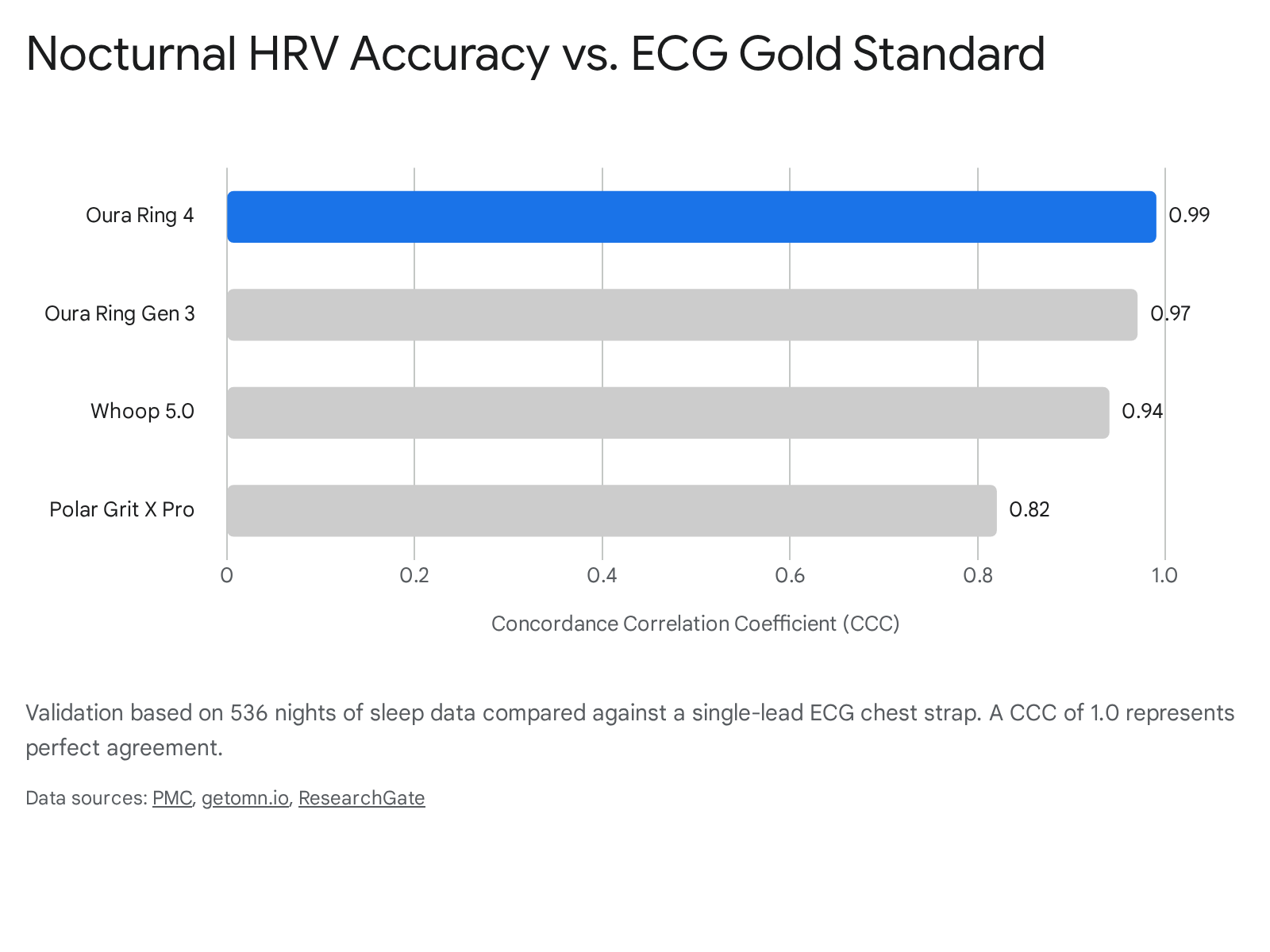
For resting heart rate (RHR), the device demonstrated a CCC of 0.98 and a MAPE of 1.94% 75. The structural advantage of the ring's placement on the digital artery translates directly into superior clinical validity for passive recovery tracking 13.
The Whoop 5.0 and Whoop MG provide acceptable, though slightly less precise, resting measurements. In the identical 536-night validation study, the Whoop 4.0 and 5.0 architectures achieved a moderate agreement for nocturnal HRV, recording a CCC of 0.94 and a higher MAPE of 8.17% 756. For resting heart rate, Whoop demonstrated a CCC of 0.91 and a MAPE of 3.00% 5. While Whoop heavily markets its continuous recovery loop, independent evaluations confirm that its wrist-based optical sensors exhibit slightly more variance than finger-based sensors during sleep, though the data remains highly viable for longitudinal trend analysis 713.
The Apple Watch, however, exhibits pronounced vulnerabilities in passive HRV measurement. In a 2024 prospective cohort study analyzing 316 HRV measurements against the Polar H10 ECG paired with Kubios HRV software, researchers found that the Apple Watch (Series 9 and Ultra 2 architecture) systematically underestimated HRV. The device recorded a mean difference of -8.31 milliseconds compared to the reference standard, yielding a concerning MAPE of 28.88% and a Mean Absolute Error (MAE) of 20.46 ms 7. Equivalence testing determined that the HRV measurements from the Apple Watch did not fall within the pre-specified clinical equivalence margin of ±10 ms 7. Interestingly, the same study confirmed that the Apple Watch captures highly accurate resting heart rates (MAPE 5.91%, MAE 3.73 bpm), indicating that the failure lies specifically in the algorithmic processing of millisecond inter-beat intervals rather than general pulse detection 7.
Active Heart Rate Tracking
The performance hierarchy inverts when the user engages in physical activity. During exercise, peripheral blood flow decreases as blood is shunted to major muscle groups, and physical motion introduces massive mechanical noise to the optical sensors.
The Apple Watch dominates the sector for active heart rate accuracy. A living systematic review comprising 82 studies and over 430,000 participants confirmed that the Apple Watch exhibits a remarkably low pooled mean bias of -0.27 bpm across mixed conditions 8. Independent comparative testing demonstrates that the Apple Watch achieves 86.3% accuracy (r=0.80) against ECG during vigorous activity, significantly outperforming competitors 723. The advanced processing power of the Apple silicon allows the device to effectively filter out motion artifacts in real-time.
The Whoop 5.0 also maintains strong integrity during physical exertion, largely due to its high continuous sampling rate (up to 100 Hz) and its ability to be secured tightly on the bicep, away from the complex movements of the wrist joint 99. Conversely, ring-based sensors like the Oura Ring 4 struggle profoundly during strength training or high-intensity interval training. The gripping of weights or handlebars compresses the digital arteries, temporarily occluding blood flow and causing catastrophic signal dropout 1725.
However, sports scientists note a critical caveat for all optical sensors: any activity involving heavy wrist flexion (such as rowing, tennis, or Olympic weightlifting) disrupts the capillary beds beneath the sensor 2510. For absolute clinical precision during resistance training or interval work, no optical wearable currently rivals a dedicated ECG chest strap 711.
Sleep Architecture and Staging Efficacy
Accurately mapping sleep architecture - the cyclic progression through Wakefulness, Light sleep, Deep (Slow-Wave) sleep, and Rapid Eye Movement (REM) sleep - is the most complex algorithmic challenge for consumer wearables. Clinical polysomnography (PSG), the gold standard in sleep medicine, relies primarily on electroencephalography (EEG) to measure electrical brainwave activity. Consumer devices entirely lack EEG capabilities; they must infer neurological states indirectly by analyzing autonomic nervous system outputs such as heart rate variability, respiratory rate, peripheral skin temperature, and gross motor movement 28.
Two-Stage Classification
When the algorithmic task is simplified to two-stage classification - distinguishing periods of sleep from periods of wakefulness - modern wearables perform exceptionally well. In a comprehensive 2022 laboratory validation study involving 53 healthy adults monitored simultaneously with PSG and six consumer wearables, the baseline agreement for sleep-wake determination was robust 12. The Apple Watch achieved an 88% agreement (Cohen's kappa = 0.30), the Whoop device achieved an 86% agreement (κ = 0.44), and the Oura Ring achieved an 89% agreement (κ = 0.51) 12. In practical terms, all three devices are clinically viable for tracking total sleep time, sleep onset latency, and general sleep efficiency. In fact, one systematic review found that Whoop tracks total sleep time with a mean absolute error of only 1.4 minutes compared to PSG 13.
Multi-Stage Polysomnography Validation
The accuracy degrades significantly when devices attempt four-stage classification. The physiological markers separating Light sleep from REM sleep, or the subtle transitions into Deep sleep, are difficult to detect purely through optical and kinetic sensors.
Independent validation studies repeatedly highlight the Oura Ring as the industry leader in four-stage sleep classification. In a prominent single-night inpatient protocol study conducted at Brigham and Women's Hospital involving 35 healthy adults, the Oura Ring Gen 3 demonstrated the highest published accuracy among tested consumer wearables 281314. The Oura Ring achieved a substantial Cohen's kappa of 0.65 for four-stage agreement, correctly classifying 76.3% of all 30-second sleep epochs 14. Specifically, the ring achieved sensitivities of 78.2% for Light sleep, 79.5% for Deep sleep, and 76.0% for REM sleep 14. While 79.5% accuracy still means one in five epochs is misclassified, it remains the highest benchmark in the consumer space 17.
The Apple Watch exhibits profound disparities in multi-stage accuracy. In the same Brigham and Women's Hospital study, the Apple Watch Series 8 demonstrated high sensitivity for identifying Light sleep (86.1%) and REM sleep (82.6%) 14. However, its capability to detect Deep (Slow-Wave) sleep collapsed to a sensitivity of just 50.5%, meaning the device missed nearly half of the physically restorative Deep sleep verified by the clinical PSG 1432. Consequently, the Apple Watch's multi-stage kappa scores vary widely in peer-reviewed literature, ranging from a moderate 0.60 to a poor 0.20 depending on the study's exact methodology 1214.
The Whoop platform provides moderate overall four-stage accuracy. While its total sleep time estimations are precise, its ability to delineate specific stages yields a Cohen's kappa of 0.44 12. Independent assessments confirm Whoop achieves a Deep sleep sensitivity of 69.6% and a REM sleep sensitivity of 62.0% 32. Whoop's algorithms prioritize the measurement of overnight cardiovascular recovery over the exact minutiae of sleep staging, utilizing the sleep data primarily as an input variable for its proprietary daily Recovery Score rather than a standalone clinical diagnostic 513.
| Device Model | Two-Stage Agreement (Sleep vs. Wake) | Four-Stage Agreement (Cohen's Kappa) | Deep Sleep Sensitivity | REM Sleep Sensitivity | Total Sleep Time Accuracy |
|---|---|---|---|---|---|
| Oura Ring Gen 3/4 | 92.0% | 0.65 (Substantial) | 79.5% | 76.0% | Excellent (Mean absolute error < 5 mins) |
| Apple Watch (Series 8+) | 93.0% | 0.60 (Moderate)* | 50.5% | 82.6% | Excellent (Over 90% agreement with PSG) |
| Whoop 4.0/5.0 | 86.0% | 0.44 (Moderate) | 69.6% | 62.0% | Exceptional (Mean absolute error ~1.4 mins) |
Note: The Apple Watch exhibits high variance in multi-stage kappa scores across different studies due to persistent difficulties in isolating Deep sleep epochs from Light sleep 12131432.
Cardiopulmonary and Metabolic Biomarkers
Beyond heart rate and sleep, consumer wearables attempt to measure broader indicators of cardiopulmonary fitness and metabolic health. These metrics are heavily reliant on algorithmic estimation rather than direct physiological sampling.
Blood Oxygen Saturation (SpO2)
Monitoring peripheral blood oxygen saturation (SpO2) has become a standard feature since the global pandemic. The Apple Watch utilizes specific red and infrared sensors to calculate the absorption ratio of oxygenated to deoxygenated hemoglobin. The living systematic review of Apple Watch accuracy revealed a pooled mean bias of just 0.04% for SpO2, indicating that, on average, the device's readings align closely with medical pulse oximeters 8.
However, the limits of agreement (LoA) for the Apple Watch range widely from -4.01% to 3.94% 8. While the device performs excellently within the normoxic range (95% to 100% saturation), measurement error increases significantly as oxygen levels drop. In states of clinical hypoxemia, the Apple Watch and competing optical wearables exhibit wider variability, often failing to accurately record sudden drops in saturation 8. The Oura Ring 4 and Whoop 5.0 track SpO2 primarily overnight to detect respiratory disturbances rather than providing on-demand spot checks, making their data useful for identifying chronic trends (such as potential sleep apnea indicators) rather than acute medical crises 1633.
Maximum Oxygen Uptake and Energy Expenditure
Maximum oxygen uptake (VO2 max) is the defining metric of cardiovascular fitness. Because true VO2 max requires indirect calorimetry - measuring the exact ratio of inhaled oxygen to exhaled carbon dioxide in a laboratory setting - wearables must estimate this figure using submaximal heart rate data, pace, and demographic algorithms.
Independent validations demonstrate that the Apple Watch systematically underestimates VO2 max. Studies calculate a Mean Absolute Percentage Error (MAPE) of 13.31% to 16% for the Apple Watch, with a mean difference of 6.07 mL/kg/min 715. This is a substantial margin of error for a metric that typically ranges from 30 to 60 mL/kg/min 7. The algorithms exhibit a systematic bias, pulling users toward the population mean by overestimating sedentary individuals and underestimating highly trained athletes 723. Competitor brands specializing in endurance sports, such as Garmin, perform significantly better (MAPE 5.7 - 7%) 7.
Furthermore, estimating energy expenditure (caloric burn) is universally inaccurate across all wearable devices. Research indicates that the best-performing wearables max out at roughly 71% accuracy for calories burned during activity, with frequent, large errors in both overestimation and underestimation 823.
Subclinical Diagnostics and Predictive Algorithms
As sensor hardware faces diminishing returns in raw accuracy, the commercial battleground in 2026 has shifted toward the detection of subclinical disease states. Wearables are moving from passive fitness trackers to proactive triage tools.
Continuous Blood Pressure Monitoring
The most significant regulatory and technological developments in recent years surround blood pressure tracking. Hypertension is the leading preventable cause of heart attack and stroke, yet traditional cuff measurements capture only brief moments in time.
The Apple Watch Series 11 and Ultra 3 feature an FDA-cleared "Hypertension Notifications" system 1617. Crucially, the Apple Watch does not generate real-time systolic or diastolic numbers 37. Instead, it uses its optical heart sensor to passively analyze how blood vessels respond to each heartbeat, taking 60-second samples approximately every two hours 216. The algorithm evaluates these pulse wave parameters over a non-overlapping 30-day window 2.
In a pivotal clinical validation study involving 2,229 subjects, the Apple Watch demonstrated an overall sensitivity of 41.2% for detecting hypertension, and a sensitivity of 53.7% for identifying more severe Stage 2 hypertension 2. While the device misses over half of actual hypertension cases, its overall specificity is excellent at 92.3% (and 95.3% for users with normal blood pressure), meaning false alarms are rare 2. When the watch flags a consistent abnormality, it sends a notification prompting the user to conduct a seven-day confirmation test using a validated third-party clinical cuff 1637.
The Whoop MG takes a fundamentally different, and more controversial, approach. The MG aims to provide daily overnight estimates of systolic and diastolic blood pressure ranges 2518. This methodology requires an initial calibration against a standard medical cuff, followed by monthly recalibrations 25. Independent clinical testing indicates that while the Whoop MG performs well in controlled laboratory settings (within 5 mmHg of clinical monitors), the algorithm loses calibration rapidly when the user's heart rate spikes above 140 BPM 10. Consequently, the FDA issued warnings to Whoop regarding unauthorized medical device claims related to these continuous blood pressure features, forcing the company to heavily caveat the tool's diagnostic utility 2519.
| Metric Category | Apple Watch Hypertension Notifications | Whoop MG Blood Pressure Insights |
|---|---|---|
| Measurement Type | 30-day passive trend analysis 2 | Daily overnight systolic/diastolic estimate 25 |
| Output Provided | Binary alert ("Possible Hypertension") 16 | Estimated BP range values 18 |
| Calibration Required | None (opportunistic sampling) 2 | Initial and monthly medical cuff calibration 25 |
| Validation Efficacy | 41.2% Sensitivity, 92.3% Specificity 2 | Calibration lost during HR spikes >140 BPM 10 |
| Regulatory Status | FDA-cleared as a screening tool 1737 | Under FDA scrutiny for unapproved claims 2519 |
Atrial Fibrillation and Electrocardiography
Both Apple and Whoop offer FDA-cleared capabilities for detecting atrial fibrillation (AFib). The Apple Watch utilizes its electrical heart sensor to allow users to generate an on-demand, single-lead electrocardiogram (ECG) 2. The 2026 systematic review found that the Apple Watch is highly specific (0.91) but moderately sensitive (0.79) for AFib detection 8. Because of the high specificity, a positive AFib notification from the Apple Watch warrants immediate clinical investigation. However, the system is hindered by a high rate of inconclusive ECG tracings - ranging between 15% and 25% across studies - which impacts the overall diagnostic yield 8.
The Whoop MG introduces a "Heart Screener" feature via conductive pads in its new clasp, allowing for on-demand single-lead ECG readings 1140. Real-world movement testing shows the Whoop MG's AFib detection matches clinical references like the KardiaMobile 6L approximately 78% of the time, though false positives can occur due to muscle artifact confusion during intense physical activity 10. The Oura Ring 4 does not feature an electrical heart sensor and therefore cannot generate an ECG or formally detect AFib, relying instead on its optical sensors to flag general cardiac irregularities.
The Status of Non-Invasive Glucose Monitoring
Despite persistent consumer demand and a decade of rumors, true non-invasive continuous glucose monitoring (CGM) does not exist on any consumer smartwatch or smart ring in 2026 4142.
Apple has invested heavily in "Project E5," developing optical absorption spectroscopy - using lasers to read interstitial fluid through the skin - to measure blood sugar without needles 4120. While proof-of-concept prototypes existed as early as 2023, the fundamental physics and engineering challenges required to miniaturize the technology into a wrist-worn form factor have not been overcome 4120. Industry analysts estimate that a native, clinically reliable optical glucose sensor for the Apple Watch remains years away, likely arriving no earlier than 2028 to 2030 4144.
Currently, the Apple Watch Series 11 functions strictly as a display bridge. It can display real-time glucose data, but only if the user is already wearing a separate, FDA-cleared subcutaneous CGM device, such as the Dexcom G7 4120. Similarly, while several smart rings claim to provide "estimated glucose trends" based on metabolic AI algorithms, the FDA has explicitly warned consumers that no smart ring is authorized or approved to measure blood glucose non-invasively 4221. Consumers utilizing these devices to make medication or dietary decisions based on unvalidated optical algorithms face severe health risks.
Optical Sensor Bias and Skin Pigmentation Disparities
A critical, ongoing failure in the wearable health sector is the disparate performance of optical sensors across different human skin tones. This disparity is rooted in the fundamental physics of photoplethysmography.
Melanin Attenuation in Green Light PPG
The vast majority of consumer smartwatches, including the Apple Watch and Whoop, rely on green LED light for continuous heart rate monitoring 19. Green light provides an excellent signal-to-noise ratio in lighter skin, but melanin - the primary pigment responsible for darker skin tones - highly absorbs wavelengths in the visible spectrum 122. In individuals with darker skin, the melanin-rich epidermis acts as an optical filter, heavily attenuating the green light before it can reach the deeper capillary beds 122.
A comprehensive narrative review of studies published up to 2025 demonstrated that this interaction causes severe measurement inaccuracies. Devices running standard, generic operating systems (such as older WearOS models) routinely underestimated heart rates by 10 to 15 bpm in darker-skinned users during moderate to vigorous exercise, and exhibited error rates of up to 12% even at rest 1.
The Apple Watch performs significantly better than the industry average in mitigating this bias. Validation studies involving diverse demographic groups demonstrated that the Apple Watch maintained mean heart rate differences of less than 5 bpm across all Fitzpatrick skin types, indicating highly advanced signal processing capabilities capable of compensating for low light return 1. The demographic data from Apple's own hypertension validation study confirms a highly diverse testing pool (17.2% Black, 10.1% Hispanic, with 12.2% categorized as Fitzpatrick Scale Type V and VI), ensuring the algorithms are trained on representative populations 2.
Pulse Oximetry and Hypoxemia Overestimation
The bias extends beyond heart rate into blood oxygen saturation. A systematic review and meta-analysis of pulse oximetry studies found that PPG-derived SpO2 measurements frequently breached FDA guidance thresholds across diverse skin pigmentations 23. The data reveals that optical sensors consistently overestimate oxygen saturation in darker-skinned individuals 823. While this overestimation is statistically minor in healthy populations, it becomes clinically dangerous during acute respiratory distress, as the device may read normal oxygen levels while the patient is actually experiencing hypoxic hypoxemia.
To address these deeply entrenched hardware limitations, researchers at institutions like Brown University are developing polarization-sensitive PPG sensors. These experimental devices use cross-polarized light - orienting the electric field to filter out superficial scattering from melanin - to capture much stronger signals from deeper vascular tissue 24. In early 2025 tests, cross-polarized sensors consistently produced higher perfusion index values across all skin tones, pointing to a future where hardware architecture, rather than software correction, resolves the equity gap in wearable diagnostics 24. However, this technology has not yet been commercialized in the 2026 iterations of the Apple Watch, Oura Ring, or Whoop.
Regulatory Frameworks and Compliance Mandates
The distinction between a lifestyle gadget and a medical device is entirely dictated by the legal claims made by the manufacturer. By 2026, global regulatory bodies have matured their oversight of digital health, establishing stringent frameworks that dictate how these devices are developed, validated, and marketed.
United States Food and Drug Administration Oversight
The FDA delineates wearable technologies based on their intended use. Devices that merely track general fitness heuristics - such as daily step counts, calorie estimates, or generic sleep scores - are classified as "general wellness" products. These devices are largely exempt from strict pre-market medical regulation 49. The core metrics of the Oura Ring (the Readiness Score) and the Whoop band (the Strain Score) operate securely within this unregulated wellness space 254950.
However, when a manufacturer claims their software can diagnose, treat, or monitor a specific disease, the software is regulated as Software as a Medical Device (SaMD). The FDA requires extensive clinical trials to grant 510(k) clearance for these specific features. Apple's ECG app, sleep apnea detection, and recent Hypertension Notifications all underwent rigorous FDA evaluation before public release 1721. The FDA has demonstrated a willingness to crack down on overreach; as noted previously, the agency issued warnings regarding the Whoop MG's blood pressure claims, underscoring that algorithms estimating complex cardiovascular disease states without proper clinical clearance will face regulatory sanction 251921.
European Union Medical Device Regulation (EU MDR)
In Europe, the regulatory environment is significantly more restrictive. The Medical Device Regulation (EU MDR 2017/745), which fully replaced older directives, applies to all medical devices placed on the EU market 5152. Obtaining a CE mark under the EU MDR requires hardware manufacturers to meet exhaustive General Safety and Performance Requirements (GSPRs) 51.
For wearable devices seeking diagnostic classification, the EU MDR mandates comprehensive clinical evidence. Manufacturers cannot rely on equivalence to older devices; they must conduct original clinical investigations. Furthermore, the regulation places immense emphasis on post-market surveillance. Wearable manufacturers must establish rigorous Post-Market Clinical Follow-up (PMCF) plans, continuously analyzing real-world data to ensure algorithms do not degrade over time or perform poorly in specific demographic subpopulations 5253.
EUDAMED Implementation and 2026 Enforcement
A major shift in the European landscape occurred with the full operationalization of the European Database on Medical Devices (EUDAMED). Following a formal notice from the European Commission, a six-month transition period triggered strict new obligations that become fully applicable on May 28, 2026 54.
As of this deadline, manufacturers of CE-marked wearable medical devices must comply with mandatory device registration and enter their products into the Unique Device Identifier (UDI) database 5254. Any clinical investigations or adverse event reports related to wearable diagnostics must be logged centrally. Furthermore, the interplay between the EU MDR and the new EU Artificial Intelligence Act (Regulation 2024/1689) has added a massive compliance layer for devices utilizing AI 5225. Algorithms that predict health outcomes - such as AI-driven cardiac event forecasting - now face dual scrutiny, ensuring that the black-box machine learning models driving next-generation wearables are transparent, unbiased, and clinically safe 4025.
Conclusion
The clinical accuracy of wearable health devices in 2026 cannot be evaluated through a monolithic lens; performance is intrinsically tied to the specific physiological metric requested and the architectural design of the hardware.
The Oura Ring 4 provides the highest degree of clinical accuracy for passive, resting measurements. Its placement on the digital arteries yields exceptionally clean optical signals, making it the premier consumer device for tracking nocturnal heart rate variability and multi-stage sleep architecture, achieving near-perfect concordance with medical ECGs for resting metrics.
The Apple Watch Series 11 and Ultra 3 represent the pinnacle of active physiological tracking. Apple's advanced silicon expertly filters motion artifacts during intense exercise, providing the most accurate active heart rate data in the industry. Furthermore, Apple leads in the deployment of clinically validated, FDA-cleared subclinical diagnostics, utilizing opportunistic 30-day algorithmic sampling to identify silent risks like hypertension with high specificity.
The Whoop 5.0 and MG bridge the gap between lifestyle tracking and sports science. By offering the highest continuous sampling rates and off-wrist mounting options, Whoop excels at quantifying cardiovascular strain for serious athletes. However, its accuracy for specific resting metrics slightly trails the Oura Ring, and its ambitious medical-grade features face ongoing regulatory friction.
Ultimately, while the 2026 generation of wearables possesses unprecedented diagnostic potential, they remain bound by the physics of photoplethysmography and the complexities of algorithmic inference. They are profoundly effective triage tools and trend monitors, but they do not yet replace the clinical necessity of traditional medical diagnostics.