
Confirmed Government Conspiracies and Public Belief
Introduction
The study of government conspiracies and subsequent institutional cover-ups operates at the intersection of political science, historical analysis, and cognitive psychology. For decades, the term "conspiracy theory" has carried a pejorative connotation in public discourse, frequently associated with pathological paranoia, epistemic vices, and an unwarranted rejection of authoritative narratives 12. The traditional deficit model of psychology has historically treated conspiracist ideation as a manifestation of cognitive failure or individual pathology 1. However, the historical record definitively demonstrates that governments, military apparatuses, and intelligence agencies regularly engage in clandestine operations, human experimentation, and orchestrated deceptions that meet the strict definitional criteria of a conspiracy: a secret plot by two or more powerful actors to achieve malevolent, illegal, or self-serving goals at the expense of the public 3.
When these real-world conspiracies are eventually unmasked - whether through declassification, the actions of whistleblowers, shifting political regimes, or investigative journalism - they transition from the realm of fringe theory to established historical fact. The confirmation of operations such as the Tuskegee Syphilis Experiment, the Central Intelligence Agency's (CIA) MKUltra program, Japan's Unit 731, and the Argentine military junta's death flights forces a critical re-evaluation of institutional trust 545. From a socio-epistemic perspective, the empirical reality of state deception presents a profound challenge to democratic civic culture. If governments possess both the capacity and the historical precedent to execute and obscure massive ethical breaches, skepticism toward official narratives ceases to be inherently irrational 2.
This analysis examines the mechanics of major confirmed government conspiracies and the institutional frameworks that enable cover-ups. It then explores the psychological and political ramifications of these revelations, detailing how confirmed state deception alters public trust, acts as a catalyst for generalized conspiracist ideation, and creates an environment where differentiating between legitimate accountability and pathological paranoia becomes increasingly difficult.
Typologies of State Secrecy and Conspiratorial Actions
To understand how government cover-ups manifest and persist over decades, it is necessary to distinguish between routine institutional secrecy and conspiratorial deception. Political science literature differentiates between clandestine operations, which are hidden but not disguised, and covert operations, which are actively disguised to provide plausible deniability even if the results are visible 6. Furthermore, state secrecy can be categorized along a spectrum of depth, which dictates the public's ability to engage with the hidden information.
Deep Secrets and Shallow Secrets
The theoretical framework of "deep" versus "shallow" secrets provides a vital lens for analyzing institutional cover-ups. A shallow secret occurs when the public understands that information is being withheld. For instance, when a democratic government classifies troop movements, active intelligence sources, or nuclear launch codes, the citizenry knows they are ignorant of specific details 7. In these cases, the public can debate the parameters of that secrecy, petition for eventual declassification, and hold the secret-keepers accountable through democratic and legal mechanisms. Shallow secrets are a recognized, albeit contested, feature of statecraft.
Conversely, a deep secret exists when the public is entirely unaware that a secret even exists 7. The secret-keepers conceal the very fact of their concealment, creating a structural subversion of political authority. Confirmed historical conspiracies universally begin as deep secrets. Because the public is unaware of the deception, deep secrets bypass democratic deliberation entirely. Citizens are left entirely at the mercy of the secret-keepers, unable to scrutinize the underlying information or pursue accountability 78. The duplicity entailed by such double concealment typically indicates a profound institutional awareness of the illegality or immorality of the hidden actions.
Motivational Models for Institutional Cover-Ups
State actors employ cover-ups based on several motivational models that blend national security imperatives with bureaucratic self-preservation 1112. The External Threat Model justifies secrecy as a necessary measure to protect sensitive information from foreign adversaries. This rationale is frequently leveraged to shield domestic populations from the uncomfortable realities of geopolitical compromises 119.
The Bureaucratic Politics Model posits that cover-ups emerge organically from inter-agency competition, institutional self-preservation, and a collective desire to avoid accountability for egregious mistakes or legal violations. In these scenarios, the concealment is less about protecting the state from foreign enemies and more about protecting specific officials from domestic legal consequences 11.
Finally, the Internal Threat Model argues that state officials utilize secrecy and deception specifically to mislead their own domestic populations. Under this framework, officials view public opposition, democratic oversight, or civic activism as a threat to their strategic objectives, necessitating deep secrecy and domestic manipulation 1112. As historical cases demonstrate, major confirmed conspiracies frequently rely on a synthesis of these models, utilizing the veil of national security to obscure severe violations of human rights and democratic norms.
Public Health and Unwitting Human Experimentation
Government exploitation of vulnerable populations for scientific, medical, and military advancement provides some of the most extensively documented examples of confirmed conspiracies. These cases highlight the intersection of bureaucratic cover-ups and profound ethical failures within the medical and intelligence communities.
The Tuskegee Syphilis Study
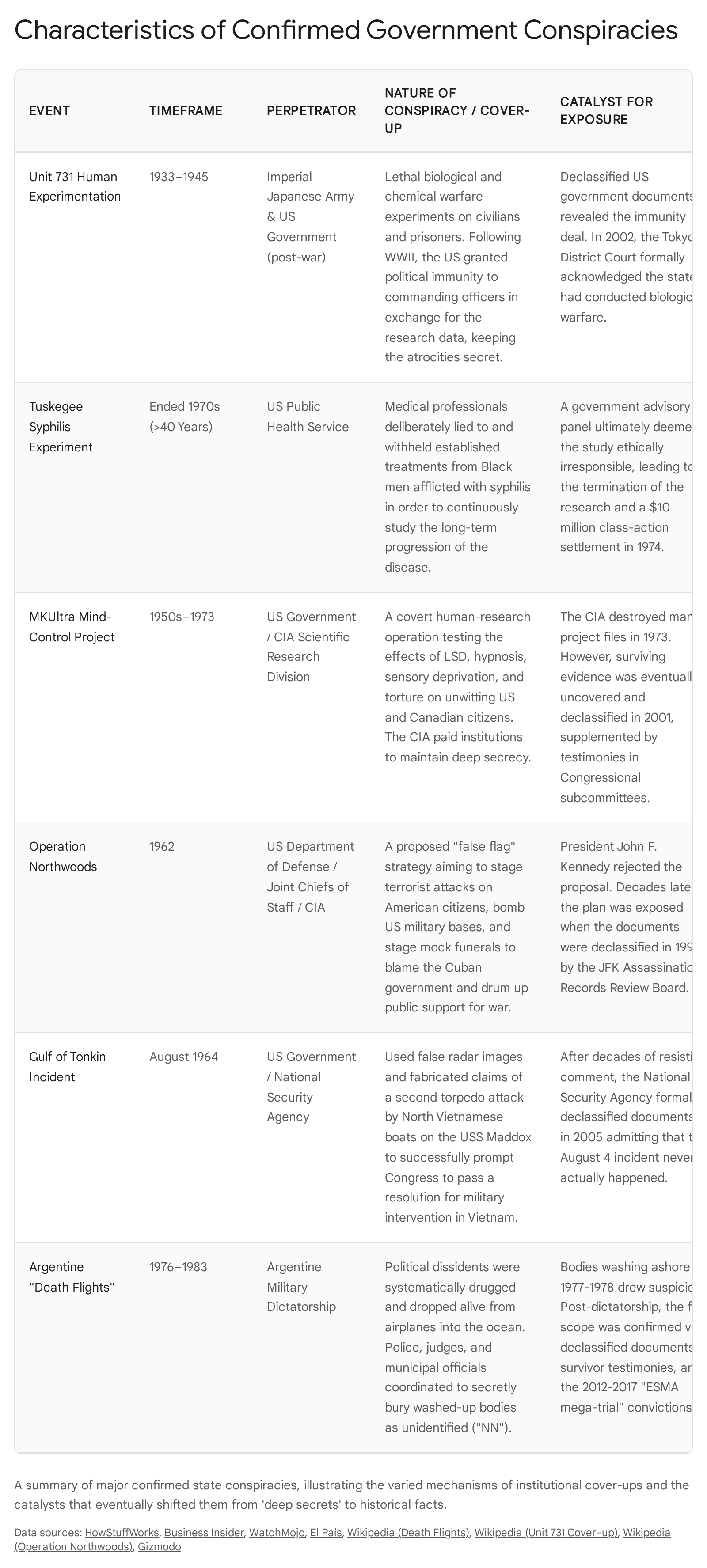
In 1932, the United States Public Health Service initiated a longitudinal study to observe the natural progression of untreated syphilis in rural African American men in Alabama. The subjects, drawn from deeply impoverished communities, were falsely told they were receiving free health care from the federal government for "bad blood," a localized colloquialism that encompassed various ailments 510.
The conspiracy required the active and sustained collusion of local doctors, military draft boards, and federal health officials to ensure the subjects did not receive external medical intervention. Even after penicillin became the standard, highly effective cure for syphilis in the 1940s, the researchers actively withheld treatment from the men to continue observing the disease's devastating neurological and physiological effects 10. The operation remained a deep secret from the general public until 1972, when a whistleblower leaked the details to the press. The resulting public outcry led to immediate congressional hearings and the termination of the study. A government advisory panel deemed the research ethically irresponsible, resulting in a 1974 out-of-court settlement for $10 million and the provision of lifetime health benefits for all participants, the last of whom died in 2004 10.
Contamination of the Polio Vaccine
Between 1955 and 1961, millions of Americans received doses of the polio vaccine that were contaminated with Simian Virus 40 (SV40). The virus, commonly found in the monkey kidney cells used to culture the vaccine, was known to cause cancer in certain animals 1011. Despite scientists expressing concerns about the potential spread of the virus to humans, medical professionals continued to administer the tainted vaccines until 1963, and contaminated oral vaccines were identified even after 1961 10.
While opinions in the medical community vary regarding a direct causal link between SV40 and human cancer, independent studies have identified the presence of the virus in the brain and lung tumors of children and adults. The Centers for Disease Control and Prevention (CDC) previously posted a fact sheet acknowledging the presence of SV40 in the historic polio vaccines, but subsequently removed it, fueling ongoing public skepticism regarding the transparency of public health institutions 10.
Project MKUltra
Driven by Cold War paranoia regarding Soviet and Chinese brainwashing techniques, the United States government authorized Project MKUltra, a deeply covert human-research operation run by the CIA's Scientific Research Division. Beginning in 1953, the project aimed to develop mind-control drugs, truth serums, and psychological torture techniques for use in interrogations and espionage 51011.
Operating through a network of front organizations, the CIA funded experiments at universities, hospitals, and prisons across the United States and Canada. Unwitting citizens - including mental patients, prisoners, and members of the general public - were subjected to sensory deprivation, psychological abuse, isolation, and hypnosis. Many were secretly dosed with high quantities of LSD without their knowledge or consent 10. The agency even enticed heroin addicts to participate in experiments by offering them heroin as a reward 10.
The cover-up of MKUltra was highly aggressive and orchestrated at the highest levels of the intelligence apparatus. In 1973, facing the impending fallout of the Watergate scandal and fearing congressional scrutiny, CIA Director Richard Helms ordered the destruction of all MKUltra records, intentionally attempting to render the conspiracy permanently unprovable 11. However, a cache of financial documents survived the purge because they were stored in a different facility. These records were uncovered via a Freedom of Information Act request in 1977, leading to the confirmation of the program during the Church Committee hearings and validating long-standing rumors of CIA mind-control experiments 5.
Unit 731 and International Immunity Pacts
Unit 731 was a covert biological and chemical weapons research facility operated by the Imperial Japanese Army in the puppet state of Manchukuo (occupied China) between 1933 and 1945 512. Led by General Shirō Ishii, the unit conducted lethal human experimentation on an estimated 3,000 to 12,000 prisoners within the facility, primarily Chinese civilians, Soviet prisoners of war, and Koreans 59.
The victims, dehumanizingly referred to as "logs" by the staff, were subjected to vivisection without anesthesia, intentionally infected with plague, anthrax, and cholera, and placed in hypobaric chambers for pressure testing 51213. Field tests of the unit's biological weapons, which involved dropping plague-infected fleas on Chinese villages, resulted in hundreds of thousands of additional deaths 514.
The primary cover-up of Unit 731 was not executed solely by the Japanese government, but was actively orchestrated by the United States. Following the surrender of Japan in 1945, General Douglas MacArthur and the Truman administration struck an immunity agreement with the perpetrators. The United States granted full political and criminal immunity to Ishii and the key doctors of Unit 731 in exchange for exclusive access to their biological warfare data 5915.
The US government actively shielded these war criminals from the Tokyo War Crimes Tribunal, classifying the incriminating evidence and blocking the prosecution's access to key witnesses 9. The US government also paid stipends to the perpetrators - amounting to 150,000 to 200,000 yen - to secure their silence and ensure the data did not fall into Soviet hands 59. American prisoners of war returning from Japanese custody were ordered not to discuss their experiences with the media 9. The Japanese government denied the existence of Unit 731 for decades, aided entirely by the American cover-up. It was not until the late 1990s and a formal 2002 Tokyo District Court ruling that the state officially acknowledged the biological warfare program and its lethal consequences 512.
Geopolitical Intervention and State Subversion
In the realm of international relations, states have routinely engineered crises or subverted foreign governments while maintaining a facade of non-intervention. These operations utilize proxy forces, economic sabotage, and fabricated intelligence to achieve geopolitical aims without triggering direct military conflict.
Covert Regime Change and Assassination Programs
Throughout the Cold War, the CIA orchestrated the overthrow of democratically elected leaders globally, operating under extreme secrecy. Confirmed operations include the 1953 coup against Iranian Prime Minister Mohammad Mossadegh (Operation TPAJAX) and the 1973 coup against Chilean President Salvador Allende 51617. The intelligence agency actively funded opposition media to destabilize public opinion, throttled local economies to create unrest, and provided logistical support to counter-revolutionary paramilitary groups 16. The US officially denied involvement while staging events to appear as organic domestic uprisings 516.
Furthermore, the Church Committee discovered that the CIA had essentially started a targeted assassination business, utilizing methods designed to mimic natural deaths, such as car accidents, suicides, heart attacks, and cancer 5. In cases where covert methods like the declassified "Heart Attack Gun" were unnecessary, conventional firearms were used. Between 1959 and 2000, intelligence services directed an estimated 638 assassination attempts against Cuban leader Fidel Castro, employing exploding cigars, poisoned diving suits, and trick cameras 516.
The legacy of these operations continues to influence modern diplomacy. To combat governments perceived as hostile in Latin America, the US relies heavily on soft power, utilizing privately owned media and foundations paid to support democratic initiatives 16. However, the historical reality of CIA subversion leads to profound skepticism regarding these modern initiatives. In 1997, it was reported that the National Endowment for Democracy (NED) was created to perform overtly what the CIA had done covertly for decades 16. Consequently, nations such as Ecuador and Bolivia have expelled organizations like the US Agency for International Development (USAID), accusing them of conspiring against the state - accusations that carry weight due to the confirmed history of actual covert interference 16.
False Flag Proposals and Intelligence Fabrication
The tactical concept of a "false flag" involves committing an act of violence or sabotage and blaming it on an adversary to justify retaliation. While historically used in naval warfare, the concept was adapted for modern geopolitics in the mid-20th century.
Operation Northwoods Perhaps the most documented example of a proposed false flag operation is Operation Northwoods. In 1962, the highest echelons of the US military - the Joint Chiefs of Staff, led by General Lyman Lemnitzer - drafted and signed a classified blueprint to manufacture public support for a war against Fidel Castro's newly communist Cuba 101819.
The declassified 12-page memorandum proposed an escalating series of staged atrocities on American soil that would be blamed on the Cuban government. Tactics included the remote control of civilian aircraft which would be secretly repainted as US Air Force planes, orchestrating terrorism and bombings in Miami and Washington, D.C., and assassinating Cuban immigrants to generate public outrage 17181920. The Joint Chiefs explicitly referenced the sinking of the USS Maine as a psychological blueprint, suggesting the military blow up a US ship in Guantanamo Bay and conduct funerals for mock victims, noting that fabricated casualty lists in US newspapers would generate a "helpful wave of national indignation" 101920.
President John F. Kennedy rejected the proposal, preventing its execution, and the document was filed away 1718. Kept secret for 35 years, the memorandum was finally declassified by the JFK Assassination Records Review Board in 1997. The release provided irrefutable proof that top military leadership was structurally willing to deceive and terrorize its own citizens to achieve geopolitical goals 192025.
The Gulf of Tonkin Incident The catalyst for massive US military escalation in the Vietnam War was the Gulf of Tonkin Incident. The Pentagon claimed that North Vietnamese patrol boats engaged in unprovoked attacks against the USS Maddox on both August 2 and August 4, 1964 1011. This narrative secured the swift passage of the Gulf of Tonkin Resolution by Congress, granting President Lyndon B. Johnson broad authority to intervene in Southeast Asia.
However, while the August 2 skirmish occurred, the August 4 attack was a complete fabrication based on false radar images and nervous sonar operators 10. Despite intelligence officials realizing the error almost immediately, the National Security Agency (NSA) actively suppressed reports that contradicted the administration's war footing. The NSA maintained this cover-up for decades, finally declassifying documents in 2005 that admitted the August 4 incident "never happened at all." NSA historian Robert J. Hanyok noted an active effort to make signals intelligence fit the desired claim of an attack 10.
Information Warfare and Manufactured Consent
Governments frequently utilize public relations firms and fabricated testimony to manipulate international sentiment and manufacture consent for military action. A prominent example is the 1990 testimony of "Nayirah" before a congressional human rights caucus. A young woman tearfully testified that Iraqi soldiers had pulled Kuwaiti babies from incubators and left them to die on the floor 511. This testimony was widely cited to drum up international support for American military intervention in the Gulf War. Amnesty International initially corroborated the claims, giving them immense credibility. However, it was later revealed that Nayirah was the daughter of the Kuwaiti ambassador to the United States, and her testimony was a fabricated propaganda scheme organized by the public relations firm Hill & Knowlton 11. Following this revelation, Amnesty International publicly criticized the administration of George H.W. Bush for their involvement in the manipulation of public perception 11.
Extrajudicial Violence and State Terrorism
Authoritarian regimes frequently employ cover-ups to dispose of political dissidents while maintaining a veneer of legality and domestic stability. These operations require extensive coordination between military forces, local law enforcement, and the judiciary.
The Argentine Death Flights
During Argentina's "Dirty War," a period of state terrorism spanning from 1976 to 1983, the military junta engaged in systematic violence against political opponents. The victims included left-wing activists, students, trade unionists, journalists, and alleged sympathizers of guerrilla groups like the Montoneros 212228. Estimates suggest up to 30,000 individuals were disappeared by the state 2122.
To dispose of the victims without leaving physical evidence or creating martyrs, the regime utilized vuelos de la muerte (death flights) 22. Dissidents held in secret detention centers, such as the Navy School of Mechanics (ESMA), were heavily drugged with sedatives, stripped naked, and loaded onto military aircraft, including the Short SC.7 Skyvan 21222823. Once over the Atlantic Ocean or the Río de la Plata, the victims were thrown out of the cargo doors to plunge to their deaths 212228.
The cover-up of the death flights required immense bureaucratic complicity. In December 1977 and 1978, strong south-easterly winds caused dozens of mutilated, naked bodies to wash up on beaches south of Buenos Aires 428. Rather than launching criminal investigations, local police, medical examiners, and municipal judges actively colluded to hide the evidence 428. Officials secretly buried the victims in unmarked graves as "NN" (unidentified persons) and falsified death certificates to protect the junta's extermination program 423.
The truth of the death flights was heavily suppressed until a former naval officer, Adolfo Scilingo, publicly confessed in the 1990s. Forensic anthropology eventually identified several of the washed-up victims, including Azucena Villaflor (the founder of the Mothers of Plaza de Mayo human rights group) and two French nuns 42123. This forensic confirmation led to landmark trials in 2012 and 2017. In late 2024, the Argentine justice system initiated a new trial specifically targeting the civilian judges, police doctors, and municipal officials who engineered the cover-up of the washed-up bodies nearly five decades prior 4212223.
Domestic Surveillance and Sabotage
In the United States, the FBI operated the Counterintelligence Program (COINTELPRO) from 1956 to 1971. The program was designed to survey, infiltrate, discredit, and disrupt domestic political organizations that the bureau deemed subversive 51124. Targets included civil rights leaders, feminist organizations, anti-war protesters, and various political activist groups. The FBI utilized illegal wiretaps, forged correspondence to create internal factionalism, and coordinated with local police departments to conduct raids. Suspicions among activists that the government was actively sabotaging their movements were frequently dismissed as paranoia until a group of citizens burglarized an FBI office in 1971, stealing classified dossiers and releasing them to the press, thereby confirming the existence of the massive domestic conspiracy 524.
Psychological Frameworks of Conspiracist Ideation
The exposure of events like MKUltra, Unit 731, and Operation Northwoods has profound implications for public psychology. The realization that governments are capable of executing highly coordinated, deeply unethical programs fundamentally alters the epistemic landscape for citizens. Psychological research has transitioned from viewing conspiracy beliefs solely as a deficit of logic to understanding them as complex responses to institutional behavior.
The Gateway Conspiracy Hypothesis
In political psychology, the Gateway Conspiracy Hypothesis suggests that engaging with and believing in real-world, confirmed conspiracies acts as a catalyst for a broader, generalized conspiracist ideation 25.
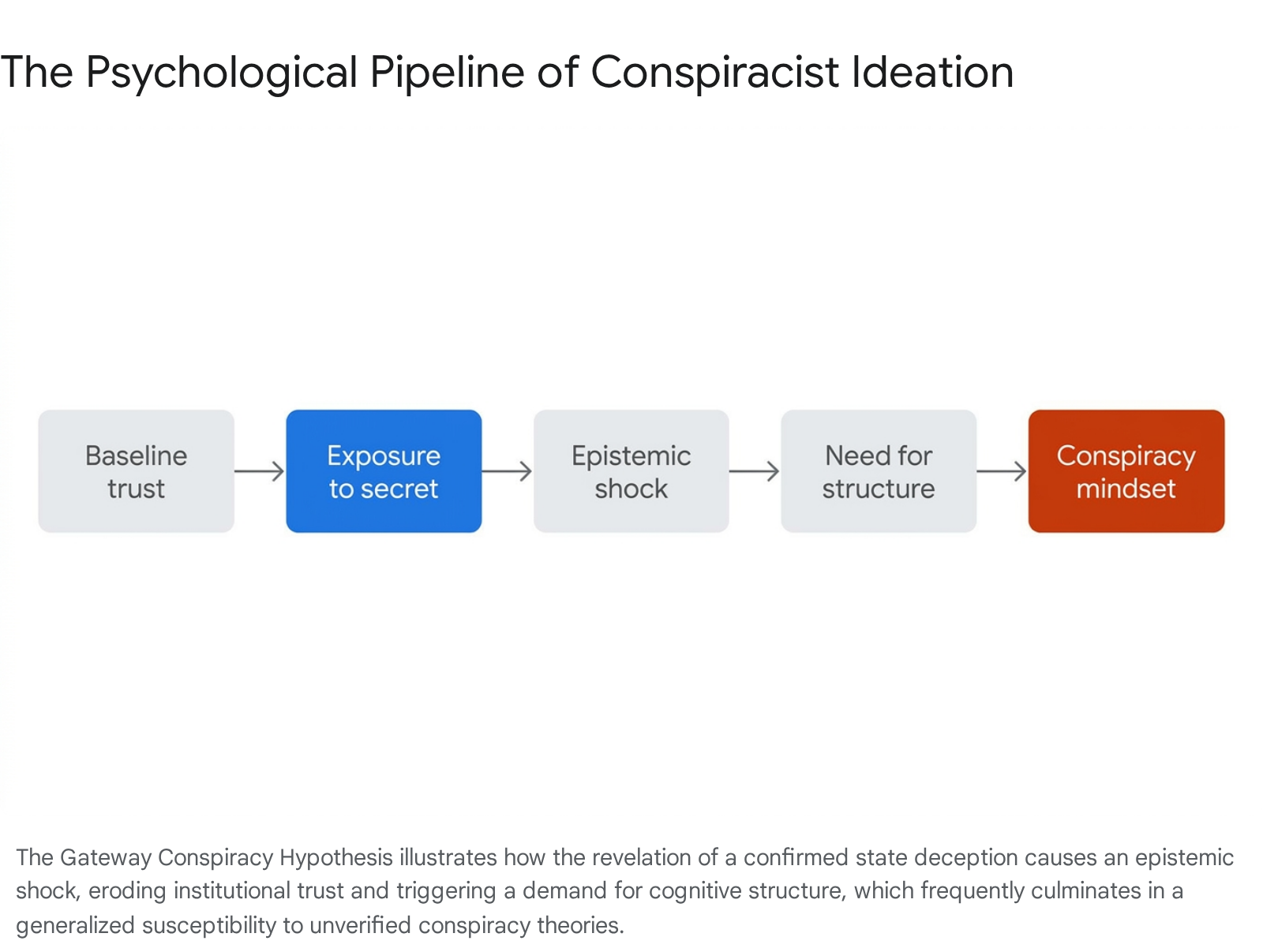
Longitudinal studies conducted during the COVID-19 pandemic demonstrated that when individuals accept the reality of a specific conspiracy - particularly one involving institutional betrayal - they become statistically more likely to endorse novel, unverified, and increasingly implausible conspiracy theories in the future, such as claims of mass voter fraud 2526.
This escalation occurs because the exposure to verified cover-ups disrupts the individual's baseline trust in official narratives. Experimental data confirms that when people are presented with evidence of genuine cover-ups (such as redacted government documents), their general belief in conspiracy theories rises 26. The cognitive logic is inherently defensive: if the Joint Chiefs of Staff were structurally willing to draft plans to murder American citizens to provoke a war with Cuba, the psychological barrier to believing that the government might be orchestrating other malevolent plots is significantly lowered 2027. The single best predictor of belief in one conspiracy theory is the belief in a different conspiracy theory, indicating that these specific beliefs eventually coalesce into a generalized worldview 328.
Theoretical Models: Rational Skepticism Versus Gullible Conspiracism
A core debate in the study of conspiracy theories revolves around distinguishing valid institutional skepticism from pathological paranoia. Psychological literature offers competing models to explain how individuals process conspiratorial information.
The Rational Conspiracist Hypothesis suggests that believers are critical freethinkers who do not take official readings of events for granted. They independently collect and examine evidence, acting as lay scientists 29. In contrast, the Gullible Conspiracism Hypothesis argues that belief in unverified conspiracies is driven by intuitive, System 1 processing, heuristics, and negative emotions. A deep-rooted distrust leads believers to reflexively reject official accounts and uncritically accept implausible alternatives 29.
Recent theoretical frameworks attempt to reconcile these approaches by evaluating conspiracy theories along two axes: cognitive motivation (truth-seeking versus cognitive/group needs) and normative alignment (low-anomie versus high-anomie) 2. Low-anomie theories align with known historical facts and institutional behavior. Suspecting the FBI of sabotaging civil rights groups in the 1960s was a low-anomie theory because it aligned with state capabilities; its eventual confirmation as COINTELPRO validated the rational, truth-seeking motivations of the skeptics 224. Conversely, high-anomie theories deviate radically from physical reality or institutional norms, such as beliefs in shape-shifting reptilian elites. The endorsement of highly implausible, high-anomie theories is consistently associated with suboptimal information processing and cognitive biases 224.
The danger of the "conspiracy mindset" - a generalized, monological belief system measured by instruments like the Generic Conspiracist Beliefs Scale (GCBS) and the Conspiracy Mentality Questionnaire (CMQ) - is that it blurs the line between low and high-anomie theories 3031. Once an individual adopts the generalized worldview that authoritative institutions are inherently deceptive, they process new information reflexively. This leads to the endorsement of mutually incompatible theories (e.g., believing Princess Diana was murdered while simultaneously believing she staged her own death) simply because both narratives oppose the official account 3.
| Psychological Framework | Primary Mechanism | View of the Subject | Relationship to Evidence |
|---|---|---|---|
| Deficit Model | Cognitive failure or pathology. | Subject suffers from paranoia or lack of analytic skill. | Actively ignores factual evidence. |
| Rational Conspiracist Hypothesis | Independent lay-scientific investigation. | Subject is a critical freethinker. | Seeks truth, but may make honest errors. |
| Gullible Conspiracism Hypothesis | System 1 heuristics, intuition, negative emotion. | Subject reflexively rejects authority. | Embraces confirmation bias; accepts implausible theories. |
| Socio-Epistemic Model | Epistemic mistrust born of societal inequities and historical breaches. | Subject reacts rationally to an untrustworthy environment. | Rejects authoritative sources due to prior betrayal. |
Cognitive Traits and the Demand for Structure
Not all citizens react to the revelation of a government cover-up by adopting a monological conspiracy mindset. Susceptibility is strongly mediated by specific individual cognitive styles and personality traits 303233.
Individuals with a low tolerance of ambiguity feel deeply uncomfortable with vague, uncertain, or chaotic situations. When complex geopolitical events occur, the lack of a clear narrative is deeply unsettling. Conspiracy theories provide a neat, definitive - albeit malevolent - explanation that resolves this discomfort 32. Similarly, recent studies indicate that individuals with hyper-systemizing traits, characterized by a high drive to find strict patterns and rules in everyday life, are significantly more likely to endorse conspiracy theories 34. Because confirmed historical conspiracies demonstrate that secretive structures do exist beneath seemingly random political events, hyper-systemizers project this logic forward, finding appealing, organized narratives in chaotic events where no actual conspiracy exists 34.
Furthermore, the belief in an unjust world strongly predicts conspiratorial ideation. Individuals who perceive society as fundamentally unfair are predisposed to believe that powerful groups are secretly pulling the strings. The exposure of events like the Tuskegee experiment validates the perception that institutions actively prey on the powerless, cementing this worldview and fostering a profound sense of disenchantment and powerlessness 2632. Interestingly, studies show that a participant's level of formal education does not necessarily buffer them against these beliefs; the psychological function the theory serves often overrides analytic training 32.
The Impact of Confirmed Deception on Institutional Trust
The ultimate consequence of confirmed state conspiracies is the severe erosion of institutional trust, which serves as the connective tissue of a functioning democracy 3536. When the social contract is repeatedly breached by covert state action, the resulting civic disenchantment manifests in measurable political disengagement.
Empirical Trends in Public Trust
Recent data underscores a severe and sustained deterioration in public confidence in democratic institutions. In the United States, aggregated polling by the Pew Research Center indicates that public trust in the federal government to do what is right "just about always" or "most of the time" has plummeted from a peak of 54% in late 2001 to a historic low of 17% in late 2025 4337. The United States has also fallen to its lowest-ever rank in Transparency International's Corruption Perception Index, sitting alongside nations with historically weaker democratic traditions 37.
The Partnership for Public Service notes that while trust fluctuates based on partisan control of the White House, the overall baseline remains severely depressed. For example, in 2024, fully 81% of self-identified Republicans stated they did not trust the federal government. Following the 2024 presidential election and a shift in administration, that metric swung, with 42% of Republicans expressing trust in 2025, while Democratic trust fell to 31% 3638. Despite these partisan oscillations, massive majorities consistently view the government as corrupt (roughly 75%), incompetent (66%), and wasteful (85%) 36.
Globally, the Organization for Economic Co-operation and Development (OECD) reports that across 30 member nations, the proportion of citizens with low or no trust in their national government (44%) outweighs those with moderate or high trust (39%) 39. The largest trust gaps are not strictly socioeconomic, but are associated with an individual's sense of political efficacy: 69% of those who feel they have a say in government actions trust the government, compared to only 22% among those who feel they do not 39.
| Demographic / Metric | High/Moderate Trust in Gov. | Low/No Trust in Gov. | Data Source & Year |
|---|---|---|---|
| US General Public | 17% | ~83% | Pew Research (2025) 43 |
| OECD Average (30 Nations) | 39% | 44% | OECD Survey (2023) 39 |
| US Republicans | 10% | 81% | Partnership for Public Service (2024) 36 |
| US Republicans | 42% | 37% | Partnership for Public Service (2025) 38 |
| US Democrats | 39% | 41% | Partnership for Public Service (2024) 36 |
| US Democrats | 31% | 56% | Partnership for Public Service (2025) 38 |
The Paradox of Anti-Corruption Accountability
It is generally assumed that exposing corruption and holding conspirators accountable will restore public faith in the system. However, empirical research reveals a paradox: the confirmation of high-level conspiracies often inflicts lasting damage on civic engagement, regardless of the judicial outcome.
A 2024 comparative study in Latin America analyzed public opinion following the unprecedented prosecution and sentencing of former presidents in Argentina and Costa Rica on corruption charges. Counterintuitively, citizens interviewed in the aftermath of these successful anti-corruption trials did not express renewed faith in the justice system or the state 4041. Instead, the confirmation of the high-level corruption caused them to express lower trust in institutions overall, and they became statistically less likely to vote or engage in collective civic demonstrations 4041.
This demobilizing effect demonstrates that high-profile efforts to punish corrupt actors function similarly to political scandals. The revelation that the conspiracy was real - even when the perpetrators are caught - validates cynical attitudes that the entire system is irredeemably tainted, resulting in apathy and withdrawal from the democratic process 404142.
The Zero-Sum Fallacy and Media Ecosystems
The erosion of trust in government does not inherently lead citizens to trust alternative sources. Psychological research demonstrates the zero-sum fallacy in media consumption. When a mainstream institution is caught in a lie or severe error, trust in that institution drops rapidly, but trust in competing, counter-mainstream sources does not proportionately rise 43. Instead, the exposure of institutional deception often triggers a state of generalized epistemic anomie - a breakdown in the public's belief that any reliable truth can be found 2843.
This creates an information vacuum. Once voices of authority are negated by their own historical malfeasance, citizens are left without epistemological anchors. While active, interactional social media use can sometimes mitigate the negative effects of uncertainty avoidance by keeping individuals connected to their communities 44, the structural dynamics of modern platforms often exacerbate the problem. Studies of the Canadian online ecosystem reveal that while overall belief in specific conspiracies remains limited, a highly active minority of influencers - often operating on platforms like X (formerly Twitter) - drive the vast majority of conspiratorial visibility, exploiting algorithmic amplification during high-profile events 45.
However, despite intense media focus on the phenomenon, comprehensive historical analysis indicates that the overall percentage of people who believe in conspiracy theories is not actually increasing over time. Studies comparing polling data from 1966 to the present show that while the content of the theories changes - shifting from UFOs and JFK to 5G and COVID-19 - the baseline propensity for generalized conspiracism remains relatively stable 4647. The crisis, therefore, is not a sudden epidemic of new paranoia, but the persistent, corrosive effect of historical state deception manifesting in a highly visible digital ecosystem.
Conclusion
The historical record confirms that governments possess both the bureaucratic machinery to execute massive, unethical conspiracies and the power to enforce deep secrecy to cover them up. From the lethal biological experiments of Unit 731 and the mind control pursuits of MKUltra, to the extrajudicial killings of Argentina's Death Flights and the fabricated intelligence of the Gulf of Tonkin, the public has repeatedly been subjected to sophisticated, institutional deception.
The eventual exposure of these events serves a vital democratic function by providing necessary accountability. However, the psychological and political fallout is profound. Confirmed state conspiracies validate the foundational premise of conspiracist ideation: that authoritative institutions are capable of systemic malice and coordinated deceit. This realization acts as a psychological gateway, particularly for individuals with a low tolerance for ambiguity and a high need for cognitive structure, driving them from rational skepticism toward generalized, pathological paranoia.
Modern state and non-state actors regularly weaponize these historical truths. The confirmed reality of Operation Northwoods and MKUltra is frequently invoked to legitimize contemporary disinformation campaigns and digital false flags, providing permanent empirical ammunition to those who wish to undermine democratic institutions. Ultimately, the profound erosion of public trust observed in contemporary democracies is not solely the result of modern digital manipulation; it is a long-tail consequence of the state's own historical actions. When governments conspire against their own citizens or the international community, they fundamentally breach the social contract, creating an epistemic vacuum that leaves the public alienated, demobilized, and deeply vulnerable to the belief that the truth is always being hidden.