
Effectiveness of interventions to reduce conspiracy theory beliefs
The proliferation of digital misinformation represents a profound vulnerability within the modern information ecosystem, catalyzing public health crises, political polarization, and the erosion of democratic institutions globally. In response to this escalating threat, the academic disciplines of cognitive security, infodemiology, and political psychology have transitioned from purely descriptive analyses of how false information propagates toward the rigorous empirical evaluation of interventional strategies 123. However, the efficacy of these mitigation strategies is heavily mediated by a complex matrix of cognitive mechanisms, technological mediums, and localized cultural contexts 354.
Contemporary literature highlights three critical evolutions in the study of misinformation interventions. First, there is a paradigm-shifting empirical consensus effectively dismantling the "backfire effect" narrative, reinstating direct, evidence-based debunking as a viable and necessary communicative tool 567. Second, the rapid integration of Artificial Intelligence (AI) and Large Language Models (LLMs) has operationalized highly personalized, conversational interventions - such as automated Motivational Interviewing (MI) and deep canvassing - at unprecedented digital scales 81112. Third, a concerted effort to de-center historically Western-centric experimental designs has illuminated how interventions must be culturally and linguistically calibrated to function effectively in the Global South, where diverse socio-political dynamics govern systemic trust and digital literacy 91410.
This report provides an exhaustive, multi-dimensional analysis of contemporary misinformation mitigation frameworks. It critically evaluates the intersection of cognitive mechanisms, empirical effect sizes, algorithmic scalability, and ecological validity, drawing strictly from peer-reviewed empirical studies to guide future public health and democratic resilience initiatives.
The Psychometric Deconstruction of the Backfire Effect
For over a decade, a primary hesitation among fact-checkers, journalists, and public health officials regarding the direct correction of false claims was the pervasive fear of the "backfire effect." Early literature posited that challenging entrenched beliefs triggered defensive cognitive processing, selective exposure, and biased assimilation, resulting in a boomerang effect where the corrective message inadvertently strengthened an individual's belief in the original misinformation 611.
Methodological Artifacts and Item Reliability
Contemporary empirical consensus, however, has thoroughly revised this narrative, demonstrating that the backfire effect is exceptionally rare in practice and largely an artifact of methodological limitations in earlier, foundational study designs 567. Extensive replication efforts utilizing longitudinal pre/post designs and substantially larger sample sizes have consistently failed to reproduce the worldview or familiarity backfire effects across a multitude of controversial topics 56.
Recent psychometric analyses reveal that instances previously categorized as backfire effects were primarily driven by poor test-retest reliability in the chosen measurement instruments 512. Researchers utilizing single-item measures - which inherently suffer from lower statistical reliability - were significantly more likely to observe a pseudo-backfire effect due to random statistical variation or regression to the mean 12. When evaluating corrections using multi-item measures and accounting for item reliability ($\rho = -.61$ to $-.73$), the backfire rate inversely correlates with reliability. Essentially, less reliable items backfired at a substantially higher rate than more reliable items, explaining up to 53% of the variance in backfire rates in rigorous controlled experiments 512. Corrections that exposed participants to novel misinformation did not lead to stronger misconceptions compared to a control group never exposed to the false claims 5.
The Mandate for Direct Correction
Consequently, the contemporary academic and policy consensus dictates that fact-checkers and science communicators should not withhold corrective information out of fear of amplifying false beliefs 5712. While corrections may not completely eliminate the persistent influence of misinformation - a phenomenon known as the "continued influence effect" - they consistently reduce belief in inaccurate claims compared to no-correction control groups 121813.
Furthermore, concerns regarding the "illusory truth effect" - the cognitive quirk where repeating a false claim during the debunking process makes it feel more familiar and thus truer - have been shown to be overstated in the context of robust corrections 57. Corrective interventions effectively neutralize the familiarity threat without amplifying the misconception 5. Ultimately, the primary challenge for scientific communication is no longer avoiding backfire, but rather understanding how to engineer corrections that are durable and capable of overcoming subsequent cues from elite spreaders of disinformation who continuously promote congenial but less accurate claims 614.
The Integration of LLMs in Personalized Conversational Interventions
The advent of highly capable Large Language Models (LLMs) has fundamentally altered the economics and mechanics of digital persuasion. Traditional debunking suffers from a structural disadvantage: misinformation is mathematically cheap to produce and rapid to disseminate, whereas high-quality fact-checking requires substantial human cognitive labor, editorial oversight, and time 57. Generative AI inverts this dynamic by enabling hyper-personalized, conversational interventions at virtually unlimited scale 811.
Automating the Cognitive Labor of Debunking
Recent studies evaluating LLM-based interventions against deeply entrenched conspiracy theories demonstrate profound empirical efficacy. In controlled experiments, tailored conversational dialogues with an AI (such as GPT-4) induced a significant 20% reduction in conspiracy theory belief 11. Other experimental trials noted an 11.81% (10-point) decrease in belief certainty among participants holding epistemically weak conspiracy beliefs 8. The underlying mechanism for this success is not the psychological novelty of the AI messenger, but rather the AI's ability to summarily marshal vast arrays of targeted, fact-based counter-evidence. By executing the exhaustive cognitive labor required to directly dismantle bespoke conspiratorial arguments across multiple conversational turns, LLMs achieve a depth of personalized rebuttal that is logistically impossible for human fact-checkers to scale across a population 811.
Large Language Models and Motivational Interviewing
Beyond direct factual rebuttal, researchers are actively deploying LLMs to simulate highly empathetic, non-confrontational persuasion frameworks such as Deep Canvassing and Motivational Interviewing (MI) 122115. Deep canvassing - an approach relying on non-judgmental narrative exchange, active listening, and perspective-taking - has historically proven highly effective at durably shifting exclusionary attitudes 212324. Similarly, MI was developed to address ambivalence and amplify personal motivation, functioning exceptionally well in clinical environments to reduce vaccine hesitancy by allowing individuals to identify reasons for change within their own experiences 151617.
Recent evaluations of LLMs prompted to engage in MI reveal significant potential alongside notable structural limitations. Automated similarity metrics demonstrate that advanced models possess a strong foundational knowledge of MI principles. For instance, in MI knowledge tests, models like GPT-4o score near perfectly (0.95 accuracy), outperforming earlier iterations 1218. Advanced analytical techniques, including the use of Hidden Markov Models to track motivational state transitions, demonstrate that LLMs can successfully categorize client utterances based on their intention toward or away from change (change talk vs. sustain talk), correctly identifying high-quality MI sessions characterized by fluid transitions between motivational states 19.
However, longitudinal session analyses reveal that LLM performance decays over extended conversational turns. AI models frequently struggle with long-range thematic coherence, exhibiting increased verbosity and a loss of contextual grounding as the dialogue progresses 20. Comparative evaluations using contextual deep-learning-based metrics (e.g., DeepEval) versus cosine similarity based on sentence embeddings show that while LLMs mimic the superficial structure of therapeutic responses, they often lack the subtle emotional nuance, genuine empathy, and safety transparency inherent to human-delivered MI 122021. Many systems fail to adequately address the risk of algorithmic hallucinations, which could inadvertently introduce novel misinformation during a therapeutic intervention 1221. Despite these limitations, the application of LLMs in delivering immediate, personalized cognitive scaffolding represents a massive evolutionary leap in intervention scalability 1131.
Broadening the Demographic Scope: Interventions in the Global South
Historically, over 80% of experimental research on misinformation interventions has been conducted on populations in the United States and Europe 11432. This geographical bias is deeply problematic, as vulnerability to misinformation is highly contextual, interacting with local literacy rates, political polarization, varying state capacities, and the penetration of encrypted peer-to-peer messaging networks like WhatsApp 101422. Recent research has actively sought to test mitigation frameworks in non-Western, culturally diverse populations, revealing critical data regarding cultural adaptation and the limits of specific intervention formats.
The Cranky Uncle Vaccine Project in East and West Africa
To address severe vaccine hesitancy and health misinformation, researchers adapted the Cranky Uncle psychological inoculation game for populations in Uganda, Kenya, Rwanda, and Ghana 9342324. Recognizing that a direct translation of Western educational materials would fail, the intervention utilized human-centered co-design workshops in Kampala, Kitale, and Kigali to culturally localize the digital game 925. This involved adapting character skin tones, local clothing, healthcare worker depictions, and contextualizing the logical fallacies used by the antagonist to reflect regional misinformation narratives (e.g., specific rumors regarding malaria or COVID-19 vaccines, false causes, and "natural is best" fallacies) 92325.
The empirical results were robust across multiple linguistic deployments, including English, French, and Kinyarwanda versions 24. In pilot tests across East Africa, playing the localized game significantly improved general vaccine attitudes and the ability to discern facts from fallacies 3423. Most notably, among participants who expressed pre-game vaccine hesitancy, 58% in the Uganda/Kenya cohort and 53% in the Ghana cohort shifted to being "somewhat" or "very likely" to receive a vaccination after completing the intervention 323423. The effect was particularly pronounced among older, less formally educated populations, demonstrating that gamified, active inoculation can successfully cross cultural barriers when meticulously co-designed with local stakeholders 3426. Interestingly, in the Rwandan deployment, agreement with specific vaccine facts showed no significant change, avoiding the problematic outcome of inadvertently reducing trust in accurate information, which sometimes plagues poorly designed interventions 24.
Literacy, Pedagogy, and Correction Efficacy in India
India presents a critical case study for understanding the mechanics of misinformation due to its massive electorate, diverse linguistic landscape, low baseline digital literacy, and tragic instances of vigilante violence sparked by social media rumors 101439. Research in this demographic underscores a sharp distinction between intensive, longitudinal interventions and light-touch, rapid corrections.
A massive, four-month classroom-based field experiment in Bihar, India, involving 13,500 students across 583 villages, demonstrated the profound efficacy of sustained media literacy education 1427. The curriculum, aimed at building lateral reading skills and shifting social norms, resulted in a 0.31 Standard Deviation improvement in the ability to discern true from false information 14. Crucially, the effects were highly durable; four months post-intervention, students not only retained their resistance to health misinformation but spontaneously applied these critical evaluation skills to novel, polarizing political misinformation 1427. Furthermore, researchers noted secondary transmission effects, where the parents of the students also demonstrated improved misinformation discernment, indicating that comprehensive pedagogical interventions can alter household information consumption norms 27.
Conversely, brief, light-touch interventions in similar demographics have consistently faltered. A single, hour-long face-to-face digital literacy campaign conducted during the highly polarized 2019 Indian general elections yielded null results, failing to improve respondents' average ability to identify fake news 141022. Furthermore, an evaluation of brief user-corrections targeting COVID-19 misinformation on social media in India and Brazil showed only small, often statistically insignificant reductions in belief and sharing intentions 28. This juxtaposition proves that while short-term, top-down corrections may function adequately in highly literate Western contexts, combating elite-driven disinformation in lower-literacy environments requires sustained, socially embedded, and culturally resonant pedagogical interventions 142242.
Evaluating Core Mitigation Frameworks: A Comparative Analysis
To effectively counter the multi-faceted threat of digital manipulation, researchers have codified a spectrum of interventions. These strategies differ fundamentally in their temporal deployment, cognitive mechanisms, empirical efficacy, and ecological scalability.
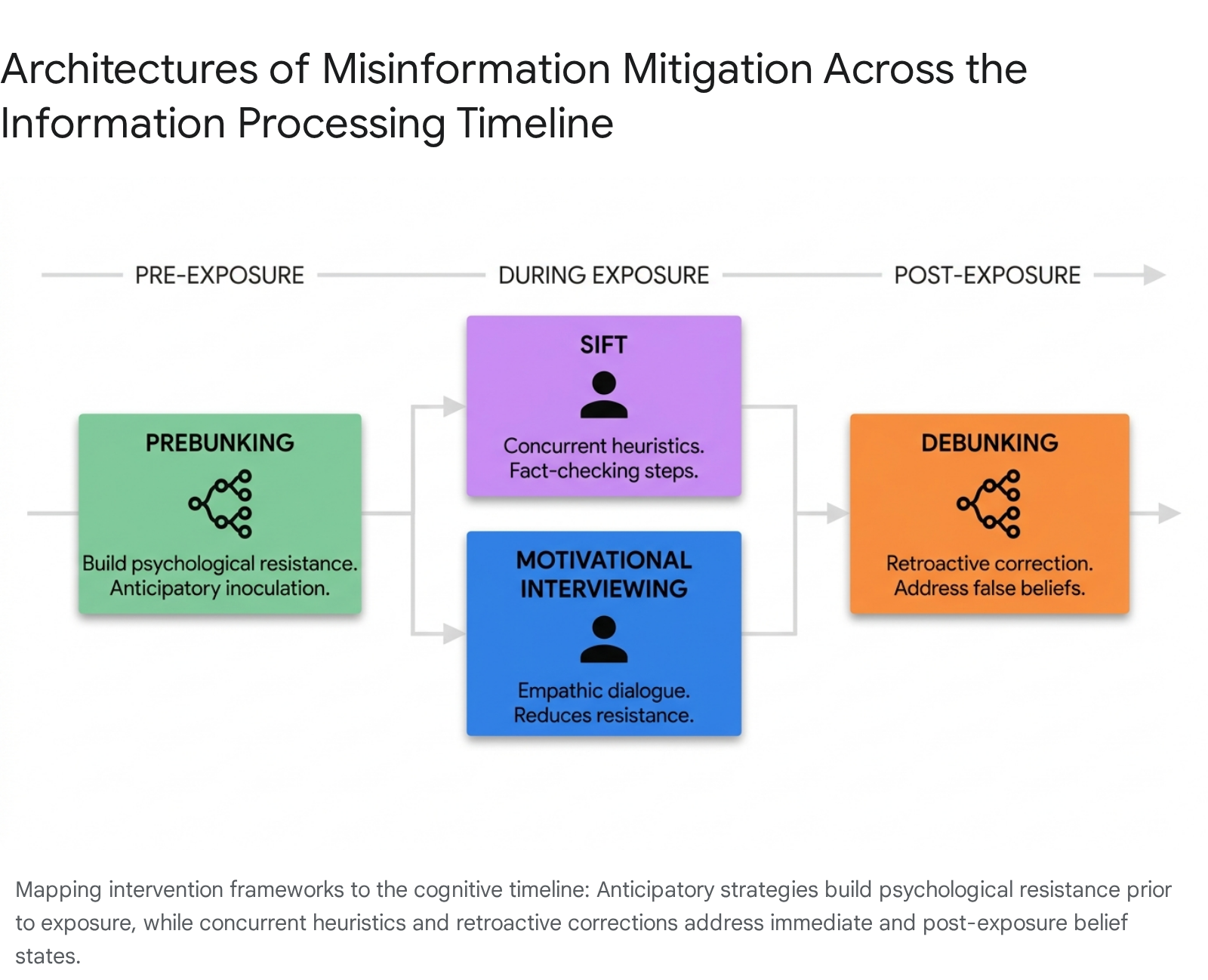
The following analysis and structured table contrast four dominant frameworks: Prebunking (Psychological Inoculation), Debunking (Post-Exposure Correction), SIFT (Lateral Reading), and Motivational Interviewing (MI).
Structured Comparison of Mitigation Frameworks
| Dimension | Prebunking (Inoculation) | Debunking (Fact-Checking) | SIFT (Lateral Reading) | Motivational Interviewing (MI) |
|---|---|---|---|---|
| Temporal Deployment | Pre-Exposure: Anticipatory warning delivered prior to encountering misinformation 529. | Post-Exposure: Retroactive correction directly addressing specific false claims 329. | Concurrent: Executed actively while reading or evaluating unfamiliar digital content 313031. | Concurrent/Post-Exposure: Interpersonal dialogue occurring during belief evaluation 1517. |
| Cognitive Mechanism | Threat conferral and counter-arguing; builds active mental "antibodies" 932. | Knowledge revision; updating mental models with clear factual alternatives 1347. | Heuristic evaluation; leaving the source to verify contextual reputation and funding 4833. | Resolving ambivalence; providing autonomy support; non-confrontational empathy 172150. |
| Empirical Efficacy (Effect Size) | Medium. Cohen's $d \approx 0.37$ to $0.60$ for manipulative intent discernment 3435. | Medium. Cohen's $d \approx 0.30$ or roughly a $7-10\%$ shift in explicit belief accuracy 1336. | Large for specific skill application (e.g., $6\%$ to $49\%$ improvement in source evaluation) 37. | Variable but robust. $r \approx 0.19$, $d \approx 0.25$ to $0.57$ for health behavior shifts 5038. |
| Target Data | Manipulation techniques (e.g., emotional language, scapegoating, logical fallacies) 3239. | Specific explicit factual inaccuracies and established false narratives 2947. | Source credibility, potential conflicts of interest, and secondary coverage 313340. | Underlying psychological needs, identity defense, and personal value systems 241741. |
| Longevity Metrics | Temporary. Effects last $1$ to $13$ weeks; decays without regular "booster" treatments 3235. | Fades over time (decay effect) due to the persistent continued influence effect 61813. | Highly persistent over months (up to 1 year) with repeated practice and modeling 374243. | Highly durable; creates intrinsic motivation to shift deep-seated attitudes 2115. |
| Scalability Limits | High: Easily delivered via gamification, targeted ads, and digital platform prompts 534. | High: Highly scalable via platform warning labels and algorithmic down-ranking 6744. | Medium: Requires initial pedagogical investment and sustained user effort to form habits 374362. | Low/Emerging: Human-led is practically unscalable; LLM-led faces empathy/safety limits 2121. |
Contextualizing the Frameworks
Prebunking (Psychological Inoculation): Drawing direct conceptual parallels from biomedical epidemiology, inoculation theory operates by preemptively exposing individuals to a "weakened" form of misinformation 539. Rather than focusing on specific facts, prebunking targets the manipulation techniques used to deceive (e.g., scapegoating, fake experts, emotional manipulation) 3239. By explicitly warning the user (threat conferral) and demonstrating how the deceptive trick functions (counter-arguing), individuals develop active cognitive resistance. Digital applications, such as the Bad News game or Cranky Uncle, yield consistent, moderate effect sizes (Cohen's $d = 0.37$ to $0.60$) 3435. Because prebunking focuses on techniques rather than specific facts, it successfully bypasses partisan defensiveness and can confer broad "cross-protection" across different topics 3545. However, its effects decay over time, necessitating periodic "booster shots" to maintain long-term cognitive immunity 3235.
Debunking: While frequently maligned in early literature due to backfire concerns, modern, optimized debunking remains a cornerstone of information integrity. To be effective, debunking must avoid merely denying a claim; it must provide an alternative, factual narrative that closes the cognitive gap left by retracting the false information 1347. Studies suggest that for explicitly false claims, debunking can sometimes outperform prebunking in reducing immediate reliance on misinformation 1329. However, debunking faces a profound structural deficit: it is inherently reactive. By the time a high-quality fact-check is produced and disseminated, the falsehood has often already achieved peak algorithmic virality and seeded the continued influence effect in the target population 71813.
SIFT and Lateral Reading: The SIFT methodology (Stop, Investigate the source, Find better coverage, Trace claims) operationalizes the investigative habits of professional fact-checkers into teachable, actionable heuristics 313133. Unlike traditional media literacy tools like the CRAAP test - which encourages deep, "vertical" reading of a potentially deceptive site's internal markers - lateral reading mandates immediately leaving the unfamiliar site to evaluate its reputation via external networks (e.g., Wikipedia, Snopes, independent news coverage) 48406264. SIFT is highly effective at overcoming "belief bias" and deceptive aesthetic markers of credibility 37. Large-scale implementations in Canadian and US classrooms demonstrate dramatic improvements, shifting successful source evaluation from a baseline of 6% to 49% in delayed post-tests 37. While highly effective, SIFT places the burden of cognitive effort squarely on the user, requiring active intent, structured curriculum delivery, and ongoing pedagogical training to become an automated habit 3762.
Motivational Interviewing (MI) and Deep Canvassing: For heavily entrenched beliefs - such as anti-vaccination stances or identity-linked political conspiracy theories - informational deficits are rarely the root cause. Instead, these beliefs fulfill underlying psychological needs for control, community validation, or certainty in complex environments 2123. MI and Deep Canvassing abandon the traditional "debate frame" entirely 65. Instead of presenting confrontational counter-facts, the practitioner uses radical empathy, active listening, and open-ended questioning to elicit "change talk" from the subject, allowing them to autonomously resolve their own cognitive dissonance 195046. While this yields deep, durable shifts in behavior and attitude (MI meta-analyses show an average correlation of $r = .19$ and effect sizes up to $d = 0.57$ across various health behaviors) 5038, human-led deep canvassing is meticulously slow and practically unscalable for internet-wide infodemics 2124. The integration of LLMs into this space attempts to resolve this scalability bottleneck, though it introduces profound challenges regarding algorithmic safety, hallucination mitigation, and the authentic simulation of human empathy 122021.
The Crisis of Ecological Validity: Scaling from the Lab to the Feed
As researchers attempt to deploy these highly optimized interventions outside of controlled laboratory settings, a stark divergence in efficacy has emerged. This discrepancy highlights the critical limits of ecological validity in misinformation research and underscores the difficulty of modifying human behavior in the wild.
The "Fuzzy Matching" Dilemma and Algorithmic Friction
Meta-analyses reveal that the vast majority of experimental misinformation research utilizes brief, text-based interventions with zero delay between exposure and outcome measurement, predominantly tested in captive, high-attention survey environments (e.g., Qualtrics panels) 1. However, real-world social media feeds are characterized by radically different parameters: low user attention, rapid scrolling, aggressive algorithmic curation, and high emotional contagion 4748.
When researchers attempt to scale successful laboratory interventions into these wild environments, they encounter severe algorithmic and behavioral friction. For instance, a massive, pre-registered longitudinal field study attempted to deploy a validated psychological inoculation video to 967,640 Twitter/X users via targeted digital advertisements 6949. The study sought to measure actual behavioral change - specifically, a reduction in the subsequent sharing of negative-emotional or unreliable content. The results were entirely null; the intervention produced no meaningful change in posting or retweeting behavior post-intervention 6949.
Crucially, this failure was not necessarily a failure of the psychological theory, but a failure of the platform's architectural mechanics. Due to Twitter/X's "fuzzy matching" advertising policies, only approximately 7.5% of the targeted individuals actually viewed the intervention in full 4849. This introduces a profound "treatment non-compliance null," making it virtually impossible to assess the true efficacy of the video 4871. Furthermore, researchers discovered that analyzing this noisy field data at different arbitrary time windows (e.g., looking at effects over 1 hour versus 6 hours versus 24 hours) produced wildly contradictory significant effects. This highlights the severe methodological risk of interpreting algorithmic noise as human behavioral signal in uncontrolled field studies 694971.
The Gap Between Belief and Behavior
These field studies also illuminate a critical theoretical gap in cognitive science: the pronounced disconnect between discernment (internal belief) and sharing (external behavior) 384772. Interventions like prebunking games (e.g., Bad News) consistently improve a user's ability to accurately identify manipulative techniques in laboratory settings 3435. However, belief accuracy is only weakly correlated with sharing behavior; individuals frequently share content they know or suspect to be false if it aligns with their partisan identity or elicits high emotional arousal (the belief-behavior correlation routinely sits below $r < 0.3$) 477273.
While some content-neutral "accuracy nudges" (simple, non-intrusive reminders prompting users to consider accuracy before sharing) have shown modest success in reducing the spread of misinformation in field settings 4773, the broader consensus indicates that individual-level educational interventions may be too "light-touch" to trigger massive, systemic behavioral change on their own 71. Because only a tiny fraction of users who are exposed to misinformation actually engage in sharing it, interventions focused purely on altering sharing rates suffer from inherently small effect sizes that are easily swallowed by the overwhelming noise of the platform 71. Consequently, comprehensive mitigation requires bridging the gap between individual psychological resilience and systemic platform-level interventions - such as adding interaction friction, adjusting algorithmic down-ranking, and promoting trusted messengers at the architectural level of the network 57.
Synthesis and Strategic Outlook
The landscape of misinformation mitigation is rapidly maturing, moving decisively away from early fatalistic assumptions about the invincibility of false beliefs toward highly nuanced, evidence-based interventions. The decisive empirical retirement of the backfire effect serves as a critical mandate for institutions to confidently deploy direct, factual debunking without the fear of inadvertently reinforcing falsehoods 56. However, traditional reactive fact-checking remains insufficient in an era where generative AI allows disinformation to scale exponentially and adapt to diverse psychological profiles 5.
To counteract this, the deployment of personalized, LLM-driven interventions - capable of automating the exhaustive cognitive labor of debunking and simulating the empathetic frameworks of motivational interviewing - represents a highly promising, albeit ethically complex, frontier 821. Furthermore, the successful adaptation of anticipatory frameworks like the Cranky Uncle intervention in diverse African nations, alongside rigorous, multi-month lateral-reading classroom initiatives in India, demonstrates that psychological inoculation and SIFT methodologies can successfully transcend WEIRD demographics 91424. These interventions are highly efficacious when they are culturally grounded, rigorously translated, and socially embedded into the target community's daily life.
Ultimately, the most pressing challenge facing researchers and policymakers is bridging the ecological validity gap. Laboratory successes must be translated into the chaotic, algorithmically mediated environments of real-world social media 4871. Mitigation cannot rely solely on fortifying the individual's cognition against an endless tide of algorithmic manipulation. It must be intimately coupled with systemic platform redesigns that reduce the algorithmic amplification of emotionally manipulative content 71. By synthesizing pre-exposure psychological inoculation, concurrent lateral reading heuristics, empathetic conversational AI, and robust post-exposure corrections, society can build a resilient, multi-layered defense against the continued evolution of digital misinformation.