
What Actually Helps with Narcissism in Relationships
Direct Answer The academic and clinical consensus from 2023 to 2026 establishes that narcissism exists on a highly nuanced spectrum, ranging from context-dependent, everyday selfishness to pervasive, pathological Narcissistic Personality Disorder (NPD). Recent large-scale longitudinal and cross-cultural empirical data dismantle prevailing assumptions, revealing that narcissistic traits are universally present across global cultures - often manifesting in collectivistic societies in highly adaptive, prosocial ways utilized to navigate complex social hierarchies. While pop-psychology and social media trends have dangerously diluted clinical terminology, true pathological narcissism in intimate relationships inflicts severe, measurable psychological trauma. Evidence indicates that individuals with NPD can achieve meaningful clinical change, but this requires years of targeted individual psychotherapy and a foundational shift in epistemic humility. In contrast, standard couples counseling is frequently contraindicated and can inadvertently facilitate further emotional abuse.
The Internet Buzzword Phenomenon: When Pop-Psychology Hijacks Clinical Reality
Over the past few years, mental health awareness has experienced an unprecedented surge, largely driven by the democratization of psychological concepts on social media platforms. While the destigmatization of mental health struggles is an undeniable net positive for global society, this movement has generated a significant secondary complication: the weaponization and dilution of precise clinical terminology. If one were to scroll through popular short-form video platforms or relationship forums today, it would appear that humanity is experiencing an epidemic of clinical narcissism. Every ex-partner who forgets an anniversary is branded a narcissist, every disagreement over a shared memory is labeled gaslighting, and every enthusiastic first date is hastily diagnosed as love bombing 113.
The algorithms that govern digital discourse thrive on high-arousal, easily digestible content, which inherently strips away the diagnostic nuance required to understand complex personality structures. This hyper-saturation of therapy buzzwords has effectively broken the vernacular. A vocabulary that was carefully developed over decades by psychiatrists, psychoanalysts, and behavioral scientists to describe severe, pervasive, and often dangerous patterns of manipulation is now routinely deployed to pathologize ordinary human friction, emotional immaturity, and everyday selfishness 142. Such oversimplification reflects a broader societal therapeutic turn, where psychological categories become tools for distributing moral judgment rather than instruments for clinical healing 6.
This phenomenon presents a profound danger to both clinical practice and public mental health. When the language of abuse is co-opted to describe standard relationship disappointments, it minimizes the devastating reality of those who have actually survived relationships with individuals possessing severe pathological traits. Furthermore, it obscures the path to recovery. The therapeutic interventions required to heal from a thoughtless, self-centered partner are fundamentally different from the trauma-informed protocols required to rebuild an identity systematically dismantled by a partner with Narcissistic Personality Disorder 3. To navigate the labyrinth of narcissism in intimate relationships, it is necessary to clear away the digital noise and return to the empirical, peer-reviewed foundations of contemporary clinical psychology.
FAQ 1: What Is the Actual Difference Between Everyday Selfishness, High Narcissistic Traits, and Clinical NPD?
To address the rampant misdiagnoses occurring in popular culture, clinical psychology requires a strict delineation between transient behavioral states and enduring personality traits. Narcissism is not a binary condition; it operates on a highly complex continuum.
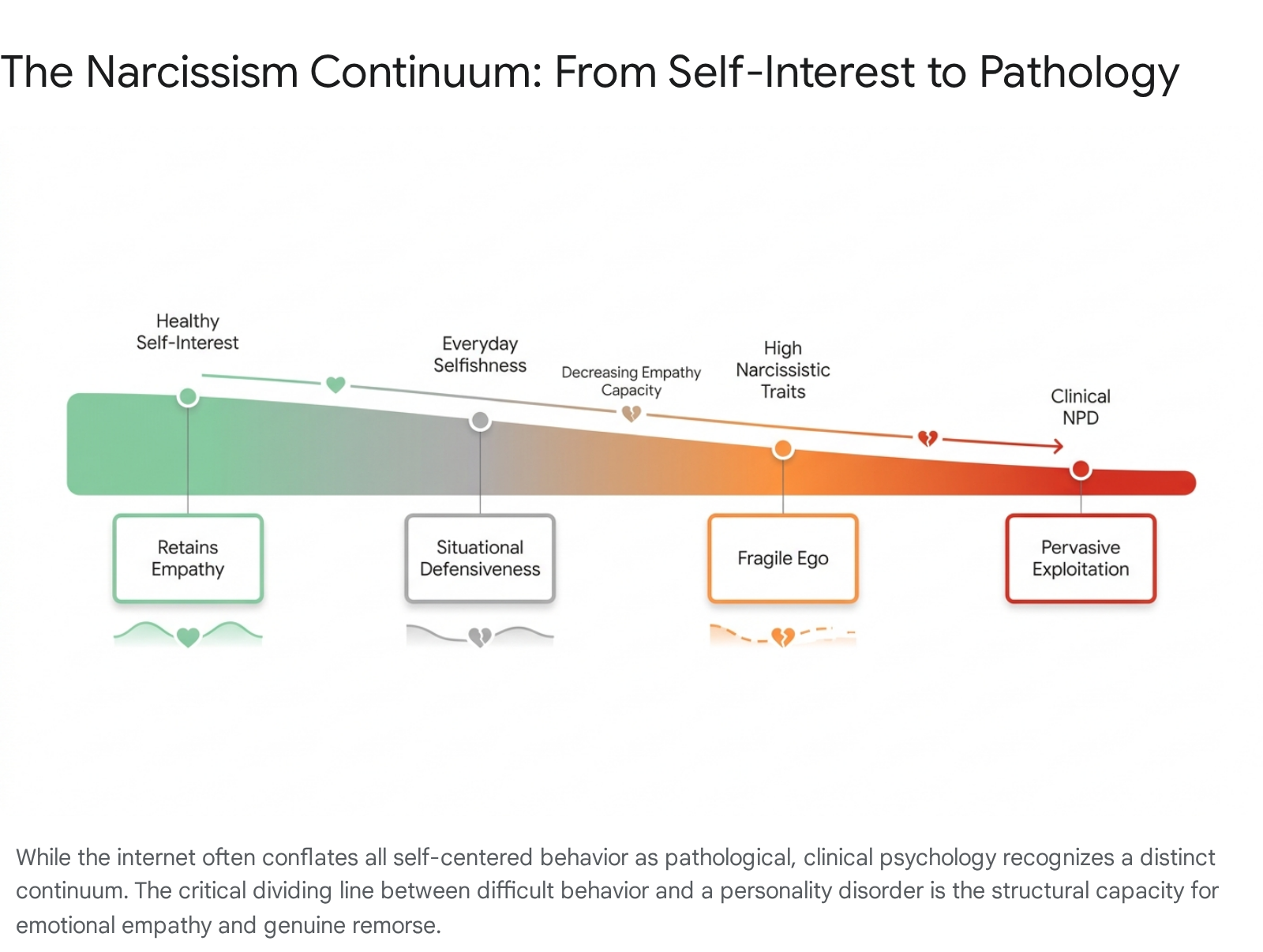
Understanding where an individual falls on this continuum is paramount for determining relationship viability and clinical prognosis.
Everyday selfishness serves as the baseline of this spectrum and is, fundamentally, an evolutionary adaptation. To a certain extent, prioritizing one's own needs, boundaries, and emotional bandwidth is a requirement for psychological survival and healthy functioning 47. Everyday selfishness becomes problematic when it manifests as a habit of thoughtlessness. A selfish partner might consistently prioritize their career over the relationship, dominate conversations, or act inconsiderately regarding shared responsibilities. However, the critical distinction lies in their emotional architecture. Selfish individuals generally retain their capacity for emotional empathy. When confronted with the pain their actions have caused, they are capable of experiencing genuine remorse 38. Their behavior can be modified through communication because their foundational sense of self is not threatened by the admission of fault. They can tolerate calibrated uncertainty regarding their own perfection 345.
Moving further along the spectrum, individuals with high narcissistic traits display a more rigid, ego-syntonic pattern of self-focus. These individuals may exhibit pronounced arrogance, a deep need for validation, and a tendency to exploit others in specific domains of their lives, such as demonstrating highly manipulative behavior in the workplace while remaining relatively stable in their immediate family life 1213. Unlike everyday selfishness, which is often a passive failure of consideration, high narcissistic traits are actively deployed to maintain an inflated ego. However, individuals in this sub-clinical category do not meet the full diagnostic criteria for a personality disorder because the traits are not entirely pervasive. They can still maintain long-term friendships, experience situational empathy, and occasionally demonstrate a capacity for self-reflection, even if it is shallow or externally motivated 813.
At the furthest end of the spectrum lies Clinical Narcissistic Personality Disorder. Narcissistic Personality Disorder is a severe, inflexible mental health condition affecting approximately 0.5% to 6% of the population, with a higher prevalence observed in men 1467. According to the Diagnostic and Statistical Manual of Mental Disorders (DSM-5-TR), a clinical diagnosis requires a pervasive, long-term pattern of grandiosity, a relentless need for admiration, and a fundamental deficit in emotional empathy that significantly impairs the individual's functioning across all areas of life 81718. The diagnostic threshold requires the presence of at least five of nine pervasive traits, which include a grandiose sense of self-importance, a preoccupation with fantasies of unlimited success or power, a belief in one's unique specialness, a demand for excessive admiration, a profound sense of entitlement, a pattern of interpersonal exploitation, an inability to recognize the needs of others, chronic envy, and haughty or arrogant behaviors 21718.
At this extreme pathological end, the behavior is not driven by simple ego, but by a profound, structural fragility often rooted in early childhood attachment trauma or inconsistent validation 1219. The narcissist's self-esteem is incredibly brittle, requiring constant external regulation, known clinically as narcissistic supply, to prevent psychological collapse 812. Consequently, they cannot tolerate criticism. What a healthy individual views as constructive feedback, the individual with NPD experiences as a narcissistic injury - an existential threat that triggers disproportionate rage, defensive projection, and severe retaliation 820. In this state, the capacity for genuine remorse is virtually non-existent. Any apology offered is merely a tactical maneuver designed to regain control and reset the cycle of abuse 3.
| Diagnostic Indicator | Everyday Selfishness | High Narcissistic Traits | Clinical NPD (DSM-5-TR) |
|---|---|---|---|
| Core Motivation | Convenience, personal gain, or simple thoughtlessness. | Ego reinforcement, validation, and maintenance of social status. | Desperate protection of a fragile, unintegrated false self. |
| Capacity for Empathy | Intact. Can emotionally resonate with a partner's distress and adjust behavior. | Variable. Can demonstrate cognitive empathy, but emotional empathy is limited and transactional. | Severely impaired. Views others strictly as extensions of the self or instruments for psychological use. |
| Response to Criticism | Defensiveness followed by eventual reflection and behavioral adjustment. | High defensiveness, deflection, and blame-shifting to protect self-image. | Narcissistic injury resulting in intense rage, vindictiveness, and severe reality distortion. |
| Expression of Remorse | Genuine and leads to altered future behavior. | Often performative, utilized primarily to soothe the immediate conflict. | Non-existent or weaponized. Apologies are highly conditional tactics to maintain control. |
| Pervasiveness | Situational or isolated to specific stressors and environments. | Noticeable across several domains but may spare certain close, established relationships. | Pervasive across all life domains, persisting consistently since early adulthood. |
| Relationship Impact | Causes frustration and hurt, but leaves the partner's core identity intact. | Causes chronic anxiety, emotional exhaustion, and relational instability. | Systematically dismantles the partner's reality, resulting in complex trauma and identity erosion. |
FAQ 2: How Do Social Media Misconceptions Distort the Clinical Reality of "Gaslighting," "Love Bombing," and "Narcissistic Abuse"?
The migration of clinical terminology from peer-reviewed journals to the public domain has resulted in severe semantic drift. To accurately assess relationship dynamics, clinicians and individuals alike must reclaim the precise definitions of these psychological phenomena. When colloquial definitions replace clinical ones, the severity of actual psychological abuse is dangerously minimized.
Originating from the 1938 British play and subsequent 1944 film Gaslight, the term gaslighting has become the ubiquitous internet shorthand for lying, disagreeing, or simply having a different perspective on a shared event 1218. If a partner states that they do not remember a conversation occurring, they are frequently accused of gaslighting by the prevailing internet culture. Clinically, however, gaslighting is vastly more insidious. It is a form of sustained, systemic psychological abuse designed to induce profound epistemic uncertainty, causing the victim to completely lose trust in their own sanity, memory, and cognitive faculties 2123910. It involves a perpetrator deliberately fabricating events, denying reality with absolute conviction, and persistently accusing the victim of being crazy or hypersensitive when confronted with undeniable facts 826. The psychological goal is not merely to win an argument; the goal is total psychological subjugation. By severing the victim's connection to their own reality, the gaslighter ensures the victim becomes entirely dependent on the abuser's narrative to navigate the world, effectively destroying their epistemic trust and agency 2310.
Similarly, the concept of love bombing has been severely diluted. In colloquial usage, love bombing is often misapplied to individuals who are simply eager, overly affectionate early in dating, or moving slightly too fast due to standard infatuation 126. While overwhelming, standard romantic eagerness lacks malicious intent. In the clinical literature, love bombing is recognized as a highly calculated phase of emotional manipulation and the initial stage in the cycle of abuse 23111213. During this phase, the perpetrator overwhelms the target with excessive communication, grand romantic gestures, and psychological mirroring to create a synthetic sense of soulmate-level intimacy 231112. The psychological mechanism at play is intense operant conditioning. The love bomber floods the victim's neurological reward centers with dopamine and oxytocin to fast-track attachment and bypass their defensive boundaries 26. Once the victim is psychologically dependent and successfully isolated from their external support systems, the love bombing abruptly ceases, giving way to the devaluation phase. The victim is then left perpetually chasing the artificial high of the relationship's beginning, rendering them highly compliant to the abuser's subsequent control tactics 1131.
Furthermore, skeptics in some academic and public circles have argued that narcissistic abuse is not a formal DSM diagnosis and has morphed into nothing more than a trendy hashtag used to explain away any bad behavior or failed relationship . However, contemporary empirical research from 2023 and 2024 strongly validates the unique traumatology associated with this specific abuse dynamic. Narcissistic abuse refers to a cyclical pattern of idealization, devaluation, and discard, heavily featuring coercive control, financial abuse, and emotional manipulation inflicted by an individual with high antagonistic traits 1433. Research indicates that the psychological damage inflicted by this specific form of relational trauma is profound and enduring. Survivors frequently present with symptoms mirroring Complex Post-Traumatic Stress Disorder (C-PTSD), including profound nervous system dysregulation, somatic complaints, chronic self-doubt, and a phenomenon known as the narcissist's echo, wherein the abuser's hyper-critical voice is internalized by the victim, leading to pervasive learned helplessness 3315. The academic literature is increasingly recognizing that the intersection of psychopathy and narcissism in intimate partner violence results in a highly specific, insidious form of cognitive and emotional destruction that standard domestic violence frameworks often fail to adequately capture 1416.
FAQ 3: How Do Narcissistic Traits Manifest Across Global Cultures and Non-Western Societies?
Historically, the field of psychology has suffered from a profound geographic bias, deriving the vast majority of its data regarding personality traits from WEIRD (Western, Educated, Industrialized, Rich, and Democratic) societies 17. For decades, the prevailing assumption in behavioral science - an assumption heavily popularized by global media - was that narcissism is an inherently Western phenomenon, a direct byproduct of the hyper-individualistic, capitalist structures of nations like the United States 1819. However, groundbreaking cross-cultural studies published between 2024 and 2026 have completely upended this ethnocentric assumption, revealing a far more complex global landscape.
In one of the largest and most culturally diverse psychological datasets ever assembled, researchers from Michigan State University analyzed survey data from over 45,000 individuals across 53 countries using the Narcissistic Admiration and Rivalry Concept framework 171819. The comprehensive findings demonstrated that narcissism is a deeply ingrained, universal human trait that transcends geographical borders, but its specific expression is heavily modulated by macroeconomic forces and cultural value systems 171819.
The most disruptive finding from recent global research is the identification of the collectivism paradox. The data revealed that individuals from highly collectivistic societies - cultures that fundamentally prioritize group harmony, interdependence, and social cohesion over individual expression - frequently report higher levels of narcissism, particularly in the dimension of narcissistic admiration, than those in highly individualistic societies 171920. This directly contradicts the long-held psychological belief that collectivism naturally suppresses the ego. The literature suggests that in collectivistic environments, narcissistic traits adapt to serve entirely different social functions. Instead of seeking resources and validation by standing out as a unique, independent rebel, which is the standard Western individualistic model, narcissists in Eastern or collectivistic societies seek resources by aggressively climbing rigid social hierarchies to achieve high status within the group 1720.
Furthermore, researchers investigating cohorts in Indonesia and China have identified a complex phenomenon wherein narcissism actively fuels prosocial behavior in collectivistic settings 20. Moderated by an interdependent self-construal, where a person's identity is inextricably tied to group relationships, a narcissist may engage in highly visible, extravagant acts of charity, community service, or group leadership 20. While the actions objectively benefit the community, the underlying psychological motive remains deeply narcissistic: the aggressive pursuit of social status, admiration, and unparalleled prestige within the collective 20.
The global data also revealed an intriguing, consistent correlation with Gross Domestic Product. People living in nations with a higher GDP reported significantly elevated levels of overall narcissism across all measured subtypes 171819. Economic prosperity appears to create environments with greater resource abundance, which inadvertently lowers the inherent social risk associated with selfish behavior and encourages extreme self-focus 17. Notably, the United States did not rank in the top five most narcissistic countries in the dataset; the highest overall narcissism scores were found in diverse nations including Germany, Iraq, China, Nepal, and South Korea, while the lowest scores were found in Serbia, Ireland, the United Kingdom, the Netherlands, and Denmark 1819.
Despite these macro-level variations in overall cultural scores, the underlying demographic architecture of narcissism remains universally consistent. Across all 53 countries, regardless of religion, GDP, or cultural values, two demographic facts held true with remarkable consistency: young adults are universally more narcissistic than older adults, suggesting a developmental trajectory of the trait, and men consistently exhibit higher levels of narcissism than women across all societies studied 171819.
FAQ 4: Do Narcissists Sabotage Relationships Immediately, or Does the Damage Unfold Over Time?
A common misconception among the general public is that entering a relationship with a narcissist guarantees an immediate descent into misery. In reality, the psychological toll is rarely instantaneous; rather, it is usually the result of a slow, corrosive erosion of the partner's well-being and autonomy. The precise timeline of this destruction is intricately linked to the specific dimensions of narcissism the individual possesses and the developmental stage of the relationship.
Recent psychological frameworks split grandiose narcissism into two distinct operational pathways: Narcissistic Admiration, which is the tendency to boost one's own ego through self-promotion, charm, and seeking praise, and Narcissistic Rivalry, which is the darker tendency to protect one's fragile ego by derogating, attacking, and putting others down 2141.
A landmark six-year longitudinal study tracking over 5,000 couples challenged the clinical assumption that all narcissists inevitably and rapidly destroy their partnerships 2141.
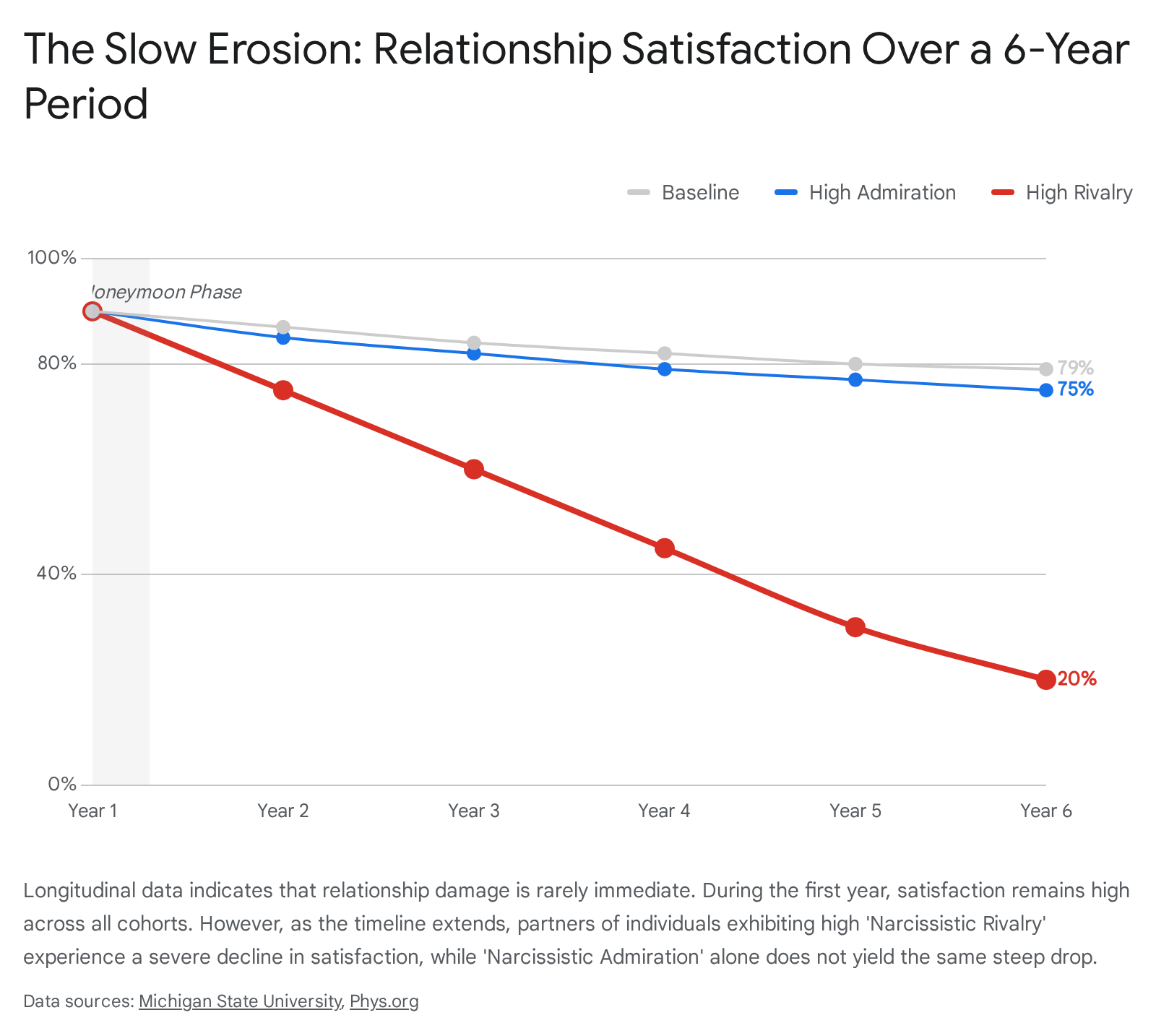
The researchers discovered a nuanced divergence based on the specific traits active in the relationship. Narcissistic rivalry was consistently linked to a severe, ongoing decline in relationship satisfaction for both partners over the six-year period. The constant antagonistic behavior, defensive hostility, and profound lack of empathy quickly toxify the relational environment, making sustainable connection impossible 21. Surprisingly, however, narcissistic admiration had no meaningful long-term effect on the decline of relationship satisfaction 2141. Individuals high in admiration are often highly charming, charismatic, and intensely focused on maintaining a flawless outward image, which can masquerade as relationship stability for extended periods.
Furthermore, the data indicated that during the first year of a relationship, commonly known as the honeymoon phase, narcissistic traits showed virtually no association with relationship dissatisfaction at all 21. The narcissist's initial ability to actively mirror their partner and maintain their false self effectively masks the underlying pathology. The decline is not a sudden cliff, but rather a slow, treacherous slope. As the relationship progresses beyond the initial infatuation stage, the narcissist gradually ceases the performative charm. The subtle invalidation, boundary crossing, and relentless demand for narcissistic supply begin to steadily erode the partner's self-esteem and sense of agency 2141. Over a period of years, the non-narcissistic partner may develop severe psychological distress, anxiety disorders, and depression as a direct result of the continuous emotional manipulation 154222.
Additionally, longitudinal data exploring the lifespan development of narcissism reveals a social investment effect. As individuals age and invest in normative social roles, such as advancing in a career or entering parenthood, absolute levels of narcissism generally decline 2223. However, while the average person becomes less narcissistic with age, those who meet the clinical threshold for NPD often severely resist this maturation process. Their inability to adapt to the humbling realities of aging often results in increased bitterness, isolation, and a significant worsening of vulnerable narcissistic traits in later life 2224.
FAQ 5: Does the Clinical Evidence Indicate That a Narcissistic Partner Can Truly Change?
One of the most intensely debated topics in modern clinical psychology is the prognosis for Narcissistic Personality Disorder. For decades, the prevailing narrative in both academic and public spheres was exceptionally bleak: narcissists are fundamentally untreatable, and their personality structures are permanently fixed. However, emerging clinical research from 2023 to 2025 provides a highly nuanced counter-narrative, proving that meaningful change is entirely possible, but the parameters for achieving this success are extraordinarily narrow and demanding.
A breakthrough 2024 study published in the Journal of Nervous and Mental Disease rigorously investigated the potential for psychotherapy to effect improvements in patients with NPD. The researchers identified a cohort of patients who underwent highly specialized psychotherapy, and the findings were striking. After 2.5 to 5 years of continuous, targeted treatment, all eight patients in the case series showed such significant symptomatic improvement that they no longer met the DSM-5 or Diagnostic Interview for Narcissism (DIN) criteria for the disorder 4625. These individuals demonstrated massively improved psychosocial functioning, particularly in their ability to maintain romantic relationships, regulate their emotions, and engage productively in their careers 4625.
While these results provide necessary clinical hope, behavioral scientists urge extreme caution against false optimism for those in relationships with narcissistic individuals. The capacity for a narcissistic partner to change is contingent upon overcoming several critical, often insurmountable hurdles.
The first hurdle is the profound insight deficit. The core psychological mechanism of narcissism is the projection of a flawless, invulnerable self. Acknowledging that one has a severe psychological deficit that requires years of intense therapy is entirely antithetical to the disorder's primary defensive structure 1246. Therefore, narcissists almost never enter therapy voluntarily. They typically only seek help when forced by a catastrophic, undeniable life event - such as a high-stakes divorce, severe career failure, or the total depletion of their narcissistic supply 48.
The second hurdle involves the concept of epistemic humility versus arrogance. Recent psychological frameworks emphasize the absolute necessity of calibrated uncertainty or intellectual humility in personal growth 345. To undergo therapeutic change, one must possess the capacity to admit they might be wrong and that their perception of reality may be flawed. Narcissistic individuals, particularly those of the grandiose subtype, fundamentally substitute unwarranted arrogant certainty for epistemic humility. Their severe inability to tolerate the vulnerability of not knowing or being flawed blocks the therapeutic process before it can begin 3.
Finally, the hurdle of treatment resistance is immense. Even when a narcissist is successfully coerced into therapy, the dropout rates for individuals with NPD are staggeringly high, estimated to be between 63% and 64% 26. Building a successful therapeutic alliance is incredibly difficult because the narcissist often views the therapist not as a guide, but as an adversary to be outsmarted or an inferior to be dominated 262728. While evidence-based approaches like Schema Therapy, Transference-Focused Psychotherapy, and Mentalization-Based Therapy offer pathways to healing, the transformation is not measured in weeks or months, but in years of sustained, grueling psychological restructuring 1246.
FAQ 6: Is Couples Therapy an Effective or Safe Intervention for Narcissistic Relationships?
When an intimate relationship reaches a critical breaking point, the default societal advice is almost universally to attend couples counseling. However, when one partner exhibits severe narcissistic traits or clinical NPD, the overwhelming consensus among relationship experts and clinicians is that traditional couples therapy is not only highly ineffective but often actively dangerous for the non-narcissistic partner 20525354.
The fundamental architecture of couples therapy assumes a level playing field. It operates on the core premise that both partners possess a baseline of emotional empathy, a shared, genuine desire to improve the relationship, and a willingness to take mutual accountability for the dysfunction 205355. When dealing with a pathological narcissist, none of these prerequisites exist. Applying a framework of mutual accountability to a unilateral dynamic of emotional abuse results in profound clinical failure and the further traumatization of the victim.
In the hands of a narcissist, the therapy room ceases to be a place of healing and instead becomes a controlled arena for impression management, manipulation, and the infliction of further narcissistic injury. Several highly toxic dynamics routinely occur during these sessions.
The first dynamic is triangulation and therapist capture. Highly charismatic, grandiose narcissists will frequently attempt to manipulate the therapist into forming a coalition against the non-narcissistic partner 525354. If the attending therapist is not highly trained in identifying the covert markers of emotional abuse and personality disorders, they may be easily charmed by the narcissist's polished persona. Consequently, the therapist may inadvertently validate the abuser's false narrative, leaving the victim feeling entirely isolated, invalidated, and convinced that they are indeed the problem 5355.
The second dynamic involves topic dominance and blocking. Micro-sociological analyses of therapy sessions utilizing conversational analysis reveal that narcissistic clients utilize highly specific interactional practices to maintain ultimate control of the narrative. They will actively resist answering direct questions from the therapist, aggressively block the disclosure of their own vulnerabilities, and dominate the conversation to ensure the focus remains hyper-fixated on their partner's perceived flaws and reactions to the abuse, rather than the abuse itself 2753.
The most insidious outcome of attempting couples therapy with a narcissist is the weaponization of clinical vocabulary. Therapy often inadvertently equips the narcissist with new, sophisticated psychological jargon. A narcissist will learn terms like "boundaries," "validation," "triggering," and "gaslighting" from the clinician, only to return home and weaponize these precise concepts against their partner. They will confidently accuse the victim of committing the exact behaviors the abuser is perpetrating, a tactic known as clinical projection 52.
Couples therapy should only be considered if the narcissistic partner is concurrently engaged in intense, long-term individual therapy and is actively demonstrating verifiable self-reflection and behavioral modification 1252. If a couple does proceed under these rare circumstances, strict clinical safety protocols must be established. The therapist must prioritize their own internal safety and secure attachment style to prevent being manipulated, establish rigid boundaries to stop in-session gaslighting, and remain acutely vigilant to the power imbalances at play 5429. Often, the most successful outcome of couples therapy involving a narcissist is not the miraculous restoration of the relationship, but the provision of a structured, mediated environment that allows the abused partner to clearly recognize the incurable pathology and safely transition toward separation 52.
Translating Science to Practical Takeaways: Relationship Management
Understanding the complex clinical mechanisms, neurobiological underpinnings, and cross-cultural manifestations of narcissism is only truly valuable if it can be translated into actionable strategies for survival, relationship management, and eventual recovery. For individuals navigating an intimate relationship with a highly narcissistic partner, contemporary behavioral science suggests the following rigorous protective measures:
Differentiate Everyday Selfishness from Pathology Use the established clinical criteria to objectively assess the partner's behavior over a sustained period. If the partner demonstrates genuine remorse, attempts to understand your emotional reality, and exhibits tangible behavioral change after conflicts, you are likely dealing with everyday selfishness or emotional immaturity. This can be effectively addressed through standard communication, boundary setting, and mutual effort. However, if there is a pervasive lack of empathy, relentless blameshifting, DARVO tactics, and intense rage in response to any constructive feedback, you must recognize the pathology and adopt an entirely different defensive strategy 378.
Establish Epistemic Anchors Because systemic gaslighting and reality distortion are primary tools of the narcissist, victims often lose their grip on objective reality, leading to severe cognitive dissonance and anxiety. It is absolutely crucial to establish epistemic anchors. Document interactions meticulously, maintain physical evidence such as text messages, emails, and financial records, and actively cultivate a strong, confidential support network outside the immediate relationship 5254. Third-party validation from trusted friends or professionals acts as a critical tether to reality, preventing the total erosion of self-trust and epistemic agency.
Implement the Gray Rock Method for Harm Reduction Narcissists require continuous emotional reactivity, known as narcissistic supply, to regulate their fragile self-esteem. When safely exiting the relationship is not immediately possible due to complex entanglements such as co-parenting responsibilities or financial abuse, clinical experts recommend deploying the Gray Rock method. This involves making oneself as uninteresting, unresponsive, and emotionally flat as a gray rock. By completely starving the narcissist of the emotional drama, conflict, and desperate pleas they crave, the target makes themselves a far less viable source of supply, often prompting the narcissist to direct their destructive energy elsewhere.
Prioritize Individual Trauma Therapy Over Couples Counseling Do not expend emotional energy and financial resources dragging an abusive, highly narcissistic partner into couples therapy in the desperate hope of a sudden epiphany. The clinical data strongly indicates that this approach is futile and dangerous 5255. Instead, unilaterally redirect those resources toward individual, trauma-informed therapy. A specialized therapist can help you dismantle the internalized narcissist's echo, rebuild your shattered self-esteem, process the complex PTSD symptoms, and systematically map a safe, strategic exit plan 5255.
Bottom Line The intersection of recent peer-reviewed psychology, longitudinal data, and cross-cultural relational dynamics proves unequivocally that narcissism is far more complex than the superficial labels heavily propagated by modern social media. While a formal clinical diagnosis of Narcissistic Personality Disorder remains statistically rare, the psychological trauma inflicted by individuals possessing high-spectrum narcissistic traits is profound, resulting in systematic emotional abuse, coercive control, and the devastating dismantling of a partner's reality. While emerging longitudinal evidence shows that clinical remission is theoretically possible through years of highly specialized psychological intervention, the absolute prerequisite for change - genuine intellectual humility and a willingness to admit fundamental flaws - is exactly what the disorder's architecture prevents. Consequently, the clinical imperative for partners is rarely to attempt to cure the narcissist through mutual counseling, but rather to clearly recognize the severe pathology, ruthlessly fortify their own psychological boundaries, and prioritize their individual safety, sanity, and eventual recovery.