
Longitudinal and cross-cultural trends in narcissism
The assertion that contemporary society is suffering from a "narcissism epidemic" has permeated cultural, sociological, and psychological discourse for over two decades. Driven largely by early cross-temporal meta-analyses of college student data in the early 2000s, the narrative posited that successive generations - particularly Millennials and Generation Z - exhibited unprecedented, pathological levels of self-entitlement, grandiosity, and self-focus compared to their predecessors 123. However, contemporary personality psychology, fortified by advanced psychometric modeling, exhaustive longitudinal cohorts, and highly diverse cross-cultural datasets, has fundamentally reappraised this paradigm.
The present analysis provides an exhaustive evaluation of the modern scientific consensus (2020 - 2026) regarding the trajectory of narcissism. By strictly disambiguating clinical from subclinical presentations, isolating the grandiose from vulnerable facets, and deconstructing the critical age-period-cohort confounds that plague cross-temporal research, the evidence overwhelmingly demonstrates that the purported epidemic is largely a methodological artifact. The apparent historical rise in narcissism is more accurately explained by normative developmental lifespan trajectories, shifting cultural norms surrounding female empowerment, and the psychometric instability of historical assessment tools applied across changing epochs 456.
Conceptual Framework: Disambiguating the Narcissism Construct
A primary driver of the confusion surrounding the "narcissism epidemic" has been the persistent failure in early literature to maintain rigid conceptual boundaries around what exactly is being measured. Narcissism is not a monolithic psychological entity; it exists simultaneously as a categorical psychiatric diagnosis and as a continuous, multidimensional personality trait. Conflating the two has generated significant epistemological errors in public and academic interpretations of generational data 78910.
Clinical Narcissistic Personality Disorder (NPD) vs. Subclinical Trait Narcissism
Clinical Narcissistic Personality Disorder (NPD), as codified in the Diagnostic and Statistical Manual of Mental Disorders (DSM-5), represents a severe, pervasive pattern of grandiosity, a constant need for admiration, and a pronounced lack of empathy that leads to significant functional impairment or subjective distress 71011. NPD is treated as a discrete diagnostic category characterized by severe interpersonal disruption, exploitativeness, and deeply brittle self-esteem regulation 89. The prevalence of clinical NPD in the general population remains relatively low, and a clinical diagnosis relies on comprehensive psychological evaluation across multiple domains of dysfunction 911.
In contrast, subclinical or "trait" narcissism operates on a continuum within the healthy, general population. Trait narcissism reflects individual differences in self-enhancement, dominance, and entitlement that do not cross the threshold of clinical pathology 7121314. The vast majority of epidemiological and sociological claims regarding generational changes in narcissism rely exclusively on subclinical trait measurements - primarily administered to healthy, non-clinical populations such as undergraduate university students 61213.
To deduce that an elevation in subclinical trait scores equates to an epidemic of clinical personality disorders represents a fundamental diagnostic overreach. Trait variations exist on a spectrum where moderate levels of certain narcissistic characteristics, such as self-efficacy and extraversion, may actually confer adaptive psychosocial benefits, a nuance completely lost in alarmist interpretations of raw psychometric data 131516. When rigorous measurement invariance testing is applied to DSM criteria for NPD, researchers have found that the actual underlying prevalence of pathological symptoms remains notably stable, cautioning heavily against any narrative suggesting a widespread explosion of psychiatric dysfunction 911.
The Bifurcation of Trait Narcissism: Grandiose vs. Vulnerable Facets
Modern structural models of personality and psychopathology, including the Hierarchical Taxonomy of Psychopathology (HiTOP), recognize that subclinical trait narcissism cannot be accurately measured as a single, global construct. It must be bifurcated into two distinct, albeit correlated, phenotypic presentations: grandiose narcissism and vulnerable narcissism 710171819.
Grandiose narcissism is characterized by an overt, agentic, and highly extraverted presentation. Individuals high in grandiose narcissism exhibit dominance, self-assurance, exhibitionism, and a resilient, inflated sense of self-worth 71014. They tend to actively seek leadership positions and utilize instrumental, exploitative strategies to maintain their feelings of superiority, often scoring high in models of narcissistic admiration and rivalry 101420. Grandiose narcissism often overlaps with highly adaptive traits, such as high self-esteem, low neuroticism, and high subjective well-being, particularly when isolated to its "leadership/authority" sub-dimensions 151621.
Vulnerable narcissism, conversely, involves a deeply fragile, defensive, and internalizing presentation. While sharing the core antagonistic features of entitlement and a belief in personal exceptionalism, vulnerable narcissism is heavily saturated with neuroticism, introversion, hypervigilance, and profound emotional dysregulation 71022. Individuals high in this facet experience contingent self-esteem, deep-seated feelings of inadequacy, and hypersensitivity to criticism, often reacting to ego threats with internalized shame or covert, brooding hostility 102223.
The generational literature that sparked the initial epidemic narrative almost exclusively utilized assessment tools that primarily capture the grandiose, agentic dimension of narcissism while entirely neglecting the vulnerable dimension 71023. Consequently, any historical claims about the trajectory of "narcissism" as a whole are fundamentally incomplete. Recent longitudinal studies incorporating comprehensive tools, such as the Pathological Narcissism Inventory (PNI) which captures vulnerable traits, indicate that both grandiose and vulnerable features demonstrate significant normative declines as individuals transition from emerging adulthood into middle age 192122. Furthermore, gender disparities exist within these facets; traditional male socialization often channels narcissistic traits into grandiose externalization, whereas female socialization historically channeled these traits into vulnerable internalization 2223. By measuring only grandiosity, historical research artificially skewed the understanding of how narcissistic phenotypes manifest and evolve across different demographics.
The Assessment Apparatus: Critiques of the Narcissistic Personality Inventory (NPI)
The entire foundational architecture of the "narcissism epidemic" rests heavily upon data derived from a single instrument: the Narcissistic Personality Inventory (NPI) 132424. Developed in 1979 by Raskin and Hall, the NPI (most commonly deployed in its 40-item iteration) is a forced-choice self-report questionnaire where participants must select between a theoretically narcissistic statement and a non-narcissistic alternative 132026. Examples include choosing between "I am a born leader" versus "Leadership is a quality that takes a long time to develop," or "I am an extraordinary person" versus "I am much like everybody else" 202625.
While historically foundational to personality and social psychology, the NPI suffers from profound psychometric limitations that fatally undermine its use in cross-temporal, multi-generational comparisons spanning several decades 1624.
Measurement Non-Invariance and Shifting Cultural Interpretation
To validly compare mean scores across different generations or historical epochs, a psychometric instrument must exhibit strict measurement invariance. This statistical property ensures that the instrument measures the underlying latent construct identically across different groups or time periods 624. If measurement invariance is violated - a condition known as differential item functioning (DIF) or differential test functioning (DTF) - it indicates that the population's interpretation, endorsement thresholds, or cultural relationship with the test items has fundamentally changed 624. Under such conditions, computing and comparing simple aggregate mean scores across decades becomes mathematically and conceptually invalid.
Rigorous evaluations of the NPI across massive datasets spanning the 1990s to the 2010s have revealed pervasive measurement non-invariance 62426. Contemporary undergraduates interpret and endorse specific NPI items quite differently than undergraduates did in the early 1980s. When advanced item response theory (IRT) and latent mean models are applied to statistically adjust for this nonequivalence, the purported generational increase in overall narcissism completely disappears. Instead, these models reveal a small but statistically significant decline in overall narcissism levels (d = -0.27) from the 1990s to the 2010s 5624.
Female Empowerment Masquerading as Pathology
The structural failure of the NPI across generations is most acutely evident when examining the shifting sociological landscape regarding gender roles and expectations. The NPI's factor structure includes a distinct "Leadership/Authority" subscale, consisting of items such as "I would prefer to be a leader" (Item 33), "I am a born leader" (Item 36), and "I like to have authority over other people" (Item 17) 15202625.
In the late 1970s and early 1980s, societal norms heavily discouraged women from expressing overt agentic, authoritative, or leadership-oriented behaviors. According to social role theory and role congruity theory, women were expected to exhibit communal, nurturing, and subservient traits, while agentic assertiveness was strictly penalized as violating gender norms 2728. During this era, a woman endorsing NPI items claiming natural leadership or authority was statistically rare and potentially indicative of a deviation from normative socialization, which early researchers coded as a narcissistic trait 152728.
Over the subsequent decades, massive cultural shifts, corporate diversity initiatives, and global female empowerment movements actively dismantled these restrictive paradigms 293230. Young women today are culturally encouraged, mentored, and explicitly trained to exhibit self-efficacy, claim authority, and actively aspire to executive leadership roles 272931. Consequently, contemporary female university students endorse the Leadership/Authority items of the NPI at significantly higher rates than their 1980s counterparts.
Because the standard application of the NPI aggregates all 40 items into a single total score, this highly adaptive, culturally progressive shift in female agency is mathematically erroneously coded as an increase in systemic "narcissism" 6151624. When item-level factor analysis is conducted, facets such as leadership and self-sufficiency are shown to be the primary drivers of measurement non-invariance, while highly maladaptive facets like entitlement remain relatively stable or even decline 62426. To label the successful sociological empowerment of women - and their resulting rise in healthy self-esteem and leadership aspiration - as an "epidemic" of psychopathology highlights the critical danger of utilizing outdated psychometric algorithms without contextualizing them within changing historical realities 32.
Structural Disparities in Methodological Frameworks
The deep disparity in scientific conclusions regarding the historical trajectory of narcissism is fundamentally rooted in the structural differences between the research designs utilized by competing academic camps. The debate essentially pits cross-temporal meta-analyses against modern longitudinal cohort studies. Understanding the mechanical limitations of each approach is paramount to evaluating their validity.
| Analytical Dimension | Cross-Temporal Meta-Analysis | Longitudinal Cohort Study |
|---|---|---|
| Fundamental Architecture | Aggregates disparate cross-sectional samples (e.g., college freshmen) at the same age but from different historical years 1233. | Tracks the exact same individuals across multiple time points as they age over months, years, or decades 37343940. |
| Primary Unit of Analysis | Group-level means (aggregated study-level data points) 413536. | Individual-level data (within-person trajectories and rank-order stability) 373439. |
| Primary Scientific Utility | Identifying macro-level historical or cultural trends within a specific demographic slice over prolonged time periods 23637. | Establishing rank-order stability, within-person mean-level change, and precise developmental trajectories over the lifespan 343938. |
| Core Vulnerability and Blind Spots | The Ecological Fallacy: Drawing definitive inferences about individual psychological changes based entirely on shifts in aggregated group means 413639. Highly susceptible to hidden demographic confounds (e.g., changing university admission standards, shifting ethnic demographics on a specific campus) 13335. | Attrition Bias (Dropout Bias): The progressive, non-random loss of participants over time. If individuals with highly maladaptive narcissism drop out of the study at higher rates, the remaining sample may falsely appear to mature or decrease in narcissism 3941353947. |
| Primary Confounding Variables | Unmeasured sample non-equivalence (e.g., comparing the socioeconomic and ethnic background of a college student in 1982 to one in 2012) 16. | Practice effects (respondents becoming overly familiar with the test instrument) and severe resource expenditures limiting total sample sizes 3947. |
The reliance on cross-temporal meta-analyses in early generational research introduced severe ecological fallacies. By comparing a sample of university students from 1982 against a distinctly different sample from 2006, researchers assumed the populations were identical save for their birth year. However, university demographics shifted massively during this period. For instance, researchers tracking specific campuses noted that Asian-American enrollment doubled during these specific decades 16. Because Asian-American students historically score lower on the highly individualistic NPI due to culturally mediated self-construal, this demographic shift artificially depressed mean scores at certain universities, demonstrating how cross-temporal designs easily conflate changing demographics with shifting personality traits 16.
The Epidemic Debate: A Methodological Comparison
The scholarly conflict over generational narcissism is best understood by directly contrasting the two primary bodies of literature that have defined the field: the Twenge and Campbell cross-temporal paradigm that originated the epidemic narrative, and the Roberts, Miller, and Trzesniewski longitudinal paradigm that subsequently dismantled it.
| Feature | The Twenge / Campbell Paradigm | The Roberts / Miller / Trzesniewski Paradigm |
|---|---|---|
| Primary Methodology | Cross-temporal meta-analysis of aggregated sample means across multiple institutions 1240. | Archival cohort analysis, individual longitudinal tracking, and strict measurement invariance modeling 15624. |
| Datasets Utilized | 85 separate, independent samples of American college students (Total n = 16,475) collected between 1979 and 2006 240. | Vast multi-cohort datasets (e.g., N = 59,000+ across the 1990s, 2000s, and 2010s); detailed internal databases from UC Davis and UC Berkeley 1524. |
| Statistical Treatment of the NPI | Relied almost entirely on aggregate NPI Total Scores; assumed all 40 items functioned identically across 30 years of cultural evolution 2640. | Conducted Differential Item Functioning (DIF) and Item Response Theory (IRT) analyses; separated adaptive sub-facets (Leadership) from maladaptive ones (Entitlement) 562426. |
| Addressing Confounds | Acknowledged changes in campus demographics but argued that the raw effect sizes surpassed demographic shifts. Suggested ecological correlations are standard practice 14041. | Explicitly controlled for campus-specific demographic shifts, such as the increase in Asian-American enrollment, proving demographic variance accounted for apparent longitudinal mean changes 16. |
| Published Conclusions | Asserted NPI scores increased by 0.33 standard deviations from 1982 to 2006. Declared almost two-thirds of modern college students scored above the 1980s mean, indicating an "epidemic" of inflated egos 2340. | Found absolutely no evidence of a generational increase when controlling for measurement non-invariance. Documented a slight, continuous decline in overall narcissism (d = -0.27) from the 1990s to the 2010s 5624. |
This methodological schism reveals how data aggregation without rigorous individual-level tracking and psychometric invariance testing can generate massive, culturally pervasive false positives. When researchers treat the NPI as a blunt instrument rather than a culturally sensitive matrix of independent facets, the resulting conclusions fundamentally misread the psychological landscape.
Deconstructing the Core Misconception: Developmental vs. Cohort Effects
The fundamental analytical error driving the public perception of a narcissism epidemic is the enduring conflation of a developmental effect (normative biological and social maturation across the lifespan) with a cohort effect (a unique, permanent psychological characteristic imprinted upon a specific generation) 42435244.
The Age-Period-Cohort (APC) Confound
In sociological and psychological temporal research, three highly collinear variables operate simultaneously to influence any measurement: Age (the biological and developmental stage of the individual), Period (the macro-historical, economic, or technological events occurring at the exact time of measurement), and Cohort (the specific generation the individual belongs to, defined by their birth year) 435245. Because Age is always equal to Period minus Cohort, separating the unique variance contributed by each element is mathematically notoriously difficult - a dilemma formally known as the APC identification problem 435245.
Cross-temporal meta-analyses of college students inherently hold Age constant (they always measure 18-to-22-year-olds) while observing variations in Period and Cohort. When older adults (for example, Baby Boomers currently in their 50s or 60s) observe Millennials or Generation Z in their 20s, they routinely perceive the younger demographic as highly narcissistic, entitled, and overly self-focused 346. However, this widespread perception entirely fails to account for the fact that the Baby Boomers themselves exhibited statistically similar levels of agentic self-focus when they were in their early 20s 46.
"Every Generation is Generation Me": The Normative Maturation of Personality
Emerging adulthood is a distinct, universally challenging developmental epoch characterized by intense identity exploration, elevated social and mating competition, and the vital evolutionary necessity of establishing autonomy and acquiring novel resources 56. Both evolutionary and developmental psychology frameworks suggest that elevated levels of agentic self-focus (narcissistic admiration) during this specific period are highly functionally adaptive. Young adults must project unwavering confidence, assert their personal needs, and engage in heightened, sometimes aggressive self-presentation to secure competitive employment, attract high-quality partners, and separate successfully from parental familial structures 56.
As individuals age, they transition into adult social roles that strictly penalize overt, exploitative narcissism. The responsibilities of marriage, long-term career integration, community leadership, and particularly parenthood demand high levels of agreeableness, emotional stability, conscientiousness, and sustained prosocial investment 1956. Consequently, longitudinal tracking consistently demonstrates that narcissism undergoes a normative, universal decline as people navigate the life course.
A landmark 2024 meta-analytic review of longitudinal studies definitively mapped the lifespan trajectory of narcissism from childhood to late adulthood.
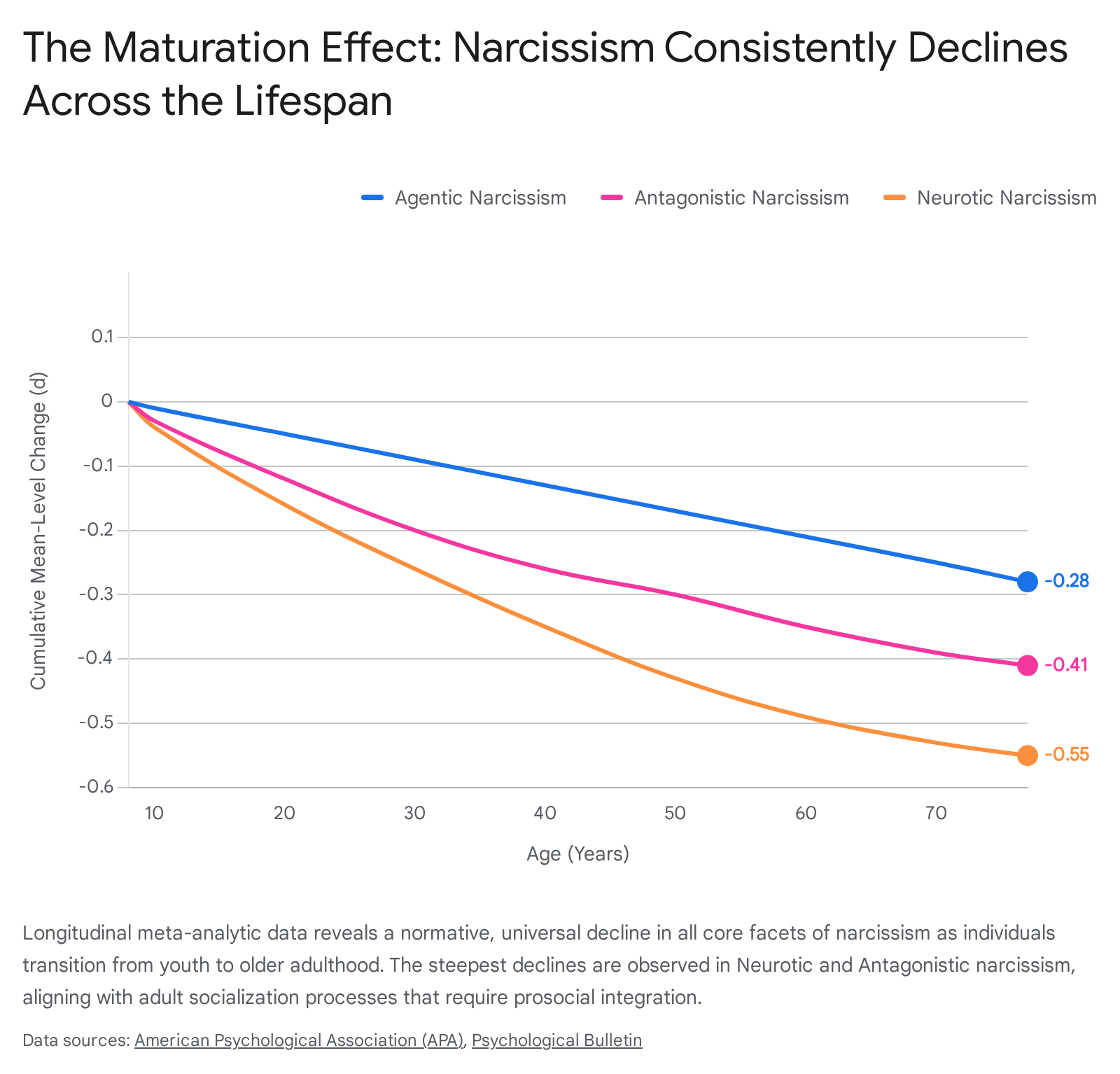
Utilizing a massive dataset (k = 51 independent samples, N = 37,247 participants) ranging from age 8 to 77, researchers proved that narcissism does not remain static over a lifetime 3847. The analysis revealed substantial, aggregated decreases across all specific facets of narcissism over the lifespan: * Agentic Narcissism: Showed a cumulative decline of d = -0.28. * Antagonistic Narcissism: Showed a steeper cumulative decline of d = -0.41. * Neurotic Narcissism: Showed the most severe cumulative decline of d = -0.55 3847.
Crucially, the researchers conducted exhaustive moderator analyses demonstrating that this mean-level decline held true regardless of the participant's gender or, most importantly, their birth cohort 3847. The rank-order stability of narcissism remained high (with average values of .73 for agentic, .68 for antagonistic, and .60 for neurotic over average 11-year time lags), meaning that while an individual's relative standing compared to their peers remains stable, the absolute level of narcissism drops significantly for everyone as they age 3847. This definitively confirms that the elevated self-focus observed in young people is a transient developmental stage, not a permanent generational mutation. The cultural label "Generation Me" is a distinct misnomer; the scientifically accurate phrasing is that every human generation experiences a temporary "Stage Me" during emerging adulthood 46.
The Modern Global Consensus (2020 - 2026): Expanding Beyond WEIRD Demographics
In the contemporary literature operating between 2020 and 2026, the scientific consensus regarding narcissism has dramatically and permanently shifted. Armed with vastly larger datasets and an acute emphasis on rigorous global representation, researchers have not only debunked the US-centric epidemic narrative but have, in many respects, entirely inverted it.
The Exhaustive Global Evidence Against the Epidemic
The definitive, global refutation of the narcissism epidemic was formalized by Oberleiter and colleagues (2024/2025). Conducting an unprecedented, precision-weighted cross-temporal meta-analysis, the researchers aggregated self-report NPI data from 1,105 independent studies encompassing an astonishing 546,225 participants across 55 countries, spanning from 1982 to 2023 34948.
The results of this massive undertaking were unequivocal: data collection years were negatively associated with narcissism scores across virtually all analytical subsets. Rather than uncovering an epidemic of grandiosity, the data confirmed a cross-temporally decreasing trend in self-reported narcissism on a global scale 3448. A precise segmented line regression revealed that narcissism scores remained largely stable throughout the 1980s and 1990s, before exhibiting a definitive negative slope (declining scores) throughout the 2000s and 2010s 3448.
This macro-level, global deflation of egos is widely hypothesized by contemporary sociologists and psychologists to be a profound "period effect" driven by the 2008 Global Financial Crisis (GFC) and the harsh economic realities that followed. The severe economic recalibrations, stagnating global wages, reduced homeownership rates, and highly competitive, precarious job markets encountered by Millennials and Generation Z acted as a profound societal humbling mechanism. These structural barriers effectively suppressed entitlement and grandiose expectations globally, forcing a shift toward realism, subjective well-being, and necessary community cooperation 4334849.
Broadening the Geographic Scope: Non-WEIRD Data and Cultural Complexities
Historically, personality psychology has been severely constrained by its over-reliance on WEIRD (Western, Educated, Industrialized, Rich, and Democratic) demographics, particularly American university students enrolled in introductory psychology courses 5650. The assumption that the "Generation Me" phenomenon was a uniquely American or Western outcome of late-stage capitalism, social media proliferation, and hyper-individualism has been thoroughly dismantled by recent cross-cultural longitudinal research.
In 2025 and 2026, Chopik and colleagues led a landmark initiative analyzing demographic differences in narcissism across 53 distinct countries, utilizing a highly diverse and representative dataset of over 45,000 participants 1228565162. The researchers deliberately employed multidimensional frameworks (evaluating both narcissistic admiration and narcissistic rivalry) and rigorously assessed the moderating effects of national Gross Domestic Product (GDP) and cultural dimensions of individualism versus collectivism.
The findings completely upended conventional Western hypotheses. The United States, often heavily stereotyped in media as the global epicenter of narcissism and self-indulgence, ranked merely 16th globally in overall narcissism scores 125162. The five nations registering the highest overall narcissism scores were entirely geographically and culturally distinct: Germany, Iraq, China, Nepal, and South Korea 125162. Conversely, the lowest-scoring nations included Serbia, Ireland, the United Kingdom, the Netherlands, and Denmark 1251.
A highly counter-intuitive but remarkably robust finding emerged from this data: participants from more collectivistic countries (such as China, South Korea, and Nepal) consistently reported higher levels of narcissism, particularly on the agentic "admiration" dimension, than those in individualistic nations 2856. This shatters the long-held assumption that narcissism is an exclusive byproduct of individualistic societies that prioritize personal uniqueness and independence.
In highly collectivistic, structurally rigid societies, narcissistic traits may serve entirely different, highly pragmatic functions. Rather than expressing a desire to "stand out as unique" or rebel against the community, agentic narcissism in collectivist cultures is often deployed to successfully navigate intense, hyper-competitive social, academic, and corporate hierarchies. In these environments, asserting superiority, projecting unwavering confidence, and demanding respect are often requisite for resource acquisition, familial honor, and status maintenance within the rigid collective 56. Furthermore, higher national GDP was consistently associated with higher narcissism across all cultural domains, suggesting that economic prosperity and wealth - regardless of cultural orientation - provides the necessary environmental scaffolding and leisure time to support overt self-promotion and grandiose ideation 2856.
Despite the macro-level variations in baseline narcissism averages across different nations, the underlying demographic architecture of the trait remained astonishingly universal. Across all 53 countries surveyed - regardless of primary language, dominant religion, GDP, or collectivism - younger adults consistently reported higher narcissism than older adults, and men consistently reported higher narcissism than women 565162. The gender gap, observed for both admiration and rivalry dimensions, aligns with global social role theories where men are often socialized to be dominant and assertive, traits that map heavily onto narcissism, while women are broadly encouraged toward communal behaviors 2856. This cross-cultural psychometric isomorphism strongly implies that the core fluctuations in narcissism over a lifespan (peaking in youth, skewing higher in males due to evolutionary and socialization pressures, and universally declining with age) represent deeply embedded, universal features of human development and life-history strategy, rather than culturally specific artifacts or modern generational diseases 285662.
Synthesis and Conclusion
The sprawling narrative of the "narcissism epidemic" serves as a profound cautionary tale in the modern behavioral sciences, vividly illustrating the dangers of drawing sweeping sociological conclusions from methodologically flawed, dimensionally limited, and culturally bound data.
Through the rigorous application of measurement invariance testing, the critical theoretical separation of grandiose from vulnerable facets, and the essential methodological shift from cross-temporal meta-analyses (which heavily suffer from ecological fallacies and unresolvable age-period-cohort confounds) to true longitudinal cohort studies, the field of personality psychology has successfully corrected a multi-decade error.
The empirical evidence definitively demonstrates that narcissism has not undergone a generational explosion. The modest historical increases observed in early NPI datasets were heavily polluted by shifting cultural norms - most notably the highly adaptive and progressive rise in female empowerment, assertiveness, and corporate leadership aspirations, which the outdated inventory erroneously penalized as pathological grandiosity. When these measurement artifacts are mathematically controlled for, massive global datasets spanning the past four decades actually reveal a stabilization, and in many regions, a slow but definitive decline in narcissistic traits, likely tempered by shifting global economic realities such as the 2008 financial crisis.
Ultimately, the persistent perception of hyper-narcissism in youth is not indicative of an epidemic; it is an enduring, universal, and highly functional feature of human biological and social development. Emerging adults, regardless of whether they reside in the highly individualistic United States or the deeply collectivistic frameworks of South Korea and China, require elevated agentic self-focus to establish initial autonomy, secure resources, and navigate early, high-stakes social hierarchies. As these cohorts age, ironclad longitudinal data guarantees that their narcissism will undergo a normative, prosocial decline as they integrate into adult responsibilities. The "narcissism epidemic" has been unequivocally debunked; what remains in its wake is a highly nuanced, globally robust understanding of how human personality dynamically adapts to the universal demands of the lifespan.