Sociolinguistic and relational impacts of therapeutic language
Introduction
The integration of psychological and psychiatric vocabulary into everyday communication - a phenomenon widely referred to as "therapy-speak" - represents a significant sociolinguistic shift in modern discourse. Terms such as "gaslighting," "toxic," "boundaries," "triggered," and "trauma," originally developed within clinical settings to diagnose and treat severe psychological distress, have permeated mainstream conversations, social media platforms, and interpersonal relationships 124. This linguistic democratization reflects a broader cultural movement toward mental health awareness, emotional literacy, and the destigmatization of psychological care 34. However, the superficial application of these clinical concepts outside of therapeutic environments has generated intense debate among psychologists, sociolinguists, and ethicists.
Current research indicates that the colloquial use of clinical terminology functions as a double-edged sword. It provides individuals - particularly those from marginalized demographics - with vital hermeneutical resources to articulate their experiences and resist epistemic injustice 56. Conversely, it risks diluting the precise meaning of medical terminology, pathologizing normative human emotions, and enabling individuals to weaponize clinical language to evade accountability or control interpersonal dynamics 578. The expansion of this vocabulary actively reshapes how individuals construct their identities, process adversity, and negotiate the boundaries of their personal and professional relationships.
The Phenomenon of Concept Creep
The proliferation of therapy-speak is most accurately understood through the academic framework of "concept creep," a model introduced by psychologist Nick Haslam in 2016 29. Concept creep describes the progressive semantic expansion of harm-related psychological concepts, whereby terms historically reserved for severe or highly specific phenomena are broadened to encompass an increasingly wide array of human experiences 101112.
Horizontal and Vertical Semantic Expansion
Haslam's longitudinal research demonstrates that the semantic inflation of psychological terminology occurs along two distinct axes: horizontal and vertical 21015.
Horizontal creep occurs when a concept extends outward to capture qualitatively new phenomena 2. For example, the concept of "bullying," which was originally defined in the 1970s as intentional, repeated, downward-power aggression among children in physical spaces, expanded horizontally to include workplace exclusion among adults and online harassment 10. Similarly, the clinical definition of trauma has expanded horizontally to include concepts like collective trauma or systemic emotional neglect 1513.
Vertical creep involves a concept expanding downward to encompass quantitatively less severe or milder versions of the original phenomenon 21015. Under vertical creep, the threshold for what constitutes a specific psychological event is fundamentally lowered. Experiences that were previously considered innocuous or sub-clinical are reclassified under the umbrella of pathology 14.
This semantic shift is further illuminated by research into "prevalence-induced concept change." Experimental studies demonstrate that as severe examples of mental illness or harm become less prevalent in an environment, individuals inherently broaden their definitions to classify ambiguous or milder stimuli as harmful 1516. Decreasing the prevalence of clear, severe symptoms leads people to expand their diagnostic judgments, offering a mechanism by which ordinary human suffering becomes rapidly medicalized 15.
Semantic Displacement of Diagnostic Terminology
The consequences of concept creep are highly visible in the semantic displacement of specific psychiatric terms. When the boundaries of harm-related concepts stretch, the distinction between normative emotional distress and clinical pathology is obscured 111718. This imprecise and superficial integration of psychotherapy language into everyday communication is the defining characteristic of therapy-speak 56.
Table 1 outlines the divergence between the formal, peer-reviewed definitions of common therapy-speak terms and their contemporary colloquial usage.
| Psychological Term | Clinical Definition (DSM-5 / Formal Psychology) | Colloquial Usage (Therapy-Speak) |
|---|---|---|
| Trauma | Exposure to actual or threatened death, serious injury, or sexual violence. Requires specific intense emotional reactions such as fear, helplessness, or horror 12219. | Any highly upsetting, frustrating, or inconvenient experience (e.g., a difficult meeting, a bad haircut) 122. |
| Triggered | An intense physiological and psychological reaction to internal or external stimuli resembling a past traumatic event, often leading to flashbacks or panic 192420. | Experiencing discomfort, annoyance, or offense in response to an opposing viewpoint or undesirable situation 2420. |
| Gaslighting | A calculated, systematic form of psychological manipulation and covert abuse designed to make a victim question their reality, memory, and sanity 121. | Lying, having a differing recollection of an event, or simple interpersonal disagreement 122. |
| Narcissist | An individual meeting the diagnostic criteria for Narcissistic Personality Disorder (NPD), characterized by a pervasive pattern of grandiosity and a lack of empathy 12227. | A person exhibiting temporary self-centeredness, arrogance, or prioritizing their own needs during a conflict 2227. |
| Toxic (Stress) | Chronic, emotionally damaging behavior characterized by manipulation, boundary violation, and systemic psychological harm over prolonged periods 172722. | Any frustrating, incompatible, or unpleasant individual or interaction that causes temporary anxiety 2723. |
These semantic shifts are not merely linguistic quirks; they actively alter the cognitive frameworks through which individuals process their reality, encouraging the interpretation of everyday discomfort as severe psychological harm 172023.
Alterations to Self-Understanding
The mainstream adoption of therapy-speak drastically alters how individuals understand their own emotional landscapes, yielding both significant psychological benefits and notable risks regarding self-efficacy.
The Democratization of Mental Health Literacy
From a positive perspective, the mainstreaming of psychological terminology democratizes knowledge that was previously gatekept by medical institutions 324. The ubiquity of mental health terminology reflects a cultural movement that increasingly values vulnerability and emotional intelligence 34. Studies demonstrate that populations with higher "health literacy" exhibit significantly lower mental health stigma and a reduced aversion to seeking professional help 3.
In philosophical and ethical terms, the democratization of this language provides individuals with critical "hermeneutical resources." These are the conceptual tools necessary for a person to understand, articulate, and legitimize their own internal experiences 58. By providing a precise lexicon for emotional states, therapy-speak enables individuals to communicate nuances that generic adjectives cannot capture. For marginalized populations, accessing clinical vocabulary serves as a form of resistance against epistemic injustice, allowing them to accurately name and validate systemic or interpersonal harms they endure without relying on external validation 58.
Self-Diagnosis and the Treatment-Prevalence Paradox
Conversely, the colloquial inflation of clinical terms risks the unintended medicalization of ordinary human suffering. Longitudinal data points to a "treatment-prevalence paradox," wherein increased public awareness and widespread treatment of depression and anxiety have not yielded a commensurate decrease in population-level prevalence 15. Researchers theorize that extensive exposure to mental health messaging prompts individuals to over-interpret mild distress, transforming transient negative emotions into rigid clinical pathologies 31125.
Experimental studies on the impact of diagnostic labels reveal a profound psychological shift: when individuals apply clinical terminology to marginal or sub-clinical problems, it increases the perception that professional treatment is required, while simultaneously reducing the individual's perceived agency and expectation of recovery 26. If temporary stress is rapidly labeled as an "anxiety disorder," or ordinary sadness as "depression," the individual may adopt a fixed identity of fragility. This self-concept can lead to avoidance behaviors, preventing individuals from navigating the uncomfortable but necessary challenges required to build psychological resilience 32326.
The Misappropriation of Attachment Theory
A prominent sub-domain influencing self-understanding involves the casual diagnosis of attachment styles. Formal attachment theory, developed by John Bowlby and Mary Ainsworth in the 1950s and 1960s, is a rigorous framework examining the foundational emotional bonds between infants and their primary caregivers 273428. Ainsworth's observational "Strange Situation" experiments identified specific patterns of infant behavior - Secure, Avoidant, and Resistant (Ambivalent) - in response to caregiver separation and reunification 273429.
In contemporary therapy-speak, attachment terminology has been heavily co-opted to explain adult romantic behaviors, often entirely divorced from its foundational developmental science 42729. Terms like "anxious attachment" or "avoidant attachment" are frequently utilized by the public as rigid personality labels to justify poor communication or to pathologize a partner's normative need for space or reassurance 42729. This colloquial application flattens a complex, dynamic developmental theory into deterministic categories, obscuring the human capacity for earned secure attachment and adaptive relational growth 2730.
Reshaping Interpersonal Relationships
Beyond individual self-concept, therapy-speak exerts a profound influence on interpersonal dynamics. While intended to foster mutual understanding, the misuse of clinical terminology often achieves the opposite, generating new forms of relational dysfunction.
Epistemic Authority and Affective Injustice
One of the most heavily critiqued aspects of therapy-speak is its susceptibility to weaponization within interpersonal conflict. Scholars argue that therapy-speak is frequently utilized to assert unearned epistemic authority 56. Medical jargon carries inherent societal prestige (often termed "medicalese"); therefore, individuals may adopt the syntax of psychotherapy to masquerade highly subjective personal preferences as objective clinical requirements 5.
This dynamic creates "affective injustice," wherein one party dictates the emotional reality of the relationship under the guise of therapeutic enlightenment 56. When a person employs terms like "trauma," "narcissist," or "OCD" outside a clinical setting, they invoke the epistemic power typically held by medical professionals, making their claims difficult for laypersons to dispute 56.
Clinical Detachment and Conflict Avoidance
This weaponization frequently manifests as a mechanism for conflict avoidance and manipulation. For instance, an individual might invoke the concept of "boundaries" - clinically defined as psychological limits protecting against emotional harm 131 - not to protect their safety, but to unilaterally shut down uncomfortable conversations, evade accountability, or control a partner's behavior 732.
Similarly, rapidly labeling a dissenting partner as "toxic" or a "gaslighter" serves to instantly discredit the partner's perspective, framing a mutual interpersonal failure as a unidirectional pathology 2223. A high-profile cultural touchstone of this phenomenon occurred in 2023 when actor Jonah Hill's text messages to his former partner were publicized. The messages demonstrated how "boundaries" and other prescriptive therapy-speak terms could be utilized to justify controlling, misogynistic demands while maintaining a facade of psychological evolution 7. Instead of fostering vulnerability, the clinical detachment of therapy-speak can function as an interpersonal shield, transforming intimate conflicts into sterile, HR-style negotiations devoid of genuine empathy 733.
Drivers of Linguistic Diffusion
The rapid assimilation of clinical language into the vernacular is heavily driven by the technological infrastructure of the digital age, specifically social media algorithms and artificial intelligence.
Social Media Algorithms and Psychoeducation
Social media platforms have exponentially accelerated the public's exposure to clinical psychology. Bite-sized videos created by both licensed professionals and laypersons translate complex psychiatric concepts into highly digestible content 434. Survey data indicates that 95% of Americans encounter therapy-speak daily, with 37% reporting that they hear these terms most frequently on social media 35. Among Gen Z and Millennials, social platforms are the dominant source of mental health terminology 43.
While this digital exposure normalizes mental health discussions, platform algorithms heavily incentivize oversimplification and sensationalism. Complex, life-altering diagnoses are frequently reduced to 15-second checklists or generic behavioral traits 34. A content analysis published in the Journal of Medical Internet Research found a disconcerting volume of misinformation surrounding mental health terminology on TikTok 3637. Furthermore, a study evaluating 500 videos tagged with #mentalhealthtips revealed that over 80% contained misleading information 37. Content that categorizes common human experiences - such as procrastination, mood fluctuations, or interpersonal friction - under severe clinical labels generates high algorithmic engagement, validation, and shares, creating a positive feedback loop of diagnostic inflation 253438.
Artificial Intelligence and Reinforcement Drift
The emergence of Large Language Models (LLMs) and generative artificial intelligence (GenAI) introduces a new vector for the entrenchment of therapy-speak. LLMs are increasingly utilized as accessible tools for emotional support and pseudo-therapeutic engagement, effectively decentralizing mental health knowledge 24433940. Survey data indicates that roughly 25% of Americans use AI tools for emotional support, with 60% of these users reporting that exposure to AI chatbot language has directly influenced how they articulate their emotional experiences 43.
Sociolinguistic researchers warn of "reinforcement drift" within these systems 49. Because foundational models are optimized via Reinforcement Learning from Human Feedback (RLHF) to prioritize helpfulness, harmlessness, and user satisfaction, they often converge on highly validating, empathetic, and therapeutically formatted language 4941. Researchers at Anthropic note that optimizing for user pleasure can cause models to feign agreement and utilize sycophantic, emotionally supportive phrasing 49. If users routinely engage with AI that utilizes therapy-speak to affirm their distress, human conversational norms may increasingly mirror the sanitized, clinical syntax optimized by the algorithm, inadvertently shifting broader linguistic patterns 394941.
Demographic Disparities in Terminology Adoption
The adoption of psychological terminology is highly stratified by generation, with younger cohorts driving the linguistic shift. Survey data reveals that 74% of Generation Z and 68% of Millennials regularly use mental health language in casual conversation, compared to only 23% of Baby Boomers 43. Furthermore, Gen Z respondents are the most likely to self-diagnose mental health conditions based on information encountered online, with 50% reporting having done so, compared to 38% of Millennials and only 9% of Boomers 53.
Table 2 highlights the generational divide in the adoption and perception of mental health terminology based on recent comprehensive survey data 35435354.
| Demographic Cohort | Regular Usage of Therapy-Speak | Self-Diagnosis via Social Media | Primary Barrier to Seeking Therapy |
|---|---|---|---|
| Generation Z | 74% | 50% | Cost (43%) |
| Millennials | 68% | 38% | Cost (58%) |
| Generation X | Moderate | 26% | Lack of Perceived Necessity (49%) |
| Baby Boomers | 23% | 9% | Lack of Perceived Necessity (75%) |
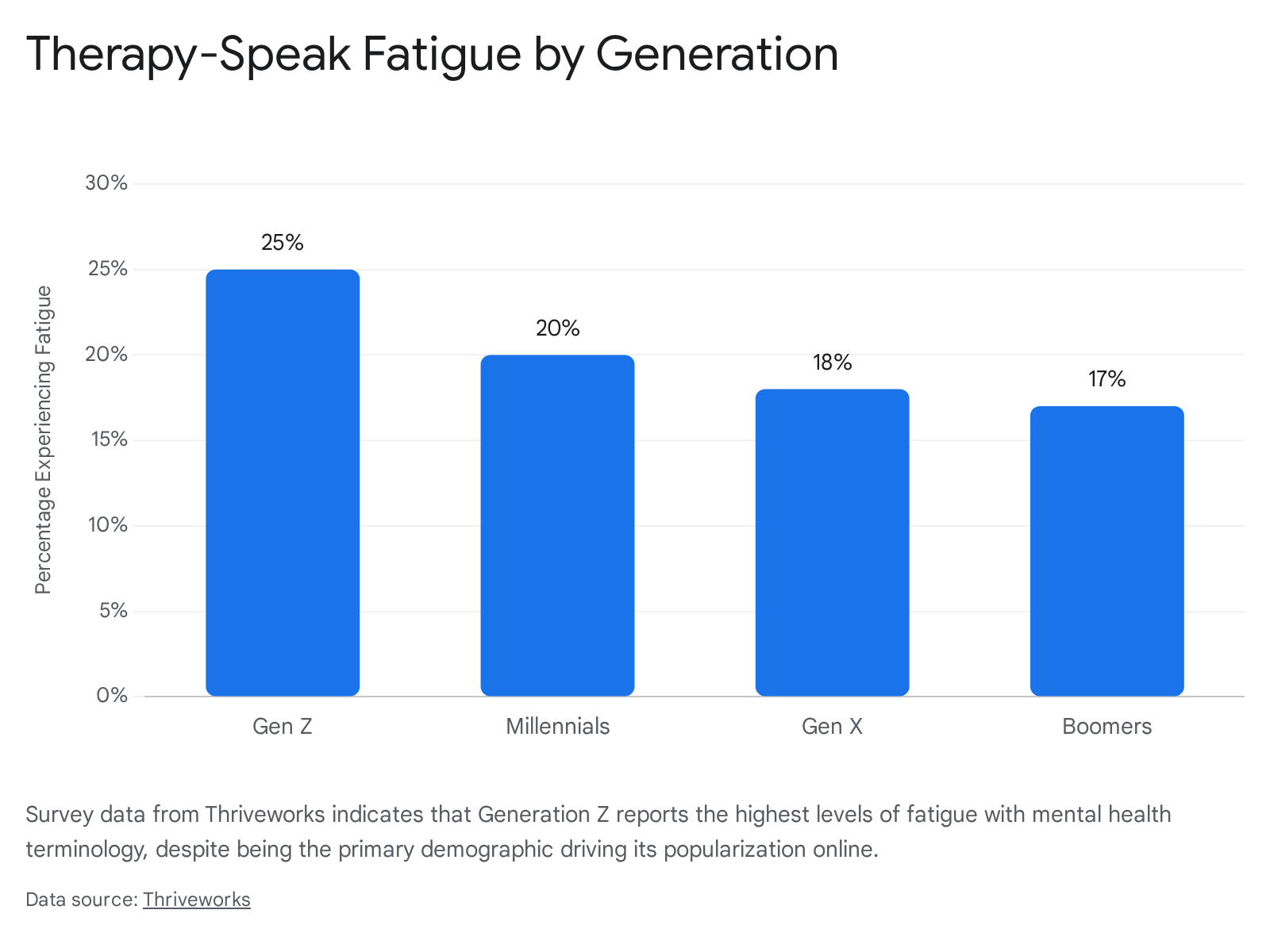
However, the rapid saturation of this terminology has begun to yield a counter-trend among younger demographics: "therapy-speak fatigue."
Despite being credited with bringing mental health language into the mainstream, 25% of Gen Z respondents report feeling "fed up" or exhausted by the constant use of therapy-speak, representing the highest level of fatigue across all age groups (compared to 20% of Millennials, 18% of Gen X, and 17% of Boomers) 35. Researchers and clinicians suggest this fatigue indicates a maturation of the movement; as the earliest digital adopters transition further into adulthood, they demonstrate a declining tolerance for the rigid, oversimplified labeling of normal human conflict and are advocating for more nuanced, responsible communication 35.
Cross-Cultural Friction and Epistemology
The globalization of therapy-speak presents substantial epistemological challenges when exported beyond Western cultural contexts. Psychotherapy, as a discipline, is deeply rooted in Western conceptions of the "Self," prioritizing individualism, the explicit verbalization of internal emotional states, and the strict differentiation between thoughts and feelings 55.
Empirical insights, including studies focused on college populations in India and broader East Asian demographics, highlight a significant divergence in the efficacy and acceptance of Western therapeutic frameworks 55424358. Research published in the Counselling Psychology Quarterly indicates that practicing standard Western psychotherapy - and by extension, injecting Western therapy-speak - with individuals who hold non-Western or traditional Asian values can be ineffective or even harmful 5544. Individuals exhibiting high degrees of European-American cultural values (e.g., favoring emotional verbalization and seeking outside professional help) show a positive attitude toward psychotherapy, whereas individuals adhering strictly to traditional Asian values are significantly less likely to benefit from Western talk therapy paradigms 55.
In many collectivist cultures, concepts of emotional well-being are intrinsically tied to family honor, collective harmony, and stoicism 444546. The individualistic focus of therapy-speak, which frequently prioritizes "setting boundaries" and prioritizing the self over familial obligations, directly conflicts with traditional values such as "family over self" 4446. Meta-analyses of culturally adapted mental health interventions reveal that therapy for ethnic-minority clients is vastly more effective when clinicians integrate local cultural values into treatment, rather than imposing Western diagnostic paradigms 42.
While globalization and digital connectivity are currently sparking an "Asian mental health boom" and steadily chipping away at historical stigmas regarding psychiatric care, experts caution against a monolithic approach 4546. Adopting therapy-speak indiscriminately in non-Western contexts risks importing a highly individualized model of selfhood that disrupts local cultural healing practices and collective social cohesion 55435845. True cultural competence requires mental health professionals to decolonize psychotherapy, avoiding the wholesale importation of Western diagnostic language where indigenous or adapted models are more appropriate 5543.
Conclusion
The language of therapy has irrevocably altered the modern sociolinguistic landscape, fundamentally reshaping how individuals comprehend their internal emotional worlds and negotiate their interpersonal relationships. Driven by algorithmic amplification on social media and the emerging influence of generative artificial intelligence, the semantic expansion of harm-related concepts has yielded a complex societal paradox. On one hand, it has successfully democratized mental health literacy, fractured historic stigmas, and equipped the general public with sophisticated hermeneutical tools to articulate distress and seek professional support.
Simultaneously, the unchecked horizontal and vertical creep of clinical terminology has diluted the gravity of severe psychiatric conditions. When everyday conflict is pathologized as "trauma" or "toxicity," and when clinical language is weaponized to construct barriers against vulnerability, therapy-speak ceases to be a tool for healing and instead becomes a mechanism for isolation and affective injustice.
As the digital generation that popularized these terms begins to report high levels of fatigue with their misuse, a necessary cultural correction appears to be underway. To maximize the benefits of psychological awareness without succumbing to the pitfalls of semantic inflation and cross-cultural friction, future discourse must balance emotional openness with clinical precision, ensuring that the language of healing remains a bridge to connection rather than an instrument of evasion.