
Technology adoption gap between early adopters and the early majority
The diffusion of technological innovations through consumer and enterprise markets represents a central focus of modern market strategy, organizational behavior, and product development. Traditional economic models frequently assume that superior technology will naturally and linearly achieve market dominance based on its intrinsic functional utility. However, empirical observation of high-technology markets demonstrates that the trajectory of innovation adoption is rarely linear or guaranteed. The foundational framework for understanding this phenomenon is the Diffusion of Innovations theory, introduced by sociologist Everett Rogers in 1962, which provided a sociological model categorizing adopters into distinct psychographic segments distributed across a normal bell curve 123.
Building upon this sociological foundation, Geoffrey Moore's 1991 framework introduced a critical discontinuity into this life cycle, specifically applying to high-technology, discontinuous innovations. Moore posited that a severe adoption gap, termed the "chasm," exists between the early market, dominated by technology enthusiasts and visionaries, and the mainstream market, controlled by pragmatists and conservatives 14.
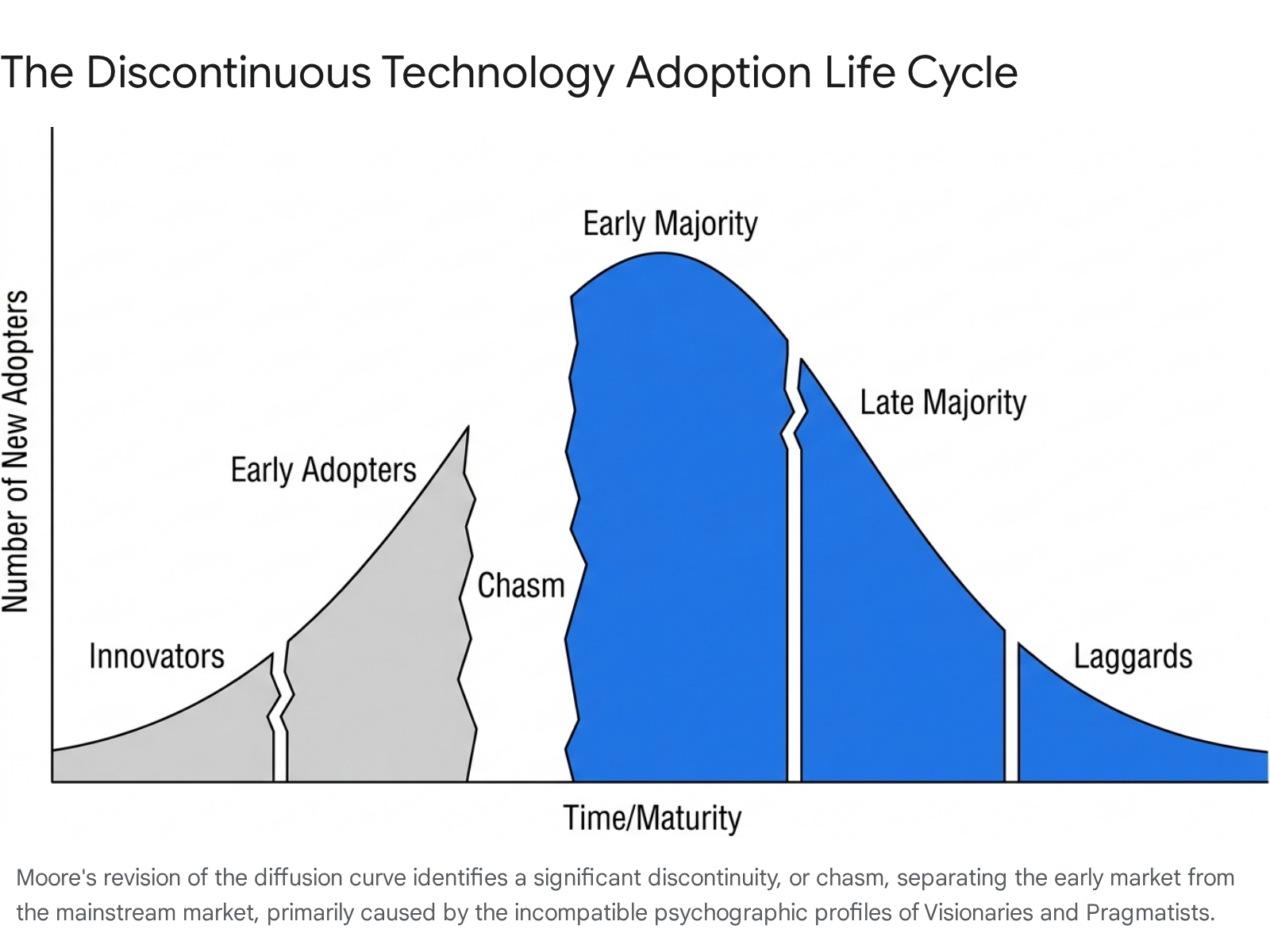
This analysis provides an exhaustive examination of the historical and theoretical development of the market chasm, the strategic frameworks required to traverse it, and the evolution of the theory in the context of contemporary software distribution models, enterprise artificial intelligence, and emerging global markets.
Theoretical Foundations of the Adoption Gap
Origins of the Technology Adoption Life Cycle
The Technology Adoption Life Cycle traces its origins to agricultural sociology. Everett Rogers developed the initial diffusion model by studying the adoption rates of hybrid corn seeds among American farmers in the 1950s 35. Rogers observed that the willingness to adopt a new agricultural innovation was not uniform across the farming community but rather followed a predictable, normal distribution based on individual psychological and demographic characteristics 23.
In 1989, a task force of senior consultants at Regis McKenna Inc., including Lee James and Warren Schirtzinger, translated Rogers' agrarian psychographic descriptions into profiles specifically applicable to high-technology buyers 56. This adaptation recognized that the underlying thesis of Rogers' model - that innovations are absorbed in stages corresponding to the social profiles of specific segments - was highly applicable to the software and hardware industries 56. This effort culminated in the formalization of the Technology Adoption Life Cycle, which divides the market into five distinct segments based on their standard deviations from the mean time of adoption 27.
The first segment, categorized as Innovators, constitutes approximately 2.5 percent of the total population. These are technology enthusiasts who aggressively pursue new technological products purely for the sake of exploration 23. Innovators are highly risk-tolerant, expect early-stage bugs or incomplete features, and are primarily motivated by the desire to understand and master the technology itself 38. While they rarely possess significant purchasing power, their validation is critical for proving the fundamental viability of an innovation.
Following the Innovators are the Early Adopters, representing roughly 13.5 percent of the market. This group consists of visionaries who, while not necessarily technologists themselves, possess the strategic insight to match an emerging technology with a high-value business opportunity 346. Early Adopters are willing to take substantial organizational risks to secure a fundamental breakthrough or a significant competitive advantage in their respective industries 610. They rely on their own intuition rather than established industry references, making them the critical engine for opening any high-tech market segment 910.
The Early Majority marks the beginning of the mainstream market, encompassing 34 percent of the population. Individuals in this segment are pragmatists who share some of the Early Adopters' ability to relate to technology but are ultimately driven by a strong sense of practicality and risk mitigation 3. Pragmatists know that many technological inventions end up as passing fads. Consequently, they wait to see how earlier adopters fare before investing, demanding well-established references, proven productivity improvements, and complete, reliable solutions 11.
The Late Majority, also accounting for 34 percent of the market, consists of conservatives who believe significantly more in tradition than in technological progress 27. Members of the Late Majority are fundamentally uncomfortable with their ability to handle new technology. They adopt an innovation only when it has become an established, unavoidable industry standard, and even then, they prefer to purchase from large, highly established vendor organizations that can provide extensive support 21415.
Finally, the Laggards make up the remaining 16 percent of the distribution. These are skeptics who resist new technology entirely, believing that disruptive innovations rarely fulfill their promised guarantees 2315. Laggards typically adopt a new technology only when their existing methods or tools become completely obsolete and unavailable 1. While they are not a viable target market for sales, their criticisms often highlight fundamental product flaws that vendors must address 15.
The traditional, unrevised model assumes a seamless transition across these five categories, positing that sales momentum in earlier segments naturally generates the social proof required to prompt adoption in subsequent segments 16. Geoffrey Moore's critical intervention was identifying that this continuous transition is a fallacy when applied to certain types of technological innovations.
Continuous Versus Discontinuous Innovations
The applicability of the chasm phenomenon depends entirely on the nature of the technological innovation. Market literature strictly differentiates between continuous and discontinuous innovations 45. Continuous innovations represent incremental improvements or upgrades to existing products that do not require the end-user to undergo a substantial behavioral change or modify their underlying infrastructure 145. Because these innovations align with existing user habits and values, their adoption follows the original, graceful transition outlined by Rogers without encountering severe structural gaps 58.
Conversely, discontinuous innovations demand radical changes in user behavior and significant disruptions to existing operational methodologies 14. When a technology imposes substantial learning curves, organizational restructuring, or shifts in systemic infrastructure, the psychographic differences between adopter categories become highly pronounced, creating severe gaps in the adoption curve 5. Many organizations fail by misdiagnosing continuous innovations as discontinuous, thereby over-engineering their go-to-market strategies to cross a barrier that does not actually exist 18.
The Mechanics of the Market Chasm
Within the realm of discontinuous innovations, Moore identifies several disassociations, or "cracks," between adjacent psychographic groups, representing the difficulty any group has in accepting a product presented in the same manner as it was to the preceding group 1612. The first minor crack occurs between Innovators and Early Adopters, where an innovation struggles to demonstrate strategic business value beyond its raw technological novelty. A second crack exists between the Early Majority and Late Majority, hinging primarily on the technological competence required of the end-user; if an innovation remains too difficult for non-technical conservatives to operate, adoption stalls 9.
However, the most formidable and unforgiving transition lies between the Early Adopters and the Early Majority. This gap is so profound that it is classified as a "chasm" 49. The chasm exists fundamentally because the consumer groups on either side possess utterly incompatible values, motivations, and purchasing criteria, creating a structural failure in market momentum 110.
The fundamental issue is the establishment of a reference base. Because discontinuous technologies require high commitments, pragmatists in the Early Majority will categorically refuse to purchase a product without reliable, established references from other trusted pragmatists within their specific industry 21213. However, the only current customers a company possesses at this stage are visionaries from the Early Adopter segment. Visionaries are actively rejected as valid references by pragmatists. Moore identifies several characteristics of visionaries that actively alienate pragmatists: visionaries possess a perceived lack of respect for the practical experiences of their colleagues, they prioritize raw technology over established industry infrastructure, and their primary goal is overall organizational disruptiveness 1012.
This dynamic creates a perilous catch-22 for high-technology firms: pragmatists will not buy without references from other pragmatists, but the firm cannot acquire pragmatist references without first selling to them 13. Because the customer orders look superficially similar between the two cohorts during the transition, many unwary startups fail to recognize the shifting market dynamics 9. They continue attempting to sell visionary concepts to pragmatic buyers, leading to a catastrophic stall in market development 10.
The behavioral and motivational distinctions that define this structural break are detailed in Table 1 below.
| Psychographic Attribute | Early Adopters (Visionaries) | Early Majority (Pragmatists) | Market Impact and Transition Challenge |
|---|---|---|---|
| Primary Motivation | Strategic advantage, competitive differentiation, and breakthrough innovation 610. | Practical problem-solving, incremental productivity gains, and risk minimization 11. | Marketing messaging must pivot from emphasizing "revolutionary change" to "reliable evolution." |
| Risk Tolerance | Extremely high. Willing to tolerate software bugs, incomplete features, and complex integration hurdles 39. | Extremely low. Demand proven, highly reliable, and "safe" solutions with established support networks 314. | Pragmatists actively reject products that force them to act as beta testers for unfinished software. |
| Reference Requirements | Rely almost exclusively on their own intuition, technological foresight, and internal vision 910. | Require verifiable references from trusted, conservative peers within their specific industry 21213. | Visionary references are discarded by pragmatists, causing a complete stall in word-of-mouth momentum 10. |
| Product Expectations | Willing to assemble a functional solution from disparate pieces of raw, cutting-edge technology 820. | Demand the "Whole Product," encompassing support, native integrations, and robust training 814. | High-technology firms often fail because they under-resource the transition from core technology to full solutions. |
Strategic Frameworks for Crossing the Gap
Navigating the transition from an early market dominated by visionary enthusiasts to a mainstream market controlled by cautious pragmatists requires a fundamental reorganization of corporate strategy. Organizations must transition from product-based values to market-based values, necessitating highly disciplined approaches to market segmentation and product completeness 10.
Niche Market Targeting and the Beachhead Strategy
To bridge the credibility gap and resolve the reference catch-22, Moore prescribes a strategy modeled extensively on the Allied invasion of Normandy during World War II. The core tenet of this approach is to abandon broad market outreach and instead focus overwhelmingly on securing a localized "beachhead" 1221. A beachhead consists of a single, highly specific, and narrowly bounded niche market within the Early Majority 4.
The strategic objective is to concentrate all available corporate resources - marketing, sales, product development, and support - to solve one intractable, mission-critical problem for a tightly knit group of pragmatist buyers 1215. By achieving rapid, dominant market leadership within this specific micro-segment, the organization generates intense word-of-mouth momentum within that closed community. Because pragmatists within the same industry communicate extensively, dominating the niche successfully manufactures the referenceable pragmatist customer base required to legitimize the product 13.
Confronted with the vast financial opportunity represented by the broader mainstream market, many high-technology ventures lose their focus, attempting to chase every prospective opportunity that presents itself 1023. This lack of discipline results in an inability to deliver a genuinely compelling, highly tailored proposition to any single pragmatist buyer, leaving the organization stranded in the chasm 10.
Once dominance is established in the initial beachhead niche, the company can utilize its newly acquired references to expand into adjacent market segments. This sequential expansion is frequently referred to as a "bowling alley" strategy, where dominating the lead pin creates the momentum and credibility necessary to systematically address adjacent verticals and eventually capture the broader mainstream market 115.
The Imperative of the Whole Product Concept
Securing a beachhead and satisfying the demands of pragmatist buyers requires shifting the organizational focus from the core technology to the delivery of the "Whole Product" 141625. The whole product concept, originally popularized by Theodore Levitt, dictates that there is an inherent gap between the marketing promise made to the customer and the functional reality of the shipped core product 2617.
During the early market phase, visionaries are perfectly willing to bridge this gap themselves. They view the integration work, the training of personnel, and the hacking of systemic workarounds as acceptable costs for gaining a strategic technological advantage 820. Pragmatists, however, possess zero tolerance for this friction. To appeal to the Early Majority, the core innovation must be systematically augmented into a comprehensive, turnkey solution 814.
The construction of the whole product involves several distinct layers 1718: * The Core Product: The fundamental technology, application, or software code itself. * The Expected Product: The baseline operational requirements, including reliable performance, intuitive user interfaces, and dedicated customer support structures with clear escalation paths 818. * The Augmented Product: The differentiators that facilitate adoption, such as comprehensive documentation, robust training materials, consulting services, and standardized API integrations 1418. * The Potential Product: The future roadmap, the community ecosystem, and the network of value-added resellers that ensure the product's long-term viability 1718.
For traditional enterprise technology organizations, constructing the whole product necessitates the establishment of tactical alliances 825. Pragmatists naturally seek to minimize risk, leading them to prefer established market leaders 2. By forging partnerships with familiar, trusted industry incumbents - such as hardware providers, legacy software vendors, or prominent consulting firms - startups can project an aura of stability, significantly reducing the perceived organizational risk of adoption for the mainstream buyer 122519.
Digital Transformation and Modern Distribution Models
The original formulation of the chasm theory was developed within the context of the 1990s enterprise hardware and software landscape, characterized by massive capital expenditures, lengthy procurement cycles, and highly complex on-premise deployments 1. Over subsequent decades, the rapid maturation of cloud computing infrastructure, agile development methodologies, and purely digital distribution models has fundamentally altered the mechanics of technology adoption and reshaped the nature of the chasm 1.
The Rise of Product-Led Growth and Software as a Service
The proliferation of Software as a Service (SaaS) and the emergence of Product-Led Growth (PLG) strategies directly address the primary psychological barrier of the early majority: the fear of risk 120. PLG is a decentralized go-to-market strategy that relies on the product itself as the primary vehicle for user acquisition, conversion, retention, and expansion, largely bypassing traditional top-down sales methodologies 2021.
By utilizing freemium pricing models or frictionless, self-serve free trials, PLG effectively lowers the barrier to entry, allowing risk-averse pragmatists to experience the product's tangible value within their own operational environments prior to making any financial or organizational commitment 132. This dynamic radically compresses the traditional sales cycle. Rather than relying on highly compensated enterprise sales representatives to pitch visionary, abstract concepts to C-suite executives, PLG engages end-users directly, allowing individual contributors to validate the solution and subsequently champion its adoption upward through the organization 2033.
The PLG model fundamentally alters the execution of the "Whole Product" requirement. In the modern SaaS context, the whole product is no longer a static, massive, upfront package. Agile software development methodologies and continuous delivery pipelines enable products to be constantly iterated upon, utilizing real-time usage analytics to refine features and address friction points 121. Because mainstream users have grown accustomed to receiving incremental updates and beta features, the expectation of an entirely flawless product at initial launch has diminished 1. Furthermore, native API integrations allow modern software to plug seamlessly into existing tech stacks, rapidly establishing a functional ecosystem without the necessity of formal, cumbersome corporate alliances 814.
The distinct shifts in strategy required between traditional chasm models and modern SaaS models are summarized in Table 2.
| Go-To-Market Attribute | Traditional Enterprise Model (1990s-2000s) | Product-Led Growth SaaS Model (Contemporary) |
|---|---|---|
| Primary Risk Mitigation | Achieved via comprehensive "Whole Product" delivery, tactical vendor partnerships, and strict Service Level Agreements (SLAs) 814. | Achieved via freemium access tiers, self-serve onboarding, and low-friction, immediate trialability 132. |
| Product Delivery Cycle | Static, large-scale, disruptive deployment requiring high internal IT capability and extensive change management 112. | Continuous delivery pipelines; the product evolves rapidly and iteratively based on aggregated user behavioral data 121. |
| Target Buyer Persona | Top-down orientation: Chief Information Officers (CIOs), senior executives, and centralized IT procurement 1220. | Bottom-up orientation: Daily end-users, individual contributors, and decentralized departmental managers 2620. |
| Sales Cycle Mechanics | Exceptionally long, high-touch processes heavily reliant on navigating corporate bureaucracy and presenting reference customers 3222. | Short, potentially viral cycles driven by immediate time-to-value, in-app upgrade triggers, and internal referral loops 2021. |
The Inevitable Transition to Market-Led Growth
Despite its efficiency in accelerating initial user adoption and bypassing the early stages of the chasm, reliance solely on Product-Led Growth encounters severe limitations as markets mature and saturate. Recent longitudinal market data indicates that a significant percentage of SaaS companies identifying strictly as product-led struggle to sustain year-over-year expansion 23. These organizations often face rising customer acquisition costs and unsustainably high churn rates because they prioritize acquiring free users rapidly over retaining them through deep, integrated value 23.
As SaaS technologies penetrate deeper into the late early majority and late majority phases, the complexity of enterprise needs inevitably increases. Industry analysts highlight a necessary strategic transition toward Market-Led Growth, dictating that companies must eventually pair bottom-up product adoption mechanics with top-down, outcome-oriented market positioning 23. This transition mirrors Moore's original mandate: high-technology firms must move beyond merely supplying software features and focus explicitly on solving specific, high-value business outcomes for a highly defined Ideal Customer Profile (ICP) 3637. Even the most successful PLG companies ultimately find it necessary to layer sophisticated Sales-Led Growth (SLG) motions on top of their self-serve models to capture lucrative, enterprise-wide deployments 820. This reality underscores that while the chasm has been compressed and altered by digital distribution, it remains a tangible barrier for high-commitment, organization-wide technology adoption 820.
The Adoption Gap in Enterprise Artificial Intelligence
The contemporary landscape of Artificial Intelligence (AI), particularly generative and agentic AI, provides a highly visible, real-time case study of the technology adoption life cycle and the chasm phenomenon. As of 2024 and 2025, global consumer usage of AI has achieved unprecedented scale, driven by highly accessible chat interfaces that provided the ultimate low-friction "free trial" for the masses 3824. However, the deployment of customized, enterprise-grade AI solutions reveals a stark and persistent adoption gap.
The Divergence of Hype and Mainstream Scale
While market surveys indicate that up to 78 percent of organizations now use AI in at least one isolated business function, a distinctly smaller fraction - estimated between 9 and 11 percent - are classified as genuinely AI-mature, meaning they have deployed the technology at scale across the enterprise to achieve measurable, transformative financial impact 384025.
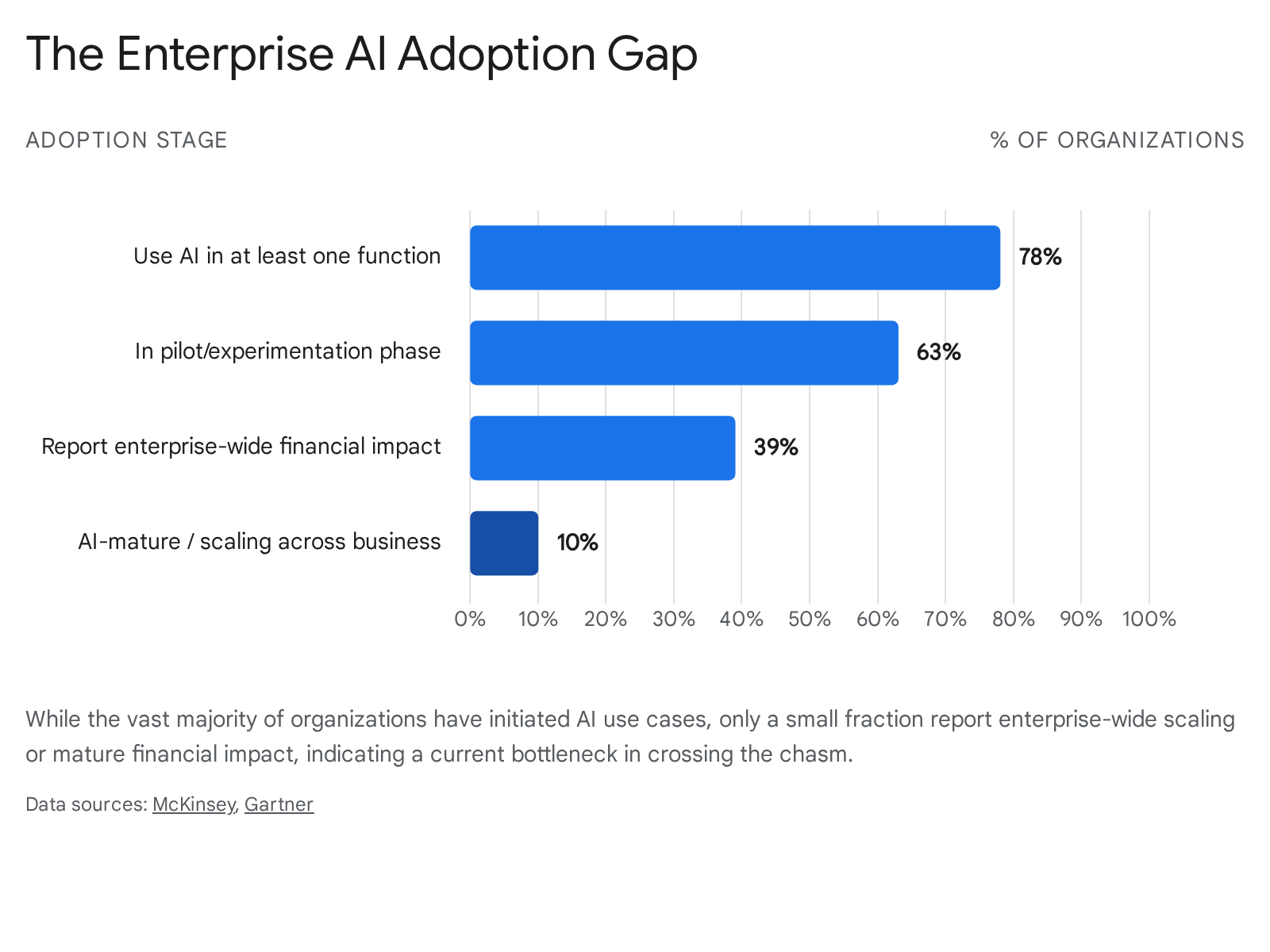
The vast majority of global organizations remain stagnant in the pilot or experimentation phases, indicative of a revolutionary technology trapped in the early market 4026.
This divergence in enterprise AI adoption maps flawlessly to Moore's psychographic framework. Visionary companies, operating as Early Adopters, are actively deploying experimental AI models to secure asymmetric competitive advantages. In doing so, they willingly accept the inherent, severe risks associated with early AI technology, including algorithmic hallucinations, undefined data privacy boundaries, and highly unpredictable outputs 4026.
Conversely, pragmatist organizations - particularly those operating in highly regulated industries such as finance, insurance, and healthcare - exhibit classical early majority behavior. They absolutely require systemic reliability, rigorous security compliance, predictable latency, and a mathematically proven return on investment before permitting AI to interface with high-stakes, proprietary environments 4026. For these pragmatist organizations, an AI system that fails to produce consistent, auditable results negates the business case entirely, causing deployment to stall indefinitely 40.
Security, Latency, and Internal Deployment Strategies
To successfully cross the AI chasm into the mainstream enterprise market, AI solutions must rapidly transition from disjointed, isolated capabilities into fully integrated "whole products." Pragmatists are unwilling to stitch together disparate large language models; they demand seamless integration into their familiar, existing software ecosystems 4027.
Moore himself notes that the trapped value in complex enterprise operations invariably resides in latency - the systemic bottlenecks that constrain overall organizational performance 27. Agentic AI promises to directly address this latency by automating complex, multi-step workflows. However, overcoming the final mile of enterprise deployment requires navigating a profound change-management challenge. Agentic AI fundamentally reshapes how knowledge workers operate, create, and make decisions, thereby triggering intense cultural, organizational, and incentive-based resistance from the mainstream workforce 4027.
To mitigate these severe risks and satisfy pragmatist caution, many organizations are currently executing an inverted adoption strategy. Rather than deploying high-visibility, customer-facing AI applications - which carry massive reputational, financial, and liability risks if they fail - enterprises are channeling billions of dollars into internal-facing use cases, such as coding assistants, document summarization, and back-office administrative automation 44. Operating internally affords the organization vastly tighter control over user expectations, error correction protocols, and employee responsibilities. This provides a highly controlled, low-risk testing ground to prove utility, establish governance frameworks, and build the requisite social proof before attempting external, mainstream deployment 4044.
Geographic and Sector-Specific Variations
While the theoretical underpinnings of the chasm are globally applicable, the specific mechanics of crossing it adapt heavily based on regional market structures, regulatory environments, and sector-specific socioeconomic dynamics. Two prominent examples illustrating this variability are the transition to green technology in China and the deployment of financial inclusion mechanisms in emerging African markets.
Green Technology Innovations in the Chinese Market
The adoption of Green-Oriented Trajectory-Transformed Technology (GTTT), primarily exemplified by the electric vehicle (EV) market in China, presents a highly unique chasm scenario. GTTT products are fundamentally categorized as non-market-oriented innovations because their primary objective is macroscopic societal utility - such as national ecological sustainability and carbon reduction - rather than delivering immediate, superior functional utility to the individual consumer 28.
This macroeconomic dynamic creates an inherently deeper and wider chasm than traditional market-oriented innovations, as early iterations of GTTT products typically suffer from severe cost disadvantages, declining direct consumer utility, and massive infrastructural deficits, such as a lack of charging networks 28. Research focusing on the post-2015 Chinese EV market - a critical period representing the arduous transition across the chasm - identifies the highly specific consumer profiles required to bridge this gap 28.
The primary early adopters for EVs in China are classified as "Fashion Leaders." This segment is characterized by exceptionally high environmental, fashion, and leadership consciousness, coupled with a distinctly low sensitivity to price 28. However, crossing into the early majority requires the technology to appeal to an entirely different demographic: "Price-Conscious Environmentalists." This pragmatist group possesses high environmental awareness but remains intensely sensitive to upfront costs and operational reliability 28.
Crucially, this transition is heavily mediated by informational interpersonal influence. Unlike typical software markets where functional performance metrics alone might drive adoption, the widespread diffusion of GTTT requires deep, continuous social interactions that mitigate the perceived financial risk and validate both the functional capability and the ecological value of the product 28. Consequently, conservative consumers who inherently lack environmental awareness are deemed unviable targets during the chasm-crossing phase. This dynamic frequently necessitates powerful external policy interventions, such as massive government subsidies, to artificially alter the risk-reward calculus and compel the mainstream market to cross the chasm 2829.
Financial Technology Adoption in African Markets
In emerging markets across the African continent, financial technology (Fintech) serves not merely as a commercial enterprise tool, but as a critical, foundational mechanism for driving financial inclusion and macroeconomic development 3031. However, African technology startups face severe, unique structural deficits that exponentially compound the difficulty of crossing the adoption chasm.
The transition from early adopters - who are typically affluent, urban, and technologically literate individuals - to the early majority - comprising vast rural populations, informal small-to-medium enterprises, and marginalized demographic groups - is hindered by profound infrastructural and literacy barriers. Academic research indicates that severely low financial and digital literacy, particularly among rural women, frequently prevents fintech from naturally crossing the chasm 31. Without targeted educational interventions, the introduction of advanced fintech can perversely exacerbate the existing gender digital divide rather than closing it 31.
Furthermore, unlike software adoption in developed nations, mainstream adoption in Africa relies heavily on the presence of physical telecommunications infrastructure. Empirical data demonstrates a direct, powerful correlation between mobile network coverage (specifically, proximity to LTE towers) and the regional adoption rates of digital financial services 31. To successfully cross the chasm in these highly complex environments, fintech providers cannot rely on software interface superiority alone. The "whole product" in the African context necessitates designing highly resilient digital infrastructure for "last mile connectivity," deploying robust offline capabilities for regions suffering from poor network access, and navigating varying degrees of institutional quality and fragmented regulatory compliance across different national borders 31.
Academic Critiques and Theoretical Limitations
While Moore's Chasm theory has profoundly and indelibly influenced high-tech marketing strategy over three decades, it has faced sustained, rigorous academic and practical critique regarding its universal applicability and its foundational sociological assumptions.
The Misapplication to Continuous Innovation
A primary source of industry confusion and strategic misapplication of Moore's theory stems from the frequent failure of practitioners to distinguish between continuous and discontinuous innovations. The chasm model was explicitly and narrowly designed to address discontinuous (disruptive) innovations - those rare products that demand substantial, painful behavioral changes from the user or require the complete modification of existing infrastructure 45.
Many businesses erroneously attempt to apply the highly rigid chasm framework to continuous innovations, which are simply incremental upgrades or iterative feature improvements to an existing, established product category. For continuous innovations, the market adoption process naturally follows the smooth, uninterrupted transition initially modeled by Rogers, precisely because they do not force a painful behavioral shift or severe learning curve on the end-user 158. Forcing the prescriptive chasm framework onto an incremental product results in severely misallocated marketing resources, vastly over-engineered go-to-market strategies, and an artificial, detrimental narrowing of the target market to address a barrier that does not fundamentally exist 1832.
Furthermore, Everett Rogers himself explicitly challenged the fundamental existence of a structural chasm within his original framework. Rogers argued that comprehensive empirical research demonstrates no statistical support for a permanent, structural break between certain adopter categories. He posited that innovativeness, if measured properly, is a continuous variable across a population 115. Therefore, Rogers and subsequent academics suggest that what Moore identifies as an inherent, immutable sociological "chasm" may simply represent a localized deceleration in sales caused by inadequate product execution, poor vendor market strategy, or insufficient user education, rather than an unbreakable law of consumer behavior 115.
Dynamic Psychographics and Macro-Environmental Forces
The theory's strict reliance on static psychographic profiles is increasingly contested in contemporary sociological research. The original framework categorizes individuals highly rigidly as either Innovators, Pragmatists, or Laggards. In reality, modern adopter behavior is highly dynamic, situational, and heavily domain-specific. A consumer or corporate entity might act as a risk-tolerant Innovator regarding the adoption of enterprise communication software, but simultaneously operate as a highly conservative Laggard regarding the implementation of decentralized finance or autonomous logistics 132. The assumption that stable, universal cohorts exist across all technological domains is increasingly viewed as an oversimplification 32.
Additionally, the rigid boundary of the chasm inherently assumes a stable, predictable macroeconomic environment. However, severe external catalysts have repeatedly demonstrated the capacity to bypass, forcefully compress, or entirely obliterate the chasm. The COVID-19 pandemic served as a universal, unavoidable forcing function that compelled the rapid, panicked mass adoption of digital communication and remote work tools 110. In this scenario, the absolute necessity of maintaining basic operational continuity instantly overrode the Early Majority's inherent risk aversion, rendering the traditional, slow chasm-crossing strategy irrelevant 110.
Finally, the widespread adoption of modern Agile software development methodologies inherently functions to narrow the theoretical gap. By emphasizing continuous customer feedback, rapid iteration, and continuous delivery pipelines, Agile development actively closes the gap between the original developer intent and the shifting realities of the pragmatic market. The continuous, micro-refinement of software prevents mainstream users from experiencing the deep "trough of disillusionment" that typically characterizes the perilous gap between an innovation's early visionary promise and its eventual mainstream utility 1.
Geoffrey Moore's adaptation of the Technology Adoption Life Cycle remains a deeply foundational heuristic for understanding the structural friction inherent in commercializing disruptive innovations. The concept of the "chasm" accurately and durably diagnoses the profound psychological and operational disconnect between visionaries seeking strategic breakthroughs and pragmatists demanding reliable, integrated solutions 410. However, organizations seeking to navigate the modern technology landscape must recognize that the chasm is no longer a static, impenetrable abyss. It is a highly fluid, context-dependent barrier that can be widened by deep infrastructural deficits or rapidly bypassed through low-friction digital distribution, continuous agile iteration, and sudden macro-environmental shifts 131. Crossing the chasm in the contemporary era demands a synthesis of continuous product evolution, highly rigorous market segmentation, and an acute, dynamic understanding of the specific risk profiles of mainstream consumers.