
Jobs to Be Done hire moments and consumer decision journeys
Theoretical Foundations of Demand and Choice
The study of consumer behavior and market innovation has historically relied on demographic segmentation and product-centric feature analysis. However, as global markets have digitized and consumer choices have proliferated, these traditional frameworks frequently fail to capture the underlying causal mechanisms of purchasing and switching behavior 1234. Traditional market segmentation sorts consumers by demographics, such as age and income, or firmographics, such as company size and industry 235. This approach assumes that populations with similar demographic attributes will purchase similar products. However, extensive academic literature indicates that demographics provide only statistical correlation, not behavioral causality 146.
To address this explanatory deficit, the Jobs to Be Done (JTBD) theory emerged as a robust framework for identifying the fundamental progress a consumer seeks to make in a specific circumstance 512. The conceptual roots of JTBD trace back to the economic principle popularized by Theodore Levitt, who noted that consumers do not want a quarter-inch drill; they want a quarter-inch hole 36. This concept was subsequently formalized into a predictive framework by Clayton Christensen, Tony Ulwick, and Bob Moesta, shifting the unit of analytical focus away from the consumer's profile and onto the "job" itself 2359.
Concurrently, strategic marketing research transitioned away from linear purchasing funnels toward the Consumer Decision Journey (CDJ), a model popularized by McKinsey & Company that views consumer decision-making as an iterative, cyclical process . The intersection of JTBD theory and the CDJ provides a comprehensive lens through which to analyze consumer switching behavior, churn, and product adoption. While the CDJ maps the specific temporal touchpoints a consumer navigates, JTBD explains the motivational forces that propel the consumer through these phases 11. This report provides an exhaustive analysis of how the discrete milestones of JTBD - specifically the "Big Hire" and the "Little Hire" - map onto the modern consumer decision journey. Furthermore, it examines the forces that dictate switching behavior, contrasts these causal models with traditional statistical churn models, and evaluates their application through empirical case studies.
The Architecture of Consumer Adoption
Central to JTBD theory is the conceptualization of consumer adoption not as a single transaction, but as a dual-stage hiring process. Consumers do not simply buy products; they "hire" them to complete a specific task or achieve an outcome 236. This hiring process is bifurcated into two distinct, critical moments: the Big Hire and the Little Hire 11213. Winning market share requires organizations to successfully facilitate both moments, as they represent entirely different cognitive thresholds for the consumer.
The Big Hire Concept
The Big Hire represents the initial purchase or signup decision 112. It is the definitive moment when a consumer, motivated by a recognized unmet need or frustration, commits financial resources, time, or explicit intent to acquire a new solution. In the context of software-as-a-service (SaaS) or digital platforms, the Big Hire occurs at the exact point of subscription, contract execution, or initial application download 13.
The Big Hire is primarily driven by external marketing, sales execution, brand positioning, and the initial value proposition 1314. It reflects the consumer's belief that the product possesses the capability to solve their problem. However, winning the Big Hire is merely the acquisition phase; it does not guarantee long-term retention or actualized value. Many organizations mistakenly optimize their entire go-to-market strategy around the Big Hire, investing heavily in sales and acquisition marketing while neglecting the structural requirements for ongoing product utilization 1213.
The Little Hire Concept
The Little Hire refers to the recurring, in-the-moment decision to actually utilize the product to complete a task 112133. If the Big Hire is the acquisition of a new software platform, the Little Hire is the daily decision by an employee to log into that platform rather than reverting to a legacy spreadsheet 31617. The Little Hire is fundamentally driven by product quality, user experience design, and the continuous delivery of value 13.
Retention and churn problems are almost exclusively failures of the Little Hire 1213. A consumer may have committed to a subscription, but if they fail to integrate the solution into their daily workflow, the underlying "job" remains unfulfilled. Understanding the distinction between these two milestones is critical for operational success, as the metrics diverge significantly: the Big Hire is measured by conversion rates and customer acquisition cost, whereas the Little Hire is measured by weekly active usage, feature adoption, and time-to-value 513.
The Software Consumption Gap
The dissonance between a successful Big Hire and a failed Little Hire generates a structural market inefficiency termed the "consumption gap" 18456. The consumption gap is defined as the distance between the theoretical value a product can provide and the actual value a customer extracts through active usage 5723.
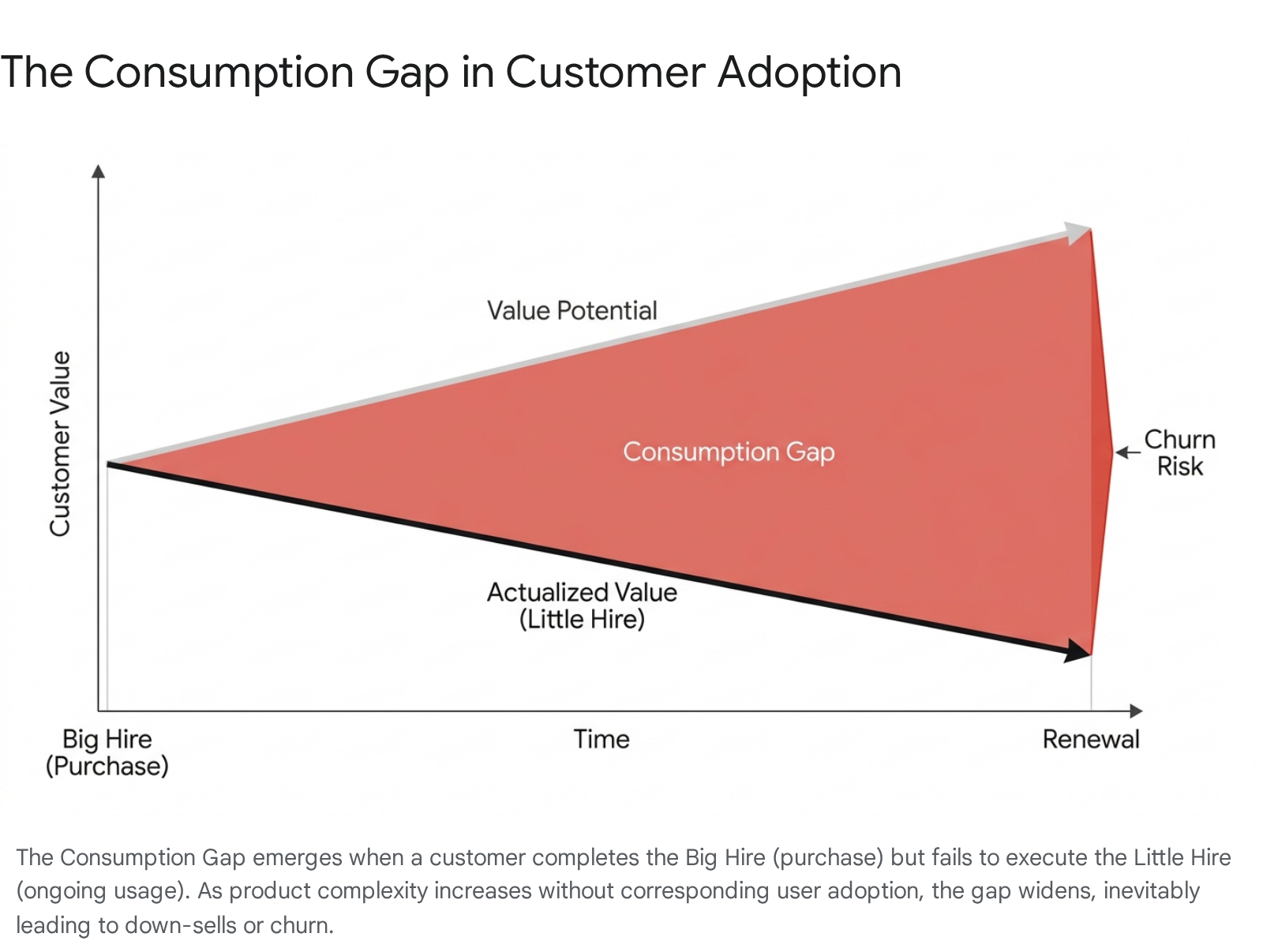
Mechanics of the Consumption Gap
In the enterprise technology ecosystem, the consumption gap represents a massive operational liability. This gap typically occurs because enterprise buyers - the decision-makers who execute the Big Hire - are often disconnected from the end-users who are responsible for executing the Little Hire 24. When the complexity of a technology outpaces the end-user's ability or willingness to absorb it, the consumption gap widens, turning expensive software deployments into unutilized "shelfware" 184.
If a provider fails to facilitate the Little Hire through in-application guidance, targeted customer success management, and reduced friction, the purchasing organization will eventually recognize the lack of return on investment 45. As the consumption gap becomes visible during financial audits or contract renewal periods, it inevitably triggers down-sells, vendor consolidation, or total account churn 57.
Empirical Data on Software Utilization
Recent data highlights the severity of the consumption gap in contemporary markets. By 2024 and 2025, organizational software adoption reached unprecedented levels; 99% of organizations reported using at least one SaaS tool 89. Companies employing over 1,000 personnel utilized an average of 150 to 473 distinct SaaS applications, driven largely by decentralized purchasing and the rapid adoption of generative artificial intelligence tools 8910.
However, telemetry data indicates that up to half of all purchased SaaS licenses remain entirely unused 9. The average enterprise organization loses approximately $18 million annually on software licenses that experience zero engagement 9. Furthermore, as software vendors continue to bundle new modules into premium tiers, customers frequently acquire secondary products they never explicitly intended to use, rapidly expanding the distance between paid capacity and utilized capacity 67. Consequently, mitigating the consumption gap through systematic activation of the Little Hire has become the primary operational mandate for customer success divisions 5623.
The Four Forces of Progress
The transition from a legacy solution to a new product is rarely frictionless. Consumer switching behavior is governed by an emotional and functional equation known as the "Four Forces of Progress" 151216111213. This model categorizes the psychological drivers of demand into two opposing groups: forces that generate demand and forces that reduce demand 1712.
Demand Generation Forces
For a consumer to initiate a change, the combination of promoting forces must overcome the inertia of their current state.
First, the "Push of the Situation" acts as the catalyst. This force originates from internal frustrations or external circumstances that render the current solution untenable 11216. It is the acute pain point or the realization that the "as-is" state is fundamentally broken. Without a significant push, consumers lack the foundational motivation to search for an alternative, regardless of how innovative a new product might be 11612.
Second, the "Pull of the New Solution" provides direction. This is the magnetic attraction of a new product or service. It represents the promise of progress and the allure of an improved future state 1121613. While conventional marketing relies heavily on emphasizing the pull by highlighting features and benefits, pull alone is insufficient to trigger a switch if the push is weak or if blocking forces are too strong 12.
Demand Reduction Forces
Opposing the desire for progress are the silent competitors of inertia and fear. These forces act as severe barriers to both the Big Hire and the Little Hire 1711.
The "Habit of the Present" represents the comfort of the status quo and the human tendency to remain unchanged. Consumers often settle for "good enough" solutions because the cognitive load of learning a new system outweighs the perceived benefit 1161713. This inertia manifests clearly in what academic researchers term the "habit slip" 14. Studies indicate that consumers who purchase a new product with full intention to use it will frequently slip back into old behavioral routines because automated context-response associations override conscious intentions 1415. Habit forces are particularly detrimental to the Little Hire, as they prevent repeated engagement.
The final force is the "Anxiety of Adoption." Anxiety encompasses the innate fear of the new and the uncertainty associated with change 121613. Within JTBD theory, researchers subdivide this force into two distinct temporal phases that align with the hiring milestones.
Anxiety in Choice Versus Anxiety in Use
Understanding the temporal nature of anxiety is critical for diagnosing adoption failures 161733.
"Anxiety-in-Choice" occurs strictly before the Big Hire. It is the fear of purchasing the wrong product, the fear of hidden costs, or uncertainty regarding whether the product will actually fulfill the designated job 161733. Anxiety-in-choice drives away prospective, first-time buyers and is typically mitigated by commercial strategies such as free trials, money-back guarantees, and transparent pricing structures 1416.
Conversely, "Anxiety-in-Use" occurs after the Big Hire, directly threatening the Little Hire. Once the purchase is finalized, the consumer begins to worry about the effort required to use the product, the steepness of the learning curve, or the reliability of the service 161733. For example, a consumer may successfully purchase a transit pass (Big Hire) but experience anxiety about whether the bus will actually arrive on time (Anxiety-in-use) 1633. Anxiety-in-use drives away repeat customers and creates the consumption gap. It must be addressed through superior user onboarding, intuitive interfaces, and proactive support 13164.
Summary of the Four Forces
| Force Category | Specific Force | Phase Impacted | Consumer Psychology | Strategic Mitigation or Amplification |
|---|---|---|---|---|
| Demand Generation | Push of the Situation | Pre-Journey / Consideration | Current processes are broken and increasingly frustrating. | Amplify by explicitly highlighting current pain points and struggles in marketing collateral 114. |
| Demand Generation | Pull of the New Solution | Active Evaluation / Big Hire | The new product promises a highly desirable future outcome. | Amplify by clearly articulating the specific progress the consumer will achieve 114. |
| Demand Reduction | Habit of the Present | Little Hire / Ongoing Use | The old method is familiar and requires less cognitive effort. | Mitigate by seamlessly integrating the new solution into existing workflows and reducing friction 11416. |
| Demand Reduction | Anxiety-in-Choice | Big Hire (Purchase) | Fear that the investment will be wasted or the product will fail. | Mitigate via free trials, transparent pricing, and robust social proof 161733. |
| Demand Reduction | Anxiety-in-Use | Little Hire (Consumption) | Fear of incompetence during operation or unpredictable performance. | Mitigate via comprehensive onboarding, customer success interventions, and clear UI design 1617433. |
Integration with the Consumer Decision Journey
The traditional marketing funnel, conceptualized as a linear path moving from awareness to action, posited that consumers methodically whittled down a large set of brands to arrive at a single purchase . However, extensive research analyzing the purchasing decisions of nearly 20,000 consumers revealed that this model failed to account for the explosion of digital touchpoints, the non-linear nature of modern shopping, and the critical importance of the post-purchase experience .
In response, McKinsey & Company formalized the Consumer Decision Journey (CDJ), redefining the process as a dynamic, circular loop encompassing initial consideration, active evaluation, closure, and postpurchase experience 16. The CDJ and JTBD frameworks operate as deeply complementary analytical tools. The CDJ provides the spatial and temporal map of where a consumer interacts with a market, while JTBD provides the causal logic explaining why the consumer transitions between those phases 11.
Initial Consideration and Active Evaluation
In the CDJ, the journey begins with "Initial Consideration," where a consumer forms a baseline set of brands 35. Through the JTBD lens, a consumer only enters this phase when the "Push of the Situation" becomes severe enough to disrupt their habitual inertia 11613. A consumer does not passively enter consideration; they are forced into it by a failing workaround. If the push force remains weak, the consumer remains in a state of non-consumption 1217.
The subsequent phase is "Active Evaluation," where consumers research options and consult digital reviews, a phase also characterized as the "Zero Moment of Truth" 16. Within this phase, a fierce psychological battle occurs between the "Pull of the New Solution" and "Anxiety-in-Choice" 1617. Consumers are evaluating which solution offers the highest probability of job completion with the lowest associated risk 41214. Marketing organizations that rely on feature-based positioning often lose in this phase to competitors who explicitly address the consumer's desired progress and systematically dismantle their anxieties through trust signals 1416.
Closure and the Loyalty Loop
The "Closure" phase of the CDJ maps exactly to the JTBD "Big Hire" 13. The consumer commits to the purchase. However, the most critical innovation of the CDJ was the formalization of the "Postpurchase Experience" and the subsequent "Loyalty Loop" 1635.
In the postpurchase phase, the consumer attempts the "Little Hire." They evaluate the product against their initial expectations. Here, the forces of Habit and Anxiety-in-Use emerge as primary threats 161733. If the product requires excessive cognitive load to operate, the consumer will succumb to habit slips, effectively abandoning the product 1415. Conversely, if the product seamlessly fulfills the job and minimizes friction, the consumer enters the Loyalty Loop. In the Loyalty Loop, the active evaluation phase is entirely bypassed for future purchases; the consumer immediately repurchases or habitually uses the product because the job is reliably solved .
Academic Tensions in Decision Modeling
While practitioner models like the CDJ emphasize touchpoints and marketing interventions, academic literature in marketing science frequently critiques these frameworks for assuming a one-size-fits-all progression 1819. Scholars advocate for "needs-adaptive shopper journey models," arguing that journeys are highly idiosyncratic and depend fundamentally on the consumer's specific goal state 1819.
This academic critique aligns closely with JTBD theory. For instance, a consumer seeking a functional job (rapid procurement of a commodity) will exhibit a highly compressed journey, whereas a consumer seeking an emotional job (entertainment or discovery) will exhibit an elongated, non-linear journey 1819. Integrating JTBD theory into the CDJ resolves this tension by explicitly defining the parameters of the journey based on the nature of the job being pursued 1116.
Framework Comparisons
| Framework Attribute | Traditional Marketing Funnel | McKinsey Consumer Decision Journey (CDJ) | Jobs to Be Done (JTBD) Theory |
|---|---|---|---|
| Core Philosophy | Linear reduction of options to a final purchase. | Circular process emphasizing digital touchpoints and the loyalty loop. | Causal motivation mapping based on desired progress and opposing forces. |
| Key Unit of Analysis | Product attributes and demographic segments. | Brand visibility across evaluation phases. | The specific task or "job" the consumer is attempting to complete. |
| Primary Metric | Conversion rate from awareness to action. | Influence at specific touchpoints (ZMOT). | Fulfillment of the Big Hire and habitual execution of the Little Hire. |
| Post-Purchase View | Largely ignored; terminates at the transaction. | Critical phase; determines entry into the Loyalty Loop. | Focus of the Little Hire; battles Anxiety-in-Use and Habit. |
Predictive Churn Methodologies
As organizations attempt to operationalize the CDJ and predict consumer churn, they frequently rely on advanced statistical modeling. While highly valuable for tracking macro-trends and identifying at-risk accounts, these methodologies exhibit significant limitations when attempting to parse the true causality of consumer behavior 140.
Statistical Machine Learning Models
In the realm of customer retention, data science teams heavily deploy Machine Learning (ML) and Deep Learning (DL) models - such as Logistic Regression, Decision Trees, Random Forests, and XGBoost - to predict churn probabilities 20212223. These models process massive, high-dimensional datasets encompassing contract details, login frequencies, interaction histories, and usage drops to identify accounts with a high statistical probability of canceling their subscriptions 202223.
Ensemble algorithms like XGBoost have demonstrated exceptionally high accuracy and recall in predicting when a customer will churn based on historical telemetry data, particularly in complex B2B SaaS environments 2022. Furthermore, techniques such as SHAP (SHapley Additive exPlanations) analysis allow data scientists to identify which specific variables - such as a drop in relationship strength or a decline in specific feature usage - are most predictive of a churn event 22.
Diagnostics Versus Root Causes
Despite their predictive power, ML models are fundamentally diagnostic tools identifying symptoms, not root causes 2022. An ML model may accurately flag a 40% drop in weekly active usage, signaling a severe failure of the Little Hire 13. However, the algorithm cannot explain why the end-user abandoned the workflow. It cannot determine if Anxiety-in-Use was too high due to a recent software update, or if the Pull of a competitor's interface overcame the user's Habit 1617.
JTBD methodology acts as the necessary qualitative complement to quantitative ML churn models. While ML identifies the failing accounts and the exact moment usage dropped, JTBD timeline interviews - often referred to as Switch Interviews - reconstruct the behavioral forces that led to the churn event 512142425. By interviewing churned customers through the JTBD lens, product teams can fix the structural flaws in the product's UX or onboarding process, rather than relying on reactive measures like offering financial discounts to frustrated users 5121425.
Comparison of Predictive Methodologies
| Methodology | Primary Function | Data Input | Strengths | Limitations |
|---|---|---|---|---|
| Machine Learning (XGBoost, Random Forest) | Predictive symptom identification. | Quantitative telemetry, login frequency, demographic flags 202122. | Highly scalable; excellent at predicting when an account will churn 2022. | Cannot explain why the user stopped extracting value; identifies correlation, not causality 422. |
| JTBD Switch Interviews | Causal root-cause analysis. | Qualitative interviews mapping the Four Forces of Progress 51225. | Uncovers emotional and functional drivers; identifies precise UX failures causing Anxiety-in-Use 1425. | Resource-intensive; relies on small sample sizes; requires skilled interviewers 525. |
Cross-Cultural Consumer Behavior
The mechanics of the Big Hire, the Little Hire, and the Four Forces of Progress are universally applicable, but they manifest with extreme intensity in non-Western and emerging markets. In these environments, institutional voids, infrastructural deficits, and deep-seated cultural habits create extreme Push and Anxiety forces that digital disruptors must navigate carefully 26272829.
M-Pesa and Digital Financial Infrastructure
Launched in 2007 by Safaricom and Vodafone in Kenya, M-Pesa is a mobile money platform that revolutionized digital payments across the African continent 30315332. Prior to M-Pesa, the unbanked population in Kenya relied on highly risky, informal methods to transfer money to rural relatives, such as sending physical cash via bus drivers 3153.
Through the JTBD lens, the consumer's job was clear: securely and quickly transfer funds to family without requiring physical travel or a traditional bank account 31. The Push force was the extreme danger, high cost, and slow speed of physical cash transfers 3053. The Pull was the ability to transfer money instantly via simple SMS protocols 3133. M-Pesa also successfully leveraged Habit forces by formalizing the existing practice of trading mobile airtime as a proxy currency 31.
To secure the Big Hire, M-Pesa had to overcome severe Anxiety-in-Choice regarding trusting a telecommunications company with actual cash. This anxiety was mitigated when a rigorous audit by the Central Bank of Kenya verified the system's security, providing the necessary institutional trust for mass adoption 31. By securing the Little Hire - facilitating daily, seamless transactions - M-Pesa scaled to process over 61 million transactions daily, fundamentally altering the economic landscape, driving agricultural productivity, and significantly reducing the consumption gap for digital financial services 3153. By 2014, M-Pesa transactions accounted for nearly half of Kenya's GDP 53.
Nubank and Latin American Banking Disruption
Founded in 2013 in Brazil, Nubank emerged in a market dominated by a highly concentrated oligopoly of five legacy banks 26343536. These incumbent institutions charged some of the highest interest rates globally and subjected consumers to labyrinthine bureaucracy and hostile customer service environments 3435.
The underlying job for the Brazilian consumer was to manage personal finances with transparency and dignity, without wasting hours in physical bank branches 2634. The Push force was the intense frustration with exorbitant fees and poor service 263436. The Pull was a 100% digital, no-fee credit card managed entirely via a smartphone application 3536.
Nubank secured its position by focusing intensely on eliminating Anxiety-in-Use, designing an intuitive user experience that stripped away the complexity of traditional credit systems 2637. By solving the core job vastly better than incumbents, Nubank generated a massive Loyalty Loop via organic word-of-mouth. This allowed the company to grow to over 114 million customers across Latin America while maintaining a highly efficient acquisition cost 353637.
Gojek, Grab, and Southeast Asian Transit
In Southeast Asia, platforms like Grab in Singapore and Gojek in Indonesia evolved from simple ride-hailing services into comprehensive "super-apps" 386139. Rapid urbanization in cities like Jakarta created paralyzing traffic congestion, and the existing informal motorcycle taxis (ojeks) lacked standardized pricing or safety guarantees 6139.
Consumers hired these applications to navigate chaotic urban traffic predictably, safely, and at a transparent price 6139. The Push force was the daily loss of hours in gridlock and the anxiety of negotiating fares with informal drivers 6139. The Pull was a standardized, GPS-tracked, app-based booking system 6139.
Both platforms had to overcome the entrenched Habit of flagging down drivers directly on the street. Gojek explicitly leveraged lean startup methodologies and rapid experimentation to find product-market fit, continuously testing features to ensure the app addressed the exact jobs consumers needed done 61. By continually expanding their services to include food delivery, logistics, and digital payments, these super-apps secured the Little Hire across multiple daily touchpoints, cementing their position in the consumer's active journey and achieving multi-billion dollar valuations 38613963.
Disruption Mechanics in Emerging Markets
| Disruptor | Region | Primary Push Force (Frustration) | Primary Pull Force (Solution) | Key Anxiety Mitigated | Scale and Impact |
|---|---|---|---|---|---|
| M-Pesa | East Africa | Unsafe, slow physical cash transfers; exclusion from formal banking 3153. | Instant, SMS-based digital money transfers 3153. | Trust in non-bank entities handling cash (validated by central bank) 31. | 61M+ daily transactions; massive poverty reduction 3153. |
| Nubank | Latin America | High fees, extreme bureaucracy, hostile branch experiences 263436. | 100% digital, no-fee credit card and banking app 3536. | Complexity of traditional credit; hidden fees (anxiety-in-use) 2634. | 114M+ customers; largest digital bank in LatAm 3637. |
| Gojek / Grab | Southeast Asia | Severe urban gridlock; unstandardized pricing and safety of transit 6139. | App-based booking, transparent pricing, multi-service ecosystem 3861. | Safety concerns and price negotiation friction (anxiety-in-choice) 6139. | Dominance in ride-hailing, food delivery, and digital payments 6163. |
Implications for Organizational Strategy
The integration of Jobs to Be Done theory with modern decision journey frameworks necessitates a fundamental shift in how organizations approach product development, marketing, and customer success. The evidence dictates that competing solely on product features or targeting demographic profiles yields diminishing returns, particularly as digital channels become saturated and acquisition costs rise 1440.
To capture market share, marketing organizations must transition from feature-centric messaging to outcome-driven communication. By explicitly targeting the "Four Forces of Progress," marketers can amplify the "Push" of the customer's current struggle and the "Pull" of the desired outcome, while proactively addressing the "Anxieties" that block the Big Hire 1413.
Furthermore, as the global SaaS consumption gap continues to expand, organizations must recognize that revenue is not secure at the point of sale. Post-purchase operations must be meticulously designed to ensure the Little Hire occurs consistently. This requires product teams and customer success divisions to eliminate friction, combat habit slips, and neutralize anxiety-in-use 46714. Ultimately, companies that deeply understand the causal mechanisms of their customers' jobs - and design end-to-end experiences that guarantee progress - will command the loyalty loop and achieve durable competitive advantage.