
Strategic dissonance and internal political dynamics in large firms
Organizational survival in high-technology and rapidly evolving industries frequently depends on a firm's ability to navigate fundamental market shifts. These periods of industry transformation, characterized by changes in dominant technologies, regulatory frameworks, or competitive bases, create severe internal friction within incumbent firms. Central to understanding this friction is the concept of strategic dissonance, formulated by Robert Burgelman and Andrew Grove. Strategic dissonance provides an evolutionary perspective on corporate strategy, detailing how internal political dynamics, resource allocation processes, and the structural tension between top and middle management determine a firm's ability to survive disruption 12.
Rather than viewing strategic adaptation merely as a product of executive foresight, the strategic dissonance framework posits that adaptation is a complex, often chaotic internal ecological process. It shifts the analytical focus from the external market environment to the internal selection environment, exposing the political and cognitive battles that dictate resource flows 33. This report exhaustively analyzes the theoretical mechanics of strategic dissonance, contrasts it with other dominant paradigms of organizational disruption, and evaluates its explanatory power across historical and contemporary corporate case studies.
Theoretical Foundations of Strategic Adaptation
To comprehend the internal political dynamics of large firms facing disruption, it is essential to first deconstruct the core components of the Burgelman and Grove framework. The theory challenges traditional, top-down models of strategic planning, suggesting instead that strategy emerges from the ongoing competition for resources within the firm.
The Evolutionary Theory of the Firm
The strategic dissonance framework is heavily grounded in organizational ecology and evolutionary biology 34. In biological evolution, environments undergo long periods of stasis punctuated by discontinuous, revolutionary changes 4. Similarly, corporate environments fluctuate. An organization's survival is dictated by its internal evolutionary mechanisms: variation, selection, and retention 36.
Traditional management literature often treats firms as rational actors executing deliberate plans. However, Burgelman argues that highly dynamic industries feature unpredictable interactions of forces, rendering long-term strategic plans unreliable by the time of implementation 35. Therefore, corporate longevity depends not on flawless prediction, but on the firm's capacity to generate internal variations (new ideas, products, or operating methods), select the variants that best match the external environment, and retain them by reallocating corporate resources 336.
Strategic Inflection Points
The precipitating event for strategic dissonance is the "strategic inflection point" (SIP) 12. A strategic inflection point occurs when the fundamental dynamics of an industry change, altering the prevailing winning strategies and dominant technologies 2. These points represent critical junctures where the historical trajectory of a business is no longer a reliable indicator of future success.
SIPs are not instantaneous events but rather prolonged periods of transition characterized by high ambiguity. During an SIP, the signals indicating a shift in the market are often faint, contradictory, and obscured by the noise of ongoing business operations 1. Early indicators of a strategic inflection point frequently emerge at the periphery of the organization - such as sales teams noticing a shift in customer inquiries or front-line engineers observing limitations in legacy technologies - long before they are reflected in macroeconomic data or executive dashboard metrics 16.
The Mechanics of Strategic Dissonance
Strategic dissonance itself is the organizational friction generated by an SIP. It is formally defined as the divergence between a firm's stated strategic intent - what top management claims the company's strategy is - and its actual strategic action, which is manifested through the day-to-day resource allocation decisions made by lower and middle-level management 2.
Dissonance arises because the basis of competition in the external environment begins to diverge from the firm's historical distinctive competencies 2. Top executives, whose identities and cognitive models are deeply intertwined with the legacy business that brought them success, typically cling to the established strategic intent. Conversely, front-line and middle managers, who interact directly with shifting market realities, technologies, and customer demands, begin to alter their behavior and reallocate resources to address the new environment 6. The resulting gap between official rhetoric and operational reality produces severe cognitive and political strain within the hierarchy.
Structural Context versus Strategic Context
The internal ecology of strategy-making within this framework relies on the interplay between two distinct processes: induced strategic action and autonomous strategic action, which are governed by the firm's structural and strategic contexts 3578.
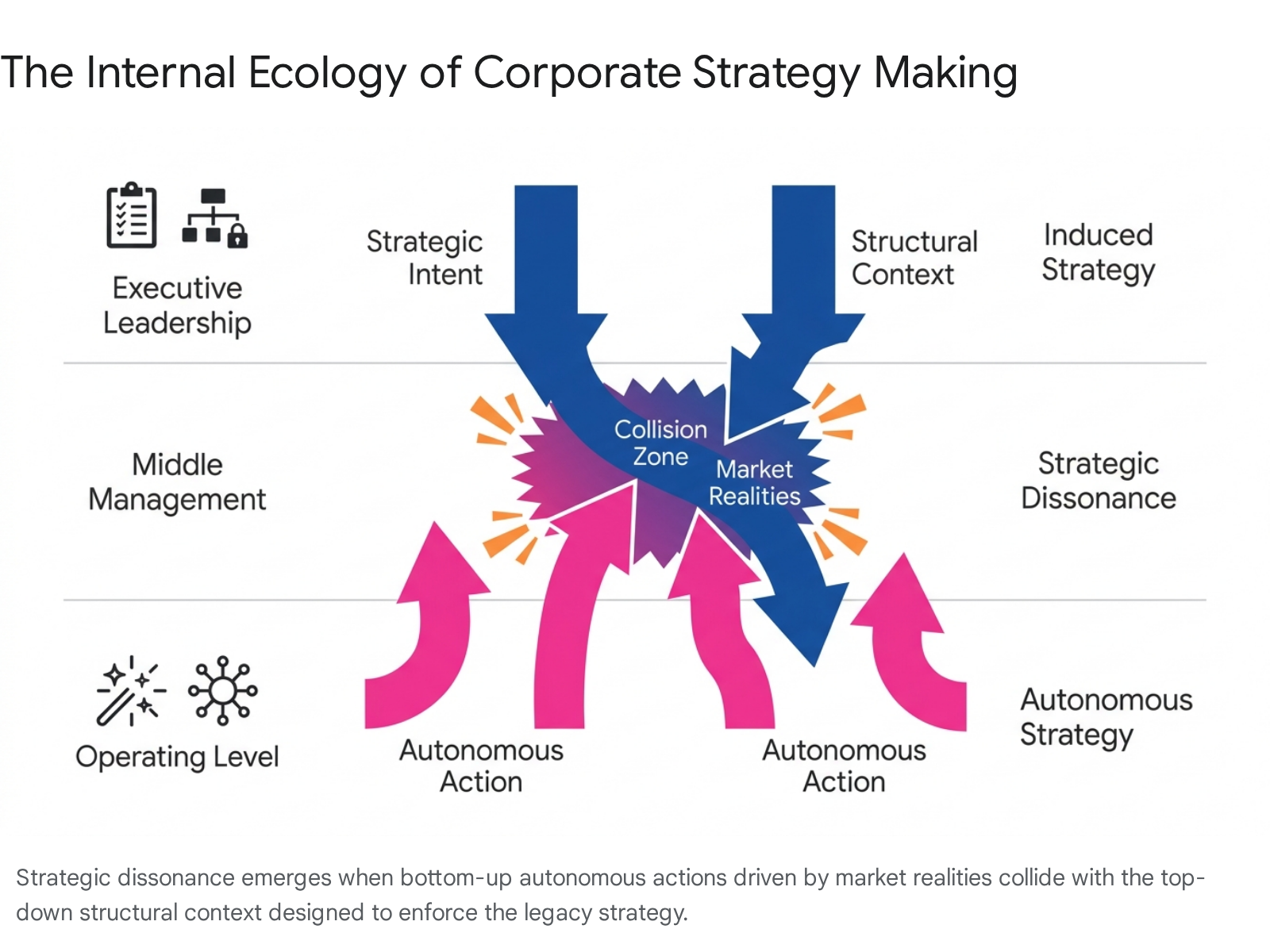
Induced strategic action encompasses initiatives that fit seamlessly within the current, official corporate strategy 89. It is driven by the organization's structural context - the formal administrative mechanisms, incentive systems, organizational charts, and cultural norms established by top management to maintain strategic alignment 38. The induced process seeks to reduce variation, maximize efficiency, and exploit the firm's existing product-market environment 89. It acts as the engine of the legacy business.
Autonomous strategic action involves initiatives pursued by individuals or small teams that fall outside the scope of the official corporate strategy 89. These actions are variation-increasing and introduce instability, as entrepreneurial employees explore new opportunities, technologies, or markets that deviate from the established path 58. Because autonomous actions do not fit the established structural context, their survival depends on the creation of a new strategic context - a compelling business case that justifies the divergence to senior leadership 7812.
| Characteristic | Induced Strategic Action | Autonomous Strategic Action |
|---|---|---|
| Primary Goal | Exploit current product-market domains | Explore new product-market domains |
| Variation Impact | Variation-reducing (efficiency and alignment) | Variation-increasing (innovation and instability) |
| Alignment Status | Aligned with official corporate strategy | Divergent from official corporate strategy |
| Key Actors | Top management (planning), Middle management (execution) | Operational personnel (ideation), Middle management (championing) |
| Resource Mechanism | Formal structural context (standard budgeting) | Strategic context definition (bootstrapping, strategic forcing) |
Internal Political Dynamics and Resource Allocation
Strategic dissonance is fundamentally a political phenomenon. Large organizations are not monolithic entities executing a unified will; they are complex ecosystems where different managerial layers possess distinct incentives, risk profiles, and access to disparate sets of information. When an SIP occurs, the hierarchy fragments along these lines.
The Role of Middle Management
Research consistently indicates that middle managers often experience the highest levels of dissatisfaction and stress within the corporate workforce 13. This stress is primarily structural; middle managers occupy the fault line between top management's strategic intent and the operational realities of the front line 1310. They lead the "coordinating system," tasked with translating long-range corporate bets into actionable tactical objectives, applying resources across competing divisions, and managing stakeholder expectations 1311.
During a strategic inflection point, middle managers are the first to experience the failure of the induced strategy. They face the immediate, granular consequences of commoditization, shifting customer preferences, or technological obsolescence 7. Because their performance is judged on operational success, they cannot afford to wait for top management to revise the corporate strategy. Consequently, middle managers begin to champion autonomous strategic actions 67.
This championing requires a politically fraught process known as "strategic forcing" 6. Middle managers must reallocate critical resources - often subtly, illicitly, or outside standard budgetary cycles - away from the failing core business and toward emerging, high-potential projects 67. They create early, minimum viable products and secure initial customers to generate "facts on the ground" 6. This reallocation represents a profound political act, as it defies the formal structural context, bypasses established hierarchy, and challenges the resource monopoly of the dominant legacy business units.
Top Management Isolation and Cognitive Inertia
While middle managers adapt to the external environment through autonomous action, top management often suffers from pronounced cognitive inertia 11218. Executive leadership is frequently insulated from the granular realities of the market by bureaucratic reporting structures, aggregated financial metrics, and filtered information 13.
Furthermore, historical success with the induced strategy creates a "competency trap." The firm becomes overly reliant on the skills, metrics, and products that drove past profitability 112. Executives' professional identities, compensation structures, and public reputations are tied to the legacy paradigm. Consequently, top executives may view autonomous actions not as necessary adaptations, but as insubordinate distractions that dilute the firm's focus 122014.
The resulting political struggle is characterized by a war over context. Middle managers attempt to construct a new "strategic context" to prove the viability of an autonomous paradigm, while top management attempts to enforce the traditional "structural context" to rein in deviations 7812. Executives may utilize stringent financial return metrics, legacy stage-gate approval processes, or structural reorganizations to suppress these autonomous initiatives 13.
The Process of Strategic Recognition
The resolution of this internal political conflict requires a specific, difficult capability from executive leadership, termed "strategic recognition" 1215. Strategic recognition is the retroactive realization by top management that an autonomous strategic action, which bubbled up from middle management, represents the firm's best and most viable response to a strategic inflection point 125.
Strategic recognition marks a departure from traditional strategic planning. It requires top management to act as fast learners and sense-makers rather than omniscient forecasters 5. Executives must observe the dissonance, evaluate the resource reallocations that middle managers have organically instituted, understand why the legacy models are failing, and officially adopt the new direction 25. By endorsing the autonomous action, leadership realigns the firm's strategic intent with its new strategic actions, dissolving the dissonance and allowing the firm to mobilize its full scale behind the new trajectory 2. Achieving this state requires a corporate culture that values dissent, encourages debate, and allocates resources based on competitive reality rather than historical precedent 2.
Comparative Theoretical Frameworks
To fully appreciate the nuance and distinct utility of strategic dissonance, it is necessary to contextualize it against other prominent theories of organizational disruption, notably Clayton Christensen's Innovator's Dilemma and Tushman and O'Reilly's paradigm of Organizational Ambidexterity.
Contrasting with the Innovator's Dilemma
Christensen's framework argues that successful companies fail precisely because of their sound management practices - specifically, their tendency to listen closely to their most profitable customers and invest heavily in sustaining innovations that yield the highest immediate margins 20141617. This phenomenon, termed "resource dependence," renders incumbents blind to disruptive technologies 1416. Disruptive technologies initially serve low-end or emerging markets with inferior, but cheaper and simpler, products that mainstream customers reject 201617.
While both frameworks address incumbent failure during technological shifts, their explanatory mechanisms differ fundamentally. The Innovator's Dilemma attributes failure primarily to external resource dependence - the gravitational pull of the existing customer base and the rational pursuit of known profit pools 1416. Strategic dissonance, conversely, focuses on internal resource allocation, cognitive inertia, and the political difficulty of altering the firm's structural context 2.
The prescribed solutions also diverge. Christensen advocates for creating fully autonomous spin-off entities to pursue disruptive technology, arguing that the parent company's resource allocation processes will inevitably starve the new venture 1819. Burgelman and Grove argue that the parent company itself can evolve and survive internally, provided that top management exercises strategic recognition and integrates autonomous actions into a newly defined corporate core 12.
Contrasting with Organizational Ambidexterity
Organizational ambidexterity refers to a firm's ability to simultaneously explore new opportunities and exploit existing capabilities 420212223. Ambidextrous organizations explicitly design their structures to manage this duality. They establish structurally separate units for exploration (characterized by flexible cultures, decentralized structures, and experimental metrics) and exploitation (characterized by efficiency, control, centralization, and strict variance reduction) 2021. These disparate units are held together by a tightly integrated senior management team that balances the inherent tensions, orchestrates shared assets, and maintains a unified strategic vision 2022.
Ambidexterity views the balancing of exploration and exploitation as an optimal, sustainable organizational design that can be engineered from the top down 1823. Strategic dissonance, however, views the friction between legacy operations and new ventures as an inherently chaotic, punctuated evolutionary process. In the strategic dissonance model, the tension is rarely neatly managed by a harmonious top management team; rather, it is a messy political battle where middle managers often force the firm's hand by reallocating resources subversively before top management formally agrees 6.
| Theoretical Framework | Core Mechanism of Failure | Primary Driver of Change | Proposed Strategic Solution | View of Internal Friction |
|---|---|---|---|---|
| Strategic Dissonance (Burgelman & Grove) | Internal cognitive inertia and rigid structural context | Middle managers reallocating resources (Autonomous Action) | "Strategic Recognition" by top management to realign intent with action | An evolutionary necessity to be resolved via robust internal debate |
| Innovator's Dilemma (Christensen) | External resource dependence on current profitable customers | External entrants capturing low-end, ignored market segments | Create independent spin-off organizations to isolate disruptive tech | A fatal flaw of rational, margin-seeking management structures |
| Organizational Ambidexterity (Tushman & O'Reilly) | Inability to simultaneously manage conflicting operational modes | Top management orchestrating dual organizational architectures | Implement structurally separate but integrated exploration/exploitation units | An ongoing tension to be permanently balanced by executive teams |
Foundational Case Analysis of the Technology Sector
The theoretical constructs of strategic dissonance - inflection points, induced versus autonomous action, and strategic recognition - manifest vividly across historical corporate case studies. Analyzing these events reveals how internal political dynamics dictate survival or failure.
Intel Corporation and the Microprocessor Pivot
The genesis of the strategic dissonance framework stems from Intel's profound transition from a dynamic random-access memory (DRAM) company to a microprocessor company in the mid-1980s 136.
In the late 1970s and early 1980s, Japanese semiconductor manufacturers heavily disrupted the DRAM market, utilizing superior manufacturing scale to drive down prices and severely erode Intel's market share (which dwindled to roughly 2-3 percent) 1. Despite this overwhelming external signal, Intel's top management - whose identities, reputations, and historical success were inextricably tied to the memory business - maintained the strategic intent that Intel was primarily a memory company 16. Consequently, corporate planning continued to allocate equal R&D funding to both the failing DRAM division and the emerging microprocessor division 6.
However, the operational reality diverged significantly. Intel utilized a decentralized resource allocation rule at the manufacturing level known as "maximize margin per wafer" 6. Because Japanese competition drove down DRAM prices, microprocessors began yielding much higher profit margins per silicon wafer. Consequently, middle managers in charge of fabrication facilities organically reallocated manufacturing capacity away from DRAM and toward microprocessors to maximize their operational metrics and departmental profitability 36.
This created profound strategic dissonance: top management claimed Intel was a memory company, but the firm's actual resource commitments demonstrated it was becoming a microprocessor company 16. The dissonance was resolved when CEO Andy Grove exercised strategic recognition, acknowledging the reality created by middle management. He officially exited the DRAM market, realigned the company's strategic intent with its strategic actions, and formally inaugurated Intel's dominance in the microprocessor industry 1615.
Nokia Corporation and the Smartphone Disruption
Nokia's precipitous decline in the mobile phone market offers a stark counter-example of unresolved strategic dissonance, driven by dysfunctional internal political dynamics and collective organizational fear 1213.
In the late 1990s and early 2000s, Nokia was the undisputed global leader in mobile handsets, largely due to its highly efficient supply chain, massive economies of scale, and dominance in hardware design 132425. However, the introduction of the Apple iPhone in 2007 and Google's Android operating system represented a severe strategic inflection point. The basis of competition fundamentally shifted from hardware efficiency to software ecosystems, touch interfaces, and application platforms 12181324.
Nokia's top management suffered from severe cognitive inertia, remaining fixated on hardware volume metrics and device-centric strategies. They heavily relied on their increasingly fragmented and outdated Symbian operating system, which required extensive recoding for every new hardware model, slowing innovation 1218. The internal political dynamics were toxic; research and insider interviews indicate that middle managers were terrified of top executives, who aggressively demanded positive short-term financial results and dismissed the threat of new entrants 13.
Consequently, middle managers engaged in temporal myopia - focusing on short-term, incremental hardware releases and actively hiding the negative reality of their software deficiencies from top management 13. Because middle managers were too fearful to champion autonomous software strategies or reallocate resources against the wishes of the hierarchy, top management remained overly optimistic and isolated from competitive reality 13. The absence of internal debate meant strategic dissonance was suppressed rather than resolved. By the time CEO Stephen Elop issued his famous "burning platform" memo in 2011, officially acknowledging the inflection point, the firm had missed the critical window for strategic recognition and was structurally years behind its competitors 1224.
Kodak and Fujifilm in the Photographic Industry
The parallel trajectories of Fujifilm and Eastman Kodak during the transition from analog to digital photography provide a definitive study in the impact of structural context on strategic recognition 2627282930.
Both firms possessed immense R&D capabilities and foresaw the digital disruption decades in advance; the failure was not one of technological forecasting but of organizational adaptation 262930. Kodak was paralyzed by a culture of complacency and a rigid structural context that tied all innovative endeavors to the financial performance metrics of its legacy film business 2829. The massive margins of analog film disincentivized middle managers from aggressively pursuing digital avenues. Any autonomous actions regarding digital technology were swiftly curtailed if they threatened to cannibalize the core business, leading to Kodak's eventual bankruptcy 262730.
Conversely, Fujifilm acknowledged the strategic inflection point and recognized that maintaining its historical business model was unsustainable 2629. Top management dismantled the rigid structural silos and engaged in radical strategic renewal 29. Crucially, Fujifilm leveraged its distinctive competencies in chemical engineering, oxidation control, and materials science - originally developed for film - to pursue autonomous strategic actions in entirely new domains 272829. By applying these competencies to medical imaging, pharmaceuticals, and highly profitable functional cosmetics, Fujifilm exercised successful strategic recognition 2731. This allowed the company to transition from a single-product analog film producer to a highly diversified, multi-billion-dollar technology conglomerate 2627.
| Firm | Response to Strategic Inflection Point | Internal Political Dynamic | Resulting Outcome |
|---|---|---|---|
| Intel | Middle managers reallocated manufacturing to microprocessors. | Andy Grove exercised Strategic Recognition of middle management's actions. | Dominated the PC microprocessor market. |
| Nokia | Ignored software ecosystems; clung to hardware volume metrics. | Culture of fear caused middle managers to hide software failures from executives. | Loss of market dominance; sale of mobile division. |
| Kodak | Suppressed digital innovation to protect high-margin film business. | Structural rigidity prevented autonomous actions from gaining corporate funding. | Bankruptcy and liquidation of legacy assets. |
| Fujifilm | Leveraged core chemical competencies into new markets (medical, cosmetics). | Top management actively supported autonomous diversification and restructuring. | Survived and grew into a diversified technology conglomerate. |
Strategic Dissonance in Asian Consumer Electronics
The Japanese consumer electronics industry faced a sustained strategic inflection point over the past two decades, driven by the rise of digital platforms, software integration, and aggressive low-cost manufacturing from emerging Asian economies (particularly China and South Korea) 39323334. The varied responses of traditional giants like Sony and Panasonic further illustrate the mechanics of strategic dissonance.
Sony and the Shift to Components and Software
Initially, both Sony and Panasonic attempted to compete by restructuring legacy hardware divisions, an approach that yielded temporary stock price bumps during the initial phase of "Abenomics" (early 2013-2015) 39. However, maintaining long-term competitiveness required fundamentally shifting the business model away from commoditized consumer hardware 34.
Sony, facing deep financial losses, embraced the strategic dissonance. The company made the difficult political decision to exit highly visible legacy businesses - such as selling its iconic Vaio personal computer division - and pivot aggressively 39. Sony poured resources into developing complementary metal-oxide-semiconductor (CMOS) image sensors for smartphones, alongside a heavy focus on software and digital entertainment (gaming) 39. By officially recognizing that their distinctive competence no longer lay in consumer hardware assembly but in specialized high-tech components and content ecosystems, Sony realigned its strategic intent with the new realities of the market 3935.
Panasonic and the Persistence of Hardware Manufacturing
Panasonic initially resisted this shift, illustrating the dangers of cognitive inertia. The company persisted with a strategic focus on hardware, notably pouring resources into electric vehicle (EV) battery production 39. While EV batteries represented a growing market, the technology quickly commoditized, leaving little room for continuous innovation 39. Panasonic suffered from organizational rigidity and executive hesitancy to completely abandon the founder's traditional manufacturing ethos 3435.
Consequently, Panasonic entered punishing price wars with Chinese competitors who rapidly scaled up EV battery manufacturing using existing technology 39. Panasonic's profitability slipped, and its share price slumped as the firm found itself trapped in an induced strategy that no longer provided a sustainable competitive advantage in the global market 3933.
State-Owned Enterprises and Institutional Disruption
The concept of strategic dissonance extends beyond Western and Asian publicly traded technology firms. In state-owned enterprises (SOEs) and emerging market multinationals, the internal political dynamics are substantially complicated by the inclusion of national strategic objectives. This creates a unique layer of dissonance between commercial viability and political mandates.
Embraer and Strategic Coupling
In Latin America, the Brazilian aerospace conglomerate Embraer highlights how firms navigate tension between commercial realities and institutional constraints 36373839.
Operating in a developing economy with limited domestic institutional support and complex bureaucratic environments, Embraer engaged in autonomous strategic actions through a process defined as "strategic coupling" 3638. Rather than relying solely on internal R&D or domestic government support, Embraer formed aggressive risk-sharing partnerships with global suppliers and international scientific knowledge providers 363839. These partnerships allowed suppliers to take on the financial risk of developing core aircraft components.
This approach represented a deviation from traditional, vertically integrated aerospace manufacturing. It allowed Embraer to bypass local institutional constraints and access global technology networks. Top management's recognition of these decentralized partnerships as the core mechanism for product development allowed Embraer to capture market leadership in the regional jet segment, overcoming established incumbents like Bombardier 3839.
Petrobras and the Energy Transition
Petrobras faces a more acute form of strategic dissonance. As a mixed-capital company controlled by the Brazilian state, top management is perpetually forced to balance profit maximization with political mandates regarding local content, fuel pricing, and national economic development 404142.
Currently, Petrobras is navigating the monumental strategic inflection point of the global energy transition 41. The dissonance lies between the commercial imperative to invest heavily in low-carbon technologies (such as biorefining, wind, solar, and green hydrogen) to remain globally competitive, and the political pressure to focus on core deepwater exploration and production (E&P) 41. Core E&P generates immediate state revenue, funds social programs, and maintains national energy security 41.
The internal political dynamics at Petrobras require executives to constantly mediate between the autonomous push toward decarbonization (led by engineers and international market analysts) and the induced, politically mandated focus on fossil fuels and domestic refinery monopolies 41. This balancing act leaves the firm vulnerable to "strategic drift" if capital expenditure is spread too thin across conflicting priorities.
Chinese Technology Firms and Geopolitical Disruption
For Chinese technology giants, strategic dissonance is heavily influenced by geopolitical pressures and national industrial policies, presenting distinct mechanisms for resolving internal friction.
Huawei and Supply Chain Blockades
Huawei, historically reliant on global supply chains for advanced semiconductors and operating systems, faced an external shock in the form of US technological blockades 43444546. This geopolitical disruption created an immediate divergence between their established strategy of global integration and the sudden necessity for technological autarky 46.
Huawei's response highlights rapid strategic recognition. Rather than persisting with the blocked supply chain strategy or engaging in prolonged internal debate, the firm accelerated autonomous R&D efforts 4346. They pivoted aggressively to build localized supply chains, develop proprietary operating systems (HarmonyOS), and invest in domestic semiconductor capabilities 434446. The internal political alignment was facilitated by a shared sense of existential threat and strong state policy support, which mitigated the typical friction and resistance seen in Western firms facing dissonance 46.
Tencent and Artificial Intelligence Investments
Tencent navigates dissonance by balancing its core consumer applications (gaming and social media) with heavy investments in emerging, state-prioritized technologies. The firm utilizes its vast capital - investing nearly 25% of its annual revenue - to explore multiple technological trajectories simultaneously, including artificial intelligence, enterprise cloud services, and fintech 4445. By actively investing in external startups and maintaining internal "media labs," Tencent institutionalizes autonomous strategic action, allowing the firm to rapidly recognize and integrate successful disruptive technologies before they threaten the core business 444547.
Generative Artificial Intelligence as an Inflection Point
The contemporary emergence of Generative Artificial Intelligence (GenAI) and large language models (LLMs) represents the most significant strategic inflection point since the commercialization of the internet 48495051. The rapid diffusion of agentic AI models is currently generating profound strategic dissonance across nearly all sectors, challenging traditional management theories globally 495152.
Shadow Artificial Intelligence and Autonomous Adoption
The integration of GenAI highlights the critical role of middle management and front-line employees. While top management outlines broad AI strategies and mandates adoption, middle managers face the operational reality of implementation 4953. They must navigate the "implementation gap" - translating high-level AI directives into concrete workflow interventions while addressing employee resistance, skills gaps, and data governance issues 495253.
Currently, autonomous strategic action regarding AI is rampant. Employees and operational units are rapidly adopting unsanctioned generative AI tools to improve immediate productivity, creating "shadow AI" infrastructure that diverges from official corporate IT strategy and security protocols 4954.
The political challenge for top management is not to suppress these autonomous experiments through rigid structural context and blanket bans, but to exercise strategic recognition. Executives must evaluate which localized, employee-driven AI applications are yielding genuine business value and retroactively integrate them into a secure, scalable corporate strategy 495155. Firms that attempt to dictate AI adoption purely from the top down risk missing the nuanced, domain-specific innovations discovered by front-line workers, falling victim to the very cognitive inertia that doomed legacy firms in past eras 5256.
Green-Digital Dissonance in Corporate Governance
Firms are presently caught between dual transformative pressures: digital transformation via AI and the imperative for sustainable, green development (ESG) 555758. Research indicates that navigating these simultaneous mandates creates a novel form of friction termed "green-digital strategic dissonance" within corporate boardrooms 5758.
Executive leadership struggles to allocate resources efficiently between highly capital-intensive AI infrastructure (which often has a massive carbon footprint) and mandatory decarbonization initiatives 57. This multi-goal tension within the board often leads to "strategic drift," where the firm fails to commit decisively to either the digital or the green path 57. Empirical evidence suggests that this board-level dissonance significantly undermines long-term firm value, particularly in smaller or non-state-owned enterprises lacking the buffer of vast financial reserves 57. Resolving this requires dynamic capabilities, allowing firms to use AI precisely as a tool to enhance green innovation, thereby merging the two conflicting goals into a unified strategic intent 55.
The Human Resource Analytics Implementation Gap
The dissonance caused by AI extends deeply into talent management. Organizations are deploying Human Resource Analytics (HRA) to optimize workforce capability and retention 5359. However, there is a pronounced implementation gap. Advanced analytics often remain isolated as descriptive reporting tools because middle management lacks the authority or capability to translate data into structural interventions 53. Strategic recognition is required from senior leadership to acknowledge that workforce capability and retention are not peripheral HR topics, but core business variables that directly impact corporate survival in the AI era 53. Furthermore, retaining the talent necessary to navigate AI disruption requires shifting from traditional monetary compensation to strategic recognition programs - acknowledging employee contributions holistically to prevent turnover of highly skilled personnel 59686970.
Mechanisms for Resolving Strategic Dissonance
The primary lesson of the strategic dissonance framework is that internal friction during periods of disruption is not an anomaly to be eliminated, but an evolutionary mechanism to be harnessed. Strategic dissonance provides the raw, unfiltered informational input necessary for strategic renewal 2. For organizations to survive strategic inflection points, top management must cultivate specific leadership behaviors and organizational structures.
Designing the Internal Selection Environment
Executives must construct an internal selection environment that protects and funds autonomous strategic actions, even when those actions threaten the legacy business model 235. This involves creating parallel resource allocation processes that do not subject exploratory ventures to the strict margin requirements or mature performance metrics of the core products 58. If middle managers are forced to justify a disruptive technology using the financial models of the legacy business, the innovation will invariably be starved of resources.
Cultivating Psychological Safety and Debate
Leadership must foster a culture of intense, data-driven debate 12. As demonstrated by the catastrophic failure of Nokia, a culture of fear that suppresses negative information is fatal during a disruption 13. Middle managers must feel psychologically safe to present contradictory data, highlight failing products, and challenge the official strategic intent based on their interactions with the competitive reality 12. Dissent must be viewed as a strategic asset rather than insubordination.
Mastering Strategic Recognition
Ultimately, the responsibility of the executive team during a disruption shifts from omniscient planning to strategic recognition 1256. In highly dynamic environments, predictable strategic plans are obsolete upon implementation 3. Instead, top management must continuously monitor the periphery of the organization, identify which autonomous initiatives are gaining traction against the new basis of competition, and decisively pivot corporate resources to support them 235.
By institutionalizing the capacity to recognize and resolve strategic dissonance, large firms can continuously shed outdated identities, overcome cognitive inertia, and co-evolve with their shifting competitive landscapes.