
Resource-based view and disruptive innovation theory in the AI era
Introduction to the Strategic Dichotomy
The architecture of modern strategic management is fundamentally shaped by two towering, yet frequently conflicting, theoretical paradigms: the Resource-Based View (RBV) of the firm and Disruptive Innovation Theory (DIT). Originating from distinct intellectual traditions, these frameworks offer divergent explanations for how competitive advantage is achieved, sustained, and ultimately lost. Before the ascendance of these theories, the field was heavily dominated by Industrial Organization (IO) economics, notably Michael Porter's Five Forces framework, which posited that external industry structure and competitive positioning were the primary determinants of firm profitability 123. In stark contrast, the Resource-Based View, championed by Jay Barney and grounded in the earlier foundational work of Edith Penrose and Birger Wernerfelt, introduced an "inside-out" perspective. The RBV argues that long-term outperformance stems not from market positioning, but from the accumulation, orchestration, and protection of idiosyncratic, internal firm assets 3455.
Conversely, Clayton Christensen's Disruptive Innovation Theory offers a dynamic, "outside-in" lens, demonstrating how the very pursuit of high-margin, resource-intensive strategies creates structural vulnerabilities 67989. Christensen's work reveals a pervasive paradox: the precise management practices that the RBV extols - listening closely to demanding customers, investing heavily in proprietary technologies, and maximizing the yield on existing resources - are the exact mechanisms that allow under-resourced entrants to subvert industry incumbents from the bottom of the market 37910.
In an era characterized by exponential technological change - specifically the proliferation of Artificial Intelligence (AI) and digital platform economies - the friction between these two theories has never been more pronounced. Post-2023 scholarship published in leading journals such as the Strategic Management Journal and the Academy of Management Review reveals that the static assumptions of the RBV are increasingly inadequate for explaining competitive dynamics in algorithmic and ecosystem-driven markets 511. Simultaneously, the mechanisms of disruption have accelerated, evolving beyond low-cost hardware into complex digital abstractions, autonomous decision-making algorithms, and data network effects 111213.
This comprehensive analysis deconstructs how the Resource-Based View interacts with Disruptive Innovation Theory. It dissects their foundational conflicts, bridges them through the theoretical constructs of dynamic capabilities and core rigidities, and details the precise internal mechanisms - specifically the Bower-Burgelman resource allocation process - that cause rational incumbents to fail. Furthermore, the analysis explores the geographic asymmetries of disruption through the lens of emerging markets and reverse innovation, culminating in an evaluation of how contemporary AI technologies are forcing a radical reconceptualization of both strategic frameworks.
Foundational Paradigms
To understand the interaction and ultimate conflict between these two dominant theories, it is imperative to establish their core tenets, definitions, and boundaries.
The Resource-Based View (RBV) and the VRIO Framework
The Resource-Based View emerged as a dominant paradigm in the late 1980s and 1990s, fundamentally shifting the focus of strategy from the external competitive environment to the internal endowments of the firm 12345. The RBV operates on two critical assumptions: resource heterogeneity (firms possess different bundles of resources, even within the same industry) and resource immobility (these resources are "sticky" and cannot be easily traded or acquired by competitors) 517.
Jay Barney (1991) formalized this concept into the VRIN framework, which was later refined into the VRIO framework. This model stipulates that for an internal resource to generate a sustainable competitive advantage, it must satisfy specific, stringent criteria.
| VRIO Dimension | Strategic Definition and Implication | Examples and Vulnerabilities |
|---|---|---|
| Valuable (V) | The resource enables the firm to formulate and implement strategies that improve its efficiency or effectiveness, exploiting external opportunities or neutralizing threats 35514. | A deep retail distribution network is valuable for consumer goods. However, value is context-dependent; as environments shift (e.g., from physical retail to e-commerce streaming), previously valuable resources can become liabilities 317. |
| Rare (R) | The resource is controlled by a small number of competing firms. If a resource is ubiquitous, it results in competitive parity rather than a strategic advantage 5517. | Specialized engineering talent or proprietary algorithms. In the AI era, rarity is increasingly difficult to maintain as foundational models become commoditized 11. |
| Inimitable (I) | The resource is prohibitively costly or difficult for rivals to duplicate. This is the cornerstone of sustained advantage, protected by "isolating mechanisms" 351520. | Protected by path dependency (historical development), causal ambiguity (unclear link between resource and success), and social complexity (organizational culture, trust) 351715. |
| Organized (O) | The firm possesses the appropriate organizational structure, management control systems, and compensation policies to fully exploit the resource's potential 316. | A firm may own a valuable patent portfolio but lack the internal commercialization pipelines or cross-functional communication routines to turn those patents into profitable products 317. |
Under the strict interpretation of the RBV, strategic management is the continuous, inward-looking process of identifying, nurturing, and fiercely protecting these VRIO resources 559. Success is a function of accumulating legacy assets that competitors cannot easily replicate. Firms are advised to deepen their commitment to these highly specialized, causally ambiguous resources to extract maximum economic rents over time 3515.
Disruptive Innovation Theory
Introduced by Clayton Christensen in 1997, Disruptive Innovation Theory seeks to explain a recurring corporate tragedy: why exceptionally well-managed companies, which listen closely to their customers, invest heavily in new technologies, and possess formidable VRIO resources, consistently lose their market dominance when faced with certain types of technological change 7981023.
A strict, academic definition of disruption is critical to understanding its conflict with the RBV. In popular business vernacular, "disruption" is widely and incorrectly used as a synonym for any radical, breakthrough, or highly successful technology 6823. In strict theoretical terms, disruptive innovations are distinctly different from sustaining innovations. Sustaining innovations make good products better for existing, mainstream customers - such as a pharmaceutical company developing a more efficacious drug, or Apple introducing a faster microprocessor 698918. Incumbents almost always win battles of sustaining innovation because their VRIO resources are perfectly aligned to execute them 9819.
True disruptive innovation, however, describes a specific evolutionary process characterized by distinct market trajectories and a fundamental duality of price and performance 67989. The process requires an inefficient start, allowing disruptors to be ignored until their productive efficiency increases enough to shift the entire market structure 20. The trajectory of disruption unfolds across four critical phases:
First, the disruptive product takes root in simple applications, establishing a foothold at the bottom of an existing market (low-end disruption) or creating a completely new market by turning previous non-consumers into consumers (new-market disruption) 6989. Second, at the time of introduction, the disruptive innovation is typically inferior to established products according to the traditional performance metrics valued by mainstream customers. However, it introduces a different, asymmetric set of attributes - such as being cheaper, simpler, smaller, or vastly more accessible 68921. This duality changes the consumer evaluation matrix entirely 7.
Third, a dynamic of asymmetric motivation takes hold. Incumbents are highly motivated to flee the low-margin, bottom-tier segments and focus their resources on sustaining innovations for their most profitable, demanding customers 89. Because there is no immediate profitability incentive to fight for the bottom of the market, incumbents willingly cede these segments to the disruptor, viewing them not as a threat, but as an opportunity to shed unprofitable business 8922.
Finally, the disruptor relentlessly improves its technology. Because the pace of technological progress invariably outstrips the ability of customers to utilize it - a phenomenon known as performance oversupply or overshooting - the once-inferior disruptive product eventually meets the performance requirements of mainstream customers 6989. At this intersection, the disruptor displaces the incumbent, bringing its structural cost advantages and new value network into the mainstream, thereby rendering the incumbent's legacy VRIO resources obsolete 6989. While incumbents fortify their core market positions using valuable and inimitable resources, this upward trajectory systematically ignores low-end and new-market footholds. Disruptors enter through these undefended segments, utilizing new technological trajectories that eventually intersect and collapse the incumbent's value network.
The Theoretical Conflict: Static Defense vs. Dynamic Attack
The friction between the Resource-Based View and Disruptive Innovation Theory is profound and multi-dimensional. The theories frequently offer contradictory prescriptions for executive action, creating a strategic dichotomy that forces management teams to choose between exploiting current assets and exploring new paradigms 523.
According to the RBV, sustained competitive advantage relies on deepening the firm's commitment to its highly specialized resources. A firm possessing a superior global distribution network, proprietary manufacturing technology, and deeply ingrained brand equity should logically leverage these VRIO assets to extract maximum rents 3515. The RBV intrinsically promotes a strategy of path dependency, where past investments dictate future success, and managers are encouraged to build higher walls around their existing competitive positioning 31524.
Disruptive Innovation Theory counters that these very strengths become fatal weaknesses during periods of discontinuous change. DIT asserts that the accumulation of specialized resources inextricably links the firm to its current value network - the specific context within which it identifies customer needs, procures inputs, measures profitability, and reacts to competitors 79. When a disruptive technology emerges, the incumbent's meticulously curated VRIO resources are often entirely irrelevant to the new value network 9.
The historical collapse of Blockbuster illustrates this conflict vividly. Blockbuster's massive retail footprint and highly optimized logistics network constituted a textbook VRIO resource in the era of physical media rental 817. According to traditional RBV logic, this should have guaranteed sustained advantage. Yet, when Netflix introduced a disruptive model - initially targeting niche DVD-by-mail consumers and eventually deploying streaming technology - Blockbuster's physical stores transitioned rapidly from a core competence into an expensive, inflexible liability 817. The RBV's inherent failure lies in its static assumption that value is intrinsic to the resource itself, rather than recognizing that value is highly contingent upon the external market context 517.
Furthermore, recent scholarship critiques the RBV for suffering from a tautological flaw: resources are often only deemed "valuable" or "inimitable" ex-post, after they have generated a competitive advantage 5. In highly volatile digital markets subjected to constant disruption and regulatory shifts, the predictive power of the RBV is severely compromised 5. A resource can satisfy all VRIO criteria one year and be rendered entirely obsolete the next by a sudden external shock or an asymmetric attack 517. Conversely, critics of DIT, utilizing an Occam's razor approach, note that disruption theory itself frequently suffers from post-hoc definitions, where innovations are only labeled "disruptive" after they have successfully toppled an incumbent, leading to ambiguity regarding its ex-ante predictive capabilities 723.
Comparative Table: Resource-Based View vs. Disruptive Innovation
| Strategic Dimension | Resource-Based View (RBV) & VRIO | Disruptive Innovation Theory (DIT) |
|---|---|---|
| Primary Unit of Analysis | The internal firm and its distinct, heterogeneous resource bundles. | The external value network, customer segments, and technology trajectories. |
| Source of Competitive Advantage | Possession of Valuable, Rare, Inimitable, and Non-substitutable (VRIN) assets. | Asymmetric motivation, low-cost structures, and novel business models targeting non-consumers. |
| Perspective on Incumbent Assets | Legacy assets are protective moats that sustain long-term market leadership. | Legacy assets act as heavy anchors, tying incumbents to outdated value networks and cost structures. |
| Approach to Innovation | Generally favors sustaining innovations that leverage and reinforce existing core competencies. | Focuses on discontinuous, market-creating, or low-end innovations that redefine the basis of competition. |
| Managerial Prescription | Deepen, protect, and orchestrate existing resources to maximize economic rents. | Create autonomous spin-offs; target overserved or non-consumers; ignore traditional ROI metrics initially. |
| Theoretical Vulnerability (Blind Spot) | Tends to be static and tautological; struggles to predict the sudden devaluation of resources due to external shocks. | Can be overly focused on technology failure; sometimes underestimates an incumbent's ability to absorb or co-opt disruption. |
(Source Data: Synthesized from 3455679891723)
Bridging the Divide: Capabilities and Rigidities
To reconcile the inward-looking, static nature of the RBV with the outward-looking dynamism of DIT, strategic management scholarship has developed crucial bridging concepts. These constructs explain how and why internal resources fail during external disruption, and precisely what organizational structures are required to survive paradigm shifts.
Core Capabilities as Core Rigidities
Dorothy Leonard-Barton (1992) introduced the concept of "core rigidities" to explain the paradox of managing new product development and technological discontinuity. She observed that the very capabilities that constitute a firm's competitive advantage - its prized VRIO resources - are deeply intertwined with organizational values, cultural norms, and established managerial systems 10171725263327.
A core capability is not merely a technical asset; it consists of employee skills, technical systems, managerial processes, and values regarding what constitutes "good" business 1717. While these integrated systems are highly effective for executing sustaining innovations, they harden into "core rigidities" when confronted with discontinuous technological shifts 172633. Because an incumbent firm's culture and operational systems are hyper-optimized to serve its most profitable customers, the organization inherently rejects projects, ideas, and knowledge that do not neatly fit its established paradigm 1733.
This phenomenon is exacerbated by "threat rigidity theory," a concept positing that in threatening, uncertain situations, organizations tend to exhibit risk-averse behaviors 2627. When faced with a disruptive shock, rather than experimenting, incumbents retreat to their established routines, enhancing centralized control and conserving resources based on limited, historically shaped decision-making capabilities 26.
In the contemporary context of AI adoption, recent literature (2024 - 2025) highlights that the relentless pursuit of process automation can inadvertently generate new, devastating core rigidities 263328. Organizations that embed narrow AI into standardized, legacy workflows optimize existing processes for maximum efficiency. However, in doing so, they create deep path dependencies and a "paradigmatic lock-in" that actively resists structural transformation 2433. By violating the sociotechnical principles of joint optimization, they achieve task-level efficiency while cementing system-level rigidity, turning their AI investments into a modern institutional straightjacket 33.
The Dynamic Capabilities Framework
If core rigidities explain why possessing VRIO resources causes firms to fail to adapt, the "Dynamic Capabilities" framework explains the mechanism by which they might survive. Developed by David Teece, Gary Pisano, and Amy Shuen (1997) as a direct extension and dynamic correction of the RBV, dynamic capabilities are defined as a firm's higher-order ability to "integrate, build, and reconfigure internal and external competences to address rapidly changing environments" 4151719252930.
While the traditional RBV focuses on the static possession of operational capabilities (e.g., owning a highly efficient manufacturing plant or a specific patent), dynamic capabilities focus on the orchestration and continuous renewal of those assets 412153038. Building upon earlier evolutionary economics theories by Nelson and Winter regarding organizational routines, as well as Nonaka and Takeuchi's models of knowledge creation, Teece breaks dynamic capabilities down into three essential micro-foundations: 1. Sensing: The capacity to continuously identify, filter, and assess emerging technological opportunities and market threats globally, acting as the organization's radar 5151931. 2. Seizing: The ability to mobilize resources rapidly to capture value from those new opportunities. This often requires the courage to aggressively redesign existing business models and cannibalize existing revenue streams 5151931. 3. Transforming (Reconfiguring): The ongoing process of continuous organizational renewal. This involves realigning tangible and intangible assets, establishing cross-functional communication routines, and intentionally dismantling core rigidities before they become fatal 515171931.
The Dynamic Capabilities framework acts as the theoretical bridge between the RBV and Disruptive Innovation Theory. It acknowledges that while possessing VRIO resources is necessary for current profitability and competitive positioning, surviving a disruptive threat requires the meta-capability to deliberately dismantle, re-evaluate, and reassemble those resources in response to turbulent environmental conditions 4172538.
The Mechanism of Failure: The Resource Allocation Process
Understanding the conflict between RBV and DIT requires examining the precise internal mechanics of corporate decision-making. Why do intelligent, rational executives allow their firms to be disrupted? Disruptive Innovation Theory points to the asymmetry of financial incentives, but the exact organizational mechanism that causes the failure is explained by the Bower-Burgelman process model of resource allocation 224041423233.
Early strategic management theory operated on a simplified, top-down assumption: the CEO formulated a grand strategic plan, and the organization mechanically executed it. However, Joseph Bower (1970) and Robert Burgelman (1983) demonstrated that in large, complex organizations, strategy is rarely a top-down mandate. Instead, it is an emergent, highly iterated, and deeply political process driven by the allocation of resources at the middle-management level 224042323334.
The Bower-Burgelman model reveals that resource allocation (capital budgeting and talent deployment) is composed of three interlocking stages that systematically evaluate initiatives: 1. Definition (The Operational Level): Technical and operational personnel at lower levels of the organization interact with the market, identify technological shifts, and propose new initiatives 323334. This is frequently where disruptive ideas, or "autonomous" strategic behaviors, first emerge. 2. Impetus (The Middle Management Filter): For an operational project to receive corporate funding, it requires a sponsor - a middle manager who must champion the project upward to senior executives 333435. Middle managers face severe career risks; their success is measured by near-term financial metrics, ROI targets, and their ability to serve the demands of existing key customers 203334. 3. Structural Context (Top Management): Top executives establish the administrative mechanisms, reward systems, and financial hurdle rates that dictate how middle managers behave and which projects they are willing to sponsor 3334.
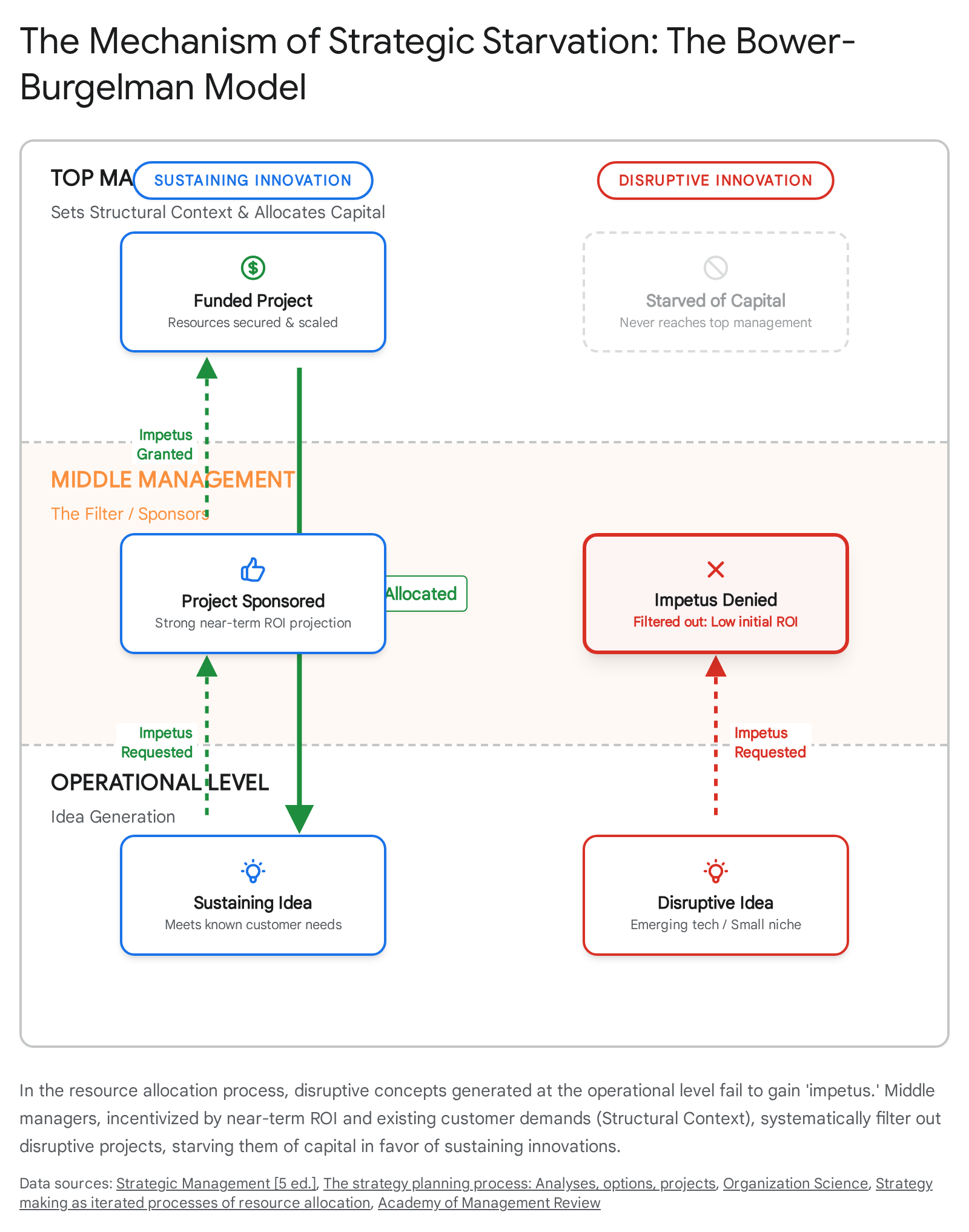
The conflict between RBV and Disruption is institutionalized through this very mechanism. Because an incumbent firm's structural context is designed precisely to protect and exploit its existing VRIO resources, the financial metrics demand high margins, massive addressable markets, and immediate synergies 173233. Disruptive innovations - which initially offer lower margins, target small or unproven non-consumer segments, and utilize untested technologies - simply cannot clear the hurdle rates established by top management 81033.
Consequently, middle managers acting rationally in their own self-interest choose not to provide impetus to disruptive projects. The projects are systematically starved of resources 10203334. The failure of incumbents in the face of disruption is rarely rooted in executive ignorance or poor engineering; rather, the resource allocation process is working exactly as designed. It successfully filters out projects that do not maximize the utilization of current VRIO assets, inadvertently leading the firm toward corporate obsolescence through entirely rational, profit-maximizing behavior 10203334.
Disruption and RBV in the Digital and AI Economies (Post-2023)
The advent of the digital platform economy and the rapid, pervasive deployment of Artificial Intelligence have catalyzed a profound re-evaluation of strategic theory in top-tier management literature from 2023 through 2026. The unique nature of AI - particularly generative AI (GenAI), machine learning, and advanced neural architectures - stretches the conceptual boundaries of both the Resource-Based View and Disruptive Innovation Theory.
The AI Commoditization Debate: Does AI Satisfy VRIO?
A central debate in contemporary literature involves whether AI itself can constitute a source of sustained competitive advantage. The traditional RBV approach attempts to classify AI infrastructure, proprietary algorithms, and vast data lakes as VRIN resources 141638363749.
However, emerging scholarship profoundly challenges this application. Research by Wingate et al. (2025) and others forcefully argues that raw AI technologies, including advanced Large Language Models (LLMs), are rapidly commoditizing 11. Because foundational models are widely accessible via APIs, open-source availability, and cloud infrastructure, they are inherently replicable and fundamentally fail the "Rare" and "Inimitable" criteria of the VRIO framework 11. If any enterprise can instantly rent state-of-the-art cognitive processing power, the algorithm itself ceases to function as a protective competitive moat. The raw technology is insufficient to deliver sustained advantage 11.
Instead, Krakowski et al. (2023) writing in the Strategic Management Journal, propose that the strategic advantage of AI lies not in its possession as a static, isolated asset, but in its role as a dynamic resource orchestrator 13. AI transcends traditional asset constraints by introducing continuous, data-driven capabilities that fundamentally reconfigure a firm's innovation processes 13. Competitive advantage in the AI era shifts from "owning the best algorithm" to possessing the dynamic capabilities required to embed AI into unique, socially complex organizational ecosystems 11. The true rarity lies in utilizing AI for federated learning, ensuring robust ethical governance, and establishing open innovation (OI) partnerships that competitors find impossible to untangle or replicate 11.
Digital Platforms and Ecosystem Disruption
The digital economy further challenges the classical RBV assumption that competitive advantage relies solely on internal firm resources. In platform-based environments, sustained advantage often stems from network effects, massive data accumulation, and external ecosystem orchestration 1214.
Recent research indicates that digital platforms heavily leverage "AI boundary resources" - external AI capabilities accessed seamlessly via APIs - to lower operational costs and accelerate process improvements 38. This externalization allows firms to rapidly scale and adapt without needing to own the underlying asset, directly contradicting classical RBV logic which demands strict internal control and immobility of resources 1438.
Furthermore, AI introduces a terrifying new dimension to the speed and scope of Disruptive Innovation. Traditional disruption, as mapped by Christensen, targets the low end of the market with cheaper, simpler products, slowly marching upmarket over years or decades 98. However, AI-driven disruption can occur at an unprecedented velocity across multiple market tiers simultaneously. As AI algorithms autonomously learn from vast data inputs, they create exponential "data network effects" - where the utility of the platform improves autonomously as more data is ingested 12. This allows AI-driven startups to not merely encroach slowly from the bottom, but to achieve rapid performance superiority that entirely bypasses the traditional, multi-year upward trajectory of physical disruptive technologies 1239.
To survive this hyper-accelerated threat landscape, literature published in 2024 and 2025 insists that firms must integrate the RBV with the Dynamic Capabilities View to achieve profound organizational ambidexterity 141629303140. Firms must transition from viewing AI merely as a tool for operational efficiency (exploitation of current resources) to leveraging it as a catalyst for continuous business model innovation and strategic sensing (exploration of new value networks) 2938.
Geographic Asymmetries: Emerging Markets and Reverse Innovation
The principles of Disruptive Innovation Theory and the Resource-Based View are not geographically bound, but they manifest uniquely in the Global South. Emerging markets - characterized by vast populations, severe resource constraints, high environmental turbulence, and underdeveloped infrastructure - serve as the ultimate incubators for disruptive innovations 53414243.
From Glocalization to Reverse Innovation
Historically, Western multinational corporations (MNCs) employed a strategy of "glocalization" - developing high-end VRIO resources in advanced economies and subsequently stripping down those products or features to sell in emerging markets 4458. However, scholars such as Vijay Govindarajan note that this strategy is increasingly failing 444546. The entrenched cost structures, rigid quality standards, and legacy mindsets of Western incumbents act as severe core rigidities that prevent them from serving subsistence consumers effectively 4344.
This dynamic has given rise to Reverse Innovation, defined strictly as the process by which a product, service, or business model is initially designed for and adopted in emerging markets, before eventually "trickling up" to disrupt advanced economies 53444661624748. Reverse innovation is, fundamentally, the geographic embodiment of Christensen's Disruptive Innovation Theory 534461.
In emerging markets, innovators face five critical "gaps" compared to developed markets: performance, infrastructure, sustainability, regulatory, and preferences 44. To bridge these gaps, local entrepreneurs and forward-thinking MNCs engage in "frugal innovation" or "bricolage" - making do with highly limited resources to create solutions that are ruthlessly cost-effective, durable, and practical 53414246. To achieve this, ventures in regions like Southeast Asia employ "contextual ambidexterity" strategies to simultaneously balance extreme local adaptation with regional replicability 42.
Case Studies in Reverse Disruption
Several prominent empirical examples from recent scholarship illustrate how emerging markets spawn global disruptions that confound traditional RBV protections:
| Sector | Reverse Innovation Case Study | Mechanism of Disruption |
|---|---|---|
| Healthcare Technologies | General Electric (GE) Ultrasound (China/India): GE recognized its bulky, expensive machines were unsuited for rural clinics with poor infrastructure 44624765. | By establishing an autonomous unit (circumventing the traditional Bower-Burgelman resource allocation rigidities), GE developed a highly portable, PC-based ultrasound machine at a fraction of the cost 4462. This frugal innovation dominated Asia and subsequently disrupted US outpatient care by offering a "good enough," accessible alternative 446265. |
| Financial Technology (FinTech) | M-Pesa (Kenya) & Lumni (Latin America): M-Pesa circumvented the lack of banking infrastructure by utilizing basic mobile networks 4249. Lumni pioneered new business models to finance higher education via investments rather than traditional debt 50. | These innovations served vast populations of non-consumers. M-Pesa scaled rapidly, establishing a decentralized digital finance model that has heavily influenced global mobile payment platforms 4258. Lumni's income-share agreements trickled up to advanced economies 50. |
| Electric Vehicles (EVs) | BYD (China): Focused intensely on the emerging market's need for highly affordable, acceptable-range electric and hybrid vehicles, ignoring the premium market initially 6151. | By optimizing battery technology at lower price points and scaling massively domestically, BYD accumulated dynamic capabilities. It is now aggressively entering Western markets, disrupting incumbents who relied on premium, VRIO-protected brand segments 6151. |
These cases demonstrate that the Global South is no longer just a secondary endpoint for obsolete technology, but the primary crucible for disruptive innovation. For Western incumbents, the failure to engage in reverse innovation means risking an asymmetric attack in their home markets by emerging-economy multinationals whose frugal capabilities have evolved into formidable, globally competitive resources 43444561.
Synthesis and Strategic Imperatives
The exhaustive synthesis of the Resource-Based View and Disruptive Innovation Theory reveals that while they appear hopelessly contradictory on the surface, they are in fact complementary frameworks describing different phases of the organizational lifecycle and environmental turbulence. The RBV excels at defining the strict requirements for extracting maximum value during periods of incremental, sustaining change and stable industry structure. Disruptive Innovation Theory excels at identifying the systemic, catastrophic vulnerabilities that these very same resources and management processes create.
In the contemporary landscape of pervasive AI integration and globalized digital platforms, relying solely on the static protection of legacy assets is a guaranteed blueprint for obsolescence. The data decisively indicates that sustainable competitive advantage is no longer guaranteed by the sheer possession of data or the procurement of sophisticated algorithms 11.
Instead, strategic leadership must pivot to focus on several critical imperatives. Organizations must cultivate profound ambidexterity, simultaneously exploiting existing VRIO resources to fund operations while actively exploring disruptive, market-creating innovations 32938. This structurally requires dual operating systems where disruptive initiatives are insulated from the traditional corporate resource allocation process, allowing them to gain impetus without being starved by near-term ROI metrics 2033.
Furthermore, the true strategic moat in the AI era is the organizational agility to elevate dynamic capabilities over static resources. Firms must excel at sensing technological shifts, rapidly deploying AI boundary resources, and continuously reconfiguring the workforce and business model 13293031. Finally, survival requires harnessing external ecosystems - moving beyond the rigid boundaries of the firm to leverage open innovation, platform data network effects, and cross-border reverse innovations 11144252. The future of competitive advantage lies not in building thicker walls around legacy resources, but in the perpetual, agile orchestration of capabilities to continuously preempt disruption and redefine the markets of tomorrow.