
Should You Hire a College Admissions Consultant
Hiring a college admissions consultant is not strictly necessary for college entry, but it has become a highly leveraged luxury for families attempting to navigate an increasingly unpredictable and hyper-competitive admissions system. While consultants do not guarantee admission to elite institutions or write essays for students, they provide strategic project management and personalized applicant positioning that dramatically outpace the mere 45 minutes of total college advising the average public school student receives. Ultimately, deciding whether to hire a consultant depends on a student's specific institutional targets, their pre-existing socioeconomic structural advantages, and whether the family requires an outsourced project manager to preserve household harmony.
The college admissions landscape has grown incredibly complex, leaving many families wondering if paying thousands for a consultant is a necessary investment or an overpriced luxury. At dinner tables across the country, the conversation has shifted from academic aspiration to strategic anxiety. Record-low acceptance rates, shifting federal policies, and a barrage of conflicting institutional advice have transformed what was once a straightforward application process into a high-stakes, multi-year campaign. For upper-middle-class and high-income families, the independent educational consultant (IEC) has emerged as a crucial figure - part strategist, part academic therapist, and part project manager - hired to decode a system that appears increasingly opaque.
This comprehensive report provides an exhaustive, data-driven analysis of the college admissions consulting industry. By synthesizing peer-reviewed economic studies, institutional data, and independent education journalism, this analysis separates the statistical realities of admissions advantages from the aggressive marketing rhetoric of the consulting industry itself.
The Core Deficit: Why the Consulting Market Exists
To understand the explosion of the independent educational consulting market, one must first examine the structural deficit within the public education system. The demand for private consultants is a direct market response to the severe under-resourcing of public high school counseling infrastructure.
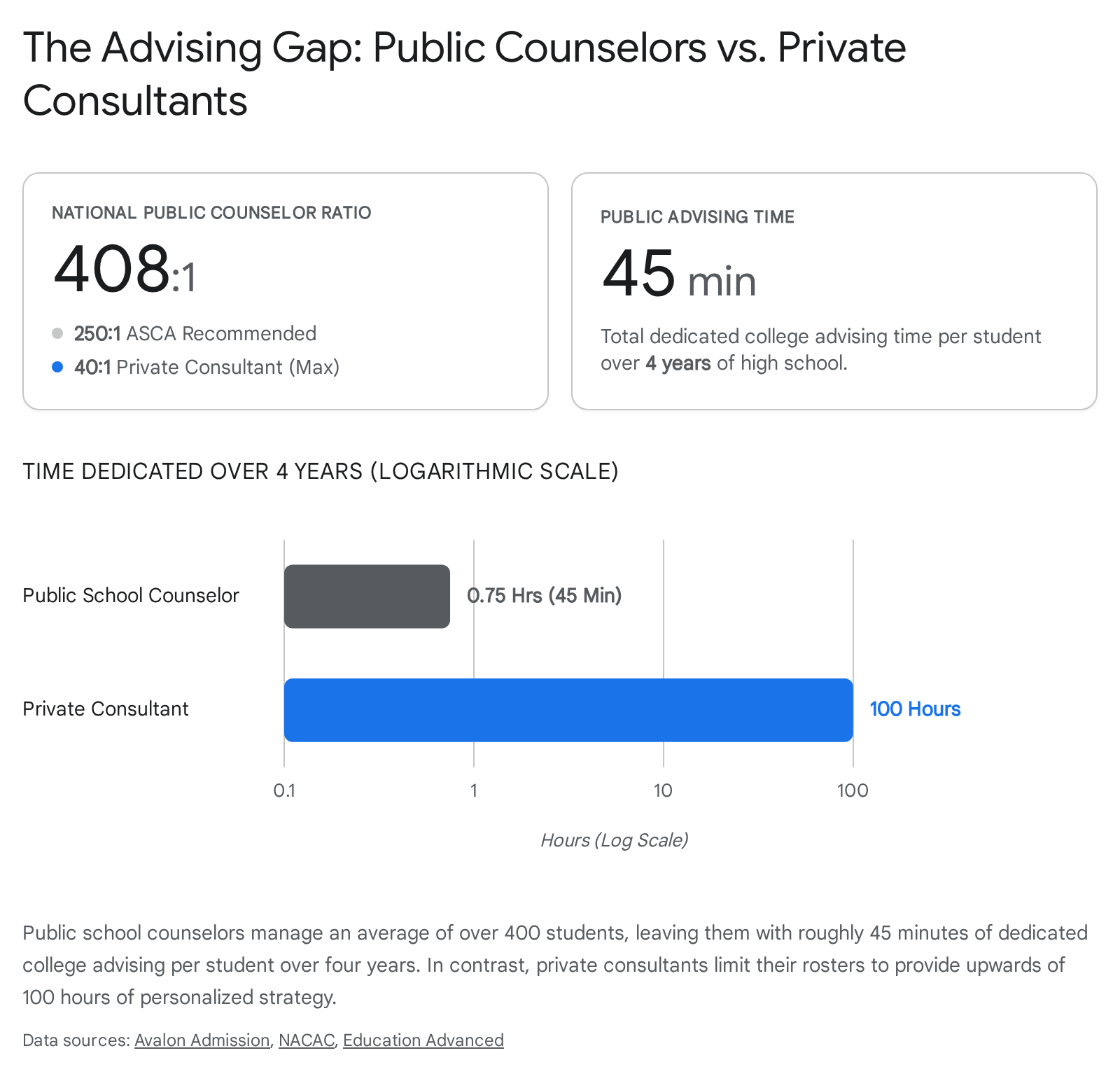
According to comprehensive tracking by the American School Counselor Association (ASCA) and the National Association for College Admission Counseling (NACAC), the national average student-to-counselor ratio in public schools hovered between 405:1 and 408:1 during recent academic years 12. This figure vastly exceeds the ASCA's recommended maximum ratio of 250:1 12. The disparity is particularly acute in specific geographic regions; for instance, Arizona has reported ratios as high as 905:1, while states like Michigan and Illinois regularly exceed 600:1 3.
Crucially, college advising represents only a fraction of a public school counselor's purview. Public school counselors report spending up to 75 percent of their time on non-college-related duties, including disciplinary interventions, psychological counseling, crisis management, course scheduling, and proctoring standardized exams 56. As a result of these overwhelming caseloads and competing administrative priorities, the average public high school student receives approximately 45 minutes of dedicated college advising over the entirety of their four years of high school 7.
By contrast, comprehensive private college consultants routinely dedicate upward of 100 hours to a single student over a multi-year period, drilling down into intricate details such as course sequencing, extracurricular narrative building, and essay refinement 74.
This chasm in resource allocation means that proactive families are often forced to independently conduct their own research or outsource the labor to the private sector 6. The consulting industry thrives precisely because it fills this structural vacuum, providing the individualized attention that public infrastructure cannot currently support.
How much do college admissions consultants actually cost?
The financial commitment required to secure a college admissions consultant is highly variable, dictated by the scope of the engagement, the prestige of the consulting firm, and the geographic market. Industry data indicates that the cost of admissions guidance is heavily segmented, ranging from tax-payer-funded public resources to luxury concierge services that rival a year of college tuition in their own right.
At the baseline, public school counseling is free, though its efficacy is severely limited by the aforementioned resource constraints. For families seeking targeted, modular assistance, many consultants offer "a la carte" hourly services. An hourly essay coach or application strategist typically charges between $150 and $300 per hour 9. In these arrangements, students might purchase a five-to-fifteen-hour block during their senior year specifically dedicated to brainstorming personal statements, refining supplemental essays, or conducting mock interviews 910. This model allows families who cannot afford a multi-year retainer to still purchase specialized expertise for the most daunting aspects of the application.
Moving up the market, the traditional comprehensive multi-year consultant package covers the student from late sophomore or junior year through final college selection. Industry benchmarks place these comprehensive packages between $4,000 and $15,000 10. These engagements involve long-term academic planning, extracurricular narrative building, summer program selection, complete college list curation, financial aid strategy, and rigorous management of all essays and deadlines 910.
At the apex of the market are elite or international boutique firms. Firms marketing themselves as elite - often boasting staffs composed entirely of former Ivy League admissions officers - charge a significant premium, with comprehensive packages frequently exceeding $25,000 to $80,000 115. These luxury services function as full-scale life coaching, offering specialized research and publication placement, legacy and donor strategy, athletic recruitment videos, and, in the case of international students, complex visa and standardized test planning 11513. In international markets, particularly China, the stakes and costs are exceptionally high, with top-tier agencies charging tens of thousands of dollars to navigate the complex translation of international credentials into the American holistic review system 115.
| Service Tier | Average Cost | Time Spent per Student | Specific Services Provided |
|---|---|---|---|
| Public School Counselor | Free (Taxpayer Funded) | ~45 minutes total over 4 years 7 | General graduation tracking, basic course scheduling, uploading official transcripts, writing standardized letters of recommendation 25. |
| Hourly Essay/Strategy Coach | $150 - $300+ per hour 9 | 5 - 15 hours (Senior Year) | A la carte services: Essay brainstorming, structural editing, final application review, or targeted interview preparation 910. |
| Comprehensive Multi-Year Consultant | $4,000 - $15,000+ per package 10 | 50 - 100+ hours (Grades 9 - 12) 7 | Long-term academic planning, extracurricular narrative building, summer program selection, complete college list curation, financial aid strategy, and management of all essays and deadlines 910. |
| Elite / International Boutique | $25,000 - $80,000+ 115 | Unlimited / Concierge | Full-scale life coaching, specialized research/publication placement, legacy/donor strategy, athletic recruitment videos, visa and standardized test planning (highly prevalent in Asian markets) 11513. |
Recent Developments (2023+): The Triple Shock to the System
The value proposition of college admissions consultants has historically been tied to reducing friction, managing deadlines, and mitigating household anxiety. However, a series of unprecedented systemic shocks between 2023 and 2026 transformed the consultant's role from a simple project manager to an essential crisis navigator. Three major developments permanently altered the admissions landscape, forcing consultants to radically shift their strategies.
The Supreme Court's Affirmative Action Ruling
In June 2023, the U.S. Supreme Court struck down race-conscious admissions in Students for Fair Admissions (SFFA) v. Harvard and SFFA v. UNC, effectively ending four decades of affirmative action precedent 146. The ruling dictated that universities could no longer use race as an explicit demographic checkbox in admissions decisions 16. However, Chief Justice John Roberts included a specific, highly scrutinized carveout: universities are permitted to consider an applicant's discussion of how race or systemic adversity affected their life, provided it is tied to individual courage, determination, or unique perspectives 177.
This "essay carveout" triggered a seismic shift in admissions strategy. Without the ability to explicitly consider demographic data, the personal statement and supplemental essays became the primary, high-stakes vehicles for demonstrating diversity, resilience, and unique campus contribution 177. Admissions consultants quickly adapted their value proposition to focus intensely on narrative storytelling. Independent education journalists and researchers noted that this shift placed an unprecedented premium on sophisticated essay coaching. Crafting a narrative that effectively communicates identity, heritage, and adversity without appearing legally contentious or politically polarizing requires a high degree of calibration - a skill set that paid consultants actively market 17. The end of affirmative action inadvertently increased the demand for elite consulting, as families sought experts who could help students "read between the lines" of new, complex supplemental essay prompts designed to glean background indirectly 1417.
The Whiplash of Test-Optional vs. Test-Required
The COVID-19 pandemic catalyzed a massive, seemingly permanent shift toward test-optional admissions, with over 80 percent of colleges dropping SAT/ACT requirements by the early 2020s 89. However, the resulting data presented a new reality for admissions officers: without standardized tests, they struggled to accurately differentiate among thousands of applicants presenting with perfect grade point averages, a symptom of rampant, systemic grade inflation 1721.
By 2024, an abrupt reversal occurred among elite institutions. Groundbreaking research from economic organizations like Opportunity Insights revealed that standardized test scores were highly predictive of post-college success, early-career earnings, and academic readiness, far more so than high school GPAs 1011. Consequently, highly selective institutions - including MIT, Georgetown, Dartmouth, Yale, Brown, and Harvard - reinstated mandatory testing requirements 89.
For applicants and their families, this sudden policy whiplash created strategic paralysis. Students were suddenly forced to pivot back to intensive test preparation or carefully calculate which schools on their list required scores and which did not 21. Consultants capitalized heavily on this confusion, offering specialized "standardized test strategy" sessions to advise students on the nuanced game theory of whether to submit a borderline score to a test-optional school or withhold it 13. The lack of a uniform national testing policy has made the consultant's role as a strategic forecaster more critical than ever.
The FAFSA Rollout Fiasco
In an attempt to simplify the Free Application for Federal Student Aid (FAFSA), the U.S. Department of Education completely overhauled the application system for the 2024 - 2025 academic year 12. The rollout was widely documented by independent journalists as a historic failure, plagued by technical glitches, delayed data transmissions, and incorrect aid calculations 1326.
The resulting delays meant that millions of students did not receive their financial aid packages until weeks before - or sometimes after - traditional May 1 commitment deadlines 1213. First-year college enrollment of 18-year-olds fell by an alarming 5 percent in the fall of 2024, a decline experts largely attribute to the FAFSA disaster, which disproportionately devastated low-income and first-generation students 14. In this chaotic environment, affluent families utilizing consultants had a distinct, structural advantage. Independent counselors were able to help families interpret estimated net price calculators, aggressively negotiate with financial aid offices, and navigate the shifting, chaotic deadlines, ensuring their paying clients were not frozen out of the enrollment system while lower-income peers were left waiting for government data to clear 29.
Do consultants really increase your chances of getting in?
This is the central, often agonizing question for any family considering the investment. The answer requires detangling a profound statistical web of correlation versus causation. Industry marketing materials and public relations arms, such as those from the Independent Educational Consultants Association (IECA), frequently boast statistics claiming that their clients are "three times more likely to be admitted" to out-of-state or private institutions 4. However, consumers must treat these industry-funded statistics with extreme skepticism. Independent academic research paints a much more nuanced picture, highlighting that the types of families who can afford to hire consultants already possess deep structural advantages that inflate their acceptance rates long before an application is ever submitted.
The most definitive and exhaustive research on this topic comes from Opportunity Insights, a team of economists led by Raj Chetty, David Deming, and John Friedman. Their landmark 2023 study analyzed anonymized tax records linked to SAT/ACT scores and admissions data for Ivy-Plus colleges (the Ivy League, Stanford, MIT, Duke, and UChicago) 1516. The findings were stark and definitive: Children from families in the top 1 percent of the income distribution are more than twice as likely to attend an Ivy-Plus college as students from middle-class families with the exact same SAT or ACT scores 1532.
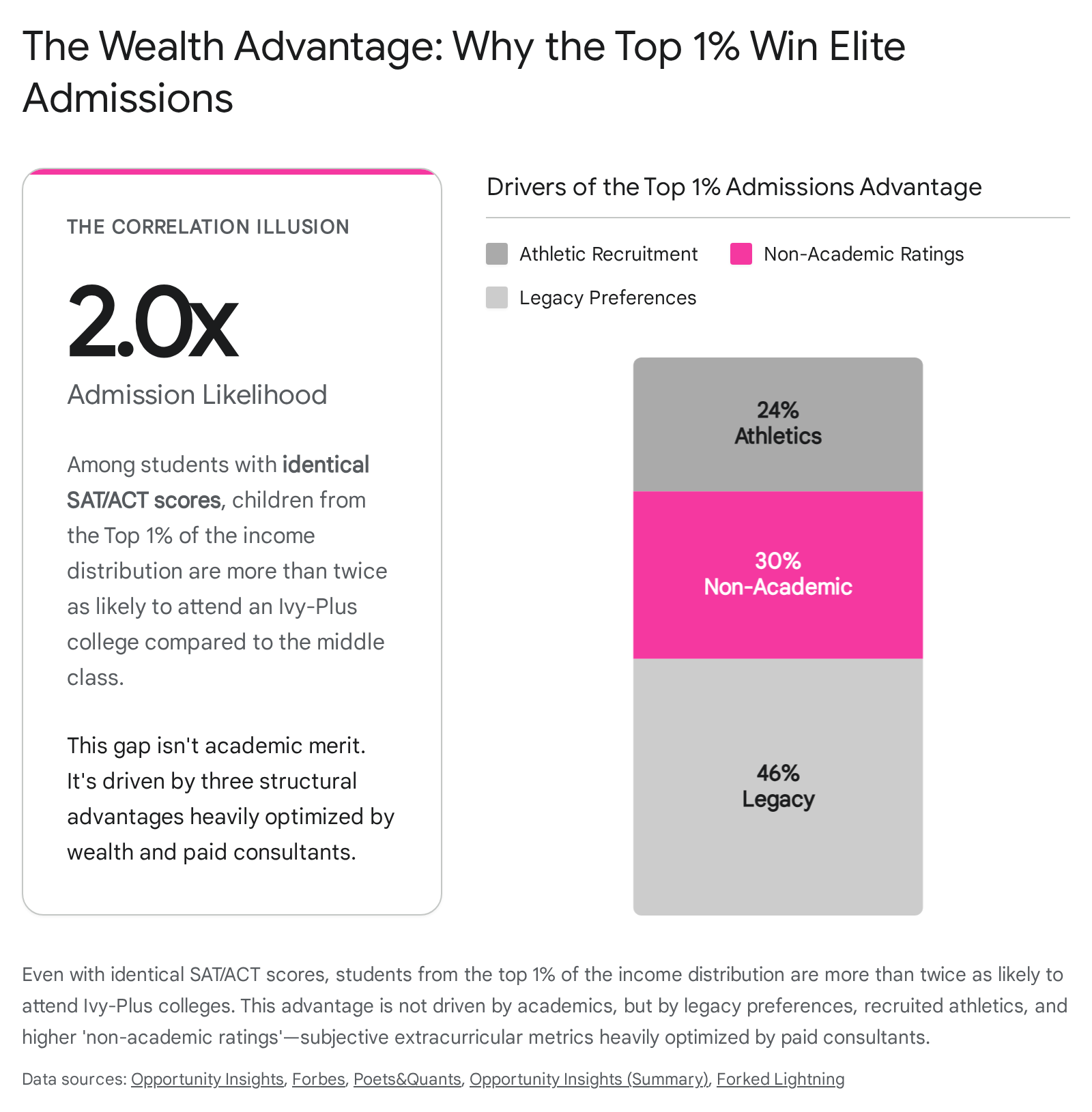
The researchers identified three primary drivers for this massive high-income admissions advantage. The first is legacy preferences, which show deep favoritism toward children of alumni who are overwhelmingly wealthy 1517. The second is athletic recruitment; wealthy students disproportionately participate in niche, expensive sports such as fencing, rowing, sailing, and lacrosse, which elite colleges recruit for heavily 1734. The third, and most critical for understanding the consulting industry, is non-academic ratings. These are the highly subjective scores given by admissions officers for an applicant's extracurricular activities, leadership capacity, and personal traits 1718.
It is precisely within this third category - the non-academic rating - that the impact of the college admissions consultant is most visible and potent. Chetty's data shows that students from private high schools, who are exponentially more likely to utilize private consultants, receive significantly higher non-academic ratings than their public school peers with identical test scores and academic records 18.
Consultants do not magically increase a student's innate intelligence or academic aptitude. Rather, they serve as highly paid architects of the non-academic profile. A skilled consultant understands that top colleges do not want generally "well-rounded" students; they want a "well-rounded class" made up of highly specialized, "angular" students 36. A consultant will advise a high school freshman to drop generic, low-impact activities and instead focus deeply on one specific, highly curated passion project. This might involve launching an independent research initiative, securing a specialized corporate internship, or founding a targeted community organization 3637. This long-term, strategic curation directly and artificially inflates the "non-academic rating" that elite colleges use as a tie-breaker to distinguish between thousands of applicants with flawless academic transcripts 1838.
Therefore, explicitly attributing a student's admissions success solely to the consultant is a statistical fallacy. Wealthy students who can afford a $15,000 consultant also possess the requisite capital to fund unpaid summer research internships, afford intensive SAT tutoring regimens, and attend elite high schools with robust institutional connections 1139. The consultant is a multiplier of existing privilege, optimizing a foundation that is already structurally primed for success; they are not an alchemist who turns a sub-par academic record into an Ivy League acceptance 3840. As noted in admissions forums, a wealthy applicant with top scores is already on a trajectory for success; the consultant's job is simply to ensure they do not make unforced strategic errors in their essays that would derail that trajectory 1141. Furthermore, researchers like Christopher Avery have long documented the immense statistical advantage of applying Early Decision, which boosts yield but favors affluent students who do not need to compare financial aid packages - another strategic lever consultants pull heavily for their clients 4219.
Common Misconceptions
The anxiety surrounding college admissions breeds profound misinformation and predatory marketing. To evaluate the true value of an independent consultant, it is critical to debunk the most pervasive myths surrounding the industry.
A primary misconception is that hiring an expensive consultant guarantees admission to an Ivy League or highly selective university. The reality is that no ethical consultant can or will guarantee admission to any specific institution, particularly those with acceptance rates plummeting below five percent 44. The admissions process at these elite tiers is heavily dictated by institutional priorities that are entirely invisible to the public and beyond the control of any external consultant. An institution may need to fill a specific orchestra seat, balance a geographic quota by admitting a student from a rural state, or prioritize a major donor's child 20. Consultants who claim to have "special connections" to admissions offices or guarantee placement are engaging in marketing falsehoods; following the "Varsity Blues" scandal, universities and professional organizations like NACAC have cracked down severely on these unethical promises 4446.
Another widespread myth is that consultants actively write the application essays for the student. Legitimate, ethically bound consultants do not engage in ghostwriting. Professional organizations like NACAC and the Independent Educational Consultants Association (IECA) have stringent guidelines that explicitly forbid members from fabricating narratives or writing on behalf of the applicant 2148. While rogue operators - particularly those functioning in loosely regulated international markets - have been caught committing application fraud, ethical consultants act strictly as editors and Socratic guides 4149. They work to help students brainstorm topics, structure their narratives for maximum impact, and refine their tone, ensuring the final product remains authentically in the voice of a seventeen-year-old high school student 1136.
Finally, there is a lingering fear among families that colleges actively penalize applicants if they discover a consultant was used. In practice, admissions officers generally do not penalize students for utilizing consultants, primarily because it is nearly impossible to definitively prove 40. Furthermore, wealthy students attending elite private preparatory schools essentially receive "consultant-level" packaging from their highly paid, low-caseload internal school counselors, making it hypocritical for colleges to penalize external help 11. However, admissions officers are highly trained to detect and penalize applications that feel over-polished, sterile, or fundamentally lacking in an authentic teenage voice 3650. If an essay reads as though it were drafted by a middle-aged public relations executive, it will trigger immediate skepticism and likely result in rejection. The hallmark of the best consulting work is that it is entirely invisible in the final application; the consultant's labor highlights the student's unique attributes rather than masking them behind corporate prose 3641.
Geographic and Demographic Disparities
The market for admissions consulting is not evenly distributed across the population. Access to guidance and strategic maneuvering is heavily fractured along lines of geography, socioeconomic status, and nationality, creating distinct micro-economies within the consulting industry.
The Rural-Urban Divide
While much of the media anxiety regarding elite college admissions is concentrated in affluent urban centers and wealthy suburban zip codes, a silent educational crisis exists in rural America. Statistical data reveals a profound disconnect: rural high school students actually graduate at higher rates (90 percent) than their urban (82 percent) and suburban (89 percent) peers 22. However, despite this higher graduation rate, only 55 percent of rural students transition directly to college, compared to 64 percent of suburban students 2223.
This glaring gap is driven by severe, systemic resource deficits. For example, only 33 percent of rural high schools are able to offer Advanced Placement (AP) math courses, which drastically lowers their students' academic competitiveness for elite institutions before an application is even opened 23. Furthermore, elite college recruiters notoriously neglect rural areas. Studies by researchers at institutions like UCLA demonstrate that recruiters overwhelmingly favor higher-income public and private high schools in major metropolitan areas due to the logistical inefficiency of visiting sparsely populated regions 2253. Consequently, rural students often suffer from acute "imposter syndrome" and entirely lack peer networks navigating the complex admissions process 2253. The private consulting market largely ignores these areas as well, focusing its marketing muscle almost exclusively on high-income suburban enclaves where parents have the disposable income to afford their services.
The International Applicant Market
For international students, the college admissions consultant is rarely viewed as a luxury; rather, it is seen as an absolute necessity to bridge the vast cultural and structural gap between foreign educational systems and the American holistic admissions model. In major source countries like China and India, university admission is traditionally determined by a single, high-stakes, objective standardized test, such as the Gaokao in China 554.
Translating a student profile built entirely for a test-centric, rote-memorization system into the American holistic model - which demands demonstrated leadership, community service impact, and deeply reflective personal essays - is incredibly jarring for foreign families 554. Consequently, reliance on consultants is massive; industry surveys indicate that up to 60 percent of Chinese applicants to U.S. schools utilize agents or independent consultants to translate their achievements into American institutional expectations 5.
Notably, recent data from the 2023 - 2024 academic year reveals a historic demographic shift that is altering the international consulting landscape: India has officially surpassed China as the largest source of international students in the United States 55. Driven by escalating geopolitical tensions, heightened U.S.-China visa scrutiny, and China's shrinking youth demographic, Chinese student enrollments have declined by 22 percent since 2019 55. Indian students, conversely, are applying in record numbers. Intriguingly, data shows that Indian applicants are distributing themselves much more broadly across mid-tier public universities and technology-focused institutions, rather than concentrating exclusively on the highest-ranked coastal elite universities favored by the Chinese market 55. This rapid shift is forcing international consulting firms to quickly adjust their business models, fee structures, and institutional knowledge bases to cater effectively to the surging Indian demographic.
Are there reliable free alternatives?
Recognizing the immense equity gap created by the booming private consulting market, a robust ecosystem of non-profit organizations, institutional partnerships, and free digital resources has emerged to support high-achieving, low-income, and first-generation students. These alternatives strive to replicate the strategic advantages of paid consultants without the prohibitive price tag.
Community-Based Organizations (CBOs) are at the forefront of this effort. Non-profits such as College Possible, iMentor, and OneGoal provide dedicated, multi-year coaching that guides students from high school course selection straight through to college graduation 5657. These organizations function much like comprehensive private IECs, offering personalized mentorship, essay review, and financial aid guidance, but they provide these services entirely free of charge for eligible low-income students.
National match programs also offer highly effective pathways. Organizations like QuestBridge are specifically designed to bridge the opportunity gap by connecting high-achieving, low-income students with over 50 of the nation's most selective colleges 56. QuestBridge offers a specialized, early application pathway that culminates in the National College Match, which provides full-ride scholarships to admitted students 56. Similarly, the Matchlighters Scholars Program pairs high-achieving, lower-income students with experienced private college counselors who donate their expertise and time pro bono, granting these students the exact same caliber of advice that wealthy families purchase 58.
Furthermore, many elite private consulting firms, recognizing their inherent role in exacerbating educational inequity, now operate dedicated pro bono divisions. Programs like IvyWise Scholars provide free, comprehensive counseling and standardized test tutoring to selected high-achieving, low-income applicants, guiding them through every facet of the preparation process 59. Finally, the proliferation of high-quality, free digital resources has democratized access to baseline admissions strategy. Platforms like CollegeData offer sophisticated, free scholarship finders and admissions calculators, while independent educational advocates provide vast, accessible libraries of free essay workshops, timeline checklists, and structural writing guides online 5860.
Bottom line
The college admissions landscape has evolved into a highly complex, high-stakes ecosystem characterized by shifting testing policies, the elimination of affirmative action, and chaotic financial aid rollouts. In this fractured environment, the independent educational consultant has transitioned from a luxury proofreader into a specialized project manager, strategically optimizing a student's non-academic profile to appeal to the highly subjective criteria of holistic admissions review.
The core takeaway for families is that the demand for consultants is fueled by a genuine structural deficit: public school counselors, burdened by massive caseloads, simply do not have the time to provide bespoke college strategy. However, it is vital to recognize that consultants act as wealth multipliers, not miracle workers. Peer-reviewed economic data confirms that while wealthy students have a massive statistical advantage in elite admissions, this is primarily due to embedded structural privileges - legacy status, access to elite private schools, and participation in expensive niche sports. Consultants amplify this existing privilege by perfectly calibrating the student's narrative and ensuring no strategic errors are made; they cannot manufacture academic merit out of thin air. Furthermore, the consulting arms race exacerbates deep national inequalities, particularly disenfranchising rural domestic students and creating a high-priced barrier to entry for international applicants adapting to the American system. Ultimately, the most effective consultants do not write essays or guarantee admission; they act as editors and strategic guides, ensuring the student's authentic voice shines through a highly engineered process.
What this means for the average family is a necessary calibration of expectations. If a family requires an outsourced project manager to preserve household harmony, track complex deadlines, and refine essay structures, a consultant is a highly effective, albeit expensive, tool. However, if the expectation is that a consultant will buy access to an Ivy League institution for a student who lacks the underlying academic foundation, the investment will yield nothing but frustration.
Looking toward 2025 and 2026, several lingering uncertainties will continue to shape the value proposition of the consulting industry. The long-term legal and practical ramifications of the Supreme Court's affirmative action ban continue to unfold, with universities quietly monitoring how new "adversity essays" impact diversity yields, leaving consultants to guess at shifting institutional priorities. Additionally, the rapid integration of Artificial Intelligence by both students for essay drafting and universities for algorithmic application screening threatens to upend the traditional evaluation process entirely, potentially rendering traditional essay coaching obsolete. Finally, as more public institutions adopt automated "direct admissions" policies to combat widespread enrollment declines, the role of the bespoke consultant may become increasingly localized strictly to the upper echelon of hyper-selective elite universities, rather than remaining relevant to the broader higher education market.