
SEO vs GEO: What's the Difference for Marketers
Traditional Search Engine Optimization (SEO) focuses on driving website traffic by securing top rankings for specific keywords, whereas Generative Engine Optimization (GEO) aims to secure brand citations directly within AI-generated answers. As artificial intelligence intercepts user queries and synthesizes information before a click ever occurs, marketers must adapt to a "zero-click" environment where becoming a trusted AI reference often yields fewer but significantly higher-converting leads.
The Dawn of the Generative Search Era
For over two decades, the architecture of digital marketing was built on a simple premise: a buyer had a problem, they typed a query into a search engine, and they clicked a link to discover a brand 123. This click-based ecosystem is undergoing a rapid, structural contraction. Driven by the mainstream adoption of large language models (LLMs) and conversational interfaces like ChatGPT, Perplexity, and Google's AI Overviews, user behavior is fundamentally changing.
In early 2024, the technological research and consulting firm Gartner predicted that traditional search engine query volume would drop by 25% by 2026 as users increasingly turn to AI chatbots and virtual agents for immediate answers 1242. Market data from late 2025 and early 2026 indicates this shift is actively underway. Zero-click searches - where a user's query is resolved entirely on the search results page without a click to an external website - reached nearly 60% in the United States and Europe, climbing to 69% for certain informational queries 126.
When an AI-generated summary appears at the top of a search page, organic click-through rates (CTR) plummet. Multiple datasets confirm that the presence of an AI Overview reduces organic CTR by an average of 58% to 61%, with top-ranking content experiencing a severe reduction in click volume 173. The top organic result, long considered the most valuable real estate on the internet, now delivers significantly less traffic than it did just a few years ago 14.
However, the disruption extends beyond raw traffic loss; it represents a transformation in how brand discovery happens. When a buyer asks an AI assistant for a vendor recommendation or a solution to a complex problem, they are not presented with a list of links to explore. They receive a synthesized, confident answer that implicitly ranks brands based on the model's training data and real-time web retrieval 1910. If a brand is not included in that synthesized answer, it becomes invisible during the most critical moment of the modern buyer's journey.
Defining the Ecosystem: SEO, AEO, and GEO
To navigate this landscape, it is essential to establish the boundaries of the distinct disciplines that have emerged to capture digital visibility. While often used interchangeably, SEO, Answer Engine Optimization (AEO), and GEO target different technical mechanisms and user experiences 11124.
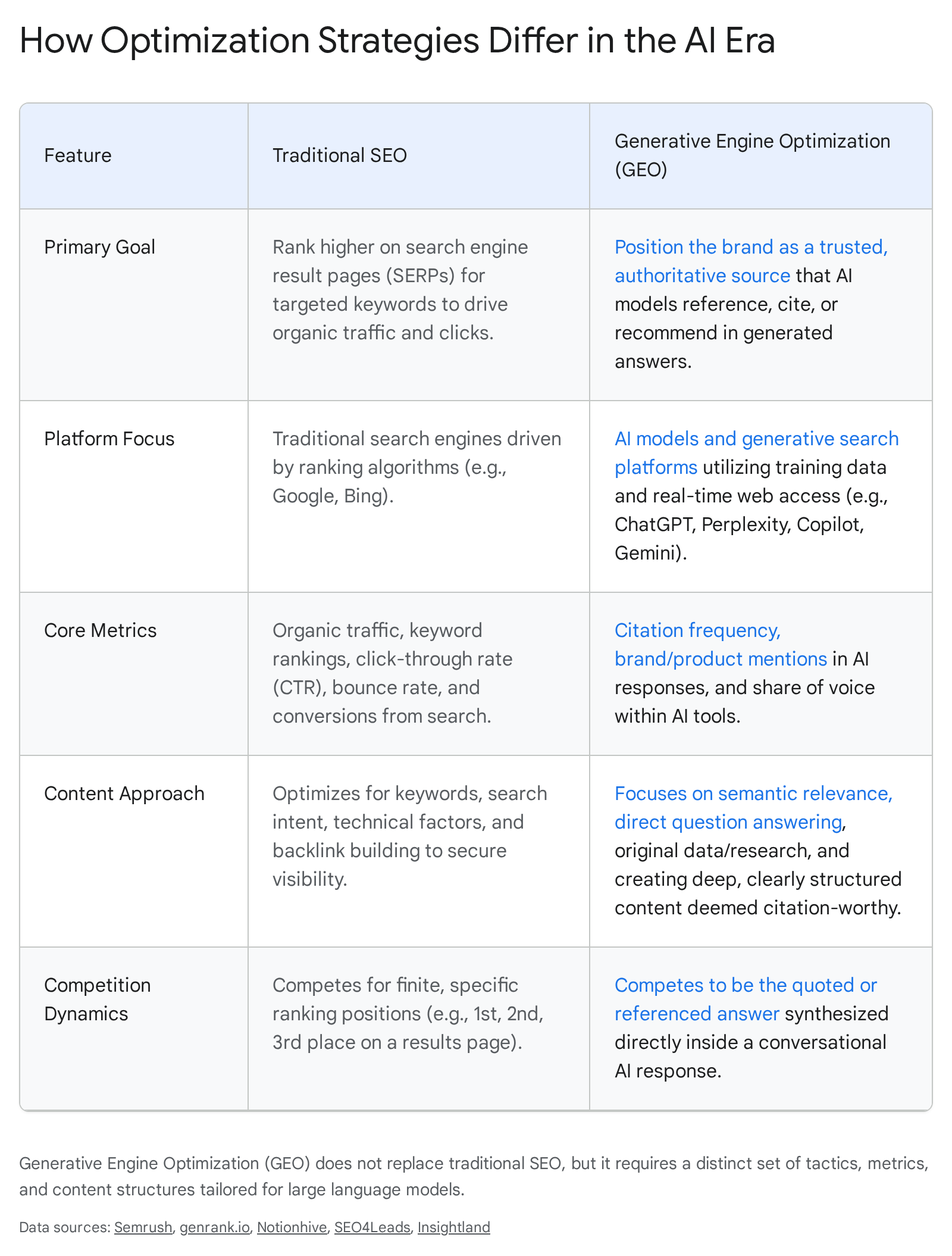
- Search Engine Optimization (SEO): The practice of improving a website's visibility on traditional search engine results pages (SERPs). The goal is to secure high rankings to drive clicks and organic traffic. It relies heavily on keyword matching, backlink profiles, domain authority, and technical website performance 11515.
- Answer Engine Optimization (AEO): A transitional discipline bridging traditional search and generative AI. AEO focuses on structuring content so it can be easily extracted by systems that provide direct, concise answers, such as voice assistants (Siri, Alexa) and traditional featured snippets. It relies heavily on strict Q&A formatting and schema markup 1112.
- Generative Engine Optimization (GEO): The practice of optimizing content to be cited, referenced, or recommended specifically within the conversational, multi-source responses generated by LLMs like ChatGPT, Perplexity, and Google Gemini. GEO focuses on establishing deep topical authority, providing verifiable statistics, and structuring content for machine comprehension 16618.
The Mechanics of Retrieval-Augmented Generation (RAG)
The mechanics of optimization differ entirely between these disciplines because the underlying technologies are fundamentally opposed. Traditional SEO optimizes for a crawler that indexes web pages to present them in a ranked list. GEO, conversely, optimizes for a Retrieval-Augmented Generation (RAG) pipeline 78.
When a generative engine processes a query, it does not look for a single authoritative document. Instead, it segments the available web content into small vector embeddings, retrieves the most semantically relevant passages, and synthesizes a net-new answer 8. Generative engines process content in these small chunks. Traditional SEO content that buries answers in long, keyword-dense paragraphs is often discarded during this extraction phase because the chunking algorithm cannot isolate a clean fact. Conversely, GEO-optimized content built with clear headings, data tables, and explicit definitions passes seamlessly through the AI extractor into the final synthesized answer 8910.
Because of this extraction process, traditional SEO ranking signals like keyword density or the raw number of backlinks carry far less weight. Instead, AI systems look for "consensus signals" - agreement across multiple independent, high-authority sources that a specific brand or product is the optimal answer 11.
New Metrics for a Zero-Click World
This extraction-based ecosystem requires an entirely new framework for measurement. Marketers can no longer rely solely on organic traffic, click-through rates, or bounce rates to determine success. Success in GEO is measured through emerging metrics designed for a conversational interface:
| Metric Category | Traditional SEO Equivalent | Description |
|---|---|---|
| Citation Frequency | Organic Traffic | The raw count of how often a brand is hyperlinked or explicitly referenced as a source in an AI-generated response 95. |
| Share of Model | Search Impression Share | The percentage of AI-generated answers for core industry queries that mention the brand compared to its competitors 25. |
| Perception Drift | Rank Tracking | A metric tracking the consistency of a brand's categorization within LLM responses over time. High volatility indicates the AI lacks a firm understanding of the brand's entity 24. |
| AI Readiness Index (ARI) | Domain Authority | A composite 0 - 100 score evaluating how prepared a brand is to be recommended, factoring in entity clarity, citation authority, and structured proof 25. |
The Financial Impact of AI Referrals
While the sheer volume of organic search traffic is declining across most industries, the quality of traffic referred by AI engines is proving to be exceptionally high. As of early 2026, AI referral traffic accounts for roughly 1.08% to 4.7% of total website traffic, depending on the sector and the specific tracking methodology utilized 262728. Though this absolute volume appears marginal compared to legacy Google search, its growth velocity and conversion efficiency are unprecedented.
AI referral traffic grew by an estimated 357% to 975% year-over-year between early 2025 and 2026, marking it as the fastest-growing acquisition channel in the digital landscape 32429. More importantly, visitors arriving from AI platforms convert at substantially higher rates than traditional search visitors.
Because generative engines process natural language and possess deep reasoning capabilities, they excel at narrowing down options and refining a user's intent before a click ever occurs. When a user asks an AI tool for a recommendation, they are effectively skipping the top-of-funnel research phase and moving directly to the vendor selection or purchase phase 330. By the time they click a citation link to visit a website, their intent is crystallized.
Industry benchmarks compiled in 2026 demonstrate that the median website conversion rate for traditional organic search hovers around 2.86% 27. In contrast, average AI search referrals convert at 3.49%, with traffic originating specifically from ChatGPT hitting 3.71% 27.
In specialized B2B sectors characterized by complex sales cycles, such as technology consulting and managed IT services, the difference is profound. One large-scale study of 312 B2B tech firms found that while AI traffic accounted for only a single-digit percentage of overall volume, those visitors converted at a staggering 14.2% - roughly five times the rate of Google organic traffic 329.
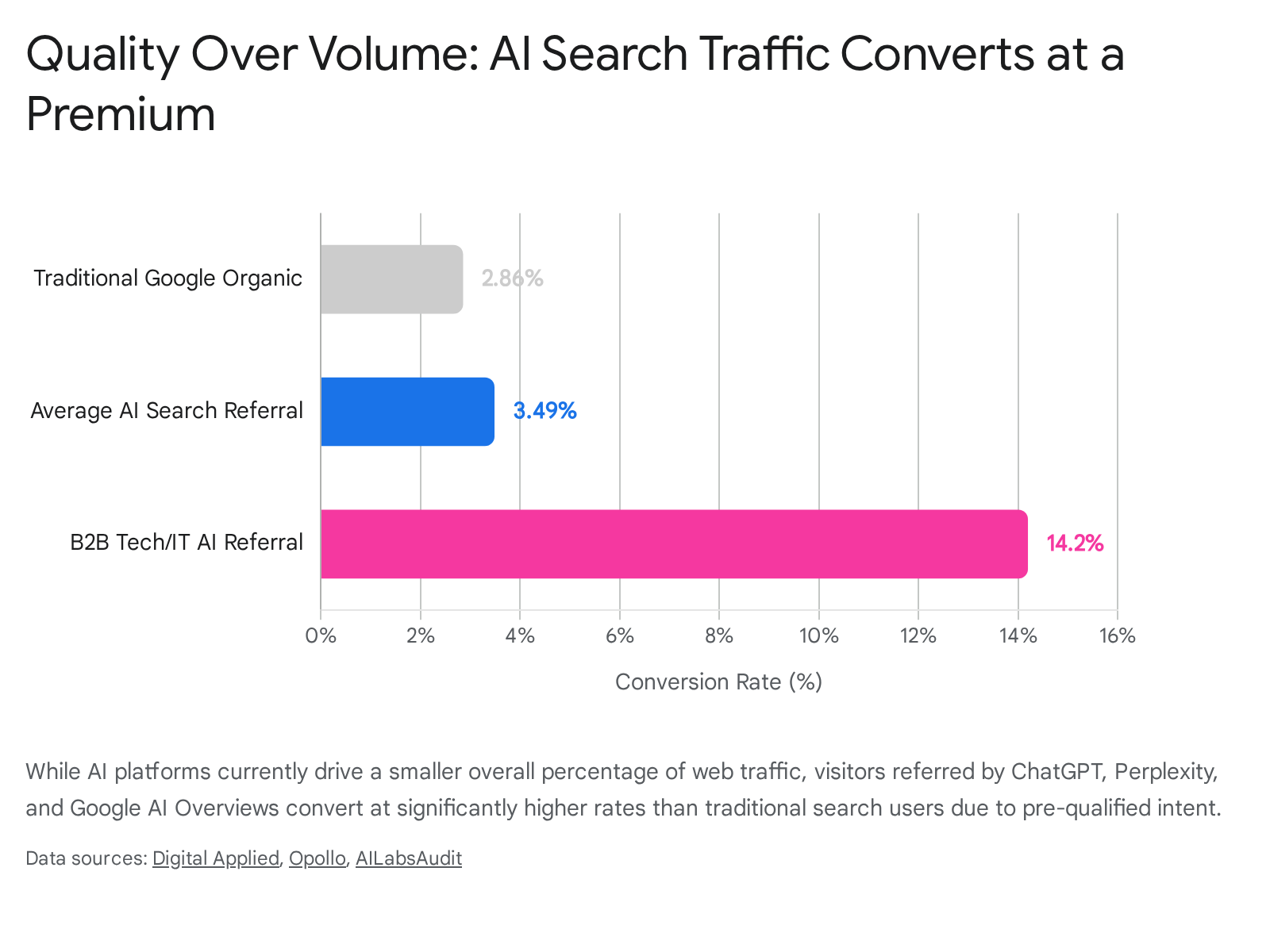
The dynamic is clear: brands cited in AI answers receive less raw traffic, but the traffic they do capture is ready to transact 31.
How Different AI Platforms Choose Sources
A persistent vulnerability in early GEO strategies is treating "AI search" as a monolith. Generative engines are highly fragmented; they utilize different underlying models, rely on distinct web retrieval mechanisms, and prioritize entirely different trust signals 1012.
Research analyzing hundreds of millions of AI citations reveals that only about 11% of cited domains appear across multiple platforms 1213. A unified SEO strategy that secures the top position on Google will not automatically translate to visibility on ChatGPT or Perplexity.
| AI Platform | Underlying Index / Retrieval | Core Optimization Priority | Citation Behavior |
|---|---|---|---|
| ChatGPT | Training Data + Bing Search 13 | Consensus and established authority. | Favors encyclopedic sources (Wikipedia), established media, and aggregated competitor data 1014. |
| Perplexity | Proprietary Real-Time Index 1213 | Freshness and community validation. | High reliance on peer discussions (Reddit), real-time news, and recently updated content 101314. |
| Google AI Overviews | Google Organic Index 713 | Traditional SEO ranking + structural extraction. | 97% of citations pull from the top 20 existing organic results 710. |
| Google AI Mode | Gemini 3.5 Flash (Query Fan-Out) 1516 | Modular content covering sub-topics. | Rarely overlaps with AI Overviews (13.7%); requires highly specific, segmented answers 1316. |
ChatGPT: The Consensus Synthesizer
ChatGPT accounts for the vast majority of AI referral traffic, estimated at over 87% of all LLM-driven visits 2628. It relies on a combination of its underlying pre-trained knowledge base and real-time retrieval via Microsoft's Bing search index 13.
Because it operates primarily as a conversational synthesizer rather than a pure search engine, ChatGPT heavily favors consensus. It seeks agreement across multiple independent sources before confidently citing a brand 11. Consequently, it is most likely to cite established, encyclopedic knowledge bases - Wikipedia represents roughly 7.8% of its total citations - as well as aggregate industry reviews 1014. For a brand to be recommended by ChatGPT, it requires a robust "digital footprint." The model looks for consistency across third-party review sites, industry publications, and technical forums. Relying solely on an optimized company blog is rarely sufficient to trigger a ChatGPT recommendation, as the model interprets third-party validation as a necessary trust signal 101137.
Perplexity: The Real-Time Research Assistant
Perplexity operates distinctly from ChatGPT. It is built entirely around Retrieval-Augmented Generation, meaning every single query triggers a real-time web search against a proprietary index of billions of URLs; it does not answer "from memory" 712.
Perplexity's retrieval algorithm heavily weights freshness and community validation. Content updated within the last 30 days is significantly more likely to be cited by Perplexity than older material, with one study showing an 82% citation rate for recent content compared to 37% for older pages 713. Furthermore, Perplexity demonstrates a strong affinity for peer-to-peer information, with Reddit serving as one of its top citation sources (representing up to 46.7% of top citations in some specific B2B contexts) 1014. To succeed on Perplexity, marketers must publish frequently, clearly date their content, and actively ensure their brand is part of industry forum discussions.
Google AI Overviews vs. Google AI Mode
Google currently operates two distinct generative search interfaces, creating immense confusion for marketers 151638.
Google AI Overviews appear automatically at the top of standard search results pages. Powered by the Gemini 2.5 model, AI Overviews function as synthesized summaries of the traditional web index 1538. Because they are deeply tied to Google's core ranking systems, traditional SEO remains highly relevant here. Data indicates that 97% of the sources cited in AI Overviews come from pages that already rank in the top 20 organic results 710. For AI Overviews, traditional SEO authority combined with easily extractable content formatting is the required formula 37.
Google AI Mode, conversely, is a separate, opt-in conversational interface powered by the more advanced Gemini 3.5 Flash model 1516. It completely replaces the traditional ten blue links. AI Mode relies heavily on a mechanism called "query fan-out." When a user asks a complex question, the model simultaneously breaks the prompt down into up to 16 parallel sub-queries, retrieving distinct chunks of text for each facet of the question 161740.
Crucially, the overlap in citations between Google's AI Overviews and Google AI Mode is remarkably low - only 13.7% 1316. Optimizing for AI Mode requires extreme content specificity. A single, monolithic article is less effective than modular formatting that allows the engine to extract individual paragraphs or statistics to satisfy one specific node of a fanned-out query 17.
The Science of GEO: Insights from the Princeton Benchmark
The shift from speculative SEO advice to empirical GEO strategy was catalyzed by a landmark 2023 research paper, subsequently published at the prestigious KDD 2024 conference. Authored by researchers from Princeton University, Georgia Tech, the Allen Institute for AI, and IIT Delhi, the study formalized the discipline 618411819.
The researchers created "GEO-Bench," a massive benchmark of 10,000 diverse user queries spanning 25 domains. They systematically tested nine distinct content modification strategies to observe which tactics actually influenced the black-box retrieval systems of generative engines 182045. The results provided the first scientific roadmap for AI optimization, demonstrating that targeted content modifications could increase visibility inside AI-generated answers by up to 40% 412021.
High-Impact Strategies That Drive Citations
The Princeton study identified three techniques that yielded massive visibility improvements across almost all tested domains:
| GEO Modification Strategy | Average Visibility Increase | Mechanism of Action |
|---|---|---|
| Statistics Addition | +30% to +40% | Embedding specific, quantitative data rather than qualitative descriptions signals factual authority to the model's extraction layer 214722. |
| Quotation Addition | +28% to +41% | Incorporating direct quotes from subject matter experts significantly boosts authenticity, particularly for queries related to news or debates 414522. |
| Cite Sources | +30% to +40% | Explicitly linking to authoritative domains (e.g., .edu, .gov, or research papers) signals to the RAG pipeline that the content is a verified node of information 2122. |
What Fails in Generative Search
Equally important was the discovery of what actively harms AI visibility. Traditional SEO "keyword stuffing" - the practice of unnaturally injecting exact-match query terms into the text - resulted in a 10% decrease in AI visibility compared to a completely unoptimized baseline 454749. Generative engines prioritize semantic depth and language fluency over raw keyword repetition.
Furthermore, the study revealed a fascinating dynamic regarding existing search rankings: top-ranked pages in traditional Google search often saw their AI visibility drop when certain modifications were made, whereas lower-ranked pages (e.g., those sitting in position five) saw massive visibility increases - up to 115% - when proper citations and statistics were added 41. This proves that securing the #1 organic spot does not guarantee AI citation; the content itself must be engineered for machine synthesis.
The CITABLE Framework for Engineering AI Visibility
Building on academic research and empirical marketing data, industry practitioners have developed systematic methodologies for content creation in the generative era. The most prominent of these is the "CITABLE" framework, designed to engineer content that satisfies both human readers and the specific retrieval needs of LLMs 1291023.
Rather than focusing on keyword density or meta descriptions, the CITABLE framework standardizes the mechanics of machine readability:
| Element | Optimization Directive | Strategic Purpose |
|---|---|---|
| C - Clear Entity & Structure | Start with a "Bottom Line Up Front" (BLUF). Provide a 40 - 60 word summary that explicitly defines the subject matter, brand, and core premise immediately 910. | Prevents the AI from hunting for context; boosts extraction likelihood by up to 140% 9. |
| I - Intent Architecture | Cluster content around the main query and its logical follow-up questions (cost, implementation, alternatives) 1040. | Satisfies the "query fan-out" behavior of advanced models like Gemini 3.5 1640. |
| T - Third-Party Validation | Reference external reviews, case studies, and industry benchmarks directly within the text 121023. | Builds the multi-source "consensus signals" that algorithms require to confirm brand authority 1011. |
| A - Answer Grounding | Ensure all claims are strictly factual and consistent with public directories (e.g., matching pricing data exactly) 410. | Prevents the LLM from discarding the source due to conflicting or hallucinatory data parameters 1025. |
| B - Block-Structured for RAG | Format content modularly using short paragraphs (100 - 180 words), clear H2/H3 headings, bulleted lists, and tables 8910. | Aligns perfectly with the vector chunking algorithms used in Retrieval-Augmented Generation 810. |
| L - Latest & Consistent | Feature explicit publication timestamps (e.g., "Updated May 2026") and undergo regular quarterly reviews 71013. | Captures citations from freshness-biased engines like Perplexity, which heavily favor 30-day update cycles 713. |
| E - Entity Graph & Schema | Define relationships explicitly using backend JSON-LD structured data (FAQ, Product, and Organization schema) 11910. | Allows LLMs to parse the exact nature and hierarchy of the web content without guessing 1110. |
Is Traditional SEO Actually Dead?
With the rapid ascent of generative engines, hyperbole surrounding the "death of SEO" has become common. However, the data strongly suggests that traditional SEO is not dead; rather, it has transitioned from being the entire funnel to serving as a foundational layer within a broader "search everywhere" strategy 1724.
There are specific sectors where traditional SEO remains fiercely protected from AI disruption. The most notable is local search. Data from early 2026 reveals that only 7.9% of local queries (e.g., "wedding photographer near me" or "plumber in Austin") trigger an AI Overview. The vast majority of local searchers still rely heavily on the traditional Google Maps "3-pack" and conventional localized results 31. For local service businesses, traditional technical SEO, Google Business Profile management, and local link-building remain the primary drivers of customer acquisition.
Furthermore, traditional SEO serves as the indexing bedrock for Google's own AI features. Because Google's AI Overviews draw up to 97% of their citations from pages that already rank in the organic top 20, a brand cannot simply ignore traditional ranking factors 710. A website with poor technical SEO, slow loading speeds, or an un-crawlable architecture will not be indexed by Google, and therefore cannot be synthesized by Gemini into an AI Overview.
For e-commerce, the paradigm is shifting toward "narrative SEO." Product pages overloaded with technical specifications but lacking comprehensive, explanatory content perform poorly in AI-generated responses 10. Generative systems reward coherence over raw keyword matching. E-commerce brands must ensure that their product descriptions, buying guides, and external reviews (from Reddit, YouTube, and third-party affiliates) all tell a consistent, verifiable story 1024.
Bottom line
The transition from traditional SEO to Generative Engine Optimization marks a fundamental shift from optimizing for traffic volume to optimizing for machine trust and citation. While traditional search engines remain crucial for local queries and base-level indexing, AI platforms are increasingly intercepting informational research, delivering highly qualified, ready-to-buy users. To remain visible, marketers must adopt a multi-platform strategy - structuring content with clear statistics, expert quotes, and modular formatting - while cultivating a consistent brand narrative across the wider web to satisfy the consensus algorithms of modern AI.