
How to Show Up in AI Search Answers
Generative Engine Optimization (GEO) is the practice of structuring digital content so that artificial intelligence platforms like ChatGPT, Perplexity, and Google AI Overviews cite your brand in their synthesized answers. Unlike traditional search engine optimization, which focuses on ranking a webpage on a list of results, GEO aims to make your content the most factual, extractable, and verifiable source of truth for an AI model to quote directly.
The Shift from Search Engines to Answer Engines
The way people discover information, compare products, and make purchasing decisions is undergoing a fundamental restructuring. For two decades, traditional search engines operated on a simple premise: crawl the web, index pages, rank them based on relevance and authority, and present the user with a list of blue links. The user was responsible for clicking through, reading the content, and synthesizing the answer themselves.
By 2026, that paradigm has shifted entirely. Generative AI tools have evolved from conversational novelties into mainstream search infrastructure. Rather than returning a list of destinations, these platforms return direct, synthesized answers. This shift is driven by hundreds of millions of users migrating to platforms like ChatGPT, Perplexity, Claude, and Google's integrated AI Overviews 123.
The statistics underpinning this transition reveal a massive change in consumer behavior. As of mid-2026, ChatGPT processes hundreds of millions of weekly queries, effectively operating as one of the top five search properties globally by query volume, and boasting over 800 to 900 million weekly active users 123. Perplexity AI processes roughly 50 million weekly queries, attracting a disproportionately high-value demographic of researchers, analysts, and corporate decision-makers, with over 100 million monthly active users 234. Meanwhile, Google's AI Overviews, powered by its Gemini models, appear on approximately 25% to 47% of all Google searches - up dramatically from previous years - reaching nearly two billion monthly users 14.
For brands and content creators, the implications of this shift are profound. When a user receives a complete answer directly in the chat interface, they have little to no incentive to click through to a website. This zero-click behavior now dominates the AI search landscape. In many cases, up to 93% of AI search sessions end without a single website click 1. Consequently, traditional organic search traffic to informational publishers has declined heavily, with some major media and business sites losing between 30% and 80% of their organic Google traffic 34.
The Conversion Rate Premium
However, while the overall volume of clicks has decreased, the commercial value of the clicks that do occur has skyrocketed. The traffic referred by large language models is highly qualified. Because the user has already engaged in a conversational back-and-forth and received a synthesized answer, a click on a citation indicates immense purchase intent.
Industry data consistently demonstrates this premium. Traffic referred by AI agents and large language models converts at significantly higher rates - often 2 to 4.4 times higher than traditional organic search traffic 145. Visitors arriving from AI platforms also tend to spend nearly 70% more time on the target website and view three times as many pages per session 45. To capture this new, high-converting audience, organizations must move beyond traditional tactics and adopt Generative Engine Optimization.
How AI Search Works: Retrieval-Augmented Generation
To understand how to optimize for AI engines, one must first understand the backend architecture that allows them to retrieve information. Generative AI search relies almost entirely on a framework known as Retrieval-Augmented Generation, or RAG 767.
A standard language model generates text based solely on the static data it ingested during its training phase. It cannot access real-time information, and it is prone to confidently fabricating facts when it lacks knowledge. RAG solves this problem by combining the reasoning capabilities of the generative model with the real-time retrieval capabilities of a search engine 1011.
The contrast between legacy systems and this new architecture is stark. The linear traditional search process involves a user submitting a query, the engine checking its index, and returning a ranked list of links. In the dynamic RAG pipeline, the system takes the user's query and converts it into a vector embedding. It then performs a knowledge retrieval step to find relevant external data, feeds that data into the language model for synthesis, and finally outputs a cohesive, cited answer.
The Four Stages of the RAG Pipeline
When a user asks a question to an AI answer engine, the system executes a precise, multi-step pipeline behind the scenes. The first step is query processing and embedding. The user's natural language query is translated into a high-dimensional mathematical vector, known as an embedding. This numerical format captures the deep semantic meaning and intent behind the words, rather than just matching literal keywords 1012. In advanced systems, this step may involve query transformation, where the AI breaks a complex question into multiple sub-queries to gather more comprehensive data 13.
The second step is vector search and retrieval. The system searches an external index - such as the live internet or a proprietary vector database - to find content with embeddings that closely match the query's vector. Unlike traditional search, which looks for whole pages, the RAG system retrieves specific, highly relevant passages or chunks of text 1114. Some sophisticated engines even use a technique called Hypothetical Document Embeddings (HyDe), where the AI generates a hypothetical perfect answer and uses that to search the database for real documents matching that ideal structure 12.
The third step involves prompt augmentation. The retrieved passages, along with their metadata and source URLs, are injected into the system's hidden prompt. The AI is essentially instructed to answer the user's query using only the provided, retrieved context 768.
Finally, the system enters the generation and attribution phase. The language model reads the retrieved context, synthesizes a fluent, natural-sounding answer, and attaches citations linking back to the specific sources it relied upon 1116. Because the AI generates its answer directly from these retrieved passages, GEO is the strategic art of ensuring your content is the most easily retrieved, cleanly parsed, and highly trusted passage available during the second step of this pipeline.
SEO vs. GEO: Understanding the Core Differences
Traditional SEO and Generative Engine Optimization are related but entirely distinct disciplines. They share a technical foundation, as a website must be fundamentally crawlable, fast, and indexable to succeed in either environment 171819. However, they diverge completely in their ultimate goals, performance metrics, and content strategies.
While SEO targets algorithms designed to rank entire documents based on link authority and keyword relevance, GEO targets language models designed to extract specific facts and synthesize human-like responses.
| Feature | Traditional SEO (Search Engine Optimization) | GEO (Generative Engine Optimization) |
|---|---|---|
| Primary Goal | Drive clicks and organic traffic to a website. | Earn citations and visibility within AI-generated answers. |
| User Experience | User sifts through ten blue links to find information. | User receives a direct, synthesized answer (Zero-click). |
| Key Metrics | Organic sessions, Keyword rankings, Click-Through Rate. | Citation frequency, Share of Voice in AI, Brand mentions. |
| Content Strategy | Long-form content, keyword optimization, persuasive copy. | Concise, answer-first structure, high factual density, statistics. |
| Authority Signal | Domain authority and inbound backlinks. | Entity strength, external brand mentions, expert quotations. |
| Algorithmic Focus | Keyword relevance and link graphs. | Semantic similarity, vector embeddings, and RAG extraction. |
Table 1: A comparison of traditional SEO and Generative Engine Optimization (GEO) strategies and metrics 92110.
Why Traditional Authority Signals Are Changing
One of the most critical conceptual shifts in the transition from SEO to GEO is moving away from keyword density and traditional backlink building. AI engines do not care how many times a keyword appears on a page. They evaluate content based on semantic clarity, factual accuracy, and structural logic.
Furthermore, the concept of domain authority has evolved. Traditional SEO relies heavily on inbound backlinks as a proxy for trust. AI engines, however, weigh entity consistency and unlinked brand mentions across the web much more heavily. Industry analyses of millions of AI Overviews reveal that brand mentions correlate with AI citation probability at a rate of 0.664, whereas traditional backlinks correlate at just 0.218 11.
If independent, credible sources - such as news outlets, Wikipedia, or industry forums - frequently mention a brand in relation to a specific topic, the AI model builds a strong associative link between that entity and the topic. This entity strength makes the AI vastly more likely to select that brand as a cited source during the generation phase 1112.
The Science of Citability: The Princeton GEO Study
For years, search optimization relied on a mixture of leaked algorithms, trial and error, and industry folklore. Generative Engine Optimization, however, was born with a rigorously documented academic foundation. In late 2023, researchers from Princeton University, Georgia Tech, IIT Delhi, and the Allen Institute for AI published a landmark study that formalized the field of GEO 132614.
The research team developed a benchmark called GEO-Bench, consisting of 10,000 diverse queries. They tested nine distinct content modification strategies to see which techniques actually convinced generative AI models to cite a specific source over its competitors 2615. The results systematically dismantled several long-held SEO beliefs and established the core tenets of AI visibility.
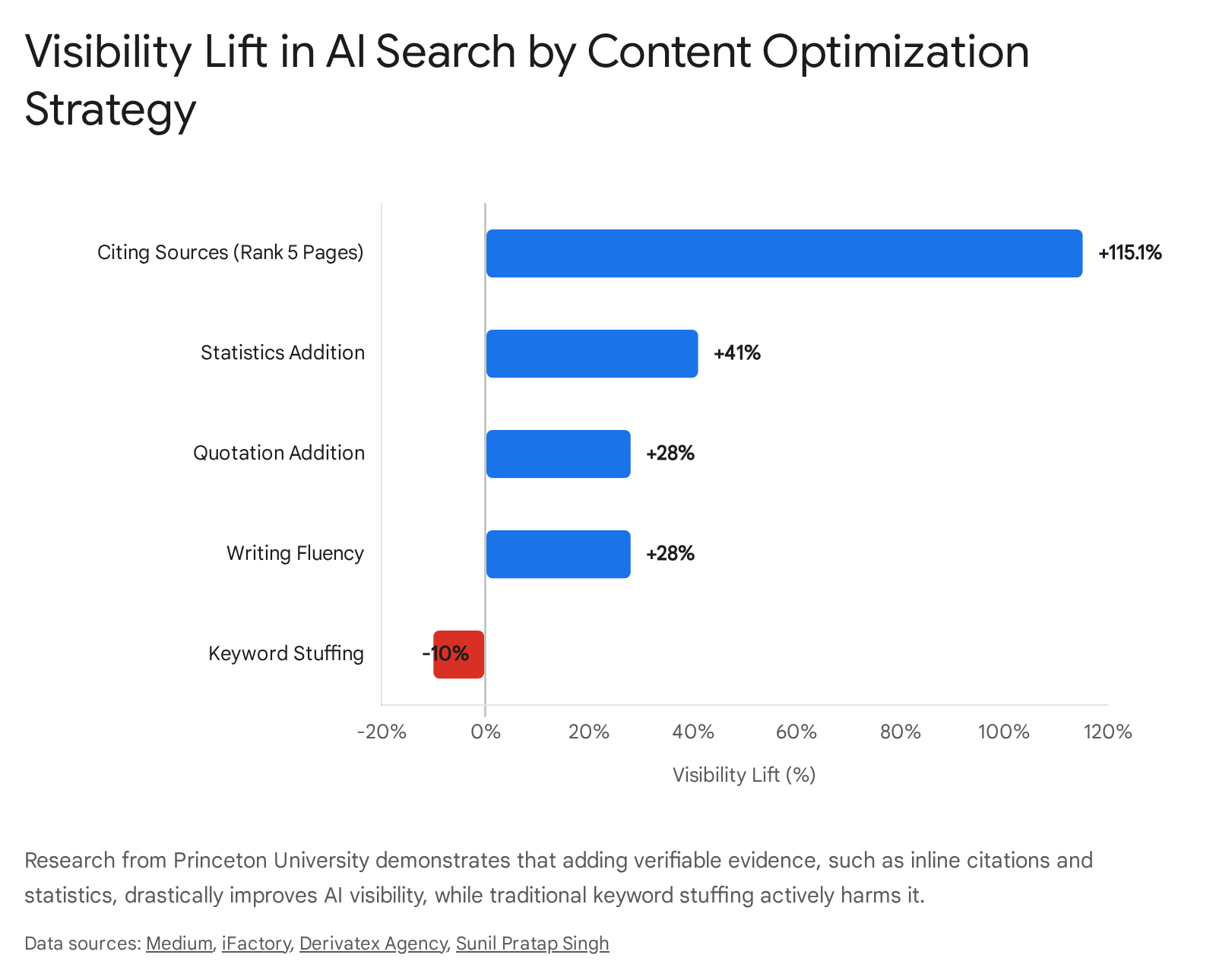
The researchers discovered that simple, targeted modifications to the text could boost a webpage's visibility in AI responses by an average of up to 40%, completely independent of traditional ranking signals 1315. The most successful method involved adding authoritative, inline citations to external credible sources within the text. Generative engines prioritize content that can be mathematically verified against other known entities.
Another highly effective approach was statistics addition. When an AI synthesizes an answer, it actively searches for hard facts to anchor its response. The study found that content providing specific percentages, numerical data points, and concrete figures was cited 41% more frequently than baseline content 111416. Similarly, the inclusion of direct quotations from recognized experts or primary sources provided a 28% visibility lift. These quotable claims act as highly extractable nuggets of information that fit perfectly into the conversational structure of an LLM output 1116. Improving general writing fluency also contributed a 28% increase in visibility, as cleaner text is easier for the natural language processor to parse 16.
Equally important were the tactics that actively harmed AI visibility. The Princeton study confirmed that traditional keyword stuffing actually reduced a page's visibility in generative search by 10% compared to the baseline 1116. Additionally, overly persuasive or promotional language, as well as artificial content padding designed simply to increase word count or time-on-page, failed completely to influence AI models 17. Generative engines are trained to filter out marketing fluff and extract pure signal.
Why Lower-Ranked Sites Benefit Most
Perhaps the most commercially significant finding from the Princeton research is how GEO democratizes search visibility. The study demonstrated that the most powerful GEO tactics have a disproportionate impact on lower-ranked pages.
When researchers applied the strategy of citing authoritative external sources to a website ranking fifth on a traditional Google search results page, that page saw a massive 115.1% increase in AI visibility. In contrast, when the exact same tactic was applied to the number-one ranked page, its AI visibility actually dropped slightly 112617. This indicates that the top organic ranking does not translate cleanly into AI visibility. By implementing robust GEO strategies, smaller brands and newer domains have a proven mathematical mechanism to outmaneuver massive legacy websites inside generative answer engines.
Essential Strategies to Win AI Citations
Building on the foundational academic research, industry practitioners have analyzed tens of millions of AI queries to isolate the exact signals that determine which domains get cited in the real world. A comprehensive meta-analysis of 54 industry studies identified 23 specific factors that correlate most strongly with AI citations across platforms like ChatGPT, Gemini, and Perplexity 18.
While URL accessibility and traditional search rank still hold the top two positions, scoring near perfect on the evidence scale, the subsequent factors highlight the unique architecture of AI engines. Fan-out rank is critically important; this refers to a domain's ability to rank highly across a wide cluster of related, long-tail queries. Because AI engines perform multiple supplementary background searches to ground their answers, a domain that covers a topic exhaustively has a massive statistical advantage during the retrieval phase 18.
Another vital factor is query-answer match. The source text must share tight semantic closeness with the final answer generated by the AI. If a piece of content meanders through long introductions before answering the user's question, it is far less likely to be retrieved 18. AI parsing models are highly resource-intensive and frequently extract content located only in the first scrollable section of a webpage. If the core answer is buried late in the text, the AI simply may not process it 1819.
Furthermore, AI engines are tasked with constructing confident, definitive answers. They preferentially cite content that utilizes explicit phrasing and factually specific claims, avoiding content built around cautious framing or vague generalizations 18. The structural design of the text also matters immensely. Self-contained passages - where a single paragraph or sentence is completely interpretable without needing the surrounding context - are highly prized because they map perfectly to how vector databases chunk and store information 18.
Structuring Data for AI Extraction
Translating these theoretical factors into a practical content strategy requires a shift in editorial workflows. Content intended for AI citation must prioritize a direct, answer-first structure. Instead of building up to a conclusion, the core answer must be placed in the very first paragraph. Utilizing question-format headings, and answering the question immediately in the text below, aligns perfectly with how AI systems extract citable units 1920.
Enhancing extractability also requires technical implementation. AI engines parse code differently than human readers. Utilizing Schema.org markup removes interpretative ambiguity for the machine. Implementing FAQPage, HowTo, and Article schema provides the AI with neatly labeled, discrete units of information that it can ingest with high confidence 1219.
Recency is also a potent signal, particularly for platforms like Perplexity, which heavily weights fresh information. Content updated within the last 90 days earns citations at significantly higher rates than older content, making regular content audits a core component of GEO 12. Finally, establishing robust author bylines with verifiable credentials, linked professional profiles, and Person schema provides the direct Experience, Expertise, Authoritativeness, and Trustworthiness (E-E-A-T) signals that models rely on when determining citation credibility 1220.
How to Track AI Referral Traffic in GA4
One of the most persistent roadblocks in executing a GEO strategy is proving its return on investment. For years, digital marketers relied on default analytics configurations to clearly label organic search traffic. However, in the 2026 landscape, tracking AI referral traffic remains heavily fragmented, requiring specific technical interventions to measure success accurately 34.
The Direct Traffic Problem
The core issue stems from how AI platforms handle outbound links. When a user clicks a citation link inside an interface like ChatGPT, Perplexity, or Claude, the referring platform often strips the referral data for privacy or app-architecture reasons. Consequently, Google Analytics 4 (GA4) fails to recognize these visitors as originating from an AI assistant.
Instead, a quietly growing chunk of a website's highest-converting traffic is dumped into the generic "Direct" traffic bucket. To the analytics platform, an AI referral looks identical to a user manually typing the URL into their browser or clicking a personal bookmark 3536. This misclassification leads marketing teams to severely under-attribute the value of their GEO efforts.
Implementing Custom Regex Channel Grouping
To reclaim this data, data teams must build custom channel groups in their analytics platforms. By forcing the analytics tool to identify specific source patterns, organizations can accurately isolate AI-driven traffic.
To set this up in GA4, administrators must navigate to the data display settings and create a entirely new custom channel group, rather than altering the default group which could corrupt historical data. The new channel should be named something explicit, like "AI Referrals." The critical step is setting the condition to match a regular expression (regex) that captures the major large language model referrers. A comprehensive regex string for 2026 includes variants for all major platforms, such as chatgpt\.com|openai\.com|perplexity\.ai|claude\.ai|gemini\.google\.com|copilot\.microsoft\.com 3436.
Because GA4 processes channel rules sequentially, it is absolutely crucial to drag this new AI Referrals channel to the very top of the processing list, placing it above standard organic search and default referral rules. If this ordering is incorrect, the AI data will continue to be swallowed by broader categories 536. Additionally, for edge cases where the referrer is stripped entirely, advanced teams implement server-side tracking to capture the document referrer data at the moment of session start, catching the clicks that GA4 naturally drops 35.
The Google AI Overviews Blind Spot
While custom regex solves attribution for standalone chat interfaces, it does not solve the attribution problem for Google's own AI Overviews. When a user clicks a citation link inside a Google AI Overview, Google passes the referrer simply as standard organic traffic. It is entirely blended with traditional blue-link search traffic in GA4 537.
Currently, the only native way to monitor Google AI Overview traffic is through Google Search Console, which now provides specific impression and click data for AI Overview and AI Mode queries 34. For more granular tracking, technical SEO teams utilize Google Tag Manager to track URL text fragments. When a user clicks a highlighted snippet from an AI Overview, Google often appends a specific text fragment to the URL. Tracking the occurrence of these fragments allows teams to isolate which specific sessions originated from an AI Overview click 34.
The Software Landscape: GEO and AI SEO Tools
As the financial impact of AI search visibility became undeniable, a new software category emerged to help brands measure and optimize their GEO presence. By 2026, the market is roughly split between legacy SEO giants adapting their platforms to the new reality, and native GEO platforms built from the ground up for the AI era 38.
Legacy SEO suites, such as Semrush and Ahrefs, possess vast historic datasets and have successfully bolted AI visibility tracking onto their existing architecture. Ahrefs introduced Brand Radar to monitor entity mentions across various language models, while Semrush added an AI Toolkit to track prompt-level rankings, sentiment insights, and AI Overview presence 383940. These platforms are ideal for enterprise teams that want a single, familiar dashboard combining traditional keyword tracking with baseline AI visibility. However, because their core architecture was built for traditional search, their optimization recommendations often lean heavily toward legacy SEO factors 40.
Conversely, specialized native GEO platforms have emerged to handle deeper optimization. Platforms like SEO-GEO offer dual content scoring, evaluating content simultaneously for traditional Google crawler readiness and AI semantic parsing 40. Goodie AI focuses heavily on cross-LLM visibility, treating AI search as the primary front door and publishing deep analyses on what drives citations across different black-box models 38. Other tools, such as Gauge and Anvil, provide specialized capabilities like prompt-tracking, gap analysis, and sentiment monitoring specifically calibrated for generative engines 3841. These native tools generally offer much deeper diagnostic capabilities regarding the factual density, structural clarity, and schema markup required for successful AI extraction.
Risks and Roadblocks in the AI Search Era
The rapid transition to generative search is not without severe friction. AI models suffer from inherent structural flaws, and the aggressive data scraping required to build and operate these models has triggered a global legal reckoning.
The most persistent technical vulnerability in AI answer engines is the phenomenon of hallucination - the generation of fluent, authoritative text that is entirely fabricated 2143. Large language models are probabilistic engines; they do not retrieve facts like a relational database. Instead, they predict plausible sequences of text 44. Even with sophisticated RAG architectures designed to ground answers in real documents, hallucinations persist.
The consequences of these fabrications are no longer viewed as mere technical curiosities; they are material liabilities. In the legal sector, hundreds of court cases have been documented worldwide where lawyers submitted briefs containing entirely fictitious case law, fabricated statutes, and hallucinated citations generated by AI tools 4322. In response, judges are increasingly demanding transparency regarding AI use and issuing monetary sanctions for unverified AI content 43.
Similarly, in spatial and urban analytics, researchers have documented "geo-hallucinations," where AI foundation models confidently generate spatially incoherent mapping data or misidentify urban features. These failures distort spatial knowledge and carry significant socio-political risks if relied upon for urban planning, navigation, or governance 21. For brands optimizing for GEO, the risk is highly reputational: if an AI engine hallucinates false information about your product, correcting that distributed misinformation across multiple opaque language models is exceptionally difficult.
The Copyright Clash and Legal Status of AI Scraping
The existential threat to AI search engines is not technical, but legal. The foundational data used to train language models, and the real-time data retrieved via RAG, relies heavily on copyrighted material owned by independent publishers, authors, and news organizations. These rightsholders argue that AI platforms are unlawfully scraping their content, synthesizing it into direct answers, and destroying the publishers' referral traffic and advertising revenue in the process 42324.
In March 2026, this conflict reached the Court of Justice of the European Union (CJEU) in the landmark case Like Company v. Google Ireland Limited 484925. Like Company, a European digital press publisher, alleged that Google's Gemini chatbot systematically extracted and displayed significant portions of its protected journalism in response to user prompts without authorization or compensation 4925.
The case hinges on profound questions regarding digital copyright. The court must decide whether the Text and Data Mining (TDM) exception within the EU's Copyright in the Digital Single Market Directive covers the training of generative AI models, and whether an AI summarizing a protected article constitutes an unauthorized communication to the public 492627.
Google argues that language models do not copy text but rather learn statistical linguistic patterns, and that providing a summary is fundamentally different from reproducing a copyrighted work. They also point out that publishers can utilize opt-out mechanisms 4927. Conversely, publishers argue that if users get all the information they need from the AI summary, the economic foundation of independent journalism collapses, raising concerns not just about copyright, but about media plurality and anti-competitive platform dominance 23.
Similar battles are occurring globally, with the Association of American Publishers heavily involved in litigation against major developers, arguing that unauthorized AI training tramples on centuries of established copyright law 2854. The ultimate rulings in these cases will likely dictate whether AI companies must secure licenses to scrape content, a decision that could fundamentally alter the economics and operational reality of Generative Engine Optimization.
Bottom line
Generative Engine Optimization has moved from an experimental tactic to a mandatory discipline for any organization looking to maintain visibility as search behavior shifts toward direct AI answers. To succeed, digital content must abandon legacy keyword strategies and embrace answer-first structures rich in factual density, authoritative citations, and verifiable statistics. While the legal and technical landscape surrounding AI scraping remains volatile, the mechanical reality of how these models retrieve information dictates that brands producing the most highly structured, extractable truth will dominate the next era of digital discovery.