
Secure large language model fine-tuning on proprietary trading data
The integration of large language models (LLMs) into quantitative finance has precipitated a structural shift in algorithmic trading. Traditionally, quantitative research concentrated on identifying autoregressive structures within highly structured, low-latency market data. The advent of foundational generative models has expanded this paradigm to include the semantic parsing of massive, unstructured datasets, ranging from SEC EDGAR filings and earnings call transcripts to real-time global news feeds 11. To contextualize the scale of this integration, high-frequency trading networks generate an estimated 177 billion stock market tokens annually, a volume approaching the 500 billion tokens utilized to train early foundational models like GPT-3 1.
Despite these advanced reasoning capabilities, deploying off-the-shelf autoregressive LLMs within proprietary trading desks introduces a critical vulnerability: the exposure of sensitive, alpha-generating proprietary data. Firms must leverage the generative capabilities of these models while rigorously safeguarding trade secrets, adhering to extraterritorial data privacy regulations, and managing acute inference latency constraints 124. Attempting full-parameter fine-tuning on centralized, multitenant cloud infrastructure exposes proprietary signals to platform risks, data leakage, and compliance violations 36. Consequently, the industry has migrated toward a sophisticated matrix of adaptation methodologies, blending Parameter-Efficient Fine-Tuning (PEFT), Retrieval-Augmented Generation (RAG), Differential Privacy (DP), hardware-isolated Trusted Execution Environments (TEEs), and Federated Learning (FL). This report provides an exhaustive analysis of the architectural, cryptographic, and regulatory frameworks required to securely adapt LLMs using proprietary financial data.
Methodological Approaches to Model Adaptation
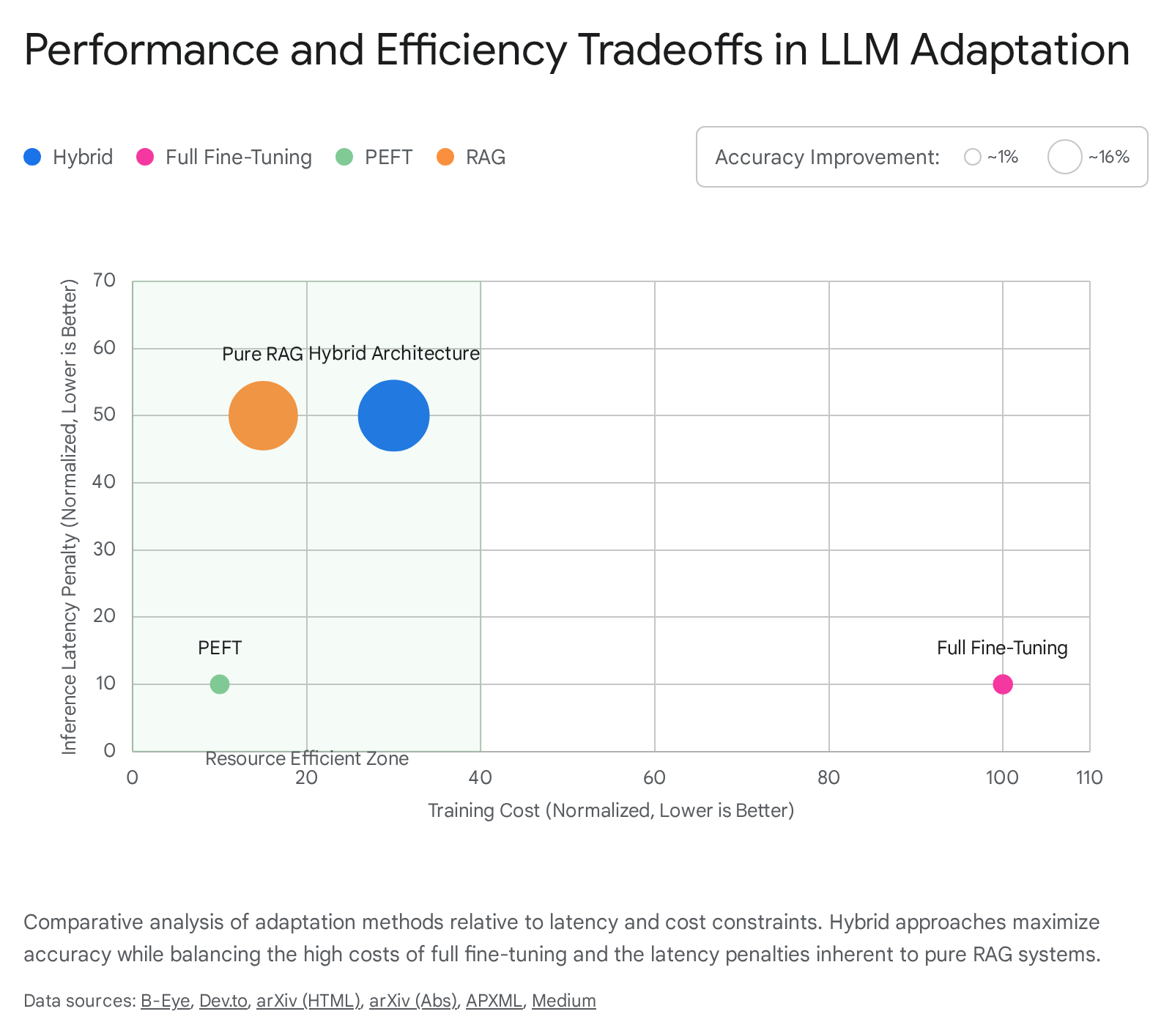
The foundational challenge in adapting general-purpose LLMs for financial trading lies in embedding specialized domain knowledge - such as interpreting nuance in forward-looking statements or pricing volatility from geopolitical news - without inducing catastrophic forgetting of the model's baseline reasoning capabilities 17. The approaches to model adaptation are primarily evaluated across three constraints: training cost (capital expenditure), inference latency, and contextual accuracy.
Full-Parameter Fine-Tuning Mechanics
Full fine-tuning (FFT) modifies all internal parameters within a neural network to optimize the model for a designated financial task. For a typical 7-billion parameter model, this requires calculating, storing, and applying gradients for the entirety of the weight matrices during backpropagation 89. Furthermore, optimizer states, such as those utilized in AdamW, necessitate memory allocations often two to four times the size of the model parameters themselves 8. This forces reliance on multi-GPU, data-center-grade clusters, driving up initial capital expenditure 89.
In highly latency-sensitive applications, such as high-frequency automated suggestions or inline algorithmic code generation, FFT delivers optimal sub-second response times because the entirety of the financial knowledge is embedded directly into the model's weights. Once trained, queries process through the neural network without requiring dynamic retrieval steps at inference, guaranteeing maximum throughput 71011. However, FFT introduces a high risk of catastrophic forgetting. When aggressively optimized on narrow financial datasets, models may lose their broader analytical competence or general conversational formatting capabilities 78. Furthermore, knowledge within an FFT model remains entirely static; updating the model to reflect new market conditions requires periodic, computationally exhaustive retraining cycles 1012.
Parameter-Efficient Fine-Tuning Architectures
The computational and financial burdens of FFT have driven the adoption of Parameter-Efficient Fine-Tuning (PEFT) methods, particularly Low-Rank Adaptation (LoRA) and Quantized LoRA (QLoRA). PEFT preserves the foundational language modeling capabilities by freezing the original pre-trained weights of the LLM. Instead of updating the massive base matrices, PEFT appends small, trainable, low-rank adapter matrices to specific attention layers within the transformer architecture 789.
By updating only a fraction of the parameters - often around 0.1% to 1% of the total model - PEFT reduces GPU VRAM requirements by up to 90%, allowing substantial models to be fine-tuned on single consumer-grade or prosumer GPUs 913. Empirical evaluations of PEFT in textual analysis workflows report that methods like LoRA achieve training time reductions of 32% to 44% and utilize between 140 and 280 times fewer trainable parameters compared to full fine-tuning 4. Despite this drastic reduction in computational overhead, PEFT methods maintain roughly 95% of the theoretical accuracy ceiling expected from full weight updates 9. Because the base weights remain frozen, the risk of catastrophic forgetting is heavily mitigated, allowing the model to adapt to specialized financial reasoning patterns, tone, and formatting constraints while preserving general linguistic competence 812.
Retrieval-Augmented Generation Constraints
Retrieval-Augmented Generation (RAG) serves as an orthogonal, non-parametric approach to LLM adaptation. Rather than altering internal model weights, RAG integrates dynamic, real-time external data - such as breaking financial news, rapidly updating order book metrics, and the latest quarterly earnings reports - directly into the model's context window at inference time 101115.
For quantitative trading, RAG is highly effective at managing data volatility, allowing the knowledge base to evolve continuously without requiring any model retraining 1015. It also mitigates hallucination risks by maintaining full data provenance; every generated insight can be audited and traced back to a specific chunk of proprietary data or public filing, satisfying strict regulatory documentation requirements 716. Standard one-shot RAG implementations operate by vectorizing a user query, executing a cosine similarity search against a vector database, and appending the closest text chunks to the prompt 17. Advanced financial implementations increasingly utilize iterative retrieval frameworks - such as Forward-Looking Active Retrieval (FLARE), Self-Reflective RAG (Self-RAG), and Interleaved Retrieval with Chain-of-Thought (IRCoT) - which allow the model to actively recognize knowledge gaps and trigger supplementary retrieval steps before generating a final trading signal 17.
Despite its vast adaptability, RAG introduces significant systemic friction regarding inference speed. The operational necessity to embed user queries, execute vector similarity searches, and format the retrieved context extends response times considerably. Empirical performance data dictates that RAG pipelines can increase inference latency by 30% to 50% compared to self-contained fine-tuned models 1012. For hard latency constraints common in quantitative signal generation (e.g., sub-200ms response requirements), pure RAG deployments are often unviable, creating a fundamental tradeoff between real-time data freshness and execution speed 7.
Hybrid Architectures and Empirical Personalization Benchmarks
The dichotomy between static fine-tuning and dynamic retrieval is largely resolved through the deployment of hybrid architectures that layer the two methodologies. In a hybrid setup, PEFT is utilized to teach the model the underlying behavioral styles, specialized reasoning patterns, and deterministic output formatting required by quantitative analysts, while RAG is reserved exclusively for factual grounding and the injection of highly volatile market data 7.
Research analyzing personalization benchmarks across broad datasets (such as the LaMP benchmark) provides compelling quantitative evidence for this layered approach. Standalone PEFT approaches yield a marginal average performance improvement of 1.07% over non-personalized baselines in retrieval-heavy evaluation scenarios 56. Conversely, standalone RAG delivers an average improvement of 14.92% in the same conditions 56. However, when RAG is combined with PEFT, the integrated hybrid system achieves an optimal 15.98% performance improvement over the baseline 56.
The data indicates that RAG is particularly beneficial for "cold-start" environments where historical proprietary data is sparse. As the volume of available proprietary data increases, the efficacy of the PEFT component scales positively, allowing the hybrid model to excel simultaneously in dynamic knowledge retrieval and ingrained domain logic 5.
| Adaptation Methodology | Primary Utility | Inference Latency Penalty | Training Compute / CapEx | Knowledge Volatility | Catastrophic Forgetting Risk |
|---|---|---|---|---|---|
| Full Fine-Tuning (FFT) | Fundamental capability alteration | Minimal (sub-200ms achievable) | Highest (massive GPU clusters) | Static (requires retraining) | High |
| Parameter-Efficient (PEFT) | Tone, style, reasoning patterns | Minimal (adapter overhead only) | Low (VRAM reduced by ~90%) | Static (adapter retraining) | Low (frozen base weights) |
| Retrieval-Augmented (RAG) | Real-time factual grounding | High (+30% to +50% delay) | Minimal (embedding costs only) | Dynamic (updates instantly) | None |
| Hybrid (RAG + PEFT) | Holistic domain specialization | Moderate | Low to Moderate | Dynamic (RAG) + Static (PEFT) | Low |
Reinforcement Learning and Goal-Oriented Trading
Moving beyond standard supervised fine-tuning, advanced proprietary models increasingly leverage reinforcement learning (RL) to align language generation with quantifiable trading outcomes. Traditional RL approaches based on Markov Decision Processes (MDPs) often fail in financial markets due to non-stationary data distributions and an inability to coherently model multimodal market states spanning price movements, technical indicators, and unstructured sentiment 20.
To address this, architectures like FLAG-TRADER function by integrating a partially fine-tuned LLM as the core policy network. The model processes financial information using textual state representations, enabling it to interpret market conditions semantically. Instead of fine-tuning the entire network, FLAG-TRADER employs parameter-efficient updates driven by gradient-based policy optimization linked directly to trading rewards, such as cumulative return and the Sharpe ratio 20. This structure allows a relatively small open-source model (e.g., 135 million parameters) to process multimodal market states and consistently outperform static buy-and-hold baselines as well as larger, non-RL agentic baselines 20.
Similarly, proprietary systems such as Trading-R1 employ a dual approach combining supervised fine-tuning with reinforcement learning structured around a three-stage, easy-to-hard curriculum. Training across diverse data sources spanning multiple equities allows the model to map historical data relationships and execute volatility-adjusted decision-making 21. The explicit reinforcement learning algorithms and exact reward functions utilized in elite proprietary systems frequently remain undisclosed to preserve the underlying intellectual property 21.
Data Preparation and the Token Economy
Before proprietary quantitative data can interact with model weights or vector databases, it must traverse a strict preprocessing pipeline. The financial domain features highly specific semi-structured elements that demand customized tokenization strategies to ensure optimal model performance.
Structural Normalization and Token Efficiency
In large language models, operations are measured and billed in tokens, not in standard word counts. Given the immense volume of data processed by algorithmic systems, maximizing the "token economy" is a structural necessity 122. When extracting alternative data from web scraping or processing SEC EDGAR filings, treating token efficiency as a primary optimization metric yields immediate economic and latency dividends.
Converting raw HTML financial documents into Markdown format prior to vectorization or fine-tuning preserves semantic structures - such as headings, tabular alignments, and text emphasis - while eliminating dozens of redundant markup attributes 22. Industry benchmarks demonstrate that HTML-to-Markdown conversion reduces token consumption by 20% to 30% for standard documents, and up to 95% for highly complex corporate e-commerce or regulatory pages 22. For structured financial datasets, prioritizing CSV formats over JSON can yield an additional 40% to 50% reduction in token footprints 22. Furthermore, unnecessarily precise numerical data must be tested and truncated, as excessive decimal places increase the token footprint without delivering corresponding analytical benefits 22.
Tokenization Algorithms and Data Sanitization
The tokenization process relies on subword algorithms like Byte-Pair Encoding (BPE) or SentencePiece, which are foundational to transformer-based architectures like GPT, Llama, and Mistral 23. Tokenizing financial data requires bespoke normalization to standardize extraneous whitespaces and enforce consistent handling of specialized financial acronyms 23.
Concurrently, firms must identify and mask Personally Identifiable Information (PII) or strictly regulated insider data using targeted redaction pipelines. Toolkits such as the open-source Data Prep Kit (DPK) are utilized to scan contracts, bank details, and tax IDs, obfuscating sensitive elements while retaining the integrity of the non-sensitive financial context 24. This redaction supports legal compliance and prevents the unauthorized exposure of data during the fine-tuning phase 24.
Cryptographic Privacy and Differential Privacy
Fine-tuning an LLM on proprietary trading logs, internal chat data, or localized Alpha signals creates an acute risk of data exposure. Without strict controls, adversaries can launch model inversion or membership inference attacks, attempting to extract the exact raw training data from the model's output probabilities 67. To counteract this vulnerability, quantitative organizations deploy Differential Privacy (DP) mechanisms directly into the model training phase 626.
DP-Stochastic Gradient Descent (DP-SGD)
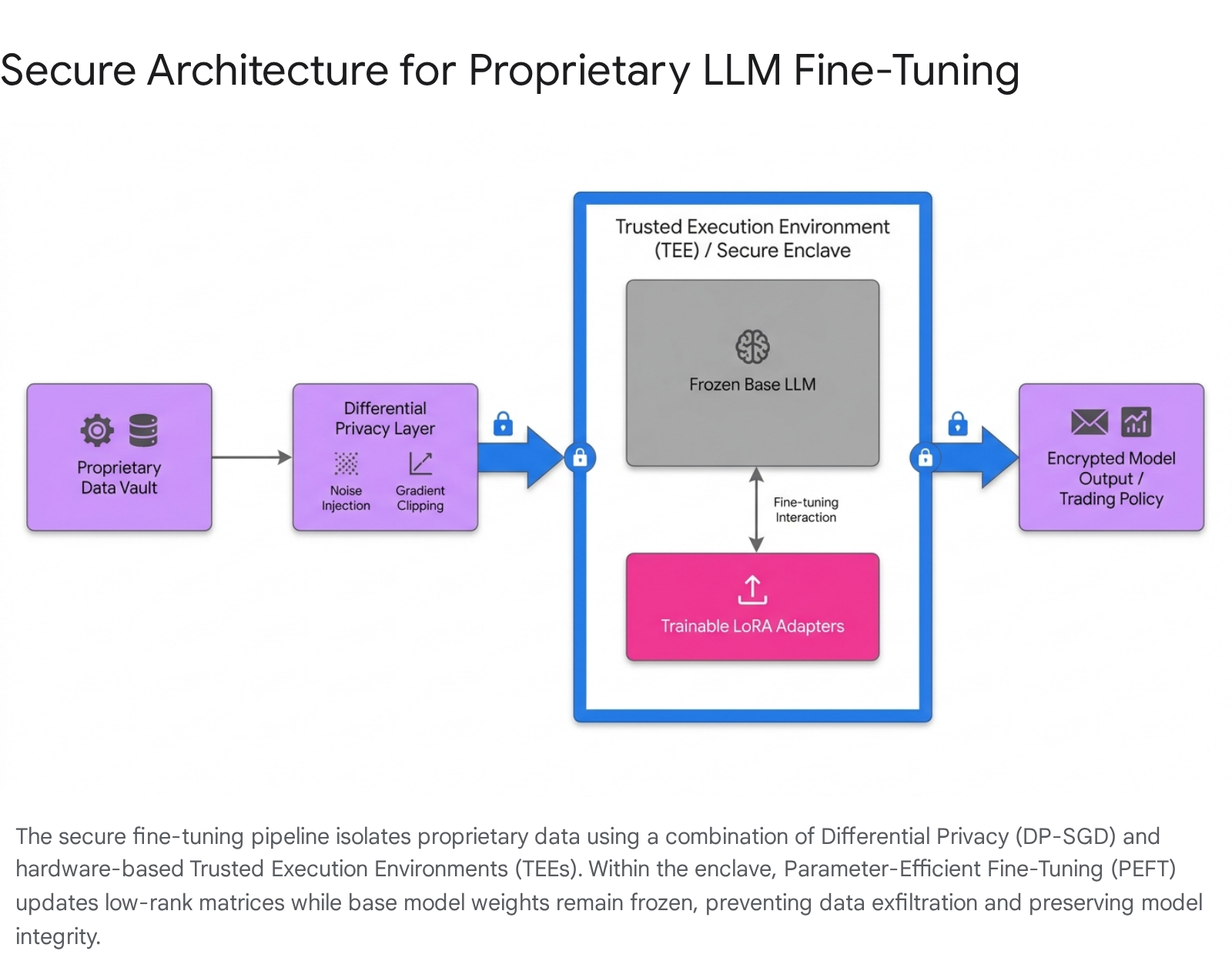
The prevailing implementation for privacy-preserving adaptation is DP-Stochastic Gradient Descent (DP-SGD). During the backpropagation phase of fine-tuning, DP-SGD limits the influence of any single proprietary training sample on the aggregate model update 6. This is achieved by applying a hard mathematical clipping bound ($C$) to the gradient norm of individual gradients, ensuring no single outlier trade or document skews the model's weights 7. Following the clipping phase, controlled Gaussian noise is injected into the averaged batch gradients prior to executing the parameter update via gradient descent 6726.
Specialized financial models, such as DPFinLLM, utilize an ($\epsilon, \delta$)-differential privacy framework specifically tailored for on-device and edge financial applications 726. The parameters $\epsilon$ (epsilon) and $\delta$ (delta) mathematically quantify the maximum allowable privacy leakage. Maintaining lower values provides stronger mathematical guarantees that the presence or absence of any specific proprietary data point in the training set will not significantly alter the LLM's generative output 7. DPFinLLM combines this DP-SGD protocol with Low-Rank Adaptation (LoRA) and efficient architectural components - such as grouped-query attention, RMSNorm layer normalization, and SwiGLU activation functions - to allow secure deployment on resource-constrained devices while maintaining performance metrics comparable to baseline models 726.
Reward-Driven Synthetic Data Generation
In highly regulated environments where exposing actual proprietary data to an LLM provider is strictly prohibited, firms leverage proxy models to generate Differentially Private synthetic data for downstream training 8. However, synthetic datasets frequently suffer from degradation, containing flawed outputs or statistical noise that harms the performance of the final fine-tuned model 8.
To rectify this, frameworks like RewardDS (Reward-driven Data Synthesis) have emerged. RewardDS deploys a two-stage quality control process: Reward Guided Filtering and Self-Optimizing Refinement. It trains a proxy reward model to evaluate the synthetic data against core trading principles, filtering out hallucinated or noisy outputs. The target LLM then refines the surviving data based on feedback instructions 8. This approach iteratively aligns the synthetic data with optimal financial logic before it is utilized to fine-tune the final target LLM, effectively bypassing the privacy dilemma without sacrificing data quality 8.
Federated Learning Architectures
When data sovereignty laws or internal risk policies dictate that data cannot legally or competitively leave the localized servers of a trading firm, Federated Learning (FL) provides a decentralized alternative to traditional centralized cloud aggregation. FL enables multiple distributed clients (e.g., distinct trading desks or regional subsidiary offices) to perform local fine-tuning updates on their private data 32829. Instead of transmitting raw trading signals, the clients upload only the resulting model gradients or parameter updates to a central coordinating server, ensuring privacy by design 28.
Advanced federated architectures manage the immense parameter size of LLMs through specific operational frameworks: - FedLLM: Clients upload standard model parameters or gradients to enable straightforward fine-tuning 29. - KD-FedLLM: Integrates Knowledge Distillation (KD) to facilitate efficient knowledge sharing via model logits rather than full weight matrices, dramatically reducing network communication overhead 29. - Split-FedLLM: Divides the neural network layers, executing the initial portion of the LLM on the resource-constrained client side and processing the remainder of the deep layers on the central server, effectively balancing the computational load across the network 329.
To prevent sophisticated adversaries from reverse-engineering the transmitted gradients in cross-silo scenarios, Federated Learning is heavily augmented with Fully Homomorphic Encryption (FHE). FHE permits the central server to mathematically aggregate and compute the encrypted gradients directly without ever decrypting them, maintaining a zero-knowledge proof environment throughout the aggregation process 289. Furthermore, when FL is combined with PEFT mechanisms like LoRA (e.g., the FedShield-LLM framework), the sheer volume of data transmitted over the network drops drastically, neutralizing the primary communication bottlenecks inherent to decentralized training and making federated architectures commercially viable 28.
Infrastructure Environments: Cloud Enclaves versus On-Premise
The choice of physical and logical infrastructure is the primary determinant of operational security, latency variance, and the Total Cost of Ownership (TCO) for financial AI deployments.
On-Premise Infrastructure Economics
Despite the rapid proliferation of cloud-native AI services, on-premise infrastructure remains highly relevant for proprietary trading desks characterized by steady, high-volume inference demands and an absolute requirement for data sovereignty 3132. Relocating inference workloads to an on-premise architecture eliminates the punishing egress fees and compounding per-token pricing models dictated by hyperscale cloud providers 3132.
An economic analysis of generative AI infrastructure in 2026 demonstrates a paradigm shift favoring physical ownership for sustained workloads. A single NVIDIA H100 GPU server, requiring an initial capital expenditure of $25,000 to $40,000, can handle the vast majority of enterprise-scale open-source models 32. When evaluated through a "Token Economics" framework - measuring Tokens Per Second per Dollar (TPS/$) - self-hosted inference achieves a breakeven point against cloud API on-demand pricing in under four months for environments operating with greater than 20% utilization 3233. Over a three-year lifecycle, owning the infrastructure yields up to an 18x cost advantage per million tokens compared to public Model-as-a-Service (MaaS) APIs 3233.
However, scaling on-premise infrastructure demands substantial facility adaptations regarding cooling and power. Traditional enterprise cloud computing operates at 5 to 10 kW per rack using standard air cooling. In stark contrast, dense AI inference deployments push 12 to 60 kW per rack, and heavy training clusters can exceed 100 kW per rack 34. This renders direct-to-chip liquid cooling an operational baseline rather than an optional upgrade, significantly increasing the complexity of data center facility management for trading firms 34.
Cloud-Based Trusted Execution Environments
For hedge funds leveraging public cloud infrastructure due to CapEx constraints or the need for elastic scaling, strict data security is maintained through hardware-based Trusted Execution Environments (TEEs), commonly referred to as secure enclaves. TEEs encrypt data in memory and physically isolate the compute environment at the hardware level, ensuring that not even the cloud provider, hypervisor administrators, or root users can access the plaintext data or the model weights during execution 35.
Major cloud providers differ significantly in their cryptographic implementations, operational limits, and hardware support:
- AWS Nitro Enclaves: This service operates using a custom, AWS-designed hypervisor. Nitro Enclaves strictly isolate CPU and memory from the parent EC2 instance. For uncompromised security, these enclaves have no persistent storage, no interactive access, and no external networking; communication is restricted solely to secure local virtual sockets (vsock) 23610. Furthermore, Nitro Enclaves enforce cryptographic attestation to verify code integrity and integrate tightly with the AWS Key Management Service (KMS) 235. However, a significant limitation as of late 2025 is that AWS Nitro Enclaves lack support for GPU TEEs. Consequently, high-performance LLM training within the enclave is computationally bottlenecked to CPU resources, and the platform relies heavily on trust in AWS's closed-source hypervisor 36.
- Azure Confidential Computing: Microsoft's offering is built heavily upon industry-standard AMD SEV-SNP and Intel SGX technologies. Azure offers fine-grained enclave isolation and protects data directly in the encrypted page cache (EPC), though managing the EPC can introduce minor latency overheads 10. Unlike AWS, Azure's implementation supports advanced scenarios like multi-party analytics, allowing different hedge funds to contribute encrypted datasets and train joint models without revealing the underlying proprietary data to one another 35.
- Phala Cloud and Specialized Providers: Emerging decentralized providers like Phala Cloud offer zero-trust TEE infrastructure engineered specifically for AI workloads. Phala integrates Intel TDX and AMD SEV-SNP, but critically, it is one of the few platforms offering hardware-level confidential computing protection directly for GPUs, specifically supporting NVIDIA H100 and H200 GPU TEEs 36. This capability is necessary for executing parameter-efficient fine-tuning on massive datasets rapidly without sacrificing latency or security 36.
| Provider / Service | Underlying Technology | GPU TEE Support | Key Strengths | Operational Limitations |
|---|---|---|---|---|
| AWS Nitro Enclaves | Custom Nitro Hypervisor | No | Tight AWS KMS integration, strict vsock network isolation 236. | No persistent storage, complex developer workflow, lacks GPU TEE 3610. |
| Azure Confidential Computing | Intel SGX, AMD SEV-SNP | Limited/Emerging | Broad CPU TEE support, Azure Attestation API, multi-party analytics 3536. | EPC management introduces minor latency overheads 10. |
| Phala Cloud | Intel TDX, AMD SEV-SNP | Yes (H100/H200) | Zero-trust model, open-source Dstack SDK, public attestation 36. | Smaller enterprise ecosystem, fewer global deployment regions 36. |
Regulatory Compliance and Data Sovereignty
The deployment of generative AI in financial markets is not governed solely by mathematical or infrastructure constraints; it is heavily shaped by an evolving matrix of international legal frameworks, audit obligations, and data sovereignty requirements.
The European Union AI Act and GDPR
The European Union's Artificial Intelligence Act (EU AI Act) represents the most comprehensive legislative framework affecting global AI deployments. Although it officially entered into force in August 2024, its staggered enforcement timeline mandates compliance across varying risk tiers through 2027 383911. The Act takes a strictly risk-based approach. Unacceptable-risk systems (such as behavioral manipulation or real-time biometric surveillance) are banned entirely 3812. Conversely, trading algorithms and proprietary financial AI models are generally scrutinized under high-risk or transparency obligations, requiring providers to conduct rigorous risk assessments, maintain human oversight, and ensure cybersecurity robustness 3839.
Crucially, the Act applies extraterritorially. A US-based quantitative fund deploying an LLM that processes data from or impacts EU residents must comply with the legislation. This phenomenon, known as the "Brussels Effect," forces multinational funds to standardize compliance to the strictest global denominator to ease global operational friction 1112. The Act also outlines specific parallel governance tracks for General Purpose AI (GPAI) systems that pose systemic risks, requiring providers to implement strict risk mitigation measures and conduct extensive external red-teaming prior to deployment 381242.
In tandem, the General Data Protection Regulation (GDPR) deeply intersects with cloud AI architectures. Under Article 28, trading desks acting as "data controllers" must establish written Data Processing Agreements (DPAs) with hyperscale cloud providers acting as "processors" 4. Furthermore, Article 35 requires Data Protection Impact Assessments (DPIAs) for high-risk processing, and Chapter V of the GDPR prohibits cross-border transfers of personal financial data to third countries without approved mechanisms 4. Attempting to bypass GDPR compliance by relying strictly on US-based data center servers is ineffective; the regulatory trigger relies on the targeted offering of services or monitoring of EU residents, not the geographic location of the server racks 4. Utilizing secure enclaves and robust encryption (Data Protection by Design) is legally mandated to meet these standards 13.
United States SEC Predictive Data Analytics Rules
Within the United States, the Securities and Exchange Commission (SEC) has escalated its scrutiny of artificial intelligence in trading environments, proposing Predictive Data Analytics (PDA) rules. These regulations specifically address the "black box" nature of neural networks and LLMs, requiring trading firms to maintain stringent model explainability 1.
Compliance does not require firms to open-source their proprietary models. However, it mandates that firms document model architecture, training data provenance, fine-tuning methodologies, and specific decision logic 1. For LLMs, this requires the implementation of attention visualization, token importance mapping, and the ability to generate human-readable summaries explaining exactly why a particular quantitative signal or trade recommendation was generated 1.
Geopolitical Deployment Patterns in Asia-Pacific
While Western markets grapple with regulatory friction and the maturation of foundational closed-source models (with enterprise usage heavily consolidating around entities like Anthropic and OpenAI), the Asia-Pacific (APAC) region has aggressively accelerated its quantitative AI deployments, reshaping the geography of algorithmic finance 4445.
Singapore and Hong Kong have emerged as fiercely competitive hubs, pulling mathematical talent and infrastructure capital away from traditional centers like New York and London 44. According to Stanford University's 2026 AI Index Report, Singapore holds the highest AI adoption rate in the APAC region at 61%, significantly outperforming the North American average of 22% and the European average of 27% 14. This growth is fundamentally driven by deliberate sovereign alignment. The Monetary Authority of Singapore (MAS) has proactively streamlined regulatory pathways for AI-driven fund managers, effectively turning the jurisdiction into a secure sandbox for regulated machine learning 44. Furthermore, immense sovereign wealth funds, including GIC and Temasek, act as anchor investors, providing the capital necessary for mid-sized funds like Quantedge and Dymon Asia to scale proprietary infrastructure and deploy strategies ranging from factor arbitrage to volatility harvesting 4447.
Conversely, Hong Kong positions itself as the optimal gateway to Mainland China, leveraging a deep pool of bilingual engineering talent capable of moving seamlessly between Mandarin-language alternative datasets and Western trading systems 4448. To reclaim global market share and counter geopolitical trade tensions, Hong Kong enacted robust tax incentives, including zero-tax waivers on investment gains from alternative assets and cryptocurrencies for hedge funds in late 2024 48. This aggressive regulatory posture prompted high-profile relocations of Western multi-strategy firms, such as Hudson Bay Capital Management and Centiva Capital, to the territory in early 2025 48.
What unites funds operating in both APAC hubs is a ferocious technology arms race focused on proprietary data infrastructure far beyond standard financial time-series. Quantitative teams are fine-tuning their LLMs on massive, localized alternative datasets - including machine vision models parsing shipping and commodity flows, e-commerce consumer receipts, and regional supply chain data - resulting in distinct geographical alpha generation that traditional Western models struggle to replicate 44.
Conclusion
Adapting Large Language Models to proprietary trading environments mandates a precise orchestration of operational efficiency, hardware security, and extraterritorial compliance. The empirical evidence dictates that traditional full-parameter fine-tuning is computationally exhaustive, economically inefficient for frequent updates, and introduces systemic risks of catastrophic forgetting. Consequently, the leading technical approach is a hybrid architecture: utilizing Parameter-Efficient Fine-Tuning (PEFT/LoRA) to ingrain complex financial reasoning patterns and strict output formatting, overlaid with Retrieval-Augmented Generation (RAG) to dynamically inject real-time market data without triggering retrieval-induced latency beyond acceptable sub-second boundaries.
To execute this training securely without exposing intellectual property to model inversion attacks or triggering regulatory breach notifications under GDPR or SEC guidelines, firms must look beyond software-level encryption. The optimal deployment path relies on either self-hosted, on-premise GPU clusters - which offer up to an 18x TCO advantage over cloud APIs at high scale - or cloud-based Trusted Execution Environments (TEEs) that support advanced GPU confidential computing. Furthermore, integrating Differential Privacy (DP-SGD) directly into the gradient update process, or utilizing Federated Learning backed by Fully Homomorphic Encryption, ensures that the underlying proprietary data remains mathematically sequestered from the final model output, aligning AI innovation with the stringent transparency demands of modern global financial regulation.