
Scientific Status of Consciousness Research in 2026
The scientific study of consciousness has historically occupied a precarious position at the intersection of neuroscience, cognitive psychology, and philosophy. For decades, the field was characterized by theoretical fragmentation, where distinct research groups generated empirical data supporting isolated, often mutually exclusive paradigms. However, by 2026, consciousness research has reached a critical methodological and theoretical inflection point. Driven by large-scale adversarial collaborations, high-resolution neuroimaging, and the urgent necessity to define sentience in rapidly advancing artificial intelligence systems, the discipline has transitioned into a highly structured empirical science 112.
Despite these unprecedented methodological advancements, the foundational explanatory gap - widely known as the "hard problem" of consciousness - remains a subject of intense scientific debate 346. The core inquiry of whether empirical science can fully explain subjective experience is no longer confined to speculative philosophy; it directly informs experimental design in neurobiology, cross-species anatomical mapping, and the architectural development of neuromorphic computing 759.
Foundational Dilemmas in Consciousness Science
The pursuit of understanding how a physical system generates subjective experience necessitates distinguishing between the measurable mechanics of the brain and the qualitative nature of experience itself. This distinction forms the basis of the ongoing debate regarding the ultimate capabilities of empirical science in this domain.
The Hard Problem and the Explanatory Gap
The "hard problem" of consciousness, as articulated by philosopher David Chalmers, demarcates the "easy problems" of cognitive science - such as explaining information routing, attention, and verbal reporting - from the deeply intractable problem of why any physical processing is accompanied by an internal, subjective "feel" or qualia 3610. Even if researchers successfully map every functional, dynamic, and structural property of a conscious mind, the question of why it is conscious remains conceptually unanswered by standard reductionist models 6.
Neurobiologists such as Antonio Damasio have noted that the hard problem frequently appears unsolvable by traditional biological means, leading to a persistence of dualistic frameworks that separate subjective conscious experience from the physical environment 6. Conversely, theorists like Daniel Dennett have argued against the existence of the hard problem altogether, suggesting that once cognitive science fully resolves the "easy" problems of behavioral control and systemic reporting, there is no residual phenomenon left to explain 6. Nevertheless, standard scientific methodology - rooted in objective, third-person observation - struggles to capture first-person phenomenology without relying on subjective reporting, which is inherently vulnerable to cognitive distortion and reporting bias 66.
The Neural Correlates of Consciousness and Theory-Ladenness
For over three decades, the primary operational strategy for circumventing the hard problem has been the search for the Neural Correlates of Consciousness (NCC). The NCC approach aims to identify the minimal neuronal mechanisms that are jointly sufficient for any specific conscious experience 467. However, recent epistemological critiques in 2025 and 2026 have highlighted the severe limitations of treating NCC research as a theory-neutral endeavor.
Scientific theory-making in consciousness research is irreducibly shaped by substantive theoretical and conceptual commitments 7. Experimental phenomena - such as the expectations regarding neural signatures traced via functional magnetic resonance imaging (fMRI) or electroencephalography (EEG) - are not tested in a theoretical vacuum 7. Furthermore, isolating a "proper" NCC is confounded by processes that precede consciousness (such as attention and arousal) and processes that follow it (such as memory encoding and task reporting) 67. Because "no-report" paradigms and causal interventions are heavily dependent on how a researcher defines consciousness, the field has recognized that empirical observation in consciousness science cannot proceed from a purely theory-neutral foundation, necessitating structured, adversarial methodologies 78.
Prominent Theoretical Frameworks
Rather than treating consciousness as a monolithic phenomenon, contemporary science is dominated by several major theoretical frameworks that prioritize different computational principles, neuroanatomical regions, and phenomenological axioms 289.
Global Neuronal Workspace Theory
Global Neuronal Workspace Theory (GNWT), developed by Stanislas Dehaene and others, posits that consciousness arises when information is globally broadcast across the brain, making it available to various specialized, unconscious cognitive subsystems 91011. According to this model, unconscious processing occurs in localized modules. When a stimulus reaches a threshold of significance, it triggers a non-linear "ignition" in a widespread fronto-parietal network 1112. This ignition amplifies the information and sustains it in a global workspace, allowing for flexible behavior, memory formation, and verbal reporting 121314. GNWT fundamentally views consciousness as a functional, cognitive process of information routing, heavily implicating the prefrontal cortex as a critical node 1415.
Integrated Information Theory
In stark contrast, Integrated Information Theory (IIT), championed by Giulio Tononi and Christof Koch, approaches consciousness from a first-principles phenomenological perspective 91116. IIT identifies the essential properties of experience (axioms) and postulates the physical properties a system must possess to support them 911. The theory equates consciousness with a system's maximum irreducible intrinsic cause-effect power, mathematically quantified by the metric Phi ($\Phi$) 11.
Unlike GNWT, which views consciousness as a functional process, IIT asserts that consciousness is an intrinsic structural property 1117. Anatomically, IIT predicts that the physical substrate of consciousness resides in a "posterior hot zone" encompassing the occipital, temporal, and parietal lobes, where anatomical connectivity supports dense, recurrent integration 1112. Crucially, IIT implies a form of panpsychism, suggesting that any physical system with a non-zero $\Phi$ - regardless of whether it is a biological brain or a sufficiently integrated artificial circuit - possesses some rudimentary degree of subjective experience 5.
Predictive Processing and Active Inference
The Predictive Processing Framework (PPF) conceptualizes the brain not as a passive receiver of sensory input, but as an active inference machine that continuously generates top-down predictions about the environment 1819. Rooted in the thermodynamic free energy principle, PPF models cognition as an ongoing effort to minimize surprise and resolve uncertainty by updating internal models based on bottom-up prediction errors 2026.
Active Inference, a first-principles derivative of PPF, extends this by suggesting that biological systems can minimize prediction errors not only by updating their internal models (perception) but also by acting upon the world to change their sensory input (action) 2021. Within this context, Active Inference (AI-C) and Neurorepresentationalism (NREP) theories argue that subjective experience is inextricably linked to this hierarchical construction of generative models 1628. Unlike GNWT and IIT, which search for localized correlates, PPF emphasizes dynamic, continuous interactions across the entire cortical hierarchy 1821.
First-Order and Higher-Order Theories
The debate between First-Order Theories (FOT) and Higher-Order Theories (HOT) centers on the necessity of meta-representation for subjective experience 2230. First-order theories, such as Local Recurrency Theory (RPT), maintain that consciousness arises directly from recurrent processing within early sensory cortices 222. For example, recurrent signaling within the visual cortex is deemed sufficient to produce a visual experience, regardless of whether downstream networks monitor that activity.
Higher-Order Theories counter that first-order sensory representations remain unconscious until they are targeted by a higher-order representation, typically generated in the prefrontal or parietal cortices 3023. A higher-order state is the brain's meta-representation of its own lower-order processing. HOTs are categorized into "sparse" theories (where higher-order states merely index the reliability or intensity of sensory signals) and "rich" theories (where the higher-order state fully determines the phenomenal content of the experience) 30. Relational and non-relational HOTs further debate whether higher-order states can "misrepresent" lower-order data, leading to experiences that do not align with physical sensory input 30.
| Theoretical Framework | Core Computational Principle | Primary Neuroanatomical Correlate | Position on the Function of Consciousness |
|---|---|---|---|
| Global Neuronal Workspace (GNWT) | Global broadcasting of information; non-linear "ignition" | Fronto-parietal network | Facilitates cognitive integration and behavioral flexibility. |
| Integrated Information Theory (IIT) | Irreducible intrinsic cause-effect power ($\Phi$) | Posterior cortical "hot zone" | Consciousness is an intrinsic property; functional utility is secondary. |
| Predictive Processing (PPF / Active Inference) | Hierarchical prediction error minimization; free energy | Distributed across cortical hierarchy | Optimizes the organism's generative model of the environment. |
| Higher-Order Theories (HOT) | Meta-representation of lower-order sensory states | Prefrontal and parietal cortices | Distinguishes conscious from unconscious processing via self-monitoring. |
| First-Order Theories (FOT) | Local recurrent processing | Early sensory cortices (e.g., visual cortex) | Direct generation of phenomenology from sensory loops. |
Empirical Arbitration via Adversarial Collaboration
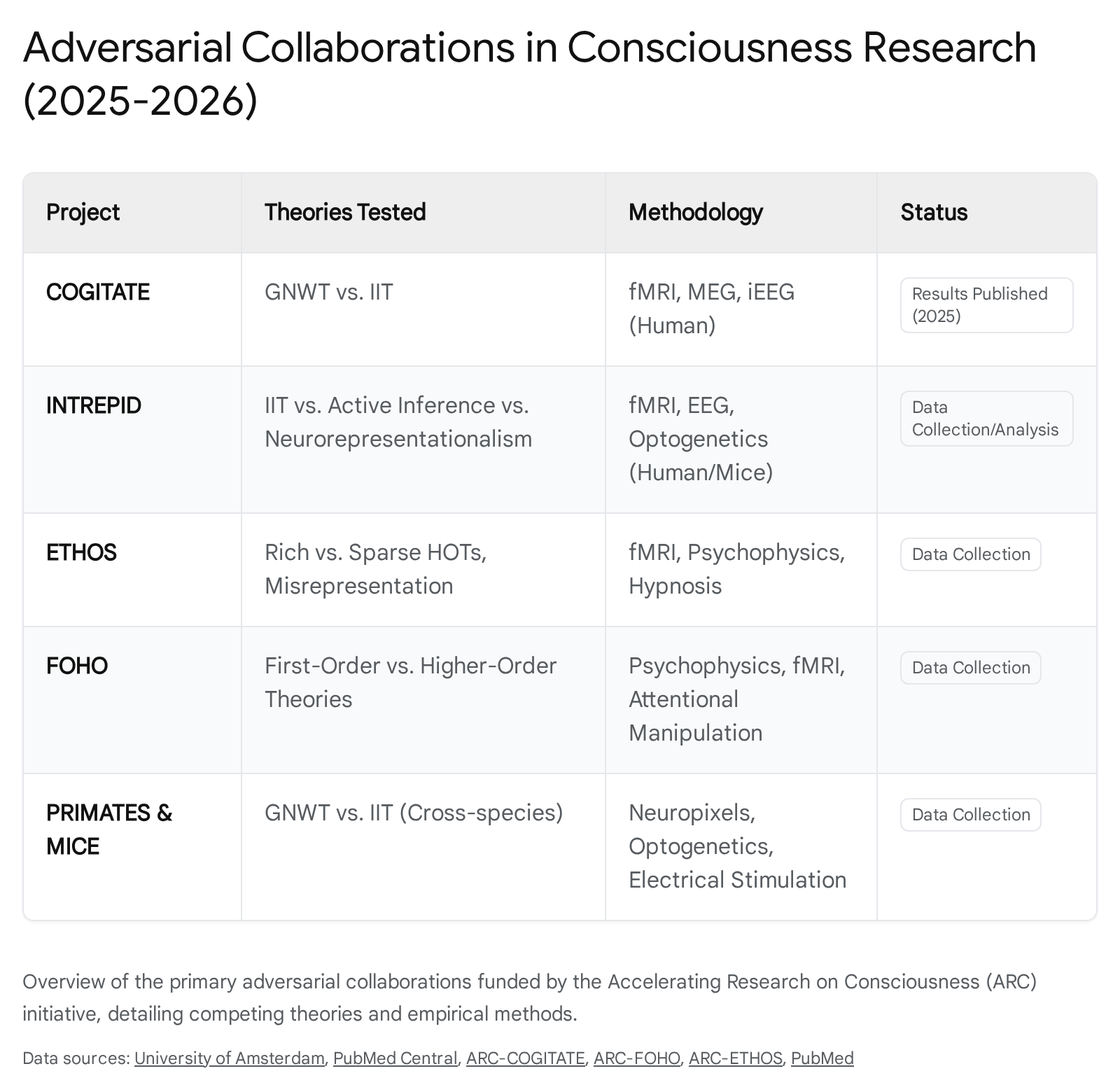
Recognizing that confirmation bias and selective experimental design were paralyzing the field, the scientific community widely adopted adversarial collaborations by the mid-2020s. Heavily funded by the Templeton World Charity Foundation's (TWCF) $30 million Accelerating Research on Consciousness (ARC) initiative, these collaborations force competing theorists to co-design experiments, preregister divergent predictions, and rely on independent laboratories for data collection and analysis 12.
The COGITATE Consortium Outcomes
The flagship adversarial collaboration, COGITATE, directly pitted GNWT against IIT. The study utilized fMRI, magnetoencephalography (MEG), and intracranial electroencephalography (iEEG) to monitor 256 human participants while they viewed suprathreshold stimuli for variable durations 1432. The results, published in Nature in mid-2025, provided unprecedented, high-resolution data that challenged key tenets of both theories, revealing that biological consciousness defies simple localization 1433.
The findings confirmed IIT's prediction that information regarding conscious content is heavily concentrated in the posterior cortex, demonstrating sustained responses in the occipital and lateral temporal cortices reflecting stimulus duration 1426. However, IIT failed a critical preregistered prediction: the data showed a lack of sustained inter-areal synchronization within the posterior cortex, contradicting the theory's claim that continuous network connectivity is the direct physical substrate specifying conscious experience 1432.
GNWT suffered equally significant empirical setbacks. While the study did find content-specific synchronization between frontal and early visual areas as GNWT predicted, it failed to observe the non-linear "ignition" response at the offset of the stimulus 1214. Furthermore, prefrontal cortex decoding could not reliably capture certain dimensions of the conscious experience, challenging the GNWT assertion that prefrontal broadcasting is universally required for conscious perception 1214.
The mixed outcome of COGITATE sparked controversy, notably culminating in a 2023 open letter signed by 124 researchers labeling IIT as "pseudoscience" due to the purported untestability of its core mathematical formalisms 26. However, editorial responses in major journals pushed back, emphasizing that the adversarial process itself demonstrated that the neurobiological intuitions derived from these theories are highly testable, even if the underlying mathematics of $\Phi$ remain abstract 2624.
The INTREPID Project
Following COGITATE, the INTREPID project evaluates IIT against two predictive processing theories: Active Inference (AI-C) and Neurorepresentationalism (NREP) 1628. Led by the University of Amsterdam and institutions across three continents, INTREPID utilizes a Bayesian evidence accumulation scheme to synthesize disparate experimental results, moving beyond strict falsification toward model comparison 162835.
Crucially, INTREPID moves beyond correlational neuroimaging by introducing causal interventions 225. One specific experimental protocol utilizes optogenetics in mice to silence specific neurons in the visual cortex. This tests an explicit IIT prediction: that the physical inactivation of neurons alters the cause-effect structure of the system (and thus conscious content) differently than when those same neurons are merely inactive due to a lack of sensory stimuli 237. Furthermore, human psychophysical experiments utilizing motion-induced blindness evaluate whether active inference is a necessary prerequisite for changes in conscious content, directly contrasting PPF models against IIT's structuralism 26.
The ETHOS and FOHO Collaborations
To resolve specific architectural disputes, the ETHOS and FOHO collaborations focus on metacognition and higher-order processing 2728. The ETHOS collaboration systematically evaluates four HOT variants (HOROR, PRM, HOSS, and SOMA) to determine the nature of higher-order representations 3029. By utilizing neuroimaging combined with hypnotic suggestion and visual psychophysics, ETHOS investigates how subjective vividness shifts independently of sensory input, testing whether higher-order states can genuinely "misrepresent" lower-order data 3027.
Concurrently, the FOHO (First-Order vs. Higher-Order) project evaluates whether metacognitive monitoring is necessary for subjective experience at all 2228. Researchers manipulate task performance independently of subjective experience to create "subjective inflation" - instances where participants report high subjective visibility despite severely degraded objective task performance 2830. By dissociating these variables, FOHO tests whether first-order neural signatures in early visual cortex can account for this inflation alone, or if the data necessitates the recruitment of higher-order networks championed by HOT 2228.
Cross-Species Arbitration in Primates and Mice
A parallel adversarial collaboration extends the GNWT vs. IIT debate into non-human primates and mice, aiming to establish whether the neural correlates of consciousness are evolutionarily conserved 725. Utilizing high-density Neuropixel probes, electrical stimulation, and optogenetics, researchers record single-neuron spiking activity across the anterior-posterior axis of the cerebral cortex 725. The deployment of backward masking techniques (where a target stimulus is rapidly followed by a masking stimulus to interrupt processing) combined with intracranial electrophysiology provides a spatiotemporal resolution impossible in human subjects 7. This approach aims to yield definitive causal data regarding the necessity of prefrontal broadcast mechanisms across mammalian lineages 725.
Artificial Intelligence and Machine Sentience
The rapid acceleration of generative artificial intelligence, large language models, and neuromorphic engineering has fundamentally altered the trajectory of consciousness research. In 2026, the question of machine sentience moved from theoretical speculation to an urgent matter of safety, ethics, and governance 143.
Computational Functionalism and the 19-Researcher Framework
In January 2026, Trends in Cognitive Sciences published a landmark framework authored by a consortium of 19 leading researchers, including Turing Award laureate Yoshua Bengio and philosopher Tim Bayne 11043. Seeking to establish a rigorous methodology for identifying potential consciousness in artificial systems, the authors rejected reliance on behavioral imitation in favor of a structural and architectural analysis 1044.
The framework is grounded in "computational functionalism" - the philosophical premise that consciousness depends entirely on the functional organization of information processing, regardless of the biological substrate 104345. Acknowledging theoretical uncertainty, the researchers constructed a probabilistic rubric extracting indicators from multiple theoretical models 143.
According to this rubric, an AI system demonstrates a higher probabilistic likelihood of consciousness if it possesses architectures analogous to: * Global Workspace: A limited-capacity bottleneck that selects and broadcasts information globally to specialized subsystems 110. * Predictive Processing: Hierarchical top-down predictive models that continuously minimize error against incoming data streams 133. * Higher-Order Representation: Internal models that can represent, monitor, and report the system's own cognitive and attentional states 133.
Surveys of experts within this consortium indicated a 90% median probability that digital minds with morally relevant experiences are possible in principle, reflecting a broad acceptance of computational functionalism within the AI research community 43.
The Counter-Movement: Biological Computationalism
The consensus surrounding computational functionalism has been heavily contested by proponents of biological naturalism, who argue that digital computation is inherently incapable of instantiating subjective experience 944. In late 2025 and early 2026, researchers published work proposing a refined framework termed "biological computationalism," which seeks to bridge the divide between biological naturalism and computer science 4531.
Biological computationalism posits that the brain does compute, but it does so in a manner entirely distinct from von Neumann digital architectures, where software operates independently of hardware 3147. In biological brains, the algorithm is inseparable from the physical substrate 3147. Neural computation operates through a hybrid of discrete events (action potentials) and continuous analog dynamics (field effects, graded potentials) that are inextricably linked to metabolic constraints, real-time physical thermodynamics, and energy scarcity 94531.
From this perspective, standard software executed on silicon microchips - no matter the algorithmic complexity or the presence of a "global workspace" in the code - can only simulate intelligent behavior, not instantiate true qualia 947. Biological computationalism suggests that synthetic consciousness requires novel physical ontologies - such as highly developed silicon memristor networks, fluidic architectures, or iontronic systems - where the computation and the physical energy dynamics co-determine one another 945. This paradigm warns that optimizing AI algorithms without fundamentally altering the underlying computational substrate will yield highly capable, yet entirely non-conscious, systems 931.
| Computational Functionalism | Biological Computationalism |
|---|---|
| Core Premise | Consciousness is substrate-independent and arises from specific functional organization (e.g., software). |
| System Architecture | Abstract, sequence-based processing; discrete states; software distinct from hardware. |
| Implications for AI | Standard digital AI can eventually achieve sentience if programmed with correct architectural markers. |
Integrating Non-Western Epistemologies
Recognizing the limitations of strictly materialist paradigms in addressing the hard problem, contemporary cognitive science in 2025 and 2026 has increasingly integrated frameworks from classical Indian philosophy, particularly Advaita Vedanta and Buddhism, to operationalize and understand subjective experience 4849.
Advaita Vedanta and Non-Dualistic Ontologies
Advaita Vedanta, systematized in the eighth century, provides a sophisticated, non-dualistic ontology where pure consciousness (Chit) is not an emergent property of neural computation, but rather the foundational reality from which mind and matter manifest 4950. Peer-reviewed studies in cognitive science journals have mapped Vedantic constructs - such as the precise distinction between the pure observer consciousness (Atman/Brahman) and the mechanics of organized, discriminative cognition (buddhi/manas) - onto contemporary debates regarding intentionality and the hard problem 495032.
This integration directly challenges purely computational or materialist ideas about the mind. By positing that reality is shaped by consciousness (resonating with certain interpretations of observer-dependent quantum mechanics), Vedantic frameworks offer an alternative to the reductionist view that consciousness must somehow arise from non-conscious physical matter, a view that continually frustrates NCC research 5033.
Buddhist Conceptions of the Constructed Self
Concurrently, the Buddhist doctrine of anatta (no-self) aligns closely with emerging neuroscientific models, such as predictive processing and self-model theory 4834. Both traditions posit that the "self" is not a unified, static entity but a fluid, dynamic process generated by representational mechanisms 48. The Buddhist analysis of the "Five Aggregates" - which elucidates how neutral sensory signals are processed into phenomenological experiences of attachment or distress - offers a robust theoretical model for the psychological deconstruction of experience 3435.
Neurophenomenology and Contemplative Practice
These philosophical frameworks have directly informed the empirical methodology of neurophenomenology, which combines rigorous first-person introspective reports with third-person neuroimaging (MRI, EEG) 3536. Research on Long-Term Meditators (LTMs) demonstrates that systematic contemplative practice induces profound, measurable neurobiological shifts 35.
LTMs exhibit enhanced cognitive-sensory integration and a pronounced decoupling of affective processes from sensory input 35. Neuroimaging indicates that advanced meditation alters activation in the salience network and reduces connectivity between the executive network (dorsolateral prefrontal cortex) and the salience network (dorsal anterior cingulate cortex), correlating with reduced pain perception and enhanced emotional neutrality 35. By intentionally altering the boundaries of self-awareness and conscious content, contemplative practices serve as a real-time experimental mechanism for testing theories of consciousness, providing a structured approach to studying the mind from within 3537.
Conclusions on the Explanation of Subjective Experience
The scientific status of consciousness research in 2026 reflects a discipline that has matured from isolated, theoretical silos into a rigorous, collaborative, and fiercely debated empirical science. The deployment of structured adversarial collaborations - such as COGITATE, INTREPID, ETHOS, and FOHO - has successfully operationalized the search for the neural correlates of consciousness, demonstrating that complex theories can yield falsifiable neurobiological predictions 22232. As evidenced by the recent Nature findings, no single theory currently offers a comprehensive explanation of consciousness, forcing continuous refinement of frameworks like IIT, GNWT, and Predictive Processing 121426.
Simultaneously, the explosive growth of artificial intelligence has mandated the creation of probabilistic frameworks for assessing machine sentience 143. The resulting tension between computational functionalism and biological computationalism highlights a pivotal realization: understanding the algorithmic architecture of cognition is not synonymous with understanding the physical and thermodynamic requirements for subjective experience 91031.
To the core question - can science ever explain subjective experience? - the consensus in 2026 remains highly calibrated. Empirical science is undeniably succeeding in identifying the precise neuroanatomical mechanics, hierarchical inferences, and energetic constraints required to support cognitive awareness. However, the ontological origin of qualia - the "hard problem" - remains a persistent anomaly 365. Whether this gap will eventually yield to advanced causal mapping, require a fundamental physical paradigm shift toward panpsychism or idealism as suggested by researchers like Christof Koch, or remain an inherent limitation of objective observation, continues to define the absolute frontier of modern science 536.