
Scientific and Psychological Study of Mysticism
The academic investigation of mysticism and transcendent experiences encompasses a multidisciplinary effort to understand phenomena in which individuals perceive a fundamental unity with the divine, the universe, or an ultimate reality. Historically relegated to the domains of theology and speculative philosophy, the empirical study of these phenomena began with early psychological frameworks aimed at cataloging subjective accounts. This endeavor has evolved into a robust scientific pursuit spanning psychometric measurement, clinical psychiatric differentiation, cross-cultural phenomenology, and advanced neuroimaging.
The foundational text for the psychological study of religious experience is widely considered to be William James's The Varieties of Religious Experience (1902) 12. Rather than dismissing anomalous spiritual events as pathological or reducing them to dogmatic artifacts, James isolated and defined the phenomenological markers of the mystical state 11. He proposed four defining characteristics for genuine mystical experiences: ineffability, meaning the experience defies adequate description in ordinary language; a noetic quality, referring to the impartation of deep, direct knowledge or insight unmediated by discursive intellect; transiency, indicating the temporary nature of the state; and passivity, the subjective feeling that the experience happens to the individual, often driven by an external or higher power 114.
Building upon this framework, philosopher Walter T. Stace formalized the cross-cultural study of mystical phenomenology in his 1960 work Mysticism and Philosophy 12. Following earlier distinctions made by Rudolf Otto, Stace divided mystical states into two primary modes: extrovertive and introvertive 1. Extrovertive mysticism is characterized by a unifying vision in which the subject perceives the multiplicity of the external world - objects, nature, and living beings - as fundamentally interconnected, often described as an apprehension of the "One" shining through the material realm 13. Introvertive mysticism involves an inward journey that results in the complete obliteration of ordinary empirical consciousness, leading to a state of "pure consciousness" or an unconstructed void devoid of sensory or conceptual multiplicity 14.
Philosophical Frameworks in Mysticism Studies
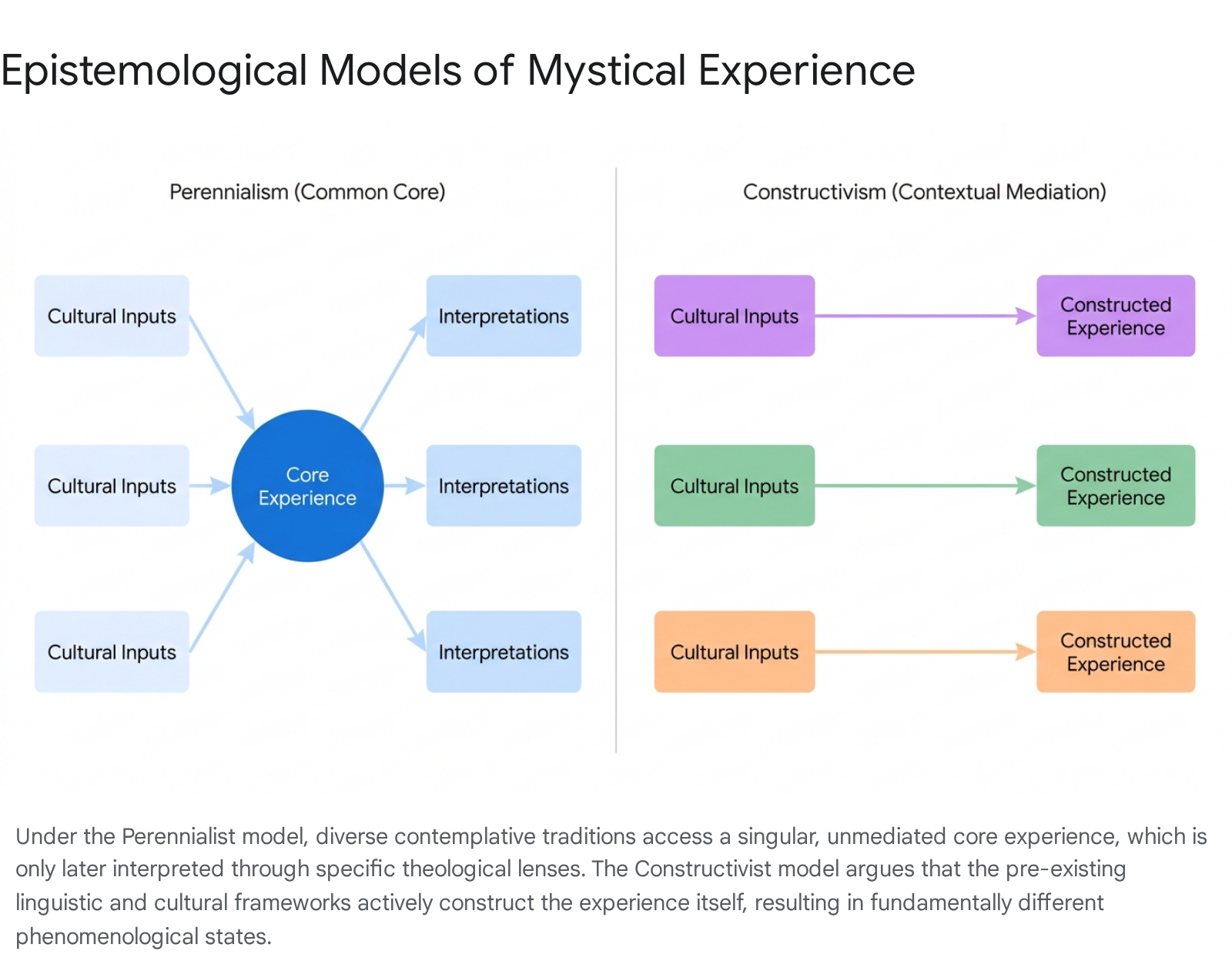
The academic study of religious experience is heavily structured by an epistemological debate regarding the nature of mystical states and their relationship to human language and culture. This debate is polarized between two theoretical camps: perennialism and constructivism 567.
Perennial Philosophy and the Common Core Hypothesis
Perennialism, championed by early scholars such as William James, Aldous Huxley, and later expanded by Robert Forman, posits that beneath the diverse theological doctrines and cultural expressions of the world's religions lies a singular, universal "common core" of mystical experience 157. Perennialists argue that mystics across different eras and geographies - whether Christian contemplatives, Buddhist monks, or Sufi ascetics - access the same fundamental, unmediated transcendent reality 78.
According to this paradigm, the experience itself is pre-linguistic and pre-conceptual 8. Only after the mystic returns to ordinary waking consciousness do they apply the specific theological vocabulary of their respective tradition to describe the ineffable event 8. Consequently, a Christian might describe the experience as "union with God," an Advaita Vedantin as the realization of "Brahman," and a Buddhist as the apprehension of "Śūnyatā" (emptiness), despite the phenomenological core of the experience being identical 412.
Contextual Mediation and Constructivism
In opposition to perennialism, the constructivist approach, prominently articulated by Steven T. Katz in his 1978 work Language, Epistemology, and Mysticism, rejects the possibility of an unmediated experience 67. Katz's central epistemological axiom states that "there are no pure experiences" 69. Constructivism asserts that the human mind is not a blank slate during mystical states; rather, the inherited linguistic, doctrinal, and cultural frameworks of the mystic actively construct the phenomenality of the experience 578.
From the constructivist perspective, pre-mystical training, religious education, and socio-cultural expectations set structured and limiting parameters on what the experience will ultimately be 57. A Buddhist meditating on emptiness does not have the same experience as a Carmelite nun contemplating the passion of Christ 610. By asserting that all knowledge and experience are subject to active organizing principles of consciousness, constructivists argue that the vast diversity of mystical reports reflects genuine, irreconcilable differences in the experiences themselves, countering the common core hypothesis 7811.
Decontextualism and the Pure Consciousness Event
Rebuttals to constructivism have yielded refined perennialist frameworks, frequently termed "decontextualism." Robert Forman, countering Katz, highlighted the Pure Consciousness Event (PCE) - a wakeful state devoid of intentional objects or discursive thoughts 5912. Forman argued that certain contemplative techniques operate through a process akin to "forgetting" rather than constructing, actively stripping away conceptual formulae to achieve an objectless state 12. From this perspective, the PCE demonstrates that human consciousness can exist independently of cultural constructs, preserving the validity of the perennialist common core 12.
Psychometric Measurement of Transcendent States
To empirically test the parameters of mystical states, psychologists required a validated instrument to quantify subjective accounts. The most prominent tool in the psychology of religion is the Mysticism Scale (M-Scale), developed by Ralph W. Hood Jr. in 1975 21314.
Scale Construction and Factor Structure
Hood based the M-Scale on Stace's philosophical criteria. The instrument consists of 32 self-report items - both positively and negatively worded to mitigate response set bias - measuring dimensions such as ego quality, unifying quality, temporal/spatial quality, inner subjective quality, noetic quality, positive affect, ineffability, and religious quality 220.
Initial factor analyses of the M-Scale identified two primary factors: a general mystical experience factor (20 items) and a religious interpretation factor (12 items) 2. Subsequent structural modeling refined this into a robust three-factor solution that maps directly onto Stace's categories: 1. Extrovertive Mysticism: Measuring the perception of unity within the diversity of the external empirical world 2015. 2. Introvertive Mysticism: Measuring the experience of an inner void, loss of self, and spatial/temporal transcendence 2015. 3. Religious Interpretation: Measuring the degree to which the subject applies theological or sacred frameworks to their anomalous experiences 2015.
The M-Scale has demonstrated high construct validity, correlating positively with intrinsic religious motivation (using Hoge's intrinsic scale), openness to experience (via Taft's ego permissiveness scale), and self-rated spirituality 213. Crucially, the scale operates independently of general psychopathology indices, differentiating intense religious experience from clinical disorders 2015.
Methodological Limitations and Cross-Cultural Applications
Extensive cross-cultural applications have tested the M-Scale beyond Western, Christian paradigms. Confirmatory factor analyses uphold the three-factor structure among Iranian Muslims, Israeli Jews, Indian Hindus, Chinese Christians, and Tibetan Buddhists 1415. The phenomenological factors (introvertive and extrovertive) tend to remain structurally invariant across cultures, but the interpretation factor exhibits significant variance 1315. Studies comparing American Protestants with Iranian Muslims, or Chinese Christians with non-Christians, indicate that while core mystical phenomenology scores are similar, the subsequent religious interpretation diverges strictly along doctrinal lines 1315.
Despite its ubiquity, the M-Scale is subject to methodological critique. Scholars note that psychometric instruments often suffer from a latent Abrahamic bias, inadvertently framing questions around Western conceptualizations of the "sacred" or "divine" 1322. Furthermore, researchers of Asian traditions observe that classical Buddhist and Advaita Vedanta texts rarely describe the "personal mystical experiences" of their authors in the emotional or unitive terms expected by Western psychology 2216. Applying the M-Scale to these traditions risks imposing a foreign epistemological framework onto indigenous contemplative practices, forcing ontological realizations into the mold of transient psychological events 1617.
Phenomenological Models Across Cultural Traditions
The operationalization of transcendent experiences requires an understanding of how different cultural and philosophical traditions frame the relationship between the self, the environment, and ultimate reality.
Eastern Traditions: Advaita Vedanta and Buddhism
In Eastern philosophical systems, the concept of a "mystical experience" is often integrated into rigorous metaphysical frameworks rather than treated as an isolated anomalous event. In Advaita Vedanta, the ultimate realization is the non-dual identity of the Ātman (individual self) and Brahman (the ultimate, unchanging cosmic consciousness) 122216. This realization is not inherently a transient "experience" in the Jamesian sense, but a fundamental ontological shift in the apprehension of reality, sublating the illusion (Maya) of multiplicity 1222.
Conversely, Mahāyāna Buddhism, particularly the Mādhyamaka and Yogācāra schools, rejects the notion of an eternal, underlying consciousness. Buddhist phenomenology emphasizes Śūnyatā (emptiness) and pratītyasamutpāda (dependent origination), denying any intrinsic essence to consciousness 12. Modern scholars debate whether the authors of classical Indian texts relied on spontaneous "mystical experiences" at all, suggesting instead that their systems developed through analytical meditation and the philosophical deconstruction of standard consciousness 1618. Nonetheless, contemporary researchers frequently map Buddhist meditative attainments onto Western psychological constructs of non-dual awareness 317.
Indigenous Models of Transcendent Experience
The study of Indigenous religions introduces a radical departure from Western biomedical and dualistic paradigms. Indigenous frameworks rarely compartmentalize human existence into separate physical, psychological, and spiritual domains; rather, they view the body, the community, the land, and the spiritual realm as an interconnected, holistic system 192021.
Scholars employing phenomenological methods in Indigenous studies emphasize that transcendent experiences in these cultures are deeply embedded in enculturation, seasonal rhythms, and communal resilience 2922. The Framework of Historical Oppression, Resilience, and Transcendence (FHORT) demonstrates how Indigenous faith practices - whether traditional ceremonies, integrated Christianity, or hybrid practices - serve as mechanisms for transcendence and liberation from colonial mindsets 2324. In these contexts, spirituality is not merely a private, ineffable encounter with the absolute, but a communal resource for navigating life, addressing historical trauma, and maintaining cosmic balance 22.
| Phenomenological Dimension | Western Mysticism (e.g., James/Stace) | Eastern Non-Dualism (Advaita/Buddhism) | Indigenous Frameworks |
|---|---|---|---|
| Ontological Focus | Encounter with the Absolute, "One," or Divine 112. | Realization of emptiness (Śūnyatā) or pure consciousness (Brahman) 412. | Interconnectedness of land, community, and spirit 1920. |
| Nature of the Self | Temporary dissolution of the ego or merging with a higher power 325. | Deconstruction of the self as an illusion; realization of no-self (Anattā) 312. | Identity derived from relationships and kinship with human and non-human life 2021. |
| Epistemological Approach | Focus on transient, ineffable, individual experiences 11. | Sustained analytical meditation, deconstruction of reality 1718. | Holistic, lived bodily experiences; truth derived from collective and cyclical existence 1920. |
| Function of the Experience | Personal transformation, moral elevation, psychological integration 2627. | Liberation from suffering (Moksha / Nirvana) 1222. | Communal resilience, healing imbalances, surviving historical oppression (FHORT) 2223. |
Clinical Psychology and the Boundary of Psychopathology
A critical challenge in the psychology of religion and clinical psychiatry is distinguishing genuine, life-enhancing mystical experiences from acute psychotic episodes. The phenomenological overlap between mysticism and severe mental illnesses, such as schizophrenia and bipolar mania, has been a subject of extensive clinical debate, complicated by the absence of definitive biological markers for either category 282930.
The Phenomenological Overlap
Both acute psychoses and mystical states can feature a radical disintegration of the mundane worldview, alterations in the perception of time and space, feelings of expanded identity, and perceptual anomalies 32831. Early psychiatric models frequently pathologized religious experiences, reducing them to symptoms of neurosis or infantile regression 2829.
However, detailed autobiographical and clinical analyses reveal significant functional and cognitive differences. While both states may involve a profound sense of noesis (revelatory knowledge) and exultation, the cognitive disorganization, severe thought disorder, and tangentiality characteristic of acute schizophrenia are largely absent in mystical reports 293132. Furthermore, visual hallucinations (such as visions of light or geometric unity) are more common in mystical states, whereas paranoid, commanding, or derogatory auditory hallucinations are highly indicative of schizophrenia 2631.
In cases of bipolar disorder, manic episodes share features with extrovertive mysticism, including elevated mood, grandiosity, and perceived hyper-connectedness 3233. However, mania is consistently accompanied by clinical markers such as a decreased need for sleep, rapid speech, impulsivity, and eventual functional impairment, which do not align with the serene, passive nature of classical mystical integration 3334.
Differential Diagnosis and Clinical Markers
To establish clinical markers for differential diagnosis, researchers emphasize evaluating the context, content, memory, and functional effect of the anomalous experience 262935.
The diagnostic category of "Spiritual Emergency" or "Mystical Experience with Psychotic Features" was proposed to classify brief, acute states of psychological fragmentation that ultimately lead to reintegration and higher functioning 282935. Mystics generally possess or subsequently construct a contextual framework to process their anomalous experiences, allowing them to suspend identificatory processes and integrate the event into their lives as a source of meaning and purpose 28. Conversely, patients suffering from psychotic disorders often struggle with fixed, idiosyncratic delusions that isolate them socially and cause enduring distress and deterioration of real-world functioning 326.
Observational measures like the Sydney Psychosis Observation Tool (SPOT) have been developed to differentiate between schizophrenia and mania during acute admissions, analyzing variables such as psychomotor activity and affect 32. Furthermore, researchers are identifying visual endophenotypes, such as motion discrimination deficits, that serve as trait markers for schizophrenia independent of psychotic or mystical states 36.
| Clinical Domain | Mystical Experience / Spiritual Emergency | Acute Psychosis (e.g., Schizophrenia) | Bipolar Mania with Psychotic Features |
|---|---|---|---|
| Cognitive Functioning | Intact discursive thought post-experience; deep noetic clarity 2931. | Severe thought disorder, incoherence, tangentiality, non-sequiturs 3132. | Racing thoughts, flight of ideas, distractibility 3233. |
| Hallucinatory Profile | Predominantly visual (light, unity); voices, if present, are benevolent or guiding 2631. | Predominantly auditory; voices are often derogatory, commanding, or paranoid 2632. | Mood-congruent hallucinations (e.g., hearing angels during euphoria) 33. |
| Ego and Identity | Voluntary ego-dissolution followed by reintegration; sense of interconnectedness 325. | Involuntary loss of self-boundaries; fears of mind-control or thought broadcasting 332. | Grandiose delusions; inflated self-esteem or belief in special powers 33. |
| Long-Term Effect | Enhances serenity, tolerance, purpose, and prosocial behavior 2026. | Functional decline, social withdrawal, chronic distress 2628. | Episodic functional impairment; requires mood stabilizers for regulation 3334. |
Neurobiology and Brain Mapping of Mystical States
The advent of advanced neuroimaging - including functional Magnetic Resonance Imaging (fMRI), Positron Emission Tomography (PET), and Electroencephalography (EEG) - has established the field of "neurotheology," seeking to map the precise neurobiological correlates of transcendent phenomena 453738.
The Default Mode Network and Ego Dissolution
A central finding in the neuroscience of mysticism is the role of the Default Mode Network (DMN). The DMN is a network of interacting brain regions - primarily the medial prefrontal cortex (mPFC), posterior cingulate cortex (PCC), and the inferior parietal lobule - that exhibits high baseline activity during passive resting states, mind-wandering, self-reflection, and autobiographical memory retrieval 254539. It is widely considered the neurological substrate of the "ego" or the narrative self 2540.
During mystical experiences, deep meditation, and prayer, neuroimaging consistently reveals a profound downregulation or desegregation of the DMN 254541. The reduction of neural activity in these key connector hubs acts to temporarily silence the narrative self, providing a neurobiological mechanism for the subjective experience of "ego-dissolution" and the blurring of boundaries between the self and the external universe 25. As the DMN quiets, it effectively acts as a "reducing valve" that opens, permitting a hyperconnected state where brain regions that do not normally communicate begin to interact, fostering feelings of non-local consciousness 2542.
Regional Activations and Parietal Deafferentation
While the DMN downregulates, other neural regions exhibit specific modulations linked to mystical phenomenality. fMRI studies on Carmelite nuns asked to recall their most profound mystical experiences demonstrated complex neural activations, countering the notion of a localized "God spot" in the brain 3743. Activations were observed in the right medial orbitofrontal cortex, right middle temporal cortex, and the midbrain periaqueductal gray (PAG) 37.
The PAG, a dense neural hub linking primal homeostatic drives with higher cortical centers, has been hypothesized as a crucial structure in generating the profound feelings of universal love and positive affect characteristic of mystical states 43. By modulating cortical activity, the PAG scales up fundamental mammalian survival and bonding mechanics to induce transcendent emotions 43. Furthermore, SPECT and fMRI studies frequently show a functional deafferentation (reduced sensory input) to the posterior superior parietal lobule (PSPL) 3738. Because the parietal lobe is responsible for spatial orientation and calculating the physical boundary between the self and the environment, its deactivation correlates directly with the transcendent experience of spacelessness, timelessness, and absolute unity 373843.
Electroencephalography in Contemplative Practices
Electroencephalographic (EEG) studies provide insight into the temporal dynamics and oscillatory brainwave states of mystical practices. Comparative research between Buddhist loving-kindness meditation and Christian prayer reveals distinct neuro-electrical signatures based on the specific contemplative mechanism employed 4445.
Buddhist meditation is frequently associated with significant increases in slow-wave activity, particularly in the delta (2-4 Hz) and theta (4-8 Hz) bands, localized in central and frontal regions, reflecting internalized attention and deep emotional processing 444546. Conversely, devotional prayer has been shown to induce high-frequency gamma oscillations (30+ Hz) and widespread alpha 1 (8-10 Hz) activity, indicating states of heightened sensory integration, serene focus, and robust cognitive binding 4447. Despite these distinct electrophysiological signatures, both pathways lead to overarching patterns of neural synchronization that facilitate positive affect and transcendence 44.
Psychedelic Science and Mystical Quantification
A highly significant development in the modern empirical study of mysticism is the renaissance of psychedelic science. Compounds such as psilocybin have proven capable of reliably and safely inducing profound altered states of consciousness that are phenomenologically indistinguishable from spontaneously occurring classical mystical experiences 274257.
Clinical Trials and the MEQ
In a landmark 2006 double-blind study at Johns Hopkins University, researchers administered high doses of psilocybin to spiritually active adults in a controlled, supportive setting. To measure the outcomes, they utilized the Mystical Experience Questionnaire (MEQ), a validated psychometric tool derived from the early Pahnke-Richards scale, which quantifies dimensions of unity, sacredness, noetic quality, positive mood, and transcendence of time and space 5748.
The results demonstrated that over 60% of participants receiving a high dose of psilocybin met the threshold for a "complete mystical experience" 2757. Longitudinal follow-ups revealed that these experiences were not merely transient hallucinatory events; the intensity of the mystical experience accurately predicted profound, enduring changes in core personality traits - most notably, significant increases in the domain of "Openness" 2748. Clinical applications of psilocybin-assisted psychotherapy report that the occurrence of "oceanic boundlessness" and a low dread of ego dissolution strongly correlate with lasting improvements in life satisfaction and reductions in treatment-resistant depression and substance use disorders 4849.
Network Scrambling and Hyperconnectivity
Neuroimaging studies of the brain under the influence of psilocybin provide a mechanistic explanation for these mystical states. Research indicates that psilocybin, acting via 5-HT2A serotonin receptor agonism, temporarily scrambles and destabilizes established functional networks, particularly the introspective DMN 41425051.
As modular networks disintegrate, the brain enters a state of dynamic global "hyperconnectivity." Regions of the brain that typically operate in isolation begin to cross-talk extensively, resulting in a functionally fluid, entropic neural state 414252. This hyperconnected pattern correlates directly with subjective reports of oceanic boundlessness and ego-modification 42. The compound acts as a profound disruptor of rigid cognitive priors, allowing the brain to entertain novel conceptual associations 4253. As the acute effects subside, the DMN resynchronizes, but the temporary period of boundary dissolution allows for a "reboot" of psychiatric functionality, offering a neurobiological rationale for why psychedelically induced mystical states hold immense therapeutic potential 5051.