
Neuroscience of mystical and religious experiences
For centuries, spiritual states characterized by feelings of profound unity, ego dissolution, timelessness, and transcendent awe were strictly the domain of theology, philosophy, and anthropological observation. However, the advent of advanced neuroimaging technologies - including functional magnetic resonance imaging (fMRI), single photon emission computed tomography (SPECT), positron emission tomography (PET), quantitative electroencephalography (qEEG), and voxel-based lesion-symptom mapping - has enabled researchers to isolate the physiological correlates of these subjective states 1224.
A central inquiry in early neurotheology was the hypothesized existence of a "God spot" - a localized, singular neuroanatomical center dedicated exclusively to processing spiritual or religious encounters 36. Current neuroscientific consensus unequivocally rejects the existence of a single isolated locus for spirituality 64. Instead, mystical experiences emerge from the highly complex, dynamic interplay of distributed, large-scale brain networks 5678. These networks regulate self-referential thought, spatial orientation, executive control, and emotional processing, demonstrating that the human brain relies on widespread neural recruitment to facilitate transcendent states.
This comprehensive analysis examines the neural mechanisms underlying spiritual and mystical experiences. It maps the contributions of specific neuroanatomical regions, evaluates the functional connectivity of large-scale brain networks, and compares neuroimaging data across diverse contemplative practices ranging from shamanic trance and Sufi whirling to contemplative prayer. Furthermore, it differentiates the neural signatures of pharmacological and non-pharmacological altered states, and assesses the evolutionary and clinical contexts of hyper-religiosity.
Regional Cortical and Subcortical Contributions
While network-level analysis provides a macroscopic view of consciousness alteration, specific localized regional activity maps directly onto the phenomenological attributes of spiritual experiences - such as a sense of divine presence, timelessness, and the suspension of logic.
The Temporal Lobe and the Limbic Marker Hypothesis
The temporal lobes, encompassing deep limbic structures such as the hippocampus and amygdala, have long been implicated as critical nodes in religious ideation 8. The "limbic marker hypothesis" proposes that the limbic system functions as an emotional tagging mechanism that assigns profound, transcendent significance to subjective experiences 8. When these structures undergo hyper-synchronized or aberrant activation, mundane thoughts, neutral experiences, or internal visual imagery are tagged with overwhelming feelings of ultimate reality, cosmic harmony, or divine contact 8.
The temporoparietal junction (TPJ), located at the intersection of the temporal and parietal lobes, is heavily involved in the Theory of Mind - the cognitive ability to attribute mental states, intent, and emotions to oneself and others - as well as spatial self-location 9. Modulation or disruption of the TPJ has been repeatedly correlated with out-of-body experiences (OBEs) and the sensation of encountering invisible agents, deities, or spiritual presences 369. Neuroimaging of individuals recalling profound spiritual encounters highlights the right temporal cortex's particular sensitivity, demonstrating an increased presence of high-frequency beta and gamma wave activation during religious cognition 9.
The Parietal Lobe and Spatial Deafferentation
The parietal cortex processes complex sensory information related to spatial awareness, body orientation, and the physical boundaries between the self and the external environment 610. Studies utilizing SPECT and fMRI consistently demonstrate an inverse relationship between spiritual awareness and activation in the inferior parietal lobule (IPL) 1011.
During deep meditation, repetitive prayer, or intensely focused spiritual cues, blood flow to the posterior superior parietal lobe significantly decreases 4. Because this neural region is strictly responsible for orienting the physical body within three-dimensional space, its deafferentation - the severe reduction or cutting off of incoming sensory input - results in the brain's inability to detect where the physical body ends and the surrounding environment begins 65. Phenomenologically, this manifests as "spacelessness," a loss of temporal flow, and the quintessential mystical experience of cosmic unity or oneness with the universe 4. This phenomenon has been documented across religious traditions, including in fMRI studies of Carmelite nuns who exhibited widespread neural alterations (including left inferior parietal lobule deactivation) while subjectively experiencing a state of union with God 4.
Frontal Lobe Inhibition and Executive Control
The prefrontal cortex (PFC), specifically the dorsolateral prefrontal cortex (dlPFC), governs high-level executive functions such as logic, goal-directed behavior, cognitive control, and the critical filtering of reality 1512. To evaluate causal hypotheses regarding the PFC's role in spirituality, researchers have utilized voxel-based lesion-symptom mapping in patients with localized brain damage. Data from the Vietnam Head Injury Study revealed that veterans who suffered penetrating traumatic brain injuries to the dlPFC and middle/superior temporal cortex reported significantly greater and more intense mystical experiences than matched healthy controls 212.
This pathological data confirms that the frontal lobes normally exert an inhibitory, regulatory effect on mystical cognition. By maintaining a strict perceptual and logical filter, the dlPFC anchors consciousness in mundane, objective reality. When this inhibitory function is permanently suppressed via injury, or temporarily downregulated via intense meditation or rhythmic ritual, a "door of perception" opens 2912. This downregulation allows the brain to entertain supernatural interpretations of unusual stimuli without the standard logical override that would normally dismiss such phenomena as irrational 2912.
Summary of Regional Neural Contributions
To contextualize the neuroanatomical data, specific phenomenological aspects of the mystical state can be mapped to their primary neural correlates.
| Phenomenological Attribute | Primary Brain Region / Network Implicated | Biological Mechanism of Action |
|---|---|---|
| Spacelessness and Oneness | Inferior Parietal Lobule (IPL), Posterior Superior Parietal Lobe | Deafferentation (reduced sensory input) resulting in the loss of spatial boundary detection between self and environment 41011. |
| Sense of Divine Presence | Temporoparietal Junction (TPJ), Right Temporal Lobe | Alterations in Theory of Mind processing, spatial self-location, and agency detection 39. |
| Profound Cosmic Significance | Limbic System (Amygdala, Hippocampus) | Hyper-activation providing emotional "tagging" that imbues mundane or internal experiences with immense, transcendent weight 8. |
| Suspension of Logic / Belief | Dorsolateral Prefrontal Cortex (dlPFC) | Downregulation of executive control and reality-filtering mechanisms, allowing supernatural interpretations 2912. |
Large-Scale Brain Networks in Mystical Transitions
Beyond isolated regions, the transition from ordinary waking consciousness to an altered spiritual state relies on the functional connectivity and dynamic interplay between three major intrinsic brain networks: the Default Mode Network (DMN), the Salience Network (SN), and the Central Executive Network (CEN) 171813.
The Default Mode Network and Ego Dissolution
The Default Mode Network - comprising the medial prefrontal cortex (mPFC), posterior cingulate cortex (PCC), precuneus, and lateral parietal cortex - is highly active during resting states, daydreaming, autobiographical memory retrieval, and self-referential thought 172021. The DMN effectively constructs and maintains the continuous narrative sense of self, which is often referred to in contemplative traditions as the "ego" 5.
Neuroimaging consistently demonstrates that profound mystical states - characterized by "ego dissolution" or a sense of absolute interconnectedness - are correlated with a marked downregulation or structural disruption of the DMN 51415. When DMN activity is suppressed, the psychological boundaries between the internal narrative self and the external environment become phenomenologically blurred 1617. For example, 7T fMRI studies on advanced Buddhist meditators practicing formless advanced concentrative absorption meditation (ACAM-J) indicate a steep, progressive reduction in DMN activity. This neural quietude corresponds to subjective reports of minimal phenomenal experience, a state of pure awareness devoid of standard subject-object duality 26.
The Salience Network as a Consciousness Toggle
The Salience Network, anchored in the anterior insula and the dorsal anterior cingulate cortex (dACC), operates as a neurological mediator. It continuously monitors the environment to detect biologically and cognitively relevant stimuli, subsequently directing the brain to switch between the internally focused DMN and the externally focused, goal-directed CEN 1727.
During ordinary cognition, the Salience Network regulates shifts between these two mutually exclusive networks. In healthy brains, the DMN and CEN are rarely active simultaneously to avoid mixed cognitive messages 1813. However, during spiritually significant tasks, rituals, or trances, there is a distinct disruption or modulation of SN activity. Research investigating trance states, such as shamanic journeying, highlights an unusual increased co-activation and centrality of the PCC (a core DMN hub) alongside the dACC and insula (SN hubs) 61819.
This evidence suggests that rather than the brain completely shutting down its internal systems during a trance, these networks enter a unique, paradoxical state of integration. The SN modulates the brain to maintain an extended, highly salient internal focus within the DMN while deliberately gating out irrelevant external stimuli from the auditory or visual cortices 630. This synchronized interplay enables the practitioner to transition smoothly into an altered state, experiencing vivid internal imagery or profound emotional insights without the disorientation that typically accompanies major neurological shifts 171831.
Functional Interplay of Brain Networks
The mechanisms by which these networks interact dictate the specific nature of the altered state experienced by the subject.
| Network | Core Neuroanatomical Nodes | Primary Function in Waking State | Role During Mystical / Trance States |
|---|---|---|---|
| Default Mode Network (DMN) | mPFC, Posterior Cingulate Cortex (PCC), Precuneus | Maintains autobiographical memory, self-reflection, and the narrative ego 1721. | Suppressed or decoupled, leading to the subjective experience of ego dissolution and unity 51426. |
| Salience Network (SN) | Anterior Insula, Dorsal Anterior Cingulate Cortex (dACC) | Detects important stimuli and toggles activation between the DMN and CEN 1727. | Co-activates unusually with DMN hubs to maintain extreme internal focus while filtering external noise 61831. |
| Central Executive Network (CEN) | Dorsolateral Prefrontal Cortex (dlPFC), Posterior Parietal Cortex | Executes high-level cognitive tasks, problem-solving, and logical reasoning 1718. | Downregulated to suspend logical filtering, allowing abstract, paradoxical, or spiritual ideation to emerge 217. |
Neuroimaging of Specific Trance and Meditative Practices
Human cultures have developed a vast array of methodological disciplines to induce mystical states. Neuroimaging reveals that while the subjective destination (e.g., profound peace, unity) may be similar, different practices leverage entirely distinct neurophysiological and structural pathways.
Shamanic Trance and Rhythmic Entrainment
Shamanic healing rituals, documented globally among indigenous populations such as the San people of southern Africa, various Amazonian groups, and practitioners of core shamanism, frequently rely on rhythmic auditory stimulation 32333435. Neuroscientific studies of experienced shamanic practitioners utilizing isochronous drumming (roughly 4 to 7 Hz) reveal specific, measurable alterations in brain wave dynamics and regional connectivity 142037.
A primary mechanism of this induction is "auditory driving," wherein the brain's motor and auditory cortices mechanically entrain to the external rhythmic beat. This sensory entrainment forces the synchronization of theta and low beta brainwaves across the cortex, creating a full-brain immersive state that serves as a stepping stone to trance 1437. Functional MRI data reveals that during the depth of a trance, there is paradoxically a decreased functional connectivity within the auditory pathway 620. This indicates that the monotonous, highly predictable rhythm of the drum reduces cognitive load; it requires minimal ongoing processing, allowing the brain to actively gate out external acoustic stimuli and turn attention entirely inward 637.
Furthermore, High-Density EEG studies demonstrate that the shamanic trance state is accompanied by increased absolute gamma power - which positively correlates with elementary visual alterations - and decreased neural signal diversity in the gamma band 2142038. A decrease in signal diversity (often measured as Lempel-Ziv complexity) indicates that the brain's electrical activity becomes highly synchronized and less chaotic. This structured neural environment is inversely correlated with profound feelings of insightfulness, distinguishing the disciplined shamanic state from disorganized psychotic or pharmacologically overwhelmed states 21438.
In highly active rituals, such as the San trance dance of the Kalahari, auditory driving is combined with intense physical exertion, repetitive movement, and hyperventilation. Anthropological and physiological models suggest this activates the sympathetic nervous system, releasing noradrenaline. Practitioners describe a healing energy, known as !num, rising along the spine, culminating in a deeply emotional state called Kia 333439. fMRI data from an expert Sangoma entering a trance showed the orbitofrontal cortex (a DMN component) was negatively activated, while disruption in the right temporal parietal junction facilitated the blurring of self/other distinctions, leading to profound body distortion and the subjective experience of spiritual flight 1939.
Sufi Whirling and Vestibular Adaptation
The Mevlevi Sema ceremony, commonly known as Sufi whirling, is an ascetic somatic meditation involving prolonged, rapid counter-clockwise spinning. While such sustained rotation would induce severe vertigo and vestibular distress in an untrained individual, experienced Sufi Whirling Dervishes (SWDs) undergo profound structural brain plasticity to adapt to the physical demands of the ritual 20.
High-resolution MRI studies comparing experienced dervishes (averaging 10.5 years of practice) to meditation-naïve controls reveal significant cortical thinning in specific neural networks. Practitioners possess structurally thinner cortices in the bilateral precuneus, bilateral fusiform gyrus, right lingual gyrus, and right dlPFC 20. This localized structural adaptation fundamentally alters spatial awareness and place-change perception, physiologically suppressing the normal vestibular response that causes dizziness and nausea 20.
Functionally, this somatic practice grants practitioners rapid access to deep meditative states characterized by theta brain wave patterns within minutes - a stark contrast to the extended durations typically required in seated meditation . The intense concentration and physical engagement also result in long-term functional decreased activation in the DMN, which significantly reduces mind-wandering, dampens anxiety, and facilitates a deep present-moment focus and emotional regulation both during the ceremony and in daily life 21.
Contemplative Meditation and Mantra Repetition
Seated meditative traditions display varying neural signatures depending on the specific cognitive strategy employed, generally categorized into Focused Attention (FA) and Open Monitoring (OM) practices.
Focused Attention meditations, such as specific Tibetan Buddhist techniques, require sustained concentration on a single object or thought. These practices heavily activate regions associated with the voluntary regulation of thought, including the premotor cortex and the dorsal anterior cingulate cortex 1522. Neuroimaging of advanced Tibetan monks exhibits an inverted U-shaped learning curve regarding cortical activation. Novices require substantial neural resources and widespread cortical activation to maintain focus, whereas highly trained experts achieve intense, unwavering concentration with minimal neural effort, displaying significantly reduced amygdala reactivity to sudden emotional distractors 22. Furthermore, analysis of EEG data reveals that different styles affect the brain's criticality - the mathematical boundary between order and chaos. Vipassana (an OM practice) moves the brain closer to this critical tipping point, maximizing flexibility and sensitivity to the present moment, whereas FA practices prioritize structured stability 23.
Mantra recitation, such as Islamic Dhikrullah (the repetition of divine names), introduces a vibrational and auditory component to contemplation. EEG studies indicate that the rhythmic repetition of vocalized or internalized sound synchronizes the brain to the frequency of the stimulus, rapidly shifting the brain's dominant frequency to alpha waves (8-12 Hz) 4445. This state of calm wakefulness directly stimulates the autonomic nervous system to produce endorphins. Consequently, regular Dhikr practice reduces cortisol levels, downregulates sympathetic arousal, and is clinically associated with improved sleep architecture, reduced anxiety, and enhanced emotional resilience 4445.
Pharmacological versus Non-Pharmacological Altered States
The phenomenological overlap between drug-induced psychedelic experiences and non-pharmacological mystical states (like deep meditation, breathwork, or shamanic trance) is exceptionally high 21638. Both pathways reliably yield profound spiritual insights, vivid visual alterations, ego dissolution, and long-term psychological benefits such as reduced death anxiety and the alleviation of refractory depressive symptoms 16244748.
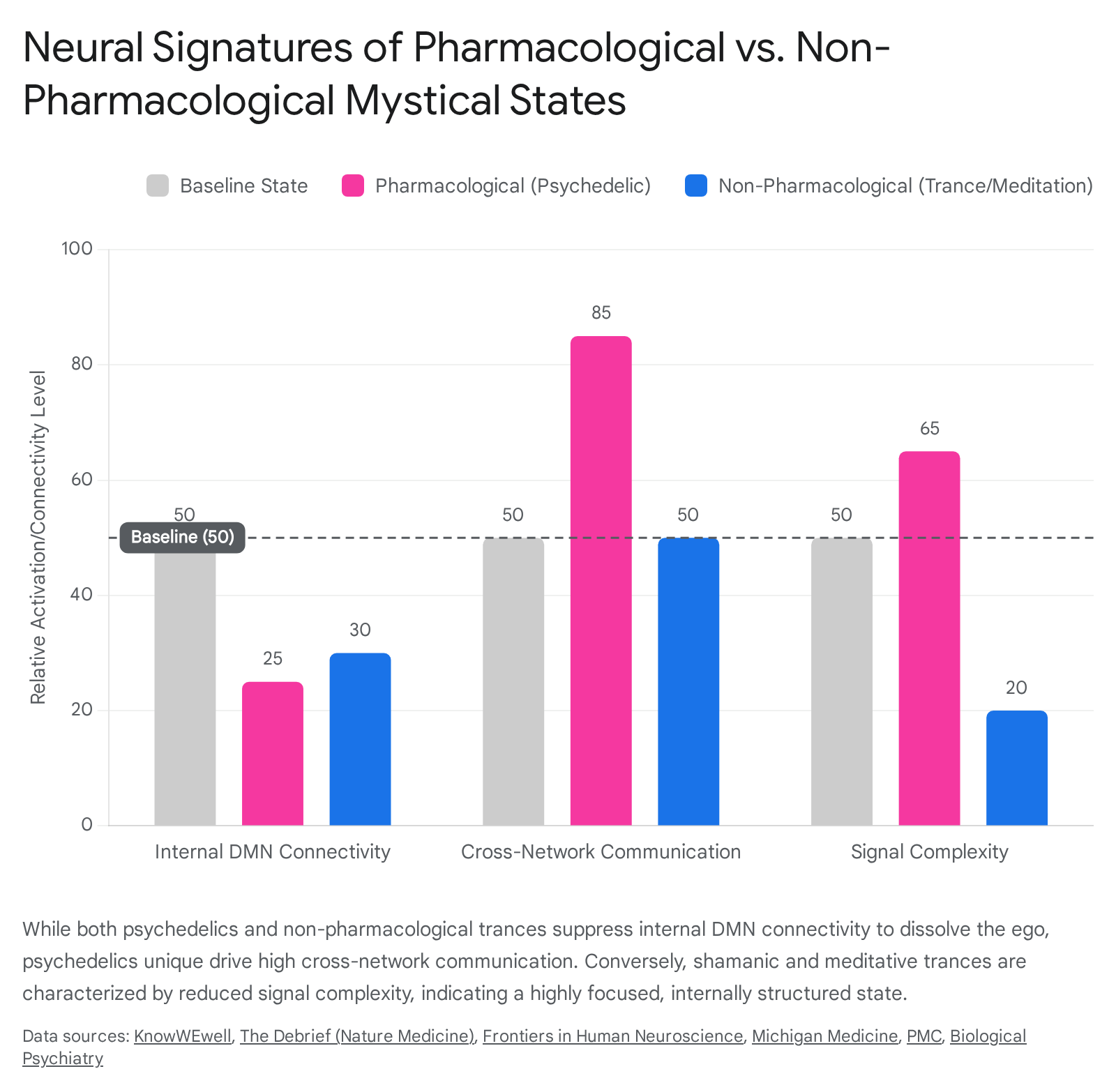
However, advanced neuroimaging has revealed that the foundational neural signatures underlying these externally similar states are fundamentally distinct. Classical psychedelics - such as psilocybin, LSD, and the DMT found in the Amazonian brew ayahuasca - primarily act as 5-HT2A receptor agonists 32. A landmark 2026 neuroimaging study analyzing five different psychedelics demonstrated two consistent, acute network changes across all substances: a severe structural weakening of functional connectivity within internal brain networks (such as the mPFC, PCC, and precuneus of the DMN), and a dramatic, chaotic increase in cross-talk between canonically separate functional networks 1725. This drug-induced hyper-connectivity allows signals to bleed between high-level executive networks and lower-level sensory regions, providing the biological basis for the vivid visual hallucinations, sensory blending (synesthesia), and unpredictable ideation characteristic of the psychedelic state 1725.
Conversely, while non-pharmacological states like shamanic drumming share the suppression of the DMN (yielding the shared trait of ego dissolution), they absolutely do not exhibit the disorganized hyper-connectivity across the rest of the brain 235. In shamanic practitioners, trance is marked by tightly synchronized gamma activity, highly specific localized hub co-activations (particularly the PCC and insula), and decreased neural signal complexity 261430. A decrease in signal diversity indicates a highly structured, orderly, and self-generated route to altered awareness, rather than a pharmacological destabilization 238. Direct comparative studies using resting-state fMRI confirm that pharmacological methods (psilocybin/LSD) and non-pharmacological methods (hypnosis/meditation) drive entirely distinct functional connectivity patterns that are mathematically predictive at the individual level using machine learning algorithms 26.
Indigenous Cosmologies and Ecological Cognition
Beyond episodic trance rituals, neuroscience and cognitive anthropology are increasingly collaborating to map the neurological frameworks inherent in continuous, embedded indigenous spiritual practices. Research demonstrates that certain ancient traditions do not merely alter temporary states of consciousness, but fundamentally restructure memory, spatial cognition, and environmental interaction.
Aboriginal Australian "songlines" represent a sophisticated, millennia-old place-based memory system that seamlessly integrates locatedness, relatedness, and narrative 515253. While Western traditions historically utilized the classical "method of loci" (or memory palace) - which relies on abstract, imagined spatial architectures to encode information - Aboriginal songlines are anchored in genuine, physical landscapes and geographical sacred sites 5253.
This integration functions as a powerful form of distributed cognition. In this paradigm, human memory is not viewed as being stored solely within the isolated brain; rather, it is actively held and retrieved through an embodied, ongoing relationship with the physical environment 5152. Navigating these physical spaces activates neural regions associated with spatial memory (such as the hippocampus and parahippocampal gyrus) intricately intertwined with the emotional and spiritual resonance of the limbic system. This dual activation effectively encodes and preserves vast encyclopedias of survival, ecological, and cultural knowledge without the need for written text 5153.
Similarly, Japanese Shintoism, a "forest religion," venerates kami - numinous spirits believed to inhabit natural phenomena, from grand mountains to humble streams 5455. Shinto practices, steeped in animism and the core concept of musubi (the power of creation and interconnected harmonization), foster a profound intrinsic respect for environmental and human diversity 5456. Modern psychological and physiological interpretations suggest that immersion in these sacred groves (chinju no mori) and participation in associated festivals initiate physiological states of awe. This aesthetic and spiritual awe is consistently linked to parasympathetic nervous system dominance, which structurally lowers cortisol-driven stress responses, suppresses disgust, and promotes the pro-social behaviors and communal harmony essential for long-term group survival 16545557.
Evolutionary Mechanisms and Adaptive Functions
If mystical and religious experiences exact a heavy cognitive, emotional, and sometimes physical toll (such as the intense pain and exhaustion of the San trance dance or the strict asceticism of Buddhist monasticism), why have the neural pathways facilitating these states been conserved throughout human evolution? Evolutionary neuroscience and psychology offer competing, yet illuminating, models.
Agency Detection versus Predictive Processing
One prominent, historically influential hypothesis in the cognitive science of religion is the Hyperactive Agency Detection Device (HADD). Coined by Justin Barrett, this theory suggests that the human brain evolved under error management principles to default toward detecting intentional, living agents in highly ambiguous situations 58592761. Evolutionarily, it was far less costly to assume a rustling bush was a hidden predator (a false positive) than to assume it was merely the wind and be eaten (a false negative) 5827. According to this model, religious belief in invisible deities, ghosts, or spirits is a massive evolutionary by-product - a cognitive misfiring resulting from a hypersensitive perceptual system that systematically over-attributes intentional agency and causal power to random natural phenomena 5827.
However, recent critical reviews in evolutionary neuroscience argue that the HADD hypothesis is structurally flawed and lacks rigorous biological or genetic evidence 5962. Critics point out that describing complex sociological and spiritual beliefs as the result of a singular, inherited neurological "device" severely oversimplifies human neural architecture 59. Instead, predictive processing models of the brain offer a reversed, top-down explanation. Rather than an innate module misfiring, predictive processing suggests that culturally transmitted religious teachings and narratives condition believers to strongly expect the presence of agents. These strong prior expectations then shape raw sensory data, eliciting the perceptual confirmation of those agents in a self-reinforcing loop 61.
Cultural Group Selection and Social Cohesion
A biologically and sociologically robust evolutionary model for spirituality centers on Cultural Group Selection. Anthropologists and evolutionary psychologists argue that rituals, religious beliefs, and shared mystical experiences were heavily selected for because they effectively harness human psychological mechanisms to foster extreme group-beneficial behavior 2829.
Intense spiritual experiences in nature or within collective ceremonial settings reliably induce states of awe, drastically reduce the defensive, selfish distancing caused by death anxiety, and suppress individualistic impulses 1657. The profound sense of shared unity - aided neurologically by the mutual, synchronized suppression of the DMN and the corresponding release of oxytocin and dopamine - acts as a powerful social glue 6566. Human groups that routinely practiced these highly cohesive rituals historically cooperated better, shared scarce resources more effectively, and consequently outcompeted, survived, and absorbed neighboring groups lacking such unifying psycho-social structures 28296567.
Longitudinal data on transformative spiritual experiences reveals a complex "double-edged sword" effect: while profound spiritual awakenings in adolescence can lead to temporary emotional vulnerability or a disrupted sense of self, they strongly correlate with higher long-term engagement in pro-social activities like voting, volunteering, and community building in adulthood 30. Thus, subjective awareness and mystical states may not possess the causal physical efficacy to alter objective external reality, but they serve the profound social evolutionary purpose of communicating inner realities, transmitting resilient cultural beliefs, and irrevocably binding a community together against environmental pressures 69.
Clinical and Pathological Considerations
While the vast majority of religious and spiritual experiences occur in psychologically healthy populations and generally promote well-being, the study of specific brain pathologies offers critical, isolating insights into the precise biological underpinnings of extreme religious behavior.
Temporal Lobe Epilepsy and Geschwind Syndrome
Temporal Lobe Epilepsy (TLE) provides the most striking and thoroughly documented clinical model for organic hyper-religiosity. Neurologists have long observed that a specific subset of patients suffering from TLE develop a distinct, lasting interictal (between seizures) behavioral profile known clinically as Geschwind syndrome. This syndrome is characterized by a behavioral triad: severe hyposexuality, hypergraphia (an intense, obsessive compulsion to write extensively, almost exclusively on complex philosophical, moral, or religious topics), and profound hyper-religiosity 87071.
Historically, case studies noted that patients experiencing complex partial seizures originating in the temporal or frontotemporal regions reported sudden, intensely vivid religious convictions, states of ecstatic rapture, or radical spiritual conversions during the ictal (seizure) or postictal phases 87031. Modern volumetric MRI studies have provided anatomical clarity to this pathology. Extensive imaging of refractory epilepsy patients demonstrates that hyper-religiosity in TLE is specifically, negatively correlated with structural volume in the right hippocampus; notably, atrophy in the adjacent amygdala shows no such correlation with religious behavior 7717374.
The exact neurophysiological mechanism sustaining this permanent interictal religiosity remains a subject of intense investigation. Clinical evidence suggests it stems from aberrant electrical kindling within the limbic networks. As seizures repeatedly stimulate and traumatize the neural pathways connecting the temporal lobe to the emotional centers - specifically white matter tracts like the uncinate fasciculus - the brain is rewired to inappropriately and continuously assign profound, cosmic significance to everyday thoughts, visual anomalies, and minor somatic sensations 8.
Interestingly, clinical psychiatric observations reveal a fascinating inverse correlation between acute seizure frequency and these chronic neurobehavioral manifestations. When active epileptic seizure activity increases in a patient, their interictal hyper-religious thoughts and psychotic symptoms often temporarily normalize and diminish 31. This data suggests that the massive electrical discharge of the seizures themselves may act as an organic form of electroconvulsive neuromodulation, temporarily resetting or exhausting the dysfunctional, hyper-connected limbic circuits driving the religious obsession 31.
Conclusion
Modern neuroscience has firmly and empirically dismantled the notion of a localized 'God spot'. Mystical, spiritual, and religious experiences are profound, whole-brain phenomena resulting from the highly intricate manipulation of large-scale functional networks and localized cortical regions.
The subjective, transcendent feeling of absolute union with the cosmos is mirrored physically by the deep quietening of the Default Mode Network and the sensory deafferentation of the parietal lobe. The unnerving sense of an external divine or spiritual presence correlates directly with alterations in the temporoparietal junction, and the assignment of overwhelming, life-altering significance is governed by the emotional tagging of the limbic system.
Whether induced by the rhythmic, auditory driving of shamanic drumming, the disciplined somatic exertion of Sufi whirling, the repetitive, autonomic-regulating cadence of mantra prayer, or the radical neurochemical cross-network disruption of classical psychedelics, the human brain possesses a remarkable, structurally evolved capacity to transcend its mundane, survival-oriented boundaries. While neuroimaging maps the precise biological topography of these altered states, the data remains ontologically neutral; it does not confirm or refute the objective reality of the divine. Instead, the research reveals that the human brain is uniquely, biologically adapted to experience the sacred, utilizing these profound states to foster psychological resilience, diminish the paralyzing fear of mortality, and bind human communities together across the millennia.