
The Perennial Philosophy and Scientific Research on Mysticism
The academic study of mysticism has long been polarized by a central epistemological debate concerning the universality of transcendent states. At the heart of this discourse is the perennial philosophy, a framework positing that all authentic mystical experiences across disparate cultures and epochs share a common, universal core. In recent decades, advancements in neuroimaging, cognitive science, and neurophenomenology have introduced empirical data into this philosophical domain, mapping the neural correlates of phenomena such as ego dissolution, timelessness, and spacelessness. By examining cross-cultural neurophysiological findings - ranging from advanced Buddhist meditation and Islamic dhikr to indigenous shamanic trance and psychedelic states - modern science provides a nuanced resolution to the debate. The emerging consensus suggests that while human biology provides a universal substrate for transcendent experiences, the specific cultural, psychological, and physiological methods of engagement generate a plurality of distinct mystical realities. This synthesis supports a participatory and bio-culturally grounded model over strict perennialism or absolute constructivism.
The Philosophical Bedrock: Essentialism versus Constructivism
The interpretation of mystical and transcendent states is traditionally divided into competing paradigms that dictate whether these experiences represent an encounter with an objective universal reality or are entirely the product of sociocultural conditioning 11. The tension between these models established the foundational inquiries for the cognitive science of religion.
The Perennial Philosophy and Essentialism
The concept of the perennial philosophy, popularized in the mid-twentieth century by Aldous Huxley, asserts the existence of a single, ultimate, and transcendent reality that can be directly accessed by the human mind under specific contemplative circumstances 24. According to this model, the doctrinal and linguistic differences among the world's religious traditions are merely surface-level interpretations of the same underlying esoteric truth 13. Early essentialist frameworks, heavily influenced by the psychologist and philosopher William James, as well as the philosopher Walter T. Stace, operationalized this concept into phenomenological categories. James identified four universal markers of mystical states: ineffability, noetic quality, transiency, and passivity 34. Stace further categorized these into extroverted mysticism, characterized by perceiving a unifying presence within the multiplicity of the physical world, and introverted mysticism, characterized by a state of pure, contentless consciousness devoid of sensory input 13.
Contemporary essentialists differentiate between "hard" perennialism, which insists on a single doctrinal truth, and "soft" perennialism, which argues for a common phenomenological core - such as the experience of pure consciousness or profound unity - while remaining agnostic about ultimate doctrinal equivalency 12. Critics of perennialism argue that the framework relies heavily on representationalist epistemology, assuming the human mind can passively mirror a pre-given, independent spiritual reality 5. This representational theory of mind has been increasingly challenged by modern cognitive science, which views human cognition as an active, predictive process 45. Furthermore, perennialism is frequently criticized for establishing hierarchical, altitudinal standards that arbitrarily privilege non-dual, introverted states (often associated with Eastern traditions) over visionary, shamanic, or theistic states 124. Such "epistemic colonialism" artificially flattens the diversity of human spiritual experience to fit a singular paradigm 46.
Contextualism and Constructivism
In direct opposition to perennialism, the constructivist paradigm - championed most notably by Steven Katz in the late 1970s - posits that there are no unmediated mystical experiences 134. Constructivism asserts that all human experience is inextricably filtered through and structured by prior linguistic, cultural, and psychological conditioning 34. From this viewpoint, a Buddhist experiencing "emptiness" and a Christian mystic experiencing "union with God" are not having the same experience and interpreting it differently retroactively; rather, their divergent cultural frameworks literally construct entirely different phenomenological events from the outset 13.
While constructivism effectively dismantled the uncritical universalism of early perennial models, it has been critiqued for its extreme reductionism. "Hard" constructivism equates to a neo-Kantian alienation, erecting an impenetrable epistemological barrier between human cognition and any purported ultimate reality 45. By insisting that all transcendent states are entirely culturally fabricated, strict constructivism struggles to account for the profound phenomenological similarities reported by mystics across historically isolated cultures, as well as spontaneous mystical experiences occurring in individuals with no prior religious conditioning or vocabulary 14. To address these limitations, scholars like Robert K.C. Forman proposed the existence of a "Pure Consciousness Event" (PCE), a state of wakeful but contentless awareness that evades constructivist boundaries, yet the debate between unmediated access and total contextual mediation remained largely unresolved until the integration of neuroscience 44.
The Participatory Turn: A Cocreative Epistemology
Emerging as a synthesis to resolve the perennialism-constructivism impasse, the participatory turn, primarily articulated by transpersonal psychologist Jorge N. Ferrer, conceptualizes human spirituality as a fundamentally cocreative phenomenon 256. The participatory paradigm systematically rejects the perennialist "myth of the given" (the idea of a singular, pre-existing absolute awaiting discovery) as well as the constructivist "myth of the framework" (the idea that culture arbitrarily determines all reality) 456.
Instead, the participatory approach relies on an enactive epistemology, aligning closely with theories developed in modern cognitive science and philosophy of mind. It posits that spiritual realities and ultimates are brought forth, or enacted, through the active participation of human faculties - somatic, vital, emotional, cognitive, and conscious - interacting with an undetermined, generative mystery 256. In this view, divergent spiritual traditions are not varied paths up a single, universal mountain, nor are they mere linguistic fabrications isolated from reality; they are distinct, ontologically rich spiritual cocreations 246.
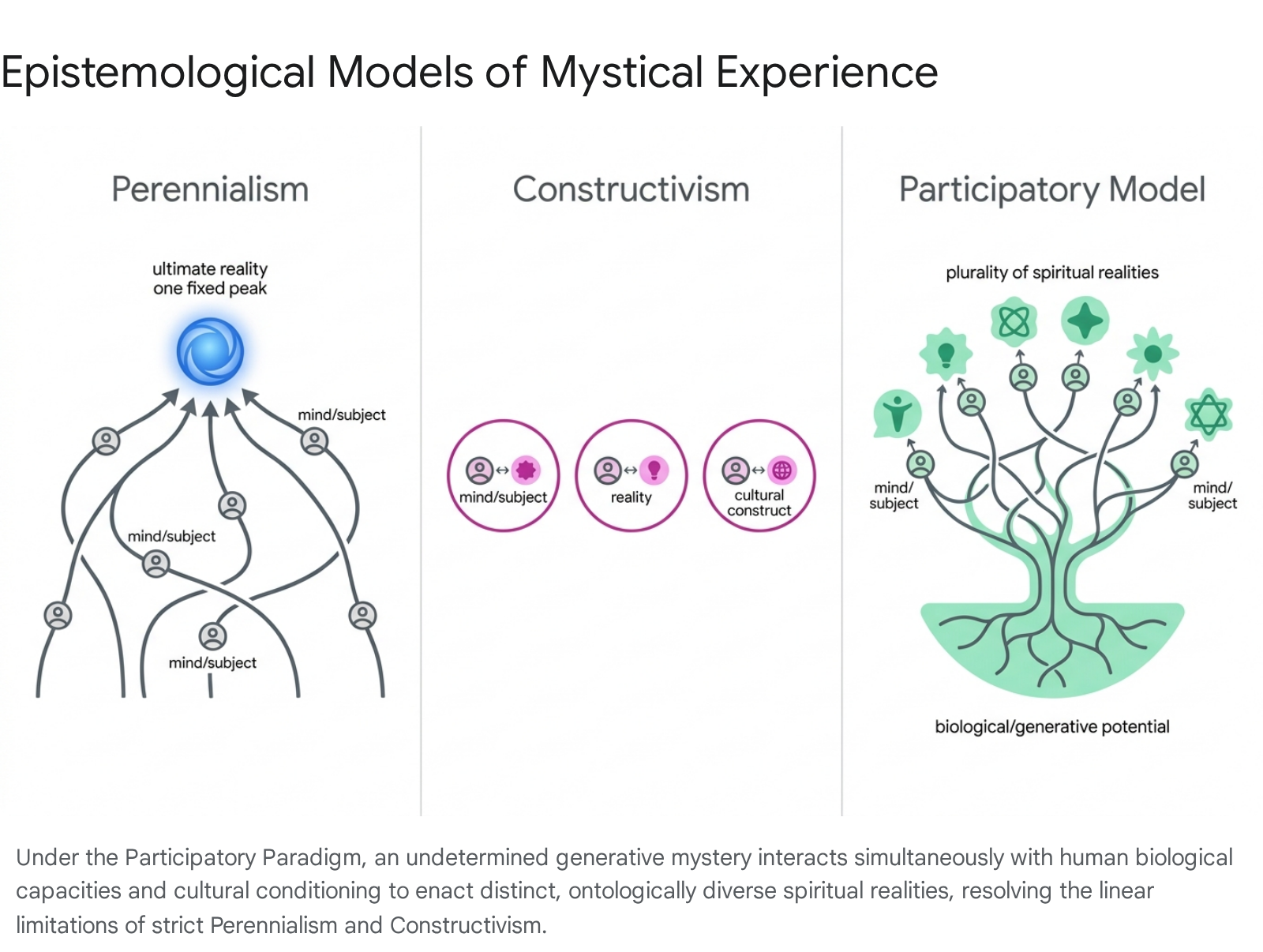
Ferrer utilizes the metaphor of an "ocean with many shores" to describe how various spiritual systems interact with the same generative source to yield legitimately distinct experiential outcomes 6.
The participatory model champions a robust spiritual pluralism, allowing for multiple, equally valid spiritual liberations 46. It acknowledges that different practices literally wire the practitioner to experience different dimensions of reality. Critics of the participatory turn, such as Abramson, have argued that postulating an underlying "undetermined mystery" is merely a form of "crypto-perennialism," while others, including Taylor, argue that the framework is metaphysically weak or vague 25. Proponents counter that this metaphysical minimalism is a necessary feature, not a bug, serving to avoid the dogmatism and religious exclusivism of historical frameworks while remaining consistent with modern cosmological theories regarding the participatory nature of observation 56.
| Feature | Essentialism & Perennialism | Contextualism & Constructivism | The Participatory Paradigm |
|---|---|---|---|
| Core Premise | All mystical traditions access the same underlying universal truth or share a phenomenological core. | Mystical experiences are entirely produced and structured by the practitioner's cultural and linguistic background. | Spiritual realities are cocreated events resulting from human interaction with an undetermined mystery. |
| Epistemological Basis | Representationalism: the mind mirrors an objective, pre-given spiritual absolute. | Neo-Kantianism: the mind projects its conceptual categories onto an unknowable noumenon. | Enactivism: knowledge and reality are brought forth through embodied, relational participation. |
| View of Ultimate Reality | Singular and monolithic. Differences among traditions are merely distinct interpretations of one reality. | Pluralistic but epistemologically inaccessible. Conceptions of the ultimate are cultural artifacts. | Pluralistic and ontologically real. Different traditions enact distinct, equally valid spiritual ultimates. |
| Scientific Limitations | Struggles to explain significant phenomenological and neural differences between distinct contemplative practices. | Fails to account for cross-cultural homologous experiences and spontaneous, non-conditioned mystical states. | Acknowledged as metaphysically minimalist; ongoing debate regarding the objective independence of enacted states. |
Neurotheology and the Search for a Common Neural Signature
To adjudicate between philosophical models of mysticism, researchers have increasingly turned to neurotheology - a multidisciplinary field exploring the neurophysiological foundations of religious and spiritual experiences 17. Operating on the premise that human consciousness relies on specific, measurable brain networks, neurotheology attempts to identify whether transcendent states possess a uniform neural signature, which would strongly support perennialist claims, or divergent signatures, which would support pluralistic models 14.
The Default Mode Network and Ego Dissolution
A central focus in contemporary neuroimaging of mystical states is the Default Mode Network (DMN), a large-scale brain network primarily comprising the posterior cingulate cortex (PCC), the medial prefrontal cortex (mPFC), and the inferior parietal lobule (IPL) 89. The DMN is highly active during self-referential thought, autobiographical memory retrieval, mind-wandering, and the continuous maintenance of the narrative ego 89.
Neuroimaging studies consistently demonstrate that during profound mystical states - whether induced by advanced meditation, deep prayer, or classic serotonergic psychedelics such as psilocybin and LSD - there is a sharp reduction in overall DMN activity and a severe disruption in the functional connectivity between its core nodes 89. The downregulation of the PCC, in particular, is robustly correlated with subjective reports of "ego dissolution," a hallmark of the unitive experience wherein the boundary between the internal self and the external environment collapses entirely 48.
Furthermore, the deactivation or deafferentation (the cutting off of sensory input) of the lateral and medial parietal nodes of the DMN corresponds directly to the subjective experience of spacelessness and timelessness 812. The parietal lobes are responsible for human spatial orientation and the sequencing of linear time; when their normal functioning is suspended through contemplative practices or pharmacological intervention, practitioners reliably report entering a boundless, eternal present 1210. The consistency of DMN suppression across various induction methods provides strong empirical support for essentialist and soft perennialist models, suggesting that human beings are biologically wired with a specific neurological architecture capable of accessing a mode of consciousness characterized by absolute selflessness and unity 14.
Content-Free Awareness and Advanced Contemplation
Recent advancements utilizing high-resolution electroencephalography (EEG) coupled with ultrafast functional magnetic resonance imaging (fMRI) have provided unprecedented insight into deep meditative states, specifically the state of Content-Free Awareness (CFA) 912. Often referred to in Eastern traditions as the "ground state of awakening" or pure consciousness, CFA represents an awareness devoid of thoughts, sensory perception, and the sense of self 12. A 2020 single-case study of an expert Buddhist monk entering CFA while inside an MRI scanner revealed a highly specific and measurable neural correlate. The onset of CFA was characterized by a sharp decrease in alpha power and a simultaneous, sustained increase in theta power 12.
Functionally, CFA involved severe decreases in posterior DMN connectivity coupled with widespread increases in functional connectivity within the Dorsal Attention Network (DAN) 912. This unusual neurological configuration - heightened attentional network activity combined with a disabled self-referential network - aligns perfectly with the perennialist descriptions of introverted mysticism: a state of alert, lucid awareness utterly devoid of specific cognitive, emotional, or visual content 112.
The reliability of these neural markers in advanced meditation has been firmly established. Research conducted at the Massachusetts General Hospital focusing on the neural responses of highly advanced meditators entering the eight sequential jhanas (increasingly subtle states of meditative absorption) demonstrated strong within-subject reliability in brain network functional connectivity 9. Researchers developed a new approach called brain network intraclass correlation (ICC) to verify that specific brain networks showed consistent engagement across all jhana states, while other areas were uniquely reliable during specific jhanas 9. This indicates that mystical experiences operate via precise, reproducible neurobiological mechanisms rather than vague psychological suggestibility or random hallucination.
Cross-Cultural Neuroimaging: Evidence for Biological Pluralism
While the suppression of the DMN and the emergence of CFA point toward a universal biological substrate for specific types of mystical experiences, cross-cultural neuroimaging studies indicate that different spiritual technologies heavily modulate how these states manifest. The resulting neurological diversity strongly challenges the monolithic claims of hard perennialism, proving that there is no single, universal destination for human spiritual development.
Indigenous Shamanic Trance and Entheogens
Shamanism, widely practiced among indigenous non-WEIRD (Western, Educated, Industrialized, Rich, and Democratic) populations, utilizes distinct methods - most notably rhythmic drumming, chanting, and the ingestion of entheogenic plant medicines - to induce non-ordinary states of consciousness for the purposes of divination, psychological integration, and communal healing 1115. A neuroanthropological approach to these practices reveals brain function alterations that diverge significantly from the mechanisms of passive meditation 15.
A 2020 high-density EEG study of expert shamanic practitioners engaging in trance via rhythmic drumming identified a neural signature fundamentally distinct from both the psychedelic state and standard DMN suppression 11. Shamanic trance induced a significant increase in absolute gamma power, decreased neural signal diversity in the gamma band, and increased criticality (a state of phase transition between order and chaos) across the beta and gamma bands 11. The practitioners exhibited decreased low-alpha and increased low-beta connectivity, changes that correlated directly with subjective reports of complex imagery, elementary visual alterations, and deep insightfulness 11. These findings suggest that while the subjective phenomenology of shamanic trance shares overlapping traits with other altered states, the specific endogenous mechanisms recruited are unique, indicating an independent, culturally enacted state of consciousness rather than a universal biological default 11.
Conversely, Amazonian shamanic practices utilizing Ayahuasca (a serotonergic hallucinogen containing DMT and beta-carbolines) demonstrate entirely different neural profiles. Retrospective fMRI studies on long-term Ayahuasca users reveal structural and functional adaptations within the brain's emotional processing centers rather than just the default mode network 1612. During emotional judgment tasks, long-term practitioners exhibited modified activation patterns detectable via machine learning (MKL and Gaussian Process Regression classifiers), alongside significantly higher psychological resilience scores 16. Furthermore, complex pharmacoimaging studies indicate that Ayahuasca specifically modulates the posterior superior temporal sulcus (pSTS) - a core hub of the third visual pathway and the mirror neuron system, which is deeply involved in theory of mind, facial emotion recognition, and social cognition 12. The hyper-connectivity generated in these regions aligns with subjective reports of increased prosocial behavior, profound empathy, and an animistic connectedness to nature, distinguishing the entheogenic mystical experience from the isolating, contentless void of introverted Eastern meditation 1612.
Abrahamic and Eastern Contemplative Traditions
Comparative studies between monotheistic traditions and non-dualistic traditions further highlight both the biological commonalities of transcendent states and the constructive power of specific doctrinal practices to shape the brain. Islamic Sufism utilizes dhikr - the repetitive, rhythmic invocation of the names of God - to achieve a state of fana (ego dissolution) and subsequent baqa (subsistence in God) 13. Recent functional MRI and QEEG studies analyzing expert practitioners during dhikr show significant activation in the prefrontal cortex, anterior insula, and angular gyrus - regions heavily associated with focused attention, self-control, and emotional regulation 1314.
When brain activations during dhikr are compared with those during general, unstructured thought about God or secular resting states, dhikr reliably decreases activity in the DMN while increasing brain synchronization and delta-wave power 13. Interestingly, while Islamic dhikr and Buddhist mindfulness practices both result in transcendent experiences and improved emotional regulation, they achieve this via overlapping but slightly different neural pathways 13. Dhikr recruits areas associated with relational attachment and theistic focus (generating a sense of "presence" or unitive relationship with a divine other), whereas certain Eastern non-dual practices (such as Advaita Vedanta or Zen) lean heavily toward the complete dissolution of the subject-object boundary, engaging deeper thalamic and parietal deafferentation 1320.
This pluralism is further evidenced in studies of Christian mystics. Research assessing Carmelite nuns in states of subjective mystical union with God identified localized activation in the right medial orbitofrontal cortex, extra-striate visual cortex, and specific regions of the brainstem 10. Unlike the content-free states of Theravada monks, the nuns' experiences were highly visionary, spatially located, and emotionally saturated with profound feelings of unconditional love and relational presence 10. Similarly, studies examining Orgasmic Meditation (OM) - a practice focusing on focalized somatic stimulation rather than cognitive control - revealed significant decreases in resting metabolism across the frontal, temporal, and parietal lobes, highlighting yet another distinct neurological pathway to altered states of consciousness 20.
These variations across traditions strongly imply that human consciousness is not merely accessing a single pre-existing "perennial" state, nor is it subject entirely to an illusion created by language. Instead, the brain actively participates in the neural shaping of the transcendent encounter based on the specific psychophysiological tools deployed by the tradition 45.
| Contemplative Practice | Primary Neural Mechanisms Observed | Phenomenological Outcome |
|---|---|---|
| Advanced Mindfulness / Jhana Meditation | Severe suppression of posterior DMN; hyperconnectivity in Dorsal Attention Network (DAN); decreased alpha, increased theta power. | Content-Free Awareness (CFA); pure consciousness; total ego dissolution; timelessness and spacelessness. |
| Shamanic Trance (Drumming) | Increased absolute gamma power; increased criticality (phase transition) in beta/gamma bands; decreased low-alpha connectivity. | Complex visionary imagery; deep insightfulness; interactive spirit encounters; feeling of somatic movement. |
| Ayahuasca / Entheogenic Ceremonies | Modulation of posterior superior temporal sulcus (pSTS); activation of the mirror neuron system; suppression of narrative DMN nodes. | Enhanced social cognition; deep relational empathy; animistic connectedness to nature; profound emotional resilience. |
| Islamic Dhikr / Theistic Prayer | Activation of prefrontal cortex, anterior insula, and angular gyrus; increased delta-wave synchronization; downregulation of DMN. | Fana (ego dissolution) paired with relational presence; heightened emotional regulation; feelings of divine proximity. |
| Christian Mystical Union (Carmelite) | Activation in right medial orbitofrontal cortex, extra-striate visual cortex, and brainstem loci. | Visionary encounters; somatic feelings of unconditional love; relational communion with a personal deity. |
Synthesizing Neuroscience and Philosophy: The Bio-Cultural Enactment of Reality
The aggregation of neuroimaging data gathered over recent years offers critical resolutions to the theoretical debate between perennialism, constructivism, and the participatory paradigm.
The Limits of Strict Constructivism
Recent neuroepistemological findings provide formidable evidence against the strict constructivist claim that unmediated experience is impossible and that all mystical phenomena are merely cultural artifacts retrofitted to mundane psychological events 14. The presence of homologous brain functions across humanity establishes that specific, innate biological dynamics generate the core features of mystical states, independent of the practitioner's cultural vocabulary 14.
The phenomenon of ego dissolution, cross-culturally characterized by a loss of individual boundary and a profound sense of unity, maps reliably onto the suppression of the Default Mode Network, regardless of whether the subject is a Peruvian curandero, a Sufi dervish, or a secular participant in a clinical psilocybin trial 1813. As Laughlin and Rock (2020) argue, the human brain possesses functional operational modules that generate our normal, waking sense of "self," "time," and "space" 1. When intensive meditation or pharmacological agents deliberately suspend the neurological processes of "protention" (the cognitive anticipation of the future) and "retention" (the immediate memory of the past), the resulting experience of an eternal "now" is driven by universal neurophysiology, not cultural suggestion 14. The occurrence of common physiological markers across disparate traditions constitutes direct evidence for an unmediated, innate biological capacity for transcendent awareness, thereby validating essentialism and soft perennialism up to a point 14.
Neuroplasticity, Deconditioning, and the Validation of the Participatory Paradigm
However, the empirical data equally refutes hard perennialism - the notion that a single, identical esoteric truth lies behind all spiritual systems, and that all paths lead to the exact same summit 14. Neuroimaging decisively demonstrates that different contemplative traditions employ fundamentally distinct mechanisms to achieve altered states, resulting in genuinely different phenomenological and neurological outcomes 111.
The neurological signature of a shamanic trance (driven by gamma criticality and rhythm-induced auditory driving) is biologically distinct from the signature of a classic psychedelic state (driven by 5-HT2A receptor agonism), which is in turn distinct from the state of Christian visionary union (driven by orbitofrontal and limbic emotional processing) 91011. From the perspective of clinical neuroplasticity, cultural and spiritual practices act as targeted technologies that physically rewire the brain 1. Mindfulness meditation, mantras, analytical inquiry, and ritual dance serve as specific "constructivist" methods that decondition habitual mental networks and recruit entirely different neurological pathways 14.
This biological reality seamlessly aligns with Jorge Ferrer's participatory paradigm. The brain's structural capacity for ego-dissolution and expanded awareness acts as the "undetermined mystery" or generative substrate 456. The specific cultural traditions, theological beliefs, and embodied psychophysical practices act as the active "participation" 25. The resulting neurological state is the enacted spiritual reality 46. Mystical experiences are therefore neither entirely objective encounters with a monolithic divine absolute independent of human cognition, nor are they mere subjective illusions engineered by language. They are profound, cocreated biological and phenomenological events 256.
Furthermore, mechanisms like "thalamic gating" and the "reducing valve" theory - originally posited by Huxley and increasingly supported by modern neuroscience - suggest that normal, waking consciousness operates primarily as a filter, suppressing an immense spectrum of cognitive, somatic, and environmental data to facilitate basic biological survival 9. Psychedelics, deep meditation, and rhythmic trance temporarily inhibit these gating functions, plunging the subject into an expanded field of awareness 9. How that expanded awareness is subsequently organized, navigated, and interpreted by the brain depends deeply on the cognitive framework and the practiced neural pathways of the individual. This proves that the ultimate mystical outcome is a reciprocal, cocreative relationship between innate human biology and cultural context 456.
Conclusion
The perennial philosophy, as originally conceptualized in the mid-twentieth century, proposed that modern science and comparative religion would eventually uncover a single, unvarying truth hidden beneath the diverse doctrines of the world's faiths. Modern neuroscience, neurotheology, and neuroepistemology have tested this hypothesis and found it to be only a partial truth. Empirical science strongly supports the idea of universal mystical capacities - innate structural features of the human brain, such as the Default Mode Network and thalamic gating mechanisms, which, when suppressed or altered, universally generate experiences of profound unity, spacelessness, and ego dissolution.
Yet, science does not support the existence of a single, uniform mystical truth or a singular, hierarchical destination of spiritual development. Cross-cultural neuroimaging demonstrates that the human nervous system interacts dynamically with specific cultural technologies - be they the rhythmic drumming of an indigenous shaman, the repeated dhikr of a Sufi ascetic, or the silent, non-dual introspection of an Advaita Vedanta practitioner - to enact unique, complex, and phenomenologically diverse states of consciousness.
The integration of these neuroscientific findings points definitively toward a bio-culturally grounded participatory pluralism. Human beings are not passive recipients of a pre-given ultimate reality, nor are they trapped in inescapable linguistic constructs. Through deliberate, embodied practice, individuals cocreate distinct transcendent realities, bridging the biological potential of the brain with the profound depths of human meaning-making. As the tools of neurotheology continue to refine our understanding of these complex brain states, the academic study of mysticism must advance beyond the reductive binary of perennialism and constructivism, fully embracing the diverse, participatory, and enactive nature of spiritual life.