
Why Exercise Improves Your Mood
Physical activity elevates mood through an immediate surge of endocannabinoids that cross the blood-brain barrier to produce a short-term sense of calm, coupled with long-term structural changes in the brain. Over time, exercise triggers the release of neurotrophic factors that physically grow new neural pathways, while simultaneously fostering psychological resilience, enhancing self-efficacy, and interrupting cycles of negative thinking. The most profound mental health benefits occur at moderate, consistent doses, meaning that regular movement is vastly more important than extreme physical exhaustion.
The Neurobiology of the "Runner's High"
For decades, scientists and fitness enthusiasts alike attributed the euphoric afterglow of a difficult workout to a single chemical process: the release of endorphins. Today, advanced neurobiology paints a much more complex and fascinating picture of how the body communicates with the brain during and after physical exertion.
The Endorphin Myth
Endorphins are hormone-like peptides naturally produced by the body in response to stress or pain 12. In the 1980s, researchers observed that endurance athletes had highly elevated endorphin levels in their bloodstream post-workout, which seemed to perfectly explain the phenomenon known as the "runner's high" 14. Endorphins act as a self-produced opioid, binding to receptors to block pain signals and promote physical endurance 14.
However, modern science has identified a critical mechanical flaw in the endorphin hypothesis: endorphins are large molecules that cannot cross the blood-brain barrier 1242. The blood-brain barrier is a highly selective, semi-permeable cellular border that prevents circulating blood - and potentially harmful pathogens - from non-selectively crossing into the extracellular fluid of the central nervous system. Because endorphins cannot easily breach this barrier, the endorphins produced in the body during a workout remain largely isolated below the neck 24. While they act as effective localized painkillers for fatigued and aching muscles, they cannot directly interact with the brain's emotional centers to produce a psychological high 12.
Enter the Endocannabinoid System
Current scientific consensus points to a different chemical mediator for the runner's high: the endocannabinoid system (ECS) 142. Discovered in the early 1990s, the ECS is a vast, intelligent network of receptors, enzymes, and lipid-based neurotransmitters that help maintain physiological homeostasis, regulating everything from mood and sleep to pain and inflammation 114.
During aerobic activity, as heart rate rises, the body significantly increases the production of circulating endocannabinoids, most notably a lipid-based neurotransmitter called anandamide 12. The name anandamide is derived from ananda, the Sanskrit word for "bliss" 14.
Unlike bulky endorphins, anandamide is highly lipophilic (fat-soluble) and effortlessly crosses the blood-brain barrier 212. Once inside the brain, anandamide binds to CB1 and CB2 receptors 142. These are the exact same neuro-receptors activated by plant-based, exogenous cannabinoids like THC and CBD 11. The activation of central CB1 receptors triggers intense subjective experiences: short-term mood elevation, analgesia (pain relief), anxiolysis (reduced anxiety), and intense post-exercise sedation or calm 12.
| Feature | Endorphins | Endocannabinoids (e.g., Anandamide) |
|---|---|---|
| Molecule Type | Peptide hormones | Lipid-based neurotransmitters |
| Primary Trigger | Physical pain and extreme stress | Aerobic cardiovascular exertion |
| Blood-Brain Barrier | Cannot cross easily; largely isolated to the body 24. | Crosses easily; interacts directly with brain receptors 12. |
| Primary Effect | Blocks localized muscle pain signals 12. | Reduces anxiety, elevates mood, and induces euphoria 12. |
The intensity of this endocannabinoid release appears tied to the specific type of physical stress 14. Activities that require an individual to support their own body weight, such as running, produce more physiological stress than lower-impact activities like cycling or swimming, which may explain why runners often report a more pronounced euphoric buzz 1.
Long-Term Brain Remodeling
While anandamide explains the immediate, transient glow following a workout, the long-term mood stability provided by exercise relies on literal, structural changes within the brain. Physical activity is one of the most potent non-pharmacological interventions for enhancing neuroplasticity - the brain's lifelong ability to adapt, heal, and form new neural connections 374.
Neuroplasticity and the BDNF "Miracle-Gro"
At the center of exercise-induced neuroplasticity is Brain-Derived Neurotrophic Factor (BDNF) 374. Often referred to by neuroscientists as "Miracle-Gro for the brain," BDNF is a crucial protein that supports the survival of existing neurons and encourages the growth and differentiation of new neurons (neurogenesis) and the formation of new synapses (synaptogenesis) 375.
In individuals suffering from chronic stress, anxiety, or clinical depression, certain brain regions physically atrophy. The hippocampus - a region central to learning, memory, and emotional regulation - is particularly vulnerable to stress-induced shrinkage 76. Regular physical exercise consistently elevates both peripheral and central BDNF expression, which actively reverses this atrophy 74. By binding to TrkB receptors, mature BDNF activates signaling pathways that prevent cell death, preserve gray and white matter, and build long-term cognitive resilience 375.
The Muscle-Brain Lactate Pathway
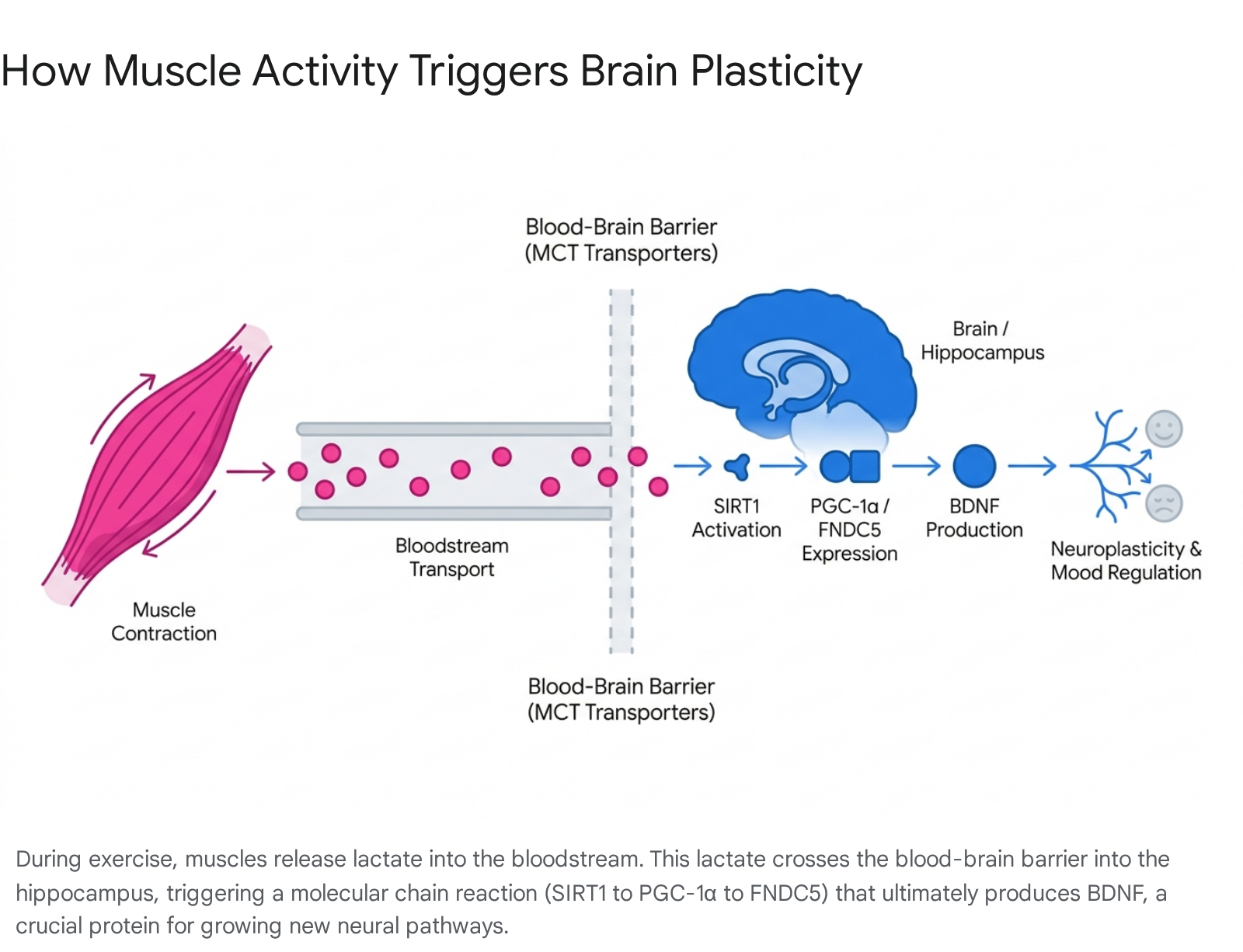
For years, a missing link in exercise science was understanding exactly how flexing skeletal muscles signaled the brain to produce more BDNF. Recent research has identified the messenger: lactate 78910.
Historically dismissed as a mere metabolic waste product responsible for muscle fatigue and burning sensations, lactate is now recognized as a vital signaling molecule 5710. During moderate to high-intensity exercise, working muscles generate high levels of lactate, which spills into the systemic bloodstream 89. This lactate travels to the brain and successfully crosses the blood-brain barrier via monocarboxylate transporters (MCTs) 91011.
Once inside the brain, particularly in the hippocampus, lactate acts as a neurochemical trigger 810. It activates a specific deacetylase enzyme known as SIRT1. SIRT1 then increases the levels of a transcriptional coactivator called PGC-1α and a secreted molecule known as FNDC5 8910. This precise molecular cascade - driven entirely by the physiological byproduct of working muscles - is what ultimately induces the expression of BDNF and enhances memory and spatial learning 810.
Glutamate, Monoamines, and Inflammation
While BDNF and endocannabinoids are the most heavily researched pathways, physical activity acts as a broad-spectrum intervention across multiple neurobiological systems. For over half a century, the "monoamine hypothesis" dominated the understanding of depression, suggesting that a depletion of neurotransmitters like serotonin, noradrenaline, and dopamine caused mood disorders 6. Exercise actively elevates synaptic serotonin availability by increasing tryptophan hydroxylase activity and reducing serotonin reuptake, functionally mimicking the mechanisms of many modern antidepressants 612.
More recently, the "glutamate hypothesis" has gained traction 6. This theory suggests that rapid mood improvements can be tied to alterations in glutamate receptors. Exercise supports this by increasing brain lactate, which serves as a vital precursor for glutamate production, helping to restore energy balance and functional connectivity in the brain 610.
Furthermore, physical activity directly combats the "inflammation hypothesis" of depression 6. Chronic stress triggers systemic inflammation and an overproduction of reactive oxygen species (oxidative stress), which degrades brain tissue 6. Consistent exercise acts as an anti-inflammatory agent, enhancing mitochondrial biogenesis and bolstering the body's natural antioxidant enzyme activity 617.
Telomeres and Cellular Aging
The physiological stress-buffering effects of exercise even reach down to the cellular level. Telomeres are protective caps on the ends of chromosomes that dictate how cells age. Chronic psychosocial stress accelerates telomere shortening and reduces telomerase activity, essentially aging the body and brain faster 17. A growing body of research links health-promoting behaviors, including cardiovascular exercise and mind-body practices, to the preservation of telomere integrity 17. By modulating immune responses and reducing the allostatic load (the wear and tear on the body from chronic stress), exercise slows cellular aging, providing a foundational physiological resilience that supports long-term emotional stability 1713.
The Psychological Architecture of Movement
The mood benefits of physical activity are not strictly chemical; the psychological context of the movement plays an equally vital role in mediating emotional wellbeing 1415.
Breaking the Cycle of Rumination
One of the oldest psychological frameworks for understanding exercise-induced mood enhancement is the distraction hypothesis 1416. Individuals with clinical depression or anxiety disorders frequently suffer from chronic rumination - a destructive, repetitive cycle of dwelling on negative emotions, past regrets, or future worries 16.
Exercise, particularly complex or intense movement, demands immediate physical focus, energy allocation, and coordination. This cognitive demand forces a deliberate break in the rumination cycle 1416. Because the brain has limited attentional bandwidth, actively engaging in a challenging physical task provides a temporary but vital psychological reprieve from repetitive negative thinking patterns 16.
Self-Efficacy and Emotional Regulation
Guided by social cognitive theory and the Conservation of Resources (COR) theory, researchers have found that exercise systematically builds self-efficacy - an individual's fundamental belief in their own capability to achieve goals, master tasks, and exert control over their environment 121415.
As a person successfully navigates progressively difficult physical challenges - running a slightly longer distance or lifting a heavier weight - their perceived competence grows 1215. This mastery experience does not remain isolated to the gym; it reliably generalizes to other areas of life 12. Higher self-efficacy promotes stable and adaptive emotional coping strategies, enhancing an individual's cognitive reappraisal abilities 15. When faced with complex life stressors, individuals who exercise regularly are more likely to deploy adaptive coping mechanisms rather than falling into despair 1315.
Cross-Stressor Adaptation
This psychological hardening aligns directly with the physiological "cross-stressor adaptation hypothesis" 16. Because vigorous exercise places a deliberate, controlled physiological load on the body, it forces the biological stress response system - including heart rate variability (HRV) and cortisol regulation - to adapt 1617.
Studies tracking autonomic nervous system function have shown that exercise interventions significantly improve HRV, increasing high-frequency (HF) bands associated with parasympathetic rest, while decreasing low-frequency (LF) bands associated with stress 17. Over time, individuals who exercise regularly become less biologically and emotionally reactive to non-exercise-related psychological stress 16. By regularly engaging in the controlled physical stress of movement, participants build a biological resilience that translates into a lower perception of everyday life stress 1316.
Finding the Sweet Spot: Dose and Intensity
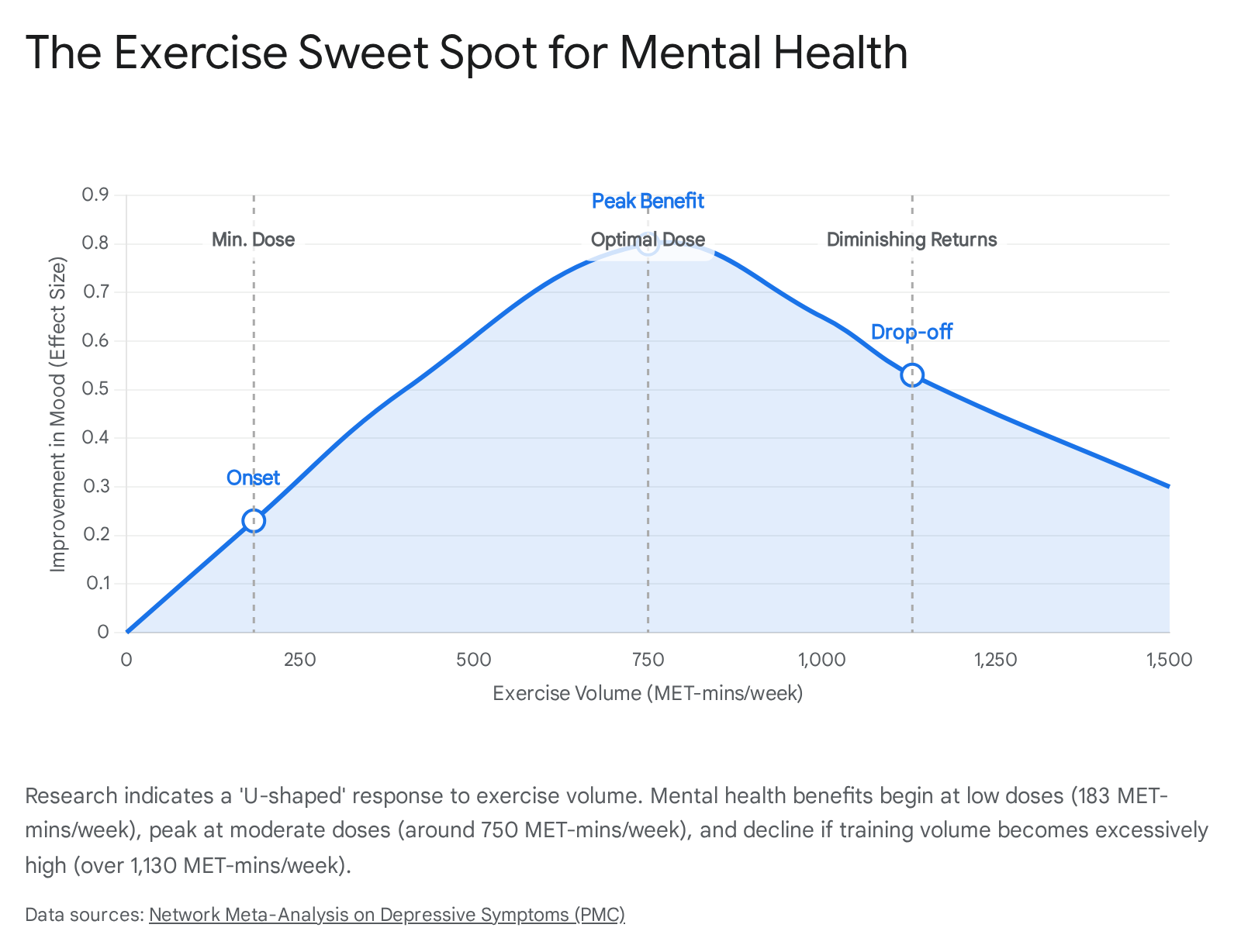
When using exercise as a clinical tool for mood management, more is not universally better. Recent large-scale network meta-analyses investigating the optimal dose of physical activity for treating mental health conditions have uncovered a distinct, non-linear U-shaped dose-response curve 1819.
Exercise volume is frequently measured in MET-minutes (Metabolic Equivalent of Task). A MET represents the energy cost of a specific physical activity relative to resting metabolism. The data indicates that mental health benefits operate within a specific therapeutic window, avoiding the extremes of total inactivity and extreme overexertion 18.
The U-Shaped Dose-Response Curve
The relationship between exercise volume and mood improvement follows three distinct phases:
- The Minimum Effective Dose: For many populations, statistically significant reductions in depressive symptoms begin at surprisingly low thresholds. Research identifies an initial threshold of approximately 183 MET-minutes per week (roughly equivalent to 45 - 60 minutes of light-to-moderate activity) 18.
- The Optimal Dose: The peak therapeutic benefit - the greatest reduction in depressive symptoms - occurs at around 750 MET-minutes per week. In practical terms, this equates to roughly 125 minutes of vigorous aerobic exercise or 188 minutes of moderate-intensity training weekly 18.
- Diminishing Returns: Once an individual exceeds roughly 1,130 MET-minutes per week, the antidepressant effects begin to plateau and ultimately diminish 18.
The Dangers of Overtraining
The upper threshold of the U-shaped curve is a critical biological warning. While moderate exercise regulates stress, extreme physiological load triggers negative stress responses 1819. Excessive training without adequate recovery elevates resting cortisol levels, taxes the hypothalamic-pituitary-adrenal (HPA) axis, and induces systemic inflammatory cytokines 1819. Because elevated cortisol and unchecked inflammation are biological underpinnings of depression, overtraining can paradoxically mimic or exacerbate the exact mood disorders an individual is attempting to cure 1819.
Does the Type of Exercise Matter?
Historically, aerobic activity (such as running, cycling, and swimming) dominated psychiatric research. However, recent evidence reveals that all major forms of exercise offer robust mental health benefits, with distinct variations depending on the specific psychological symptom being targeted and the demographic profile of the individual 20212223.
A landmark 2024 network meta-analysis published in the BMJ reviewed 218 randomized trials involving over 14,000 participants. It assessed the comparative efficacy of various exercise modalities against active controls (usual care or placebo tablets) using Hedges' g (a measure of effect size, where a larger negative number indicates a stronger reduction in depressive symptoms) 2324.
| Exercise Modality | Depressive Symptom Reduction (Hedges' g) 24 | Key Clinical Characteristics & Mechanisms |
|---|---|---|
| Walking or Jogging | -0.62 | Highly effective globally. Triggers significant acute endocannabinoid and BDNF release 151220. High overall acceptability across demographics 242526. |
| Yoga / Qigong | -0.55 | Exceptional for stress reduction. Features the lowest minimum effective dose required to see mental health benefits (approx. 164 MET-mins/week) 18. Particularly effective for older adults and men 2325. |
| Strength Training | -0.49 | Distinctly potent reductions in depressive symptoms, particularly in women and younger demographics 20232527. Builds self-efficacy and emotional regulation 1215. |
| Mixed Aerobic | -0.43 | Combines cardiovascular health with cognitive distraction 1424. |
While aerobic exercise tends to induce a more rapid decrease in acute anxiety symptoms through cardiovascular demand and parasympathetic modulation, resistance training demonstrates uniquely powerful effects on clinical depression 20272829. Electroencephalography (EEG) studies have shown that 6 weeks of resistance exercise can prompt a significant elevation in frontal beta waves, corresponding with notable improvements in mood 2729. Because these modalities operate through partially distinct neurobiological mechanisms, mental health experts increasingly recommend a combined "combo power" approach - blending aerobic conditioning with resistance training - to maximize holistic psychological resilience 122830.
The Social and Cultural Context of Exercise
Moving the body is fundamentally a biological act, but the environment in which it occurs deeply influences the psychological outcome. Humans have an evolutionary reliance on social connection for stress regulation, and the social setting of a workout significantly alters its impact.
The Power of Group Movement
Research directly comparing group workouts to solo regimens reveals a stark contrast in emotional outcomes. While individuals exercising alone often put in more physical effort and train for longer durations, they frequently fail to experience the same magnitude of emotional benefit as their peers in group settings 3132.
In a 12-week study focusing on medical students - a population notorious for high anxiety and burnout - participants were allowed to self-select into group fitness or solo workouts 31. Those who engaged in group functional fitness classes experienced a 26.2% reduction in perceived stress levels, alongside significant improvements across mental, physical, and emotional quality of life metrics 3132. By contrast, the solo exercise group experienced no statistically significant changes in stress levels, despite working out twice as long 3132. The communal benefits of enduring physical difficulty with peers foster vital social support, accountability, and a shared sense of accomplishment that solo exercise cannot replicate 1432.
Global Innovations in Community Mental Health
This understanding of social movement is reshaping mental health policy globally, particularly in the Global South, where structured physical activity is being deployed as a low-cost, high-impact intervention for vulnerable populations 333440.
In Sub-Saharan Africa, where access to formal psychiatric care is historically limited, organized physical activity - ranging from school-based aerobic sessions to community walking groups - has been shown to significantly reduce depression and anxiety among rural youth 333435. The focus in these regions is shifting toward peer-led, culturally relevant models 3340. For example, the Friendship Bench in Zimbabwe combines problem-solving therapy with peer-led group support, while Círculos de Mujeres (Women's Circles) in Guatemala utilizes movement, artistic expression, and group therapy to nurture resilience in marginalized communities 40. These initiatives highlight that exercise is most effective when integrated into a socially supportive, community-based framework 4036.
The Genetic Lottery of Exercise Enjoyment
Despite the overwhelming clinical evidence supporting exercise for mental health, the subjective experience of a workout varies wildly from person to person. For some, a brisk five-mile run is deeply cathartic; for others, it is nothing but a grueling, unrewarding chore. This discrepancy is not merely a matter of willpower or discipline - it is deeply influenced by our DNA 373839.
Genetic variability dictates how efficiently the brain produces and utilizes neurochemicals during and after physical exertion 3738.
The BDNF Val66Met Polymorphism
A prominent example is the BDNF Val66Met single nucleotide polymorphism. This common genetic variation occurs when a methionine (Met) amino acid substitutes for a valine (Val) amino acid in the BDNF gene 40.
Individuals carrying the mutant "Met" allele experience a significant reduction in the activity-dependent secretion of BDNF in response to physical exertion 3740. Consequently, these individuals may not experience the same immediate cognitive clarity, emotional memory enhancement, or robust mood lift following a workout compared to those with the standard "Val/Val" genotype 374041. Research indicates that those with the mutant allele often report higher perceived exertion, elevated heart rates, and a generalized lack of intrinsic reward during exercise 38.
COMT Genes and Working Memory
Similarly, the Catechol-O-methyltransferase (COMT) Val158Met polymorphism affects how the brain modulates neurotransmitters like dopamine in the prefrontal cortex 3941. Studies show that interactions between COMT and BDNF gene variants directly influence working memory, emotional decision-making, and resting-state functional brain activity following physical exertion 3941.
Understanding these genetic predispositions is vital. It highlights that a lack of an immediate "exercise high" is a biological reality for a substantial portion of the population. For these individuals, relying on the promise of euphoria is an ineffective strategy; instead, they must adopt a structured, disciplined approach to maintaining physical activity routines, focusing on long-term health rather than chasing a fleeting chemical rush 38.
Exercise vs. Traditional Psychiatric Treatments
The sheer volume of literature on exercise and psychiatry has reached a tipping point, prompting global public health organizations to formally reevaluate standard depression treatment protocols.
Efficacy Against Antidepressants and Therapy
In 2023 and 2024, massive umbrella reviews and network meta-analyses encompassing hundreds of trials and tens of thousands of participants established that physical activity is a highly effective, frontline treatment for major depressive disorder 22232425.
In cases of mild-to-moderate depression, psychological stress, and anxiety, comprehensive analyses suggest that physical activity can be up to 1.5 times more effective at reducing symptoms than standard pharmacotherapy (like SSRIs) or cognitive behavioral therapy (CBT) alone 2242. While psychotherapy and pharmacotherapy produce notable improvements (typically reducing symptoms by 22% to 37%), structured physical activity interventions have been shown to produce median symptom reductions ranging from 42% to 60% 22. These benefits appear consistent across diverse populations, including healthy adults, pregnant and postpartum women, and those managing chronic physical illnesses 2242. Shorter, high-intensity interventions (lasting 12 weeks or less) often produce the most rapid and striking clinical improvements 2242.
A Combined Approach for Clinical Severity
Despite these impressive metrics, medical professionals consistently caution against framing exercise as a universal, standalone replacement for traditional psychiatric care 233043. The clinical reality is complex.
In cases of severe clinical depression - where patients frequently suffer from debilitating fatigue, psychomotor retardation, malnourishment, or active suicidal ideation - initiating any exercise regimen is often practically impossible 43. Expecting a severely depressed individual to simply "go for a run" ignores the paralyzing nature of the illness 43.
In these scenarios, researchers recommend a sequential, combination approach. Medical interventions, such as antidepressants or targeted therapy, are utilized first to lift the patient's baseline mood and energy levels just enough to initiate physical movement 2330. Once the patient is capable of engaging in activity, exercise is introduced to sustain those initial gains, prevent relapse, and physically repair the brain's structural integrity 2330. In this integrative model, exercise offers what pills cannot: physical resilience, active social connection, and literal brain growth 30.
Bottom line
The mood-enhancing power of exercise extends far beyond the debunked "endorphin rush," operating through a highly sophisticated blend of rapid endocannabinoid release, structural brain rewiring via BDNF and lactate, and profound psychological empowerment. Whether through the vital social bonding of a group fitness class, the stress-relieving focus of mindful movement, or the confidence-building nature of weightlifting, physical activity serves as a foundational pillar of mental health. While genetic factors dictate how intensely one might feel an acute psychological "high," maintaining a moderate routine of roughly 125 to 188 minutes a week provides profound, measurable protection against depression and anxiety, matching or exceeding the efficacy of many traditional medical interventions.