
The Science of Intuition and Gut Feelings
Intuition is a highly efficient neurobiological process where the brain rapidly matches current sensory inputs against a vast database of past experiences to generate subconscious predictions. Operating largely through the gut-brain axis and interoceptive physiological signals, it allows individuals to make split-second decisions without conscious, deliberate analysis. Rather than a mystical sixth sense, gut feelings are the physical manifestation of the brain's predictive architecture functioning exactly as it evolved to do.
Beyond the Mystical: Defining Intuition in Cognitive Science
For centuries, human intuition was relegated to the realms of philosophy, spirituality, and the esoteric. It was described as a "sixth sense," a flash of divine inspiration, or an inexplicable hunch that defied logical explanation. However, modern cognitive science, behavioral psychology, and neuroscience have firmly relocated intuition from the mystical to the biological. Operationally, intuition is defined as a sophisticated, unconscious cognitive process in which the brain synthesizes vast amounts of information to produce a rapid judgment or insight 11. It is not the absence of logic, but rather the culmination of unconscious reasoning, rapid pattern recognition, and emotional tagging that occurs entirely beneath the threshold of conscious awareness 1.
It is important to distinguish intuition from a related cognitive phenomenon: insight. While both occur below the threshold of conscious awareness, they serve fundamentally different functions in human cognition. Insight - often characterized as the sudden "Eureka!" or "Aha!" moment - is the sudden conscious realization of a logical relationship or the solution to a complex problem, such as Charles Darwin's conceptualization of natural selection or Albert Einstein's theories of relativity 2. Insight brings the logical steps of a solution into conscious declarative awareness. Intuition, by contrast, occurs instantly and is heavily laden with emotion; it does not typically carry a declarative awareness of the underlying mental processing 23. It presents itself as a behavioral impetus, a physical sensation, or a sense of absolute certainty about the rightness or wrongness of a situation, person, or decision 23.
The brain is constantly processing millions of sensory inputs, comparing current environmental cues against a deeply encoded database of past experiences stored in long-term memory. When a match - or a dangerous mismatch - is found, the brain bypasses slow, deliberate reasoning and fires an immediate behavioral signal 35. This rapid pattern recognition is not a flaw in human logic; rather, it is an evolutionarily conserved survival mechanism. In primal environments where pausing to consciously analyze a threat (such as a predator or a sudden environmental hazard) would be fatal, the brain's ability to "know without knowing how" served as a critical adaptation 14. Because human survival depends on avoiding danger, our mental apparatus is wired to be especially sensitive to signs of threat, registering them and initiating action before conscious recognition is even possible 3.
The Architecture of Thought: System 1 vs. System 2
To understand how intuition operates alongside deliberate reasoning, cognitive psychology relies heavily on the dual-process theory of the mind. This framework, popularized by Nobel laureate Daniel Kahneman in his seminal book Thinking, Fast and Slow, posits that human cognition is divided into two distinct but deeply interacting modes: System 1 and System 2 5678.
System 1: The Intuitive Autopilot
System 1 is the realm of intuition. It is fast, automatic, effortless, and operates largely outside of conscious control 711. When you instinctively brake your car because the vehicle ahead swerves, when you instantly read the anger on a stranger's face, or when you experience "highway hypnosis" - driving for miles without a single conscious thought about the activity of driving - you are relying entirely on System 1 311. This system is ancient in evolutionary terms and is optimized for routine, familiar tasks, and survival-critical emotional responses 412.
The biological necessity for System 1 becomes clear when examining the metabolic cost of cognition. The human brain consumes roughly 20% of the body's total energy budget while awake, despite accounting for only about 2% of total body mass 5. Because deliberate thinking is extremely expensive in terms of energy use, the body optimizes for survival by defaulting to the low-energy processes of System 1 whenever possible 56. To achieve this speed and efficiency, System 1 relies heavily on heuristics - mental shortcuts or rules of thumb - and rapid pattern matching 4613.
However, this metabolic efficiency comes at a significant cost to accuracy in novel situations. System 1 is prone to systematic cognitive biases, applies rules indiscriminately, and is heavily influenced by immediate emotional context rather than empirical facts 511. It relies heavily on availability heuristics (judging likelihood based on what is easily recalled) and anchoring biases, where early information disproportionately shapes subsequent thinking 614. In the modern era, this system is frequently exploited; for example, the "fluency illusion" occurs when humans equate the polished, confident language of artificial intelligence outputs with absolute truth, allowing emotionally driven intuitive thinking to override critical analysis 14.
System 2: The Analytical Engine
System 2 is the antithesis of System 1. It is slow, deliberate, conscious, reflective, and analytical 511. You engage System 2 when you solve a complex mathematical equation, navigate an unfamiliar city using a map, or weigh the long-term financial implications of a major investment. Unlike System 1, System 2 operates under conscious control and requires intense focus and significant metabolic energy 5611. It leans heavily on working memory, the mental space where information is temporarily stored and processed, making it highly susceptible to distraction and cognitive overload 11.
While it is a common misconception that System 1 simply operates first and System 2 steps in to clean up its mistakes later, the reality of human cognition is far more integrated. The two systems operate in a continuous, complex dance. Kahneman explains that almost all cognitive processes are a mix of both systems 7. System 1 constantly feeds impressions, feelings, and impulses to System 2. If System 2 endorses them, these impulses turn into voluntary actions and deeply held beliefs 7.
The Evolutionary Psychology Debate
While the dual-process model is widely accepted in mainstream cognitive psychology, it is not without rigorous debate in other fields. Some evolutionary psychologists argue against the dual-mind idea, focusing instead on the mind's massive modularity 49. From this perspective, the human mind is a collection of highly specialized, domain-specific modules adapted to solve specific survival problems, and there is little evidence to suggest that a purely domain-general "System 2" evolved as a distinct mechanism 4. Conversely, cognitive psychologists point to archaeological findings indicating that humans did eventually develop a domain-general analytical capacity layered over older autonomous subsystems. The sudden rise in complex representational art, religious imagery, and swift transformations in artifact design approximately 50,000 years ago is often cited as evidence of the emergence of System 2 thinking 4.
| Dimension | System 1 (Intuitive) | System 2 (Analytical) |
|---|---|---|
| Speed & Awareness | Fast, instantaneous, automatic; operates below conscious awareness. | Slow, deliberate, step-by-step; requires conscious attention. |
| Effort & Energy | Low cognitive load; highly energy-efficient (runs on autopilot). | High cognitive load; mentally taxing and quickly drains energy. |
| Evolutionary Origin | Ancient; shared in various forms with many non-human animal species. | Evolutionarily recent; meant for domain-general reasoning. |
| Strengths | Rapid pattern recognition, managing routine tasks, survival responses. | Complex problem solving, logical frameworks, statistical reasoning. |
| Vulnerabilities | Prone to heuristics, cognitive biases, stereotyping, and impulsive errors. | Prone to analysis paralysis; easily disrupted by multitasking. |
The Neuroanatomy of Pattern Recognition
To understand how System 1 intuition physically manifests in behavior, neuroscience looks at the specific brain regions responsible for encoding, storing, and retrieving rapid judgments. Intuition is built upon the brain's remarkable capacity to synthesize vast amounts of diverse information - sensory data, emotional states, and episodic memories - into a cohesive whole in mere milliseconds.
The Ventromedial Prefrontal Cortex (vmPFC)
The prefrontal cortex is often referred to as the CEO of the brain, responsible for executive functions like planning and impulse control. However, a specific sub-region, the ventromedial prefrontal cortex (vmPFC), is a critical player in intuitive processing 110. The vmPFC acts as the brain's chief mediator between the primitive, emotional structures of the limbic system and the logical, executive functions of the broader cortical networks 10.
Studies consistently indicate that the vmPFC is crucial for integrating emotional signals and experiential memory to produce rapid, value-based decisions and intuitive insights 11. When you are faced with a complex decision, the vmPFC helps synthesize the emotional "weight" of past outcomes with current variables. It effectively guides your choice based on gut feelings, serving as a brake or an accelerator depending on what past experiences dictate 10. The critical nature of this region was first highlighted by historical neurological cases, such as that of Phineas Gage, whose frontal lobe damage left his working memory and intellect intact but destroyed his ability to make advantageous personal and social decisions 11.
The Basal Ganglia
Located deep within the base of the forebrain, the basal ganglia are a group of subcortical structures heavily involved in procedural learning, habit formation, and the execution of automatic behaviors 1. As an individual repeats a task over time - whether it is diagnosing a skin condition, playing a musical instrument, or evaluating mathematical proofs - the basal ganglia encode these routines, stripping away the need for conscious thought 11213. Over time, actions that once required heavy System 2 deliberation are outsourced to the basal ganglia, becoming intuitive and automatic. This routinization carries an intrinsic motor component, suggesting that intuition is not just a passive cognitive state but an embodied, physical readiness to act based on filtered relevant patterns 213.
The Insular Cortex and Interoception
The insular cortex, or insula, is the neurological bridge between the brain and the body's internal physical state. It is responsible for interoception - the continuous, often subconscious sensing of the body's internal physiological condition 11014. The insula constantly monitors and decodes internal sensations such as heart rate, respiration, gastrointestinal tension, and temperature 1013.
When the brain subconsciously recognizes a dangerous or highly rewarding pattern in the environment, it triggers immediate physiological changes. The insula translates these bodily changes into conscious or semi-conscious feelings and emotions 1015. This interoceptive awareness is the literal foundation of the "gut feeling," transforming raw, subconscious physiological data into a tangible intuitive signal that guides human behavior 10. The insula works closely with the limbic system to generate this emotional intuition, allowing individuals to experience subtle physical sensations - like a tightness in the chest or butterflies in the stomach - long before they can logically explain why they feel uneasy 10.
The Gut-Brain Axis: Where "Gut Feelings" Originate
The phrase "trust your gut" is not merely a linguistic metaphor; it is scientifically literal. The gastrointestinal tract and the central nervous system are engaged in a relentless, high-bandwidth conversation via the gut-brain axis. This bidirectional communication network heavily influences affect, motivation, stress responses, and higher cognitive functions - including intuitive decision-making 16171819.
The Enteric Nervous System: The Second Brain
The enteric nervous system (ENS) is an expansive, complex network of over 100 million neurons lining the entire length of the gastrointestinal tract 1720. Due to its immense size, complexity, and its ability to operate independently of the central nervous system to manage the mechanics of digestion, the ENS is frequently referred to as the body's "second brain" 1720. Developmentally, the ENS arises from the same neural crest precursor cells as the central nervous system, and it relies on the exact same neurotransmitters and signaling molecules to function 1720. While it manages digestion, its neurons act as sensory outposts, constantly gathering data about the internal environment and relaying crucial information about health and physiological states back to the brain 1420.
The Vagus Nerve Superhighway
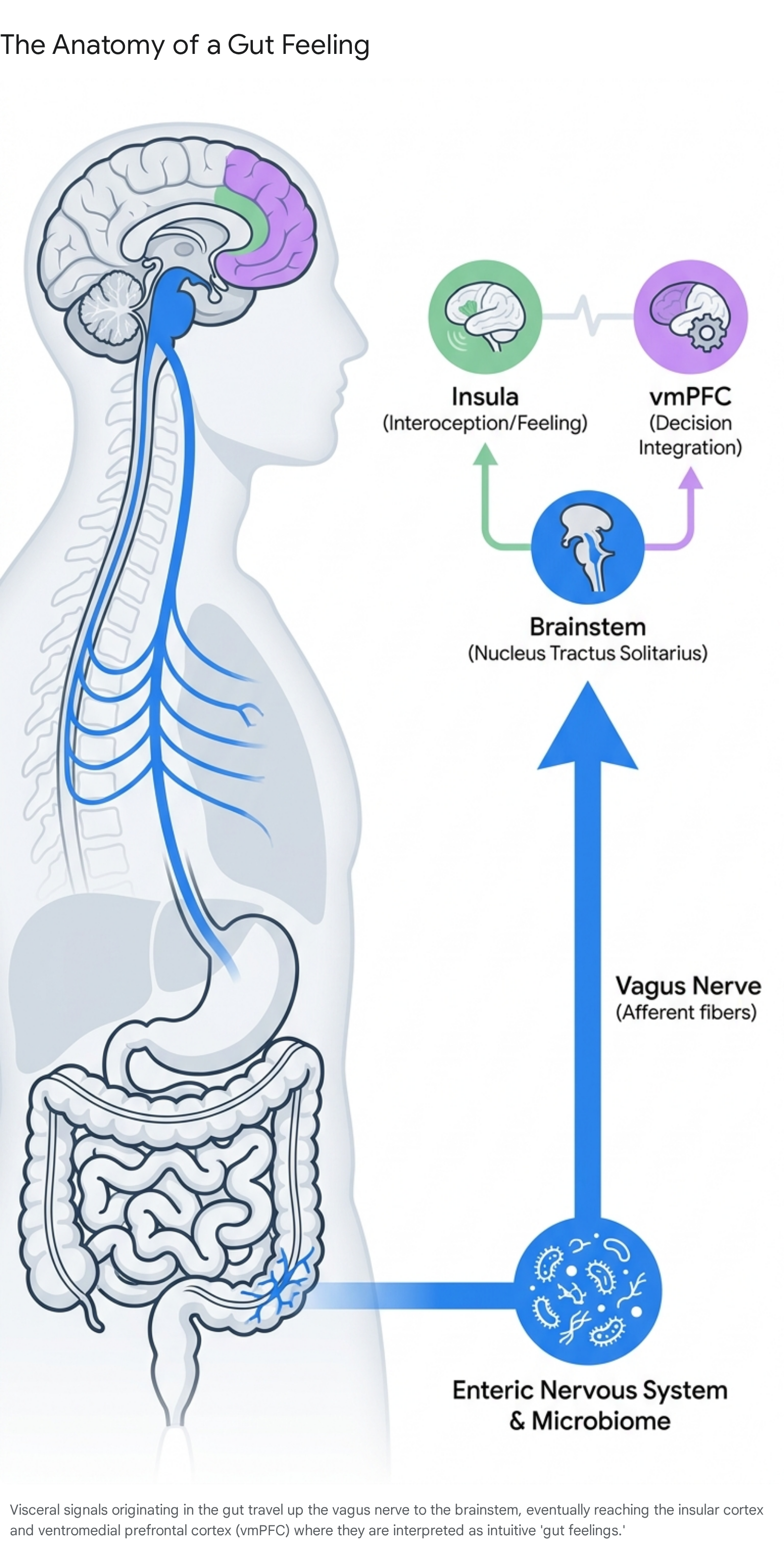
The primary anatomical conduit connecting the gut to the brain is the vagus nerve (the 10th cranial nerve). Remarkably, the vagus nerve is an asymmetric highway: it is composed of approximately 80% afferent fibers (sending sensory signals from the viscera up to the brain) and only 20% efferent fibers (sending motor signals from the brain down to the body) 1821. This structural bias highlights the brain's heavy reliance on continuous visceral feedback to understand its internal and external environment.
Signals originating in the gut - triggered by mechanical stretch, chemical changes, or hormonal shifts - travel rapidly up the vagus nerve. These afferent signals first reach the nucleus tractus solitarius (NTS) located in the brainstem 1821. The NTS acts as a central hub for gut-brain signaling. From there, complex multisynaptic pathways relay this visceral data upward to forebrain structures involved in regulating behavior and emotion, primarily the amygdala (fear and emotional memory), the insula (conscious bodily feeling), and the prefrontal cortex (decision-making) 15182122.
The Microbiome's Role in Cognition
Beyond mere nerve impulses, the gut microbiome plays a surprisingly active role in shaping cognitive states and intuitive processing. The diverse ecosystem of gut bacteria produces metabolites that directly influence brain chemistry. For example, gut bacteria ferment dietary fibers to produce short-chain fatty acids (SCFAs) like butyrate and acetate 2223. These SCFAs directly stimulate enterochromaffin cells in the gut lining to synthesize and release serotonin 22.
In fact, the gastrointestinal tract produces the vast majority of the body's serotonin, a signaling molecule that, when reaching the brain, heavily influences mood, sleep, and memory 1622. Recent neuroscience research from 2025 provides direct evidence that specific microbial metabolites (SCFAs and bile acids) directly activate vagal neurons 23. In germ-free animal models, vagal nerve activity is significantly reduced, only returning to normal when gut bacteria are reintroduced 23. This demonstrates that our microbiome dictates the chemosensory signals sent to our brain, enhancing the gut-brain axis and subsequently altering our cognitive posture and intuitive reactions 23.
Vagus Nerve Stimulation (VNS) and Human Performance
Because the vagus nerve is so intimately tied to cognition and autonomic regulation, neurologists and sports scientists have spent decades exploring Vagus Nerve Stimulation (VNS). Originally developed as an invasive surgical treatment for drug-resistant epilepsy and severe depression, VNS is now widely available in non-invasive, transcutaneous forms (taVNS) applied to the ear or neck 242526.
Recent clinical studies published in 2024 and 2025 demonstrate that stimulating the vagus nerve directly alters higher cognitive functions and intuitive performance. Research indicates that tVNS boosts accuracy during perceptual decision-making tasks without affecting reaction times, supporting the hypothesis that vagal stimulation increases sensory "gain" and enhances evidence accumulation in the brain 27. Furthermore, it has been shown to improve reinforcement learning by increasing reward sensitivity, enhancing the brain's ability to intuitively map positive outcomes to specific actions and shift accuracy-speed trade-offs toward maximizing rewards 28.
By modulating the locus coeruleus-norepinephrine (LC-NE) system - a brainstem nucleus critical for arousal, alertness, and focus - vagus nerve signals essentially fine-tune the brain's receptivity to environmental cues 252729. This ensures that our intuitive, split-second decisions are sharper and less clouded by stress. Consequently, taVNS is currently being investigated not just for elite athletic performance and cognitive flexibility, but as a potential treatment for the cognitive "brain fog" associated with long COVID, and even for slowing the accumulation of tau proteins in the locus coeruleus to protect memory in early-stage Alzheimer's disease 16242529. Note that for these therapies to be effective, emerging research suggests the electrical stimulation must be synchronized with the body's natural rhythms, specifically inhalation and heartbeat, to successfully open the "gate" to the nervous system 30.
The Somatic Marker Hypothesis: How Emotions Guide Choice
The biological mechanism linking visceral gut sensations to high-level decision-making was formalized in the Somatic Marker Hypothesis (SMH), proposed by neuroscientist Antonio Damasio and his colleagues in the early 1990s 1137. The theory originated from insights gained by studying patients with severe frontal lobe damage, such as the famous 19th-century railway worker Phineas Gage. Gage survived an iron rod being driven through his ventromedial prefrontal cortex (vmPFC); while his intellect and working memory remained largely intact, his personality changed drastically, and he lost the ability to plan behavior or learn from social mistakes 1138.
The Mechanism of Somatic Markers
In traditional economic and philosophical theory, human decision-making was often modeled as a purely logical cost-benefit analysis, entirely devoid of emotion. The SMH upends this notion, suggesting that emotions play a critical, indispensable role in the ability to make fast, rational decisions in complex and uncertain situations 11.
According to the hypothesis, as individuals navigate life, the outcomes of their choices elicit physiological, affective states (e.g., the nausea and rapid heartbeat of a severe financial loss, or the physical relaxation of a social reward). These physiological signatures - termed "somatic markers" - are processed and stored in the vmPFC and amygdala alongside the cognitive memory of the event 1138.
When faced with a complex, uncertain decision in the future, the brain subconsciously simulates the available options. Before conscious System 2 logic can evaluate the math, the vmPFC reactivates the associated somatic markers 1138. If a potential option is linked to a past negative outcome, the individual experiences a subtle, unconscious "gut feeling" of aversion. This biological alarm bell, which can be objectively measured as a transient increase in skin conductance or sweating due to sympathetic nervous system arousal, narrows the field of options 3738. By steering the decision-maker away from danger and toward advantageous choices quickly, somatic markers make the sheer volume of daily decisions computationally manageable for the brain.
Contemporary Debates and Challenges to the SMH
For decades, the SMH has been heavily supported by behavioral data, most notably from the Iowa Gambling Task (IGT) 113738. In the IGT, participants draw cards from four decks to maximize profit; two decks are highly advantageous over time, and two are disadvantageous. Studies have famously demonstrated that participants' intuitive systems (measured via skin conductance) discern the optimal safe decks after sorting through only about 10 cards, generating anticipatory stress responses before choosing from the bad decks, whereas the rational mind takes nearly 50 cards to consciously detect the mathematical pattern 12.
However, science is iterative, and recent rigorous testing has introduced significant friction into this consensus. A large-scale 2023 study examining anticipatory somatic markers challenged the fundamental premise of the SMH. The researchers tracked anticipatory skin conductance responses (SCR) prior to choices in experience-based decision tasks with varying reward and loss uncertainty 3132.
Contrary to the SMH's central predictions, the researchers found that anticipatory physiological responses did not reliably predict whether a participant would choose the optimal option 32. Furthermore, when examining outcome responses, the results were highly contradictory: in one study, losses resulted in greater skin conductance, while in a second study, the pattern reversed entirely, with wins generating higher physiological arousal 32. Because participants were able to make successful decisions and adapt to changing game rules without displaying consistent anticipatory somatic signals, the researchers concluded there is "little support" for the SMH as a universal rule, suggesting that bodily markers may not be strictly necessary to guide choice in all decisions-from-experience 32. While the SMH remains a highly influential framework in neuroeconomics, modern evidence suggests the brain's intuitive architecture is highly flexible and likely relies on multiple redundant cognitive pathways beyond just autonomic arousal.
Predictive Processing: The Brain as an Inference Machine
To truly understand intuition from a neurobiological perspective, we must undergo a paradigm shift in how we view perception itself. Historically, 20th-century science viewed the brain as a passive receiver: sensory data comes in through the eyes and ears, travels up the neural hierarchy, and is eventually assembled into a conscious picture of reality to which the brain then reacts 3334. In the 21st century, a theoretical framework known as Predictive Coding (or predictive processing) completely inverted this model, offering what is perhaps the most profound explanation for intuition to date 33343536.
The Generative Predictive Model
Tracing its philosophical roots back to 19th-century physicist Hermann von Helmholtz's concept of "unconscious inference," predictive coding posits that the brain is essentially a relentless prediction engine 36. It is constantly generating a top-down "mental model" or hypothesis about what it expects to encounter in the external environment in the next millisecond 3536. You do not simply perceive the present world; your brain predicts the world based on prior experiences, and then uses incoming sensory input merely to check its work and update its Bayesian probabilities 3537.
Under classical predictive coding, the brain actively issues these predictions from higher cortical areas down to lower sensory areas. If the incoming sensory data perfectly matches the top-down prediction, the sensory information is effectively suppressed or cancelled out. From an evolutionary standpoint, there is no need to spend precious metabolic energy deeply processing what you already knew was going to happen 3839.
However, if the sensory data contradicts the prediction, a "prediction error" is generated 3536. This error signal - the mismatch between expectation and reality - is forced back up the cortical hierarchy to update the brain's internal model and demand conscious attention 3540. In this framework, a "gut feeling" or an intuitive hunch is simply the conscious manifestation of a prediction error operating outside of deliberate awareness. When a seasoned fire commander suddenly senses that a burning building is about to collapse because the fire is inexplicably "too quiet," their brain has detected a mismatch between its highly trained predictive model of a normal fire and current auditory data, triggering an immediate, life-saving intuitive alarm before conscious logic can intervene 53741.
The 2026 Shift: Predictive Routing vs. Predictive Coding
While classical predictive coding has heavily influenced computational neuroscience and inspired biologically inspired deep neural networks, deep neurophysiological studies utilizing intracortical spiking data in 2025 and 2026 have sparked intense debate 33354243.
The classical theory requires the existence of dedicated "error neurons" in the superficial layers of the sensory cortex to constantly calculate these mathematical mismatches and feed them forward 3536. However, recent large-scale recordings of neuronal spiking during oddball paradigms have failed to find these ubiquitous error neurons in the lower visual and auditory cortices 3539. Furthermore, classical theory struggles to explain why feedback activity is often excitatory rather than purely inhibitory, and why feedforward and feedback signals often overlap in time 4344.
Instead, a refined framework known as Predictive Routing (and closely related computational models like Predictive Coding Light) has emerged to reconcile these empirical tensions 353843454647. According to this updated model, the brain does not calculate literal mathematical errors using dedicated circuitry. Instead, it uses neural oscillations - brain waves - to route information and prepare pathways 434448.
Higher-order brain areas (like the prefrontal cortex) generate predictions using low-frequency beta rhythms (around 10-30 Hz) 42434849. These beta bursts act as a preparatory gate, effectively suppressing or inhibiting the neural pathways of expected sensory inputs 434448. If the environment behaves exactly as expected, the beta waves keep the system quiet, transmitting only a compressed representation of the input and saving massive amounts of energy 384648.
But when an unexpected event occurs, it hits an "unprepared" or uninhibited sensory pathway. This triggers a massive burst of high-frequency gamma rhythms (40-90 Hz), which forcefully carry the novel information upward to demand conscious attention 39424348. Intuition, therefore, is the dynamic "push-pull" interplay of beta rhythms laying down the tracks of your expertise, and gamma rhythms sounding the alarm when reality veers off course 3948.
Applications in Psychopathology
This refined understanding of predictive processing is providing profound insights into clinical conditions such as schizophrenia, autism spectrum disorder, and anxiety 3440. In schizophrenia, for instance, patients exhibit severe disruptions in the generation, timing, and contextual deployment of beta activity 4349. Without robust beta oscillations to properly suppress expected inputs, patients suffer from a failure of contextual maintenance. Their brains cannot effectively predict the environment, leading to a state where highly improbable events (delusions) or internally generated signals (auditory hallucinations) are misinterpreted as novel, external prediction errors demanding attention 344349. The breakdown of predictive routing offers a parsimonious, mechanistic account of why the intuitive grip on reality fragments in psychosis.
Cultural Influences on Intuitive and Analytic Thinking
Because intuition relies heavily on internal models built from past experiences and learned schemas, it is inherently shaped by the sociocultural environment in which a human brain develops. Culture is not just an abstract set of societal beliefs; it literally shapes the functional organization of the brain, influencing what we pay attention to, how we categorize objects, and how we form intuitive judgments 50515253.
Analytic vs. Holistic Cognitive Styles
Psychological research spanning the last three decades has consistently demonstrated a profound divergence in cognitive styles globally, largely categorized into analytic versus holistic thinking 50535455.
Western cultures (e.g., the United States, Western Europe) generally lean heavily toward analytic thinking. Analytic thinkers tend to detach objects from their context, focusing on the properties of the object itself, and rely on formal logic, rules, and linear thinking to categorize it 50515556.
Conversely, East Asian, South Asian, Latin American, and Arab cultural zones largely exhibit a holistic cognitive style 51535565. Holistic thinkers focus on the relationships between objects and the broader context or "field" they occupy. They consider the antecedents and consequences of events more thoroughly, and are generally more tolerant of contradiction, viewing the world as complex, dialectical, and highly interconnected 50515356. In many of these cultures, heavily influenced by philosophies like Confucianism and Taoism, intuition is highly regarded and viewed as a sophisticated form of effortless deliberation (such as the Taoist ideal of wu wei, or effortless action) 66. This stands in stark contrast to Western societies, which have historically elevated deliberate reason above emotion and intuition 6657.
Interestingly, this is not strictly an East-West dichotomy. Recent studies testing cognitive styles in Latin America found that Brazilians, despite being a Western group, are consistently more holistic than U.S. Americans and, on certain measures, even more holistic than Chinese participants, highlighting a rich psychological diversity that extends beyond traditional Confusian boundaries 65.
These cultural differences are not merely philosophical; they are deeply neurological. Advanced functional magnetic resonance imaging (fMRI) studies utilizing multivariate pattern analysis in 2024 have successfully mapped the neural correlates that distinguish holistic from analytic thinking 5154. The research found that executing these different thinking styles recruits distinct networks, encompassing the bilateral frontal and parietal lobes, the fusiform gyrus, and notably, the insula - our center for interoception and gut feelings 5154. Furthermore, psychophysiological studies have shown that analytic and holistic thinkers exhibit different heart rate variability (HRV) patterns and heart rate complexity when making decisions, proving that cultural practices alter the very physiological cadence of our gut-brain reactions 56.
Indigenous Knowledge Systems and "Two-Eyed Seeing"
The traditional Western scientific dichotomy that separates reason from emotion, and the human observer from the environment, is increasingly being challenged by Indigenous knowledge systems. Indigenous sciences are built on millennia of rigorous observation, experimentation, and pattern recognition, prioritizing a relational approach where humans are viewed as active, interconnected participants within an ecosystem rather than detached observers 535859.
In 2025 and 2026, a major movement in global neuroscience, championed by the International Brain Initiative, advocated for the formal integration of these paradigms through a framework called "Two-Eyed Seeing" (or Etuaptmumk, a concept conceived by Mi'kmaq Elders Albert and Murdena Marshall in Canada) 60616263. Two-Eyed Seeing requires researchers to practice epistemic humility: viewing brain health and cognition through the lens of Western biomedical reductionism with one eye, and through the holistic, interconnected lens of Indigenous knowledge with the other, seeing both systems as equal 6163.
By incorporating cultural humility and viewing mental processes as deeply tied to spirituality, community, and the physical land, neuroscientists can gain a more accurate, inclusive understanding of the brain 616264. This is particularly relevant in African and Latin American research contexts, where traditional philosophies have long understood that emotions, intuitions, and physical well-being are inseparable, symbiotic components of human cognition - a holistic view that modern predictive coding and gut-brain neuroscience is only now beginning to empirically validate 575862.
When to Trust Your Gut (And When to Ignore It)
If intuition is simply rapid, subconscious pattern matching driven by predictive neural routing, a critical practical question arises: when are those subconscious patterns actually accurate? Behavioral science and organizational psychology provide a clear boundary condition: the reliability of your intuition is directly proportional to the predictability of the environment in which you gained your expertise 13126566.
The Power of Domain Expertise in High-Validity Environments
Intuition thrives in highly structured, predictable (high-validity) environments where immediate, objective feedback is available 1266. Professionals such as neonatal nurses, structural engineers, chess grandmasters, and military leaders develop highly accurate, life-saving intuitions 126566.
When a seasoned nurse experiences a sudden "gut feeling" that a premature infant is developing a systemic infection hours before the physiological monitors sound an alarm, it is not a mystical guess. Their System 1 is rapidly processing dozens of subtle visual, olfactory, and behavioral cues that match the pattern of sepsis they have witnessed thousands of times 12. In these high-stakes, time-compressed situations, relying on trained intuition is often vastly more accurate and efficient than pausing to engage slow, analytical System 2 thinking 1266. Multiple experimental studies on medical students have demonstrated that instructing trainees to use intuition (pattern recognition) in diagnosing skin conditions or reading EKGs yields accuracy equal to or greater than forcing them to use rigorous, step-by-step analytical reasoning 12.
The Danger of the Unpredictable
Conversely, intuition fails spectacularly in chaotic, low-validity environments where patterns do not reliably predict future outcomes 6566. You should be highly skeptical of your gut feelings when picking individual volatile stocks, forecasting long-term macroeconomic events, or interviewing candidates for a completely novel role in a new industry 1366.
In these scenarios, the brain still aggressively tries to force pattern recognition, but lacking valid data, it resorts to flawed heuristics and cognitive biases 1366. If you are evaluating a business proposal or a candidate from a different cultural background, your System 1 might signal a vague "bad gut feeling." Without conscious System 2 intervention to analyze the data objectively, you are likely falling prey to implicit bias - your insula and amygdala mistaking a lack of familiarity for a genuine threat 5114166. Furthermore, relying on intuition to interpret complex emotional cues in routine negotiations or interviews is often flawed; research shows that systematic, analytical thinking actually outperforms intuition in accurately gauging another person's true thoughts and feelings (empathic accuracy) 41. Ultimately, intuition is a powerful servant but a terrible master; it requires the executive oversight of analytical reasoning to ensure that the patterns of the past are actually relevant to the problems of the present 1266.
How to Train Your Intuition
Because intuition is rooted in biology and cumulative experience rather than magic, it is not a fixed, innate trait. It is a highly trainable cognitive skill.
- Deliberate Practice: Intuition is essentially crystallized expertise 13. To build accurate intuition, you must engage in deliberate practice - structured, highly challenging repetition within your specific zone of proximal development, coupled with immediate, corrective feedback 677868. Originated by psychologist Anders Ericsson, deliberate practice is the gold standard for skill acquisition 7869. A psychotherapist, for instance, hones their clinical intuition not just by passively seeing patients for years (which only builds purposeful practice), but by reviewing video recordings of their sessions, tracking routine outcome data, and actively role-playing micro-responses with a supervisor to push their skill threshold 786870.
- Cultivate Interoceptive Awareness: Because intuition speaks largely through the physical body via the gut-brain axis, you must learn to consciously hear it. Practices like mindfulness meditation and structured body-scanning directly target and strengthen the insular cortex 717273. By training yourself to watch thoughts without judgment and routinely paying attention to physical sensations, you increase your sensitivity to the subtle physiological shifts (like a tightening stomach or a change in breath) that accompany subconscious insights, preventing them from being drowned out by anxious, ruminative thoughts 137172.
- Think Without Thinking (Incubation): When faced with a highly complex problem featuring too many variables to analyze consciously, leverage both cognitive systems. First, immerse yourself in all available empirical data using analytical System 2. Then, intentionally step away from the problem 1367. Engaging in a relaxing, routine task (like walking in nature or taking a shower) allows the subconscious neural networks to process the complex variables without the strict bottleneck of working memory. This period of incubation often allows the optimal pattern to bubble up to the surface as a sudden, clear intuitive hunch 6771.
Bottom line
Intuition is a sophisticated, evolutionarily honed neurobiological process where the brain rapidly matches current environmental cues against a vast database of past experiences. Rooted deeply in the gut-brain axis and driven by the brain's oscillatory predictive routing, these subconscious computations surface as physical "gut feelings" to guide immediate, energy-efficient decision-making. While intuition is a formidable, life-saving tool in structured domains where we possess deep expertise, it remains highly susceptible to implicit biases and flawed heuristics in novel or chaotic environments, necessitating the careful, balancing oversight of conscious analytical thought.