
How Your Brain Builds Reality from Guesses
Predictive processing is a leading framework in cognitive science proposing that the brain does not passively take in information from the outside world, but instead actively constructs reality by constantly guessing what will happen next. Our perception is not a direct reflection of sensory data, but rather our brain's best hypothesis, continuously updated by the errors it makes when its predictions fail to match reality. This means that everything you see, hear, and feel is essentially a controlled hallucination shaped heavily by your past experiences and expectations.
The Paradigm Shift: From Passive Receptors to Active Predictors
For decades, the dominant metaphor for the human brain was a computer passively processing inputs. According to this traditional "bottom-up" model, perception was viewed as a sequential assembly line: your eyes or ears received raw data, which traveled up the nervous system to be parsed into lines and shapes, then assembled into objects, and finally delivered to your conscious mind for interpretation 121. In this view, the brain sits in waiting, reacting to the world only as information arrives at the sensory gates.
Predictive processing, which is often referred to interchangeably as predictive coding, radically upends this view. Tracing its theoretical roots back to the 1860s with the Prussian physicist Hermann von Helmholtz's concept of "unconscious inference," this framework suggests the exact opposite flow of information 123. The brain is an isolated organ locked in a dark, silent skull. To make sense of the chaotic data streaming in from the senses, it must act as an inference engine. It uses a lifetime of prior experiences to generate an internal "generative model" of the world, proactively sending predictions downward to the sensory organs before an event even happens 267.
When you open your eyes, you do not build a visual scene from scratch. You project a highly educated guess onto the world. This framework, popularized in modern neuroscience by figures like Karl Friston and Andy Clark, has become a grand unifying theory, providing a singular mechanism that explains perception, action, learning, and even mental illness 745.
Top-Down Guesses and Bottom-Up Errors
The architecture of predictive processing relies on a continuous, bidirectional loop of two opposing signals.
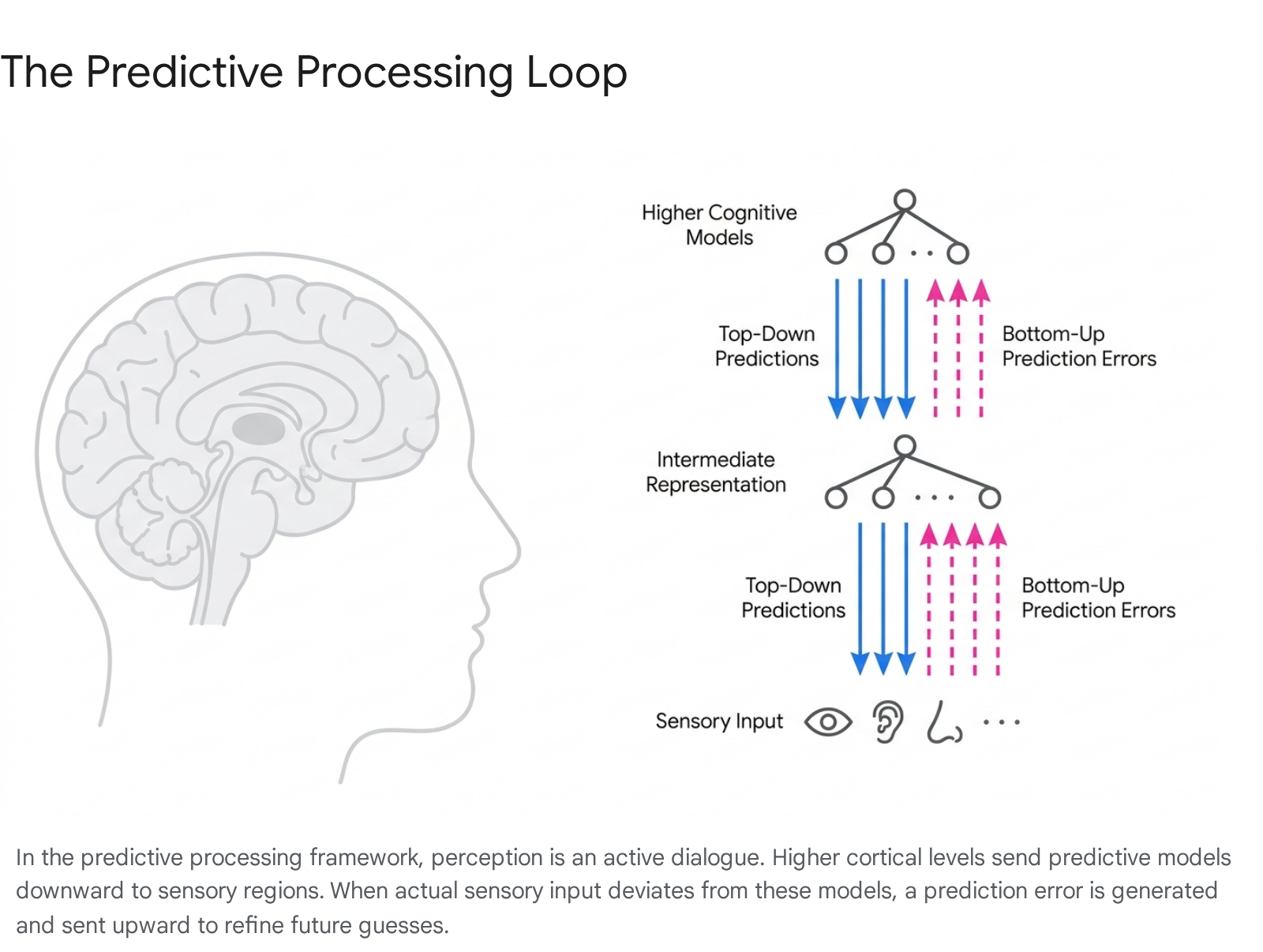
First, higher cognitive regions of the cortex generate hypotheses about the environment and cascade these expectations downward to lower sensory regions as top-down predictions 26. Simultaneously, incoming sensory data travels upward from the eyes, ears, and skin.
However, in the predictive model, the brain does not forward the raw sensory data itself. It only forwards the mismatch between what was expected and what actually occurred 266.
If your brain's prediction is perfectly accurate, the sensory data is essentially explained away or canceled out, saving vast amounts of metabolic energy 78. You perceive exactly what you expected, and higher levels of the nervous system are never bothered with the redundant information 13. But if the sensory data violates your prediction, a "prediction error" is generated. This error signal acts as a neurological alarm bell, alerting the higher cortical levels of their mistake and prompting the brain to update its internal model to prevent future surprises 1613.
Learning, therefore, is fundamentally the process of minimizing prediction error over time 67.
How Does the Brain Predict Reality?
To understand how predictive processing actually governs our daily lives, it is necessary to look at the underlying mechanics of how the brain manages uncertainty, conserves energy, and decides which sensory signals are worth paying attention to. The brain acts much like a Bayesian statistician, continuously updating the probability of its hypotheses based on new evidence 649.
Precision Weighting: The Brain's Volume Knob
Not all prediction errors are created equal. The brain must constantly decide whether a discrepancy is a meaningful change in the environment that requires a model update, or simply random noise - like a fleeting shadow, wind rustling the leaves, or static on a radio - that should be ignored 113.
This critical sorting mechanism is known as precision weighting 3710. The brain assigns a precision score, which is effectively a measure of expected reliability or statistical variance, to both its internal predictions and the incoming sensory data. If the brain is highly confident in its prior model because the environment is stable and familiar, it will essentially turn down the volume on conflicting sensory data, treating it as irrelevant noise 36.
Conversely, if the environment is highly volatile, novel, or dangerous, the brain turns up the volume on bottom-up sensory data. This heightened state of attention allows even minor prediction errors to drive rapid learning and alter perception 61011. This precision weighting is largely mediated by neurotransmitters like dopamine, which act as a chemical gain control, dictating how heavily the brain should weigh incoming surprises against its established beliefs 7.
The Evolutionary Advantage of Energy Efficiency
A central claim of predictive processing is that it is highly metabolically efficient, which offers a massive evolutionary advantage. The human brain consumes roughly 20 watts of power - about the same as a dim refrigerator lightbulb - yet it performs computational feats that completely surpass the world's most advanced supercomputers 8.
If the brain had to fully process every photon hitting the retina, every soundwave entering the ear, and every tactile sensation brushing the skin from scratch every single second, it would quickly exhaust its energy reserves. By relying on predictions, the brain utilizes a "light" coding strategy. It actively suppresses the neural firing for stimuli it has accurately predicted, allocating its precious metabolic resources solely to processing novel, surprising information 81213.
Recent functional magnetic resonance imaging (fMRI) studies measuring the cerebral metabolic rate of oxygen have confirmed this theory. Researchers found that processing highly predictable visual sequences consumes significantly less energy than processing unpredictable ones. When subjects were highly confident in a pattern, their cortex utilized up to 13 percent less oxygen, resulting in a measurable drop in metabolic cost 14.
Bottom-Up vs. Top-Down Processing
To fully grasp the magnitude of the predictive processing shift, it is helpful to compare it directly against the traditional cognitive models that dominated the 20th century.
| Feature | Traditional Bottom-Up Processing | Predictive Processing (Top-Down Inference) |
|---|---|---|
| Primary Direction of Data Flow | From sensory organs upward to higher cortical areas. | From higher cortical areas downward to sensory organs. |
| What is Transmitted Upward? | Raw, accumulated sensory data and feature detections. | Only "prediction errors" (the unexpected sensory deviations). |
| Role of Prior Knowledge | A secondary filter applied after sensory data is processed. | The primary engine of perception; actively dictates what is initially perceived. |
| Response to Predictable Stimuli | High neural activity (processing the full stimulus). | Suppressed neural activity (stimulus is already accounted for). |
| Metabolic Efficiency | Highly energy-intensive (processing all inputs equally). | Highly energy-efficient (processing only unexpected anomalies). |
2681516
Everyday Examples: "Controlled Hallucinations"
The idea that our brains conjure reality from within sounds like a concept from science fiction, but you experience the mechanics of predictive processing every day. Because the brain seeks to save energy, it relies heavily on its internal models to fill in missing information, resulting in what cognitive scientists sometimes call controlled hallucinations - a waking dream guided by sensory guardrails 41723.
Reading Scrambled Words and Linguistic Autocomplete
Consider how easily you can read a sentence riddled with typos or scrambled letters, provided the first and last letters are intact. Psycholinguistic research demonstrates that skilled readers do not process words letter by letter. Instead, the brain relies on the context of the sentence, grammatical rules, and the overall shape of the word to predict the upcoming text 1819.
If the visual input is slightly scrambled, but the top-down prediction is strong enough, the brain effectively overrides the raw visual data. You perceive the correct word because your brain's expectation acts like a mental autocorrect 61819. This is why writers are notoriously bad at proofreading their own work; their brains predict the intended sentence so strongly that they physically cannot perceive the missing words or typos on the page 19.
Neuroimaging studies utilizing Electroencephalography (EEG) and Magnetoencephalography (MEG) support this dynamic. When people listen to natural speech or read a book, the brain displays significantly lower neural activation - specifically a reduced N400 amplitude - when hearing predictable words 182021. The brain pre-activates the left fronto-temporal regions before the word is even spoken, operating almost identically to the predictive text algorithm on a smartphone keyboard 1821.
Visual Illusions and Pareidolia
Classic visual tricks, like the famous Rabbit-Duck illusion, perfectly illustrate top-down predictions. The raw sensory data - the lines on the page - never changes. However, as your brain shifts its internal hypothesis from "rabbit" to "duck," your conscious perception of the image transforms entirely. The brain selectively highlights the features that confirm its current prediction and suppresses the rest 28.
Similarly, the phenomenon of pareidolia - seeing faces in clouds, electrical outlets, or the front grilles of cars - occurs because the human brain has an incredibly strong, evolutionary prior for detecting faces. This predictive model is so powerful and trigger-happy that it routinely projects facial features onto random visual noise, resulting in a false-positive controlled hallucination 23.
Phantom Phone Vibrations
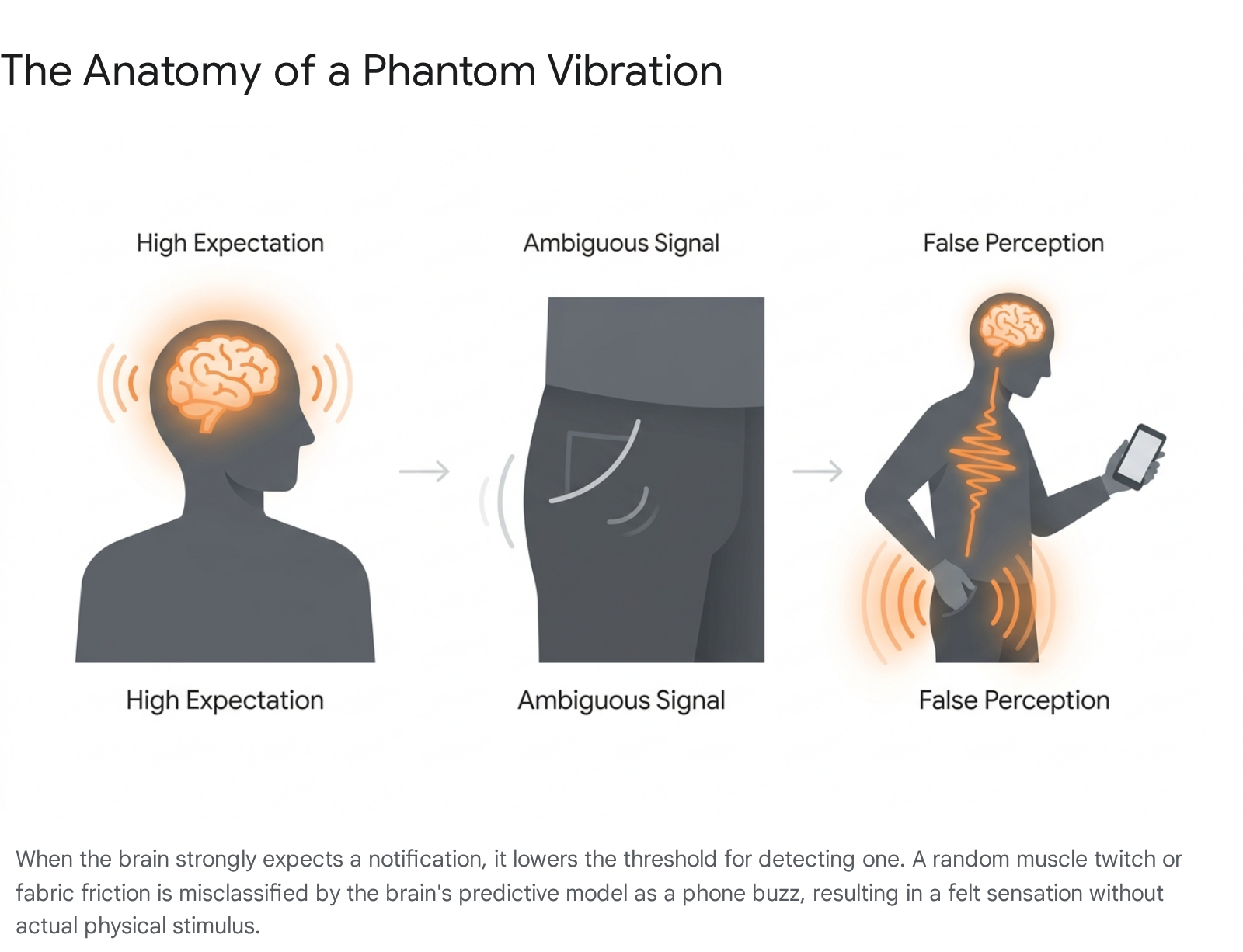
Perhaps the most relatable modern example of an unchecked prediction is the phantom phone vibration. In an era of constant digital connectivity, our brains have learned to strongly associate specific contexts - such as sitting at a desk or waiting for an important message - with incoming notifications. A heavy reliance on this prior expectation primes the somatosensory cortex 2322.
If you are highly stressed, working in a demanding environment like a hospital, or simply anticipating a text, your brain increases the precision weighting on this expectation. Consequently, a slight shift in clothing or a random muscle twitch is instantly misclassified by the brain's predictive model as a phone buzz. The brain's prediction is so robust that it generates the vivid physical sensation of a vibration where none actually exists 2322.
The Neurobiology: Wiring the Prediction Machine
How is this massive inference engine physically wired into our biological hardware? Much of the early evidence for predictive coding came from observing the visual and auditory cortices. Neuroscientists proposed that the hierarchical layers of the neocortex map perfectly onto the computational needs of a prediction machine.
Cortical Layers and Data Flow
The cerebral cortex features a distinct laminar (layered) structure, and anatomical research has identified highly specialized roles for these layers. The classic predictive coding model posits that predictions and prediction errors travel along anatomically distinct pathways to prevent the signals from getting crossed 2324.
Deep layers of the cortex, specifically Layers 5 and 6, primarily contain internal representation neurons. These neurons act as the generative model, sending top-down predictive signals backward down the neural hierarchy to prepare lower regions for expected inputs 2324. Conversely, the superficial layers, specifically Layers 2 and 3, contain error-computing pyramidal neurons. These neurons calculate the physical subtraction between the top-down prediction and the bottom-up sensory input. They then feed that resulting prediction error forward, pushing it up the hierarchy to update the model 232425.
The Great Neuroscience Debate: Coding vs. Routing
While predictive processing has achieved near-consensus status as a general theory of mind, its specific biological implementation - often called "classical predictive coding" - is currently the subject of intense, contested debate among neuroscientists.
The Local vs. Global Oddball Problem
Classical predictive coding assumes that all prediction errors feed forward from the earliest possible sensory areas. This hypothesis is typically tested using an "oddball paradigm." In a local oddball test, a subject listens to a highly repetitive sequence (e.g., "beep, beep, beep, boop"). The sudden deviant sound ("boop") elicits a sharp spike in brain activity known as mismatch negativity (MMN), which is historically interpreted as the brain generating a prediction error 72326.
However, recent studies measuring direct neuronal spiking in awake non-human primates have thrown a wrench into this assumption. When researchers tested "global oddballs" - events that violate high-level abstract sequence rules rather than just simple local repetition - they found that genuine prediction errors did not emerge early in the sensory cortex at all 2334. Instead, the neurons in the primary visual and auditory cortices fired based strictly on classic bottom-up properties. They did not show the predictive suppression of expected stimuli that the classical model requires 2334.
The Predictive Routing Alternative
To reconcile these contradictory findings, a newer, modified framework called predictive routing has emerged. Predictive routing argues that predictive processing is not a ubiquitous, automatic sensory function occurring at the lowest levels of the brain, but is instead a more selective, higher-order cognitive mechanism 232736.
In the predictive routing model, there are no dedicated error neurons hardwired into the superficial layers. Instead, higher-order areas like the prefrontal cortex send preparatory signals to lower sensory areas via slow alpha and beta brainwave oscillations (8 - 30 Hz) 232736. These beta waves essentially brace the cortex for the expected impact of a stimulus. If an unexpected stimulus hits a sensory area that has not been prepared by these beta waves, the resulting raw signal triggers an unfiltered burst of high-frequency gamma oscillations (40 - 90 Hz). This unfiltered gamma burst acts as the prediction error 23252736.
Whether the brain uses rigid, layer-specific error neurons (Predictive Coding) or dynamic oscillatory routing (Predictive Routing) remains one of the most exciting frontiers in modern neuroscience, with massive implications for how we understand brain disorders.
| Theoretical Framework | Classical Predictive Coding (PC) | Predictive Routing (PR) |
|---|---|---|
| Origin of Prediction Errors | Local; generated continuously at every hierarchical level, including early sensory cortices. | Global; primarily emerging in higher-order cognitive areas like the prefrontal cortex. |
| Error Mechanism | Dedicated "prediction error neurons" residing in superficial cortical layers (Layers 2/3). | No dedicated error neurons; errors are standard sensory inputs hitting an "unprepared" neural network. |
| Prediction Mechanism | Constant, top-down subtractive inhibition of expected signals. | Selective, preparatory routing via alpha/beta brainwave oscillations. |
| Response to "Global" Oddballs | Predicts strong error responses in primary sensory areas (often not found in direct spiking data). | Predicts error responses isolated to higher-order cognitive areas (aligns with direct spiking data). |
23342736
Active Inference: Changing the World to Fit the Mind
Predictive processing extends far beyond passive perception. According to the Free Energy Principle, formulated mathematically by Karl Friston, all biological systems strive to minimize their variational free energy - a proxy for "surprisal" or unexpectedness - to maintain homeostasis and stay alive 745. Out of all the possible states an organism could inhabit, very few are compatible with life, meaning surprise is biologically dangerous 4.
When faced with a prediction error, the brain has two choices. It can update its internal model to reflect reality (perceptual inference), or it can physically move the body to change the incoming sensory data so that it matches the existing prediction 1513.
This second mechanism is called active inference. Traditional cognitive science views motor control as the brain issuing a direct command to the muscles. Active inference suggests a bizarre inversion: motor control is just a self-fulfilling prophecy. When you reach for a cup of coffee, your brain first strongly predicts the sensory state of your hand holding the cup. The discrepancy between this prediction and your hand's current resting state generates a massive prediction error. To resolve this uncomfortable error, your motor cortex automatically moves your arm to fulfill the prophecy, bringing the sensory data into alignment with the prediction 1528.
How Do Habits Form Under Predictive Processing?
Because predictive processing unifies perception and action, it provides a profoundly accurate explanation of human habit formation 52838. Habits are automatic behaviors triggered by specific environmental cues, designed to drastically reduce the brain's cognitive effort and minimize prediction error 3829.
When you perform a sequence of actions repeatedly, your brain builds an incredibly precise generative model of the context, the behavior, and the outcome 2930. Recent systems neuroscience research highlights two distinct learning systems that govern this transition from conscious effort to automatic habit: 1. Reward Prediction Error (RPE): Driven by dopamine, this system helps us learn based on outcomes. If an action results in a better reward than expected, the RPE reinforces the value of that choice, guiding goal-directed behavior 313233. 2. Action Prediction Error (APE): Discovered more recently in the tail of the striatum, this parallel dopamine signal strengthens behaviors simply because they are repeated frequently, entirely independent of the reward 3132.
As behavior transitions from goal-directed (chasing a reward via RPE) to habitual (relying on APE), the brain offloads the processing. You no longer think about the action; your brain simply predicts the sequence and executes it automatically to avoid the error of deviating from the routine 2932.
Data from massive real-world studies utilizing machine learning to track human behavior reveals that this biological rewiring takes significant time, and varies vastly by the complexity of the action. For instance, forming a simple handwashing habit in a hospital context can take just a few weeks, while solidifying a gym habit takes several months of repetitions before the behavior reaches the asymptotic limit of predictability 303445. To break a bad habit, one must consciously interrupt the automatic flow of predictions by changing the environment or removing the triggering cues, forcing the brain out of its energy-saving autopilot and back into effortful processing 453536.
Clinical Insights: Neurodivergence and Mental Health
Because predictive processing sits at the intersection of perception, learning, and action, it has become a powerful, unifying lens for understanding neurodevelopmental and psychiatric conditions. Many traits associated with neurodivergence can be explained not as "broken" brains, but as brains that utilize different settings for precision weighting and prediction errors 2101148.
Autism Spectrum Disorder: When Sensation Dominates
Under a predictive processing framework, Autism Spectrum Disorder (ASD) is characterized by a cognitive style that places incredibly high precision weight on bottom-up sensory data, and relatively less reliance on top-down prior models 1133738.
For a neurotypical brain, a slight hum from a refrigerator or the scratchy texture of a clothing tag is quickly predicted, explained away as noise, and ignored. For an autistic brain, prior predictions are weaker, meaning these constant, minor sensory inputs continuously register as unpredicted, novel prediction errors 113. Everything is perceived as newsworthy and demanding of cognitive resources. This explains several core traits of autism: * Sensory Overload: The brain is inundated with unfiltered sensory data that demands processing, leading to rapid exhaustion, overwhelm, and autistic burnout 13751. * Need for Routine: Because the autistic brain relies heavily on immediate data rather than generalized predictive models, unpredictable environments are cognitively taxing. Strict routines impose external predictability on the world, reducing the massive computational burden of constant prediction errors 37. * Detail-Focused Thinking: By not smoothing over reality with top-down guesses, the autistic brain perceives fine details and patterns with exceptional clarity and accuracy - a well-documented cognitive strength that neurotypical brains often gloss over 37.
Repetitive movements or "stimming" (self-stimulation) can also be understood through active inference. Engaging in highly predictable, rhythmic movements generates a stream of sensory data with zero prediction error, providing a soothing, predictable anchor in a chaotic sensory environment 1351.
Psychosis and Schizophrenia: Overweighting Internal Priors
If autism represents an overweighting of sensory data, conditions like schizophrenia and early-stage psychosis are modeled as a breakdown in precision weighting that eventually leads to the overweighting of internal models, closely tied to dysregulation of the neurotransmitter dopamine 71127.
In the early stages of psychosis, patients frequently experience a phenomenon known as aberrant salience, where ordinary, meaningless details (the color of a passing car, a glance from a stranger) suddenly feel intensely important or threatening. In predictive processing terms, the brain is generating massive, false prediction errors out of random environmental noise 727. The higher cortical levels, receiving a barrage of intense error signals, frantically attempt to update their models of reality to explain this chaos.
This desperate model-updating ultimately solidifies into rigid, complex delusions (e.g., "The government is communicating with me through the radio") to explain away the false errors 71011. Once these delusional top-down priors are established, they become incredibly rigid. Hallucinations occur when these hyper-strong priors project downward so forcefully that they conjure voices or visions entirely independent of bottom-up sensory input, overriding reality 11.
Anxiety and Chronic Pain: Hypervigilant Predictions
Anxiety disorders and chronic pain are increasingly understood and treated as predictive dysfunctions. The anxious brain is hypervigilant, constantly forecasting negative outcomes and struggling to tolerate ambiguity 4839. When a person with severe anxiety encounters an ambiguous stimulus, their overly cautious generative model immediately predicts a threat, locking the nervous system into a state of chronic anticipatory stress 48.
Similarly, chronic pain can manifest or persist long after a physical tissue injury has healed if the brain continues to predict damage. If an individual strongly expects a certain movement (like bending over) to hurt, the top-down expectation alone can generate the actual sensation of pain, even if the spine is completely healthy 1339. Modern pain rehabilitation strategies, such as Pain Neuroscience Education (PNE), focus heavily on generating safe, gentle prediction errors. By moving in novel ways without pain, patients force the brain to update its outdated, hyper-protective model of the body 1339.
Debunking the Mystical: Science vs. "Manifestation"
As predictive processing and concepts like neuroplasticity have entered the public consciousness, they have unfortunately been co-opted by pseudoscientific self-help movements. Most notably, the "Law of Attraction" and the concept of "manifestation" (popularized by books like The Secret) suggest that the brain acts like a cosmic magnet, emitting vibrational frequencies that attract wealth, health, or relationships from the universe 54404157.
Predictive processing firmly refutes these magical mechanisms. The universe does not respond to your thoughts - but your brain does 5441.
When you intensely visualize a goal, you are not altering the fabric of external reality. Instead, you are intentionally updating your brain's generative model. By repeatedly focusing on a specific outcome, you program your Reticular Activating System (RAS) and prefrontal cortex to place a higher precision weighting on opportunities related to that goal 54. This causes your brain to selectively filter sensory data, suddenly noticing resources, conversations, or behavioral pathways that you would have previously ignored as background noise 54.
Furthermore, visualization activates the exact same motor planning circuits as physical practice. Manifesting only works if the updated predictive model drives active inference - altering your physical behavior to make the prediction come true 5442. Positive thinking without corresponding goal-directed action produces zero measurable changes in the external world, and assuming it does can lead to victim-blaming and learned helplessness 544157.
The Future: Artificial Intelligence and Global Research
The profound explanatory power of predictive processing has not been lost on computer scientists. Traditional artificial intelligence and deep learning rely heavily on backpropagation, a mathematical method where data flows forward through a neural network, and errors are subsequently calculated and pushed backward in an entirely separate phase to update the model 743.
Predictive coding offers a more biologically plausible, continuous alternative. In predictive coding neural networks, predictions flow down and errors flow up simultaneously. This localized computation allows for dynamic, real-time learning without the massive, energy-intensive data requirements of standard deep learning 43. The framework has heavily influenced the design of generative AI models, particularly Variational Autoencoders (VAEs) and self-supervised learning systems, which, much like the human brain, learn by predicting masked or future inputs to build robust internal models of their environment 743.
As the lines between neuroscience and machine learning blur, global research initiatives are expanding the frontiers of the predictive brain. At the Allen Institute, an international collaboration of over 50 neuroscientists recently launched the world's first crowd-sourced neuroscience study using the OpenScope platform to record signals from large populations of neurons, specifically to test the trade-offs the brain makes during predictive processing 44. Simultaneously, large-scale meta-analyses mapping predictive processing networks across different cognitive domains are emerging globally, from European universities to institutes across Asia, South America, and Africa, aiming to integrate this framework into a holistic understanding of the human connectome 2145464764.
Bottom line
Predictive processing fundamentally redefines the human brain as a proactive hypothesis tester rather than a passive receiver. By using a lifetime of prior experiences to anticipate reality, and only processing the sensory data that violates its expectations, the brain achieves remarkable metabolic efficiency and learning speed. This elegant architecture offers a unifying explanation for diverse phenomena, from visual illusions and automatic habit formation to the distinct cognitive styles of autism and schizophrenia. While debates continue regarding exactly how these predictions are routed through our neural hardware, the overarching paradigm provides a profound and humbling insight: the reality we experience is largely constructed from the inside out.