
Schema Theory and Prior Knowledge for Adult and Novice Learners
The mechanisms through which human beings acquire, process, and integrate information undergo significant transformations across the lifespan. Central to understanding this cognitive evolution is schema theory, a framework that posits that knowledge is actively organized into complex, interconnected mental structures. When applied to educational psychology, cognitive science, and instructional design, schema theory elucidates why novice learners and adult learners experience fundamentally different cognitive realities. Novice learners typically approach novel academic or practical domains with a scarcity of relevant mental structures, necessitating specific, highly guided instructional entry points to prevent cognitive overload. Adult learners, conversely, possess deeply entrenched, highly automated schemas forged through decades of life, cultural conditioning, and professional experience. While this extensive prior knowledge serves as a powerful scaffold for new learning, it simultaneously introduces the risk of profound cognitive interference, thereby creating a necessity for active, resource-intensive unlearning.
This report examines the theoretical and empirical intersections of prior knowledge activation, schema theory, and adult learning frameworks to explain the divergent instructional needs of novice and expert learners. By analyzing cognitive load variables, the expertise reversal effect, the neurobiological mechanics of cognitive interference, and the cultural dimensions of knowledge structures, the analysis provides a comprehensive model for designing differentiated instructional entry points across the lifespan.
Foundational Cognitive Architectures
The Mechanics of Schema Construction
Schemas function as the dynamic cognitive structures that human beings use to organize facts, beliefs, procedures, and expectations into meaningful systems of relationships 123. Originally conceptualized in early psychological frameworks by Frederic Bartlett and Jean Piaget, and further developed by cognitive scientists, schemas act as mental filing systems that dictate how new environmental information is perceived, encoded, interpreted, and retrieved 14456. As individuals navigate their environments, their brains continuously adapt and expand these structures, integrating new concepts into existing networks to establish understanding and predict future occurrences 27.
The efficiency of a learner's cognitive processing depends entirely on the state, organization, and automation of their existing schemas. Experts in a specific domain possess a vast repository of hierarchically organized, domain-specific schemas that allow them to process complex information effortlessly and holistically 8. Because these schemas are stored in long-term memory, they bypass the severe capacity limitations of working memory. Novices, lacking these foundational structures, must process each piece of incoming information individually and sequentially, which severely limits their working memory capacity and dramatically increases cognitive load 489. When an adult learner possesses a well-developed schema, they can quickly identify relevant patterns, predict outcomes, and apply efficient problem-solving strategies without significantly taxing their conscious cognitive resources 2411.
Prior Knowledge States and Learning Trajectories
The acquisition of complex material depends entirely on the status of a learner's prior knowledge relative to the specific instructional content. Psychological research categorizes prior knowledge into three distinct conditions, each requiring a fundamentally different cognitive mechanism for learning and distinct instructional entry points 10.
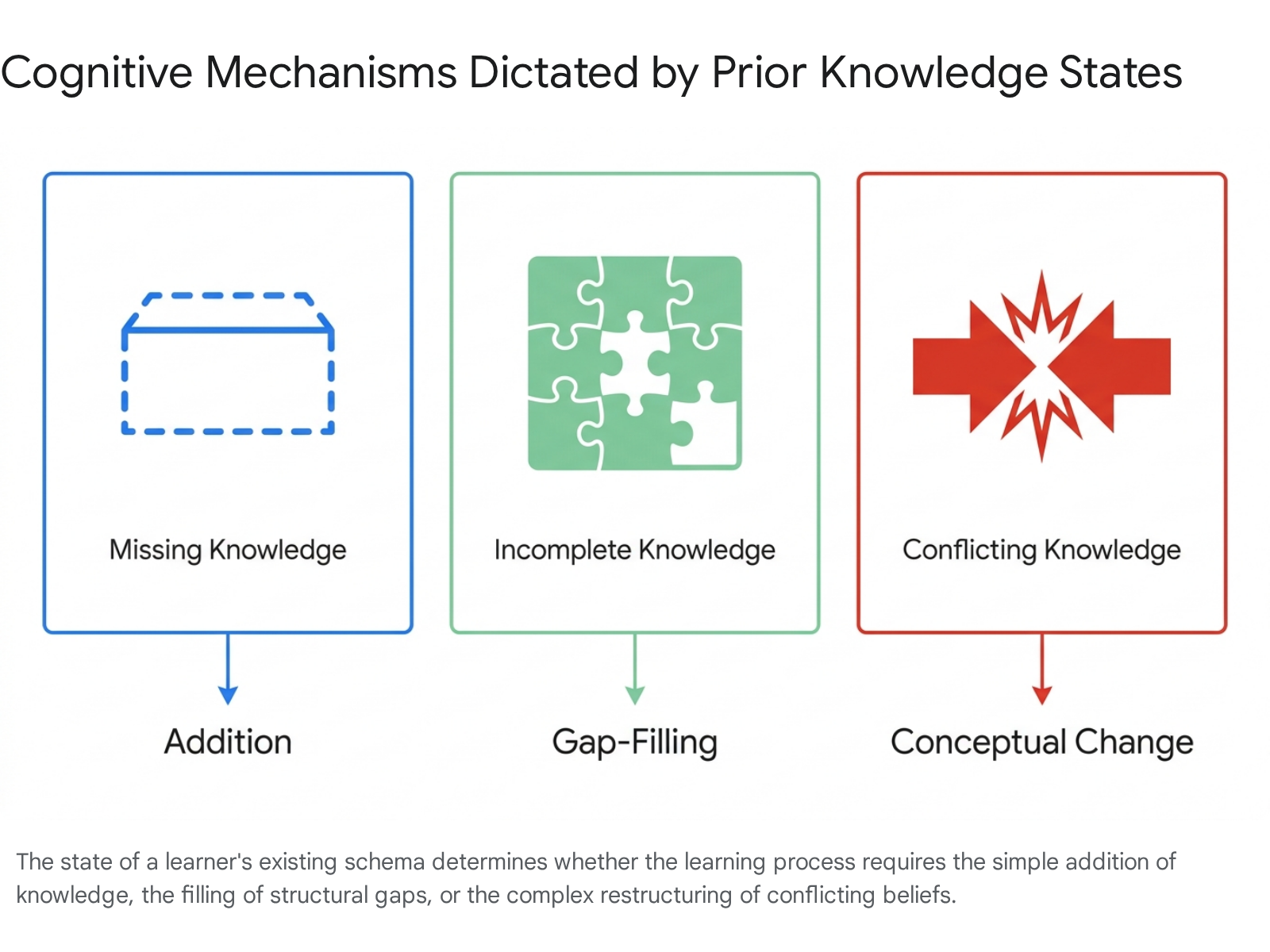
First, a learner may experience a state characterized by a "missing" schema. In this condition, the individual has no relevant background knowledge regarding the target concept. The learning process here is fundamentally additive; the cognitive system must construct a new foundational schema from raw, incoming data 410. This is the classic novice state, where instruction must focus heavily on building basic terminology and structural relationships from scratch.
Second, a learner may possess an "incomplete" schema. In this state, the learner holds some correct prior knowledge, but the network lacks critical connections, nuances, or details. Learning in this state functions as a gap-filling process, where new information enriches and expands the existing, accurate mental model without requiring the learner to discard previously held beliefs 1011.
Third, a learner may hold "conflicting" schemas. In this state, the learner has acquired ideas - through lived experience, cultural conditioning, or previous instruction - that directly contradict the target academic concepts 10. Learning under this condition is the most cognitively demanding, as it requires profound conceptual change 1011. The learner cannot simply add information; they must actively inhibit or restructure the deeply ingrained, automated schema that is causing proactive interference 101213. This condition is overwhelmingly prevalent in adult education, as adults rarely enter an instructional setting as blank slates 23.
Schema Overlap and Catastrophic Interference
In highly specialized fields, adult learners frequently encounter situations requiring the simultaneous maintenance of multiple, slightly overlapping schemas. For instance, maintaining distinct procedural schemas for closely related tasks requires precise cognitive separation to prevent "catastrophic interference" - a phenomenon where learning a new task causes the forgetting or corruption of previously learned tasks 7. While biological neural networks (unlike artificial neural networks) are generally adept at maintaining multiple schemas, the initial learning phase is highly susceptible to confusion if instruction does not account for schema overlap. Studies utilizing game-based learning environments indicate that blocked learning conditions - where one schema is mastered entirely before introducing a competing schema - facilitate better overall performance and minimal interference compared to interleaved learning 7. Furthermore, a strong "primacy effect" is often observed, wherein the first schema learned gains a substantial and persistent cognitive advantage, acting as the default perceptual lens through which all subsequent variations are filtered 7.
The Intersection of Cognitive Load and Learner Expertise
Element Interactivity and Working Memory Constraints
The design of effective instructional entry points relies heavily on human cognitive architecture, specifically the functional relationship between the limitations of working memory and the vast capacities of long-term memory. Cognitive Load Theory (CLT) posits that instruction must be explicitly designed to optimize the finite resources of working memory 131415. Instructional design must manage three types of load: intrinsic load (the inherent difficulty of the material), extraneous load (the way information is presented), and germane load (the effort dedicated to creating new schemas) 1516.
Intrinsic cognitive load is primarily determined by element interactivity - the extent to which the constituent components of a learning task interact with one another and must therefore be processed simultaneously in working memory 151617. Crucially, element interactivity is not a static property of the instructional material; it is entirely relative to the learner's existing schemas and prior knowledge 1115. For a novice, a novel academic task may contain dozens of individual interacting elements that rapidly overwhelm working memory capacity. For an adult expert, those exact same elements have already been integrated and chunked into a single, automated schema stored in long-term memory 815. Because experts can recall these vast schemas as single cognitive units, the element interactivity of the task is drastically reduced for them, freeing working memory for higher-order processing, strategy formulation, and critical reflection 822.
The Expertise Reversal Effect
The profound disparity in schema automation between novices and adults results in a phenomenon known as the expertise reversal effect. This principle dictates that instructional techniques that efficiently facilitate schema construction for inexperienced learners rapidly lose their effectiveness - and can even become detrimental to performance - when applied to adult learners with significant prior knowledge 81416171819.
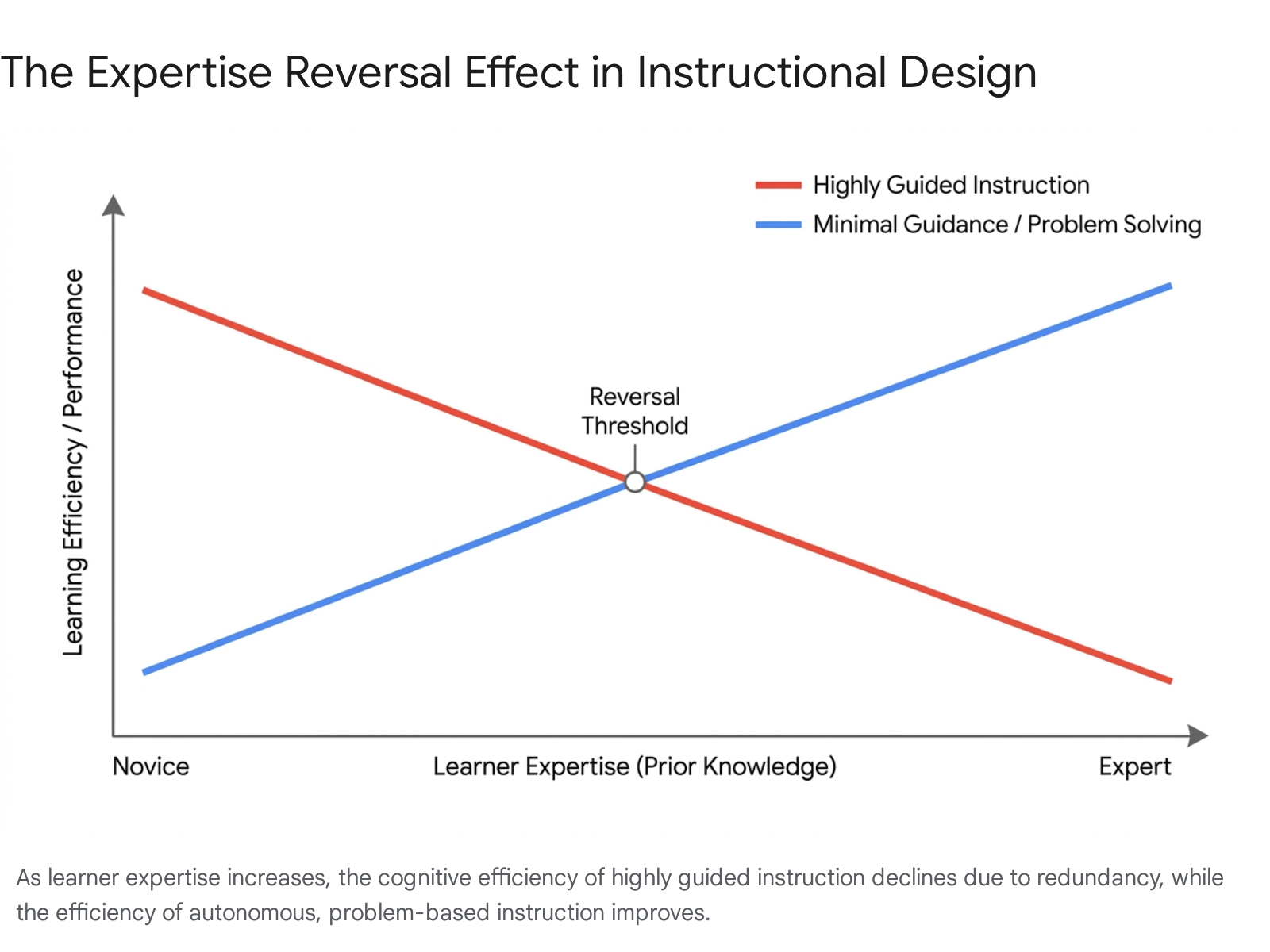
For novice learners, explicit, fully guided instruction is empirically superior to discovery-based or inquiry learning 922. Approaches such as providing highly detailed explanations, step-by-step guidance, and worked examples serve to minimize extraneous cognitive load, allowing the novice to focus purely on basic schema acquisition 161820. If novices are forced into unguided problem-solving environments too early, they must engage in inefficient search-and-match strategies that quickly induce cognitive overload, frustration, and disengagement 81622.
However, as learners acquire domain-specific schemas, their need for explicit guidance diminishes. If highly structured instruction is forced upon adult learners who already possess relevant schemas, the instructional guidance conflicts with their automated internal structures 161718. The adult learner must unnecessarily expend cognitive resources cross-referencing the provided explicit guidance with their own perfectly adequate internalized mental models. This redundancy increases extraneous cognitive load and induces a decline in learning efficiency 814161820. Consequently, instructional entry points must adapt dynamically to the learner's expertise; where novices require step-by-step worked examples, experienced adults require autonomous, problem-solving environments that challenge and leverage their pre-existing knowledge 1117.
Artificial Intelligence and Cognitive Offloading
The expertise reversal effect has gained renewed prominence in the context of generative artificial intelligence (AI) and digital cognitive offloading. Recent meta-analytic evidence from 2024 and 2025 highlights an "expertise duality" regarding human-AI collaboration: AI functions as a "leveler" for novices but an "amplifier" for experts 19. For novices, AI acts as an external hippocampus, providing the episodic information and structured guidance needed to accomplish tasks they could not manage unaided 19. While this produces immediate performance gains, it systematically bypasses the cognitive dissonance and struggle required to actually build internal schemas, leading to a phenomenon termed the "Sovereignty Trap" or the "hollowed mind" 192122. Novices begin to conflate the internet's knowledge with their own abilities, failing to develop the metacognitive skills required for true expertise 1922.
Conversely, experts use AI as an amplifier. Because experts already possess deep neocortical schemas, they do not rely on AI for basic structural guidance 19. Instead, they use it to generate patterns which they then actively validate, correct, and synthesize into novel insights 19. Studies on knowledge workers demonstrate that experts actually report investing more mental effort when using AI because their advanced schemas compel them to rigorously evaluate the AI's output, whereas novices accept the output passively 19. Therefore, relying on highly automated tools without first building foundational schemas poses a severe risk to adult cognitive development.
Andragogy and the Adult Learner
Malcolm Knowles and the Orientation to Experience
The cognitive divergence between adult and novice learners is mirrored in educational theory, specifically within the framework of andragogy. Formalized by Malcolm Knowles in the late 1960s to distinguish adult learning from the pedagogical models historically used for children, andragogy outlines core assumptions regarding adult cognitive and behavioral orientations 232430252627.
Unlike child learners, who frequently approach academic subjects with minimal contextual anchoring, adult learners arrive with a vast, highly structured reservoir of life, social, and work experience 22534. This experience serves as the indispensable foundational resource for all subsequent learning. According to Knowles' principles, adults have a deep-seated psychological need for self-direction 242526. They inherently resist educational environments that impose rigid, top-down instruction or frame them as passive recipients of knowledge, as such pedagogical models clash with their established self-concept as autonomous, capable actors 252728.
Furthermore, adult learners exhibit a highly specific orientation toward learning: they are predominantly life-centered, task-centered, and problem-centered rather than subject-centered 242526. Their readiness to learn is triggered almost exclusively by immediate, real-world utility 2425. Therefore, instructional entry points for adults must explicitly articulate the relevance of the material (satisfying the "need to know") and immediately anchor abstract concepts to practical applications 242526. If new information cannot be logically integrated into an adult's existing experiential schemas or fails to offer a solution to an ongoing life challenge, the material is frequently rejected or rapidly forgotten due to a lack of perceived utility.
Transformative Learning Theory
When an adult learner encounters novel information that aligns comfortably with their existing schemas, learning proceeds smoothly through assimilation. However, adult education frequently involves paradigms that fundamentally challenge the learner's established worldviews, professional practices, or cultural norms. In these instances, Jack Mezirow's Transformative Learning Theory provides the definitive theoretical framework 2325293730.
Transformative learning addresses situations where adults must fundamentally alter deeply held assumptions, expectations, and "habits of mind" 2529. The essential instructional entry point for this type of learning is the intentional introduction of a "disorienting dilemma" - an experience, crisis, or piece of evidence that starkly contradicts the learner's prior beliefs 232930. This dilemma creates acute cognitive friction, forcing the adult to recognize that their automated schemas are obsolete or fundamentally flawed.
The successful resolution of a disorienting dilemma requires deep critical reflection 232529. Through critical reflection, adults analyze the socio-cultural, psychological, or epistemic origins of their beliefs, question their underlying assumptions, and consciously rework their meaning perspectives 232529. Transformative learning is, therefore, not merely the accumulation of new facts; it is a profound epistemological shift that relies entirely on activating - and subsequently dismantling - the adult's prior knowledge structures 25373031.
Early Maladaptive Schemas and Emotional Interference
While academic schemas guide intellectual understanding, adults are also governed by complex psychological and emotional schemas formed early in life. In cognitive behavioral and schema therapy frameworks, Early Maladaptive Schemas (EMS) are pervasive themes regarding oneself and relationships that develop during childhood and persist throughout the lifespan 323342. Schemas such as "punitiveness," "defectiveness," or "failure" act as powerful emotional filters that distort an adult's interpretation of events, leading to false assumptions, unrealistic expectations, and self-defeating behaviors 323342.
In adult education settings, EMS can severely disrupt the learning process. An adult learner with a strong "failure" schema may interpret constructive feedback from an instructor not as an opportunity for growth, but as confirmation of their inherent inadequacy, prompting emotional withdrawal or defensive hostility. These schemas operate preconsciously; adults distort their view of events to maintain the validity of their schemas because, despite being dysfunctional, the schemas are deeply familiar and comfortable 334234. Consequently, adult educators must be aware that resistance to new learning is not always an intellectual deficit, but often an emotional defense mechanism triggered by the activation of maladaptive life schemas 3242.
Cognitive Interference and the Unlearning Process
Neurobiological Mechanisms of Unlearning
The presence of established schemas in adult learners is generally a massive advantage for knowledge acquisition. However, when new academic domains, technological advancements, or workplace paradigms render old knowledge obsolete, these automated schemas transform into distinct liabilities. Adults face the arduous task of "unlearning," defined as the deliberate process of recognizing, inhibiting, and discarding outdated organizational routines, beliefs, or cognitive structures to make room for more effective approaches 1221444535.
Unlearning is not the passive decay of memory over time; it is an active, resource-intensive cognitive mechanism 1235. From a neurobiological perspective, unlearning requires the activation of the Anterior Cingulate Cortex (ACC) and the Lateral Prefrontal Cortex (LPFC) network 1922. The brain must detect a conflict between the incoming environmental data and the internal schema, process the resulting cognitive dissonance, and expend significant executive control to inhibit the highly automated, incorrect response 12192236.
This inhibitory requirement frequently manifests as measurable cognitive interference 12363738. When an adult attempts to execute a new procedure or process a new concept, their deeply entrenched prior knowledge acts as a powerful default pathway 1338. The cognitive system must allocate substantial working memory resources to suppress the obsolete schema (proactive interference) while simultaneously trying to encode the new protocol 36373940.
Cross-Linguistic and Sensory Interference
The mechanics of cognitive interference are vividly illustrated in psycholinguistic and sensory processing studies across the lifespan. Extensive psychometric testing using paradigms like the Stroop task, negative priming tasks, and the MultiSource Interference Task (MSIT) consistently demonstrate that older adults experience heightened interference effects compared to younger demographics 383941.
However, recent research indicates that this is not merely a symptom of uniform cognitive decline, but rather a byproduct of lifelong experience and schema automation. A 2025 study examining native Mandarin speakers using a cross-linguistic Garner paradigm revealed significant nuances in how adults manage interference. When processing their native language, older adults exhibited interference patterns comparable to younger adults, utilizing lifelong experience and contextual prediction to shield themselves from distraction 38. However, when exposed to an unfamiliar tonal language (Thai), older adults exhibited significantly greater cognitive interference and delayed reaction times 38.
This demonstrates that adults rely heavily on cue weighting strategies and automated top-down schemas to process information efficiently. In familiar domains, these schemas act as a shield, allowing for rapid processing. But in novel domains, the absence of an applicable schema forces the adult brain to rely on degraded bottom-up processing, rendering them highly vulnerable to interference from irrelevant stimuli 38.
Supervised versus Unsupervised Pruning
The process of restructuring knowledge networks requires the careful "pruning" of incorrect associations. A 2025 study on adult word learning explored how learners unlearn competitor meanings that do not map onto correct targets 42. The research delineates two pruning mechanisms: supervised pruning (unlearning based on explicit negative feedback) and unsupervised pruning (unlearning based on a statistical lack of co-occurrence) 42.
The findings indicate that unsupervised statistical information - specifically the consistent lack of co-occurrence between a word and an incorrect meaning - is more effective for pruning than direct supervised feedback 42. Furthermore, the extent to which an incorrect association is unlearned depends heavily on its initial strength. If an adult has formed a strong initial mapping, that incorrect association remains stubbornly present in the lexicon even after the learner achieves near-ceiling performance on correct mappings 42. This underscores the difficulty of unlearning for adults: explicit correction is often insufficient to erase an obsolete schema. The learner must be consistently immersed in environments where the outdated schema is visibly unsupported by context, allowing the neural pathways to organically weaken over time 42.
Designing Differentiated Instructional Entry Points
Because adult learners and novice learners operate from vastly different baselines of prior knowledge, applying a universal instructional strategy inevitably alienates one demographic while cognitively overwhelming the other. Educational frameworks must calibrate entry points to the exact state of the target audience's schemas.
Entry Points for Novice Learners
When a learner possesses a missing schema, their instructional needs are characterized by high element interactivity and a severe vulnerability to cognitive overload 4111518. * Direct Instruction and Explicit Guidance: The primary entry point for true novices must be direct, unambiguous instruction. Instructors must break complex academic domains into isolated, manageable elements, teaching them sequentially before demonstrating how they interact 91516. * Worked Examples: Novices benefit immensely from studying fully solved problems. Worked examples focus the learner's cognitive resources entirely on understanding the logical steps and structure of a solution, rather than forcing them into cognitively exhausting trial-and-error searches that deplete working memory 91620. * Minimizing Extraneous Load: Instructional materials must be strictly stripped of redundant information, extraneous graphics, and split-attention formats. The learning environment should be tightly controlled to funnel all available cognitive capacity into the construction of basic schemas 81416.
Entry Points for Adult Learners
For adults with significant prior knowledge, instruction must shift away from basic schema construction and focus entirely on schema activation, refinement, and complex restructuring 12443. * Prior Knowledge Activation (PKA): Before introducing any new material, adults should be prompted to retrieve existing knowledge relevant to the topic. Techniques such as pre-instructional quizzes, concept mapping, and guided retrieval practice bring dormant schemas into working memory, priming the network to integrate new connections seamlessly 244344. * Problem-Based and Experiential Learning: Capitalizing on the expertise reversal effect, adult instruction thrives when explicit guidance is purposefully faded. Instructional entry points should center on complex, authentic problems, simulations, or case studies that mirror their real-world environments 1723264546. This honors their autonomy and directly leverages their extensive long-term memory structures 302645. * Disorienting Dilemmas and Mental Model Revision: To target conflicting schemas, adults must encounter carefully designed "failures" or anomalies that their current mental models simply cannot explain or solve 152946. These dilemmas serve as the vital catalyst for the unlearning process. Instead of aggressively overriding the learner's assumptions, instructors should use "gap-driven reframing" prompts that push the adult out of automated routines, forcing a state of ambiguity that transitions into critical reflection 11152947.
Comparative Instructional Strategies
The following table summarizes the contrasting instructional requirements based on the learner's schema state:
| Schema Status | Target Demographic | Primary Cognitive Goal | Optimal Instructional Entry Point |
|---|---|---|---|
| Missing | True Novices | Schema Construction | Direct instruction, fully worked examples, isolated elements |
| Incomplete | Intermediates | Schema Enrichment (Gap-filling) | Faded guidance, completion problems, scaffolding |
| Established | Experts / Adults | Schema Automation & Transfer | Problem-based learning, inquiry, minimal explicit guidance |
| Conflicting | Experienced Adults | Conceptual Change (Unlearning) | Disorienting dilemmas, critical reflection prompts, simulation |
Practical Applications in Adult Education
Recent empirical studies reinforce the necessity of tailoring entry points to adult schemas. In the context of disaster preparedness education, a 2025/2026 study in Germany revealed that prior knowledge significantly dictates an adult's preference for instructional entry points 28. Individuals who were already prepared (possessing robust schemas) favored advanced, structured training that built upon their existing skills 28. Conversely, the "unprepared" cohort required "high-reach, low-effort" entry points 28. For this group, formal instruction was ineffective; instead, they needed localized, highly practical touchpoints - such as power-outage simulations at local events - designed explicitly to create initial relevance and overcome public apathy 28.
Similarly, in non-Western English as a Foreign Language (EFL) contexts, a 2025 study of Pakistani learners demonstrated the critical importance of culturally contextualized schema activation 5. When teaching foreign texts, instructors vastly improved reading comprehension by connecting the text's themes to local cultural norms (e.g., comparing a foreign "manor" to a local ancestral home) 5. By utilizing localized visual aids and familiar cultural examples as instructional entry points, the educators effectively activated the students' prior knowledge, providing a meaningful scaffold for acquiring foreign vocabulary and concepts 5.
Global and Non-Western Contextual Considerations
Limitations of Western Cognitive Frameworks
The mechanisms of prior knowledge activation are intricately tied to the cultural environments in which those schemas were originally forged. The overwhelming majority of canonical adult learning theories - including traditional applications of andragogy and transformative learning - are deeply rooted in Western epistemologies. These frameworks implicitly prioritize individualism, linear logic, objective measurement, and cognitive independence 59604862.
However, instructional entry points must account for the reality that adult learners from non-Western, indigenous, or historically marginalized backgrounds often possess schemas that are fundamentally embedded in collective, holistic, and relational frameworks 596048. In many African and Indigenous cultures, knowledge is not viewed as a detached, abstract cognitive commodity to be argued over or empirically measured; rather, it is an embodied truth, inextricably linked to the community, social relationships, generational wisdom, and the natural environment 6049.
Culturally Responsive Prior Knowledge Activation
When educating adults across diverse global contexts - such as transnational migrant training, refugee integration programs, or global citizenship education - imposing a rigid, Western technocratic instructional model often results in profound cognitive and cultural dissonance 594864. If educators ignore or invalidate the culturally specific schemas of their adult learners, the "expertise" of the learner is effectively nullified, and the educational environment devolves into an exercise of epistemic violence 315948.
Consequently, effective entry points in multicultural adult education require a paradigm shift. Instructors must tap into local cultural cues, utilize collaborative and intergenerational learning methods, and validate knowledge that is constructed through community practice rather than purely formal academic transmission 5345960. Methodologies such as "circle pedagogy" and other embodied learning practices have been shown to facilitate deep prior knowledge activation for immigrants and refugees, allowing them to heal, build solidarity, and integrate new knowledge without being forced into assimilative pathways that demand the erasure of their cultural schemas 49. By approaching adult education with cultural humility and recognizing the vast diversity of human meaning-making, instructional designers can create entry points that genuinely honor the complex, pre-existing cognitive architectures of all adult learners.