
Resilience Strategies for Solo Startup Founders
The architectural model of modern entrepreneurship is undergoing a profound structural shift. For decades, the venture capital ecosystem has operated on a foundational heuristic that startup viability requires a multi-founder team, heavily penalizing solo founders under the assumption that a single operator cannot simultaneously manage product development, customer acquisition, and capital allocation. However, recent data indicates a steady decoupling of founding team size from operational success, driven by technological multipliers, evolving work paradigms, and an increasing aversion to co-founder conflict. While solo entrepreneurship offers distinct advantages in equity preservation and decision-making velocity, it introduces severe psychological and structural risks. The absence of a shared operational burden dramatically amplifies the threat of cognitive overload, social isolation, and financial stress. Analyzing the mechanisms of founder resilience is no longer merely a psychological inquiry; it is a fundamental requirement for assessing startup sustainability and economic durability.
The Evolving Landscape of Solo Entrepreneurship
The narrative surrounding the solo founder is shifting from one of perceived disadvantage to a recognized and rapidly expanding demographic within the global startup ecosystem. Understanding this macro-level shift is essential for contextualizing the unique pressures placed upon individuals building ventures independently.
Demographic Shifts in Venture Creation
The prevalence of single-founder startups has accelerated remarkably over the past decade. According to longitudinal data analyzing over 45,000 venture-backed companies, the percentage of startups led by a solo founder rose from 17% in 2017 to approximately 35% by the end of 2024 123. This trajectory continued upward, reaching 36.3% of all new corporate formations by the first half of 2025 436. This 13-point increase in roughly five years represents a historic realignment in company creation, marking the first time in 50 years of startup history that over one in three new companies are solo-founded 46.
Simultaneously, the configuration of larger founding teams is contracting. In 2024, startups with three founders accounted for only 16% of new ventures, while teams of four and five dropped to 7% and 4%, respectively - the lowest levels observed in a decade 3. Several macroeconomic and cultural variables explain this shift. Foremost among them is the risk associated with interpersonal dynamics; research indicates that up to 65% of startups fail directly due to co-founder conflict 7. By building alone, entrepreneurs trade the risk of partnership dissolution for the risk of acute isolation and increased individual workload 6.
Furthermore, solo founders are demonstrating robust capabilities in achieving extreme scale, with over 300 solo-founded companies having reached billion-dollar "unicorn" valuations globally 1. Historical exit data further complicates the multi-founder mandate, revealing that 52.3% of successful startup exits are achieved by solo founders 1. In fact, prominent investors like Y Combinator's Paul Graham have noted that solo founders have a 2.3 times higher chance of being in the top 10% of successful startups compared to teams with four or more founders 8. Despite these outcomes, solo founders face a unique set of operational timelines. Academic research from the Wharton School indicates that solo founders take 3.6 times longer to transition out of the initial startup phase compared to teams of two, highlighting a slower maturation cycle that requires sustained endurance 89.
The Venture Capital Allocation Gap
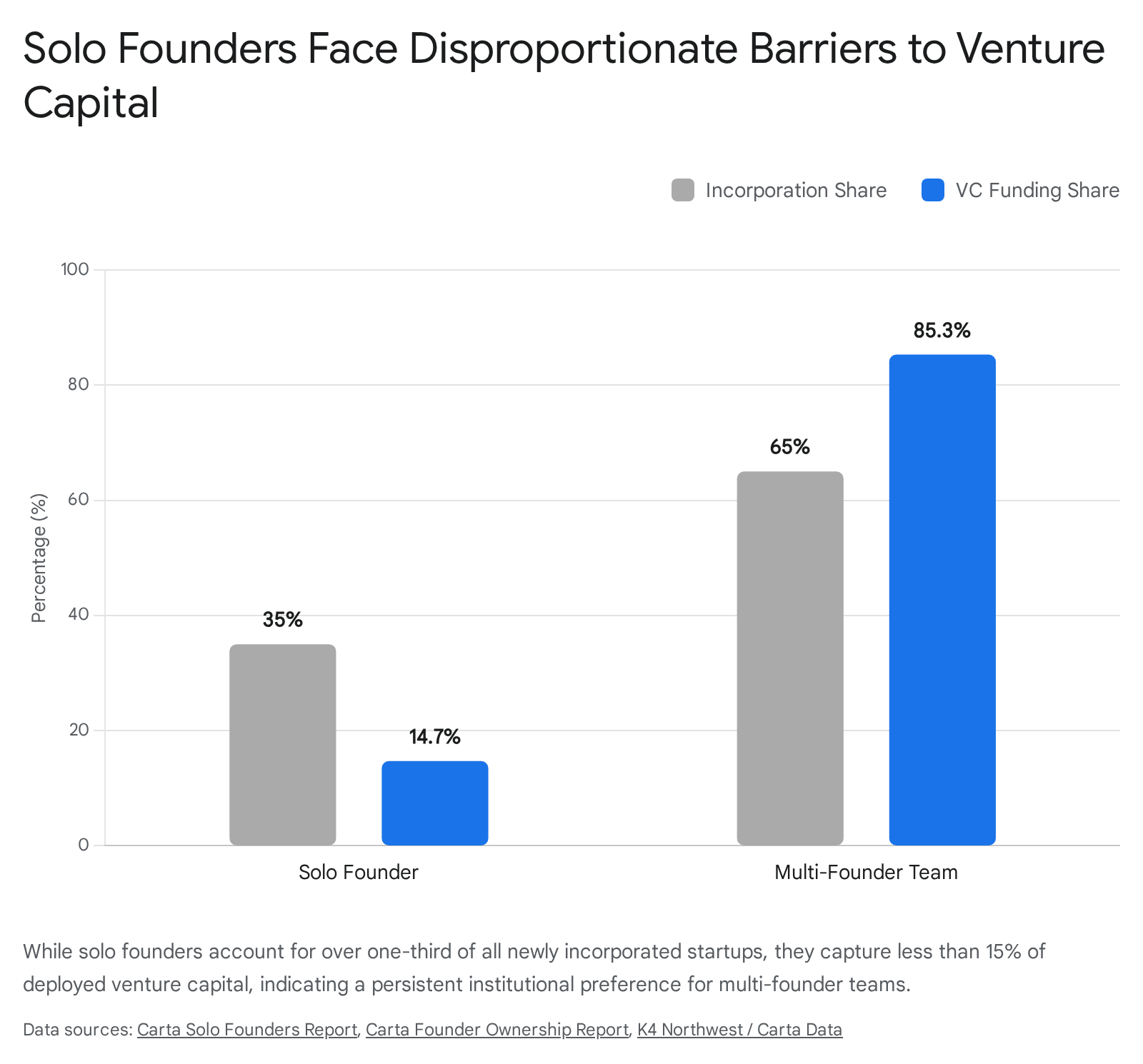
Despite representing more than a third of new company formations, solo founders face a disproportionate barrier in accessing institutional capital. In 2024, while solo-led companies constituted 35% of all startups incorporated, they secured only 14.7% of the total capital deployed in priced equity rounds 43.
Furthermore, only 17% of startups launched by solo founders in 2024 managed to close a venture capital round by the end of the year, compared to significantly higher success rates for multi-founder teams 23310.
This discrepancy suggests a persistent institutional lag. Venture capital models continue to rely heavily on multi-founder risk-mitigation heuristics, assuming that a diverse team provides a necessary safety net of complementary skills and distributed psychological burden 33. Consequently, solo founders are often forced to bootstrap their operations for longer periods. This capital scarcity directly influences the operational reality of the solo entrepreneur, requiring tighter financial discipline, slower initial hiring, and a heightened risk of burnout due to the dual pressures of product development and undercapitalized survival 9.
Equity Preservation and Execution Velocity
Despite headwinds in capital acquisition, solo founders benefit from distinct structural advantages regarding ownership and agility. The process of dividing equity among co-founders is increasingly fraught; in 2024, 45.9% of two-person founding teams opted to split their equity equally, up from 31.5% in 2015 237. This egalitarian approach often dilutes a lead founder's control and financial upside. Solo founders, possessing 100% initial equity, circumvent this entirely, eliminating early friction over control and retroactive resentment 17.
This uncompromised equity directly impacts exit outcomes. Data reveals that median ownership at exit is 75% greater for solo founders than for lead founders in multi-founder companies, as they preserve equity in the early days and often exit before suffering the massive dilution of later-stage rounds 3. Furthermore, solo founders maintain unmatched execution velocity. The absence of consensus-building allows for immediate strategic pivots 17. This agility is evident in early company building: solo founders actually hire their first employee faster than multi-founder teams, with a median of 399 days from incorporation to first hire, compared to 480 days for multi-founder companies 4.
The Epidemiology of Founder Burnout
Burnout within the entrepreneurial ecosystem is not merely an occupational hazard; it is a structural crisis that actively degrades economic output and innovation. The psychological toll of scaling a business alone is profound, transforming the intended independence of solo entrepreneurship into debilitating isolation.
Statistical Prevalence and Mental Health Strain
Recent surveys across the startup sector reveal an alarming prevalence of mental health crises among founders. A 2024 - 2025 assessment of early-stage entrepreneurs indicated that between 52% and 54% had experienced clinical symptoms of burnout within the preceding twelve months 45136157. Furthermore, 83% to 85% of founders reported enduring high levels of persistent stress, and 75% dealt with clinical anxiety 51378.
The psychological strain extends beyond acute stress into chronic physiological and mental health conditions. Comprehensive health tracking suggests that 93% to 94% of founders exhibit signs of measurable mental health strain, with levels of anxiety operating at five times the national average of the general workforce 791011. On average, founders exhibit nearly five distinct symptoms of mental health strain concurrently 1011.
The foundational study on founder mental health, conducted by Dr. Michael Freeman at UC San Francisco, exposes the biological and psychological vulnerabilities of the entrepreneurial demographic. The study found that 72% of entrepreneurs reported at least one mental health concern in their lifetime, and 49% reported two or more simultaneously 158. Relative to the general population, founders are twice as likely to report depression, six times more likely to report ADHD, three times more likely to report substance abuse, and ten times more likely to report bipolar disorder 15. The traits that correlate with founding a business - high sensation-seeking, high tolerance for ambiguity, and relentless drive - biologically overlap with psychological profiles that require active management 15.
Burnout Disparities Across Demographics
The incidence of burnout is not distributed equally across all demographic cohorts. Intersecting identities, structural disadvantages, and specific industry pressures compound the baseline stress of entrepreneurship.
| Demographic Cohort | Reported Burnout / High Stress Rate | Key Contributing Factors |
|---|---|---|
| Solo Founders | ~52% | Absence of distributed workload, extreme isolation, slower scaling timelines 8915. |
| Co-founded Teams | ~37% - 38% | Shared psychological burden, diverse skill sets, higher VC funding rates 815. |
| Female Founders | ~52% | Compounded pressures including fundraising bias (receiving ~1-2% of total US VC), caretaking responsibilities, and smaller peer networks 1015. |
| Male Founders | ~41% | Generally higher access to established venture networks and capital 15. |
| First-Generation Founders | ~57% | Lack of familial entrepreneurship history, absent informal safety nets, higher financial stakes 15. |
| Second-Generation Founders | ~38% | Access to generational knowledge, stronger baseline capital, and normalized risk tolerance 15. |
| Climate Tech Founders | ~63% (Bad/Very Bad Mental Health) | Volatile ESG regulations, geopolitical instability, inflation, and severe drops in sector funding since 2021 7. |
Note: Percentages represent aggregate survey data from 2024-2026 assessments of startup demographics and mental health 10157.
Solo founders face heightened vulnerability due to the total centralization of responsibility 15. For solo female founders, the psychological burden is distinctly amplified by the severe capital constraints they face globally; companies founded solely by women captured only about 1% to 2% of total US venture capital in 2024, despite often exhibiting stronger capital efficiency 10. Similarly, first-generation founders experience higher burnout rates (57%) compared to their second-generation peers (38%), heavily influenced by the lack of financial safety nets and the psychological weight of risking personal stability 15. Sector-specific macroeconomics also play a role; 63% of climate tech founders reported their mental health as "bad" or "very bad" in 2025, driven by a collapse in climate funding and the politicization of ESG mandates 7.
Identity Fusion and Cognitive Dissonance
A primary vulnerability for solo founders is "identity fusion," a psychological state where the founder equates their personal worth entirely with the valuation and success of their business 8. When the startup encounters friction, the founder's self-esteem collapses; when the startup succeeds, the founder denies themselves the permission to acknowledge their exhaustion, perpetuating the myth that "the founder is the company" 8.
This fusion creates a dangerous environment of cognitive dissonance. Despite 72% of founders admitting that startup stress negatively impacts their mental health and decision-making, an overwhelming 81% admit they are not open about their fears, stress, or challenges 68. This silence is highly strategic; founders feel immense pressure to project invulnerability to retain investor confidence, attract talent, and secure customers 612.
Data confirms this mistrust of institutional stakeholders: only 10% to 13% of founders feel comfortable looking to their investors for emotional or psychological support, fearing it may jeopardize future funding rounds 561011. Without co-founders to share the burden (a support vector utilized by 49% of multi-founder teams), solo founders turn primarily to their spouse or family (76%), though family members often lack the context to offer strategic relief 56. Consequently, 76% of founders report acute loneliness, a rate seven times the workplace average and 50% higher than corporate CEOs more generally 91022. Loneliness acts as a severe cognitive inhibitor, reducing problem-solving capabilities, increasing emotional exhaustion, and accelerating the path to failure 1022. Furthermore, an astonishing 77% of founders do not seek professional psychological help, trapped in a cycle of self-reliance that masks clinical distress 6.
Psychological Mechanisms of Founder Resilience
Resilience in entrepreneurship extends beyond mere endurance or stubbornness; it is defined academically as a dynamic adaptation process that allows individuals to maintain focus, recover from setbacks, and adapt to rapidly changing market conditions while developing their potential in the process 1314.
Foundational Traits and the Brief Resilience Scale
Academic institutions utilizing the Brief Resilience Scale (BRS) - a validated psychometric tool for assessing an individual's ability to bounce back from challenging situations - have isolated specific traits separating high-resilience founders from low-resilience founders 925. Findings from the 2024 Founder Resilience Research Report indicate that 92% of founders rank resilience as the absolute primary requirement for entrepreneurial success, surpassing even communication, influencing, or problem-solving skills 922.
Entrepreneurs measuring low on the resilience scale are heavily disadvantaged. Comparing cohorts, those with low resilience scores report 65% more symptoms of poor physical and mental health on average (7.38 symptoms versus 4.43) and are nearly three times more likely to experience these symptoms weekly 1114. Crucially, low-resilience founders are more than twice as likely to have actively considered quitting their venture (62% versus 37% for highly resilient peers) 1114. They are also four times more likely to feel persistently overwhelmed and stressed, leading to diminished executive function and eventual operational paralysis 914.
The Entrepreneurial Resilience Index
Resilience frameworks define survival not just as taking punishment, but as actively navigating uncertainty. The Entrepreneurial Resilience Index (ERI) structures this capability around four key pillars 26: 1. The Entrepreneur's "Why": A deep, intrinsic sense of purpose that provides cognitive fuel when external validation (funding, traction) is scarce 2627. 2. Bias Toward Action: The capacity to execute and move forward iteratively rather than succumbing to decision paralysis or overthinking 26. 3. Adaptability: The willingness to pivot, problem-solve, and embrace new approaches rapidly without being anchored to initial hypotheses 26. 4. Relevance: A commitment to staying aware of industry evolution and maintaining a growth mindset, ensuring the founder does not become obsolete 2628.
Resilient entrepreneurs do not inherently fail less; rather, they develop "rapid recovery resilience," extracting data from failure to improve their strategies immediately, rather than viewing failure as a terminal reflection of their intelligence 272829.
Positive Solopreneurship Principles
In the specific context of solo founders, researchers are developing frameworks like "Positive Solopreneurship." This evidence-based concept adapts principles of positive psychology specifically for the solo entrepreneur to address unique mental pitfalls such as social isolation and decision paralysis 15. The framework relies on four action-theoretical principles: 1. Reality Check Instead of Intuition: Combating confirmation bias by forcing empirical validation of ideas rather than relying solely on the founder's isolated intuition 15. 2. Setting Your Own Reference Points: Preventing the toxic comparison of a bootstrapped solo venture against well-funded, multi-founder hyper-growth startups 15. 3. Appreciation Instead of Habituation: Actively celebrating small wins and milestones to maintain dopamine and motivation, combating the tendency to normalize success and only focus on the next crisis 15. 4. Resilient Future Perspective: Maintaining a long-term strategic vision that buffers against the emotional volatility of daily operational setbacks 15.
Structural Causes of Solo Founder Overload
While psychological traits are critical, burnout is frequently a symptom of structural business failure rather than a personal deficit of grit. Solo founders often fall into operational traps that guarantee exhaustion, confusing motion with progress.
The Hero-Founder Trap and Systemic Fatigue
The startup ecosystem frequently romanticizes the "hero-founder" who sustains 100-hour workweeks fueled by conviction. However, post-mortem analyses of failed startups indicate that extreme overwork often masks a fundamental lack of market traction 3132. When founders rely on sheer manual hustle to push an unwanted product into a market, they experience "functional burnout" - a state where the founder continues to operate but begins making constant, avoidable mistakes due to severe decision fatigue 32. One founder described this fog as operating with the executive function of a 10-year-old, regardless of willpower 32.
Furthermore, working endless hours prevents founders from transitioning from a "doer" mindset to an "architect" mindset 32. If a startup reaches $1 million in Annual Recurring Revenue (ARR) but still requires the solo founder to be online 16 hours a day and eat expired food to function, the business is structurally flawed 31. It has failed to build repeatable distribution loops and scalable operational systems, capping its growth at the absolute limits of the founder's physical endurance 3132.
Technical Debt and the Complexity Trap
Solo founders, particularly those with technical backgrounds, are highly susceptible to the "complexity trap." Driven by the anxiety of launching an imperfect product, they often over-engineer solutions, creating massive technical debt before securing a single paying customer 3133.
Building extensive infrastructure without continuous customer validation leads to significant wasted effort. Post-mortems reveal that founders frequently invest heavy capital into features no user requested - such as one dev shop noting a founder arriving with a $40,000 budget and a 47-page Product Requirements Document (PRD) for unvalidated features 31. This pursuit of perfection isolates the founder from real market feedback. Simplicity, conversely, acts as a competitive advantage. Shipping a "small, useful thing" allows for rapid feedback cycles, preserving both the founder's capital and psychological energy 31.
Another structural risk for solo software founders is the "API cost trap." By building architectures heavily reliant on third-party integrations (like AI models) without strict usage limits, solo founders can suddenly face debilitating expenses - such as paying $47 a day in API costs for a single user on a $15 monthly subscription 32. This financial shock directly accelerates burnout 32.
Artificial Intelligence as a Synthetic Capability Multiplier
The recent surge in solo entrepreneurship is inextricably linked to the rapid advancement of Artificial Intelligence (AI). Generative AI and automated workflow tools serve as massive force multipliers, allowing a single operator to simultaneously write code, draft marketing copy, analyze customer data, and manage support channels 46. Where a solo founder in 2019 might have needed weeks to build a functional prototype, a modern AI-assisted founder can ship in hours or days, becoming vastly "multi-threaded" 6.
However, the integration of AI introduces distinct psychological and operational vulnerabilities. AI platforms act as synthetic co-founders, executing tasks efficiently, but they lack the capacity for emotional support, strategic pushback, or shared liability 9. Furthermore, managing a vast stack of AI tools increases the cognitive load of system architecture. Founders must continually monitor automated workflows to prevent algorithmic errors or hallucinations from impacting customers, trading the stress of execution for the stress of constant technical vigilance 9.
Strategic Decision-Making: Pivot Versus Perseverance
One of the most cognitively demanding challenges for a solo founder is determining whether to persist through adversity or fundamentally pivot the business model. This decision is complicated by conflicting entrepreneurial philosophies: the pragmatic necessity of "failing fast" (avoiding sunk costs) versus the celebrated resilience required to endure prolonged hardship 34.
Analytical Frameworks for Strategic Redirection
Data demonstrates that 42% of startup failures are caused by misreading market demand and failing to achieve Product-Market Fit (PMF) 103516. Founders who validate their hypotheses emotionally rather than empirically fall in love with untested assumptions, burning runway on products the market ultimately rejects 35.
A specific hazard for the solo founder is the "tar pit idea" - a concept that receives initial positive feedback and seems to solve an obvious problem, attracting immense founder energy 37. However, despite the validation, these ideas become impossible to scale and difficult to pivot away from once their structural limitations become apparent, trapping the founder in years of stagnant effort 37.
To avoid relying on isolated intuition, successful solo founders construct rigorous, data-driven frameworks to guide the pivot-or-persevere decision. Measuring simple revenue growth is insufficient, as unprofitable growth can mask fundamental business flaws 17.
| Strategic Action | Key Justifying Metrics and Signals | Market Conditions |
|---|---|---|
| Pivot | High Customer Acquisition Cost (CAC); High Churn Rate; Low Monthly Active Users (MAU); Negative Unit Economics 1718. | Target audience is unresponsive; Customer feedback requests features entirely outside the current value proposition; Cash runway is under 12 months with no traction 1718. |
| Persevere | High Net Revenue Retention (NRR); Improving Contribution Margins; Steady organic customer flow; Declining CAC 1718. | Clear validation of hypothesis; Customers exhibit high engagement despite product friction; Core infrastructure and team capacity are aligned with demand 1718. |
By aggressively tracking unit economics - such as gross margins, CAC payback periods, and lifetime value (LTV) - founders can ascertain whether growth is creating or destroying economic value 17. If unit economics are negative, customer acquisition remains prohibitively expensive, and the runway is dwindling, a pivot is mandatory to preserve remaining capital 171840.
Navigating the Sunk Cost Fallacy and Sensemaking
The decision to pivot requires a founder to overcome the "sunk cost fallacy" - the psychological bias to continue investing in a failing trajectory because of the time, money, and identity already committed 34. The strategic pivot is not a singular event but an ongoing process of reflexivity and "sensemaking" 1920. It requires the founder to detach their ego from the original idea, recognize the gap between expected and actual outcomes under environmental changes, and rapidly generate new hypotheses 19.
For solo founders, executing a pivot is often mechanically faster than in multi-founder teams, as they do not need to negotiate strategic shifts, manage co-founder consensus, or untangle disparate visions 1720. However, without a co-founder to provide a reality check, the solo founder must possess immense self-awareness to admit defeat on a specific hypothesis without internalizing it as a personal failure 2729. The stakes are remarkably high; 63% of technology startups shut down within five years, and 74% of recent shutdowns occurred at the highly fragile pre-seed and seed stages, where cash runways are shortest 1640.
Cultural and Regional Variations in Entrepreneurial Resilience
The strategies employed to maintain resilience are not globally uniform. They are heavily influenced by the macroeconomic environment, cultural stigmas surrounding failure, and the institutional support available within a given region.
Stigma and Failure Tolerance in Divergent Ecosystems
The cultural perception of failure drastically impacts an entrepreneur's psychological resilience. In the United States, failure is broadly institutionalized as a natural, expected stepping stone on the path to success 43. A failed startup is often viewed pragmatically as an education that increases a founder's future viability, and the US market tolerates longer periods of unprofitability to capture market share 1643.
Conversely, in emerging ecosystems like India, systemic cultural stigma surrounds business failure. Failure is frequently perceived as a permanent terminal event rather than a bump in the road, severely compounding the psychological pressure on founders 124344. Furthermore, access to capital in developing tech ecosystems is often strictly contingent on demonstrating immediate revenue, forcing founders to focus on monetization from day one 43. Additionally, in developing nations, creators are often solving for unfulfilled basic needs rather than the higher-level hierarchy needs targeted in developed countries, altering the stakes of the venture entirely 45.
The Global South and Community-Driven Resilience
In the Global South - particularly Latin America, Southeast Asia, and Sub-Saharan Africa - entrepreneurial resilience requires specialized adaptation. These regions often lack the deep institutional capital, advanced R&D clusters, and stable regulatory environments found in Western hubs 212223. Founders in these regions are frequently described as "battle-tested," routinely navigating severe political instability, rapid inflation, fragmented infrastructure, and supply chain shocks 212324.
To survive, these founders rely less on Western individualistic endurance and more on community-driven resilience. Startup ecosystems in Latin America thrive on high levels of collaboration, informal mentorship, and mutual support networks rather than zero-sum competition 2124. In Southeast Asia, where micro, small, and medium-sized enterprises (MSMEs) account for 85% to 99% of all enterprises, governments are beginning to recognize the necessity of protecting founder resilience through policy, such as the ASEAN guidelines designed to improve disaster planning, occupational safety, and financial buffering for the self-employed 2225. Furthermore, because domestic markets in these regions can be highly volatile, resilient founders are forced to build scalable, cross-border operations immediately, inherently diversifying their risk profiles away from a single vulnerable economy 212326.
Evidence-Based Practices for Sustainable Solo Growth
Maintaining resilience as a solo founder is not about infinite endurance; it is about building systems that protect the founder's physical and cognitive capacity. Applying evidence-based practices from organizational psychology and successful founder retrospectives provides a blueprint for sustainable growth.
The Stressor-Detachment Model
To combat chronic stress, organizational psychology emphasizes the "Stressor-Detachment Model." This framework posits that physiological and psychological recovery only occurs when an individual achieves "psychological detachment" - the complete abstention from work-related thoughts, problem-solving, and emotional engagement during non-work hours 272854. The model identifies four key recovery activities necessary to buffer the impact of excessive job stressors: 1. Psychological Detachment: Mentally disengaging from work 28. 2. Relaxation: Maintaining a state of low physiological activation 28. 3. Mastery: Embracing positive challenges through learning new, non-work-related skills 28. 4. Control: Experiencing autonomy over how non-work time is spent 28.
For solo founders, structural boundaries between work and life are virtually non-existent, making detachment exceptionally difficult 2754. However, empirical evidence shows that psychological detachment is essential; meta-analyses reveal that high detachment correlates with improved sleep quality, fewer health complaints, and lower stress levels 2854. Founders who fail to utilize detachment techniques rapidly progress into cynicism and performance degradation 1527. High-performing leaders actively practice physical detachment techniques - such as manually slowing their breath, broadening their visual field, and deliberately stepping away from the operational environment to regain perspective during high-stress scenarios 55.
Managing Energy and Setting Boundaries
The most pervasive myth in entrepreneurship is that productivity correlates directly with hours worked. High-performing founders recognize that productivity is a function of energy management, not time management 56.
Founders recovering from burnout often restructure their routines around their natural biological rhythms, reserving peak energy windows for deep, strategic work and delegating or automating routine administrative tasks during natural physiological dips 56. This concept, sometimes referred to as "Swedish balance," prioritizes sustainable rhythm and long-term performance over short-term sprints 56. Conducting an "energy audit" to track when one feels alert versus drained allows founders to optimize their schedules effectively 56.
Implementing strict work-life boundaries is mathematically proven to protect founders. Research from Lehigh University demonstrates that entrepreneurs who establish and enforce clear boundaries report low burnout at a remarkable rate of 45%, compared to just 6% among those who fail to set boundaries 8. Those without boundaries are nearly three times more likely to experience severe burnout 8.
Implementing Peer Support Systems
Because the solo founder lacks an internal sounding board, constructing an external architecture of support is mandatory. High-resilience founders actively mitigate loneliness by immersing themselves in peer networks and admitting when they need help 2228. Data shows that 41% of resilient founders regularly utilize professional coaches or therapists (compared to the 77% of general founders who avoid professional help entirely) 5622.
A diverse resilience network should include operational mentors, industry peers who understand the daily realities of venture creation, and mental health professionals who can address the unique psychological pressures of the startup environment 6828. Interacting with peer-to-peer founder communities provides an emotional life raft, allowing solo operators to normalize their struggles, crowdsource solutions to real-time problems, and externalize their anxieties to individuals disconnected from their capitalization table 222557.
Conclusion
The transition toward solo entrepreneurship marks a defining era in venture creation. While the solo path eliminates the terminal risk of co-founder conflict, preserves equity, and allows for unmatched execution velocity, it demands an extraordinary degree of psychological fortitude and operational discipline. The data unambiguously shows that founder burnout is a systemic crisis, driven by institutional capital constraints, extreme isolation, identity fusion, and the cognitive burden of navigating complex market dynamics alone.
To survive and scale, solo founders must aggressively reject the mythology of the infallible, sleepless innovator. True entrepreneurial resilience is achieved not through brute force, but through the deliberate construction of support networks, the rigorous enforcement of psychological detachment, and the reliance on objective, unit-economic data to drive strategic pivots. By pairing the technological leverage of modern artificial intelligence with evidence-based practices for mental and financial health, solo founders can mitigate the inherent risks of independence and build highly durable, high-impact enterprises.