Recombinant innovation in new product and venture emergence
Technological advancement is rarely characterized by the sudden, ex nihilo invention of entirely unprecedented scientific principles. Instead, the emergence of novel products, industrial processes, and commercial ventures is predominantly driven by the recombination of pre-existing technological components, scientific discoveries, and business models into novel architectures. The theory of recombinant innovation explains how the vast majority of breakthroughs are generated by recognizing unprecedented synergies between established domains. By combining distinct modules of knowledge, innovators bypass the constraints of fundamental, ground-up discovery to assemble complex systems capable of shifting market paradigms and redefining economic structures.
Theoretical Foundations of Recombinant Innovation
The theoretical framework explaining how existing knowledge elements coalesce into new technological paradigms draws heavily upon evolutionary economics, complex systems theory, and mathematical models of combinatorial growth. These disciplines collectively model innovation not as an isolated spark of genius, but as an ongoing, structural synthesis of historical knowledge.
Schumpeterian Economics and Combinatorial Discontinuity
The academic origin of recombinant innovation theory is deeply tied to the foundational macroeconomic work of Joseph Schumpeter. In his theories detailing economic development and the evolutionary mechanisms of capitalism, Schumpeter posited that economic evolution is driven by discontinuous, step-change disruptions rather than by continuous, infinitesimal steps 1. Central to this analytical framework is the specific concept of "new combinations." Schumpeter argued that the primary economic function of the entrepreneur is not necessarily to invent entirely new materials or natural laws, but rather to combine existing factors of production in entirely new ways to drastically lower operational costs or create unprecedented efficacy 23.
Within the Schumpeterian framework, the forces of destruction and creation are inherently linked through these combinations. The ongoing process of "creative destruction" liberates financial resources, raw materials, and human capital from outdated technologies and reallocates them into more productive, recombined configurations 2. These new combinations serve to constantly renew the economic structure from within. For instance, the mass industrialization of the automobile did not require the concurrent invention of steel, vulcanized rubber, or the internal combustion engine; rather, it necessitated the novel combination of standardized interchangeable parts, continuous moving assembly lines, and severe division of labor 2.
This recombination generates temporary monopoly rents, which serve as the primary economic incentive for the entrepreneurial risk required to challenge established equilibrium models 124. While later economists, such as Philippe Aghion and Peter Howitt, formalized these ideas into mathematical growth models - often treating destruction as a calculable externality to be managed by state intervention - Schumpeter's original vision maintained that the organic turnover of old technologies via recombination is the fundamental engine of capitalistic vitality 2.
Evolutionary Modularity and Structural Deepening
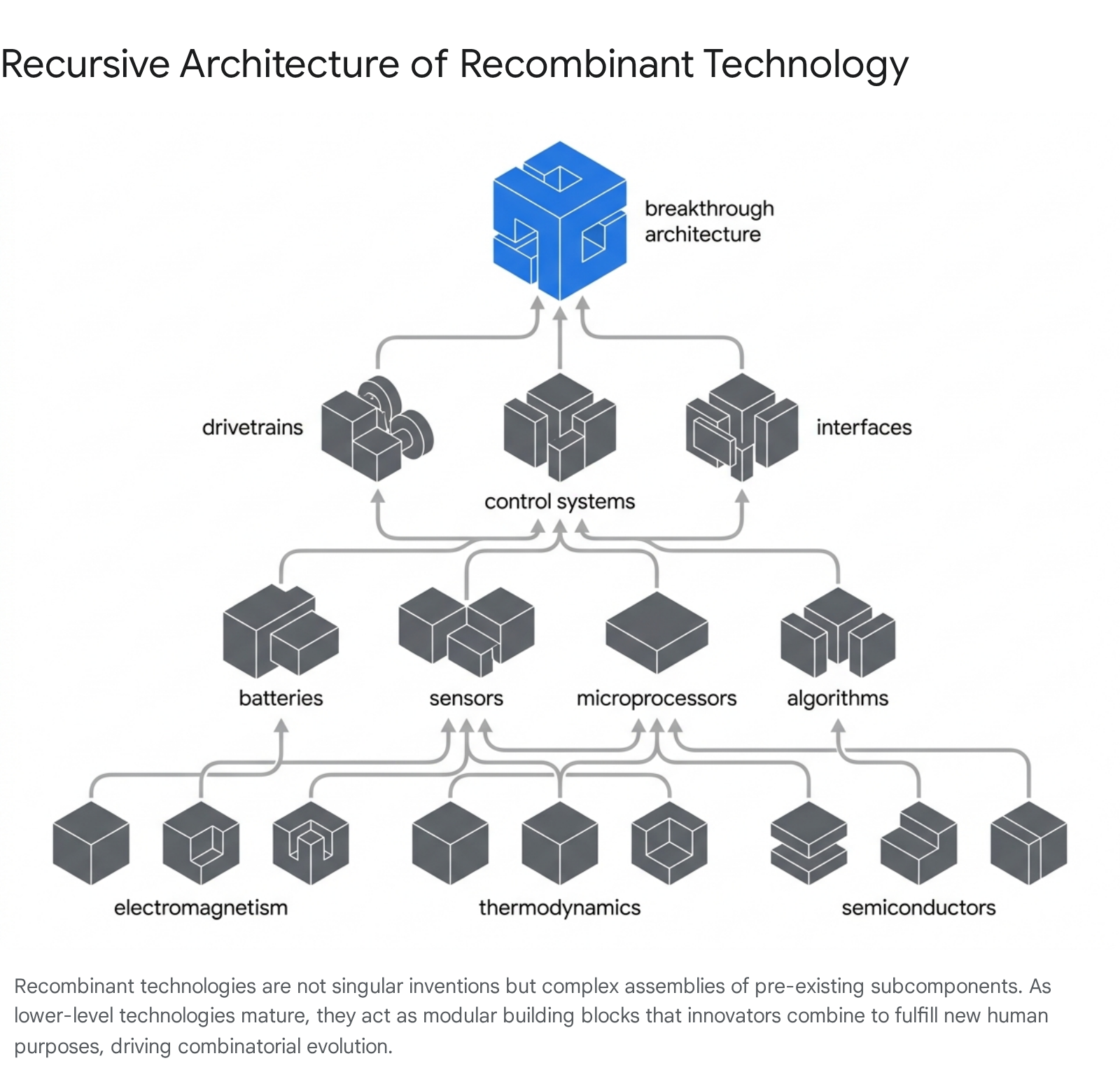
Building upon the economic foundations of combination, modern systems theory provides a structural explanation for how technologies mechanically evolve. W. Brian Arthur's framework models technology as a recursive, self-producing ecosystem 34. In this paradigm, a technology is strictly defined across three levels: a means to fulfill a human purpose, an assemblage of practices and components, and the entire collection of devices and practices available to a culture 4.
Arthur's core thesis posits that technologies possess a fundamentally modular architecture, allowing them to act as literal building blocks for future innovations. Technologies are highly composable; new and radically novel devices are essentially fresh assemblies of components inherited from preceding technologies 7. This recursive structure implies that technological evolution relies heavily on "combinatorial evolution." The sudden appearance of a seemingly radical invention becomes less abrupt when it is deconstructed into its constituent subassemblies. For instance, the laser - a radically novel technology upon its introduction - was a novel recombination of pre-existing knowledge in quantum mechanics, optics, and gas discharge techniques 7.
In this framework, natural phenomena (such as electromagnetism or the Doppler effect) function as the "genes" of technology 47. Standard engineering utilizes accepted principles to recombine these building blocks into incremental solutions. Over time, technologies undergo "structural deepening," wherein internal components are constantly swapped for better materials or more refined sub-technologies without altering the core purpose 45. This continuous "redomaining" of old tasks into new capabilities ensures that technology essentially creates itself from itself 345.
Combinatorial Growth and Idea Processing Limits
The macroeconomic implications of recombinant innovation are formalized mathematically in the endogenous growth models developed by Martin Weitzman. In conventional macroeconomic modeling, research and development (R&D) effort is frequently assumed to translate into new ideas via a linear or probabilistic function 6. Weitzman reconstructed the knowledge production function by explicitly modeling innovation as a combinatoric feedback loop. In this paradigm, pre-existing ideas act as literal seeds; when two or more distinct ideas are combined under sufficient R&D effort, they may yield a new idea, which immediately becomes a component available for all future combinations 78.
Because the total number of possible combinations grows factorially relative to the underlying idea stock, the mathematical supply of potential new ideas expands at an explosive, unprecedented rate 69. Weitzman demonstrated mathematically that standard combinatorial growth quickly outpaces exponential growth. Consequently, the ultimate structural limit to economic growth and technological advancement does not reside in society's ability to generate new ideas 710.
Instead, the binding constraint on productivity is the economy's "core processing capacity" - the finite R&D resources, financial capital, and human intellect required to systematically investigate, test, and process this overwhelming abundance of potential combinations into usable forms 691011. In the long run, the growth rate of the economy stabilizes into a steady exponential curve simply because the economy can never marshal enough resources to evaluate the near-infinite combinatorial space 69.
Taxonomies of Innovation and the Recombinant Mechanism
While "recombinant" describes the underlying systemic mechanism of technological synthesis, it intersects broadly with established business taxonomies of product and service innovation. Distinguishing recombinant processes from standard categorizations aids in understanding organizational strategy, risk profiling, and market impact.
Distinction from Incremental and Radical Innovation
Innovation is routinely mapped by researchers and business strategists along a spectrum ranging from incremental to radical, largely defined by the degree of technological newness and the extent of business model disruption 1516.
Incremental innovation entails continuous, low-risk improvements to existing products, services, or operational processes. It relies on refining existing capabilities to sustain value, maintain predictable revenue streams, and defend current market share 1517. Roughly 70 percent of all commercial innovations fall into this category, as they require minimal organizational upheaval 15. Conversely, breakthrough or radical innovation represents a complete departure from existing solutions. It requires both the development of new technological capabilities and novel business models, inherently carrying high uncertainty and long development cycles, but yielding high potential rewards by rendering competitor products obsolete 151612.
Recombinant innovation does not sit rigidly at one fixed point on this spectrum; rather, it acts as the generative engine that can produce either outcome depending on the "distance" between the combined components. When highly familiar, adjacent components within the same established technological domain are recombined, the resulting innovation is typically incremental 1314. However, when innovators successfully bridge distant ideas or combine disparate technological components that have never previously interacted, the recombination can yield radical, paradigm-shifting results 131516.
| Attribute | Incremental Innovation | Radical Innovation | Recombinant Innovation |
|---|---|---|---|
| Primary Mechanism | Refining and optimizing existing technical parameters. | Developing entirely new foundational science or technologies. | Synthesizing existing, distinct modular components in new ways. |
| Market Impact | Sustains competitiveness; defends current market share. | Disrupts markets; renders legacy systems and models obsolete. | Variable; frequently creates new product categories from mature parts. |
| Resource Dependency | Relies on existing organizational capabilities and workflows. | Requires intensive, long-term R&D and capability building. | Requires broad search capabilities, integration skills, and cross-domain knowledge. |
| Risk Profile | Low technological and market uncertainty. | High technological and market uncertainty. | Moderate to High; execution risk lies heavily in systems integration. |
An additional sub-category of the recombinant mechanism is the "repurposed innovation," which frequently emerges during acute environmental shocks or exogenous crises. During the early stages of the COVID-19 pandemic, researchers tracked biopharmaceutical firms attempting to capitalize on the rapid shift in market needs 17. The study revealed that firms possessing highly diverse, heterogeneous R&D knowledge bases were significantly more likely to repurpose existing innovations - recombining known antiviral compounds for new therapeutic contexts - rather than attempting to develop radical new solutions from scratch 17. Firms with highly focused, homogeneous knowledge bases tended to pursue radical innovation, demonstrating that the breadth of a firm's internal component library directly influences its propensity for recombinant strategies 17.
Frugal Recombination in Resource-Constrained Environments
The recombinant mechanism is particularly visible and essential in environments where capital, infrastructure, and advanced R&D resources are severely constrained. Frugal innovation - often referred to as Jugaad in the Indian context - relies on developing creative improvisations to overcome local resource limitations and solve intractable social problems 1819. Instead of engineering complex, proprietary solutions from the ground up, frugal innovators actively recombine widely available, low-cost assets to address fundamental local needs 2021.
For example, in regions lacking reliable grid electricity, complex agricultural cold-chain facilities are technically unfeasible and environmentally detrimental 20. To solve postharvest loss, frugal innovations have recombined simple principles of evaporative cooling with repurposed shipping containers or locally sourced brickwork to create highly effective, off-grid storage chambers 20. Similarly, organizations like SELCO in India have decentralized rural economies by integrating conventional off-grid solar panels with essential agricultural processing tools, such as millet hullers and polishers, making the equipment scalable and affordable 2022.
Digital platforms have also been recombined with local asset ownership models. In Sub-Saharan Africa, the platform "Hello Tractor" combined mobile SMS technology, GPS tracking, and decentralized sharing economy principles to create a pay-per-use tractor network for smallholder farmers 20. These instances demonstrate that successful recombinant innovation frequently relies heavily on astute contextual adaptation and social integration rather than purely laboratory-driven scientific invention 21.
Empirical Measurement of Recombinant Knowledge
To study the efficacy, diffusion, and economic impact of recombinant innovation quantitatively, economists and policy researchers rely heavily on patent data. Patents serve as robust, standardized proxies for technological knowledge, and the global classification systems used by patent offices provide a structural, searchable map of the recombinant process.
Patent Classification Code Overlap and the Novelty Indicator
The International Patent Classification (IPC) and Cooperative Patent Classification (CPC) systems assign highly specific, standardized codes to distinct technological domains. Researchers actively measure recombinant innovation by analyzing the co-occurrence of these codes within a single patent document 232425. If a newly granted patent contains a pair or combination of IPC codes that has never previously appeared in the historical patent record, it provides strong empirical evidence of a novel recombination bridging distant knowledge domains 2326.
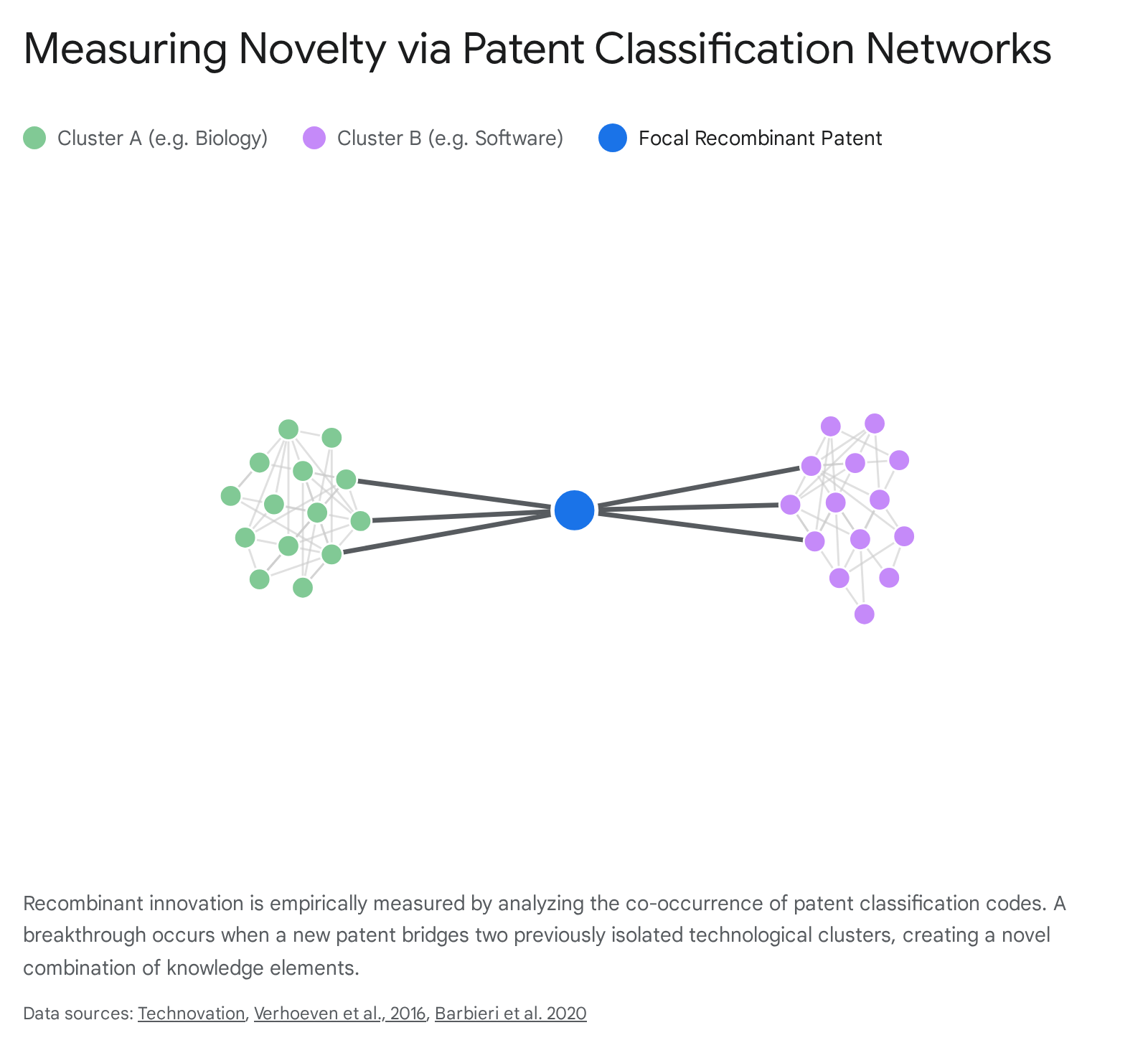
Dennis Verhoeven and colleagues established the "novelty in recombination" indicator to formalize this exact measurement 162627. An invention is classified as highly novel if it represents the very first time two specific technological components are integrated 1628. Research utilizing these indicators demonstrates that while patents featuring highly novel recombinations inherently face greater initial technological uncertainty, they are significantly more likely to achieve breakthrough market performance, garner substantially higher forward citations, and drive greater industrial productivity over a five-year horizon compared to non-recombinant patents 272936.
Furthermore, tracing the expansion of IPC network degrees over decades illustrates that the sheer complexity of technologies is consistently increasing. Between 1973 and 2012, the average degree of IPC code co-occurrence expanded significantly, confirming that modern innovation is overwhelmingly driven by the continuous integration of disparate fields 25.
| Patent Indicator | Measurement Methodology | Economic / Innovative Significance |
|---|---|---|
| Complexity (Scope) | Number of distinct IPC 4-digit codes assigned to a single patent. | Proxies the breadth of knowledge components required; correlates with higher firm valuation and licensing probability. |
| Complexity (Originality) | Variance in the technological domains of the backward citations referenced by the patent. | Indicates the variety of historical knowledge sources drawn upon to create the new technology. |
| Novelty in Recombination | Identification of an IPC code pair that has never previously co-occurred in any historical patent. | Captures the uniqueness of the recombination process; strongly predicts radical breakthrough performance and technological disruption. |
| Impact (Generality) | Variance in the technological domains of the forward citations referencing the focal patent. | Measures the pervasiveness of the invention across different future industries; a high score indicates a General Purpose Technology. |
The recombinant measurement tools have also been applied to evaluate specific sectors, such as environmental technologies. Empirical analysis controlling for technological domains reveals that "green" patents tend to be inherently more complex (higher scope) and demonstrate greater novelty in recombination compared to non-green technologies 1626. Green inventions subsequently exhibit a larger and more pervasive impact on future technological developments, partly explained by their high reliance on cross-domain recombination 1626.
Network Centrality and Knowledge Base Decomposability
Beyond tracking individual patent codes, researchers evaluate the entire knowledge space of collaborating organizations using complex network analysis. In this context, technological classification codes represent nodes in a graph, and their co-occurrence within a patent represents a relational tie 2324. The "degree centrality" of a knowledge element indicates its pervasiveness and modular utility; elements with high centrality (such as standardized wireless communication protocols or fundamental semiconductor materials) serve as frequent, highly stable building blocks for future recombinations 23.
Organizational "knowledge base decomposability" is measured through the global clustering coefficient of these networks 2324. A highly decomposable knowledge base indicates that a firm possesses modular, easily separable technological assets that can be rapidly isolated and recombined with external knowledge through R&D alliances and joint ventures 23. Firms with such architectures are statistically more successful in generating novel joint patents when collaborating with external partners, successfully overcoming both geographical distances and technological gaps 2324.
Deconstruction of Iconic Recombinant Products
The theoretical models of modular assembly and combinatorial growth are most clearly validated by examining the physical architectures of breakthrough commercial products. Iconic technologies that are often perceived by the public as singular, ground-up inventions are, upon rigorous deconstruction, elaborate orchestrations of highly mature, seemingly unrelated pre-existing components.
Smartphone Architecture and Component Integration
The introduction of the first-generation Apple iPhone in 2007 is widely regarded as a watershed moment in consumer electronics, completely turning the mobile industry on its head 30. Yet, Apple did not invent the core technologies that physically enabled the device; rather, the iPhone's unprecedented success was rooted in unparalleled recombinant engineering and systems integration 3031.
The physical architecture of the smartphone integrated several highly mature technologies into a single sleek chassis. The original device utilized a Samsung 32-bit ARM microprocessor - an architecture originating in the 1980s for desktop computers - specifically underclocked from 620 MHz to 412 MHz to preserve battery life in a mobile context 3032. The power supply relied on a 1400 mAh lithium-ion battery, a technology heavily refined over prior decades for use in camcorders and laptops 30.
The multi-touch capacitive screen, arguably the device's most defining feature, leveraged touch concepts that had been present in industrial point-of-sale systems and human-machine interfaces since the early 1990s, recombining them to eliminate the need for physical keyboards and styluses 30. The durable glass covering the screen was derived from Corning's "Chemcor," an aluminosilicate glass developed in the 1960s for aviation and automotive use, resurrected and rebranded as Gorilla Glass 3240. Furthermore, the device integrated existing cellular quad-band GSM/EDGE radio networks, Bluetooth 2.0 protocols, and standard auxiliary audio technology 30. The profound innovation lay not in the individual components themselves, but in their seamless integration and the development of an intuitive user interface that successfully bridged these disparate hardware modules 3033.
The combinatorial nature of these devices is further illustrated by their end-of-life deconstruction processes. To address the severe ecological footprint of consumer hardware and mitigate reliance on environmentally destructive mining, Apple developed proprietary, room-sized disassembly robots, such as Liam, Daisy, and Taz 343536. These automated systems mechanically reverse the recombinant process. Daisy freezes batteries to extract them safely and strips out components, while Taz utilizes specialized shredding technology to separate acoustic modules without destroying the magnetic materials 3536. By isolating the distinct materials - such as rare earth magnets, tungsten, cobalt, and aluminum - they can be purified and recombined into completely new supply chains, enabling a circular procurement model 343637.
Orbital Launch Vehicles and Aerospace Engineering
The commercial aerospace industry provides another profound example of recombinant innovation driving down costs. SpaceX's Falcon 9 medium-lift launch vehicle achieved unprecedented reductions in the financial cost of orbital access primarily through the achievement of booster reusability 383940. The technological breakthroughs enabling this reusability were largely derived from historical aerospace engineering concepts repurposed for modern applications.
The first stage of the Falcon 9 is powered by nine Merlin engines, an internally developed system that utilizes a highly reliable pintle-style fuel injector 4142. This specific injector design was originally pioneered decades earlier during the Apollo program for the Lunar Module descent engine, prized for its stability and deep throttling capabilities required for soft landings 4243.
To steer and control the 135-foot booster during its high-speed descent through the Earth's atmosphere, SpaceX utilized hypersonic grid fins 4143. Grid fins are not a novel 21st-century invention; they were originally developed in the Soviet Union in the 1950s and utilized extensively on ballistic missiles and the N1 moon rocket 44. Their unique lattice structure allows them to fold flush against a cylindrical fuselage during ascent and deploy rapidly during descent, moving the center of pressure to orient the vehicle without massive aerodynamic drag 4144.
The telemetry and communication required for these precision landings rely on advanced phased array antennas, a technology heavily refined by military radar systems, which SpaceX also heavily leverages for its Starlink satellite broadband initiative 38. By brokering these distinct, historically proven concepts and fusing them with modern flight software, cold nitrogen gas thrusters, and advanced friction-stir welding for the aluminum-lithium alloy tanks, SpaceX achieved a radical breakthrough in launch economics using incremental, historical building blocks 4244.
Electric Vehicle Powertrains and Battery Modularity
The electrification of the automotive sector similarly underscores the recombinant paradigm. When Tesla Motors developed the Model S - and its predecessor, the Roadster - it eschewed the invention of exotic new motor designs or unproven chemical storage mediums in favor of adapting existing technologies to automotive scale 454647.
The primary propulsion for these early vehicles was a three-phase, four-pole AC induction motor, a technology whose fundamental magnetic principles were originally patented by Nikola Tesla in the 1880s 4656. Rather than waiting for advanced, solid-state automotive batteries to mature, Tesla utilized thousands of standard 18650-form-factor lithium-ion cells - the exact same cylindrical cells mass-produced globally for laptop computers - packaged into a highly engineered, liquid-cooled energy storage system 4557.
Over time, as efficiency parameters shifted and the company scaled, Tesla executed a partial component swap, transitioning from induction motors to permanent magnet synchronous motors (IPM-SynRM) in their later models, illustrating the modularity of recombinant architectures 5657. The Model 3 and subsequent iterations of the Model S utilize a hybrid configuration, placing an induction motor on one axle for high-speed burst power and a permanent magnet motor on the other for low-speed efficiency 5657. The core, underlying innovation that made Tesla successful was not the invention of the battery or the motor, but the proprietary battery management software and structural packaging that allowed commodity laptop batteries to safely and efficiently power a high-performance vehicle without succumbing to thermal runaway 45.
Recombinant Biotechnology and Genetic Engineering
Recombinant innovation is not limited to mechanical or digital engineering; it is the literal foundation of modern biotechnology. The genetic engineering breakthroughs of the late 1960s and early 1970s transformed biology by allowing scientists to assemble genetic material from disparate species.
The emergence of recombinant DNA technology occurred via the appropriation of known enzymes and procedures in novel ways 48. In the early 1970s, researcher Paul Berg sought to combine the SV40 (Simian Virus 40) genome with a bacterial gene from Escherichia coli (E. coli), an organism heavily studied and utilized in standard biology labs 4849. Using recently discovered restriction enzymes that act as chemical scissors to cleave DNA molecules at specific sites, and ligases that act as glue, scientists could insert the genetic material of the virus into the bacteria 4849.
This synthesis created the first true chimera, or recombinant DNA 49. Although revolutionary in their impact - sparking both massive medical advancements and the self-imposed safety moratorium at the Asilomar Conference in 1975 - the tools and procedures per se were not revolutionary 4849. Rather, as physicist Freeman Dyson observed in contrasting Kuhnian paradigm shifts with Galisonian tool-driven science, it was the novel way in which existing tools were applied that allowed scientists to approach previously intractable problems, eventually paving the way for modern synthetic biology and mRNA therapeutics 4850.
Organizational Structures Facilitating Recombination
The capacity of a firm to consistently execute recombinant innovation is heavily dictated by its internal organizational architecture and its integration into broader market ecosystems. Adapting open innovation models to fit rigid existing structures frequently leads to failure; instead, organizational architecture must be deliberately designed to foster cross-pollination 51.
Centralized versus Decentralized Research and Development
The formal structure of corporate R&D deeply influences the type of combinatorial search a firm undertakes and the ultimate nature of its innovations 52. Empirical evidence demonstrates that highly centralized R&D structures - where budget, personnel, and decision-making authority reside at corporate headquarters - facilitate "capabilities-broadening" innovation 52.
Centralization allows managers a panoramic view of the firm's total technological assets, reducing duplicative R&D costs and enabling the identification of synergies across disparate product divisions 52. This broad search strategy is highly conducive to distant recombinations, generating innovations that exhibit broader market impact and more patents per R&D dollar spent 52. For example, when luxury conglomerates centralize the development of complex watch movements rather than having independent brands develop their own, they tap scale economies and cross-brand recombination 52.
Conversely, decentralized R&D - where authority and budgets are distributed to independent business units - tends to generate product-specific modifications and incremental refinements 52. While decentralized structures excel at addressing immediate, localized market demands and optimizing existing sub-systems, they create informational silos. These silos severely hinder the sharing of relevant cross-domain information necessary for a manager to recognize potential combinatorial synergies 52. Therefore, firms seeking radical breakthroughs through distant recombination frequently shift toward centralized or matrix architectures to coordinate their knowledge bases effectively.
Open Source Repositories and Software Ecosystems
In the contemporary digital economy, the locus of recombinant innovation has shifted significantly from within the proprietary boundaries of single firms to open-source software networks. Open-source repositories, such as GitHub, operate as massive, public engines of combinatorial evolution 536454.
Modern software applications are rarely coded entirely from scratch; they rely on complex dependency networks, where a new program is essentially a novel orchestration of pre-existing, open-source libraries across ecosystems like JavaScript, Python, and Ruby 53. The public availability of these modular building blocks dramatically lowers the barrier to entry for digital startups, allowing them to rapidly assemble prototypes by combining established codebases 5455. Today, over 90 percent of Fortune 500 companies utilize open-source products, demonstrating that collective, open recombination is a primary driver of enterprise software growth 5455.
To sustain this combinatorial engine, platforms like GitHub introduced financial incentive structures, such as the Sponsors program in 2019, to formally reward independent developers for maintaining the critical foundational packages that thousands of downstream commercial products rely upon 54.
Digital Platform Ecosystems and Third-Party Complementors
Beyond open-source code, Digital Platform Ecosystems (DPEs) represent a distinct form of interorganizational relationship cultivated on digital infrastructures 67. Companies such as Apple, Amazon, Alphabet, and Salesforce operate digital platforms that serve as foundational operating systems for entire market sectors 565758.
These platforms achieve massive scale by enabling third-party complementors (independent developers, vendors, and service providers) to access the platform's core digital assets - such as APIs, data lakes, hardware sensors, and cloud compute - and recombine them into specialized applications and services 675658. For example, the iOS App Store ecosystem, launched in 2008, transitioned Apple from a hardware manufacturer to an ecosystem broker. By providing the tools for millions of global developers to recombine iPhone hardware capabilities (GPS, camera, touch) with custom software, the App Store facilitated $406 billion in billings and sales in the US alone in 2024 5759.
This ecosystem model directly mitigates the R&D bottlenecks identified in Weitzman's growth theory. By decentralizing the combinatorial search to millions of independent agents rather than relying solely on internal staff, a platform owner ensures constant recombinant generation 5759. Amazon's AWS operates on the same principle, providing modular cloud computing primitives that startups and enterprises recombine into complex software architectures 57. As digital platforms break through path dependence, cross-category innovation emerges, allowing platforms to transcend traditional industry boundaries and reshape competitive dynamics 60.
The Impact of Artificial Intelligence on Combinatorial Search
As the combinatorial space of potential innovations is mathematically near-infinite, navigating it has historically been strictly constrained by human cognitive limits and finite physical R&D budgets 1113. The recent integration of Generative Artificial Intelligence (AI) and advanced machine learning into the R&D process represents a profound, structural shift in how recombinant search is executed.
Accelerated Hypothesis Generation and In Silico Experimentation
In domains characterized by massive data sets, high development costs, and complex variables - such as pharmaceutical drug discovery and advanced materials science - AI fundamentally alters the efficiency of recombination 61. Next-generation predictive models and active learning algorithms allow scientists to navigate vast search spaces virtually 6275.
By executing rapid in silico experimentation and utilizing synthetic data generation, AI prioritizes combinations of molecules, hardware components, or genetic sequences with the highest expected returns 6162. This drastically reduces both the duration of the search and the financial cost of physical trials 62. This advanced capability theoretically facilitates access to highly distant knowledge domains, enabling recombinations and hypothesis generation that human researchers might not have intuitively considered or had the budget to test physically 136162.
Competitive Dynamics and the Stepping-on-Toes Effect
However, recent macroeconomic modeling, embedded within Schumpeterian quality-ladder frameworks, reveals that the ultimate impact of AI on recombinant innovation is complex and non-monotonic 1363. While AI undoubtedly enhances an individual firm's ability to pursue radical, long-distance recombinations, it simultaneously empowers all rival firms across the industry 62.
This widespread technological empowerment heavily accelerates the aggregate rate of creative destruction across the economy. As innovations arrive more rapidly, the expected duration of an innovator's temporary monopoly is significantly shortened 1363. Because radical, distant recombinations remain inherently risky and capital intensive to commercialize, the diminished monopoly reward alters firms' underlying incentives, making them less likely to take massive risks 1363.
Furthermore, excessive reliance on AI models can actively erode human-AI complementarity 63. If multiple competing firms utilize similar predictive algorithms trained on similar historical datasets, AI-driven research tends to gravitate heavily toward well-explored, data-rich domains - a statistical phenomenon known as the "streetlight effect" 62. This inevitably leads to the "stepping-on-toes effect," where competitors waste resources by duplicating research efforts and converging on identical combinatorial paths 6275.
Mathematical models predict that while a moderate level of automation encourages radical innovation, expanding AI usage beyond a critical threshold of human-AI complementarity causes firms to shift their focus back toward safe, incremental innovations 1363. In the limiting scenario of full automation, the models predict that the optimal recombination distance collapses toward zero, suggesting that a fully AI-driven research environment could inadvertently undermine the very paradigm-shifting knowledge creation it seeks to accelerate 1363.
By understanding technology not as a sequence of isolated miracles, but as an ongoing, combinatorial metabolism governed by structural constraints, organizations and policymakers can better structure internal R&D, leverage platform ecosystems, and carefully calibrate their deployment of emerging algorithmic tools to sustain the long-term engine of economic development.