
Architectural innovation and forms of technological change
Theoretical Foundations of Technological Innovation
The study of technological change has long sought to explain how innovation drives industry evolution and why established, highly resourced organizations frequently fail in the face of seemingly minor technological shifts. For decades, the dominant theoretical paradigm categorized innovation along a single, binary spectrum: innovations were either incremental or radical 12. Incremental innovations involve small, continuous improvements to existing technologies, reinforcing the competitive positions of established firms 23. Radical innovations involve fundamentally new engineering or scientific principles that disrupt existing markets and typically originate from new entrants 23.
This binary framework proved insufficient for explaining industry dynamics where minor changes in a product's configuration led to the catastrophic failure of dominant incumbents. To resolve this anomaly, Henderson and Clark (1990) introduced a more nuanced framework that distinguishes between the physical components of a product and the ways those components are integrated into a cohesive system - the product's architecture 14.
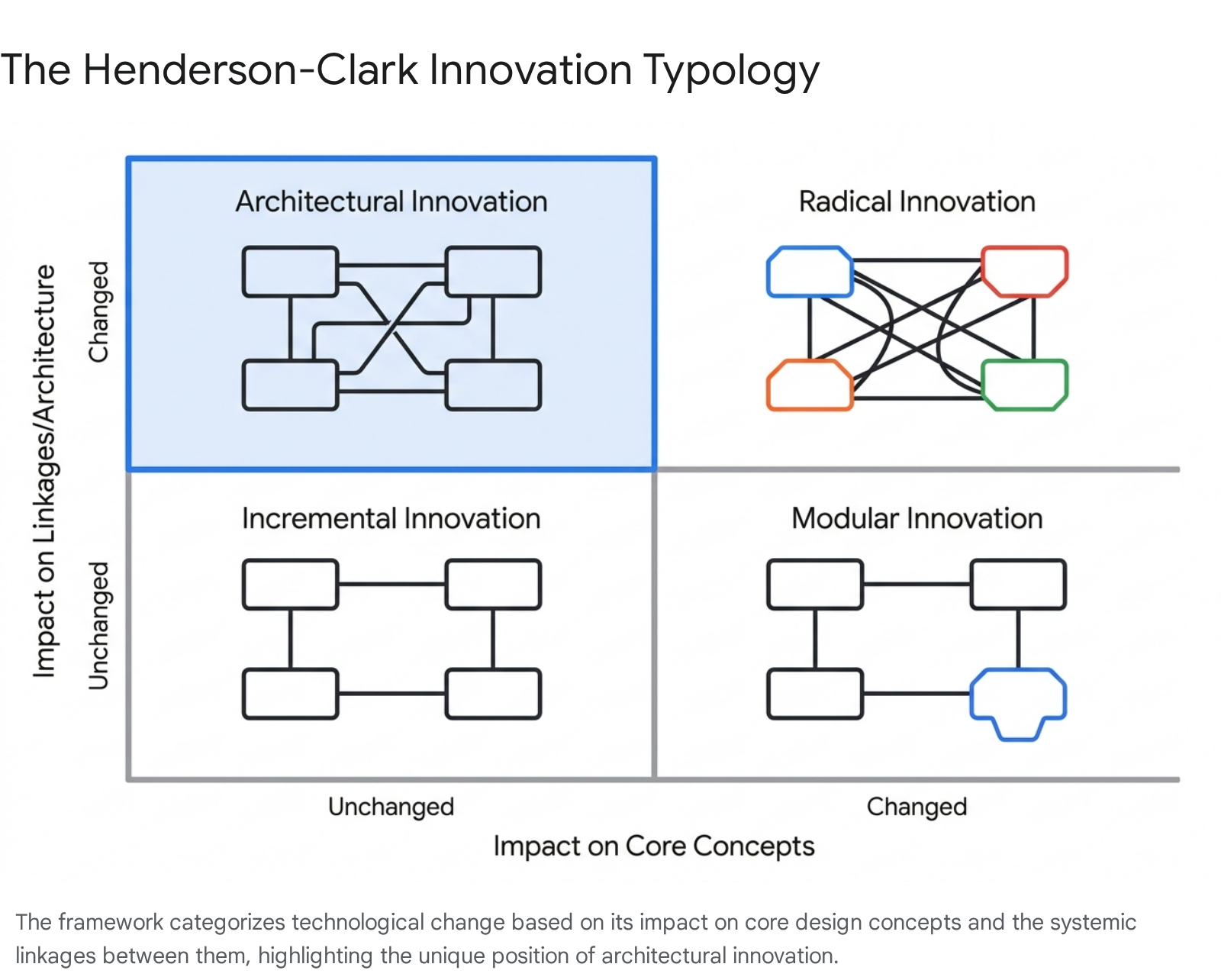
A component is defined as a physically distinct portion of a product that embodies a core design concept and performs a well-defined function 5. The architecture of a product is the scheme by which the function of the product is allocated to physical components, including the interfaces and linkages that allow those components to interact 125. By separating component knowledge from architectural knowledge, the framework establishes four distinct types of technological change: incremental, modular, radical, and architectural innovation 23.
Incremental and Radical Modalities
Incremental innovation introduces relatively minor changes to an existing product while maintaining both its core design concepts and its existing architecture 23. This form of innovation exploits the potential of an established dominant design 26. Organizations engage in incremental innovation to improve efficiency, reduce costs, and refine functionality over time 3. Because it builds directly upon the existing architectural and component knowledge of the organization, incremental innovation strongly reinforces the competitive positions of established firms 26. The internal structures, communication channels, and resource allocation mechanisms of incumbent firms are highly optimized for this type of exploitation 66.
Radical innovation represents a complete departure from existing technologies, fundamentally changing both the core design concepts of the components and the overarching architecture that links them together 23. Radical innovations are based on entirely new engineering and scientific principles 2. Because radical innovation destroys the usefulness of an incumbent's existing component and architectural knowledge, it creates immense difficulties for established firms attempting to adapt 26. Consequently, radical innovation typically opens the door for the successful entry of new firms and the total redefinition of an industry 23.
Modular Component Innovation
Modular innovation, also referred to as component innovation, involves fundamentally changing or improving the core design concepts of one or more components without significantly altering the product's overall architecture 23. In this scenario, new scientific or engineering principles may be applied to a specific module, but the interfaces and linkages between that module and the rest of the system remain stable 5. An analog is the replacement of an analog dial with a digital display on a telephone; the core concept of the dial changes, but the system's architecture and the way the component connects to the internal circuitry remain essentially the same. Modular innovation offers flexibility and promotes scalability, allowing various organizations to contribute specialized components to a shared ecosystem 3.
Reconfiguration of Linkages
Architectural innovation occupies the critical quadrant where the core design concepts of the physical components remain largely untouched, but the ways in which those components are integrated and linked together are reconfigured 1278. This reconfiguration generates emergent value by altering the interactions between subsystems 15. While radical innovation is obviously disruptive, architectural innovation presents a much more subtle, and often more dangerous, challenge to established organizations 166.
To synthesize the theoretical distinctions between the four modalities of technological change, the following structural matrix compares their impacts, organizational challenges, and representative examples.
| Innovation Typology | Component Core Concepts | System Architecture Linkages | Impact on Incumbent Knowledge | Primary Organizational Challenge |
|---|---|---|---|---|
| Incremental | Unchanged / Enhanced | Unchanged | Reinforces component and architectural knowledge. | Sustaining efficiency and continuous improvement of existing processes. |
| Modular | Changed / Overturned | Unchanged | Destroys component knowledge; reinforces architectural knowledge. | Acquiring new domain expertise for specific modules without system disruption. |
| Radical | Changed / Overturned | Changed / Overturned | Destroys both component and architectural knowledge. | Developing entirely new paradigms and scientific foundations. |
| Architectural | Unchanged | Changed / Overturned | Preserves component knowledge; destroys architectural knowledge. | Overcoming embedded communication channels and information filters. |
Organizational Mechanics of Architectural Knowledge
To understand why architectural innovation poses such a severe threat to established market leaders, it is necessary to examine how knowledge is structured and codified within organizations. As a product evolves and a dominant design emerges, a firm's engineering and management teams engage in routine problem-solving to optimize production 69. Over time, the knowledge of how the product's components interact - the architectural knowledge - becomes deeply embedded in the organization's macro-structure and micro-information-processing procedures 110.
Communication Channels and Information Filters
Henderson and Clark identify specific organizational mechanisms through which architectural knowledge is embedded, primarily communication channels and information filters 6. Organizations naturally structure themselves around their conception of a product's primary components to manage complexity 6. An organization producing vehicles, for example, might divide its workforce into an engine group, a chassis group, and an electronics group. The formal and informal communication channels that develop between these groups mirror the physical linkages between the product's components. Therefore, these communication channels physically and socially embody the firm's architectural knowledge 610.
Concurrently, organizations are barraged with vast amounts of data. As a product design stabilizes, organizations develop heuristic information filters that allow engineers to rapidly identify the data most relevant to their specific component and its established interfaces 69. Information relevant to novel interactions or new architectures is systematically filtered out as operational "noise" 69. These filters are highly efficient for incremental innovation, as they prevent engineers from being overwhelmed by irrelevant variables 9.
Problem-Solving Strategies and Incumbent Vulnerability
Firms also develop routine problem-solving methodologies for resolving interface friction 9. These strategies assume a stable architecture and rely on an established division of labor, reducing the need to constantly negotiate resource allocation 911. However, when an architectural innovation occurs, it destroys the usefulness of an incumbent firm's established architectural knowledge, even while its component knowledge remains perfectly valid 12. Because this obsolete knowledge is hardcoded into the firm's communication channels and information filters, the destruction is incredibly difficult for the firm to recognize and correct 110.
Established firms frequently misinterpret architectural innovations as mere incremental changes, assuming the underlying components are familiar 66. Their existing information filters force new, unexpected data into old paradigms 6. When components must suddenly interact in novel ways, the old communication channels fail to facilitate the necessary coordination between disparate engineering groups 611. The firm attempts to force the new architectural requirements into its legacy organizational structure, leading to catastrophic design failures, delayed time-to-market, and loss of competitive advantage 66. In contrast, new entrants possess a significant advantage. Lacking established communication channels and rigid information filters, new entrants can optimize their organizational structures from inception to exploit the novel architectural design, unburdened by legacy institutional knowledge 611.
Architectural Innovation in Semiconductor Manufacturing
The modern semiconductor industry provides one of the clearest contemporary demonstrations of architectural innovation, primarily driven by the physical limitations of traditional component scaling. For decades, the semiconductor industry relied on incremental and modular innovation driven by Moore's Law: shrinking the size of individual transistors (the components) to increase density and performance 12. However, as transistor scaling approaches fundamental physical limits in the sub-2-nanometer range, the industry has experienced a massive paradigm shift from front-end component innovation to back-end architectural integration 121314.
Advanced Silicon Packaging Paradigms
The explosive demand for artificial intelligence computation requires massive Large Language Models (LLMs) to process vast amounts of data simultaneously. This created a severe bottleneck not in the processing components (the GPUs) or the memory components (High Bandwidth Memory, HBM) individually, but in the bandwidth and latency of the linkages between them 1215.
Taiwan Semiconductor Manufacturing Company (TSMC) addressed this via an architectural innovation known as CoWoS (Chip-on-Wafer-on-Substrate) 121718. CoWoS is a 2.5D and 3D packaging technology that reconfigures how existing silicon dies are linked together 1217. Rather than relying on traditional flip-chip packaging with standard printed circuit board connections, CoWoS places multiple silicon dies side-by-side on a silicon interposer, which then sits on a larger substrate 1217.
This arrangement fundamentally alters the product architecture without requiring a change in the fundamental physics of the GPU or HBM components themselves 1213. The CoWoS-L variant, which has become the industry standard for high-end AI accelerators like Nvidia's Blackwell architecture, utilizes high-density silicon bridges to connect massive compute dies 12. This architectural reconfiguration drastically reduces latency, exponentially increases interconnect density to support 2048-bit interfaces for HBM4, and transforms the package itself into a high-speed, system-level circuit board 12.
Supply Chain Shifts and Ecosystem Moats
The shift to 2.5D and 3D packaging illustrates the competitive dynamics of architectural innovation. TSMC's mastery of CoWoS has created a near-monopoly in AI chip production 18. This dominance stems not merely from manufacturing the smallest transistors, but from mastering the architectural knowledge required to integrate multiple HBM stacks with a GPU die while managing extreme thermal envelopes and maintaining high yield rates 1518. TSMC has developed advanced solutions specific to this architecture, such as Direct-to-Silicon Liquid Cooling embedded directly into the silicon structure via microfluidic channels, bypassing traditional thermal interface materials to achieve junction-to-ambient thermal resistance of 0.055 °C/W 15.
Competitors possess highly advanced component-level manufacturing capabilities, yet they have struggled to capture market share in AI accelerators because they have lagged in architectural integration. The following table contrasts the strategic focus of the primary semiconductor foundries regarding architectural and component innovation.
| Semiconductor Foundry | Primary Strategic Focus | Component Innovation Milestones | Architectural Innovation (Packaging) | Market Position in AI Ecosystem |
|---|---|---|---|---|
| TSMC | Architectural Integration & Yield | 3nm and 2nm mass production. | CoWoS (2.5D/3D), SoIC. Deeply integrated thermal management. | Dominant. Secures over 70% of advanced AI packaging capacity (e.g., Nvidia, AMD) 1519. |
| Intel | Component Design & Scaling | 18A process, Gate-All-Around, Backside Power Delivery 1416. | Foveros Direct 3D, advanced glass substrates 17. | Transitioning. Historically led in components but lost ground due to architectural integration delays 1819. |
| Samsung | Vertical Supply Chain Integration | First to adopt GAA transistors (SF3E) 14. | 3D-IC architectures, unified memory and logic foundry services 1617. | Competitive. Leverages internal pricing hedges between memory and logic fabrication 16. |
As noted by industry analysts, the failure of competitors to match TSMC in the AI space is not due to a lack of core component capabilities, but rather the failure to industrialize the complex architectural packaging with the necessary yield and scale 18. By expanding its definition of a foundry to encompass packaging and testing - a strategy termed "Foundry 2.0" - TSMC institutionalized its architectural knowledge, securing a profound competitive moat 1315.
Architectural Innovation in Artificial Intelligence
The software field of artificial intelligence has recently undergone two massive architectural innovations. The first revolutionized the internal structure of language processing models, while the second is currently revolutionizing how AI models are deployed in enterprise software workflows.
The Transformer Architecture
Prior to 2017, the processing of sequential data, such as natural language text, was dominated by Recurrent Neural Networks (RNNs) and Long Short-Term Memory (LSTM) networks 182319. These architectures processed data sequentially, step-by-step, maintaining a hidden state to capture context 1825. While effective, the sequential architecture suffered from vanishing gradient problems when handling long-range dependencies and fundamentally prohibited parallel computation, causing massive bottlenecks in training speed 1819.
The introduction of the Transformer architecture by Google researchers in 2017 represents a pure architectural innovation 18232021. The Transformer did not invent entirely new foundational components; it still utilized standard neural network building blocks such as continuous vector representations (embeddings), feed-forward networks, and layer normalization 232528. However, it completely abandoned the architecture of sequential recurrence 1819.
Instead, the Transformer reconfigured the linkages between data points by relying entirely on a mechanism called "self-attention" 231921. Self-attention allows the model to process all tokens in an input sequence simultaneously in parallel, explicitly calculating the relevance (attention score) of every word to every other word regardless of their distance in the sequence 2319. To maintain the order of the sequence without sequential processing, the architecture introduced positional encoding, injecting mathematical vectors into the word embeddings 2319. By reconfiguring the flow of data and the linkage between tokens, this architectural innovation solved the long-range dependency problem and enabled massive parallelization across GPUs 181920. Over time, minor component enhancements have been introduced to this architecture, such as Rotary Positional Encodings (RoPE) and Mixture of Experts (MoE), but the core architectural linkage remains the engine behind modern generative AI 2829.
Multi-Agent Systems and Workflow Orchestration
As raw scaling of individual monolithic language models reaches practical and economic limits, the AI industry is undergoing a second architectural shift: the transition from single-agent models to Multi-Agent Systems (MAS) and agentic workflows 2231233324. Traditional software follows deterministic control flows, where engineers write rigid logic to handle specific inputs 35. In contrast, agentic AI embeds goal-driven autonomy, allowing systems to make runtime decisions about tool selection, planning, and self-correction 3536. While early implementations relied on a "Monolithic Single Agent with tools," this architecture faces sharp scaling drops and accuracy degradation due to semantic confusability as task complexity increases 23.
The architectural innovation lies in factoring cognitive capabilities into ecosystems of specialized agents that coordinate to achieve complex objectives 22333637. In these multi-agent architectures, intelligence is organized into modular components - such as a researcher agent, a coder agent, and a quality assurance agent - operating under a supervisor or hierarchical routing protocol 313637.
| Architectural Paradigm | Control Flow & Execution | Component Specialization | Scalability & Complexity Handling | Vulnerabilities & Constraints |
|---|---|---|---|---|
| Traditional Automation | Deterministic, linear scripts. | High. Modules perform exact functions. | Low. Cannot handle edge cases or dynamic inputs 35. | Brittle; requires constant manual updates 36. |
| Monolithic Single Agent | Dynamic routing by a single LLM reasoning engine. | Low. One general-purpose model handles all tasks and tool calling 23. | Moderate. Efficiency degrades as tool libraries exceed cognitive thresholds 23. | Hallucination risks; single point of failure; high token costs 2324. |
| Multi-Agent Systems (MAS) | Hierarchical or parallel orchestration between autonomous entities. | High. Agents possess distinct personas, context constraints, and tools 3136. | High. Distributes cognitive load; resolves tasks through debate and division of labor 3337. | Complex state management; high orchestration overhead; difficult observability 2435. |
Designing these systems is recognized as a complex architectural discipline rather than a simple engineering task 2436. The true performance constraints in MAS are no longer the capabilities of the underlying LLM components, but the governance of the collaboration - the rules defining how agents share context, resolve conflicts, and maintain observability through detailed tracing technologies like LangSmith 3536. The shift redistributes computational logic, moving away from relying on a single massive model's zero-shot reasoning toward orchestrating ecosystems of narrowly optimized, interconnected components 22.
Ecosystem Architecture and Complementor Dynamics
The concept of architectural innovation extends beyond individual physical products and software applications to encompass the structure of digital platform ecosystems. Platform ecosystems consist of a central platform owner (the ecosystem leader) and numerous external developers (complementors) who build applications that enhance the platform's value proposition 78.
Ecosystem-Sponsored Architectural Innovation
Ecosystem leaders continuously introduce technological innovations to the core platform to assert control, establish new standards, or provide new technological opportunities for downstream applications 7. When these leader-sponsored innovations are architectural - meaning they change the interfaces and the way platform components are linked without necessarily changing the core underlying functions - they can impose severe adaptation costs on complementors 78.
Because complementors design their products to integrate with a specific legacy architecture, an ecosystem-sponsored architectural innovation can disrupt established workflows, create performance discontinuities, and cause unforeseen malfunctions in complementor software 78. For example, when Apple released Core ML - a proprietary artificial intelligence module - into its iOS ecosystem, it represented an architectural shift in how third-party applications interacted with on-device AI capabilities 8. While this offered powerful new functionalities, it disrupted the performance of applications built on older architectural paradigms 8.
Complementor Alignment Strategies
To survive architectural shifts within an ecosystem, complementors must actively manage their strategic alignment with the ecosystem leader 78. Research analyzing the architectural evolution of ecosystems identifies two critical forms of complementor alignment required to mitigate negative performance externalities:
- Technological Alignment: The degree to which a complementor integrates the ecosystem leader's proprietary technologies into its own product development 78. High technological alignment allows complementors to generate synergistic value and more easily adapt their product designs to the leader's evolving architectural interfaces, minimizing the disruption caused by shifting design rules 7.
- Flow Alignment: The strategic synchronization of a complementor's technology adoption timeline with the ecosystem leader's renewal cycles 78. By aligning with the leader's release windows, complementors can rapidly integrate architectural changes, minimizing the period of performance disruption and capitalizing on the marketing momentum of the ecosystem's latest value proposition 7.
Complementors that fail to achieve technological and flow alignment during architectural shifts experience significant performance penalties, demonstrating that architectural innovation at the ecosystem level operates with the same destructive capacity toward legacy knowledge as it does at the product level 8.
Systemic Innovation and Organizational Architecture
Expanding the scope of the theory further, architectural innovation can be observed in the macro-structural design of organizations themselves. Multibusiness firms often function as modular entities, divided into distinct strategic business units or divisions 2526. Each division operates as a specialized module containing distinct resource sets, product-market charters, and capabilities 2526.
Structural Recombination in Multibusiness Firms
When competitive environments shift dramatically, corporate leaders engage in architectural innovation at the organizational level through "structural recombination" - the splitting, merging, or transferring of resources and charters between existing divisions 2526. This process alters the architecture of the corporation without destroying the core competencies (the components) embedded within the divisions 2526.
Because divisions build strong internal information filters and communication channels to optimize for their specific task environments, they often develop socio-cognitive inertia, masking the organization's ability to identify cross-module architectural opportunities 25. Thus, corporate-level architectural innovation requires dynamic capabilities and deliberate management intervention to overcome the social and economic tensions inherent in redefining division boundaries, balancing the desire for modular efficiency with the need for systemic relatedness and cooperation 26.
Systemic Innovation for Grand Challenges
Finally, the necessity of architectural innovation is becoming increasingly vital in the context of global grand challenges, such as environmental sustainability and the clean energy transition 2728. Henderson suggests that addressing these challenges requires moving beyond incremental changes to pursue "systemic innovation," a macro-level manifestation of architectural innovation 28293031.
Systemic innovation requires altering the architecture of entire systems of production and consumption - such as greening a global transportation network or revolutionizing the built environment - while many of the underlying physical components (e.g., vehicles, steel, concrete) remain recognizable 3031. Driving such systemic, architectural shifts requires unprecedented coordination across organizational, regulatory, and ecosystem boundaries 2830. This highlights that the mastery of architectural linkages and the overcoming of embedded communication filters are not merely competitive necessities for individual firms, but fundamental requirements for adapting global industrial ecosystems to modern societal imperatives 283031.