
Adjacent Possible and Boundaries of Technological Innovation
Conceptual Foundations of the Adjacent Possible
The concept of the adjacent possible provides a robust theoretical framework for understanding the mechanics of innovation, evolutionary growth, and technological advancement. Originally articulated by theoretical biologist Stuart Kauffman in his seminal texts At Home in the Universe (1995) and Investigations (2000), the framework was developed to explain how a primordial biosphere could expand its diversity through incremental steps 12. Kauffman posited that biological evolution does not occur through random, boundless leaps; rather, it proceeds by exploring the immediate perimeter of its current state. The adjacent possible represents a "shadow future," hovering continuously on the edges of the present 234.
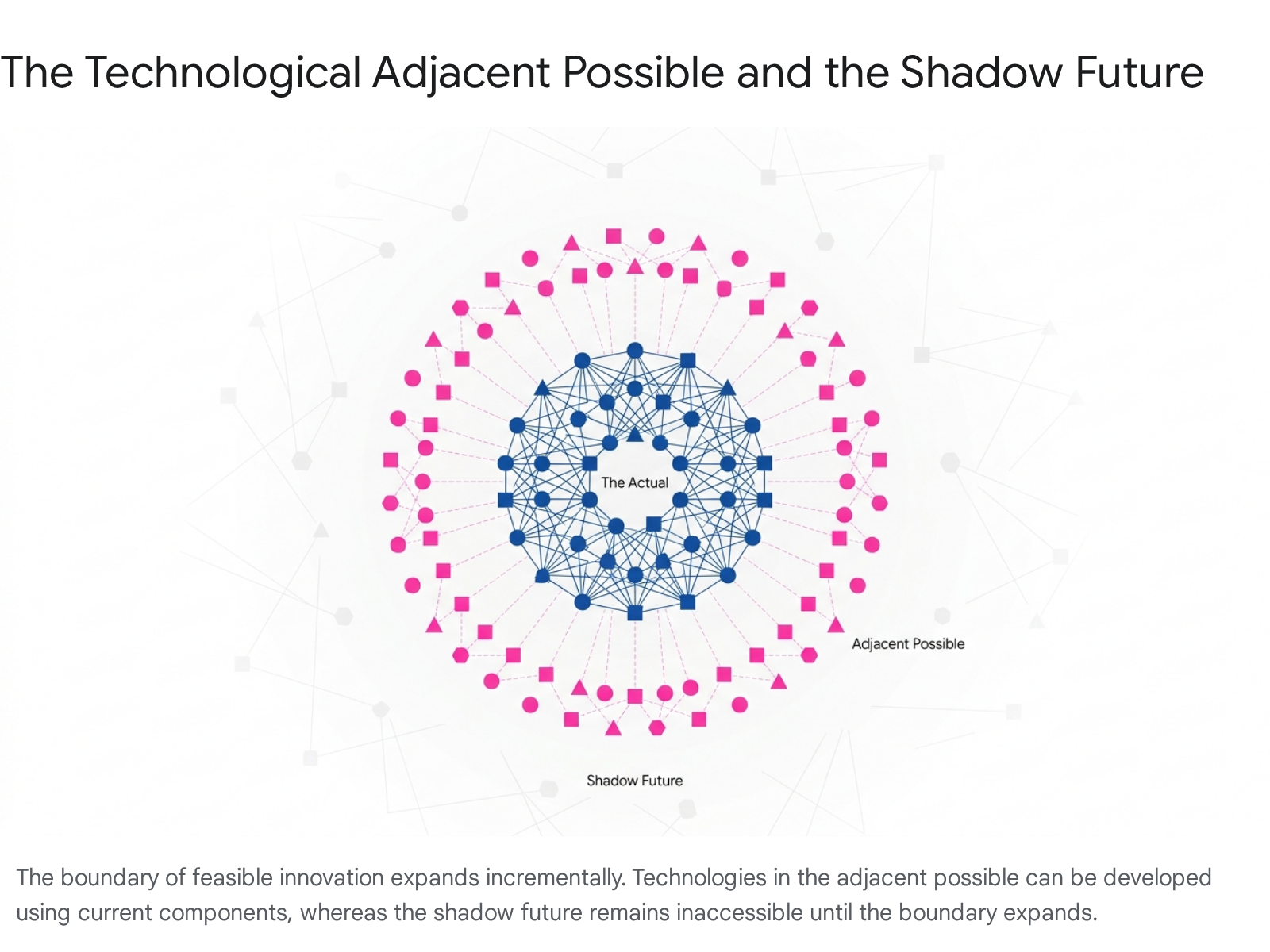
It acts as a map of all the ways in which the current reality can reinvent itself, representing a strictly bounded set of possibilities that are exactly one step away from the current configuration of a system 2.
Origins in Evolutionary Biology
In the biological context, the adjacent possible is the set of molecular species, organisms, and ecological niches that can be reached through a single mutation, a new chemical reaction, or a novel symbiotic pairing 2. Kauffman's analysis of autocatalytic sets - collections of molecules where each molecule catalyzes the formation of others in the set - forced him to confront the staggering mathematics of the search space 56. For instance, a protein of just 100 amino acids possesses $20^{100}$ possible configurations, a number that vastly exceeds the estimated $10^{80}$ hydrogen atoms in the observable universe 5.
Because exploring this entire phase space is mathematically and physically impossible, evolution probes the immediate boundaries, actualizing the adjacent possible one sequence at a time 2. The biosphere expands its diversity by entering the adjacent possible as rapidly as it can sustain new complexity, effectively creating the opportunities into which it then becomes 2. Living systems navigate this space by collapsing the wave function of possibility, guided by system-internal values, semiotic sign usage, and biological constraints 7. Kauffman and colleagues later demonstrated that in a sufficiently diverse chemical reaction system, self-reproducing collectively autocatalytic sets emerge as a first-order phase transition, generating the rudiments of linked energy metabolisms without requiring pre-existing RNA polymer enzymes 6.
Transposition to Technological Ecosystems
Scholars at the Santa Fe Institute, notably W. Brian Arthur, recognized that the dynamics governing biological evolution apply with remarkable precision to the evolution of technology 15. Technological evolution operates through the same fundamental mechanisms of adjacency and enablement; it works primarily through the recombination of existing components 57. A jet engine, for example, is not descended from an internal combustion engine through gradual variation, but rather is a novel assembly of existing components: industrial blower compressors, electrical generator turbines, and refined combustion systems from earlier engineering eras 5.
In the technological realm, human agency and play serve as the engines of diversification, pushing systems into Kauffman's adjacent possible spaces 1. Steven Johnson further popularized this framework, demonstrating that multiple people independently making the same discovery - such as Joseph Priestley and Carl Wilhelm Scheele isolating oxygen simultaneously in the 1770s - occurs because both individuals are exploring the same newly opened adjacent possible 8. Their search could not begin until the gaseous nature of air was first understood. A technological breakthrough expands the set of possibilities that become reachable next, explaining why progress clusters in time and place, and why certain inventions only become feasible after specific prior technologies, theoretical constructs, or networks are established 7810.
Mechanisms of Expansion and Constraint
The expansion of the adjacent possible is not an unobstructed outward explosion. It is governed by rigorous mechanical rules of combination, network topology, and external selection pressures that dictate which adjacent nodes are actualized and which are discarded.
Combinatorial Innovation and the Phase Space
The fundamental mechanism driving the expansion of the adjacent possible is combinatorial innovation. Arthur describes innovation in technology as an adaptive stretch into adjacent zones where development can happen, utilizing existing technologies as modules or components 1. When a new technology or scientific principle is established, it introduces new substrates or niches that are not closed off to further newly generated entities, creating a self-reinforcing upward spiral of diversity 9. Because the elements of the technosphere - tools, knowledge, concepts, facts - are continually combined in novel ways, the boundary of the adjacent possible grows precisely because it is being explored 312. Every new combination ushers new combinations into existence, meaning the limits of the phase space are not static but dynamically expand as a function of their own actualization 3.
However, the sheer volume of potential combinations leads to a combinatorial explosion 2910. The adjacent possible represents the entirety of the phase space of obvious next combinations waiting to be tested 10. While this space is vast, the actualized trajectory through it is heavily constrained by systemic factors.
Selection Pressures and Pruning Rules
Despite the vast number of combinations residing in the adjacent possible, only a fraction ever materialize into sustained innovations. This is due to severe selection pressures and pruning rules inherent to any complex adaptive system 514. While a concept might be technologically feasible - meaning it sits squarely within the adjacent possible - it may be economically, culturally, or socially unviable.
A classic example of this pruning mechanism is the QWERTY keyboard's installed base versus non-QWERTY alternatives. In the early days of personal computing, a non-QWERTY keyboard was technologically feasible and sat in the adjacent possible of Steve Jobs and the Apple Macintosh team 5. All necessary components existed. However, the established installed base of QWERTY users created a massive selection pressure. Exploring the non-QWERTY region of the adjacent possible was economically suicidal 5. The pruning rule here was the likelihood of user adoption. QWERTY's dominance did not eliminate other keyboard layouts from the adjacent possible; rather, it made them vastly more likely to be pruned by the ecosystem 5. In co-evolutionary systems, niches become more complex as diversity increases, and environments dictate the pruning of branches that fail to find a sustainable equilibrium 914.
K-Core Pruning Process in Network Evolution
The mechanics of selection in the adjacent possible can be modeled mathematically using network theory, specifically the k-core pruning process. First proposed by Seidman in 1983, a k-core is the maximal subgraph in which all nodes have a degree of at least k 1112. The pruning algorithm recursively removes nodes that have a degree less than k, which models how technological ecosystems shed unviable or poorly connected innovations 1113.
When analyzing the adjacent possible, the k-core pruning process demonstrates critical phenomena and phase transitions 1113. Depending on whether the mean degree of the initial network is above, equal to, or below a critical threshold, the network exhibits distinct evolutionary behaviors 13. Above the threshold, the network relaxes exponentially to a stable core, representing a solidified technological paradigm. At the threshold, the dynamics become critical, characterized by a power-law relaxation ($1/t^2$) 13. Below the threshold, the system experiences a long-lasting transient process (a "plateau" stage) ending in a sudden collapse, representing a mass extinction of unviable adjacent innovations 13.
Recent advancements have extended this modeling to multiplex networks using the Multicolor Non-Backtracking Expansion Branch (MNEB), revealing that the survival of an innovation often depends on its connectivity across multiple distinct layers of interaction (e.g., simultaneous technological feasibility, supply chain integration, and market demand) 12. This mathematical framework illustrates how technologies that fail to establish sufficient connections across all necessary network layers are systematically pruned from the ecosystem, strictly limiting the actualization of the adjacent possible.
Taxonomies of Innovation
In the literature of technology management and economics, Kauffman's adjacent possible is frequently juxtaposed with other foundational models, most notably Clayton Christensen's theory of disruptive innovation 371415. While these frameworks seek to explain how novelty alters industries, they analyze the phenomenon from different ontological perspectives and operate via different mechanisms.
Disruptive vs. Radical vs. Incremental Innovation
Christensen's disruptive innovation framework is fundamentally a theory of organizational behavior and market dynamics. It describes a process in which new entrants challenge incumbent firms by targeting over-looked, low-end segments of the market with products initially considered inferior by mainstream customers 141617. The disruption occurs because incumbents are structurally constrained: their incentives, accounting systems, and focus on highly profitable existing customers (sustaining innovation) blind them to nascent threats 7141823.
Conversely, Kauffman's adjacent possible is a theory of technological and scientific capability. It explains what can be built based on the recombination of existing knowledge and materials 237. Disruptive innovation operates entirely within the adjacent possible. A disruptive product must be technologically feasible to exist; its disruption lies in its novel business model and market application 17.
The management literature further distinguishes between types of innovation based on their proximity to the adjacent possible's expanding frontier. Sustaining (incremental) innovation focuses on gradual improvements, optimizing operations, and reducing costs to maintain competitiveness 16192520. Radical innovation, however, pushes the very edge of the adjacent possible. It requires the creation of entirely new knowledge and the commercialization of novel ideas that displace current products and create new market categories 1721. An extreme form of radical expansion occurs via "invasive technologies," which conquer scientific and business spaces by abruptly altering the innovation ecotone, expanding the adjacent possible and supporting dynamic interactions across newly formed niches 22.
Comparative Framework of Innovation Theories
The following table summarizes the key distinctions across major frameworks of technological innovation.
| Dimension of Analysis | The Adjacent Possible (Kauffman) | Disruptive Innovation (Christensen) | Radical Innovation | Incremental Innovation |
|---|---|---|---|---|
| Core Phenomenon | Ontological limits of technological and biological feasibility. | Market and organizational dynamics of incumbent displacement. | Transformation of industries via completely novel technologies. | Continuous, progressive improvements to existing systems. |
| Primary Mechanism | Combinatorial innovation; recombination of existing modules. | Low-end market entry; business model variation; asymmetric incentives. | Creation of new knowledge and scientific breakthroughs. | Cost reduction, efficiency gains, and minor feature additions. |
| Nature of Growth | Incremental expansion of the phase space; "shadow future" actualization. | Trajectory shifts from inferior, niche applications to mainstream dominance. | Discontinuous leaps that redefine value chains and categories. | Steady, predictable returns with lower volatility. |
| Constraint Focus | Lack of requisite precursor technologies or infrastructural baselines. | Internal corporate inertia, profit margin requirements, and legacy clients. | High uncertainty, requiring entirely new organizational capabilities. | Bounded by the ceiling of current technological paradigms. |
| Predictability | Fundamentally "unprestatable"; novel functions cannot be predicted. | Predictable structural outcomes based on resource allocation. | Highly unpredictable and requires long-term investment. | Highly predictable and tightly managed via routine metrics. |
Contextual Variations and Leapfrogging
The adjacent possible is not a universal, homogenous space. It is highly contextual and locally defined. An innovation that sits within the adjacent possible of an advanced economy may be inaccessible in a developing economy, and vice versa.
Intersection of Viability and Acceptability
For an innovation to successfully transition from the adjacent possible into the "actual," it must satisfy multiple dimensions simultaneously. It must exist at the intersection of the Adjacent Possible (Technology), the Adjacent Viable (Economy), and the Adjacent Acceptable (Society) 423. Something is within the practical realm of possibility only if it does not demand resources, knowledge, or infrastructural baselines that the specific context lacks 4.
For instance, solutions developed for highly modernized contexts with consistent electricity, high-speed internet, and specific consumer appetites cannot be seamlessly transplanted to contexts lacking those infrastructural prerequisites 4. Social innovation relies similarly on appropriate infrastructures, institutional frameworks, and cultural momentum to carry an innovation further than it could go on its own 24. Therefore, what constitutes the adjacent possible shifts dramatically depending on geography, culture, and existing capital.
Mobile Payment Leapfrogging in Developing Economies
A profound example of contextual variation in the adjacent possible is the evolution of mobile payments, specifically the M-Pesa platform in Kenya. The trajectory of payment technology is generally modeled as a sequential innovation progressing from cash to cards, and eventually to mobile payments 25. In advanced economies, high-income consumers quickly adopted card payments due to the variable cost savings on high spending levels, leading to a monotonic increase in card adoption correlated with per capita GDP 2526.
However, the early success of card infrastructure in advanced economies created an "incumbent technology curse" that severely dampened subsequent mobile payment adoption 25. Because the population was already locked into card networks, the incremental gains from switching to mobile payments were minimal. The advanced economy's adjacent possible dictated the development of "card-complementing" mobile systems (e.g., Apple Pay) that relied heavily on existing banking rails 2526.
Conversely, Kenya lacked widespread banking and card infrastructure, meaning its adjacent possible was entirely different. Without the lock-in of legacy systems, Kenya was able to bypass the card stage entirely - a phenomenon known as technological leapfrogging 2527. Launched in 2007 by Safaricom and Vodafone, M-Pesa utilized basic SMS text messages on 2G networks, supported by a network of physical agents (shops, gas stations) acting as human ATMs to allow unbanked users to deposit and transfer money 25262829. This system met all the criteria defined by the Global System for Mobile Communications Association (GSMA) for true "Mobile Money" 2628.
Crucially, the success of this leapfrogging relied on international technological integration. A pivotal step in M-Pesa's growth occurred in 2015 when Chinese technology firm Huawei assisted Safaricom in relocating M-Pesa's servers from Germany to Kenya, reducing downtime and vastly expanding the system's capacity to handle massive transaction volumes 29. The influx of affordable, Chinese-made smartphones further fueled M-Pesa's expansion into global digital payment networks 29. The M-Pesa case demonstrates that an underdeveloped legacy infrastructure can unexpectedly expand a region's adjacent possible by removing the selection pressures imposed by incumbent technologies.
Dependency Trees in Technological Evolution
To fully grasp the boundaries of feasible innovation, one must trace the long-term technological dependency trees that structure the adjacent possible. Because progress clusters in time and place, subsequent breakthroughs are strictly gated by the completion of prior prerequisites 7.
Thermodynamics and the Internal Combustion Engine
The transition from steam power to the internal combustion engine (ICE) perfectly illustrates how the adjacent possible constrains engineering. Steam engines - external combustion engines (ECE) that utilized coal to heat a secondary fluid (water) - were obvious portals for civilization development during the Industrial Revolution 103037. They transformed energy manipulation, enabling factories to operate away from rivers and powering the first locomotives 30.
However, steam engines operated with significant physical limitations. They were heavy, required massive amounts of water, and suffered from low power-to-weight ratios due to the indirect conversion of heat to work 3831. An internal combustion engine is theoretically more efficient because liquid fuel is burned directly in the cylinder chamber, offering higher energy density and eliminating the phase-change energy losses associated with boiling water 3731.
Despite these theoretical advantages, the ICE could not be developed until specific technological nodes were reached. Operating at combustion temperatures approaching 2800°F (1811K), the ICE required advanced metallurgy to withstand intense heat and pressure differentials that early steam-era materials could not survive 31. By comparison, even modern supercritical steam only reaches roughly 705°F (647K), capping the maximum theoretical Carnot efficiency at roughly 55%, whereas an ICE's higher operating temperatures allow for theoretical limits up to 84% 31. The ICE was not in the adjacent possible of the early 18th century; it required decades of incremental metallurgical science and thermodynamic theory to become feasible 3731. Once those prerequisites were met, the ICE became adjacent, ultimately replacing steam in most transportation applications due to its higher power-to-weight ratio and rapid responsiveness 3831.
Convergence of GPS and Mobile Internet for Ride-Sharing
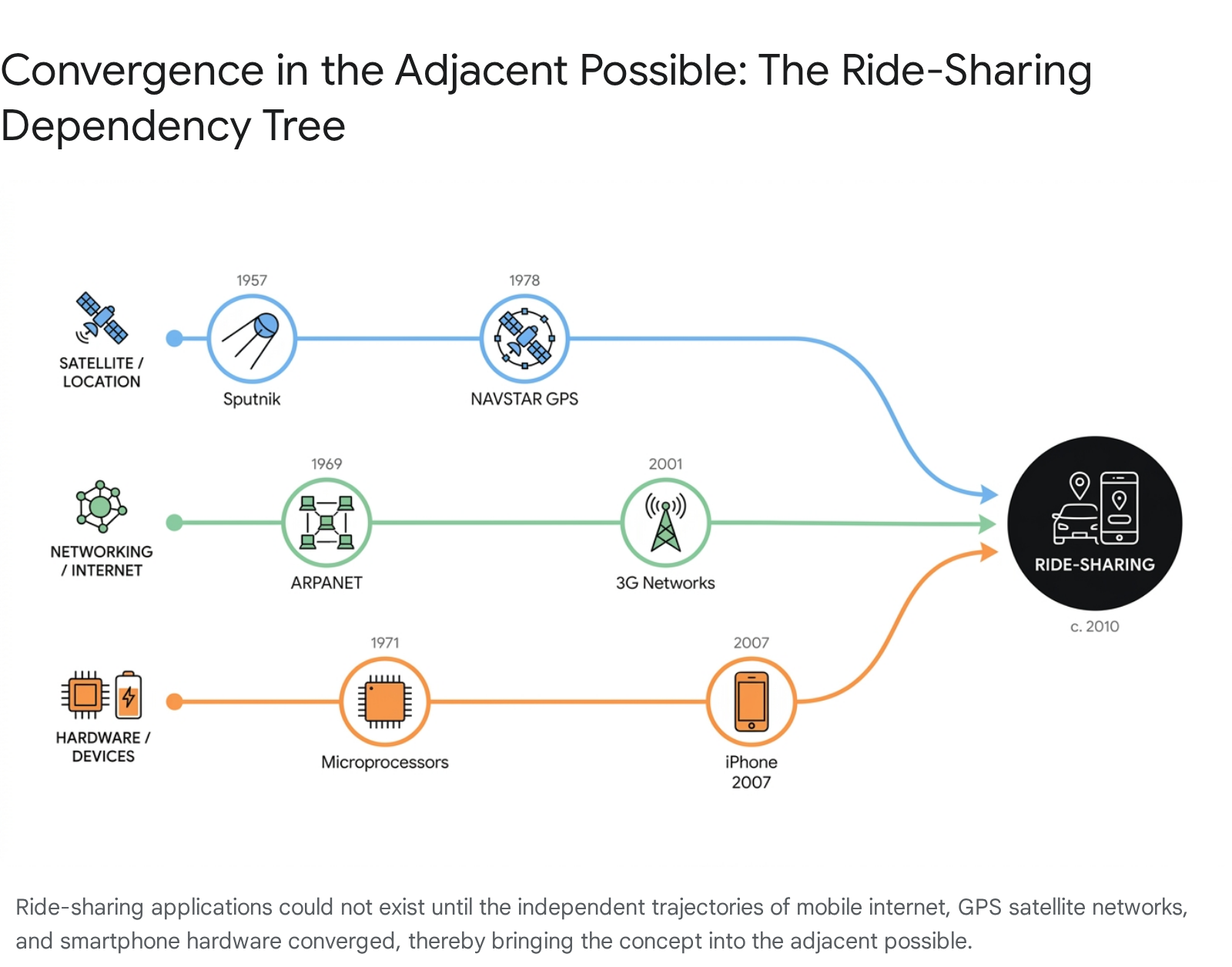
A more contemporary example is the advent of the sharing economy, specifically ride-sharing platforms like Uber and Lyft. Such platforms were entirely outside the adjacent possible in the 1990s and early 2000s because the foundational nodes did not exist 840.
The dependency tree for ride-sharing traces back to the Cold War. The launch of Sputnik in 1957 catalyzed the study of satellite radio transmissions by MIT scientists, which evolved into military ground-based navigation systems 32. Between 1978 and 1985, the U.S. military deployed the NAVSTAR GPS satellites equipped with atomic clocks 32. However, deliberate signal degradation (Selective Availability) prevented precise civilian use until May 2000, when President Clinton ended the practice 32. Simultaneously, the proliferation of the mobile internet and the introduction of smartphones with built-in GPS capabilities in the late 2000s created a new platform of innovation 4032. Polling data highlights this rapid shift: smartphone ownership among U.S. adults surged from 35% in 2011 to 91% by 2025 33.
By 2010, the convergence of high-speed mobile internet, advanced smartphone hardware, and accessible location-based services brought real-time ride-sharing into the adjacent possible 40.
Today, this ecosystem is expanding its boundaries further through the integration of blockchain technology and the Internet of Things (IoT). Decentralized peer-to-peer (P2P) ride-sharing applications use smart contracts on the Ethereum network to bypass centralized third-party aggregators, ensuring transparency, reducing single points of failure, and optimizing resource use via spatial cloaking mechanisms for data privacy 34354536. Systems like "RideChain" demonstrate how blockchain serves as a single decentralized point for transportation transactions and identity authorizations 36.
The Artificial Intelligence Paradigm Shift
The rapid integration of Generative Artificial Intelligence (GenAI) into software engineering represents a massive, contemporary expansion of the adjacent possible. Technologies and developmental processes that were previously restricted by steep cognitive and resource constraints have suddenly become accessible 47484937.
Large Language Models as Foundational Building Blocks
Large Language Models (LLMs), powered by transformer architectures with billions of parameters, have transitioned from being end-user novelties to foundational building blocks in the technology ecosystem 383953. In software development, GenAI models alter the parameters of the adjacent possible by serving as digital reasoning engines capable of universal language understanding 39.
Historically, software engineering required deep, specialized knowledge of syntax, debugging, and systems architecture. GenAI tools such as GitHub Copilot automate boilerplate code generation, perform intelligent code refactoring, and generate comprehensive unit testing 4748404156. By abstracting away the routine mechanics of coding, developers can interact with systems using natural language descriptions, shifting the paradigm from code-as-instruction to language-as-instruction 4142. This blurs the lines of accessibility, enabling non-technical users to build complex logic via low-code/no-code platforms, effectively democratizing the adjacent possible 4741.
However, expanding into this phase space involves overcoming significant new constraints. LLMs face limitations inherent to their autoregressive nature. Generating code sequentially, token by token, without foresight can lead to missing attributes, undefined references, or inconsistent logic, particularly in long code blocks 42. Furthermore, centralized cloud-centric LLM deployments introduce latency, high inference costs, and data privacy vulnerabilities 3853. Consequently, the adjacent possible is now driving toward edge computing and collaborative inference systems. Small Language Models (SLMs) and Federated Learning (FL) architectures are being developed to push AI processing directly to decentralized edge nodes, supported by the ultra-low latency and massive device connectivity anticipated in 6G wireless communication systems 3843.
Autonomous Agents and Cognitive Horizons
The evolution from traditional Generative AI to Agentic AI marks the next frontier of the adjacent possible. While GenAI creates content based on learned patterns, Agentic AI systems are designed to autonomously perceive, reason, act, and learn with minimal human supervision 4460. These agents utilize a digital ecosystem of machine learning, natural language processing, and external tools to solve problems with more variables than humans can process manually 4460.
This shift requires an updated, cognitive-centered perspective on innovation, formalized in educational and development sectors as the AI-ICE Framework. The true value of these systems does not lie solely in the automated outputs they create, but in their ability to extend human cognitive horizons, allowing researchers and developers to solve complex problems and achieve goals that were previously unreachable 37. Whether simulating desertification countermeasures, creating persistent spatial digital twins, or automating socio-economic governance models, Agentic AI acts as a collaborative researcher and strategist, exponentially expanding the boundaries of human scientific discovery 6061.
Empirical Limitations and Philosophical Critiques
While the adjacent possible is a powerful conceptual metaphor, operationalizing it for rigorous empirical innovation studies presents significant methodological and philosophical challenges. The primary obstacle is that the adjacent possible is fundamentally "unprestatable" - it is impossible to pre-state or predict the exact novelties that will emerge or to accurately measure the size of the phase space before it is actualized 45464765.
The Theory of the Adjacent Possible Equation
Recent economic and complex systems studies have attempted to formalize the adjacent possible based on the number of recombinations that can be made from available knowledge, resulting in the Theory of the Adjacent Possible (TAP) equation 14476566. Models such as urn dynamics and the TAP equation suggest that innovation should be "super-exponential" in the long run, aligning with the hockey-stick shape of historical global GDP growth 4766.
However, robust empirical testing challenges this assumption. An extensive analysis mapping long-run patterns of new product introductions in Sweden from 1908 to 2016 reveals critical inconsistencies with the super-exponential prediction 476566. The data indicates that the rate of innovation actually depends linearly on cumulative innovations 4766. This linear dependence explains the persistent advantages of incumbent firms while excluding the emergence of absolute winner-take-all distributions 4766. Furthermore, the rate of development of new types of products within organizations follows Heaps' law, indicating that the share of genuinely new product types declines over time as the immediate adjacent possible is exhausted 476566. These empirical findings suggest that the formal TAP framework makes overly strong predictions and that probing the adjacent possible is severely restricted by natural, physical, and resource constraints that bound organizational search routines 46566. In fact, recent bibliometric studies indicate that the disruptiveness of scientific papers and patents has been steadily declining over time in favor of consolidatory work, underscoring the friction inherent in expanding the boundary of the adjacent possible 67.
Teleology and the Irreducibility of Human Agency
From a philosophical perspective, Kauffman's framework faces critiques regarding reductionism, downward causation, and human agency 466848. Kauffman argues that the biosphere constitutes a non-ergodic domain, exhibiting radically emergent properties such as agency, meaning, and creativity that cannot be reduced to physical laws 466848.
Critics argue that while the adjacent possible accurately describes biological and combinatorial technological evolution, it is insufficient to explain the psycho-social layer of human complexity 46. Human beings possess the unique cognitive ability to envision long-term futures and conceptualize the "impossible." By imagining non-adjacent, distant realities, humans can generate discontinuous, dynamic creativity leaps that act as target functions for innovation 46. Unlike a biological organism that must mutate through strictly adjacent steps to evolve 24, human scientists and engineers can establish a teleological goal that theoretically skips the immediate adjacent possible. They can then direct targeted research to build the necessary intermediate steps retroactively to reach that goal. This goal-oriented foresight indicates that technological ecosystems are guided by factors that transcend the mere random collision of adjacent modules.
Conclusions
Stuart Kauffman's concept of the adjacent possible provides an indispensable lens through which to analyze the boundaries of feasible innovation within technological ecosystems. It establishes that technological progress is not a sequence of isolated, unpredictable flashes of genius, but rather a structured, combinatorial exploration of the immediate boundaries of current knowledge and materials. Innovations emerge only when all prerequisite modules - such as the metallurgical advances required for the internal combustion engine, or the convergence of GPS and mobile internet required for ride-sharing - have been firmly established in the ecosystem.
While Clayton Christensen's theory of disruptive innovation explains the market vulnerabilities of incumbent firms and the dynamics of low-end encroachment, the adjacent possible explains the fundamental ontological limits of what can physically and scientifically be built. The ongoing explosion of Generative and Agentic AI serves as a real-time demonstration of the adjacent possible expanding rapidly, as new foundational building blocks democratize access to complex software engineering and cognitive reasoning.
However, the adjacent possible is not an absolute, frictionless determinant of progress. It is heavily constrained by local economic viability, infrastructural baselines, and societal acceptance, as seen in the leapfrogging success of Kenya's M-Pesa. Furthermore, mathematical models attempting to quantify this expansion indicate that innovation often scales linearly rather than super-exponentially, bound by resource constraints, organizational capacity, and the network mechanics of k-core pruning. Ultimately, while the adjacent possible dictates the strict pathway of technological feasibility, human agency and the capacity to imagine the non-adjacent impossible remain the vital catalysts that drive the ecosystem to continuously expand its boundaries.