
Quantum Computing and LLMs in Portfolio Optimization and Pricing
The intersection of quantum computing and large language models represents a frontier in computational finance. As global financial markets increase in complexity, traditional quantitative frameworks face significant computational bottlenecks. Classical systems are increasingly constrained by the curse of dimensionality in stochastic modeling and the non-convex optimization landscapes inherent in portfolio management 12. Concurrently, the proliferation of unstructured financial data - ranging from global news feeds to regulatory filings - has exceeded the processing capabilities of traditional natural language processing architectures 3.
The convergence of large language models and quantum processing units addresses these dual challenges through a hybrid computational paradigm. Language models excel at parsing vast datasets to extract sentiment, predict agent behavior, and generate structured financial signals 126. Quantum computers, operating on principles of superposition, entanglement, and interference, offer theoretical polynomial and exponential speedups for specialized mathematical kernels such as combinatorial optimization and Monte Carlo simulations 384.
This report examines the most promising research directions combining these two technologies for portfolio optimization and derivatives pricing. It analyzes the architectural integration of classical and quantum systems, explores algorithmic advancements in sentiment-driven quantum optimization, details the mathematical acceleration of derivatives pricing, and assesses the systemic constraints and regional regulatory landscapes shaping deployment.
Architectural Integration of Language Models and Quantum Systems
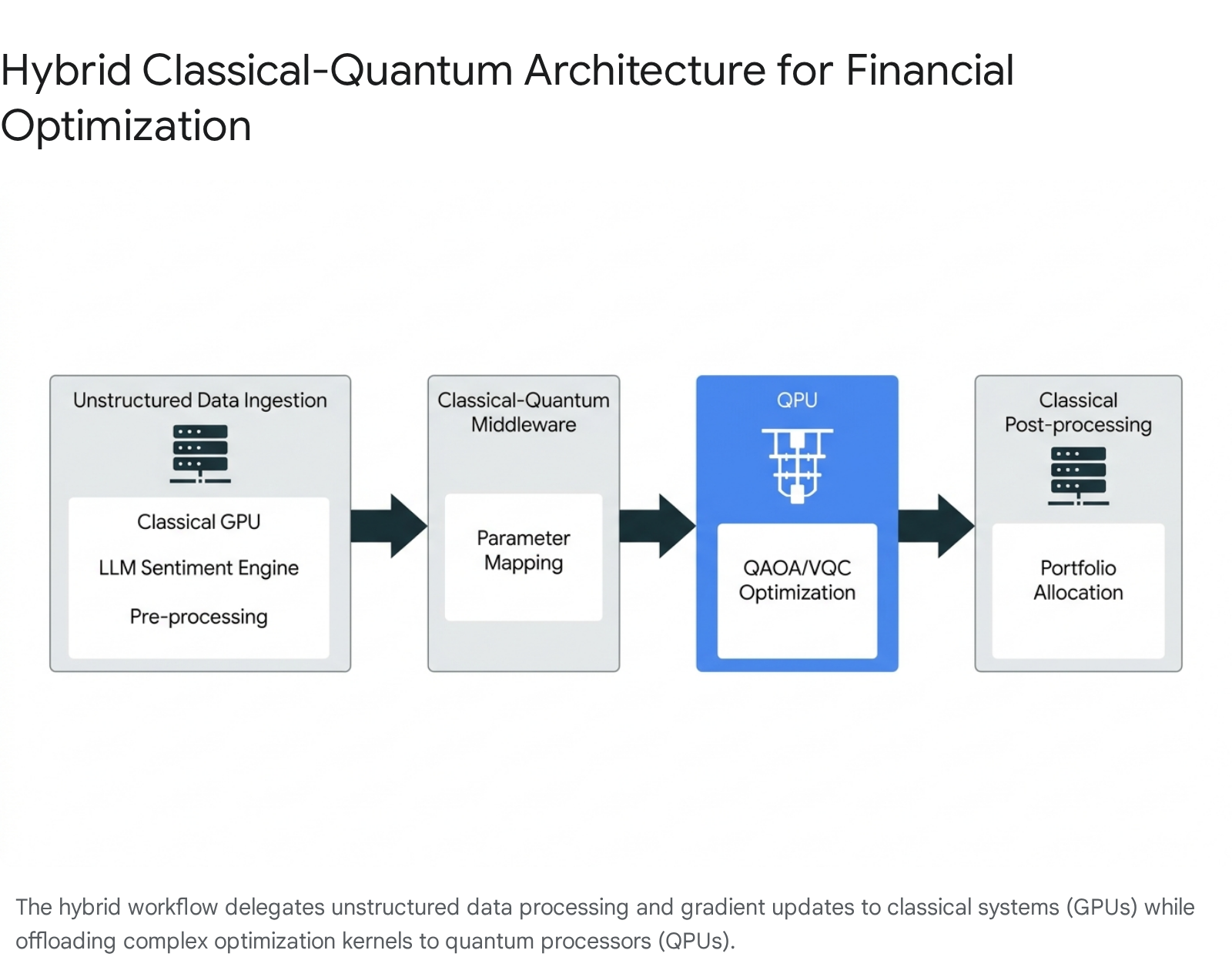
The integration of large language models and quantum computing is primarily structured around hybrid classical-quantum architectures, a necessity dictated by the current noisy intermediate-scale quantum era 356. In these architectures, classical processors handle high-volume data ingestion, language processing, and system orchestration, while quantum processing units act as specialized accelerators for computationally intractable subroutines 3612.
Classical-Quantum Middleware and System Orchestration
Effective hybrid architectures require a robust classical-quantum interface to translate unstructured semantic data into quantum-executable formats 1314. In financial modeling, a language model typically processes raw textual inputs - such as corporate earnings reports or central bank minutes - and outputs structured vectors or parameterizations 37. These parameters are passed through middleware layers that map the classical data into quantum states using techniques like angle encoding or amplitude encoding 1689.
The middleware acts as a routing engine, dynamically assessing problem complexity and directing linear algebraic tasks to graphics processing units and optimization kernels to quantum processors 12. This orchestration is critical because current quantum hardware suffers from limited qubit coherence times and high error rates, making deep, sustained quantum computation unfeasible 519. By abstracting the quantum neural network training loop from the end-user, classical-quantum interfaces allow financial analysts to deploy advanced algorithms without managing qubit topology or hardware-specific transpilation 13.
Hybrid Quantum-Classical Transformers
Recent research explores embedding parameterized quantum circuits directly into transformer architectures. The Hybrid Quantum Transformer represents the first hybrid large language model designed for natural language generation 16. In this framework, variational quantum circuits serve as drop-in replacements for standard classical linear projection layers within the transformer block 16.
The architecture utilizes a three-stage module. First, a classical dimensionality reduction encoder compresses high-dimensional semantic vectors from the transformer into low-dimensional representations via learnable affine transformations and hyperbolic tangent activation 16. Second, a parameterized quantum circuit processes the compressed features using quantum superposition and entanglement. In scale models evaluated at 8 million and 150 million parameters, this stage utilizes 10 qubits and approximately 80 quantum gates 16. Finally, a classical dimensionality augmentation decoder projects the quantum measurement statistics back to the original hidden dimension 16.
In the 150-million-parameter model, replacing the query projection matrix in the self-attention block with a quantum module reduced classical parameters by 10.7% and lowered theoretical floating-point operations from 14.66 teraflops to 13.02 teraflops, while maintaining training stability and generation quality 16. This structural approach demonstrates that minimal quantum resources can effectively substitute significant classical computational loads in financial language processing tasks. Parallel developments, such as Quantum Adaptive Self-Attention and Quantum Temporal Convolutional Neural Networks, have similarly demonstrated that quantum-enhanced attention modules can improve stability and cross-sectional equity return predictions by capturing nonlinear relationships within noisy market data 2021.
Retentive Networks and Neural Quantum States
While transformer models dominate language processing, their application to variational Monte Carlo methods for finding the ground states of quantum systems - known as neural network quantum states - is constrained by quadratic scaling with sequence length 22. Each optimization step necessitates multiple forward passes to generate Monte Carlo samples, making the quadratic cost of self-attention a severe computational bottleneck 22.
To address this, researchers have introduced alternative architectures based on retentive networks. Designed initially as an alternative to transformers for large language models, retentive networks process inputs in parallel during training but recurrently during inference 22. This enables linear inference cost with respect to sequence length, offering a highly scalable classical architecture capable of modeling complex quantum wavefunctions without the latency overhead inherent in standard attention mechanisms 22.
Circuit Optimization via Language Models
A primary hurdle in deploying variational quantum algorithms, such as the Variational Quantum Eigensolver or the Quantum Approximate Optimization Algorithm, is the "barren plateau" phenomenon 2310. In deep quantum circuits, the gradients of the cost function can vanish exponentially as the number of qubits increases, preventing classical optimizers from updating the circuit parameters effectively 2310. Language models are increasingly utilized to design, parameterize, and initialize quantum circuits to circumvent these topological flatlands.
Mitigating Barren Plateaus with Generative Models
The Generative Quantum Eigensolver reconceptualizes quantum circuit design by treating operations as a linguistic vocabulary 23. Using transformer architectures analogous to GPT-2, the system generates sequences of unitary operations that define a quantum circuit, effectively treating the circuit as a generated document 23.
Crucially, the Generative Quantum Eigensolver places all optimized parameters within the classical deep neural network rather than within the quantum circuit itself. Optimization occurs in the favorable loss landscape of the classical language model, completely bypassing the barren plateaus that impede standard variational algorithms 23. This technique also eliminates the need for numerous intermediate quantum circuit evaluations, replacing expensive quantum gradient computations with classical sampling and backpropagation. In benchmarking, this approach achieved a 40x speedup on single graphical processing units and highly efficient parallelization across multiple processing units 23.
Hardware-Aware Architecture Search
Beyond parameter optimization, language models are deployed for hardware-aware quantum architecture search. Standard approaches often rely on fixed, deep circuit templates that exceed the coherence capabilities of current quantum hardware. By prompting a language model with specific hardware constraints - such as qubit connectivity, native gate sets, and specific error rates - researchers can generate highly tailored, compact ansätze 2511.
In experimental setups involving generative modeling for Japanese government bond interest rates, language-model-generated circuits achieved superior generative performance compared to standard baselines when executed on real 12-qubit IBM quantum hardware 25. The language model successfully reduced circuit depth from 85 gates in a standard configuration to 28 gates, producing a shallower architecture strictly optimized for the specific device topology 25. Furthermore, frameworks like BRIDG-Q utilize language models to inject data-informed parameter initializations, shifting the starting parameters away from barren plateaus and achieving notable reductions in residual optimization energy 10.
Innovations in Portfolio Optimization
Portfolio optimization is fundamentally concerned with selecting a distribution of assets that maximizes expected returns for a targeted level of risk 1213. While classical mean-variance optimization operates efficiently under continuous, convex conditions, the introduction of realistic market constraints - such as integer lot sizes, transaction costs, and strict cardinality limits - transforms the task into an NP-hard combinatorial problem 141531.
Multi-Agent Systems and Alpha Factor Mining
The application of language models in portfolio management has evolved from isolated sentiment classification to fully autonomous, multi-agent systems 1321617. Advanced frameworks - such as FinCon, StockAgent, and the Multi-Agent Portfolio System - simulate decentralized interactions among agents assigned distinct investor personas or risk profiles 13216.
These systems operate through "flexible alpha mining," where agents ingest massive multimodal datasets, regulatory filings, and news feeds to autonomously extract and categorize predictive alpha factors 232. The agents organize these signals into independent liquidity, fundamental, and momentum factors, subsequently formulating trading strategies 32. Empirical validations of multi-agent architectures have shown strong out-of-sample performance; for example, specific multi-agent frameworks achieved annualized returns exceeding 50% in backtests against classical benchmarks on U.S. and Chinese equity indices 23216.
Despite these capabilities, a systematic evidence mapping of 77 recent trading agent studies revealed a severe reproducibility crisis 17. Within the primary empirical subset of studies, the vast majority failed to report extractable time-consistent protocols, explicit execution semantics, or transaction cost models 17. The lack of standardized audit trails highlights a critical bottleneck in transitioning these theoretical language model agents into institutional trading environments.
Quantum Optimization Formulations
To bypass classical computational limits, financial engineers map the combinatorial constraints of portfolio selection into a Quadratic Unconstrained Binary Optimization formulation 3712. This mathematical representation is natively compatible with both quantum annealing hardware and gate-model algorithms like the Quantum Approximate Optimization Algorithm 3121435.
The Quantum Approximate Optimization Algorithm operates by alternating between a cost Hamiltonian, which encodes the financial objective function, and a mixing Hamiltonian, which facilitates exploration of the solution space 1214. Through quantum interference, the algorithm amplifies the probability amplitudes of valid, high-quality portfolio configurations while actively canceling out suboptimal or constraint-violating solutions 12.
The Variational Quantum Risk Optimizer expands on this by implementing penalty-based formulations to strictly enforce budgetary, regulatory, and diversification constraints 14. Furthermore, systemic risk analyses encode entire inter-bank exposure networks into entangled bipartite quantum states, allowing optimization routines to calculate mitigation pathways for cascading liquidity failures more efficiently than classical network centrality methods 14.
Sentiment Integration and Black-Litterman Models
The most direct synthesis of language models and quantum computing occurs when semantic sentiment is mapped directly to quantum Hamiltonian parameters. Traditional optimization relies primarily on historical price variance, which frequently fails to account for sudden market regime shifts driven by real-world events 13.
Recent hybrid frameworks utilize large language models to continuously parse financial news and generate high-fidelity sentiment scores. To mitigate model-specific hallucination and bias, researchers employ "Meta-LLM" aggregation techniques. In these setups, multiple finance-domain fine-tuned language models process identical corpora, and their outputs are aggregated through Long Short-Term Memory recurrent neural networks to capture non-linear temporal dependencies 1819.
These aggregated sentiment scores are then integrated into expected return vectors and covariance matrices as "investor views" within the Black-Litterman optimization framework, or applied as sentiment-weighted terms within the advantage functions of Proximal Policy Optimization algorithms 7131819. When passed to a quantum optimizer, the cost Hamiltonian strictly balances historical volatility with forward-looking semantic intelligence.
| Optimization Framework | Core Mechanism | Classical Component | Quantum Component | Performance Characteristic |
|---|---|---|---|---|
| Standard Mean-Variance | Covariance matrices based on historical data. | Matrix inversion via CPU/GPU. | None. | Struggles with cardinality constraints; vulnerable to regime shifts. |
| Multi-Agent LLM System | Persona-driven alpha extraction and negotiation. | Generative LLM agents parsing unstructured text. | None. | High adaptability, but suffers from severe reproducibility issues and execution latency. |
| Sentiment-Augmented PPO | Reinforcement learning with text-derived sentiment. | LLM sentiment engine; RL neural network. | None. | Increases Sharpe ratios over baseline PPO, but bounded by classical combinatorial limits. |
| Hybrid Quantum-LLM Optimizer | QUBO mapping of sentiment and risk constraints. | LLM processing unstructured data into vector weights. | QAOA / VQE solving NP-hard combinatorial asset allocation. | Rapid exploration of constrained, high-dimensional asset spaces with forward-looking semantic data. |
Table 1: Comparison of Conventional, AI-Driven, and Hybrid Quantum Portfolio Optimization Frameworks 1314321718.
Mathematical Acceleration of Derivatives Pricing
The valuation of complex financial derivatives, particularly path-dependent options, and the computation of tail-risk metrics like Expected Shortfall rely almost entirely on stochastic Monte Carlo simulations 3814. These algorithms approximate expected payoffs by generating thousands of discrete random paths across modeled probability distributions 34.
The Limits of Classical Monte Carlo
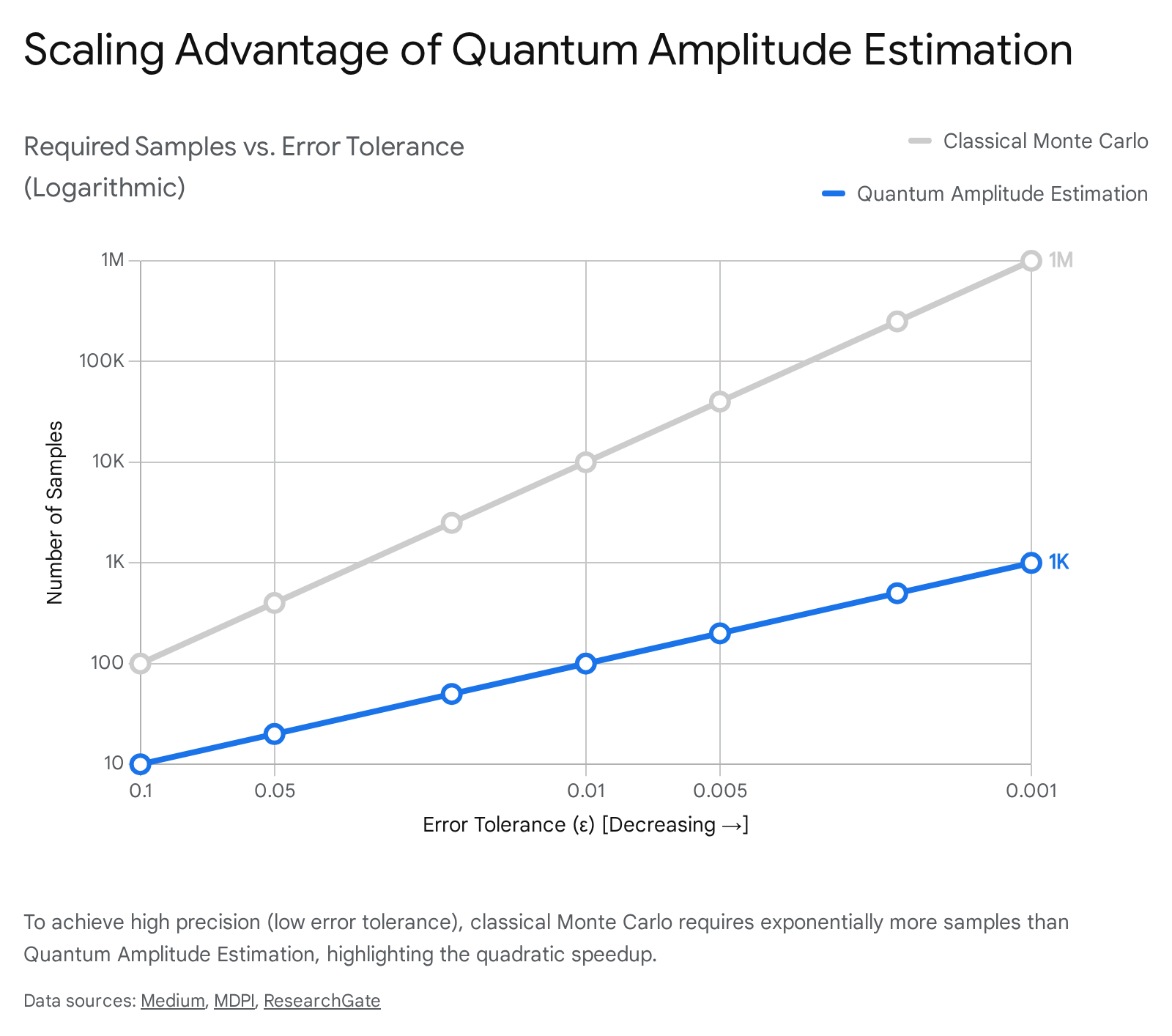
Classical Monte Carlo simulation possesses a fundamental computational bottleneck. According to Chebyshev's inequality and the central limit theorem, the convergence rate of classical sampling scales inversely with the square root of the number of samples. To achieve a target estimation error of $\epsilon$, a classical simulation requires $O(1/\epsilon^2)$ samples 43839.
In highly dimensional derivative contracts - or when executing real-time stress testing during periods of extreme market volatility - this slow convergence necessitates massive parallel computing clusters and long execution times, severely limiting the agility of quantitative risk desks 840.
Quantum Amplitude Estimation
Quantum computing resolves this sampling bottleneck through Quantum Amplitude Estimation. Built upon the principles of Grover's search algorithm, Quantum Amplitude Estimation amplifies the probability amplitude of target quantum states that represent the financial payoff 320. The algorithm computes the expectation value by performing Quantum Phase Estimation on the unitary Grover operator 3820.
The theoretical advantage of this quantum approach is profound: it requires only $O(1/\epsilon)$ queries to the quantum circuit, delivering a quadratic speedup over classical methods 33839402021. For a complex financial integral requiring an error tolerance of $\epsilon = 10^{-3}$, a classical simulation demands approximately 1,000,000 iterations. A quantum computer utilizing amplitude estimation would require only about 1,000 iterations 38.
Low-Depth Variants and Formal Verification
While the $O(1/\epsilon)$ speedup is mathematically proven, standard Quantum Amplitude Estimation relies on Quantum Phase Estimation, an algorithm requiring exceptionally deep circuits and large registers of coherent auxiliary qubits. These resources far exceed the capabilities of current hardware 838.
To bridge this gap, researchers have developed low-depth variants, most notably Iterative Amplitude Estimation and Dynamic Amplitude Estimation. Dynamic Amplitude Estimation utilizes the principle of deferred measurement, employing mid-circuit measurements and classical conditioning to replace complex controlled operations. This architectural shift reduces the required circuit width from $O(n+m)$ to $O(n)$ while strictly maintaining the theoretical quadratic speedup, making the algorithm significantly more resilient to hardware noise 43.
In production pipelines, language models function as the initial translation layer for these pricing models. Formal verification frameworks employ large language models to parse natural language term sheets for exotic derivatives and translate them into structured domain-specific languages 22. Because language models are inherently stochastic and prone to hallucination, the system utilizes dependent type theory to mathematically prove that the generated pricing logic adheres strictly to arbitrage-free boundary conditions and the Black-Scholes partial differential equation before execution on a classical or quantum solver 22.
| Pricing Algorithm | Methodological Foundation | Asymptotic Complexity | Implementation Constraints |
|---|---|---|---|
| Classical Monte Carlo | Random sampling of stochastic differential equations. | $O(1/\epsilon^2)$ | Computational time scales exponentially for high accuracy; parallel computing limits. |
| Multilevel Monte Carlo | Variance reduction across varying discretization grids. | $O(\epsilon^{-2} (\log \epsilon)^2)$ | Substantial classical compute overhead; less effective for discontinuous payoff functions. |
| Standard QAE | Quantum phase estimation on the Grover operator. | $O(1/\epsilon)$ | Requires prohibitively deep circuits and extreme phase coherence; not viable in NISQ era. |
| Dynamic QAE | Mid-circuit measurements to bypass phase estimation. | $O(1/\epsilon)$ | Drastically reduces qubit count, but mid-circuit measurement latencies expose qubits to decoherence. |
Table 2: Comparative Complexity and Deployment Constraints of Derivative Pricing Algorithms 3839402043.
Empirical Benchmarks and Hardware Constraints
Validating the efficacy of hybrid models requires rigorous benchmarking against state-of-the-art classical frameworks. Comparative studies on time-series forecasting and directional return prediction consistently highlight conditions where quantum architectures offer tangible performance gains.
In specific benchmarks evaluating daily closing prices on U.S. and emerging market equities, hybrid quantum architectures demonstrated measurable superiority. In one study, a Quantum Long Short-Term Memory network replacing classical gates with variational quantum circuits achieved a Root Mean Square Error of 0.0602 and a prediction accuracy of 0.9736, notably outperforming an architecture-matched classical model that recorded an error of 0.0693 and an accuracy of 0.8815 89. Furthermore, evaluations of frontier language models on mathematically defined portfolio optimization tasks reveal diverging capabilities: GPT-4 exhibits high accuracy and stability under rigid investment constraints, while Gemini 1.5 Pro performs strongly on pure return-based objectives but falters under complex conditions, and Llama models generally record lower baseline optimization reasoning 45.
Systemic Latency and the Q-Day Threat
Despite empirical successes, the deployment of quantum finance is currently blocked by severe operational bottlenecks. The loading of classical financial data into quantum states requires Quantum Random-Access Memory or complex state preparation circuits 19. The algorithmic depth required for this encoding scales linearly with the dataset size, frequently negating the entire quantum speedup achieved during the optimization phase 19. Consequently, hybrid models are completely unsuitable for latency-sensitive applications such as high-frequency trading, which demands microsecond execution 38.
Additionally, the probabilistic nature of quantum computation requires extensive error correction. Emulating a single, fault-tolerant logical qubit may require hundreds or thousands of noisy physical qubits 619. Until fault-tolerant architectures scale adequately - a milestone projected for the early 2030s - quantum finance will remain confined to offline analytics, risk modeling, and small-scale portfolio rebalancing 3384647.
Simultaneously, the eventual realization of cryptographically relevant quantum computers poses an existential threat to financial data security. The "Harvest Now, Decrypt Later" strategy, wherein adversaries intercept and stockpile encrypted financial data today for future decryption, makes the integration of post-quantum cryptography an urgent prerequisite for any financial institution developing quantum cloud capabilities 3122349.
Regional Ecosystems and Regulatory Postures
The development and regulation of hybrid quantum-language models are deeply influenced by varying geopolitical strategies, reflecting divergent approaches to funding, infrastructure, and technological sovereignty.
North American Corporate Integration
In the United States, advancements are primarily driven by aggressive corporate capital and strategic partnerships between major financial institutions and technology providers 5024. JPMorgan Chase serves as a prominent example of this ecosystem. The bank has deployed an internal "LLM Suite" to over 200,000 employees and developed generative investment products like "IndexGPT" for automated thematic basket curation 255326272857.
In parallel, the institution commits billions to technological modernization, including direct equity investments in quantum hardware companies like Quantinuum 46492553. In 2025, JPMorgan Chase co-authored peer-reviewed research demonstrating a quantum protocol for "Certified Randomness," marking one of the first commercially relevant applications of quantum technology in banking 2658. This model heavily favors agile, market-driven adoption, relying on private-sector venture capital to mature the hardware necessary to run complex hybrid algorithms 29.
European Union Sovereign Infrastructure
The European Union pursues a state-led, anticipatory strategy aimed at securing technological sovereignty. The EU's Quantum Flagship initiative is a centralized repository of research backed by over €1 billion in public funding 24306131. Through the EuroHPC Joint Undertaking, Europe is actively deploying hybrid quantum-classical supercomputing facilities, such as the multimodal quantum data center launched by Qilimanjaro in Spain, to provide shared infrastructure to researchers 6163.
Unlike the United States, Europe couples infrastructure investment with robust, proactive regulatory frameworks. The Quantum Europe Strategy, released in mid-2025, outlines a forthcoming Quantum Act intended to standardize industrial deployment and security 613132. This aligns with the broader EU AI Act, which imposes strict traceability, formal verification, and explainability mandates on high-risk algorithmic models deployed within financial services 22. While the region dominates in foundational academic research and early-stage talent, the reliance on public infrastructure and a lack of late-stage growth capital frequently impede the commercialization of hybrid financial products 246133.
State-Directed Megaprojects in China
China treats quantum supremacy and artificial intelligence as critical imperatives for national security and economic self-reliance. Guided by the strategic objectives of the 14th Five-Year Plan, the Chinese government has committed an estimated $15 billion to quantum research, massively outspending Western public initiatives 30663435.
This highly centralized approach facilitates the rapid construction of massive physical infrastructure, such as the $10 billion National Laboratory for Quantum Information Sciences in Hefei 6636. Researchers utilize sovereign cloud platforms like Quafu to deploy and test quantum-enhanced portfolio optimization systems 37. Furthermore, Chinese quantitative finance literature shows a heavy focus on applying deep reinforcement learning and multi-agent language models to specific regional equity markets 123216. The state-directed model effectively accelerates baseline hardware capabilities and guarantees long-term funding, though it may inherently constrain the decentralized, iterative software development ecosystems characteristic of Western markets 3266.
| Region | Primary Strategic Driver | Funding and Infrastructure Model | Regulatory and Deployment Posture |
|---|---|---|---|
| United States | Corporate innovation and private-sector financial efficiency. | Venture capital-led; aggressive partnerships between tech providers and mega-banks. | Market-driven agility; rapid deployment of proprietary language models into commercial workflows. |
| European Union | Technological sovereignty and academic excellence. | Centralized public funding (Quantum Flagship); shared multinational computing testbeds. | Anticipatory regulation (EU AI Act); strong emphasis on formal verification, ethics, and security standards. |
| China | National security and self-reliance in frontier technologies. | State-directed megaprojects; massive, sustained public capital allocation (14th Five-Year Plan). | Strategic focus on fundamental hardware superiority, sovereign networks, and controlled commercialization. |
Table 3: Comparative Global Strategies for Quantum Computing and AI Development 246131326635.
Conclusion
The convergence of large language models and quantum computing is redefining the boundaries of quantitative finance. By abstracting the classical-quantum interface, language models facilitate the rapid ingestion of unstructured market sentiment and alleviate the severe circuit design constraints that hinder variational quantum algorithms on near-term hardware. This architectural division allows quantum processors to focus their computational power exclusively on NP-hard portfolio optimizations and resource-intensive mathematical integrals.
The theoretical quadratic speedup provided by quantum algorithms over classical Monte Carlo methods offers an undeniable long-term advantage for derivatives pricing and systemic risk modeling. However, realizing this potential at a commercial scale requires navigating significant immediate limitations, including the severe latency of loading classical data into quantum states, the noise inherent in current physical qubits, and the looming requirement for post-quantum cryptographic security. As fault-tolerant hardware matures over the coming decade, financial institutions capable of seamlessly integrating generative reasoning layers with robust quantum solvers will likely secure a persistent structural advantage in global capital markets.