
Psychology of product bundling and consumer valuation
The Evolution of Bundling from Economic Theory to Behavioral Science
The strategic aggregation of products and services into a single purchasable unit, known as bundling, has long served as a foundational mechanism for price discrimination, inventory management, and revenue maximization in microeconomic theory. Historically, the academic discourse surrounding this practice relied heavily on the strict assumption of perfectly rational actors operating within a paradigm of utility maximization. Classical models posited that firms utilize bundling primarily to extract maximum consumer surplus by exploiting the negative correlation in conditional reservation prices across a heterogeneous consumer base 123. In these traditional frameworks, bundling strategies exist primarily to manipulate the statistical variance in consumers' willingness to pay, thereby driving transaction volume and profitability in markets where individualized, first-degree price discrimination is structurally or legally impossible 245.
However, contemporary research spanning behavioral economics, consumer psychology, and marketing sciences has fundamentally dismantled the assumption of strict rationality in bundle valuation. Emerging literature from 2023 onwards, combined with deeply established psychological theories, demonstrates conclusively that consumers do not evaluate product or service bundles through pure additive arithmetic. Instead, their willingness to pay is heavily distorted by cognitive heuristics, mental accounting mechanisms, varying levels of cognitive load, and deep-seated cultural paradigms 56789. The psychological valuation of a bundle is fundamentally a subjective, constructed reality. It is highly sensitive to the semantic framing of prices, the perceived complementarity of the items, and the inherent, biological limits of human cognitive capacity 101112.
This exhaustive analysis systematically deconstructs the psychology of bundling. It transitions sequentially from foundational economic principles of surplus extraction to the cognitive realities defining how human consumers actually process aggregate offerings. The investigation explicitly broadens its scope to contrast the valuation of physical, tangible goods with the uniquely complex dynamics of zero-marginal-cost digital and intangible goods 1314. Furthermore, it extensively debunks persistent industry misconceptions - most notably the additive "more is better" fallacy - by rigorously examining the categorical averaging effect 612. The analysis then incorporates a sweeping investigation of moderating variables, ranging from acute time pressure and budget constraints to brand familiarity and cross-cultural cognitive styles, ultimately providing a highly nuanced, global understanding of bundle valuation in modern commerce.
Foundational Theories: Extracting Surplus and the Architecture of Demand
To comprehend the psychological deviations inherent in bundle valuation, it is first necessary to establish the baseline economic mechanisms of surplus extraction that birthed the strategy. The neoclassical Hicksian welfare theory defines the core concepts of compensating variation and equivalent variation, which serve as the theoretical underpinnings for the metrics of willingness to pay (WTP) and willingness to accept (WTA) 1516. Willingness to pay represents the absolute maximum monetary price a buyer will exchange to acquire a given utility, effectively defining the downward-sloping demand curve 151719. Consumer surplus is defined as the geometric area residing between this demand curve and the actual market price; it represents the theoretical utility, or "money left on the table," not captured by the firm 11821.
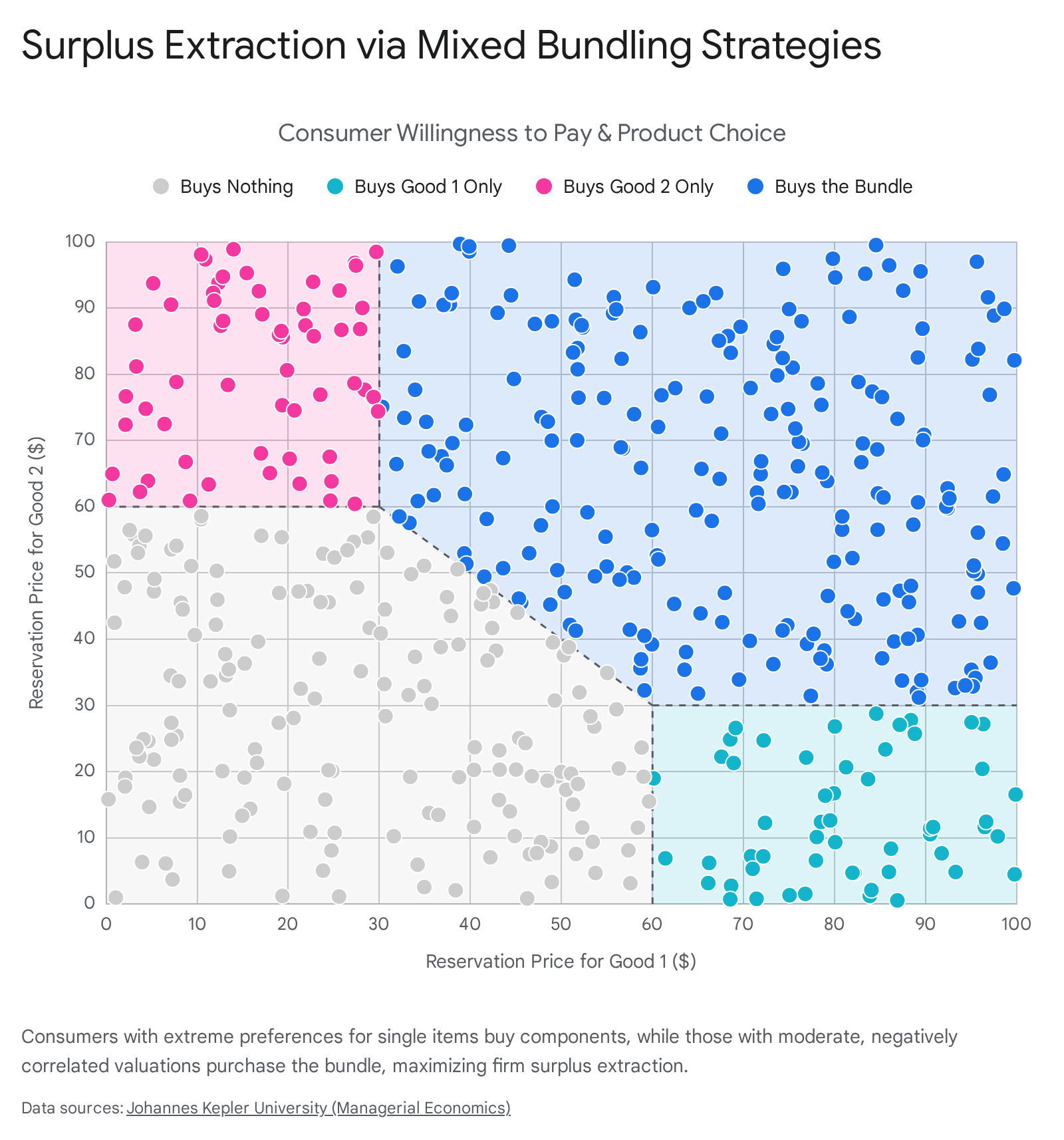
Under separate, pure-component pricing strategies, firms face an inescapable dilemma: setting prices high successfully captures surplus from consumers with robust valuations but entirely prices out those with lower valuations, resulting in significant deadweight loss 1819. Bundling circumvents this structural inefficiency by grouping products together to homogenize demand. When consumers possess negatively correlated reservation prices - meaning a consumer values Product A highly but Product B poorly, while another consumer exhibits the exact inverse preference - a bundle priced just below the sum of their combined maximum willingness to pay captures both consumers simultaneously 120.
The mathematical elegance of this strategy lies in variance reduction. The variance in the sum of product valuations is demonstrably lower than the sum of variances in individual product valuations, allowing the monopolistic or competitive firm to smooth out the demand curve and engage in highly effective second-degree price discrimination 23. Pure bundling forces the consumer to purchase the entire package or nothing, while mixed bundling represents the zenith of this pricing strategy. In a mixed bundling scenario, items are available both as separate components and as a cohesive package, allowing firms to capture niche single-item buyers who exhibit extreme preferences while simultaneously extracting maximal surplus from the broader, moderate market 1521.
Prospect Theory, Mental Accounting, and Hedonic Editing
While neoclassical microeconomics relies upon these mathematical and geometric realities, behavioral economics introduces the subjective, often irrational processing of these prices. Prospect theory, pioneered by psychologists Daniel Kahneman and Amos Tversky, completely redefines bundle valuation by asserting that human beings do not evaluate outcomes based on absolute final wealth states, but rather as discrete gains and losses relative to a highly flexible, psychological reference point, which is often tied to the status quo 5222324. Furthermore, the prospect theory value function exhibits diminishing sensitivity as it moves away from the reference point and is significantly steeper for losses than for equivalent gains, a fundamental psychological phenomenon known as loss aversion 52328. Empirical evidence reveals that individuals typically value a loss approximately 2.25 times more intensely than an equivalent monetary gain, a ratio that deeply impacts pricing architecture 23.
This asymmetry gives rise to the sophisticated concepts of mental accounting and hedonic editing. Mental accounting theory dictates that individuals systematically organize, evaluate, and track their financial outcomes into distinct, non-fungible psychological categories to simplify decision-making and enforce self-control 51516. Hedonic editing outlines the unconscious strategies individuals employ to frame these transactions in a manner that maximizes subjective hedonic value. Because the psychological pain of a monetary loss decreases marginally as the absolute size of the loss grows larger (diminishing sensitivity), enduring multiple, separate financial losses is psychologically far more painful than experiencing one large, consolidated loss 232526.
In the direct context of bundling, paying for multiple items individually forces the consumer to register multiple discrete financial losses, severely depleting their mental accounts and triggering acute loss aversion with each swipe of a card. Conversely, bundling seamlessly integrates these disparate losses into a single, unified transaction. This consolidation drastically reduces the cumulative pain of paying, effectively buffering the consumer's loss aversion and theoretically increasing their overall willingness to pay for the combined package compared to the strict arithmetic sum of its individual parts 263127. This psychological reality is leveraged not only in commercial retail but in policy design; studies demonstrate that bundling two politically painful legislative policies (losses) into a single bill significantly increases voter willingness to accept the legislation, as the integrated loss is perceived as less severe than two segregated losses 2326.
The dichotomy between willingness to pay (WTP) and willingness to accept (WTA) further complicates this framework. The "endowment effect" reveals that individuals assign greater value to goods they already possess 1724. Consequently, WTA consistently exceeds WTP, a disparity that grows when individuals lack familiarity with the product or when there is high variance in the potential outcomes 1517. Bundling can mitigate this disparity by obscuring individual component values, making it harder for consumers to isolate and fixate on the exchange value of specific items, thereby shifting their focus back to the holistic consumption utility of the package 315.
Debunking the Additive Fallacy: The Categorical Averaging Effect
A pervasive, deeply entrenched assumption in traditional marketing strategy is that bundling is inherently and strictly additive; the combination of a high-value primary product with a supplementary, lower-value secondary product is universally presumed to increase the consumer's overall willingness to pay. However, extensive research into human cognitive processing reveals a profound and paradoxical phenomenon: adding a smaller, objectively positive but less valuable prospect to a larger prospect frequently decreases the total perceived value of the bundle 1228. This phenomenon deeply contradicts standard rational utility theory, which strictly predicts that the addition of a positive alternative to a choice set must monotonically increase the overall perceived value 26.
This cognitive distortion is primarily driven by the categorical averaging effect, which is structurally grounded in fuzzy-trace theory. When confronted with multi-component bundles, consumers rarely possess the cognitive stamina to engage in precise, quantitative, additive calculations. Instead, they rely on qualitative, gist-based mental representations, imposing blunt categorical distinctions upon quantitative information 612. Human cognition possesses an innate, evolutionary preponderance for averaging when integrating categorical judgments to form overall impressions 2829.
If a consumer evaluates a bundle containing an objectively expensive, high-quality item alongside a remarkably cheap, low-quality item, the brain automatically categorizes them binarily as "expensive/premium" and "cheap/inferior." When forced to synthesize an overall valuation for the package, the cognitive system defaults to averaging the semantic weight of the two categories rather than summing their absolute monetary values. Consequently, the presence of the cheap item aggressively dilutes the perceived value of the expensive item. This results in a subtractive judgment where the combined bundle is valued strictly less than the premium item standing alone 2829.
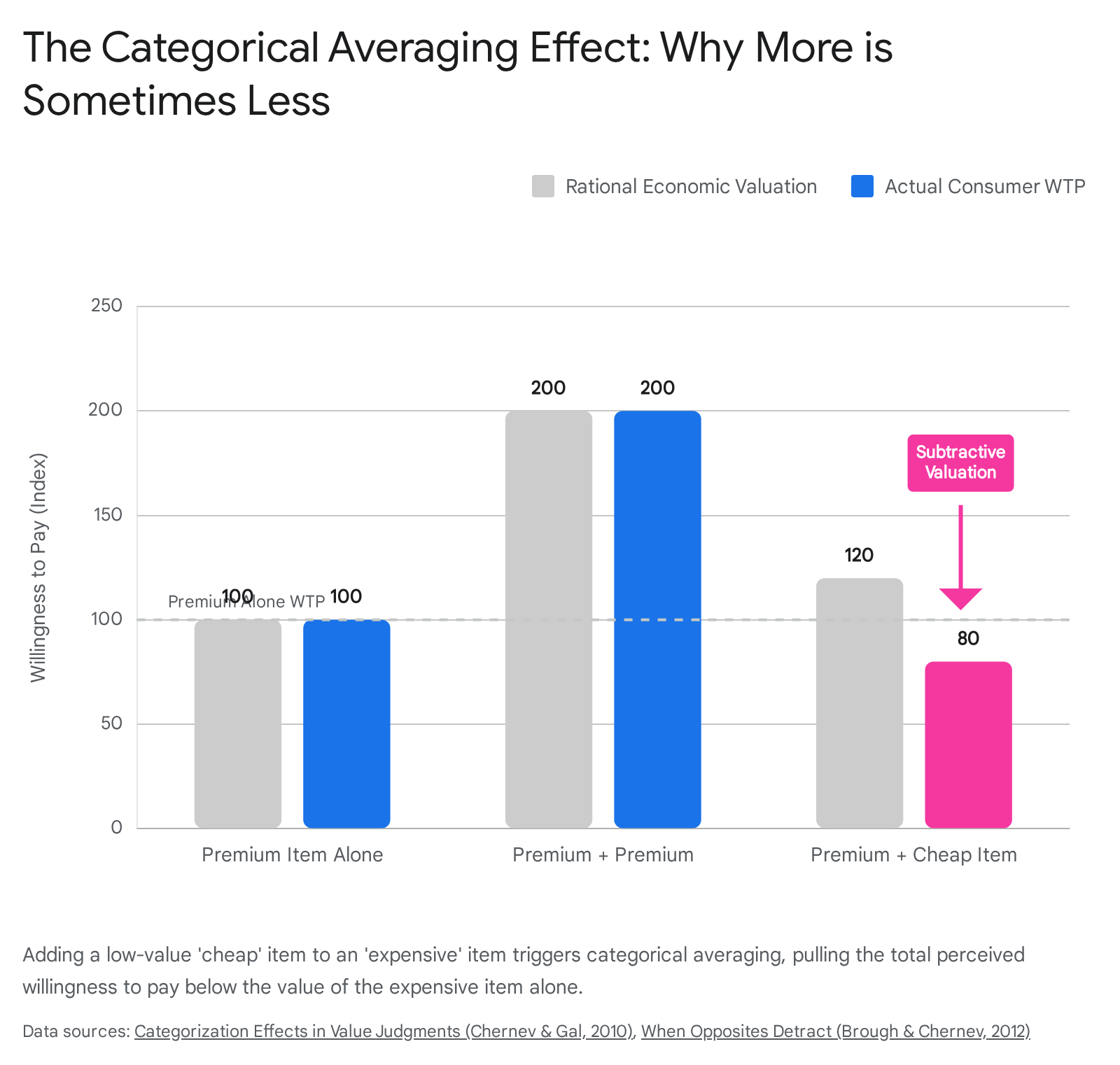
| Valuation Scenario | Rational Economic Model Prediction | Psychological Reality (Categorical Averaging) | Mechanism |
|---|---|---|---|
| Premium Item Alone ($100 Value) | WTP = $100 | WTP = $100 | Baseline singular valuation. |
| Premium ($100) + Premium ($100) | WTP = $200 | WTP ~ $180 - $200 | Categories align (High + High). Averaging maintains high perceived value. |
| Premium ($100) + Cheap ($10) | WTP = $110 | WTP < $100 | Categories conflict (High + Low). The cheap item anchors the average downward, resulting in a subtractive valuation. |
This powerful averaging bias extends far beyond retail financial valuation and permeates fundamental risk assessment and health psychology. Research consistently demonstrates that when combining food items categorized strictly as "virtues" (healthy, low-calorie) and "vices" (indulgent, high-calorie), consumers systematically underestimate the combined caloric content of the meal. The addition of a low-calorie virtue (e.g., a side salad) to a high-calorie vice (e.g., a cheeseburger) causes the consumer to subconsciously average the health categories, leading to the highly irrational conclusion that the bundled meal contains fewer total calories than the vice item consumed in pure isolation 6.
Similarly, in the high-stakes context of perceived medical risk, adding a low-risk side effect to a high-risk medical profile significantly reduces the overall perception of danger 12. Because individuals inherently believe that minor, localized prospects are more probable than major, systemic prospects, the inclusion of a minor risk (e.g., fatigue) anchors the cognitive evaluation, causing the major risk (e.g., severe neurological events) to appear less likely through a process of subtractive risk valuation 12. Therefore, from a rigorous psychological standpoint, the architectural composition of a bundle must fiercely guard its "value density." Combining premium products with generic, low-value add-ons does not enhance the commercial offering; it inflicts severe cognitive dilution and destroys willingness to pay.
The Paradigm Shift: Tangible Goods Versus Digital Intangibles
The psychological mechanisms of bundling operate fundamentally differently when transitioning from physical, tangible products to digital, intangible information goods. Traditional commodity bundling of physical goods is inherently and rigidly constrained by the marginal costs of physical production, packaging, and logistical distribution 514. The addition of a physical widget to a package incurs a measurable, non-zero cost in raw materials, human labor, and shipping weight, acting as a natural, economic brake on the maximum size of the bundle 14. Furthermore, physical bundles occupy tangible space in the consumer's reality, making the evaluation of individual components highly salient and demanding cognitive justification for each part.
Conversely, the modern digital economy operates on a radical paradigm of zero marginal cost. The marginal cost of distributing an additional digital software application, streaming a high-definition video, or providing access to a digital journalistic article is effectively zero 1314. This complete absence of physical constraint fundamentally alters the strategic calculus of both the firm and the consumer. According to the foundational Bakos-Brynjolfsson model, large-scale bundling of information goods creates massive "economies of aggregation" strictly through statistical variance reduction, independent of traditional economies of scale 13.
It is vastly easier for a digital platform to predict the average valuation of a massive collection of digital goods across a broad population than to predict a single consumer's idiosyncratic valuation for a single digital asset 1330. As the number of digital goods in a subscription bundle approaches infinity, the law of large numbers dictates that the variance in consumers' aggregate willingness to pay systematically collapses toward the mean 330. This statistical certainty allows digital bundlers to perfectly extract surplus across diverse populations without requiring individualized price discrimination - a feat economically impossible with physical goods 31330. Consequently, digital aggregators can effortlessly outbid smaller competitors for upstream content, creating unassailable market positions through sheer bundle volume 13.
However, this zero-marginal-cost reality traps digital firms into a unique psychological hazard: digital bloatware. Without the natural economic brake of physical production costs, digital firms are structurally incentivized to aggregate endless features, operating under the assumption that more features mathematically equate to more value. But psychological value density acts as a severe limiting factor in the human mind. If the standalone perceived value of a newly added digital item falls below the average value density of the existing bundle, its inclusion triggers the categorical averaging effect, dragging the entire psychological willingness to pay downward 14.
The optimal digital bundle size is not infinite; it is the exact inflection point just before an additional item dilutes the aggregate psychological value 14. The asymmetry of this strategic error is profound. Under-bundling digital goods may leave minor, incremental revenue uncaptured, but over-bundling and triggering a consumer perception of "bloatware" can destroy massive margins of potential revenue due to cognitive dilution and choice overload 1436. A bundle with low value density feels cognitively burdensome, regardless of its absolute price 14.
Moderating Variables: Expanding the Boundaries of Bundle Valuation
The baseline cognitive effects of bundling do not occur in an aseptic vacuum; they are highly susceptible to situational, environmental, and individual moderating variables. These moderators actively dictate whether consumers engage in deep, analytical processing of a bundle or fall back on rapid, error-prone heuristic evaluations.
Cognitive Load, Time Pressure, and Search Costs
The volume of mental resources demanded by a specific decision environment - known as cognitive load - drastically alters how bundle information is processed 83132. Human working memory possesses a finite, easily exhaustible capacity 1531. When consumers are subjected to high intrinsic cognitive load (complex information) or high extraneous cognitive load (poor presentation), or when they are placed under acute time pressure, their ability to process complex, multi-attribute information rapidly deteriorates 8313334. This dynamic is readily observable in high-stress scenarios, such as disaster evacuation planning, where terrain complexity and severe time constraints force individuals to rely on spatial heuristics rather than optimal routing 31.
Similarly, in commercial environments, when consumers operate under high cognitive load or strict time constraints, the motivation and sheer biological capacity for effortful thinking diminish. Consequently, these stressors actually increase a consumer's preference for pre-packaged bundles over individual component selection 8. Selecting a pre-configured bundle drastically reduces the search, evaluation, and physical assembly costs required to execute a decision, acting as a crucial, energy-saving cognitive shortcut 82035. Prior research explicitly demonstrates that preference for a bundle is exponentially greater when bundle choice actively reduces search effort, particularly among consumers who score low on the "need for cognition" scale 78.
However, this heavy reliance on heuristics comes at a severe psychological cost. High cognitive load and time pressure significantly amplify the categorical averaging bias. Because the individual lacks the mental bandwidth to quantitatively assess the sum of the components, they default completely to qualitative, gist-based averaging, rendering them highly susceptible to subtractive valuations and purchasing errors 612. Conversely, individuals with a high need for cognition, or those operating in low-load, pressure-free environments, are more likely to successfully calculate additive value, effectively resisting the averaging fallacy 78.
Brand Familiarity and Risk Mitigation
Brand familiarity serves as a potent moderating variable that fundamentally alters the perceived risk profile of a bundled transaction 3637383940. Drawing upon the Elaboration Likelihood Model, consumers with low familiarity regarding a bundle's components will bypass deep analysis and rely heavily on external, peripheral cues to judge value 3841. In multi-product bundles, the perceived financial and functional risk is heavily magnified if the components are of varying, unknown, or heterogeneous quality.
A high degree of brand familiarity provides immense psychological comfort, acting as an internal heuristic for trust and quality assurance, thereby reducing the perceived risk of the transaction 3839. When a highly familiar, reputable parent brand anchors a bundle, it casts a powerful "halo effect" over the lesser-known or lower-quality tie-in products. The presence of the familiar brand actively mitigates the negative inferences that might otherwise trigger categorical averaging 3638. Furthermore, brand familiarity strongly moderates price framing and transaction utility. Consumers evaluating bundles anchored by highly familiar brands exhibit significantly higher shopping intentions and are vastly more resilient to the cognitive dissonance associated with paying for unneeded bundle components, as the established brand equity overrides the localized transaction risk 363742.
Budget Constraints and Novel Payment Mechanisms
Strict financial liquidity and budget constraints activate rigid mental accounting protocols 515. When operating under a tightly constrained budget, consumers exhibit hyper-sensitivity to the fungibility of money, strictly allocating funds to specific, walled-off psychological accounts 1516. A bundle that crosses categorical boundaries - such as grouping a utilitarian household necessity with a hedonic, luxury item - can severely disrupt these mental pockets 36. The consumer may have the requisite budget for the utilitarian item but lack the mental allowance for the hedonic item. In these scenarios, mixed bundling causes severe decision paralysis, as the integrated, single price forces a direct violation of internal budget caps 536.
However, emerging payment mechanisms, most notably "Buy Now, Pay Later" (BNPL) schemes, artificially circumvent these constraints. BNPL systems increase payment option salience and facilitate short-term deferral of payment via installments 43. By breaking the bundle's total cost into highly digestible, temporally delayed fractions, BNPL reduces the immediate "pain of paying" and artificially expands the mental budget. Consumers utilizing BNPL exhibit significantly greater willingness to pay for premium bundles, as the delayed financial reality fails to trigger immediate loss aversion protocols 43. Similarly, complex multipart pricing strategies - where base prices are decoupled from mandatory surcharges - often reduce consumers' comprehension of total costs, obfuscating the true financial burden of the bundle and bypassing budgetary alarms 4445.
Cross-Cultural Dynamics: Holistic versus Analytic Information Processing
The cognitive architecture governing bundle valuation is not a universal human constant; it is deeply mediated by culturally ingrained modes of thought and societal conditioning. Contemporary cross-cultural psychology identifies a profound, systemic divergence in how individuals from different global regions process complex information, primarily divided into holistic and analytic thinking paradigms 952.
Analytic thinking, which is predominantly observed and cultivated in Western cultures (e.g., North America, Western Europe), involves a strict detachment of the object from its surrounding context. Analytic thinkers focus heavily on salient attributes, categorize objects based on strict taxonomic rules, and utilize formal logic to resolve apparent contradictions 952. When evaluating a product bundle, an analytic thinker - who typically possesses an independent self-construal - tends to ruthlessly dissect the package, assessing each component in pure isolation 46. They are highly sensitive to the individual, functional utility of each item and the specific, line-item price discounts applied to each part. If a bundle contains a non-complementary item, or an item that offers zero direct personal utility, the analytic thinker will view the bundle as inefficient, illogical, and fundamentally flawed, leading to a severe reduction in their willingness to pay 46.
Conversely, holistic thinking, which is highly prevalent in East Asian, Middle Eastern, and several African cultures, involves a profound orientation to the context or field as a whole. Holistic thinkers perceive the universe as vastly interconnected, paying close attention to relationships between objects and demonstrating a high tolerance for contradiction and ambiguity 952. Consumers exhibiting interdependent self-construals and holistic cognitive styles evaluate product bundles not as arbitrary collections of discrete parts, but as cohesive, singular entities 46. Their cognitive focus rests on the macro-level harmony and overall essence of the offering rather than the micro-level utility of the individual components.
Therefore, holistic thinkers are significantly more likely to assign high valuations to diverse, complex, and even non-complementary bundles. Their cognitive framework actively seeks to integrate disparate elements into a unified whole, generating a higher overall willingness to pay for complex packages compared to analytic thinkers evaluating the exact same product configuration 46.
Contemporary Findings and Shifts in Bundle Science (2023 - 2026)
Recent academic literature published between 2023 and 2026 has introduced highly nuanced mechanisms that refine and occasionally upend legacy bundling theories, demonstrating how subtle framing dictates massive shifts in consumer behavior.
The Gestalt Effect and Shopping Basket Size Expansion
A landmark 2024 study by Kobuszewki Volles et al. definitively proved that the mere presence of bundles actively alters spatial and quantitative perception during the shopping experience. When grocery stores or digital retailers offer pre-packaged bundles (such as multi-ingredient meal kits), consumers process the bundled items as a unified Gestalt - a singular conceptual unit rather than a collection of parts 747.
This holistic perception radically alters their spatial judgment of their physical or digital shopping basket. Because they view the multi-item bundle as a single entity, consumers systematically underestimate the total volume of products they have selected. This cognitive underestimation of total purchases artificially suppresses the psychological sensation of "having bought enough," prompting them to continue shopping and adding more items to the cart. Ultimately, simply incorporating bundles into a retail assortment significantly increases the overall shopping basket size and total revenue, functioning entirely independently of traditional price discrimination or discounting 747.
The Price Divisibility Effect
Further complicating the mathematics of bundling is the newly documented "price divisibility effect" for multipacks - bundles containing identical items 4849. Research published in the Journal of Consumer Research (2024) proposed that consumers are paradoxically willing to pay higher absolute prices for a multipack if the total price is easily mathematically divisible by the number of units 48.
For instance, a 4-pack of identical goods priced at $16.00 (easily divisible by 4) might generate higher purchase intent than the exact same 4-pack priced at $15.30 (non-divisible). The cognitive mechanism suggests that divisible prices unconsciously shift the consumer's attention toward the individual unit cost. This numerical fluency creates a psychological justification that the units will be consumed quickly, thereby accelerating purchase intent 48. While subsequent replication studies have debated the universal robustness of this effect across all contexts, it highlights the extreme sensitivity of bundle valuation to numerical fluency, aesthetics, and metacognitive processing 4849.
Framing Non-Complementary Bundles
Historically, marketing literature strictly mandated that bundles must contain highly complementary items (e.g., a printer and ink, or a video game console and a game) to succeed, warning that bundling non-complementary items (e.g., a laptop and an unrelated music streaming subscription) causes severe cognitive dissonance and depresses sales 311.
However, recent experimental data from 2025 reveals that the success of non-complementary bundles relies almost entirely on promotional framing rather than actual utility 11. When a non-complementary item is framed explicitly as a "price discount" on a larger bundle, consumers are triggered to engage in rigorous utility calculation, experience dissonance over the mismatched items, and reject the bundle. However, when the exact same non-complementary item is semantically framed as a "free gift," the negative cognitive effects are entirely attenuated 11. The "gift" frame acts as a psychological shield, protecting the supplementary item from strict economic scrutiny. This preserves the consumer's "smart shopper feelings" and maintains high purchase intent despite the complete lack of functional synergy between the products 11.
Synthesis: Mapping Cognitive Mechanisms to Strategy
To synthesize this exhaustive review, the following matrix explicitly maps specific cognitive mechanisms to actionable bundling strategies and details their resultant shifts in consumer willingness to pay.
| Cognitive Mechanism / Theory | Triggering Condition / Context | Applicable Bundling Strategy | Impact on Willingness to Pay (WTP) |
|---|---|---|---|
| Hedonic Editing / Mental Accounting 526 | Consumer is exposed to multiple disparate prices vs. a single aggregate price. | Pure/Mixed Price Bundling | Increases WTP: Consolidating multiple costs into one bundle limits the psychological pain of paying to a single, buffered loss event. |
| Categorical Averaging 61228 | A low-value/cheap item is visibly bundled with a high-value/premium item. | Feature Bundling / Add-ons | Decreases WTP: Consumers process qualitatively, averaging the perceived value, leading to a subtractive valuation mathematically lower than the premium item alone. |
| Statistical Variance Reduction 31330 | Aggregating vast numbers of items with near-zero marginal production costs. | Digital Subscriptions (Information Goods) | Homogenizes WTP: Crushes the variance in extreme consumer preferences, allowing a single aggregate price to capture mass-market surplus seamlessly. |
| Gestalt Perception 747 | Consumers select physical bundles alongside individual à la carte items. | Meal Kits / Retail Product Grouping | Increases Total Spend: Consumers perceive the bundle as one singular unit, mathematically underestimating their total basket size and continuing to add items. |
| Cognitive Load / Search Cost Aversion 812 | High time pressure, high information density, or complex decision environments. | Pre-packaged "Default" Bundles | Increases Selection Rate: Consumers aggressively prefer bundles to avoid the mental fatigue of assembly, though their quantitative valuation accuracy drops precipitously. |
| Holistic Information Processing 946 | Consumers possessing an interdependent self-construal (highly prevalent in Eastern cultures). | Cross-category / Complex Bundles | Increases WTP: Evaluators fluidly integrate disparate parts into a cohesive whole, accepting non-complementary items far more readily than analytic thinkers. |
| Promotional Framing (Free Gift) 11 | Bundling items that completely lack functional synergy (non-complementary). | Tie-in Promotions / Asymmetric Bundles | Maintains WTP: Framing an unrelated item as a "gift" circumvents strict rational utility analysis, preventing the cognitive dissonance seen in "discount" frames. |
Conclusion
The psychology of bundling transcends simple arithmetic addition. As demonstrated by the integration of classical microeconomic theory with the vanguard of behavioral science and cross-cultural psychology, a consumer's willingness to pay for a bundled package is a highly malleable, subjective psychological construct. Corporate strategies that blindly adhere to the additive fallacy, assuming that bundling a premium product with a generic add-on inherently creates objective value, fall victim to the devastating effects of categorical averaging and severe cognitive dilution.
The most successful bundling architectures - whether they are mixed bundles of physical, tangible goods designed to surgically transfer consumer surplus, or massive, zero-marginal-cost digital subscriptions leveraging the law of large numbers to reduce variance - are those that deeply respect the biological and cultural boundaries of human cognition. By expertly manipulating promotional framing to preserve smart-shopper feelings, utilizing Gestalt spatial effects to obscure shopping basket size, leveraging emerging BNPL payment mechanisms to bypass mental accounting constraints, and actively adapting presentation styles to match the holistic or analytic thinking paradigms of a target culture, firms can effectively bypass cognitive resistance. Ultimately, modern bundle valuation is less a rigid calculation of objective financial worth and more an intricate exercise in cognitive architecture, shaping exactly how the human mind organizes, accounts for, and internalizes value across a diverse global marketplace.