
Impact of Price Anchoring on Consumer Willingness to Pay
Introduction
The valuation of goods, services, and assets in a market economy rests theoretically on the equilibrium between supply and demand, moderated by the rational assessment of utility. However, behavioral economics and cognitive psychology have persistently demonstrated that human decision-making deviates from strict neoclassical rationality. A foundational deviation is the anchoring bias: a cognitive heuristic wherein individuals rely disproportionately on the first piece of numerical information they encounter - the anchor - when estimating an unknown quantity or establishing a willingness to pay 1. Once this initial reference point is introduced, subsequent judgments are systematically assimilated toward it, often leading to decisions that contradict objective asset valuation or personal utility maximization 23.
First formalized by Amos Tversky and Daniel Kahneman in their seminal 1974 paper, "Judgment under Uncertainty: Heuristics and Biases," the anchoring effect was originally demonstrated using an explicitly arbitrary mechanism 15. In a now-classic experiment, participants observed a rigged roulette wheel that landed on either 10 or 65. When subsequently asked to estimate the percentage of African nations in the United Nations, those exposed to the number 10 guessed 25% on average, while those exposed to 65 guessed 45% 64. Despite the undeniable irrelevance of the roulette outcome, the arbitrary numeric value functioned as a powerful cognitive magnet.
In commercial and financial domains, the ramifications of this heuristic are profound. Consumers utilize initial prices - whether an inflated Manufacturer's Suggested Retail Price (MSRP), a previous stock valuation, or a suggested tipping percentage - as baseline metrics to interpret all subsequent pricing data 2. The anchoring bias distorts consumer willingness to pay, manipulates market liquidity, alters legal damage awards, and shapes the efficacy of algorithmic dynamic pricing models 356. Understanding the psychological mechanisms, empirical magnitude, cross-cultural variances, and regulatory responses to anchoring bias is essential for comprehending modern consumer behavior and digital market architecture.
Cognitive Architectures Underlying Anchoring Bias
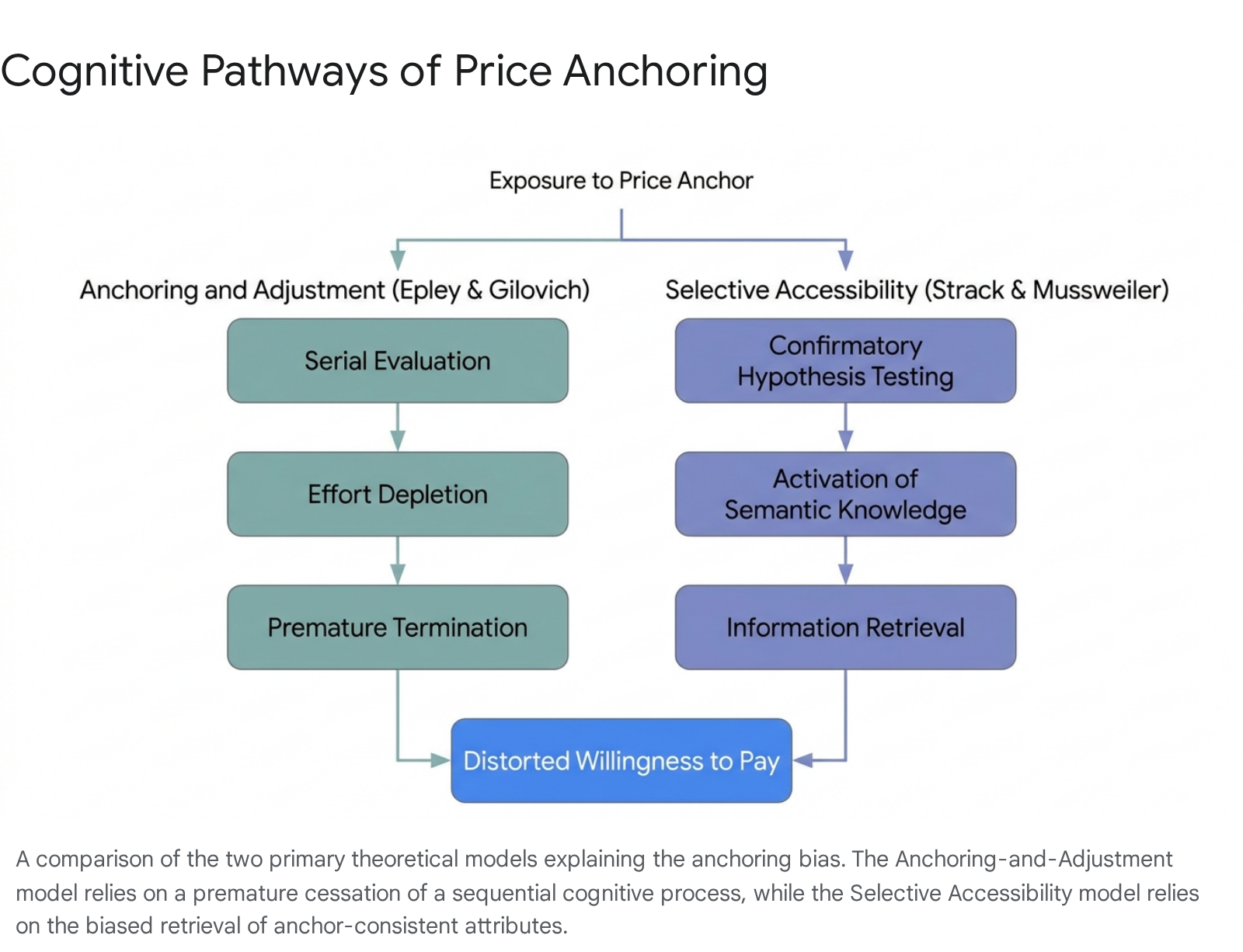
The robustness of the anchoring effect is universally recognized, but the precise cognitive architecture facilitating this bias has been the subject of extensive academic debate. Historically, the literature has gravitated toward two dominant, sometimes competing, theoretical models: the Anchoring-and-Adjustment heuristic and the Selective Accessibility model 78.
In addition, the concept of Arbitrary Coherence explains the longitudinal persistence of these cognitive distortions.
The Anchoring-and-Adjustment Heuristic
The original theoretical framework posited by Tversky and Kahneman suggests that individuals formulate estimates by beginning at a provided initial value and incrementally adjusting their judgment toward the true value 17. Because this cognitive adjustment requires significant mental effort, individuals tend to terminate the process prematurely. Specifically, decision-makers are characterized as "cognitive misers" who possess a plausible range of values for a given estimate; they adjust away from the anchor only until they reach the absolute boundary of this plausible interval, resulting in a final estimate that remains heavily skewed toward the initial anchor 79.
Subsequent research refined this model, emphasizing the attention-demanding nature of the adjustment process 710. According to this account, adjustment is a deliberative, effortful sequence. As cognitive resources become depleted - whether through time pressure, cognitive load, or intoxication - the adjustment becomes even more insufficient 910. For several years, theorists hypothesized that this specific mechanism applied primarily to "self-generated" anchors, where a person intrinsically references a known value (e.g., anchoring on 0°C when estimating the freezing point of vodka) and adjusts from there 11.
The Selective Accessibility Model
In contrast to the adjustment hypothesis, researchers proposed the Selective Accessibility Model to explain anchoring effects generated by externally provided values 71216. This model posits that anchoring operates fundamentally through semantic priming and confirmatory hypothesis testing. When a consumer encounters an external anchor (e.g., an MSRP of $1,000 for a television), they unconsciously test the hypothesis that the target's true value is equal to the anchor 7.
Because human cognition exhibits a strong confirmation bias, this hypothesis testing selectively activates information and memories that are consistent with the anchor value 1613. For instance, a high price anchor will automatically bring to mind the premium features, brand reputation, or high-quality components of the television. The final judgment is then formulated based heavily on this selectively retrieved, anchor-consistent knowledge pool 12. This model suggests that the anchor does not merely serve as a numerical starting point; rather, it fundamentally alters the semantic representation of the product in the consumer's mind 1213.
Variables Moderating Cognitive Architecture
Recent literature has increasingly blurred the rigid distinction between these two models, suggesting that multiple mechanisms may operate concurrently depending on the context, cognitive load, and whether the anchor is internal or external 1114. However, time-pressure experiments have sometimes failed to confirm the core prediction of the insufficient adjustment model - namely, that decreasing available time should push estimates closer to the anchor - leading some researchers to argue that semantic priming provides a more universally applicable architectural explanation 11.
Additional variables deeply influence these cognitive architectures. Mood is a verified moderator; evidence indicates that subjects in a sad mood exhibit higher susceptibility to anchoring than those in a positive mood 14. While historically, sadness is associated with deeper, more analytical processing, in the context of anchoring, sadness appears to intensify the selective accessibility of anchor-consistent (and often negative or conservative) semantic networks 14.
Arbitrary Coherence and Demand Curves
While the aforementioned models explain the instantaneous assimilation of an anchor, the concept of "Arbitrary Coherence" explains how anchoring creates persistent market valuations 1915. Studies demonstrate that even when consumers are fully aware that an anchor is random - such as the last two digits of their Social Security Number (SSN) - it drastically influences their baseline willingness to pay 1916. In a hallmark experiment, students with SSNs ending in 80-99 bid 216% to 346% more for items like wine and computer equipment than students with SSNs ending in 01-20 15.
More critically, arbitrary coherence posits that once an initial, arbitrary price is established in a consumer's mind, all future valuations within that product category become logically coherent with that initial anchor 1522. For instance, a consumer might not know what a fair price for a premium smartphone should be, but once they accept a $1,000 anchor, they will rationally conclude that a slightly inferior model should cost $800. The initial anchor is arbitrary, but the subsequent relational pricing is coherent. This phenomenon suggests that standard economic demand curves may often reflect manipulated reference points rather than true, intrinsic consumer preferences 22.
Empirical Magnitude of the Bias
The statistical magnitude of the anchoring effect has been rigorously evaluated across various domains. Meta-analytic data comprising 84 distinct effect sizes calculated a mean weighted effect size of r = .401 (corrected correlation estimate of .558), signifying a robust and substantial behavioral distortion 17.
The Role of Expertise and Meaningfulness
Contrary to rational choice theory, variables such as subject matter expertise do not necessarily insulate decision-makers. In many contexts, domain-relevant knowledge actually exacerbates the anchoring bias 17. Experts possess a broader and more highly developed semantic network. When exposed to an anchor, the confirmatory hypothesis testing mechanism of the Selective Accessibility Model triggers the retrieval of a larger volume of anchor-consistent information in experts than in laypeople, cementing the bias 17. Similarly, the extremity of the anchor mildly weakens the impact (as it falls outside the bounds of any plausible interval), whereas the meaningfulness or relevance of the anchor significantly strengthens the effect 1317.
Hypothetical Bias versus Real-World Financial Incentives
A critical consideration in interpreting the magnitude of anchoring effects is the distinction between hypothetical consumer research and real-world transactions. Much of the foundational evidence for anchoring originates from hypothetical paradigms, such as contingent valuation surveys, where participants face no financial consequences for their estimations 18.
Recent empirical studies utilizing the Becker-DeGroot-Marschak (BDM) mechanism to elicit true, incentive-compatible willingness to pay have revealed a distinct interaction between hypothetical bias and anchoring 18. In controlled experiments valuing physical goods, high anchors routinely inflated hypothetical willingness to pay by 48% to 53% 18. However, when responses carried actual financial consequences, the anchoring effect was severely attenuated, sometimes dropping to non-significance or an inflation rate of just 14% 18.
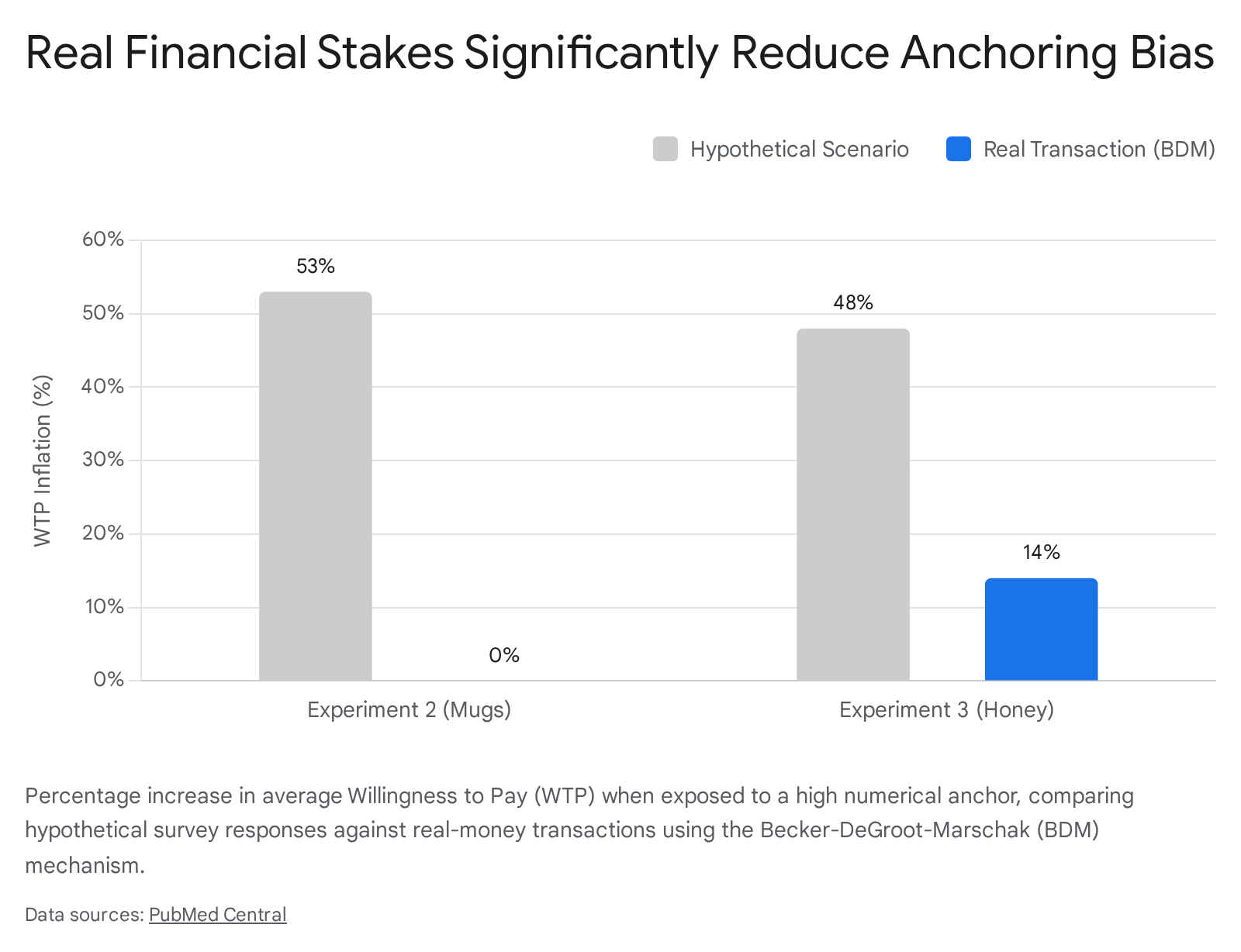
This interaction provides indirect support for the cognitive effort theories of adjustment. When financial stakes are real, individuals may exert the necessary cognitive resources to effectively adjust away from irrelevant anchors. In hypothetical scenarios, they operate as cognitive misers, accepting the anchor with minimal friction 18.
Market Applications and Consumer Distortion
The translation of theoretical anchoring mechanics into applied market strategies represents one of the most effective tools in commercial psychology. Retailers, real estate agents, legal practitioners, and digital platform architects consistently exploit reference points to dictate consumer and institutional outcomes.
Retail Pricing and Reference Mechanisms
In the retail sector, the initial price presented to a consumer establishes the benchmark against which all subsequent value judgments are made . This is most overtly manifested through Manufacturer's Suggested Retail Prices (MSRPs) and strike-through pricing, where a highly inflated "original" price is displayed adjacent to a lower "sale" price 25. The original price serves as a selective accessibility trigger; the consumer anchors on the high value, perceiving the sale price not simply as a cost, but as a quantified gain or bargain 1920.
A historical illustration of the danger of removing anchors is J.C. Penney's 2012 strategic shift. Under new management, the retailer abandoned its high-low pricing strategy (inflated anchors with constant discounts) in favor of "Everyday Fair Pricing" 3. Without the high artificial anchors to establish perceived value, consumers interpreted the transparent, lower prices as indicators of inferior quality rather than honest value 3. The removal of the anchor eliminated the psychological reward of the "bargain," leading to a catastrophic decline in sales and consumer trust.
Decoy Pricing and Charm Pricing
Retailers employ sophisticated framing techniques to establish subliminal anchors. "Charm pricing" - the practice of ending prices in .99 or .95 - forces the consumer to anchor on the left-most digit 420. Because Western reading patterns scan left-to-right, the cognitive processing of the price $9.99 anchors heavily on the 9, making it feel significantly cheaper than $10.00, despite the negligible absolute difference 20. Empirical studies show this is particularly effective for lower-priced consumer goods 20.
Additionally, "decoy pricing" relies on anchoring to alter choice architecture. In decoy pricing, an intentionally inferior or overpriced option is introduced specifically to serve as a relative anchor 2021. In a hospitality context, a hotel might offer a basic room for $100, a premium room for $150, and a premium room with an objectively poor breakfast add-on for $145. The $145 option acts as a decoy anchor; it is not meant to be purchased. Instead, it resets the consumer's value scale, making the $150 premium room seem like exceptional value in comparison, effectively steering the consumer toward higher-margin revenue 21.
High-Stakes Markets: Real Estate and Legal Damages
The influence of anchoring scales exponentially in markets characterized by high information asymmetry and subjective valuation, such as real estate and civil litigation.
In real estate, property valuation is inherently subjective, making it highly susceptible to arbitrary anchors. The seller's initial asking price serves as a dominant anchor that dictates the trajectory of the transaction 36. Research demonstrates that professional real estate agents, despite claiming immunity to pricing biases, formulate their appraisals in direct correlation with the listing price 26. In declining markets, such as the 1990s Boston housing downturn, sellers often refuse to adjust their prices downward because they remain cognitively anchored to past peak valuations. Combined with loss aversion, this creates price stickiness, resulting in prolonged listing periods, reduced market liquidity, and inefficient market stagnation 3.
In the legal domain, the introduction of numeric anchors heavily distorts compensatory and punitive damage awards issued by judges and juries 1722. Meta-analytic evidence confirms the vulnerability of legal decision-making to anchoring, yielding an effect size of r = .360 specifically within legal contexts 17. Experimental data shows that the extremity of the anchor dramatically alters judicial behavior. For example, in an experiment with federal magistrate judges, anchoring on a jurisdictional minimum of $75,000 resulted in consistently lower compensatory awards 6. Conversely, when presented with an extreme high anchor of $10 million versus a low anchor of $175,000, judges exposed to the high anchor awarded exponentially higher damages 6. Similarly, exposing bankruptcy judges to an arbitrary 21% interest rate anchor resulted in significantly higher awarded interest rates compared to a control group 6.
Default Anchors in Digital Tipping
The rapid transition from analog cash tipping to digital point-of-sale (POS) systems has fundamentally disrupted the architecture of service gratuities. Traditional tipping occurred post-service, serving as a relatively private assessment of service quality 2324. Modern digital interfaces, however, enforce a highly standardized choice architecture utilizing algorithmic default anchors 2325.
Digital POS systems routinely present consumers with pre-calculated, ascending default percentages (e.g., 15%, 20%, 25%). These options serve as powerful normative anchors, implicitly communicating evolving social expectations and establishing 20% as a baseline rather than an exceptional reward 33. Consumers, acting as cognitive misers aiming to reduce the friction of custom calculations, frequently capitulate to the middle or highest anchor 33. For instance, research demonstrates that taxi customers are significantly more likely to tip 25% when the presented options are 20%, 25%, 30% compared to when they are 15%, 20%, 25% 34.
However, the chronological placement of the anchor is highly sensitive. The emergence of "pre-service" tipping requests - where an anchor is presented before any service is rendered - has generated significant consumer backlash. Research shows that requesting a tip prior to service leads to reduced tip amounts, diminished word-of-mouth intentions, and lower online ratings 24. The psychological mechanism driving this backlash is "inferred manipulative intent." Consumers recognize the default anchors not as helpful heuristics, but as aggressive corporate coercion, which threatens their autonomy and drastically reduces brand favorability 2426.
Algorithmic Pricing and Digital Choice Architectures
As retail and service markets transition to digital platforms, human cognitive biases are increasingly encountering algorithmic and dynamic pricing architectures. This intersection creates new paradigms for how consumers perceive and respond to value.
Dynamic Pricing and Demand Learning
In digital e-commerce, dynamic pricing algorithms - often utilizing multi-armed bandit frameworks and reinforcement learning - continuously adapt prices based on real-time demand, inventory scarcity, and consumer behavioral tracking 5. These algorithms must resolve the exploitation-exploration trade-off: whether to exploit a known price point that generates acceptable revenue or explore new, potentially higher price points to map demand elasticity 5.
For the consumer, this algorithmic fluidity creates a volatile reference pricing environment. When prices fluctuate constantly, consumers struggle to establish a stable internal anchor 327. The absence of a stable anchor increases consumer reliance on external cues provided by the platform itself - such as "only 2 items left at this price" - which compounds the anchoring bias with the scarcity heuristic 1937. Furthermore, personalized pricing models utilizing artificial intelligence may subtly present different anchor prices to different users based on their historical price sensitivity, effectively weaponizing the anchoring bias on a micro-targeted scale 3728.
Psychological Fairness and the Peak-End Rule
The implementation of dynamic pricing is highly constrained by psychological perceptions of fairness 537. If a consumer anchors on a low price observed yesterday and encounters a significantly higher algorithmic price today, the discrepancy violates their internal fairness parameters, potentially destroying repurchase intent 527.
Models of dynamic pricing with learning are increasingly incorporating "peak-end" anchoring models of reference price updating 5. The peak-end rule suggests that a consumer's internal anchor is not an average of all prices seen, but heavily weighted toward the most extreme price (the peak) and the most recent price (the end) 5. Algorithms designed with fairness constraints learn that deploying smaller, incremental price increases is functionally superior to implementing large jumps. Smaller revisions allow the consumer's internal anchor to adjust upward gradually without triggering intense behavioral backlash or "sticky" fairness concerns, ultimately yielding higher long-term revenue 5.
Cross-Cultural Variances in Price Anchoring
The global application of pricing strategies requires an understanding of cross-cultural psychological variances. The majority of foundational cognitive bias research originated in Western, Educated, Industrialized, Rich, and Democratic (WEIRD) societies, characterized by individualistic social orientations and analytic cognitive styles 2930. By contrast, Eastern societies often exhibit collectivist orientations and holistic cognitive processing, emphasizing context and relationships over isolated data points 30.
Analytic versus Holistic Cognitive Styles
Meta-analytic reviews indicate that while the anchoring effect is a universal human phenomenon rooted in bounded rationality, culture acts as a significant moderator in both the manifestation and magnitude of the bias 3031. For instance, Hofstede's cultural dimensions show that societies prioritizing uncertainty avoidance or group conformity interact with anchors differently 31.
In Western populations, the drive for self-enhancement is high (e.g., d = .87 for self-serving biases), leading to optimistic processing of ambiguous data 29. When faced with a high price anchor, an individualistic consumer analytically processes the number as an isolated variable to be negotiated or accepted based on immediate utility. In contrast, holistic cognitive processing in East Asian cultures places less emphasis on the isolated numerical anchor and more on the relational context of the transaction 42.
Negotiation and Scale Usage Variations
Cross-cultural measurement studies reveal distinct variations in scale usage, which correlate with responses to numeric bounds. U.S. respondents are significantly more likely to select extreme responses on Likert scales (19.2% extreme selection compared to 13.6% for Japanese respondents), whereas Japanese respondents lean heavily toward neutral anchors (23.2% vs. 17.4%) 32.
| Cognitive Dimension / Bias | Western Context (Analytic/Individualistic) | Eastern Context (Holistic/Collectivistic) | Empirical Manifestation in Decision-Making |
|---|---|---|---|
| Self-Enhancement Bias | High magnitude (e.g., d = .87) | Low to non-existent | Westerners exhibit optimistic biases in estimation; Easterners adopt more conservative postures 29. |
| Extreme Response Style | High prevalence (41% more likely) | Low prevalence | Western consumers readily anchor on scale extremes; Eastern consumers cluster near neutral bounds 32. |
| Anchoring Magnitude | Moderate to High (r = 0.26 - 0.74) | Low to Moderate (r = 0.17 - 0.35) | The raw correlation coefficient of anchor assimilation tends to be wider and higher in Western samples 33. |
| Negotiation Focus | Transaction-oriented, discrete values | Relationship-oriented, contextual | Westerners utilize immediate numeric anchors aggressively; Easterners establish anchors based on ongoing dynamics 42. |
This data suggests that while a high initial price will universally skew perceived value upward, international pricing strategies must account for the fact that Western consumers may exhibit more aggressive adjustment deviations and a higher susceptibility to extreme numerical bounds than their Eastern counterparts.
The implementation of default tipping anchors further highlights these differences. Implementing digital tip prompts in high-context societies (e.g., Saudi Arabia) has highlighted a clash between imported Western technology paradigms and local cultural norms. Digital manipulation through stealth or default e-tipping in these environments presents severe ethical challenges, resulting in brand damage when consumer autonomy is perceived to be overridden by the software interface 26.
Regulatory Interventions and Enforcement
As digital platforms have optimized their exploitation of anchoring biases, regulatory bodies - most notably the Federal Trade Commission (FTC) in the United States - have aggressively escalated their enforcement against deceptive pricing architectures 25. Between 2024 and 2026, regulatory focus shifted heavily toward eradicating "fake" anchors and ensuring total price transparency 3435.
FTC Scrutiny of Strike-Through Pricing
Strike-through pricing relies entirely on the premise that the higher, crossed-out price represents a legitimate market valuation. The FTC's Guides Against Deceptive Pricing explicitly mandates that any advertised former price must be the "actual, bona fide price at which the article was offered to the public on a regular basis for a reasonably substantial period of time" 2547.
However, many direct-to-consumer brands artificially inflate the baseline MSRP simply to cross it out, creating a permanent, illusory discount 2547. Because the item is never genuinely sold at the MSRP, the anchor is entirely deceptive. State and federal regulators have initiated massive crackdowns on this practice. Between 2023 and 2025, major class action lawsuits and regulatory settlements resulted in tens of millions of dollars in penalties. Fast-fashion retailer Boohoo settled for nearly $200 million over fake discount claims, while home goods retailer RugsUSA settled for $14.2 million 47. Similar litigation was brought against prominent brands including Shade Store, La-Z-Boy, and Eloquii, reinforcing that courts view fabricated reference prices as fundamentally misleading to reasonable consumers 25. Previous state-level enforcement, such as a $6.8 million judgment against Overstock in California, set the precedent that companies must make good faith efforts to determine prevailing market prices and set time limits on advertised former prices 25.
Combatting Drip Pricing and Fake MSRPs
Beyond retail strike-throughs, the FTC has aggressively targeted "drip pricing" - the practice of luring consumers with an artificially low initial anchor price, only to add mandatory "junk fees" late in the checkout process 3536. This exploits the anchoring bias by locking the consumer into a psychological commitment to the initial, lower price. Once committed, the consumer adjusts insufficiently for the added fees and is less likely to abandon the transaction when the true cost is revealed 3436.
To formalize enforcement, the FTC finalized the "Rule on Unfair or Deceptive Fees," which became effective under the Trump administration in May 2025 3536. This rule specifies that offering, displaying, or advertising prices without clearly and conspicuously disclosing the total price - including all mandatory fees - constitutes an unfair and deceptive practice 36.
In early 2026, the FTC sent warning letters to 97 auto dealership groups nationwide, explicitly warning against advertising prices that do not reflect all mandatory fees, advertising conditional rebates not available to the general public, and utilizing fake MSRPs 34. This followed a landmark $20 million settlement involving Leader Automotive Group for systematically defrauding consumers through deceptive add-ons and junk fees 37.
| Year | Target Entity / Industry | Nature of Deceptive Anchoring Practice | Regulatory Action / Result |
|---|---|---|---|
| 2023 | Boohoo (Fast Fashion) | Strike-through pricing using fabricated, inflated "original" prices. | Settled class action for nearly $200 million 47. |
| 2024 | Leader Automotive Group | Bait-and-switch pricing; low advertised anchors inflated with mandatory junk fees. | $20 million settlement with FTC and State AG 37. |
| 2024 | RugsUSA (Home Goods) | Deceptive advertising of perpetual discounts against fake reference prices. | Agreed to a $14.2 million settlement fund 47. |
| 2025 | Match Group, Inc. | Low initial pricing anchors obscured by hidden recurring billing and opaque cancellation fees. | $14 million FTC settlement and mandated transparency overhauls 38. |
| 2026 | StubHub (Live Events) | Drip pricing; utilizing low initial anchors without disclosing mandatory added fees. | $10 million FTC restitution settlement 35. |
| 2026 | 97 Auto Dealerships | Advertising prices excluding mandatory fees or utilizing non-existent vehicle MSRPs. | Formal FTC warning letters under the Trump-Vance administration 34. |
Similar actions in the ticketing and hospitality sectors reflect this regulatory mandate. In August 2025, Match Group paid $14 million to resolve FTC allegations regarding deceptive advertising and hidden billing practices that trapped consumers in recurring cycles after anchoring them to low initial entry prices 38. In April 2026, StubHub agreed to a $10 million restitution settlement to resolve allegations that it advertised event tickets using low initial anchors while failing to disclose mandatory fees until the final purchase screen 35. These enforcement trends indicate a maturation in consumer protection frameworks. Regulators no longer view deceptive anchoring simply as aggressive marketing, but as an unfair trade practice that weaponizes cognitive limitations to extract undue capital from the consumer base.
Conclusion
The anchoring bias represents a fundamental constraint on human rationality, demonstrating that the initial numeric values consumers encounter - whether accurate, arbitrary, or explicitly fabricated - inevitably distort their subsequent economic judgments. The debate between the Anchoring-and-Adjustment model and the Selective Accessibility model reveals that this bias is not merely a failure of mathematical estimation, but a deep-seated semantic process where the very concept of a product's value is rewritten by the first piece of data introduced.
From the hyper-optimized dynamic pricing algorithms of digital e-commerce to the default gratuity percentages on point-of-sale tablets, modern markets are engineered to exploit these cognitive vulnerabilities. While actual financial stakes and cultural cognitive styles can slightly moderate the severity of the bias, consumers remain broadly susceptible to reference price manipulation. The recent surge in aggressive regulatory enforcement by the FTC underscores a growing acknowledgment that the systemic exploitation of anchoring - through strike-through pricing, fake MSRPs, and drip pricing - constitutes a threat to market efficiency and consumer autonomy. Ultimately, until consumers are equipped with robust, transparent pricing data and algorithmic interventions that counteract these digital nudges, the initial anchor will continue to hold disproportionate power over the global marketplace.