
Psychology of hate buying and brand anti-fandom
Theoretical Foundations of Oppositional Consumption
The study of consumer behavior has historically relied on the classical economic assumption that individuals act as rational utility maximizers, weighing costs against benefits to achieve optimal financial and functional outcomes 12. In the 1970s, economists such as Gary Becker applied rational choice theory to describe human responses to market forces, assuming stable preferences and perfect self-regulation 3. However, the emergence of behavioral economics, championed by figures like Richard Thaler, fundamentally dismantled this model. Behavioral economics demonstrates that purchasing decisions are frequently driven by cognitive biases, emotional states, environmental contexts, and social cues rather than pure logic 123. Among the most profound anomalies in contemporary consumer behavior are "hate buying" and "retaliatory consumption" - phenomena where consumers deliberately engage in purchasing behaviors that may harm their own financial interests to exact revenge, regain lost autonomy, or penalize a perceived bad actor 14.
Behavioral Economics and Retaliatory Purchasing
Retaliatory purchasing and its corollary, "revenge buying," operate on psychological mechanisms that defy classical utility models. Initially documented as a response to severe external constraints, revenge buying is characterized by an incremental increase in consumer spending following an unprecedented adverse economic or social event 56. The phenomenon became globally visible following the relaxation of COVID-19 pandemic restrictions. Across regions including China, India, Germany, the United Kingdom, and the United States, consumers rushed to purchase superfluous luxury goods, decorative objects, and fitness equipment, despite unstable economic conditions 456.
This behavior is deeply informed by reactance theory, which posits that when an individual's behavioral freedom is threatened or hindered, they will take oppositional action to regain their threatened autonomy 6. In the context of post-crisis consumption, revenge buying functions as a psychological coping mechanism to alleviate depression, repress unpleasant emotions, and reassert control over one's environment 46.
In the realm of direct brand relationships, retaliatory consumption extends beyond splurging into targeted economic sabotage. Consumers may engage in "spite buying," choosing to purchase from a direct competitor specifically to damage a focal brand's market share, or boycotting a monopoly while actively engaging in campaigns to destroy its public image 8910. Behavioral economics explains this through the lens of loss aversion - the psychological principle that losses are experienced as more painful and impactful than equivalent gains 23. Consumers invest heavily in brands, creating a high perceived value. When a brand violates this trust, the consumer experiences the loss of that relationship intensely, often prioritizing the emotional satisfaction of retaliation over objective economic utility 78.
The Love Becomes Hate Effect
The transition from brand loyalty to active hostility is governed by the "love-becomes-hate" effect. Academic research indicates that the most aggressive critics are often former loyalists. When consumers exhibit high levels of brand trust, their expectations of fair treatment, product quality, and ethical behavior are elevated 9. This is compounded by the "IKEA effect," a cognitive bias where consumers attribute significantly higher value to products they have invested effort or emotional energy into building or supporting 7.
If a product or service failure occurs, and the consumer attributes high blame to the firm - perceiving the failure as preventable, intentional, or under the firm's direct control - the resulting cognitive dissonance generates acute anger and a desire for retribution 914. Equity theory forms the theoretical foundation of this retaliatory desire. Consumers feel a profound psychological need to restore equilibrium after a perceived injustice. If a brand acts unfairly, the customer engages in vindictive complaining, third-party negative publicity, and negative word-of-mouth (NWOM) to protect other consumers and punish the firm 9. This demonstrates that brand hate is not merely the absence of brand love, but a distinct, highly energized emotional state characterized by repulsion, disgust, anger, and a desire for devaluation through contempt 1410.
Psychological Traits and Dissatisfaction
Individual personality traits heavily influence whether a dissatisfied consumer simply churns or evolves into a compulsive critic. Research utilizing the Big Five personality model indicates distinct correlations between intrinsic psychological frameworks and consumption behaviors during crises or service failures.
Personality Models and Consumption Patterns
The Big Five traits - openness, conscientiousness, extraversion, agreeableness, and neuroticism - provide a predictive baseline for how consumers will react to brand transgressions. Individuals exhibiting low conscientiousness and low agreeableness are significantly more prone to impulsive and panic-driven behaviors, as well as aggressive online retaliation 1117. Furthermore, high neuroticism is consistently correlated with heightened emotional volatility and deeper susceptibility to feeling betrayed by a brand, leading to prolonged engagement in negative online discourse 11.
| Personality Trait | Influence on Consumption Behavior | Impact on Brand Interactions |
|---|---|---|
| Conscientiousness | Highly conscientious individuals exhibit stable, planned consumption. Low conscientiousness correlates with impulsive buying. | Consumers who perceive themselves as trustworthy and organized experience intense brand hate when expectations are violated. |
| Agreeableness | Low agreeableness predicts panic buying and confrontational behavior. | Lower agreeableness leads to higher participation in vindictive complaining and public negative word-of-mouth. |
| Neuroticism | Positively correlated with all erratic consumer behaviors, including impulsive and compulsive purchasing. | Heightens emotional volatility, increasing the likelihood of long-term retaliatory campaigns and prolonged brand hate. |
| Openness | Low openness is associated with rigid adherence to existing brand expectations. | Resistance to brand repositioning or changes in product formulas, often sparking immediate backlash. |
Table 1: The influence of Big Five personality traits on consumer behavior and brand interactions. 111712
The architecture of modern social media platforms exacerbates these intrinsic traits. Platforms optimized for algorithmic engagement reward outrage and volatility, creating feedback loops that entrench negative behavior 131415. Compulsive digital behaviors, linked closely to personality disorders and traits within the Dark Triad, find a natural outlet in digital criticism, where individuals can enact moral superiority, engage in cyber-harassment, and receive immediate social validation from their ingroup 161718.
Psychological Mechanics of Anti Fan Development
Anti-fandom represents a collective and systematized manifestation of brand hate. Anti-fans are individuals who devote significant time and resources to mocking, criticizing, and organizing against a particular brand, text, genre, or public figure 192027. Far from being isolated detractors, anti-fans often form robust, highly organized communities driven by a shared animosity.
Parasocial Relationships and the Loveshock Process
The psychological lifecycle of an anti-fan typically begins with a traumatic breach of a parasocial relationship. Parasocial interactions are inherently one-sided emotional attachments formed between consumers and brands, celebrities, or media properties 1921. While these relationships lack genuine reciprocity, they have profound impacts on a consumer's emotional well-being, self-esteem, and sense of belonging 19.
When these parasocial relationships are ruptured by a scandal, a perceived drop in quality, or an ethical transgression, the fan undergoes a psychological adaptation process known as "loveshock" 22. This process is highly stressful, as the negative events involving the admired entity function as traumatic life events, threatening the fan's constructed identity 22.
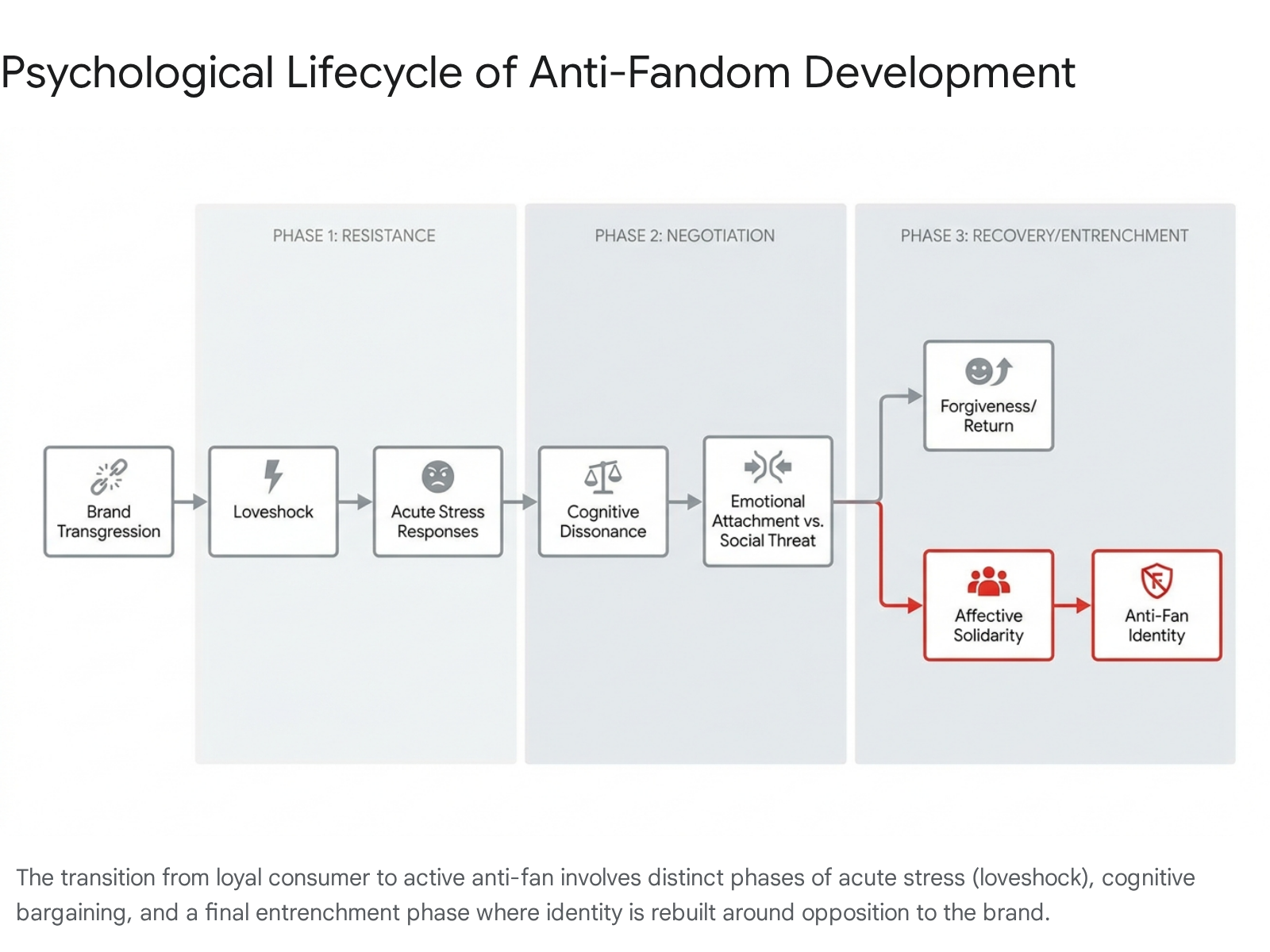
The process of renouncing a brand or idol unfolds in three distinct phases: 1. The Resistance Phase: The consumer experiences acute stress and somatic symptoms due to the initial shock of the betrayal. This phase is marked by denial and severe psychological discomfort as the individual's constructed identity - which was intimately tied to the brand - is fundamentally threatened 22. 2. The Negotiation Phase: The consumer grapples with cognitive dissonance, weighing their deep emotional attachment and behavioral dependence against the social threat of remaining loyal to a compromised entity. They bargain internally, trying to justify or condemn the brand's actions across various cognitive frameworks 22. 3. The Entrenchment Phase: If the consumer decides to sever the relationship, they reconstruct their identity in opposition to the brand. In this phase, anti-fandom becomes a coping mechanism. The former fan finds "affective solidarity" in communities of fellow haters, realizing that shared animosity can produce as much community cohesion, identification, and social currency as shared love 202324.
To distinguish between standard consumer dissatisfaction and entrenched anti-fandom, researchers evaluate the underlying motivations, social dynamics, and behavioral outputs.
| Characteristic | Dissatisfied Consumer | Entrenched Anti-Fan (Compulsive Critic) |
|---|---|---|
| Core Motivation | Resolution of a specific grievance, product replacement, or financial restitution. | Moral validation, identity reinforcement, and inflicting sustained damage to the brand's reputation. |
| Community Engagement | Individualized; generally acts alone or complains directly to customer service channels. | Highly social; actively seeks out "affective solidarity" in dedicated hate communities and forums. |
| Behavioral Output | Sporadic complaints, passive avoidance, transitioning to competing brands. | Continuous monitoring, creating anti-fan art, targeted harassment, initiating organized boycotts. |
| Response to Apology | Open to recovery; negative word-of-mouth typically ceases if restitution is perceived as fair. | Highly resistant; views apologies as manipulative PR tactics; negative word-of-mouth persists. |
| Identity Linkage | Brand is viewed functionally; low to moderate impact on personal self-concept. | Brand opposition becomes a core pillar of the individual's digital and social identity. |
Table 2: Differentiation between standard consumer dissatisfaction and anti-fandom behavior. 2025262728
Social Media Architecture and Compulsive Criticism
The rapid proliferation of digital platforms has fundamentally altered how consumer dissatisfaction is expressed and amplified. Social media is no longer a niche pastime; it is the primary environment in which social life, identity formation, and emotional feedback unfold 17. The architectural design of these platforms plays a causal role in the normalization of compulsive criticism and the aggregation of anti-fandoms.
Algorithmic Amplification and Cyber Harm
A 2024 systematic review synthesizing data from over 1.1 million children, adolescents, and young adults established robust associations between problematic social media use - defined as compulsive engagement that interferes with daily life - and severe psychological distress, including depression, anxiety, and sleep deprivation 1317. The distress is not solely a product of time spent online, but a direct consequence of how platforms are engineered. Features such as infinite scrolling, algorithm-driven content cycles, and randomized social reinforcement mimic the neurological triggers of substance dependence, specifically altering dopamine regulation 131718.
In this environment, "cyber harm" - the malicious use of digital technologies to harass or persecute entities - is not merely tolerated but structurally enabled by the attention economy. Platforms that monetize outrage and reward volatility externalize their societal costs while amplifying the dynamics that fuel anti-fandom 15. When a consumer expresses dissatisfaction, recommendation loops aggregate similar grievances, surrounding the user in an echo chamber of negativity. This algorithmic validation transforms a fleeting irritation into a rigid ideological stance, fostering communities where users compete for social status through increasingly extreme vitriol against the targeted brand 1523.
Triggers for Accidental Anti Fan Creation
Brands frequently engineer their own worst critics through strategic missteps that violate the implicit psychological contracts they hold with their audiences. While minor product failures generate standard dissatisfaction, profound brand hate is typically triggered by perceived arrogance, betrayal of core values, or cultural disrespect.
Artificial Scarcity Tactics and Consumer Alienation
In the luxury sector, exclusivity is a primary driver of brand equity. However, when exclusivity tactics cross the line into perceived exploitation, they generate intense consumer resentment. The practice of artificial scarcity - intentionally producing fewer goods than actual market demand to inflate perceived value - deeply frustrates genuine enthusiasts and loyalists 429.
For example, Rolex's artificial scarcity model has alienated first-time buyers and longtime collectors alike, who feel exploited by massive waitlists and a sprawling grey market where prices vastly exceed retail 29. This strategy, while boosting short-term perceived value, breeds long-term resentment. Similarly, in 2024, Hermès faced a high-profile antitrust and unfair business practices lawsuit in California over its system for allocating its iconic Birkin bags. Plaintiffs alleged that the brand leveraged the unique desirability and low supply of the bags to force consumers into purchasing ancillary products just to be granted the "opportunity" to buy a Birkin 30. Such schemes violate consumer perceptions of fairness and equity, transforming passionate aspirants into vocal critics who view the brand as structurally predatory and manipulative 930.
Perceived Corporate Hypocrisy and Ethical Transgressions
The contemporary consumer demands authenticity and corporate social responsibility. When brands make ethical claims that are later exposed as fraudulent or hypocritical, the resulting cognitive dissonance creates immediate anti-fandom. Corporate social irresponsibility is consistently cited as a primary predictor of brand hate, as it generates intense feelings of disgust, disappointment, and moral outrage 1410.
In 2024, Gucci faced a federal lawsuit over "fraudulent" claims that its exotic skin products were ethically sourced, exposing a rift between marketing narratives and operational realities 30. Concurrently, investigations by Italian authorities into luxury giants Dior and Armani exposed severe labor exploitation in their supply chains. The harsh footage of sweatshop conditions stood in stark contrast to the meticulously curated aura of prestige and craftsmanship these houses project 31. When a carefully constructed brand narrative shatters, consumers experience profound disillusionment. Data indicates that over 50 million people have ceased purchasing from certain luxury brands due to "broken promises," viewing these ethical lapses as a fundamental betrayal of the premium prices they paid 31.
Attempts to artificially manufacture authenticity also trigger rapid backlash. Victoria's Secret experienced a massive exodus of customers who felt profoundly betrayed by the brand. Despite a highly publicized rebranding effort that replaced their iconic "Angels" with a more diverse collective, the deep-seated perception of an outdated, exclusionary, and harmful brand identity persisted. Consumers viewed the pivot not as genuine progress, but as cynical corporate maneuvering, making it exceedingly difficult for the brand to regain relevance in a market that champions genuine representation 29.
Cultural Misalignment and Geopolitical Transgressions
In globalized markets, particularly within Asia, cultural sensitivity and national pride are paramount. Miscommunications or perceived disrespect can rapidly ignite highly organized, nationalistic boycotts. Striking the right balance between global fashion norms and local traditions is perilous, as demonstrated by the furor surrounding designer Rick Owens' avant-garde attire at Beijing's Forbidden City, which clashed severely with local cultural expectations 32.
Political and diplomatic sensitivities require meticulous navigation. The 2024 Uniqlo controversy - where a mistranslation in a BBC interview suggested the brand's CEO would refuse to use Xinjiang cotton - led to a massive diplomatic storm and immediate consumer boycotts in China 32. High-spending cohorts react fiercely if their cultural or national identities are disrespected, as seen when Nike faced intense backlash over a viral Olympic advertisement perceived as disrespectful to Chinese national pride 3233.
Furthermore, the concept of "luxury shaming" - criticizing overt displays of wealth amid broader economic hardship - gained significant traction among millennials and Generation Z in 2024. Balenciaga's introduction of a $3,300 bracelet designed to look like a roll of ordinary packing tape drew intense, polarized responses on Chinese social media, with many viewing it as an arrogant mockery of working-class aesthetics rather than avant-garde fashion 3233. These incidents demonstrate that ignoring the socio-economic and cultural contexts of a target demographic converts brand visibility into active brand hostility.
| Brand Entity | Nature of Transgression | Consumer Reaction and Commercial Outcome |
|---|---|---|
| Hermès | Artificial scarcity and "tying" practices for Birkin bag allocations. | Antitrust lawsuits; perception of predatory exploitation among highly invested consumers. |
| Dior / Armani | Labor exploitation investigations contradicting luxury craftsmanship narratives. | Severe brand equity damage; contributing to 50 million consumers abandoning luxury sectors over "broken promises." |
| Uniqlo | Mistranslation regarding the sourcing of Xinjiang cotton. | Immediate nationalistic boycotts in China; diplomatic escalation. |
| Balenciaga | Pricing a packing tape-inspired bracelet at $3,300. | Triggered "luxury shaming" backlash from Gen Z; viewed as arrogant and tone-deaf to economic realities. |
Table 3: Summary of corporate transgressions and resulting consumer backlash mechanisms. 30313233
The Anti Fan Ecosystem in Asian Entertainment
The intersection of commercial strategy, passionate fandom, and geopolitics is nowhere more volatile than in the East Asian entertainment sector. The mechanics of the idol industry provide a profound case study in how attempting to maximize global revenue can inadvertently engineer militant anti-fandoms.
K Pop and Transnational Fandom Dynamics
The South Korean pop music (K-pop) industry relies heavily on cultivating intense parasocial relationships between idols and fans. Fans believe they are directly responsible for ensuring the career success of their idols by consuming related products, streaming music, and defending the artist's media visibility 1934. To gain fans internationally and establish stable revenue streams outside of South Korea, K-pop agencies actively recruit foreign trainees from countries such as Japan, China, and Thailand 3536.
However, idols in this system are frequently viewed as manufactured commodities rather than independent artists 35. While agencies leverage foreign members for market penetration, they frequently fail to protect these individuals from systemic xenophobia and cultural resentment. Japanese members of prominent K-pop groups - such as Aespa's Giselle, IZ*ONE's Hitomi, and NCT's Yuta - have historically faced severe mistreatment. Despite fluency and rigorous training, foreign idols are routinely given minimal vocal lines, cut from choreography, and excluded from promotional materials, triggering intense outrage from international fans who perceive the agencies as fundamentally biased 44.
Conversely, when geopolitical tensions between South Korea and neighboring nations escalate, the dynamics of fandom invert into political anti-fandom. During the 2019 trade dispute between Korea and Japan, domestic Korean fans weaponized their fandom, organizing hashtag protests (e.g., #Cancel_Japan_Concert) to demand entertainment agencies cancel lucrative Japanese tours. Initiated by fans of groups like EXO and Seventeen, the protests challenged the dominant industry discourse. Fans prioritized their nationalistic identity over their parasocial relationships, arguing that performing in Japan during heightened geopolitical tension was taboo and criticizing agencies for prioritizing capital over patriotism 363738.
The vulnerability of transnational idols was further highlighted when 70,000 Japanese citizens signed a petition demanding the K-pop girl group Aespa be removed from a prestigious Japanese year-end broadcast. The backlash targeted Ningning, a Chinese member, for previously sharing a controversial image related to historical geopolitical grievances 39. In these instances, the corporate attempt to maximize transnational commercial appeal directly collides with localized cultural identities, birthing highly organized, politically motivated anti-fans.
The 227 Incident and Chinese Cancel Culture
The most extreme manifestation of commercial disruption by an organized anti-fandom is evident in the "227 Incident" in China, which fundamentally altered the landscape of celebrity endorsement and brand risk management.
In early 2020, fans of the highly lucrative Chinese actor Xiao Zhan discovered a piece of homo-romantic fan fiction hosted on the global platform Archive of Our Own (AO3) that they felt demeaned his image 4840. Engaging in aggressive protective fan labor, Xiao Zhan's core fanbase orchestrated a mass reporting campaign to Chinese state censors, arguing the content violated core socialist values and endangered minors. This resulted in the total banning of the AO3 platform behind the Great Firewall 4840.
The destruction of AO3 - a beloved repository for creative freedom - enraged millions of users across various subcultures, triggering an immediate and devastating retaliatory campaign. Because these aggrieved individuals could not strike back at the state censorship apparatus or the powerful corporate entertainment agencies, they directed their absolute fury at Xiao Zhan himself. They formed an organized anti-fandom known as the "227ers," named for the date the incident escalated, February 27 40.
The 227ers recognized that the most effective way to "cancel" the actor was through his commercial ties. They systematically targeted the brands he endorsed - including major multinational corporations like Estée Lauder, Olay, and Budweiser. They flooded brand social media channels with negative word-of-mouth, launched coordinated boycotts, requested fapiao (official tax invoices) to disrupt accounting departments, and aggressively demanded that advertisers drop him 154840. The incident illustrates a critical evolution in consumer behavior: modern anti-fans understand the structural mechanics of the attention economy and will weaponize corporate revenue streams to exact ideological revenge 1541. While Xiao Zhan eventually recovered his commercial standing due to immense backing by capital, the incident exposed a massive gap in brand PR strategies, demonstrating that partnering with polarizing figures who possess militant fanbases carries inherent, uncontrollable commercial risk 484142.
Commercial Consequences of Compulsive Critics
The financial toll of organized anti-fandom is severe and multifaceted. Brand hate leads directly to brand equity erosion, manifesting through online complaints, offline negative word-of-mouth, and ultimately, non-repurchase behaviors that damage the bottom line 1412.
Negative Word of Mouth and Brand Equity Erosion
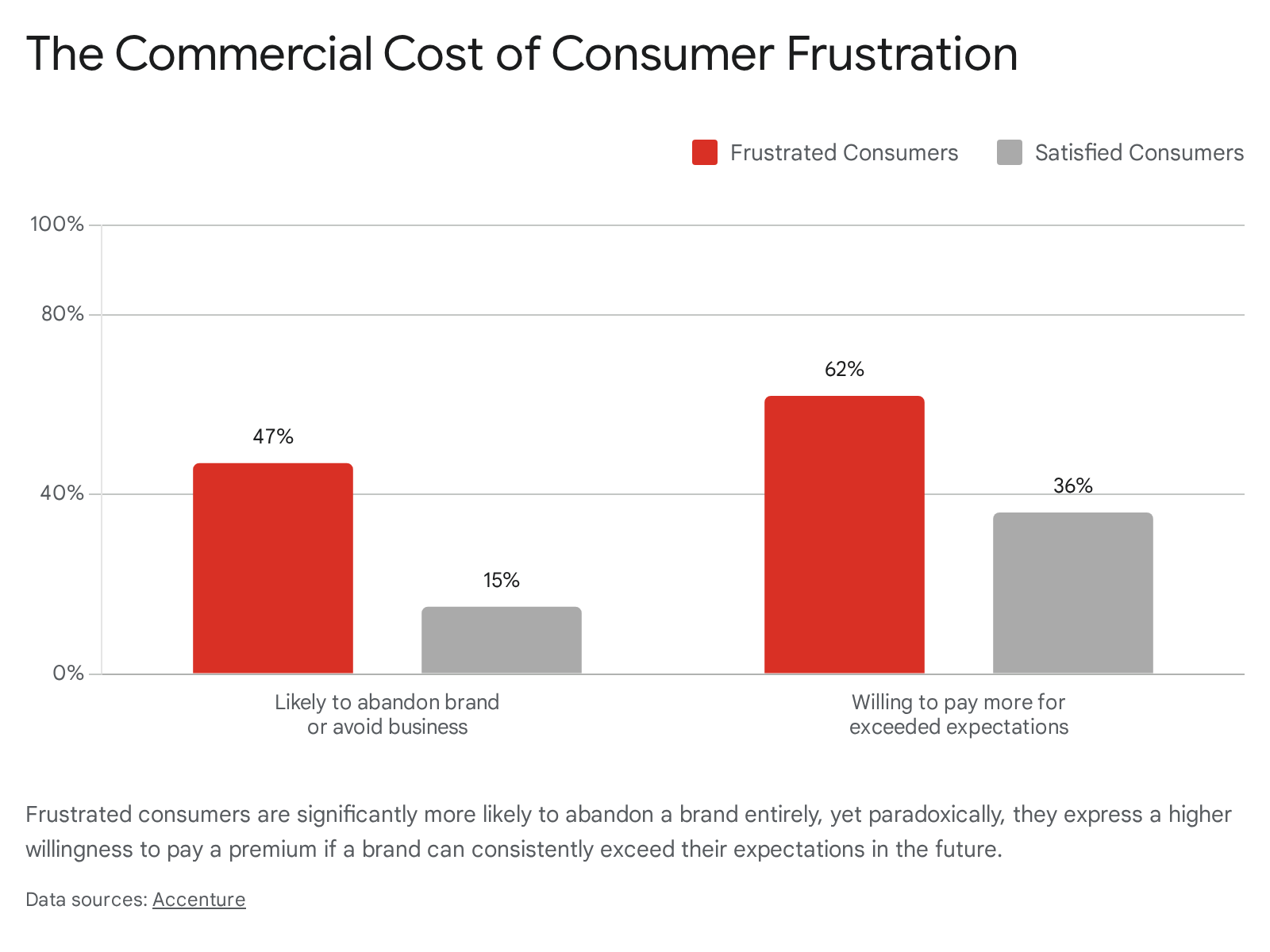
The impact of a frustrating consumer experience extends far beyond a single lost sale. A comprehensive 2019 Accenture study encompassing over 20,000 consumers across 19 countries revealed the disproportionate damage caused by negative experiences 43.
The data indicates that of the 42% of consumers who reported frustration with a brand, 47% stated they would avoid doing business with the offending company entirely - making them three times more likely to abandon the brand than satisfied consumers 43.
The situation is compounded by the digital transmission of negative word-of-mouth (NWOM). NWOM is not only spread by former loyalists but is actively amplified by fans of rival brands. Social identity theory explains that highly identified fans of a competing brand experience schadenfreude (pleasure derived from another's misfortune) when a focal brand stumbles. Consequently, they aggressively transmit the focal brand's NWOM to reinforce their own in-group superiority, artificially expanding the reach of the PR crisis 4445.
The cost of countering this negative narrative is astronomical, given the realities of the modern attention economy. For context, to reach a mass audience capable of resetting a brand narrative, companies must rely on marquee broadcast events. The cost of a 30-second commercial during the Super Bowl - one of the last remaining monocultural events capable of reaching over 100 million simultaneous viewers - escalated to an estimated $8 million in 2026 46. The sheer expense required to override organic, algorithmic brand hate underscores the severe financial liability of allowing an anti-fandom to entrench itself.
Strategic Brand Recovery and Radical Transparency
When a brand successfully engineers its own anti-fandom, standard public relations platitudes are entirely insufficient. Anti-fans are highly resistant to traditional marketing rhetoric and possess a sophisticated media literacy that allows them to deconstruct, mock, and meme corporate apologies 2723. Recovering lost brand equity requires a fundamental operational pivot and a commitment to radical transparency.
Apology Formulation and Psychological Forgiveness
Research into consumer forgiveness indicates that brand hate promotes negative word-of-mouth and avoidance behavior robustly prior to any corporate recovery effort 26. However, once a service failure occurs, issuing a highly sincere apology combined with tangible compensation significantly moderates these effects. Specifically, a sincere apology acts as an emotional regulator, sharply reducing relationship termination intentions and mitigating adverse psychological changes in the consumer 26.
The benchmark for radical transparency in brand recovery remains Domino's Pizza's late-2000s turnaround. Facing plummeting customer satisfaction and a reputation synonymous with poor quality, the brand completely avoided defensive posturing. Instead, Domino's launched an unprecedented advertising campaign featuring executives reading harsh, genuine customer criticisms - including statements that the crust tasted like cardboard 474849. This extreme honesty dismantled the cognitive dissonance typically inherent in corporate crises. By publicly validating their harshest critics, Domino's effectively disarmed their anti-fans. They followed this communicative strategy with immediate, tangible action: completely revamping their core pizza recipe through extensive taste testing and investing heavily in supply chain transparency and digital tracking 4849.
Operational Overhauls and Policy Implementation
Concrete actions that address the root causes of reputation problems are the only metrics entrenched critics respect 47. When United Airlines faced a massive viral backlash in 2017 after a passenger was violently removed from an overbooked flight, the brand's initial defensive response severely damaged its equity 50. Recovery only began when the airline implemented a customer-focused policy overhaul. They vastly increased compensation limits for denied boarding, fundamentally changed employee protocols regarding passenger removal, and invested heavily in customer service de-escalation training 50.
Similarly, when Starbucks faced a severe racial bias incident in one of its Philadelphia stores, the company did not rely solely on press releases. They executed a highly visible, financially costly operational halt, closing thousands of stores nationwide for an afternoon to conduct mandatory racial bias training for all employees 4748. This action signaled a willingness to prioritize core ethical values and customer dignity over immediate short-term profit.
This approach echoes the historical precedent set by Johnson & Johnson's 1982 Tylenol recall. Following a crisis where capsules were tampered with, the company absorbed massive financial losses to recall 31 million bottles nationwide to ensure public safety, prioritizing consumer well-being above corporate defense 4748. This proactive step not only restored confidence but actually strengthened the brand's long-term reputation for integrity 47.
Ultimately, anti-fandoms are born in the psychological gap between a brand's projected image and its operational reality. Closing that gap through ethical consistency, transparent communication, and respect for consumer intelligence is the only definitive mechanism for neutralizing brand hate and dismantling the compulsion of the modern critic.