
Psychology of brand switching and consumer defection factors
Introduction
The conceptualization of brand loyalty - long revered as the ultimate objective of marketing strategy and consumer psychology - is undergoing a profound and unprecedented erosion. A convergence of macroeconomic volatility, algorithmic and frictionless commerce, and shifting socio-cultural paradigms has engineered a consumer landscape defined by extraordinary fluidity. Recent empirical data and large-scale demographic studies reveal that brand defection is no longer a fringe behavior isolated to highly price-sensitive demographics; it has materialized as a central, defining characteristic of the global market. According to exhaustive consumer research tracking behaviors into 2024 and beyond, brand loyalty is weakening symmetrically across all age cohorts, geographic regions, and income brackets, driven by a complex interplay of psychological, situational, and dispositional factors 1.
Historically, older consumers exhibited strong habitual loyalty, serving as reliable, foundational anchors for legacy brands. Today, however, they are empirically just as likely as younger generational cohorts to explore new brands, abandon incumbent retailers, and fundamentally alter their purchasing habits . Concurrently, younger consumers - raised in an era characterized by infinite digital choice and algorithmic discovery - exhibit highly sophisticated brand-switching behaviors. These younger cohorts increasingly prioritize immediate tangible value, aesthetic parity, and resonant community experiences over historical brand allegiance 3. In advanced markets alone, over a third of consumers report experimenting with entirely different brands within a given quarter, while approximately forty percent have actively switched their primary retailers in pursuit of superior pricing or digital convenience 12.
Understanding this pervasive climate of defection requires a highly multidisciplinary approach. It necessitates drawing upon classical behavioral economics, human migration theories recently adapted for service marketing, and modern cognitive psychology. This report delivers an exhaustive, expert-level analysis of the psychological architecture underlying brand switching. By deconstructing robust theoretical frameworks such as the Push-Pull-Mooring (PPM) model, prospect theory, and cognitive dissonance, this analysis delineates the exact mechanisms driving consumers away from incumbent brands. Furthermore, it contrasts modern situational catalysts - such as inflation-induced "price paranoia," the rapid proliferation of dupe culture, and the double-edged sword of frictionless digital environments - against innate dispositional traits like variety-seeking behavior. Finally, it explores how these psychological triggers manifest uniquely across varying levels of product involvement (e.g., fast-moving consumer goods versus retail banking) and distinct cultural dimensions (individualistic Western markets versus collectivistic non-Western markets).
Theoretical Frameworks for Consumer Defection
To accurately map the psychological architecture of brand switching, researchers rely on robust theoretical paradigms that explain human decision-making under conditions of economic uncertainty, choice abundance, and cognitive strain.
The Push-Pull-Mooring (PPM) Model
Originally developed in demographic and sociological studies to explain human geographic migration - tracing back to Ravenstein's classical "Laws of Migration" and later formalized by Moon - the Push-Pull-Mooring (PPM) model has been highly successful in its adaptation by consumer psychologists to explain service provider and brand switching behavior 3456. The framework posits that a consumer's decision to defect from an incumbent brand is rarely the result of a single isolated variable. Instead, the behavior is the net outcome of three interacting, dynamic forces: push effects, pull effects, and mooring effects 37.
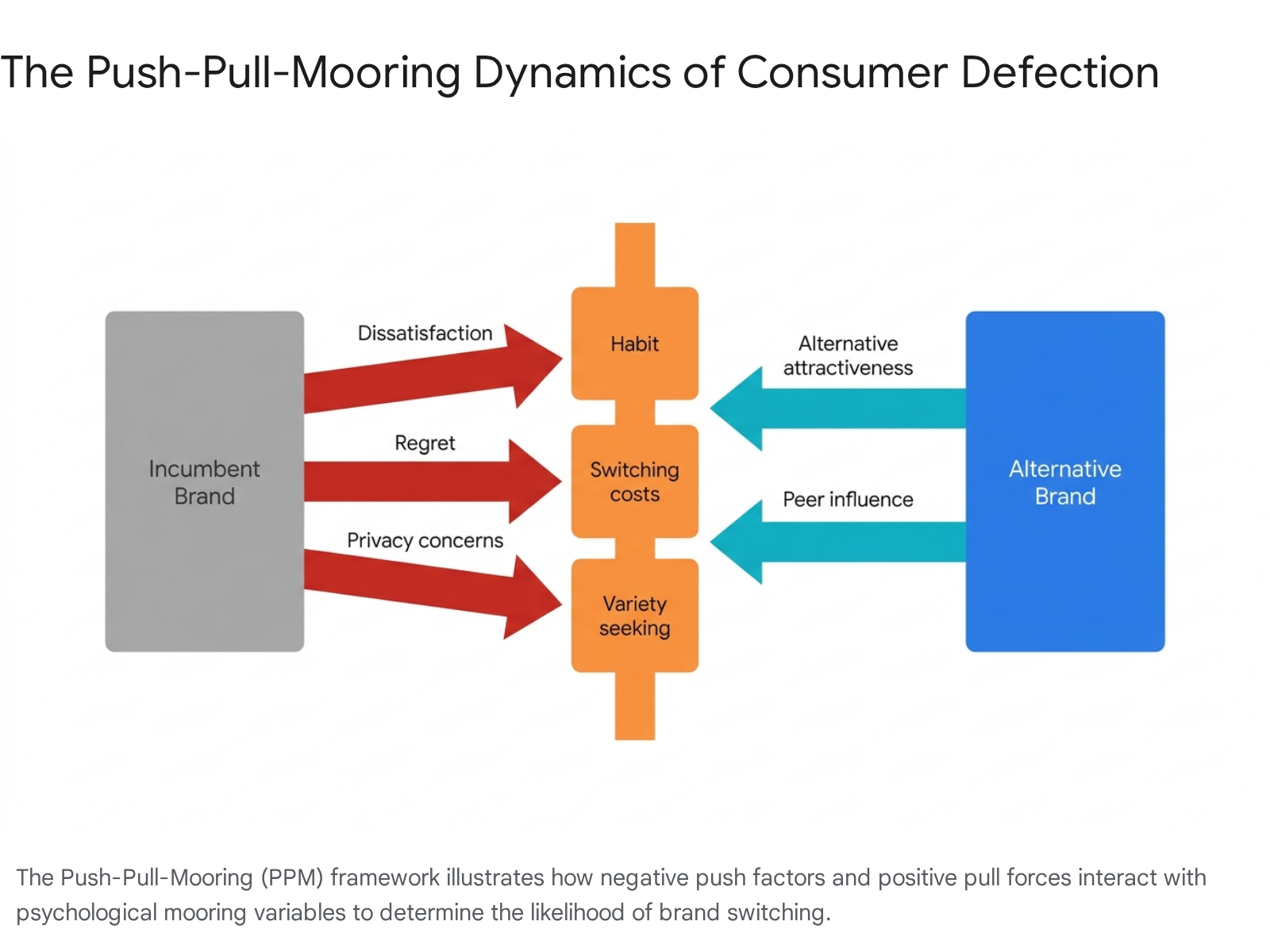
Push factors constitute the negative attributes, failures, or aversive experiences associated with the incumbent brand that actively drive the consumer away. In the foundational applications of the PPM model, general dissatisfaction was considered the most prominent push factor 56. However, contemporary cognitive psychology recognizes that mild dissatisfaction alone is often insufficient to trigger actual defection due to behavioral inertia. Regret, a highly cognitive and deeply emotional response, has recently been identified as a significantly stronger predictor of brand defection than mere dissatisfaction, particularly in high-involvement categories such as consumer electronics 38. When consumers experience post-purchase regret - often stemming from unmet expectations or the sudden realization that a functionally superior choice was readily available - they develop an active psychological aversion to the incumbent brand. Other critical push factors identified in recent literature include perceived low systemic quality, unresponsiveness to consumer feedback, and information privacy concerns. The latter has emerged as a primary driver of defection in digital services, e-commerce platforms, and mobile applications, where a perceived breach of trust permanently severs the brand-consumer relationship 69.
Pull factors, conversely, are the positive, attractive attributes of competing brands that actively draw the consumer toward a new choice. Alternative attractiveness is the dominant pull factor across the literature, encompassing superior pricing architectures, enhanced technological features, highly responsive customer service, or a more resonant corporate ethos 347. In an era characterized by algorithmic discovery and hyper-targeted advertising, alternative attractiveness is constantly thrust into the consumer's cognitive field via social media feeds, bypassing intentional search behaviors 1213. Additionally, subjective norms - encompassing the influence of peer groups, family recommendations, and online community consensus - act as incredibly powerful pull mechanisms. If a consumer's social circle collectively validates a competing brand, the resulting social value pulls the consumer toward defection. This phenomenon proves particularly potent in highly collectivistic cultures where social harmony dictates consumption 910.
Mooring factors function as the personal, social, and situational variables that either inhibit or facilitate the ultimate switching decision. They act as critical moderators between the repelling push forces and the attracting pull forces 34. High switching costs - whether they are financial, procedural, or purely psychological - act as heavy moorings, keeping dissatisfied consumers tethered to an incumbent brand out of sheer convenience or fear of disruption 5. Conversely, personal innovativeness, high technological literacy, and innate variety-seeking traits act as facilitators, loosening these psychological moorings and making defection highly likely even if push factors are relatively weak 49. Habit, deep emotional commitment, and active brand community engagement function as powerful psychological moorings that can often override the logical, economic appeal of pull factors 311.
| PPM Component | Psychological Definition | Key Variables in Consumer Research | Market Manifestation & Impact |
|---|---|---|---|
| Push Factors | Negative perceptions or experiences driving a consumer away from their origin (incumbent brand). | Dissatisfaction, post-purchase regret, perceived low quality, information privacy concerns, unmet desires 368. | Active avoidance of legacy brands; abandonment of digital platforms following privacy breaches; brand fatigue. |
| Pull Factors | Positive, alluring attributes of an alternative destination (competing brand). | Alternative attractiveness, favorable subjective norms, superior pricing, peer validation, perceived technological advantage 4710. | Migration to disruptive startups; adoption of highly reviewed substitute products; algorithmically suggested impulse purchases. |
| Mooring Factors | Intervening personal, social, or environmental variables that facilitate or inhibit the migration decision. | Switching costs, variety-seeking traits, personal innovativeness, deeply ingrained habits, emotional commitment 349. | Retention despite dissatisfaction (due to high switching costs); or rapid defection despite satisfaction (due to high variety-seeking). |
Prospect Theory and Loss Aversion
To fully grasp why consumers sometimes defect with alarming speed and why they sometimes remain paralyzed in suboptimal habitual loops, one must integrate prospect theory, developed by behavioral economists Daniel Kahneman and Amos Tversky 12. A core tenet of prospect theory is that human beings do not make decisions based on absolute, rationally calculated utility - as traditional Expected Utility Theory assumes - but rather, they evaluate choices based on perceived gains and losses relative to a specific, internal baseline reference point 13.
Crucially, the psychological pain resulting from a loss is experienced roughly twice as intensely as the psychological pleasure derived from an equivalent gain. This profound cognitive bias is known as loss aversion 1213. In the direct context of brand switching, loss aversion frequently acts as a formidable psychological mooring factor. When a consumer contemplates abandoning an incumbent brand for a new competitor, they automatically weigh the potential gains (e.g., a moderately cheaper price, a novel product feature) against the potential losses (e.g., the risk that the new product will fail, the cognitive time spent learning a new interface, the forfeiture of accumulated loyalty program points) 12. Because potential losses loom disproportionately larger in the consumer's mind than equivalent gains, individuals exhibit a profound cognitive bias toward the status quo. Consumers frequently choose to remain with an incumbent brand even when an objective, mathematical analysis indicates that a competitor offers objectively superior value 12.
However, when external situational triggers forcibly reframe the consumer's reference point, defection occurs rapidly. For example, if an incumbent brand introduces hidden fees, subtly reduces product sizes (shrinkflation), or drastically raises prices, the consumer suddenly perceives their continued loyalty not as the safe, comfortable status quo, but as an active, ongoing financial loss 18. This reframing triggers an immediate, loss-averse reaction to halt the "bleeding," thereby transforming previously passive, habituated consumers into highly active defectors eager to punish the offending brand 14. The way pricing and discounts are framed also heavily influences this defection velocity; a brand that frames a purchase as "avoiding a loss of value" often captures market share more effectively than a brand framing the identical transaction as "gaining savings" 1318.
Cognitive Dissonance and Post-Purchase Rationalization
Leon Festinger's seminal Theory of Cognitive Dissonance provides another critical, empirically validated lens for understanding brand defection 815. Cognitive dissonance occurs when an individual simultaneously holds contradictory beliefs, or when their observable behavior fundamentally contradicts their internal self-image, resulting in acute psychological tension and mental discomfort 815.
In modern consumer behavior, dissonance frequently arises during intense pre-purchase choice anxiety, or subsequently as post-purchase buyer's remorse 15. If a consumer actively chooses a brand but subsequently encounters highly negative peer reviews, or realizes a vastly superior alternative was available at a fraction of the cost, a severe psychological discrepancy arises between their aspiration (being a smart, savvy shopper) and their reality 8. To resolve this uncomfortable psychological tension, consumers generally attempt to rationalize the purchase, selectively seeking supportive information and ignoring contradictory evidence 815.
However, if the dissonance is too great to be rationalized away, it permanently crystallizes as profound consumer regret 8. Regret fundamentally fractures the foundational trust required for brand loyalty. Recent academic studies indicate that regret - particularly what is termed "digital regret" arising from poor online product expectations or inadequate return policies - lowers trust in platforms and brands far more severely than general dissatisfaction 8. When cognitive dissonance results in unresolved regret, the consumer actively seeks to repair their damaged self-image by aggressively severing ties with the offending brand. This mechanism guarantees future defection, as the consumer seeks out alternatives that better align with their desired self-perception 15.
True Brand Loyalty vs. Habitual Purchasing
As the underlying psychological mechanisms of defection are deconstructed, an uncomfortable reality emerges for brand managers and behavioral analysts: much of what has historically been classified as robust "brand loyalty" was merely unexamined consumer habit and inertia.
Cognitive psychology and traditional marketing models have long prioritized the cultivation of attitudinal and affective loyalty. This framework posits that consumers repeatedly purchase a specific brand because they share a deep, emotional bond with its ethos, advocate for it openly, and possess a conative desire to remain loyal regardless of competitor actions 1617. While this undoubtedly holds true for certain high-involvement, highly differentiated prestige brands, empirical evidence suggests that for the vast majority of day-to-day commerce, repeated purchasing is driven predominantly by behavioral loyalty, or sheer automaticity 161718.
The scientific literature surrounding habit dictates that automatic behavior is sustained by a continuous, unbroken loop of situational triggers and psychological rewards 18. When a consumer navigates a supermarket aisle and repeatedly purchases the exact same brand of dish detergent, they are rarely doing so out of a deep emotional connection to the soap. Rather, they are engaging in a low-cognitive, heuristic-driven shortcut designed exclusively to minimize choice anxiety and conserve mental energy 151718. This dynamic is not loyalty; it is behavioral inertia.
Consumer buying behavior is broadly classified into four typologies: complex buying behavior, dissonance-reducing buying behavior, variety-seeking buying behavior, and habitual buying behavior 19. Habitual buying occurs precisely when involvement is low and perceived differences among brands are negligible 19. The distinct danger for businesses in the modern era lies in mistaking this fragile inertia for emotional commitment. When digital ecosystems, algorithmic recommendations, and frictionless payment models seamlessly remove the old physical triggers of the habit loop, and subsequently introduce variable new rewards (e.g., targeted flash sales, gamified discounts), the behavioral loop is instantly broken 1318. The consumer awakens from their state of automaticity, rapidly realizes they possess no true emotional tether to the incumbent brand, and defects without a second thought. True brand loyalty, therefore, requires continuous, proactive value generation that engages the consumer emotionally and cognitively beyond the mere utility of a repeated transaction 3.
Dispositional Triggers: Variety-Seeking Motives
While macroeconomic shocks and digital environments provide the situational context for brand switching, certain psychological predispositions guarantee a baseline level of defection regardless of external stability. Variety-seeking buying behavior is a prominent dispositional trait characterized by a consumer's innate tendency to switch brands not out of dissatisfaction, but out of an inherent, biological need for novelty and cognitive stimulation 1925.
This specific dispositional behavior is most prevalent in low-involvement purchasing scenarios, where the financial, social, and psychological risks associated with making a suboptimal choice are virtually non-existent 1926. When consumers face a vast, undifferentiated array of products (e.g., beverages, potato chips, fast fashion, cosmetics), repeated selection of the exact same brand - even a highly satisfactory one - eventually leads to sensory or psychological satiation 102520. Variety-seeking consumers derive a distinct, measurable psychological pleasure from the act of discovery itself, viewing brand switching as an expression of personal freedom, autonomy, and control over their environment 1928.
Interestingly, retail psychological studies tracking consumer behavior across socioeconomic strata indicate that lower socioeconomic status (SES) consumers often exhibit disproportionately higher rates of variety-seeking in small-ticket, low-involvement items. In these instances, the behavior functions as a vital compensatory mechanism, allowing lower-income consumers to exercise a tangible sense of autonomy and choice in accessible product categories when larger, systemic financial freedoms are heavily restricted 28. Furthermore, traits such as impulsiveness and personal innovativeness amplify this variety-seeking behavior. Impulsive consumers, operating primarily on intuitive "System 1" thinking, are highly susceptible to peripheral cues and will readily abandon an incumbent brand simply to experience the immediate gratification of a novel alternative 1321.
Situational Triggers in the 2024-2026 Landscape
While dispositional traits explain the baseline hum of market churn, the period between 2024 and 2026 has introduced severe situational triggers that have accelerated brand defection to unprecedented velocities across all demographics.
Inflation, "Price Paranoia," and the Rise of Private Labels
The sustained, cumulative inflationary pressures of the post-2020 global economy have fundamentally rewritten consumer loyalties. Extensive data across 18 global markets comprising 90 percent of global GDP indicates that price remains the undisputed kingpin of switching behavior; roughly forty percent of consumers globally have actively switched retailers or brands in direct pursuit of better prices and aggressive discounts 12.
However, the psychology of inflation-driven defection has evolved beyond passive, reluctant budgeting. It has transitioned into an active, almost militant consumerism. Leading market analysts at Gartner have declared 2024 and beyond as the era of "The Year of the Wake," identifying a prevailing consumer sentiment categorized as severe "price paranoia" 22. Consumers no longer attribute high prices merely to abstract macroeconomic forces, monetary policy, or residual supply chain disruptions. Instead, they view constant, unpredictable price changes as concrete evidence of corporate gouging and opportunistic profit-padding by mega-brands 22. A staggering 68 percent of consumers express feeling actively exploited and manipulated by brands that utilize dynamic pricing models, and 79 percent report experiencing highly negative, unexpected pricing scenarios such as hidden fees or sudden rate hikes 14.
This profound, systemic mistrust has given rise to a situational behavioral trend categorized as "The New Spartan" or "conspicuous underconsumption" 1422. Consumers are increasingly viewing thrift and brand abandonment not as painful financial necessities, but as aspirational psychological flexes and necessary mechanisms for regaining personal control 1422. A reported 68 percent of consumers cite direct self-improvement motives for intentionally reducing their consumption and resisting corporate marketing 14. By actively delaying purchases, seeking out secondhand alternatives on peer-to-peer marketplaces, or deliberately switching to store-brand private labels, shoppers are engaged in a psychological counter-offensive 2324. The defection to private labels is particularly striking; 36 percent of consumers now plan to purchase private-label products more frequently, and a commanding 60 percent firmly believe that these private brands offer equal, if not superior, quality compared to traditional, legacy national brands 125. In this highly adversarial environment, blind brand loyalty is viewed by the consumer not as a virtue, but as an exploitable vulnerability.
Fascinatingly, despite this severe cost consciousness, McKinsey research identifies a contradictory behavior termed the "squeezed-but-splurging middle" . Middle-income consumers, though highly sensitive to grocery and essential pricing, refuse to abandon discretionary spending entirely. Instead, they strictly compartmentalize their budgets, aggressively trading down on staples (triggering massive FMCG brand defection) to finance premium splurges in experiential categories like travel and dining 23.
Dupe Culture and the Redefinition of Value
Perhaps the most fascinating socio-psychological trend driving brand defection in lifestyle, beauty, and fashion categories is the rapid normalization and overt celebration of "dupe" (duplicate) culture. To understand the psychology of the dupe, one must strictly differentiate it from the counterfeit. Counterfeit goods illegally infringe upon protected intellectual property, bear fake brand logos, and carry a deep psychological stigma of inauthenticity, ethical impropriety, and illegality 262728. Dupes, conversely, are legally manufactured products that closely mimic the broader aesthetic, functional ingredients, or sensory benefits of premium luxury goods at a mere fraction of the cost, without replicating trademarked logos 2627.
The psychology underpinning dupe consumption represents a massive paradigm shift in brand perception. Historically, counterfeit consumption was driven by a deep-seated desire to project false affluence, paired with an underlying psychological fear of social exposure and embarrassment 27. Dupe culture, conversely, is characterized by absolute transparency and communal pride. Driven by highly viral, algorithmic social media formats on platforms like TikTok and Instagram, consumers actively share, review, and boast about discovering high-quality dupes 2729.
The defection from premium, prestige brands to dupe alternatives offers the modern consumer a potent dual psychological reward. First, it directly satisfies the economic imperative to manage limited disposable income wisely amidst ongoing inflation 29. Second, and more importantly, it provides a distinct social and emotional value: the consumer feels financially responsible, highly savvy, and triumphantly immune to the artificially inflated pricing and perceived arrogance of luxury brand hegemony 2930. Academic studies utilizing text analysis and manual coding demonstrate that consumers actively rationalize dupe purchases as smart, ethical shopping, drawing a clear moral line that accepts dupes as valid market alternatives while vehemently rejecting counterfeits 28. This cultural shift transforms brand defection from a shameful act of "trading down" into a celebrated, peer-validated countercultural movement against brand exclusivity 26.
Frictionless Digital Switching and Subscription Churn
A primary, historical mooring factor that effectively prevented brand defection for decades was the procedural switching cost - the physical time, cognitive effort, and administrative friction required to change providers or find alternative products. The modern proliferation of seamless payment infrastructures and frictionless digital ecosystems has systematically eradicated this barrier, fundamentally altering consumer stickiness.
The widespread adoption of frictionless payments - including digital wallets, biometric approvals, and one-click checkouts - produces dual, conflicting psychological effects for businesses. On one hand, it significantly reduces the psychological "pain of paying," leading to higher conversion rates, increased frequency of shopping, and elevated average order values. This is particularly true among Gen Z consumers, who overwhelmingly favor digital-first behaviors and often view digital spending as less "real" than physical cash 31324133. Indeed, 50 percent of surveyed consumers admit they shop more frequently when the payment process feels entirely seamless 32.
On the other hand, the complete removal of friction dictates that abandoning a cart or instantly switching to a competitor is equally effortless 3133. This friction-free environment is most acutely and painfully felt within the subscription economy. Driven by a modern consumer preference for "access over ownership," consumers now manage myriad overlapping subscriptions across entertainment media, enterprise software, and physical wellness goods 3444. However, the ease of digital onboarding is perfectly mirrored by the ease of digital cancellation. Recent industry data from payment processors reveals that the average monthly churn rate for subscription businesses has climbed to an alarming 20 percent 35. Furthermore, acquisition efficiency is plummeting; current trial conversion rates show that a mere 1.7 percent of application downloads translate into actual paying subscribers within the first thirty days 4647.
To combat subscription fatigue, consumers are increasingly demanding centralized control mechanisms, with 77 percent expressing a strong desire to view and manage all recurring subscriptions directly through their primary banking applications 35. The psychological takeaway for brand strategists is severe: when procedural switching costs approach zero, retention cannot rely on the inertia of forgetfulness. Brand loyalty must be continually, actively re-earned through unassailable, daily value delivery 4448.
Algorithmic Nudging and the Erosion of Intentionality
The architecture of digital discovery has forcibly shifted control away from both the incumbent brand and the conscious consumer, placing it squarely within the opaque logic of recommendation algorithms. Platforms such as TikTok and algorithmic e-commerce marketplaces like Amazon now sit as highly intelligent, deterministic layers between the consumer's initial intent and their final purchase decision 49.
Traditional models of brand loyalty relied heavily on consumers deliberately seeking out a preferred, known brand via search engines or physical store visits. Today, predictive algorithms preempt this intentional search. Utilizing vast datasets of behavioral history, recommendation engines proactively push highly relevant, hyper-personalized, and often cheaper alternatives directly into the consumer's feed before the consumer even consciously realizes a need 1350. This relentless algorithmic nudging seamlessly exploits profound cognitive biases, particularly the "availability heuristic," wherein consumers base their purchasing decisions almost entirely on the information and products most readily and effortlessly presented to them 52.
Furthermore, these algorithms heavily leverage behavioral economics to induce rapid, impulsive defection. By utilizing artificially engineered scarcity cues (e.g., dynamic "Only 3 left in stock" labels) and urgent countdown timers, platforms intentionally trigger "System 1" thinking 13. This mode of thought is fast, intuitive, and highly emotional, effectively bypassing and sidelining the slower, rational "System 2" evaluation processes that might otherwise remind a consumer of their existing brand loyalties or long-term financial goals 13. Consequently, consumers are gently but firmly steered toward brand defection, frequently perceiving these algorithmically curated suggestions as their own organic, autonomous choices 52. Social media's impact is undeniably massive in this regard; with 80 percent of consumers making buying decisions based on a friend's or influencer's social media post, the algorithm's ability to prioritize specific viral content directly dictates which brands capture market share and which face sudden obsolescence 53.
Contextualizing Defection: Product Categories and Cultural Dimensions
The psychological triggers that initiate brand defection are not monolithic across the global economy; they vary radically depending on the intrinsic nature of the product and the deep-seated cultural background of the consumer.
High-Involvement Services vs. Low-Involvement Goods
Consumer psychology broadly categorizes purchasing decisions into two distinct paradigms: high-involvement and low-involvement. The velocity and rationale for brand switching differ dramatically between the two.
Low-Involvement (Fast-Moving Consumer Goods - FMCG): Purchases such as routine groceries, toiletries, and basic snacks carry incredibly low financial, social, and psychological risk 26. The decision-making process is abridged, and consumer persuasion occurs primarily via peripheral routes (e.g., attractive packaging, shelf placement, and basic price cues) 2621. In this domain, brand switching is highly frequent, fluid, and heavily influenced by immediate price advantages and localized peer recommendations. Survey data covering Europe, North America, and the APAC region demonstrates that a lower-priced competitor is the absolute primary driver of defection in FMCG, capturing over 42 percent of consumers in advanced Western markets 36.
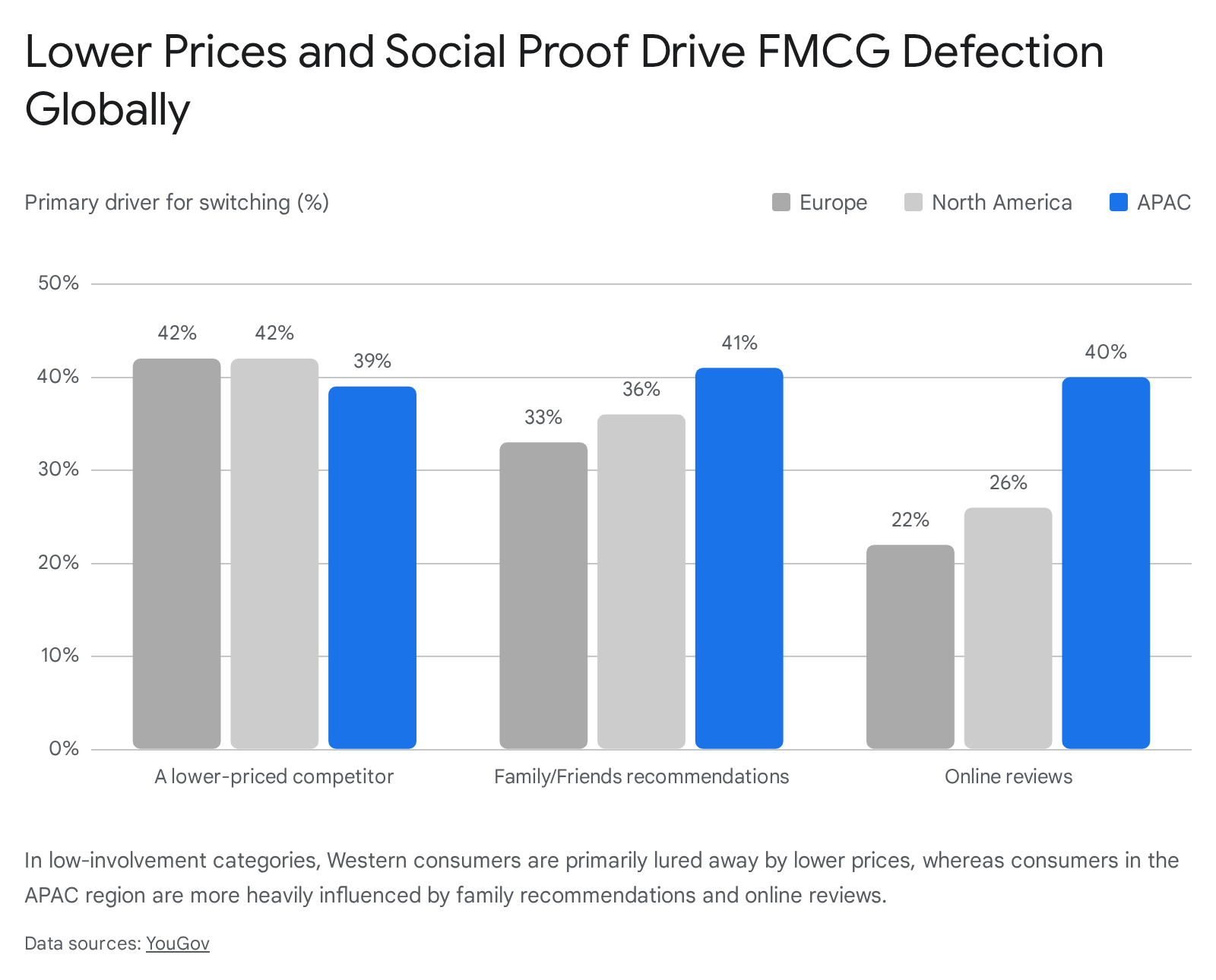
Defection here is rarely the result of deep philosophical misalignment; it is usually driven by habitual disruption, promotional pricing, or the innate variety-seeking trait 1937.
High-Involvement (Banking and Financial Services): Conversely, high-involvement decisions - such as selecting a retail bank, purchasing an automobile, or choosing expensive technological ecosystems - tie deeply into the consumer's ego, self-image, and long-term financial security 26. The cognitive processing required for these decisions is exhaustive, utilizing the central routes of persuasion where consumers critically analyze extensive information 2621. In retail banking, for example, the mooring factors - specifically procedural administrative burdens and deep psychological switching costs - are incredibly dense. Consumers rarely switch banks based on minor, peripheral price fluctuations. Instead, defection in high-involvement sectors requires massive push factors, such as severe, repeated service failures, technological inadequacy, or systemic structural disruptions like local branch closures that force the consumer to break habitual use 3839. Research into banking churn reveals that the ultimate decision to defect is highly correlated with proactive, intensive search behavior; a customer must overcome significant inertia merely to search for alternatives. Demographic variables such as higher education and financial literacy significantly increase the probability of this initial search-and-switch behavior, while the presence of heavy overdraft usage acts as a restrictive mooring 38.
Cross-Cultural Dynamics: Western Individualism vs. Eastern Collectivism
The underlying psychological motivations for brand selection and the specific triggers that precipitate defection differ dramatically across global cultural dimensions.
Individualistic Western Markets: In cultures prevalent across North America and Western Europe, consumer psychology is deeply rooted in the veneration of independence, personal achievement, and overt self-expression 584060. Individualistic consumers generally view brands as utilitarian tools utilized to separate themselves from the crowd and construct a highly unique, independent persona 40. Consequently, their purchasing decisions are far less tethered by social conformity or communal expectations. If a rival brand enters the market offering superior personal utility, more advanced features, or more aggressive pricing, the individualistic consumer will switch brands with minimal cognitive friction or social anxiety 41. They tend to separate the product entirely from its surrounding social context, focusing strictly on its intrinsic, objective attributes and how it serves their immediate personal goals 4060.
Collectivistic Non-Western Markets: In collectivistic cultures, commonly found throughout Asia, Latin America, and the Middle East, personal identity is deeply intertwined with broader community cohesion, social harmony, and group objectives 586041. Consumers in these markets tend to evaluate purchases holistically rather than in isolation, actively looking for symbolic brand connections that reinforce their social status and maintain communal bonds 40. Defection in these markets is therefore highly sensitive to, and often gated by, social influence. Within the parameters of the PPM model, the pull factors in collectivistic markets are heavily dominated by subjective norms; a collectivistic consumer is highly likely to switch brands only if the new brand is perceived to be validated, accepted, and utilized by their immediate peer group or broader community 91041.
Global brands must navigate these dimensions carefully. For instance, messaging promoting aggressive individualism might resonate in the U.S. but falter in Japan, where brands like Toyota succeed by emphasizing "for everyone" communal messaging 6062. Even within seemingly monolithic regions, nuances exist; urban millennials in Eastern markets are increasingly adopting individualistic preferences for tech and lifestyle goods, blending cultural paradigms 62.
Fascinatingly, current macroeconomic data from McKinsey reveals a stark, counter-intuitive divergence in how these distinct cultures are responding to contemporary global economic uncertainty. While younger consumers (Gen Z and Millennials) in advanced, individualistic Western economies are actively trading down to private labels and overtly deprioritizing previously held values - such as environmental sustainability - in favor of strict affordability 25, young consumers in emerging, collectivistic Asian and Middle Eastern markets exhibit immense economic optimism 25. Consequently, these non-Western youths are up to twice as likely to actively trade up, willingly defecting from mid-tier brands to higher-priced, premium products that elevate their social standing within the community 25.
Synthesizing the Triggers: Situational vs. Dispositional Mapping
To synthesize the vast array of variables driving the modern crisis of brand loyalty, the following table explicitly maps the interaction between situational environmental triggers and internal dispositional traits, detailing their psychological mechanisms and real-world market impacts.
| Factor Category | Specific Variable | Psychological Mechanism & Theoretical Basis | Real-World Market Impact |
|---|---|---|---|
| Dispositional | Variety-Seeking Trait | Innate psychological desire for novelty to combat sensory/cognitive satiation; low arousal from routine 1925. | Frequent, low-friction switching in FMCG categories (snacks, cosmetics); fundamentally low baseline brand loyalty 1925. |
| Dispositional | Impulsiveness & Low Cognitive Control | Dominance of intuitive "System 1" thinking; deliberate bypass of rational "System 2" cognitive evaluation 1321. | High susceptibility to algorithm-driven flash sales; rapid, unplanned brand switching on platforms like TikTok 1321. |
| Dispositional | Personal Innovativeness | High individual tolerance for risk; psychological desire to be perceived as an early adopter or trendsetter 4. | Rapid defection to highly disruptive technologies, beta software, or novel service delivery models 4. |
| Situational | Macroeconomic Inflation | Severe budgetary constriction forcing the rationalization of spending and triggering acute loss aversion 1223. | Mass defection to private labels; widespread "price paranoia"; adoption of militant "New Spartan" thrift behaviors 1422. |
| Situational | Dupe Culture Prominence | Peer-validated reframing of value; substituting prestige emulation (counterfeits) with savvy financial optimization (dupes) 2629. | Erosion of luxury brand hegemony; normalization of imitating premium aesthetics without ethical stigma 2830. |
| Situational | Algorithmic Nudging | Curated discovery overriding intentional search; exploitation of the availability heuristic and scarcity cues 4952. | Subversion of incumbent brand visibility; consumers gently steered toward defection via highly personalized, targeted feeds 1349. |
| Situational | Frictionless Commerce | The systemic technological elimination of procedural switching costs and the reduction of the "pain of paying" 3241. | Exceedingly high subscription churn (20%); increased cart abandonment upon encountering minor friction; rapid one-click alternative adoption 323546. |
Conclusion
The psychology of brand defection is no longer a localized anomaly reserved for highly volatile market segments; it has become the dominant, defining current of modern global commerce. Driven by an intricate, overlapping web of dispositional traits - such as innate variety-seeking and digital impulsiveness - and massively accelerated by unprecedented situational forces including inflationary "price paranoia," the cultural normalization of dupes, and the inescapable rise of algorithmic nudging, consumers are exercising their power of choice with unprecedented ruthlessness.
The rigorous application of established theoretical models, notably the Push-Pull-Mooring framework and prospect theory, reveals that modern defection is fundamentally a delicate balancing act. The consumer is constantly weighing the psychological aversion to loss against the relentless pursuit of superior alternative value. As digital switching costs approach absolute zero, the procedural moorings that once held dissatisfied or indifferent consumers in place are vanishing completely. Brands can no longer passively rely on the mere inertia of historical purchasing habits or the high friction of switching to retain their user base.
To survive in an era characterized by militant underconsumption, where algorithmically curated alternatives are presented to the consumer before a need is even consciously registered, organizations must fundamentally transcend purely transactional relationships. They must deeply understand the distinct cultural dimensions and category-specific triggers of their target audiences, consistently validate the consumer's choice to prevent the onset of cognitive dissonance and digital regret, and actively rebuild genuine, emotionally resonant attitudinal loyalty in a marketplace that structurally and psychologically encourages constant defection.