
Consumer sunk cost fallacy and loyalty to failing products
Theoretical Foundations of the Sunk Cost Effect
In classical economic theory, rational decision-making dictates that only prospective costs and expected future utility should influence choices. This axiom, widely known as the "bygones principle," argues that past expenditures of capital, time, or physical effort are fundamentally unrecoverable and should therefore be strictly excluded from present and future economic decisions 11. According to standard microeconomic models, a rational actor evaluates an ongoing investment based solely on its future expected returns compared against current alternatives 1.
However, foundational research in behavioral economics has repeatedly demonstrated that real-world consumer behavior deviates systematically from this theoretical model. The sunk cost fallacy occurs when individuals persist in a failing endeavor, maintain a suboptimal course of action, or continue consuming an inferior product primarily because of the cumulative prior investments they have made, regardless of the expected future value 243. This cognitive bias was formally delineated in the context of consumer psychology by researchers Hal Arkes and Catherine Blumer in 1985, who demonstrated that individuals exhibit "a greater tendency to continue an endeavor once an investment in money, effort, or time has been made" 4756.
This cognitive bias radically transforms the nature of consumer loyalty. While genuine, organic brand loyalty is typically driven by affective trust, continuous product satisfaction, and high perceived value fairness, the sunk cost fallacy generates what researchers identify as "trapped loyalty" 7. In these scenarios, consumers remain tethered to failing products, outdated ecosystems, or unused digital subscriptions not out of preference or utility, but out of a psychological compulsion to validate and protect prior expenditures 4.
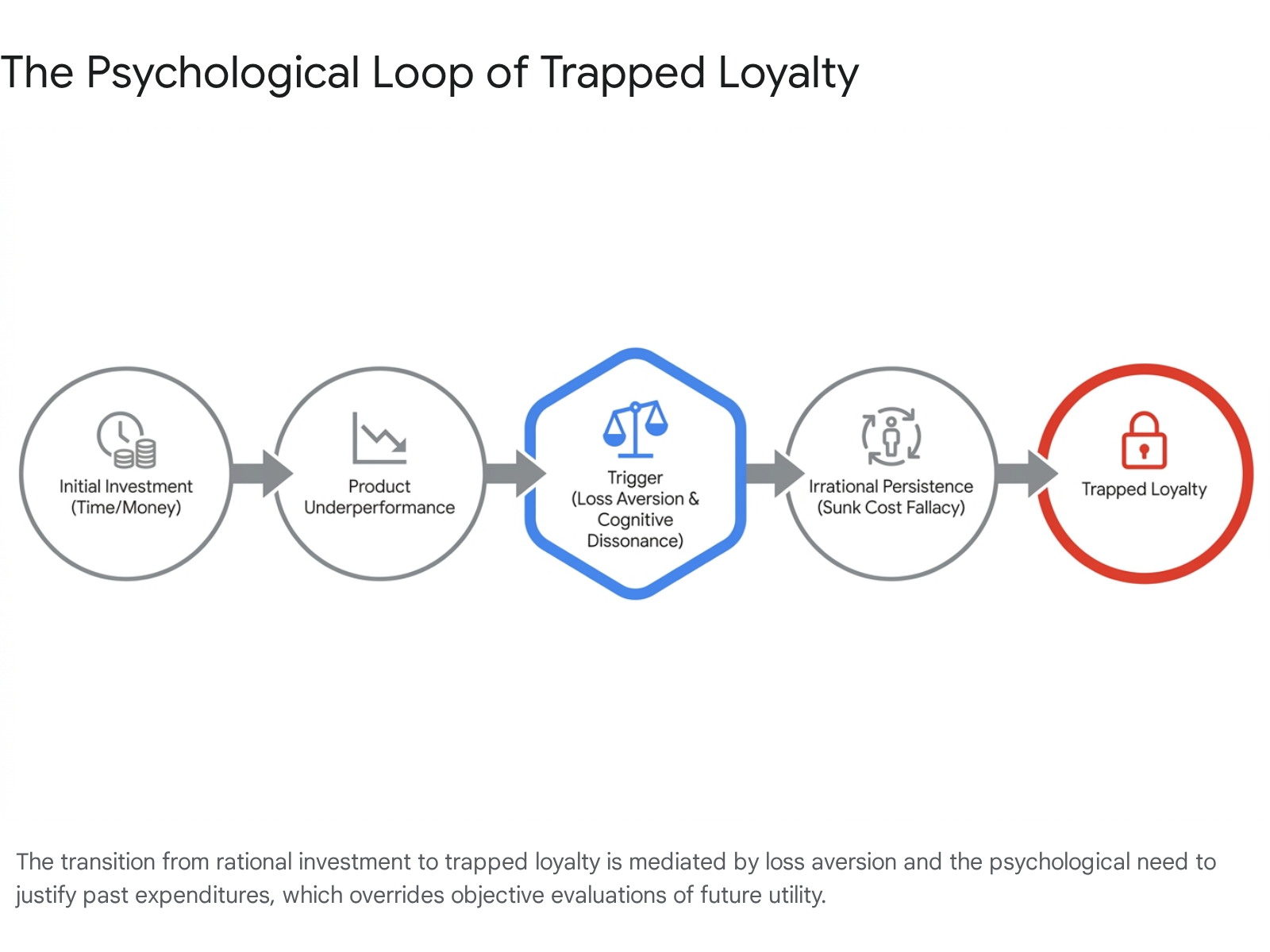
The magnitude of the sunk cost effect is often directly proportional to the scale of the initial investment; larger prior investments of capital or effort generate a stronger psychological compulsion to persist, resulting in a phenomenon colloquially described as "throwing good money after bad" 11128.
| Economic Paradigm | View of Past Investments | Decision-Making Driver | Resulting Consumer Behavior |
|---|---|---|---|
| Classical Economics | Unrecoverable "bygones" to be ignored. | Future utility and prospective opportunity costs. | Rational abandonment of failing products; switching to superior alternatives. |
| Behavioral Economics | Psychological anchors carrying perceived residual value. | Avoidance of realized loss and waste. | Escalation of commitment; "trapped loyalty" to suboptimal products. |
Financial and Behavioral Dimensions of Sunk Costs
The sunk cost fallacy manifests across two distinct axes of consumer investment: financial and behavioral. Financial sunk costs represent straightforward, unrecoverable monetary investments. These include non-refundable subscription fees, high-cost hardware purchases, non-transferable software licensing costs, and upfront service deposits 9. When consumers evaluate whether to upgrade a device or cancel a service, the initial purchase price frequently anchors their decision, even if the asset's current market value or functional utility has depreciated to zero 1.
Behavioral sunk costs, by contrast, involve the unrecoverable expenditure of non-financial resources. This specifically encompasses the time, cognitive effort, and physical energy required to research, select, learn, and integrate a product into a consumer's daily routine 9. Studies indicate that behavioral sunk costs can create switching barriers just as formidable as monetary ones 9. The effort invested in configuring a digital SaaS platform, building a virtual identity and social network in a video game, or learning the idiosyncratic interface of an enterprise software tool generates significant procedural inertia . When consumers consider switching to a demonstrably superior competitor, they must weigh the objective superiority of the new product against the intense psychological friction of abandoning their accrued behavioral investments, which often leads to the retention of the incumbent, failing product 9.
Psychological Mechanisms Driving Sunk Cost Bias
The mechanisms underpinning the sunk cost fallacy are rooted in several interconnected cognitive biases that override rational mathematical calculations. The consumer decision-making process is fundamentally influenced by emotional regulation and identity preservation.
Loss Aversion and Waste Aversion
A primary catalyst for the sunk cost fallacy is loss aversion, a foundational concept in Daniel Kahneman and Amos Tversky's prospect theory. Loss aversion posits that the psychological pain of losing something is experienced roughly twice as intensely as the pleasure of gaining something of equivalent objective value 8101718. When a consumer considers abandoning a failing product in which they have invested heavily, the brain processes the abandonment as an immediate, crystallized loss of the original investment 8. To avoid this emotional pain, the consumer continues to invest resources in the failing endeavor, effectively choosing a prolonged, uncertain loss over a definitive, immediate one 1011.
Closely related to this phenomenon is the concept of waste aversion. Humans are psychologically wired to avoid appearing wasteful to themselves and to their social peers 125. Acknowledging that an expensive piece of hardware is obsolete, or that a year-long subscription is useless, requires the consumer to explicitly admit that their initial capital allocation was a total waste. By continuing to use the suboptimal product or pay the recurring subscription fee, the consumer manufactures a superficial, emotional justification for the original expense, mitigating feelings of acute guilt 3512.
Cognitive Dissonance and Commitment Bias
The sunk cost fallacy is further entrenched by cognitive dissonance - the psychological discomfort experienced when a person's beliefs contradict their behaviors, or when they must confront undeniable evidence that a past decision was poor 41012. Walking away from a heavy investment requires an admission of error, which deeply threatens the individual's self-concept of competence, intelligence, and rationality 221.
To resolve this dissonance, consumers rely heavily on commitment bias. They double down on their original choices, selectively filtering information to find reasons to stay (confirmation bias) and convincing themselves that persistence will eventually yield a return on investment 3712. In high-stakes business contexts, executives may perceive persistence with failing technology implementations as a display of steadfast leadership and resilience, when it is objectively a profound misallocation of ongoing corporate resources 221.
Trapped Loyalty in Digital and Subscription Economies
The exploitation of the sunk cost fallacy varies structurally depending on the product category, but it is perhaps most pronounced in modern digital economies. The global shift toward subscription-based revenue models relies heavily on sunk cost dynamics, status quo bias, and automated billing to elevate switching barriers. The subscription economy has expanded at an explosive rate, growing 435% over the last decade and substantially outperforming standard retail models 1314. Total market valuations for the global subscription economy reached an estimated $492.34 billion in 2024, with projections indicating it will exceed $1.5 trillion by 2033 1314.
However, this model frequently results in severe "subscription fatigue" and extensive consumer financial waste. Consumers are increasingly paying recurring fees for software (SaaS), media streaming, digital news, fitness applications, and retail delivery passes, leading to an oversaturation of recurring financial obligations 131424.
The Financial Blind Spot of Recurring Revenue
Survey methodologies yield alarming estimates regarding the disparity between what consumers believe they spend on subscriptions and their actual financial outlays. Data from CNET's 2024 and 2025 consumer surveys suggest that the average US adult spends approximately $90 to $91 per month (over $1,080 annually) across various subscription services 15. However, specialized financial audits reveal a much wider gap. An analysis by C+R Research indicates that average actual household subscription spending is $273 per month, yet when surveyed, those same consumers estimated their monthly spend at only $111 26.
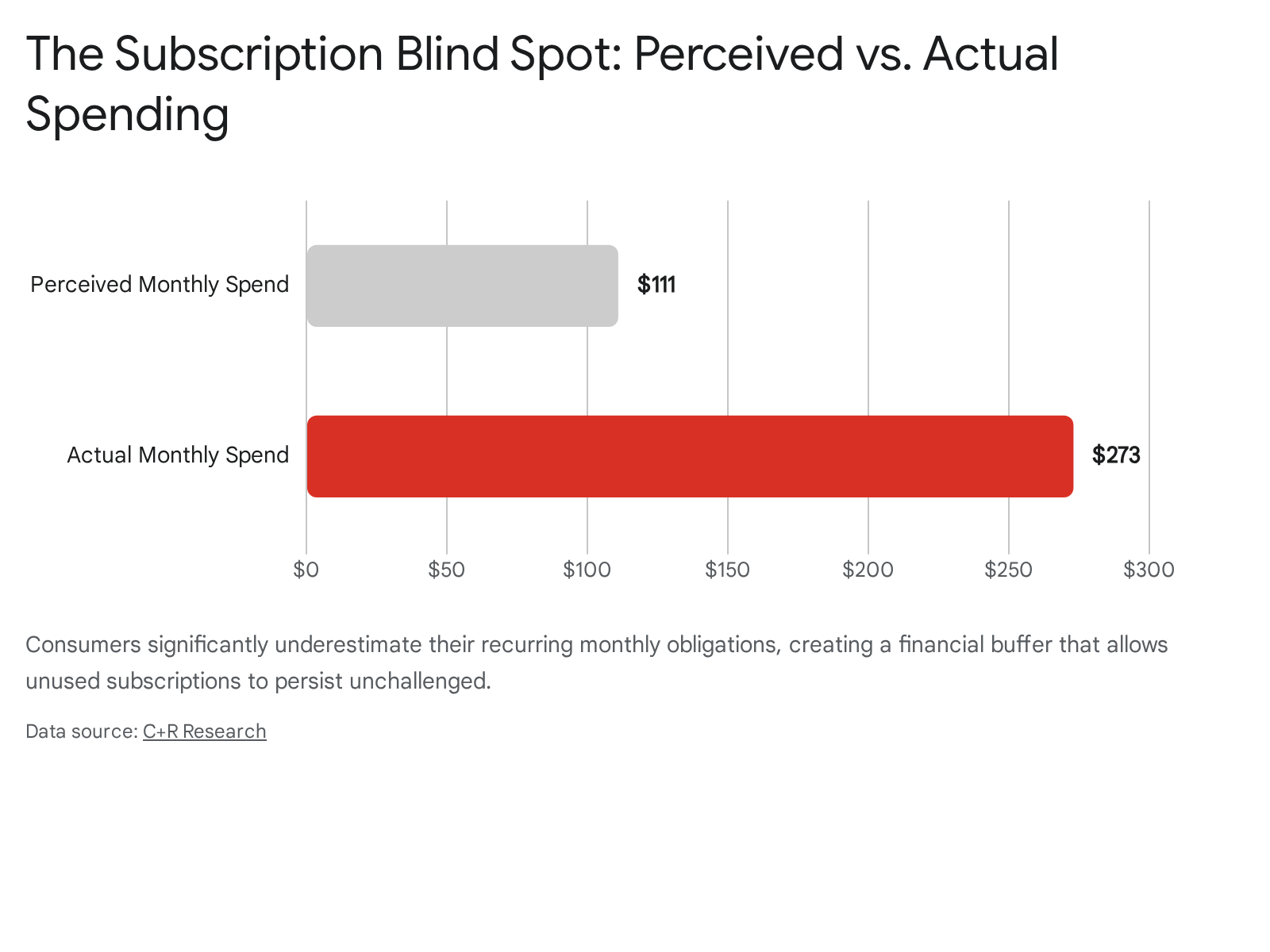
This represents a staggering 146% underestimation of recurring financial liabilities 26.
This financial blind spot allows unused and suboptimal services to persist unchallenged. A consistent theme across multiple tracking studies is the prevalence of completely unutilized services. In 2025, surveys indicated that 59.9% of respondents had at least one paid subscription going unused each month, maintaining an average of 2.6 unused paid subscriptions concurrently 27. This equates to roughly $26.79 in monthly wasted expenditure per consumer, adding up to hundreds of dollars annually strictly on services yielding zero utility 27.
The reluctance to cancel these unused services is driven by the sunk cost of prior payments and the anticipated regret of losing access to the service or the data stored within it. Even when consumer satisfaction declines, the combination of loss aversion and status quo bias reinforces retention 724.
Dark Patterns and Cancellation Friction
The inertia keeping consumers tethered to unused subscriptions is not entirely accidental; it is actively engineered by platform operators through the deployment of "dark patterns." These are deliberate user interface design choices that subtly manipulate consumers into making choices contrary to their best interests, such as remaining subscribed to a failing product or a service they no longer want 161718.
In a massive 2024 sweep coordinated by the International Consumer Protection and Enforcement Network (ICPEN) and the Federal Trade Commission (FTC), investigators analyzed 642 subscription-based websites and mobile apps across multiple global jurisdictions. The findings were stark: nearly 76% of the examined platforms employed at least one dark pattern, and 67% utilized multiple manipulative tactics simultaneously 171920.
The most common dark patterns identified were "sneaking" practices, which involve failing to clearly disclose auto-renewal terms or drip-pricing, and "interface interference" 161920. Interface interference often manifests as asymmetric cancellation workflows, commonly known as the "roach motel" design, where signing up for a service is frictionless (often requiring just one click), but cancelling requires navigating a labyrinthine web interface, mandatory phone calls to retention agents, or complex multi-step puzzle flows 16171819. By artificially inflating the behavioral sunk costs - specifically the cognitive time and effort required to execute a cancellation - companies effectively weaponize consumer exhaustion to maintain trapped loyalty 1617.
Video Game Monetization and Virtual Sunk Costs
The video game industry, particularly the mobile and free-to-play segments, has refined the exploitation of behavioral and financial sunk costs into a core, highly lucrative monetization strategy. Game designers utilize endless progression systems, massive skill trees, and time-gated unlocks to create a self-reinforcing behavioral loop where time invested directly equates to perceived psychological value 4.
Once a player invests hundreds or thousands of hours leveling up an avatar, acquiring rare digital cosmetics, or completing limited-time event chains, the psychological cost of abandoning the game becomes profound. Virtual ownership in digital spaces represents a symbolic investment of a consumer's identity and effort; therefore, abandoning the account triggers severe loss aversion 4. Furthermore, many modern games utilize "reward debt" mechanisms - such as daily login streaks or seasonal battle passes - which actively penalize players for disengaging for even brief periods. This transforms what should be leisure into a psychological obligation, where players persist in playing unenjoyable games not out of entertainment value, but simply to protect their previous efforts from decaying 417.
Scarcity and Sunk Costs in the ACGN "Guzi" Economy
This dynamic extends from digital realms into physical merchandise, highly visible in the "Guzi" economy prevalent in East Asia, notably China. Guzi refers to peripheral merchandise - such as badges, acrylic figures, and cards - derived from Anime, Comic, Game, and Novel (ACGN) intellectual properties 621. Here, the sunk cost fallacy is powerfully paired with artificial scarcity effects 621.
Consumers frequently purchase "blind boxes" containing randomized rewards. The random acquisition process obscures the total financial outlay, while the continuous pursuit of an extremely rare "hidden variant" triggers a rapid escalation of commitment 62122. The emotional investment, combined with the financial resources already sunk into acquiring common, unwanted items, provides an internal rationalization for the continued purchase of blind boxes. The consumer feels compelled to keep buying until the desired rare item is obtained, utilizing the sunk costs as a justification rather than a deterrent, effectively outsourcing cost justification to emotional self-rationalization 621. Laboratory experiments conducted on Chinese high school students engaging in blind box consumption confirm this heuristic bias, noting that susceptibility to irrational persistence increases significantly as the initial sunk costs grow larger 22.
Enterprise IT and the Burden of Legacy Technology
The sunk cost fallacy is not limited to individual consumers; in B2B and enterprise contexts, it routinely stalls digital transformation, resulting in massive accumulations of technical debt and degraded competitive agility. IT infrastructure investments often cost tens of millions of dollars and require years of organizational adaptation, workflow integration, and employee training 1. When these legacy systems inevitably become obsolete, inefficient, or unsupported by modern standards, organizations frequently hesitate to modernize due to the sheer volume of prior capital and procedural investment 23242538.
This hesitation is the enterprise iteration of the "Concorde Fallacy," named for the supersonic passenger jet project that the British and French governments continued to aggressively fund for decades despite clear, incontrovertible evidence of its commercial non-viability 123940. In enterprise IT, retaining failing or legacy systems is often erroneously framed by leadership as a conservative, cost-saving measure that respects prior investments 234026.
However, the reality is that the financial costs of maintaining legacy architecture compound exponentially over time. Industry benchmarks consistently indicate that maintaining legacy technology consumes between 60% and 80% of total enterprise IT budgets, starving organizations of capital for necessary innovation 2442.
| Legacy IT Cost Component | Financial Impact & Trajectory | Compounding Factor |
|---|---|---|
| Direct Maintenance & Licensing | $40,000 to $55,000 per application annually. | Increases steadily as vendor support wanes. |
| Talent Premiums (e.g., COBOL) | Specialized salaries rise as legacy language developers retire. | Labor scarcity drives up operational overhead by 42%. |
| Productivity Loss | System outages and slow processing times. | Averages 3 hours of wasted employee time per day. |
| Opportunity Cost & Risk | Prevents digital transformation; high breach risk. | Potential $57B missed revenue in banking sector by 2028. |
| Five-Year Cost Trajectory | Baseline $2.4M escalating to $3.6M. | Compounding 10-20% annually. |
Data synthesized from 24252642.
A documented trajectory demonstrates that a legacy application costing $2.4 million in total annual maintenance in year one can escalate to $3.6 million by year five due to talent scarcity (such as a lack of COBOL programmers in the banking sector), extended support unit (ESU) fees, and unpatched security vulnerabilities 2425. In the financial services sector alone, failing to modernize legacy core systems is estimated to cost banks upwards of $57 billion annually by 2028 2526. The refusal to write off the initial sunk cost traps organizations in a cycle of escalating operational overhead, hiding the true total cost of ownership behind the psychological safety of maintaining the status quo 232427.
Automotive Hardware Lock-in and Software Subscriptions
The automotive industry has historically utilized sunk costs to retain consumer loyalty over exceptionally long product lifecycles. Because major vehicle purchases are infrequent (often occurring every 5 to 7 years), manufacturers rely heavily on their dealership and service networks to maintain consumer engagement during the ownership lifecycle 4445. By utilizing the consumer's initial high-value investment in the vehicle hardware, dealerships anchor the buyer to their specific service networks, transforming service excellence into a primary loyalty engine that can boost lifetime value by 300% compared to one-time buyers 45.
Resistance to Features on Demand (FoD)
A newer frontier currently testing the absolute limits of consumer sunk costs is the automotive transition toward software-defined vehicles and "Features on Demand" (FoD). Automakers are attempting to monetize built-in hardware features - such as heated seats, advanced navigation algorithms, and enhanced battery performance - via post-purchase, recurring software subscriptions 28.
However, consumer research indicates massive pushback and high skepticism toward this model. Approximately 69% of automotive shoppers state they would likely shop elsewhere if certain standard vehicle features were exclusively available via subscription 28. Furthermore, 58% of shoppers expect an FoD approach to be far too expensive over the life of the vehicle 28. Consumers perceive the purchase of the physical vehicle hardware as a massive, definitive initial sunk cost. They view recurring subscription fees for hardware that is already physically installed in their driveway as a violation of value fairness and a transparent "money-grab," aggressively resisting this specific form of ecosystem lock-in 28. The sunk cost fallacy, while powerful, has ethical and perceived fairness limits; when a company attempts to double-charge for an asset the consumer feels they have already "sunk" capital into, brand loyalty swiftly deteriorates into active resistance.
Cross-Cultural and Demographic Variances in Sunk Cost Susceptibility
The degree to which consumers are susceptible to the sunk cost fallacy is not globally uniform; it is intricately moderated by cultural norms, economic backgrounds, and demographic factors.
The Influence of Individualism versus Collectivism
Cross-cultural psychological research indicates that the individualism-collectivism dimension significantly influences consumer decision-making and susceptibility to various cognitive biases 293031. Individualistic cultures (prevalent in the United States, Canada, and Western Europe) emphasize an independent view of the self, highly prioritize personal autonomy, and place a massive premium on self-consistency 30. Conversely, collectivistic cultures (prevalent in China, India, Japan, and Latin America) emphasize an interdependent view of the self, prioritizing social harmony, group norms, and adaptability to changing environmental contexts 3032.
Experimental studies exploring the sunk cost effect have observed divergent behaviors between these cultural paradigms. In scenarios comparing culturally primed American and Indian consumers, researchers found that American participants made significantly more sunk cost decision errors 31. The prevailing theoretical consensus is that the individualistic drive for self-justification - the profound psychological need to prove to oneself and others that one's initial, independent choice was correct - heavily amplifies the sunk cost effect 31. In contrast, decision-makers in collectivistic cultures, which value fluidity and situational context, may be more psychologically equipped to abandon a failing course of action, viewing the change in direction not as a catastrophic threat to their personal identity, but as a necessary adaptation to a new reality 10.
However, findings in the broader literature on persuasion complicate this binary picture. Research testing Cialdini's six principles of influence found that consumers from collectivistic backgrounds were generally more susceptible to broad persuasion strategies - including the principle of "commitment and consistency" - than individualists 2933. Furthermore, when examining price-related word-of-mouth regarding consumer goods, Chinese consumers were found to perceive price expensiveness differently than American consumers when exposed to identical product scenarios, suggesting that the mental accounting of costs and investments varies deeply based on localized market contexts 34.
Age Disparities and Cognitive Susceptibility
The impact of age on the sunk cost fallacy is a subject of intense and ongoing debate within behavioral decision-making literature. Some prior research, which relied heavily on hypothetical survey scenarios, suggested that older adults might be less susceptible to the sunk cost fallacy. The theoretical argument posited that older adults possess greater crystallized intelligence, broader life experience, and better emotional regulation, allowing them to cut their losses more efficiently than younger consumers 1153.
However, recent, rigorous studies challenge these findings, suggesting that the appearance of highly rational decision-making in older adults may have been an artifact of the hypothetical prompts used in early research, which failed to adequately simulate real-world loss 53. When tested using real decisions involving tangible, effort-based rewards (the effort-based paradigm) designed to minimize the influence of scenario-specific content, researchers found absolutely no significant differences in sunk cost susceptibility between younger (age ≤ 55) and older (age ≥ 65) adults 53. Across all demographics, over 20% of participants exhibited behavior heavily consistent with the sunk cost fallacy, indicating that the cognitive vulnerability to unrecoverable investments persists stubbornly throughout the human lifespan 53.
Environmental Sustainability and Psychological Ownership
The psychology of sunk costs and trapped loyalty also intersects heavily with modern consumer demands for environmental sustainability and green products. Transitioning consumers to sustainable behaviors is notoriously difficult, as it often requires them to abandon existing, convenient habits (behavioral sunk costs) in favor of new paradigms 54.
However, behavioral economics can be leveraged positively through "psychological ownership." Research into sustainable diets, specifically the adoption of hybrid meat alternatives (products containing both meat and plant-based proteins), demonstrates that framing environmental messaging to increase psychological ownership can overcome consumption inertia 54. When marketers use stewardship messaging like "Your Earth" instead of "The Earth," they increase the consumer's sense of personal psychological ownership, which significantly increases the purchase intention for sustainable alternatives 54.
Conversely, brands must be wary of "moral licensing," where consumers use the sunk cost of purchasing an expensive, eco-friendly product (a "green premium") as psychological justification to engage in unsustainable behaviors elsewhere, feeling they have already "paid" their environmental debt 1855. Furthermore, while gamified "eco-points" in anti-food-waste apps attempt to use sunk behavioral costs to nudge sustainable choices, these rewards lose their effectiveness under conditions of high price salience; if sustainable options are deemed too expensive upfront, the promise of future gamified rewards is insufficient to lock in consumer loyalty 35.
Compounding Consequences of Trapped Loyalty
When trapped loyalty is sustained through the exploitation of the sunk cost fallacy, it generates compounding, deleterious financial and psychological consequences for the consumer, while ultimately creating fragile business models for the provider.
Financially, the consumer's refusal to abandon suboptimal products creates massive opportunity costs. Consumers paying an actual $273 monthly for underutilized subscriptions lose the ability to redirect that capital toward higher-yield investments, savings, or genuinely useful products, resulting in thousands of dollars of lost wealth accumulation over a decade 26. In enterprise environments, the financial drain is existential; maintaining 30-year-old legacy technology prevents the reallocation of IT budgets toward necessary AI integration and digital transformation, stunting long-term innovation and exposing the organization to crippling security vulnerabilities 24254236.
Psychologically, the persistence of the sunk cost fallacy leads to acute decision fatigue and diminished consumer well-being. Consumers navigating a saturated market of recurring payments suffer from profound analysis paralysis and anticipated regret, fearing that canceling a service will result in the permanent loss of personal data or future utility 24.
When consumers ultimately realize they are trapped - whether by their own cognitive biases, cancellation friction, or predatory dark patterns - the emotional response shifts rapidly from brand affinity to intense frustration and resentment. This permanently damages the perception of the brand, leading to high consumer churn the moment a viable, frictionless alternative enters the market 1858.
In conclusion, the sunk cost fallacy remains a potent and pervasive force across the global economy, systematically transforming authentic brand loyalty into a financial and psychological trap. Driven by loss aversion, cognitive dissonance, and a fundamental human desire to avoid wastefulness, consumers routinely allow unrecoverable past investments to govern their future economic choices. Businesses across diverse sectors - from digital SaaS platforms and mobile gaming to enterprise software and automotive manufacturing - have recognized these cognitive vulnerabilities and architected their ecosystems to maximize both financial and behavioral sunk costs. Mitigating the sunk cost fallacy in modern commerce requires heightened consumer awareness, transparent UX design, and robust regulatory intervention against dark patterns, ensuring that genuine future utility - rather than the heavy anchor of past entrapment - remains the true driver of long-term consumer loyalty.