
Nonconsumer segmentation in innovation strategy
Theoretical Foundations of Nonconsumer Segmentation
The discipline of innovation strategy has historically concentrated on developing superior products for existing markets and extracting maximal value from established consumer bases. However, the conceptualization of nonconsumer segmentation fundamentally shifts the locus of strategic innovation. Rather than identifying subgroups within an already established consumer population, nonconsumer segmentation seeks to identify populations that entirely lack access to, or the ability to utilize, existing market solutions. Understanding this paradigm requires a thorough examination of the theories of disruptive innovation, the "Jobs to Be Done" framework, and the broader macroeconomic concepts surrounding market creation.
Disruptive Innovation and Market Creation
The theory of disruptive innovation, initially articulated by Clayton Christensen, outlines how organizations can upend established market leaders by targeting overlooked or entirely unserved demographics 1. Disruptive innovation typically enters markets through two distinct pathways: low-end disruption and new-market disruption 22. Low-end disruption targets customers who are overserved by incumbent products - those who utilize a product but do not require its most advanced features and are unwilling to pay a premium for incremental improvements 23. Existing industry leaders generally retreat from these low-margin segments to focus on highly profitable tiers, allowing new entrants to gain a foothold 12.
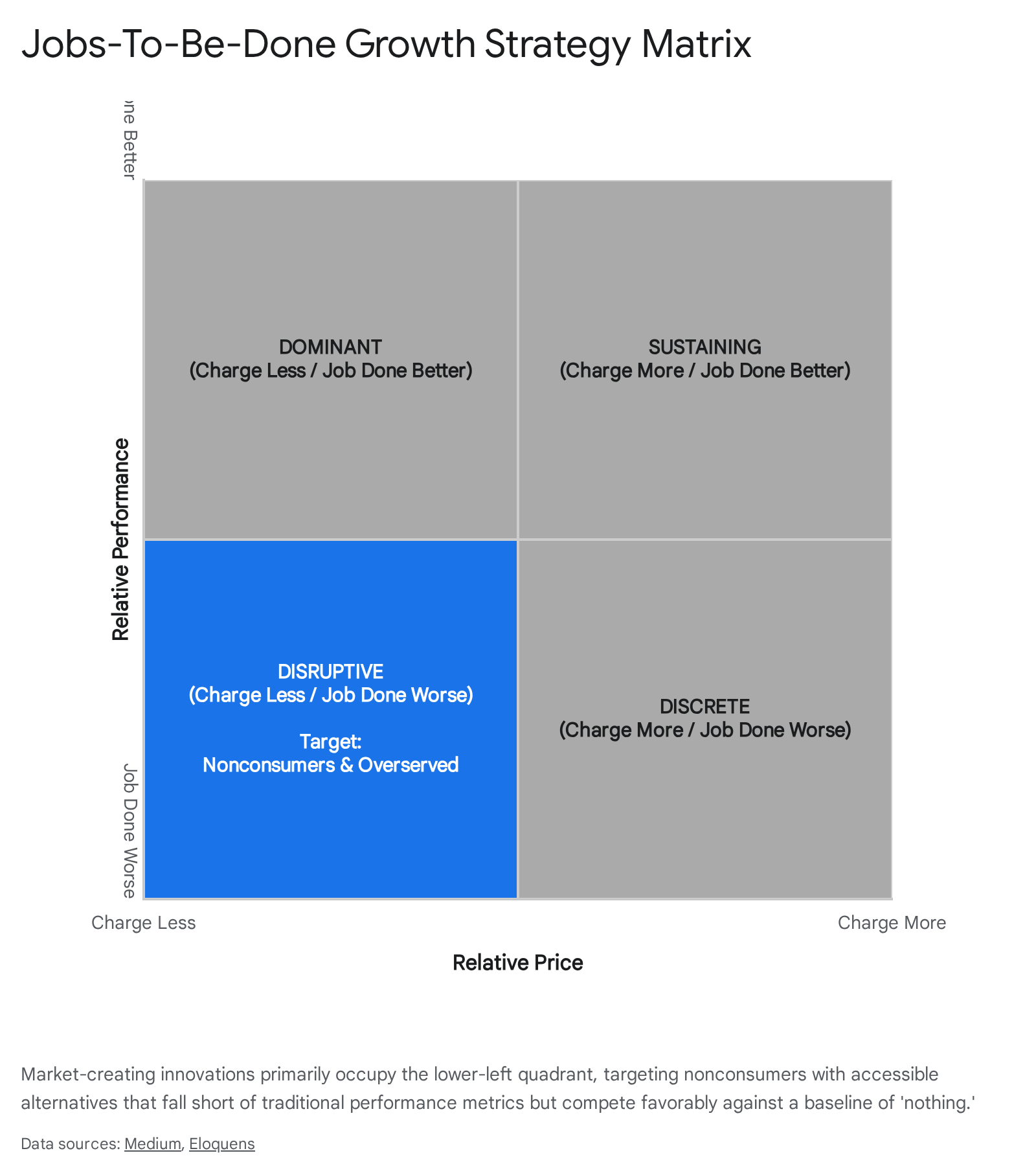
Conversely, new-market disruption explicitly targets nonconsumers 2. Nonconsumers are individuals or organizations that historically lacked the financial resources, technical skills, or geographic access to participate in a market 34. In these scenarios, the disruptive product does not compete against a high-end incumbent; it competes against "nothing" 26. Because the alternative is absolute non-consumption, a product that is objectively inferior by traditional industry metrics is often enthusiastically adopted because it presents the first viable solution to an unresolved struggle 23.
Market-creating innovations (MCIs) are a distinct subset of new-market disruptions that transform complex, expensive products into simple, affordable alternatives 56. To fully understand the strategic impact of MCIs, they must be situated within the broader typology of corporate innovation strategies.
| Innovation Typology | Primary Mechanism | Economic Impact | Target Audience |
|---|---|---|---|
| Efficiency Innovation | Streamlines operations and reduces production costs. | Maximizes free cash flow; typically eliminates jobs. | Existing corporate infrastructure and supply chains. |
| Sustaining Innovation | Improves existing products along traditional performance metrics. | Maintains high profit margins; maintains competitive vibrancy. | Existing customers, specifically highly profitable tiers. |
| Market-Creating Innovation | Simplifies complex products and dramatically lowers costs. | Requires new infrastructure; generates net-new job growth. | Nonconsumers and marginalized populations. |
As illustrated by the typology above, MCIs do more than generate revenue; they operate as a foundational engine for economic development 67. While efficiency innovations streamline operations to free up capital, and sustaining innovations improve products for existing users, market-creating innovations require the construction of entirely new supply chains, distribution networks, and support ecosystems 68. By targeting nonconsumption, MCIs effectively pull necessary infrastructure into existence, serving as a catalyst for job creation and local economic resilience 81112.
The Jobs to Be Done Framework
The identification of nonconsumers is heavily dependent on the "Jobs to Be Done" (JTBD) framework. Traditional demographic analyses operate on the premise of correlation, assuming that individuals of similar ages, incomes, or geographies will exhibit similar purchasing behaviors 613. The JTBD framework argues that correlation does not equal causality. Instead, consumers "hire" a product or service to make desired progress in a specific circumstance 1415. If the product performs well, it is hired repeatedly; if it performs poorly, it is fired 6.
A "job" encapsulates the functional, emotional, and social dimensions of a struggle 1516. Nonconsumers are not merely individuals who fail to purchase a product; they are individuals who possess an active, unresolved job to be done but find existing market solutions either too expensive, too complex, or geographically inaccessible 45. Because they cannot hire an existing solution, nonconsumers frequently engage in "compensating behaviors" - resourceful but highly inefficient workarounds designed to solve the problem using inadequate tools 61517.
The JTBD framework is crucial for nonconsumer segmentation because it shifts the unit of analysis away from the product attributes or the demographic profile and toward the underlying problem 17. By understanding the specific context of the struggle, organizations can engineer solutions that lower the barrier to entry, transforming compensating behaviors into formal consumption. This theoretical foundation was expanded by Anthony Ulwick through the Outcome-Driven Innovation process and the JTBD Growth Strategy Matrix, which formalized how companies can select competitive strategies based on unmet customer needs 39.
The Prosperity Paradox and Economic Development
The strategic application of nonconsumer segmentation is a central tenet of the "Prosperity Paradox," a framework analyzing why immense investments in global development frequently fail to generate sustainable prosperity 111210. Historic approaches to poverty alleviation have typically relied on a "push" mechanism, wherein external entities construct infrastructure (such as wells, schools, or hospitals) in low-income regions without a corresponding market demand to sustain them 111210. Research indicates that these supply-driven resources frequently degrade or collapse because the critical commercial mechanisms necessary to maintain them are absent 1211.
Nonconsumer segmentation relies instead on a "pull" mechanism. By identifying a non-consumption struggle and designing an affordable product to resolve it, market-creating innovators generate organic demand 1112. This demand subsequently pulls in the requisite resources, local infrastructure, regulatory frameworks, and employment necessary for sustained growth 412. This dynamic transitions marginalized populations into the formal, tax-paying economy, establishing a self-reinforcing ecosystem of entrepreneurship 811.
Traditional Market Segmentation Methodologies
To appreciate the distinct nature of nonconsumer segmentation, it is necessary to examine the mechanisms and objectives of traditional market segmentation. Traditional segmentation is the strategic process of dividing a broad, pre-existing target market into smaller, more defined categories to make marketing efforts more focused and efficient 212212. The primary objective is to allocate finite marketing and product development resources toward subgroups most likely to generate revenue, thereby avoiding the high advertising costs associated with generalized, mass-market messaging 221314.
Dimensions of Traditional Market Analysis
Traditional methodologies generally rely on four primary dimensions of statistical and qualitative analysis:
- Demographic Segmentation: This approach categorizes the market based on quantifiable population statistics. In business-to-consumer (B2C) contexts, these traits include age, gender, income, educational level, race, religion, and family structure 21221314. In business-to-business (B2B) markets, demographic traits extend to industry type, company size, and specific organizational roles 22. Demographic segmentation is widely utilized due to the ease of data collection and the foundational assumption that individuals within the same demographic cohort will exhibit similar purchasing behaviors 22.
- Geographic Segmentation: Markets are divided based on physical location. This can range from broad national or regional borders down to specific climates, postal codes, and population densities 211314. For example, a lawn-care company utilizes geographic segmentation to focus advertising expenditures on suburban areas rather than high-density urban centers 14.
- Psychographic Segmentation: This dimension moves beyond external demographics to segment consumers based on intrinsic traits such as personality variables, personal values, attitudes, interests, and lifestyle choices 212213. Because psychographic traits are relatively subjective, this form of segmentation requires extensive, ongoing qualitative research to implement effectively 22.
- Behavioral and Usage-Based Segmentation: This method categorizes audiences based on their actual interactions with a product or brand, including purchasing habits, feature adoption, and brand loyalty 211315. Companies frequently rely on usage-based segmentation to identify "heavy users." Following the Pareto principle, organizations often observe that 80 percent of revenue is generated by the top 20 percent of repeat users, making this segment highly attractive for continuous resource allocation 1314.
Limitations and Organizational Blind Spots
While traditional segmentation is highly effective for maximizing the profitability of existing products, it structurally discourages the identification of nonconsumers. Traditional models are inherently retrospective; they rely on analyzing the transactional and engagement data of individuals who are already active within the market ecosystem 2716. Consequently, businesses frequently fall into organizational blind spots, obsessing over incremental improvements that appeal to current, high-margin customers while entirely ignoring populations locked out of the market 117.
One prominent symptom of relying exclusively on traditional metrics is "over-segmentation." Organizations may divide their customer base into excessively nuanced, micro-targeted groups based on highly specific demographic or behavioral variables 18. Over-segmentation strains organizational resources, as each micro-segment demands bespoke marketing campaigns and product adjustments 18. This practice results in a narrow vision that prioritizes short-term metric improvements within minute cohorts at the expense of holistic, long-term market expansion 1819.
Furthermore, traditional database customer segmentation relies heavily on past transactional data, which facilitates tactical marketing but often fails to explain the underlying motivations of the consumer 27. By focusing on what a customer purchased rather than why they purchased it, companies remain unaware of the workarounds and dissatisfaction present even within their own customer base, leaving them vulnerable to disruptive innovators who design simpler, more fundamental solutions based on actual jobs to be done 131427. The reliance on static demographic predictors can also lead to misaligned marketing, as lifestyle values or age brackets are often poor predictors of actual product engagement 16.
Comparative Analysis of Segmentation Approaches
The strategic divergence between traditional and nonconsumer segmentation is stark. While one attempts to carve an existing pie into increasingly refined slices to capture available value, the other attempts to expand the size of the pie by addressing latent, unfulfilled demand. The fundamental differences between these strategic approaches dictate contrasting data collection methods, organizational structures, and success metrics.
| Strategic Parameter | Traditional Market Segmentation | Nonconsumer Segmentation |
|---|---|---|
| Primary Target Audience | Existing users, active buyers, and industry competitors' clients. | Populations lacking access, financial wealth, or technical skill. |
| Core Corporate Objective | Maximize ROI and market share among known, profitable user segments. | Create net-new markets and unlock latent global demand. |
| Underlying Framework | Demographics, Psychographics, Usage frequency, Transactional history. | Jobs to Be Done (JTBD), circumstances of struggle, compensating behaviors. |
| Product Strategy | Sustaining innovations (adding features, increasing complexity and price). | Market-creating innovations (simplifying design, lowering cost, expanding access). |
| Competitive Baseline | Direct industry competitors and equivalent alternative brands. | "Nothing" (the absence of a viable solution) or inefficient user workarounds. |
| Data Collection Focus | Surveys, CRM databases, digital analytics, focus groups. | Ethnographic observation, analysis of negative jobs, fieldwork. |
| Macroeconomic Impact | Optimizes free cash flow; typically results in minimal net-new job creation. | Drives ecosystem development, physical infrastructure, and regional job creation. |
Traditional segmentation drives efficiency and sustaining innovations. While critical for maintaining short-term corporate health and satisfying shareholder expectations for quarterly margin growth, these innovations inherently trend toward eventual market saturation 67. Nonconsumer segmentation functions as the engine for macro-level economic growth, actively bringing marginalized populations into the formal commercial ecosystem 812.
Resource Allocation and Corporate Governance
The divergent goals of these segmentation strategies inevitably create friction within established corporate governance structures. The primary barrier to nonconsumer innovation within large enterprises is internal resource allocation 6. Corporate financial modeling heavily favors sustaining and efficiency innovations, which offer predictable returns on investment (ROI) and utilize existing market data to model risk 632.
Market-creating innovations, in contrast, appear highly risky to traditional management. They target unproven demographics, operate at lower initial profit margins, and require patient capital 26. As a result, corporate resource allocation processes systematically defund nonconsumer initiatives in favor of exploiting existing, high-margin clients 36. Overcoming this organizational blind spot requires executive leadership capable of maintaining distinct innovation pipelines and shielding disruptive initiatives from the immediate margin expectations applied to the core business 217. When leadership teams possess misaligned definitions of success or suffer from decision bottlenecks, legacy processes suffocate market-creating potential 17.
Data Gathering and Identification Techniques
The methodologies utilized to identify and analyze nonconsumers differ drastically from the tools used in traditional market research. Because nonconsumers do not generate transactional data within the focal industry, standard quantitative database analysis is largely ineffective. Data gathering must therefore pivot from statistical aggregation to contextual observation and continuous behavioral discovery.
Qualitative Observation and Compensating Behaviors
Identifying nonconsumption requires extensive primary qualitative research methodologies, particularly ethnographic observation and in-depth contextual interviews 16202122. Researchers must actively search for "compensating behaviors" - instances where individuals invent highly inefficient, do-it-yourself workarounds because no adequate market solution exists 61517. For example, prior to the introduction of portable cooling devices in India, consumers who could not afford traditional refrigerators utilized communal cooling methods or altered their entire food purchasing routines to avoid spoilage 17. These workarounds signify deep frustration and a high-potential innovation opportunity 15.
Data collection in this sphere also involves exploring "negative jobs" - analyzing what people actively want to avoid doing - and observing "unusual uses," where existing products are forced to perform tasks they were not designed for 61416. The fundamental data unit in nonconsumer analysis is often a highly detailed, extended narrative of a single individual's struggle, rather than a broad statistical average 15. This stands in contrast to the quantitative surveys and A/B testing predominant in traditional segmentation, which seek to prove "how many" rather than understand "why" 21.
Digital Intelligence and Continuous Discovery
While primary qualitative data remains the bedrock of nonconsumer analysis, advancements in digital intelligence are providing new avenues for identifying latent demand. Traditional market research is evolving from point-in-time surveys to continuous digital discovery habits 1536. Tools utilizing Natural Language Processing (NLP) and agentic artificial intelligence can analyze massive volumes of unstructured data - such as social media complaints, forum discussions, and customer service logs - to detect emerging struggles and sentiment trends among populations that are dissatisfied or locked out of mainstream offerings 2136.
However, the application of digital tools must be calibrated carefully. Relying solely on web analytics, tracking pixels, or platform engagement metrics risks reinforcing the over-segmentation trap, optimizing the experience for those already capable of accessing the digital ecosystem while ignoring the offline nonconsumer 163623. To capture nonconsumers effectively, organizations must deploy a mixed-methods approach, utilizing quantitative digital signals to identify areas of widespread friction, followed by granular qualitative fieldwork to map the specific functional, social, and emotional dimensions of the underlying job to be done 162122.
Evolution of the Theoretical Frameworks
As technological capabilities accelerate and global markets integrate, the theoretical frameworks governing nonconsumer segmentation are evolving. The traditional models of disruptive innovation are currently being challenged and expanded by two major conceptual developments: the impact of Artificial Intelligence (AI) and the formalization of "nondisruptive creation."
Artificial Intelligence and Creation-Disruption Theory
Traditional disruption theory assumes that a market-creating innovation initially enters the market as an inferior product. It competes strictly on affordability and accessibility, offering a "good enough" solution to nonconsumers before gradually moving upmarket to challenge incumbents 1224.
The advent of advanced Artificial Intelligence requires a structural adjustment to this premise. The emerging Creation-Disruption (CD) Theory posits that AI-native innovations can fundamentally break the traditional price-performance tradeoff 24. Because AI provides highly scalable, autonomous cognitive capabilities, new entrants can target nonconsumer segments by offering solutions that are simultaneously cheaper and technologically superior to incumbent systems 24.
Furthermore, AI drastically reduces adoption friction. "Agentic AI" systems that operate via natural language and autonomous workflows require virtually no technical skill from the user, immediately unlocking demographics that were previously nonconsumers due to software complexity 2425. Consequently, AI-driven market creation scales at an unprecedented velocity, moving from nonconsumer footholds to broad market disruption faster than historical hardware or software equivalents, and competing directly for enterprise headcount budgets rather than software budgets 24. The CD theory synthesizes these dynamics, suggesting that market creation and disruption are inherently intertwined, rather than sequential, forces 24.
Nondisruptive Creation and Blue Ocean Strategy
In parallel, strategic frameworks such as Blue Ocean Strategy have articulated the concept of "nondisruptive creation." Authored by INSEAD professors Chan Kim and Renée Mauborgne, this concept explores how companies can achieve growth without displacing existing industries, companies, or jobs, contrasting sharply with the "creative destruction" often associated with disruption 24404142.
Nondisruptive creation focuses heavily on expanding market boundaries by analyzing noncustomers. Kim and Mauborgne identify three distinct tiers of noncustomers that organizations must understand to unlock new demand 43.
| Noncustomer Tier | Characteristics and Market Relationship | Strategic Opportunity |
|---|---|---|
| Tier 1: "Soon-to-be" Noncustomers | Individuals who use the current market offering only out of necessity but are dissatisfied. They are waiting for an opportunity to leave the industry entirely. | Can be captured by identifying the specific friction points that force them to endure the product reluctantly. |
| Tier 2: "Refusing" Noncustomers | Individuals or organizations that have consciously considered the industry's offering but rejected it because it is unacceptable, overly complex, or unaffordable. | Can be captured by fundamentally redefining the product's value proposition to eliminate the barriers to entry. |
| Tier 3: "Unexplored" Noncustomers | Populations that have never been targeted by the industry and have never considered the offering as an option for their needs. | Represents the largest opportunity for total market creation by applying solutions to entirely new contexts. |
By addressing the underlying values and removing the pain points of these three tiers, businesses can generate entirely new industries outside the boundaries of existing red-ocean competition 404143. This framework highlights that the pursuit of nonconsumers does not inherently require a zero-sum battle with incumbents; it can be a positive-sum strategy that fosters economic growth and solves societal struggles without incurring the social costs of shuttered companies and lost employment 402627.
Application and Regional Case Studies
The practical application of nonconsumer segmentation is most visible in emerging and growth economies. In these regions, the population of nonconsumers for most products and services vastly outnumbers the population of active consumers, making market-creating innovation a macro-economic necessity 5.
Agricultural and Financial Technology in Latin America
Latin America has become a primary testing ground for nonconsumer innovation, specifically within financial technology (fintech) and agricultural technology (agritech). Historically, traditional financial institutions in the region focused almost entirely on highly profitable corporate clients and wealthy individuals. This focus resulted in massive populations of unbanked and underbanked citizens, alongside exceptionally high commercial lending spreads 2829.
Recent surges in fintech innovation, supported by progressive open banking regulations in countries like Brazil and Mexico, have bypassed traditional credit barriers 2848. Digital banks and alternative financing platforms have successfully targeted nonconsumers; analyses indicate that approximately three-quarters of digital bank customers in the region are individuals and small-to-medium enterprises (SMEs) that were previously unbanked 28. By prioritizing accessibility over high-margin premium features, these market-creating innovations forced competition into the sector, reduced lending spreads, and integrated millions into the formal economy 2848.
Similarly, the Latin American agritech sector highlights the dichotomy between overserved consumers and nonconsumers. While substantial venture capital - totaling $7.3 billion between 2018 and 2022 - flows toward large-scale, highly productive agricultural operations in Brazil, Mexico, and Chile, millions of smallholder farmers remain locked out of formal credit and technological advancements 3050. These smallholders produce 50 percent of the region's food but face a $170 billion financing gap, leaving them unable to invest in productivity-enhancing tools 30. Startups addressing this specific nonconsumer segment are designing low-friction digital tools for supply chain traceability, market access, and micro-financing. By combining strategic coaching with facilitated pilots connecting smallholders to major buyers like Walmart and Danone, these innovations demonstrate how targeting the base of the supply chain can generate sustainable economic yields while restoring carbon-capturing soils 3050.
Health and Education Technology in South Asia
In South Asia, profound infrastructure deficits, a lack of public funding, and significant sociotechnical barriers have created vast nonconsumer populations in healthcare and education. The region suffers from massive brain drain, as healthcare professionals migrate to overseas systems due to low domestic salaries, exacerbating a baseline of inadequate service quality and geographic inaccessibility 5131.
Digital health (healthtech) and education technology (edtech) startups have responded by developing direct-to-consumer (D2C) virtual-first models, which account for nearly 60 percent of the region's healthtech cohort and 75 percent of the edtech cohort 5132. In the edtech sector, platforms have rapidly scaled by targeting nonconsumers who lack access to formal, high-quality schooling or test preparation. By shifting from complicated, expensive institutional software to affordable, AI-assisted applications (such as AI copilots for language proficiency and real-time doubt resolution), these entities are servicing functional jobs that traditional educational infrastructure fails to meet 32. In healthcare, telemedicine, digital health records, and culturally sensitive digital skill development sessions are bypassing the physical limitations of rural clinics, providing basic diagnostics and pharmaceutical logistics to populations whose historic alternative was zero medical intervention 3133.
Telecommunications and Consumer Goods in Africa
The African continent provides historic examples of market-creating innovations pulling critical infrastructure into existence. Traditional development efforts in Africa often relied on "push" models - building wells or schools that rapidly deteriorated due to a lack of underlying economic sustainability 1211. However, private enterprises utilizing nonconsumer segmentation have achieved massive scale.
Notable examples include M-PESA, a mobile money platform that allowed millions of unbanked citizens to store and transfer funds, and Celtel, a pay-as-you-go mobile service that democratized telecommunications by offering minutes for as little as 25 cents 1111. Celtel's success not only served a massive nonconsumer segment but also catalyzed the creation of over a hundred mobile phone companies, generating hundreds of billions of dollars in economic value and millions of jobs 11. In the consumer goods sector, Tolaram Industries created a massive market for instant noodles in Nigeria. Because the necessary logistics and energy infrastructure did not exist, Tolaram was forced to build proprietary power generation, water treatment, and supply chain networks 8. While requiring immense capital, this infrastructure investment tied directly to market demand proved far more sustainable than government-sponsored projects, transforming local supply chains and formalizing significant segments of the economy 812.
Metrics for Evaluating Strategic Success
Because nonconsumer segmentation relies on different economic mechanisms than traditional market expansion, organizations must adopt new metrics to evaluate strategic success. Evaluating market-creating innovations through the lens of traditional efficiency metrics will inevitably lead to systemic underinvestment.
Shifting from Traditional ROI to Ecosystem Metrics
Traditional market research measures success through internal, highly finite financial metrics: incremental revenue growth, short-term return on investment (ROI), customer acquisition cost (CAC), and increased market share within a pre-existing category 193456. While these metrics are viable for sustaining innovations targeted at overserved clients, applying them prematurely to market-creating innovations will result in perceived failure, as early margins are low and customer acquisition in unstructured environments is complex 26.
Market-creating innovations targeting nonconsumers require a broader, longer-term measurement framework. Key performance indicators (KPIs) must focus on ecosystem-level impacts and systemic transformation:
- Unit Economics at Scale: Rather than demanding high initial profit margins, financial success is measured by the ability to achieve sustainable profitability through massive volume at low price points, requiring strict operational discipline 2357.
- Job Creation and Capacity Building: The volume of sustainable, local employment generated through proprietary supply chains, manufacturing, and distribution networks necessary to reach the nonconsumer 81211.
- Formalization Rates: The number of individuals successfully transitioned from the informal (unbanked, unrecorded) economy into formal, tax-paying ecosystems, thereby generating revenue for local governance and infrastructure reinvestment 812.
- Workaround Reduction: Qualitative metrics demonstrating a measurable reduction in the compensating behaviors, time-expenditure, and frustrations previously exhibited by the target demographic 151635.
- Strategic Competency: The organization's demonstrated ability to anticipate blind spots, integrate cross-functional collaboration, and apply systems thinking to complex environmental and social variables 3236.
Organizations that successfully deploy nonconsumer segmentation strategies recognize that short-term efficiency metrics often contradict long-term market creation. By focusing on resolving the fundamental struggles of marginalized populations, businesses can construct resilient, proprietary markets that serve as engines for both corporate profitability and global economic prosperity.