
Nostalgia marketing and autobiographical memory in brand affinity
The global consumer landscape of the mid-2020s has been profoundly shaped by a confluence of macroeconomic volatility, accelerated technological disruption, and digital saturation. In an era defined by continuous global uncertainty, the psychological state of the consumer has fundamentally shifted. Exhaustive consumer sentiment data from 2024 and 2025 indicates that the global populace remains highly sensitized to systemic fragility, driving consumption behaviors that frequently confound traditional econometric forecasting . Analysts utilizing pre-2020 frameworks often miscalculate these patterns, assuming that inflationary pressures universally suppress discretionary spending. However, a deeper analysis reveals a pervasive paradox: consumers are aggressively trading down in essential categories while simultaneously splurging on selective discretionary items that offer high emotional resonance .
This behavior is not irrational; rather, it is a calculated exercise in emotional regulation. Consumers are actively seeking cognitive refuges - spaces where familiar aesthetic, auditory, and sensory inputs provide a psychological buffer against contemporary anxieties 12. As highlighted in WARC's Future of Media 2025 report and the Marketer's Toolkit, "comfort in the familiar" has emerged as a dominant trend, with nostalgia transitioning from a superficial creative trope into a rigorous, neuro-cognitively grounded instrument of commercial strategy 23.
This exhaustive report deconstructs the structural mechanisms of nostalgia marketing. By moving beyond aesthetic revivals to examine the profound neurological and cognitive drivers that alter consumer decision-making and willingness to pay, this analysis provides a definitive blueprint for navigating memory-driven commerce. It explicitly differentiates autobiographical from historical nostalgia, maps the highly digital behaviors of Generation Z and Millennials, and examines the cross-cultural efficacy of these strategies in non-Western markets, offering a comprehensive framework for deployment while mitigating the escalating risks of nostalgia fatigue and brand inauthenticity.
The Taxonomy of Nostalgia: Autobiographical vs. Historical Paradigms
To leverage nostalgia effectively within a marketing apparatus, it is imperative to dissect its structural taxonomy. Nostalgia is not a monolithic emotional state; it is bifurcated into two distinct psychological phenomena: autobiographical (or personal) nostalgia and historical (or imaginative) nostalgia 45. Understanding the strict division between these two is critical for strategic alignment, as they activate different cognitive pathways, resonate with different demographic cohorts, and require fundamentally different executional tactics.
Autobiographical Nostalgia: The Anchor of Self-Continuity
Autobiographical nostalgia is rooted entirely in an individual's lived, direct experience 4. It is the bittersweet, yearning recall of specific life events, past relationships, sensory encounters, and personal milestones. From a cognitive and evolutionary perspective, autobiographical nostalgia serves a vital existential function: it bolsters perceived "self-continuity" - the deeply comforting psychological sense that one's past, present, and future selves are coherently linked across the span of time 67.
When marketing strategies successfully trigger autobiographical memories, they tap into deeply entrenched, self-referential neural networks. Research published in the Journal of Consumer Research and Psychology & Marketing demonstrates that nostalgic-autobiographical advertising improves brand name recall far more effectively than factual-semantic advertising by reactivating brand-related autobiographical memories 11. This efficacy occurs because autobiographical memory is inherently and heavily emotional; consumers do not merely remember the product or the brand, they remember the idealized version of themselves that interacted with that brand during a formative period of their lives 2128.
This emotional tethering produces highly measurable commercial outcomes. It significantly increases brand trust, brand attachment, and ultimately, brand love, as the commercial entity becomes inextricably woven into the consumer's personal narrative architecture 59. The psychological safety generated by this form of nostalgia serves as a powerful coping mechanism during times of high stress, explaining the notable surge in autobiographical nostalgia campaigns following global disruptions 14. Furthermore, as noted in the Harvard Business Review, the utility of autobiographical nostalgia extends beyond consumer marketing into organizational psychology, where connecting the present to the past helps employees manage pervasive modern anxieties and fosters workplace motivation 1.
Historical Nostalgia: The Allure of the Imaginative Past
Conversely, historical nostalgia - frequently referred to as imaginative nostalgia or, in contemporary digital parlance, "anemoia" - is a longing for a time, era, or aesthetic that the individual never personally experienced 415. This phenomenon is entirely unmoored from personal autobiographical memory. Instead, it relies on collective cultural memory, romanticized historical narratives, and highly curated aesthetic signifiers 10.
Historical nostalgia operates primarily as a form of psychological escapism. Consumers project their contemporary desires for simplicity, authenticity, community, or unmediated physical interaction onto an idealized, flawless vision of the past 415. This is overwhelmingly prevalent among younger cohorts. For instance, empirical polling indicates that 68% of Generation Z consumers respond positively to throwback marketing referencing decades (such as the 1980s or 1990s) that they were not alive to witness 11.
In these instances, organizations are not selling a memory; they are selling an aesthetic of stability that contrasts favorably against the hyper-complex, algorithmically driven modern digital environment. Interestingly, academic cross-cultural studies indicate that the commercial effectiveness of these two types of nostalgia varies significantly by geography. In markets like the United Kingdom, personal autobiographical nostalgia has been shown to increase brand love more effectively than historical nostalgia. Conversely, in developing or rapidly changing markets such as India, historical nostalgia demonstrates a stronger relationship with brand love, reflecting differing cultural relationships with collective history, national identity, and rapid modernization 5.
Neurological Mechanisms: Emotion Regulation and Reward Processing
To comprehensively understand why nostalgia exercises such profound influence over consumer decision-making, it is necessary to examine the underlying neurological architecture of the emotion. Nostalgia is not merely a soft, cognitive recollection; it is a complex, biologically grounded state characterized by the simultaneous activation of specific, highly interconnected brain networks. Research synthesizing functional magnetic resonance imaging (fMRI) studies has codified these interactions into the "Nostalgic Brain Model" 1213.
The Convergence of Memory and Reward
The Nostalgic Brain Model posits that the experience of nostalgia relies on the coordinated, simultaneous activity of four primary neural components: self-reflection, autobiographical memory, emotion regulation, and reward processing 121314.
- Self-Reflection: This process is managed primarily by the medial prefrontal cortex (mPFC) and the posterior cingulate cortex (PCC). These structures show heightened activation when individuals reflect on information that is highly self-relevant, integrating the recalled past event with the individual's current sense of self, goals, and traits 1214. The mPFC acts as a critical integration hub, linking distant episodic memories to self-conscious emotional states 14.
- Autobiographical Memory: The hippocampus (HPC), an evolutionarily ancient region fundamental to encoding and retrieving episodic memories, is highly activated during nostalgic recall. It acts as the search engine retrieving the specific situational details of the past 1215.
- Emotion Regulation: Because nostalgia is often a bittersweet, ambivalent emotion - containing both the joy of the memory and the grief of its unrecoverable loss - the brain must actively regulate these competing signals. The anterior cingulate cortex (ACC) and the mPFC work in tandem to soothe this emotional conflict, rapidly vacillating between positive and negative states to maintain psychological equilibrium 121314.
- Reward Processing: Perhaps the most critical finding for consumer psychology and marketing strategy is the robust activation of the brain's reward network during nostalgic reverie. This network includes the striatum (specifically the ventral striatum, or VS), the substantia nigra (SN), the ventral tegmental area (VTA), and the ventromedial prefrontal cortex (vmPFC) 121314.
The neurological literature reveals a striking, consistent phenomenon: the co-activation of the hippocampus and the ventral striatum 141516. This indicates that the brain's memory systems and reward systems work collaboratively to literally "coproduce" the nostalgic experience 121416.
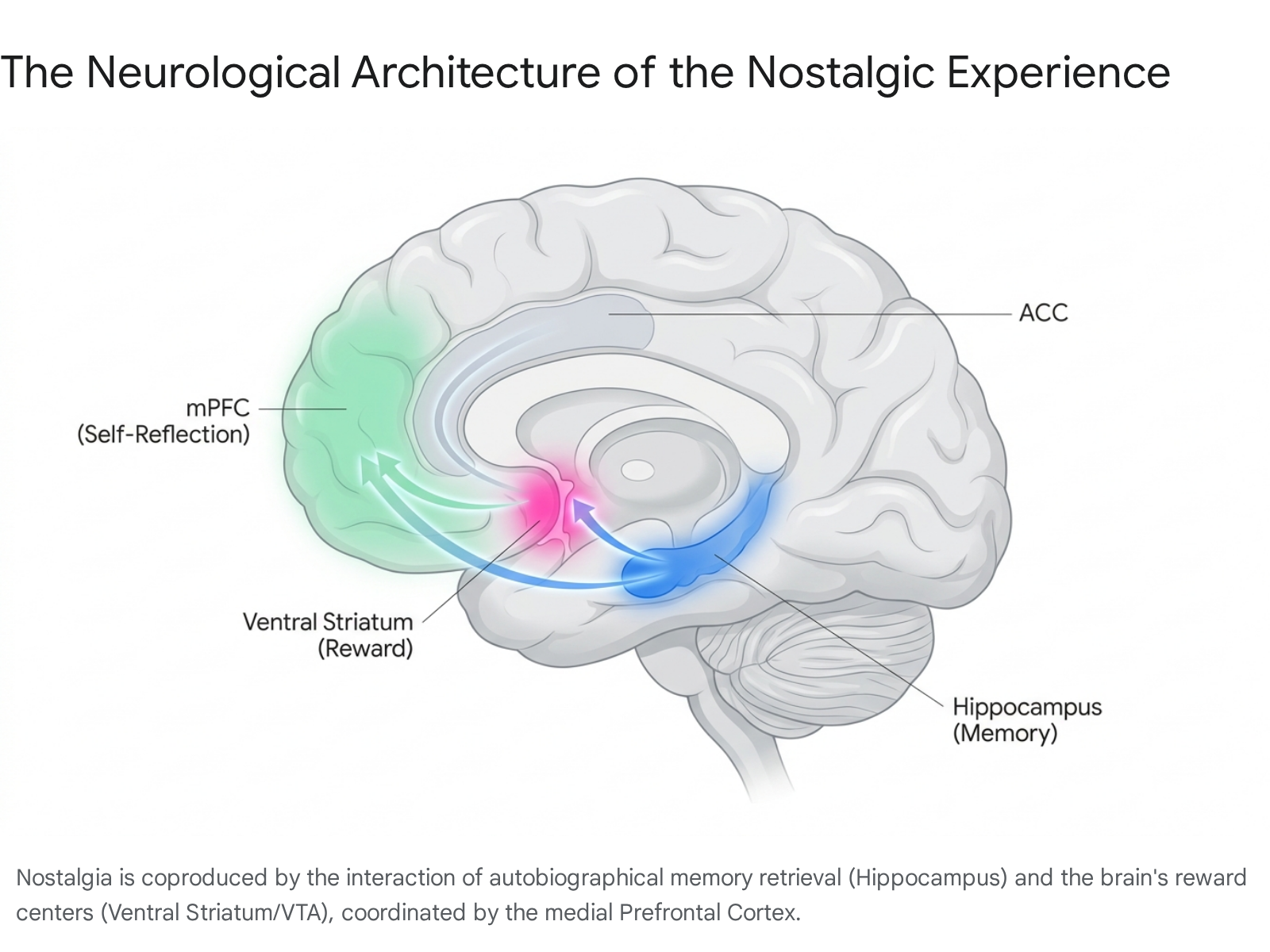
When an individual experiences nostalgia, the very act of remembering is physiologically processed as a highly rewarding event. The resulting release of dopamine and oxytocin within these pathways creates intense, immediate feelings of warmth, trust, and social bonding 2324.
Modulating Decision-Making and Probability Weighting
The deep integration of the reward processing network into the nostalgic experience has profound second-order effects on economic decision-making and probability weighting. Because the brain biologically perceives nostalgic recall as a primary reward, this neurochemical state can temporarily override standard, rational utility-maximizing calculations 12. In a landmark study published in Nature, participants engaged in a gambling task demonstrated a preference to recall positive autobiographical memories even if it meant forfeiting a tangible monetary reward - proving that the brain values the neurochemical hit of nostalgia at an extraordinarily high premium 12.
According to studies published in the Journal of Consumer Research, inducing nostalgia significantly alters consumer purchasing behavior by literally weakening the psychological desire to hold onto money 2517. When a consumer is exposed to a nostalgic trigger in a marketing context, the resulting emotional comfort and heightened perception of social connectedness systematically reduce price sensitivity 171828. The ventromedial prefrontal cortex (vmPFC) - a region deeply involved in evaluating positive outcomes, perceived value, and willingness to pay - is highly responsive to these nostalgic cues 1215.
The downstream commercial effects of this neurological manipulation are immense. Quantitative marketing metrics reveal that consumers experiencing nostalgia are willing to pay a premium of 10% to 15% for products that successfully evoke these feelings 242819.
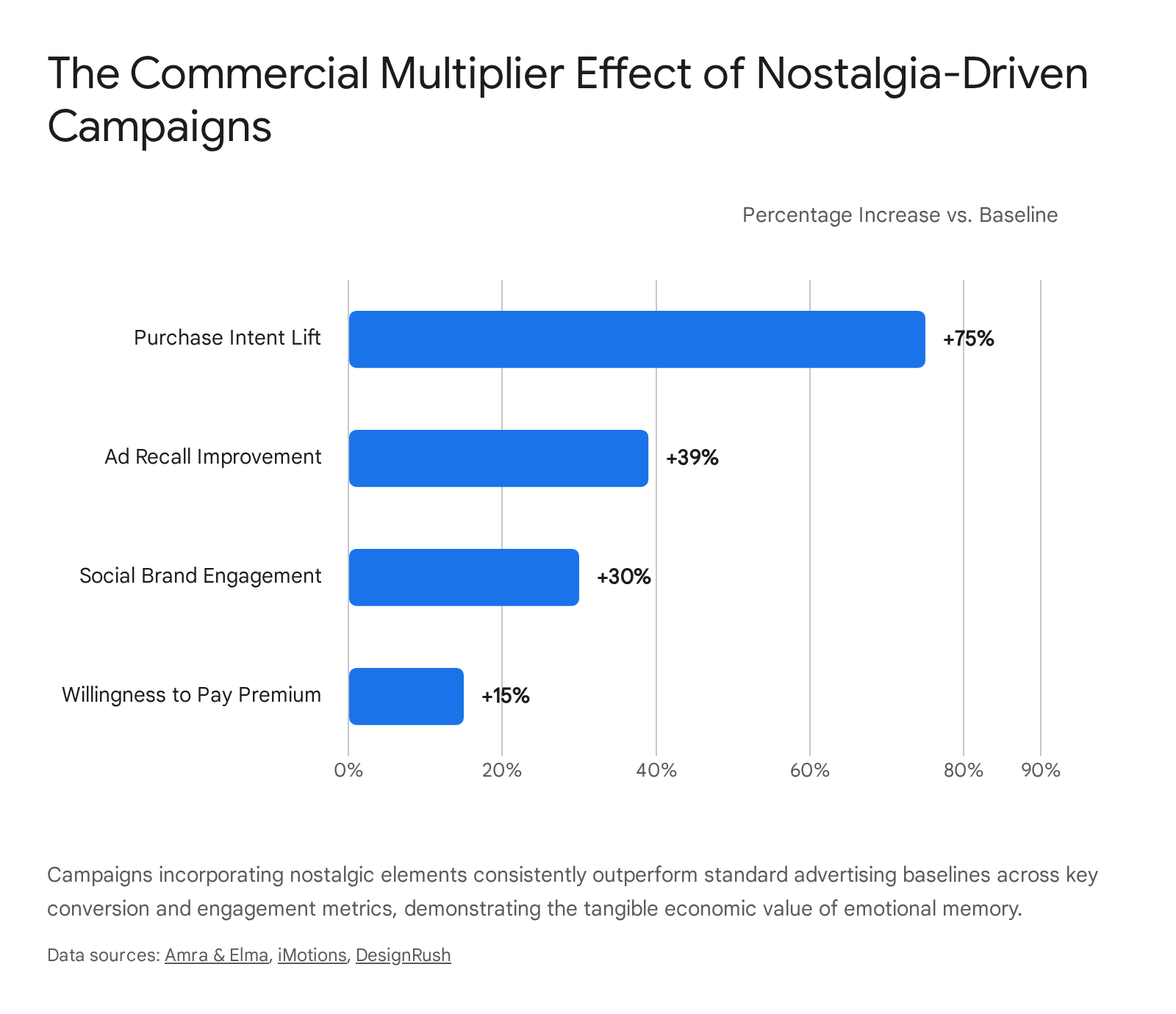
Furthermore, campaigns strategically leveraging this cognitive vulnerability report a 23% overall sales lift compared to standard non-nostalgic advertising, alongside a 24% increase in repeat purchases for revived legacy products 1130. By activating the vmPFC, nostalgic stimuli quite literally alter the perceived neurological value of a product, transforming a standard commodity into an emotionally indispensable artifact 1215.
Digital Nostalgia, "Nowstalgia," and the Gen Z Paradox
Historically, nostalgia marketing relied on the traditional 20-year cycle - the socio-cultural phenomenon where a generation reaches their 30s or 40s, gains disposable income, and begins longing for the cultural artifacts of their youth, conveniently located two decades prior 1731. However, the proliferation of digital ecosystems, on-demand streaming, and algorithmic content distribution has fundamentally shattered this linear, generational timeline. Post-2020 developments reveal a complex, fragmented environment where multiple nostalgic eras - the 1980s, 1990s, and 2000s - are consumed concurrently, driven primarily by Millennials and Generation Z 1720.
Generation Z represents a unique, unprecedented paradox in the study of consumer nostalgia. Despite being digital natives whose lives are deeply integrated with smartphones and AI, they exhibit a profound, accelerating affinity for pre-digital or early-digital aesthetics - ranging from flip phones and wired headphones to vinyl records, digital point-and-shoot cameras, and Y2K fashion 102033. Because their primary exposure to these eras is second-hand - mediated entirely through YouTube retro compilations, curated TikTok feeds, and streaming platform reboots (such as Stranger Things or Mean Girls) - their nostalgia is not autobiographical; it is entirely vicarious 21033.
This phenomenon of "new nostalgia" or "Nowstalgia" is less about accurately recalling the past and more about appropriating an aesthetic that symbolizes simplicity, tactile reality, and disconnection from the hyper-networked, high-anxiety present 1034. Digital platforms have actively gamified and weaponized this historical sentiment. Spotify's integration of AI-generated "throwback" playlists and "emo yearbook" features allows users to digitally simulate past musical identities, resulting in a staggering 44% spike in 1980s/1990s playlist listens during targeted campaigns, effectively doubling playthrough rates 1120. On TikTok, nostalgia-related hashtags - such as #nostalgia, #throwback, and #vintage - surged 130% year-over-year between 2024 and 2026, generating billions of views for highly specific "core" aesthetics like kidcore, normcore, and Y2K 1133.
The critical strategic insight for modern marketers is that for Generation Z, nostalgia functions simultaneously as a strategic language for self-expression and a psychological buffer against climate anxiety, economic precarity, and digital burnout 1020. Brands that successfully deploy Digital Nostalgia Marketing (DNM) bypass standard commercial resistance by framing their products within these emotionally resonant, algorithmically favored aesthetics. Remarkably, empirical data shows that 68% of Gen Z respond positively to this throwback marketing, and 67% view campaigns utilizing nostalgia as inherently more "authentic" 1119. This categorically proves that direct, lived autobiographical experience is no longer a prerequisite for achieving massive nostalgia-driven brand lift in the digital era.
The Generational Topography of Nostalgia: The Reminiscence Bump vs. Macro Cycles
While digital platforms have scrambled the aesthetic timeline, marketers targeting specific demographic cohorts for high-value autobiographical nostalgia must still rely on cognitive developmental frameworks. A nuanced understanding requires distinguishing between macro-cultural 20-year cycles and the neuro-biological reality of memory encoding.
The "20-year cycle" explains the macro-economic resurgence of intellectual property and fashion. However, individual consumer emotional affinity is dictated by the "Reminiscence Bump." The reminiscence bump is a universally documented cognitive phenomenon wherein adults exhibit a disproportionately high, highly vivid recollection of events that occurred between the ages of 15 and 25 2122. This heightened memory encoding is deeply, biologically tied to identity formation; during late adolescence and early adulthood, individuals form their core social identities, make defining choices regarding relationships, and establish long-term brand affinities 232425. Because these memories form the foundational architecture of the self-narrative, they are retrieved more easily, rehearsed more frequently, and carry intense emotional weight 2224.
Interestingly, research into auditory and music-evoked nostalgia reveals a slight deviation based on current age. For individuals currently under 25, childhood years (ages 6 - 10) are cited as the most deeply nostalgic period, largely because their teenage years are too recent to evoke the requisite sense of longing and temporal distance. However, for individuals over 25, the standard teenage and early-twenties reminiscence bump reasserts itself as the dominant source of nostalgic emotion 26.
Generational demographic definitions provide the targeting framework for activating these bumps. Synthesizing data from demographic institutes like the Kem C. Gardner Policy Institute and the Harvard Joint Center for Housing Studies, organizations can accurately map the peak eras for targeted historical marketing 2728.
Matrix of Generational Cohorts and Peak Nostalgic Eras
| Generational Cohort | Birth Years | Peak Reminiscence Bump Eras | Defining Cultural & Technological Artifacts for Autobiographical Targeting |
|---|---|---|---|
| Baby Boomers | 1946 - 1964 | 1960s - 1970s | Civil Rights era, classic rock emergence, first television generation, analog automotive dominance 272829. |
| Generation X | 1965 - 1980 | 1980s - early 1990s | Arcade gaming, early MTV, VHS formats, latchkey independence, analog-to-digital transition 2829. |
| Millennials (Gen Y) | 1981 - 1996 | late 1990s - 2000s | Early internet (dial-up, instant messaging), flip phones, CD walkmans, blockbuster video rentals, pre-recession optimism 2829. |
| Generation Z | 1997 - 2012 | late 2000s - 2010s | Early smartphone adoption, childhood gaming consoles (Wii, DS), early YouTube creators. (Note: High affinity for borrowed 1990s/Y2K historical nostalgia) 192829. |
Cross-Cultural Dynamics: Modulating Nostalgia in Non-Western Markets
While the underlying cognitive architecture of nostalgia - including the activation of the mPFC and ventral striatum - is a universal human neurobiological trait, its behavioral manifestation, frequency, and commercial efficacy are deeply modulated by cultural context. Western models of nostalgia marketing, which often assume a baseline cultural longing for the past, cannot be unilaterally exported to global markets without severe risk of failure.
Macro-level polling by Ipsos regarding global trends reveals stark geographical and cultural contrasts in baseline nostalgic sentiment. While consumers in markets like India, Nigeria, and Hong Kong exhibit extraordinarily high levels of nostalgia and a strong self-reported desire to return to the way their countries "used to be," sentiment in nations such as South Korea, China, Vietnam, and Japan is notably suppressed 30. In South Korea and Japan, societies heavily oriented toward rapid technological progress, rigorous modernization, and future-facing economic optimization, looking backward is often culturally deprioritized or viewed as regressive 23. As noted by researchers, nostalgia marketing generally proves less effective at a macro level in environments where the populace is overwhelmingly enthusiastic about the future and focused on forward progress 23.
However, this does not render nostalgia marketing obsolete in East Asia; rather, the triggers, scopes, and formats must be precisely localized. When nostalgia is decoupled from broad national history and focused tightly on personal, autobiographical milestones, it remains highly effective. A study published in the International Journal of Communication investigating the cross-cultural validity of the "reminiscence bump" found that when advertisements were specifically framed around this biological window of youth, they were equally effective in both the United States and South Korea 3132. In both distinct cultures, bump-framed advertising successfully bypassed cultural hesitations to elicit stronger positive nostalgia, more favorable ad attitudes, and significantly higher purchase intentions compared to present-focused advertisements 3132.
Furthermore, targeted sensory triggers remain highly potent in these markets. Academic research focusing on the South Korean market demonstrated that integrating specific nostalgic music into commercial advertisements significantly enhanced emotional connection, cognitive engagement, and consumer purchase intention, providing comfort in the post-pandemic era 633. Similarly, in Japan, leveraging the highly specific aesthetic and cultural signifiers of the Shōwa era effectively evokes a sense of comfort, reliability, and communal safety 17.
Other regions demonstrate the power of deeply localized historical events. A study examining the reminiscence bump in Bangladesh found that alongside the standard youth bump, older populations exhibited a distinct, secondary memory bump corresponding exactly to the period of the Bangladesh Liberation War, highlighting how profound national events permanently rewire memory retrieval curves 21. In Malaysia, brands like Air Selangor successfully localized the trend by tapping into highly specific national nostalgia, blending 1990s retro vibes with universal Malaysian teenage experiences and local food culture, perfectly marrying the global Gen Z trend with hyper-local authenticity 34. The overarching third-order insight is that while the cultural zeitgeist in certain markets may favor the future, the individual biological vulnerability to targeted, highly localized autobiographical nostalgic stimuli remains universally exploitable.
Strategic Implementation: Activating Memory Triggers
To successfully translate neuro-cognitive theory into measurable commercial execution, marketers must map specific memory triggers to actionable strategies. The following framework synthesizes optimal approaches for activating nostalgia across different sensory and narrative domains, supported by recent empirical outcomes.
| Memory Trigger Modality | Strategic Execution & Practical Marketing Tactics | Underlying Cognitive Mechanism Activated | Demonstrated Commercial Outcome & Metrics |
|---|---|---|---|
| Auditory / Sonic | Licensing retro pop hits, reviving classic 1990s jingles, integrating early 2000s UI sounds (e.g., console boot-ups, flip-phone ringtones) into digital video. | Highly potent, immediate activation of the Hippocampus and Ventral Striatum. Auditory processing rapidly bypasses rational filters to evoke autobiographical emotion and memory retrieval 216. | Yields a 39% improvement in long-term ad recall over standard audio. Drives massive organic virality and user-generated remixes on short-form audio-first platforms like TikTok 211. |
| Visual / Aesthetic | Deploying VHS/lo-fi video filters, reverting to legacy or "throwback" packaging design, utilizing pre-digital typography, reviving iconic brand mascots (e.g., Walmart's 1990s Smiley) 228. | Visual cortex stimulation combined with deeply ingrained pattern recognition. Provides immediate aesthetic comfort, lowers decision fatigue, and signals brand safety in chaotic environments 22449. | Generates a 16% average sales lift for vintage packaging revivals. Retro visuals drive a 17% increase in time spent on page and reduce bounce rates 11. |
| Product / Tactile | Re-releasing discontinued legacy products, creating limited-edition "throwback" drops, designing adult-oriented versions of childhood items (e.g., McDonald's Adult Happy Meals, Nintendo Classic Mini) 1749. | Tactile interaction with familiar objects heavily reinforces self-continuity. It re-establishes a physical link to a past identity, activating intense reward pathways through physical ownership 7917. | Drives a 27% increase in purchase intent due to the combined psychological power of scarcity and nostalgia. Frequently triggers immediate impulse buying behaviors 1211. |
| Interactive / Gamified | Creating custom browser games mimicking 1980s arcades (e.g., Chili's BurgerTime campaign), using AR to simulate retro environments, interactive nostalgia quizzes 1749. | Engages active working memory while triggering autobiographical recall. The gamification element provides immediate dopamine rewards, linking the brand to active pleasure 1749. | Significantly increases dwell time and deep brand engagement. Fosters high levels of brand-consumer relationship quality and interactive social sharing 717. |
| Narrative / Storytelling | Recreating iconic cultural moments, film reboots, or highlighting shared generational milestones (e.g., IKEA's revival of 2010s internet trends like the Harlem Shake for Millennials) 3434. | Engages the mPFC by directly linking the brand identity to the consumer's social identity. Fosters a strong sense of community, shared history, and tribal belonging 142434. | Generates a 2x higher emotional response rate versus standard narrative ads. Results in a 59% increase in organic social sharing due to the desire to bond over shared memories 11. |
Strategic Limitations: Nostalgia Fatigue, Inauthenticity, and Ad Avoidance
Despite its formidable potency, deploying nostalgia marketing carries significant, often underestimated strategic risks. Treating nostalgia as a panacea without rigorous audience alignment frequently results in commercial failure.
Nostalgia Fatigue and the Decay of Effectiveness
The primary limitation facing modern marketers is the threat of nostalgia fatigue. In a digital ecosystem where brands relentlessly mine the past for content, markets rapidly become saturated with retro aesthetics and throwback campaigns. From a cognitive perspective, when a stimulus is overused, the emotional resonance rapidly degrades. Repeated exposure to superficial nostalgic cues strips the physiological reward from the stimuli, reducing the strategy from a powerful psychological anchor to a transparent, easily ignored marketing gimmick 1750. Quantitative research into ad avoidance indicates that while nostalgia initially weakens the desire for money and improves brand attitude, its effect on actual purchase intention is heavily context-dependent and diminishes if the consumer perceives the tactic as a generic, non-self-referential manipulation 7.
Inauthenticity and "Aesthetic Exploitation"
Furthermore, brands risk severe consumer backlash through inauthenticity and "aesthetic exploitation" 1033. Modern consumers, particularly Generation Z, possess acute digital literacy and can easily detect "nostalgia washing" - when a brand attempts to co-opt a cultural memory or era to which it has no legitimate historical claim or foundational alignment 103033. Successful nostalgia requires profound "brand fit."
Several high-profile case studies illuminate the dangers of misapplied nostalgia: * Alienating the Core Base (Limited Too & Gap): When the 1990s fashion brand Limited Too relaunched in 2024, it targeted only young girls, completely ignoring the Millennials who held the actual, deep autobiographical attachment to the brand. This resulted in immediate backlash and a hasty pivot, demonstrating the danger of misunderstanding who holds the memory 17. Similarly, when Gap abruptly abandoned its classic blue-box logo for a modernized design, consumer outrage over the loss of nostalgic brand identity forced a reversion within days 17. * The Generational Disconnect (Levi's & MTV): A highly publicized 2024 campaign by Levi's featuring Beyoncé sought to recreate a famous 1985 "Launderette" commercial. However, the homage largely missed the mark with younger consumers who possessed no autobiographical or historical context for the original advertisement; the nostalgic anchor was cognitively illegible to them 1735. Similarly, MTV's 40th anniversary VMAs leaned so heavily into past icons that it completely alienated younger viewers, leading critics to label the brand as out of touch 17. * Novelty Without Value (Zellers): The Canadian discount retailer Zellers attempted a highly anticipated relaunch based purely on the immense nostalgic affection consumers held for its legacy branding and mascot. However, experts noted that while nostalgia drives the initial foot traffic (the "warm-glow preconception"), it cannot sustain a business model. If the core product offering lacks contemporary value, the nostalgia is entirely short-lived, and consumers will not return 23.
These failures underscore a vital strategic principle: nostalgia must be utilized as an emotional layer that complements and enhances a robust, modern value proposition - a concept industry experts term "Nowstalgia" - rather than functioning as the entirety of the brand's messaging 173450.
Conclusion
Nostalgia has transcended its origins as a simple creative aesthetic to become a measurable, neuro-cognitive lever that directly and profoundly alters consumer value perception and purchasing behavior. By facilitating a collaborative, physiological activation of the brain's episodic memory and primary reward centers, expertly deployed nostalgic stimuli can effectively override standard price sensitivities, increase willingness to pay by up to 15%, and foster deep, generational brand loyalty.
However, as the digital landscape algorithmically accelerates the consumption of past eras and gives rise to the vicarious, purely aesthetic nostalgia of Generation Z, marketers must deploy these strategies with unprecedented analytical precision. Brands that succeed in the complex commercial environment of the late 2020s will be those that avoid the pitfalls of inauthentic "nostalgia washing." Instead, they must master the delicate equilibrium of "Nowstalgia" - respecting the neuro-biological reality of the reminiscence bump, adapting to the unique cross-cultural variations of global markets, and honoring the deep psychological comfort of the past, all while remaining firmly anchored in delivering tangible, modern value.