
Psychology and health effects of nostalgia
Historical Evolution of the Concept
The conceptual understanding of nostalgia has undergone a profound transformation over the past three centuries, transitioning from a localized neurological pathology to a universal, complex psychological construct.
Seventeenth-Century Medicalization
The formal medicalization of nostalgia began in 1688 when Swiss medical student Johannes Hofer coined the term in his dissertation, Dissertatio Medica De Nostalgia, Oder Heimwehe 123. Deriving the word from the Greek roots nostos (return home) and algos (pain or grief), Hofer used the term to describe an intense, debilitating homesickness observed in Swiss mercenaries and domestic servants deployed far from their mountainous homelands 145. At its inception, nostalgia was not viewed as a sentimental emotion but as a severe, potentially fatal medical disorder 367.
The clinical profile documented by Hofer and his contemporaries included acute somatic symptoms: severe fatigue, high fever, heart palpitations, indigestion, insomnia, and anorexia 146. Physicians of the seventeenth and eighteenth centuries hypothesized that the condition was fundamentally neurological. Hofer posited that nostalgia was caused by a continuous vibration of animal spirits through specific midbrain regions, creating an afflicted imagination that could not be remedied by anything other than a return to the native land 13. Other early naturalists, such as Johann Jakob Scheuchzer, theorized an environmental etiology, suggesting that the transition from high-altitude Alpine environments to low-lying areas caused changes in atmospheric pressure that thickened the blood of Swiss soldiers 2.
Treatment modalities during this era were correspondingly physiological and often severe. Medical interventions included the application of leeches, herbal purges, and prolonged hospitalization 36. In military contexts, the condition was considered highly contagious and detrimental to troop morale. Commanders occasionally banned the singing of traditional Swiss herdsmen's songs, such as the Kuhreihen, fearing that the auditory triggers would induce mass nostalgia, leading to desertion or suicide 24.
Nineteenth-Century Military Observations
As global migration and large-scale warfare expanded in the nineteenth century, the phenomenon of nostalgia was observed far beyond Swiss military populations 4. The condition became a significant epidemiological concern for military surgeons. During the American Civil War, medical records indicate that over 5,200 Union soldiers were diagnosed with nostalgia 6.
Historians and medical anthropologists note that in many cases, soldiers succumbed to the condition as secondary clinical depression set in. Because of poor hygiene and an absence of modern medicine, the lethargy and anorexia induced by severe nostalgia left soldiers highly susceptible to opportunistic diseases that frequently proved fatal 36. Medical professionals began looking for diagnostic signs such as a melancholic expression, excessive sweating, and gastrointestinal distress, though treatments remained varied and largely ineffective 6.
Twentieth-Century Psychoanalytic Reclassification
As the discipline of psychology formalized in the early twentieth century, professionals reclassified nostalgia. It was no longer considered a neurological disease of demonic or atmospheric origin, but rather a psychiatric condition akin to melancholia or clinical depression 346.
Early psychoanalytic interpretations framed nostalgia as a maladaptive regression, viewing it as a patient's inability to mourn the passage of time or a subconscious desire to return to a fetal state 4. Psychologists speculated that individuals suffering from nostalgia were demonstrating an inherent difficulty in letting go of childhood 4. This era of psychology approached nostalgia through a deficit model, categorizing it alongside better-studied mental illnesses such as post-traumatic stress disorder (PTSD), anxiety, or schizophrenia, particularly in the context of returning veterans 13.
Contemporary Psychological Paradigms
The contemporary understanding of nostalgia did not crystallize until the late twentieth and early twenty-first centuries. Driven by the emergence of cognitive-behavioral paradigms and systematic empirical research, psychologists began distinguishing nostalgia from mere homesickness. Studies began to isolate nostalgia as a distinct, predominantly positive emotional experience characterized by a sentimental longing for one's own past 8910.
This marked a complete reversal in the scientific consensus: what was once categorized as a fatal disease became recognized as a vital psychological resource 311. The modern definition characterizes nostalgia as an intricate emotion that regulates negative states, soothes emotional conflicts, and provides existential meaning 12.
| Era | Conceptual Paradigm | Proposed Etiology | Clinical Presentation | Primary Interventions |
|---|---|---|---|---|
| Late 17th Century | Neurological Disease | Animal spirits; Atmospheric pressure | Fever, palpitations, anorexia, death | Return home, leeches, purges |
| 19th Century | Military Epidemic | Prolonged geographic displacement | Melancholy, secondary infections | Herbal drinks, hospitalization |
| Early 20th Century | Psychiatric Condition | Maladaptive regression; Subconscious denial | Depression, anxiety, social withdrawal | Psychoanalysis, institutionalization |
| 21st Century | Psychological Resource | Cognitive-emotional memory integration | Wistfulness, positive affect, comfort | Utilized as a therapeutic buffer |
Neurobiological Mechanisms and Pathways
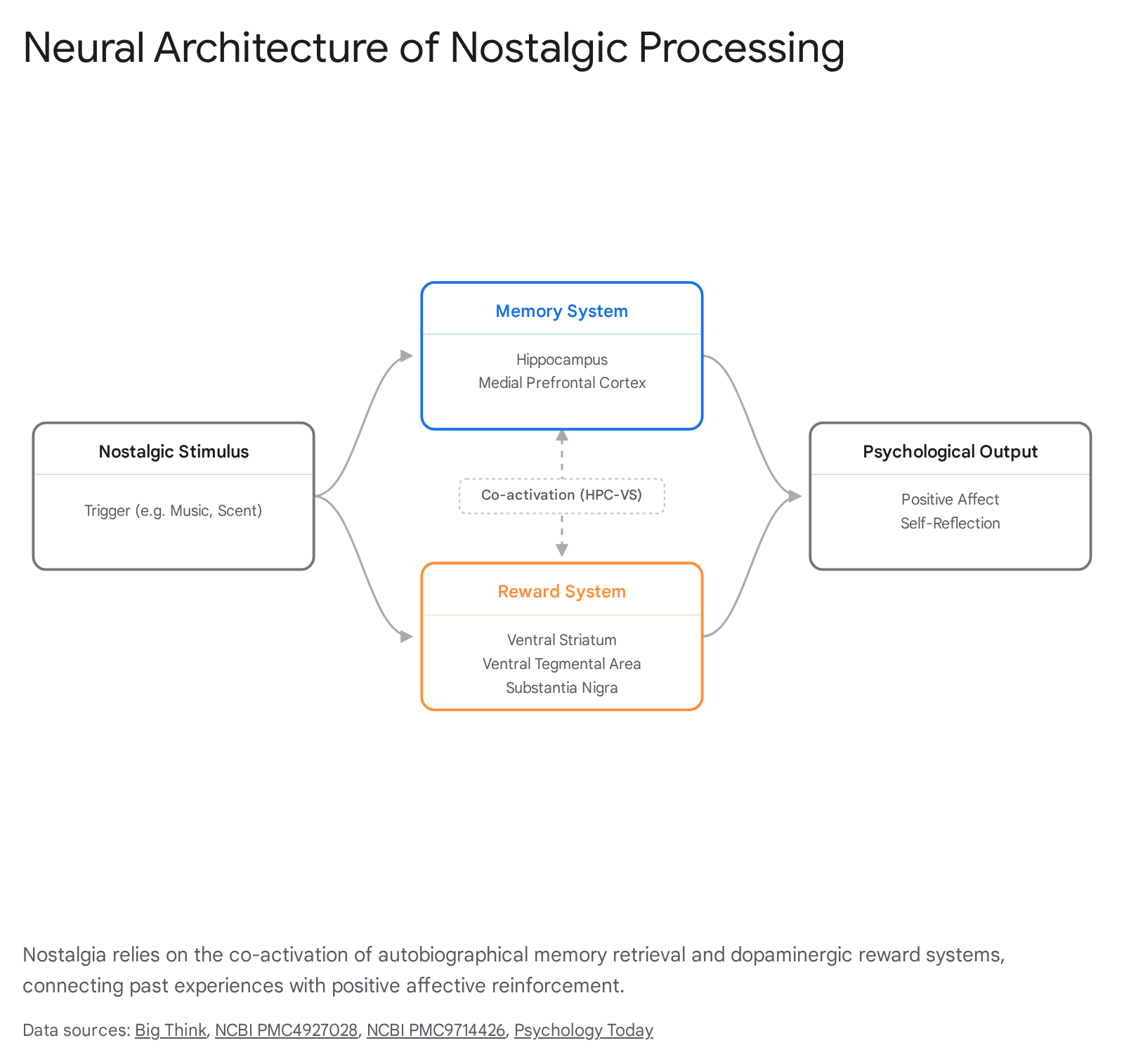
Advancements in neuroimaging, particularly functional magnetic resonance imaging (fMRI) and magnetoencephalography (MEG), have allowed researchers to map the precise neural architecture of nostalgia. The evidence indicates that nostalgic experiences rely on a highly cooperative activation of the brain's autobiographical memory networks and its dopaminergic reward pathways.
Autobiographical Memory and Reward Co-Activation
Nostalgia is fundamentally a memory-driven emotion, yet it distinguishes itself from standard autobiographical recall through its unique affective payload. Neuroimaging studies reveal that engaging in nostalgic reflection heavily activates the hippocampus, parahippocampus, and the broader medial temporal lobe, which are the core structures responsible for encoding and retrieving episodic autobiographical memories 131415.
However, the defining neurobiological signature of nostalgia is the concurrent activation of the brain's reward system. When participants view childhood-related visual stimuli, smell familiar odors, or listen to music rated as personally nostalgic, fMRI scans show pronounced activity in the ventral striatum, substantia nigra, and the ventral tegmental area 13141617. These regions are deeply implicated in the processing of pleasurable, rewarding stimuli. The strength of the co-activation between the hippocampus and the ventral striatum strongly correlates with an individual's subjective rating of how nostalgic they feel 1314. This functional connectivity indicates that the brain is not merely retrieving a factual record of the past; it is actively synthesizing memory with pleasure, effectively co-producing the bittersweet reward of the nostalgic state 1314.
Lifespan Variations in Neural Processing
Nostalgia also engages higher-order cortical networks associated with self-reflection and meaning-making. A comprehensive 2025 fMRI study investigating music-evoked nostalgia across different age groups demonstrated that nostalgic listening is associated with bilateral activity in the default mode network and the salience network, as well as supplementary motor regions 15.
The default mode network, which includes the medial prefrontal cortex, posterior cingulate cortex, and precuneus, is highly active during self-referential thought and mental time travel 1417. Psychophysiological interaction models show that nostalgic stimuli increase functional connectivity between these self-referential regions (specifically the posteromedial cortex) and affect-related regions (specifically the insula) 15. This neural integration explains why nostalgia feels so deeply personal; it binds the emotional resonance of the insula to the self-identity narrative maintained by the default mode network 18.
Furthermore, brain responses to nostalgia exhibit measurable variations across the human lifespan. Older adults (aged 60 and above) display stronger blood-oxygen-level-dependent signals in nostalgia-related regions during nostalgic listening compared to younger adults 15. In younger demographics (aged 18 to 35), the neural response to nostalgic music correlates more strongly with cognitive ability and trait-level nostalgia proneness, whereas in older adults, the response is more directly tied to their immediate affective responses to the stimulus 15.
Spatio-Temporal Dynamics and Visual Memorability
The speed at which the brain processes visually nostalgic or memorable stimuli has been quantified through advanced imaging fusion techniques. A 2024 study utilizing a combination of MEG and fMRI to map the spatio-temporal dynamics of the human brain identified a distinct brain signature of visual memorability that emerges approximately 300 milliseconds after seeing an image 19.
This rapid processing involves a highly distributed network across the ventral occipital cortex and temporal cortex, regions historically associated with color perception and object recognition 19. The research indicates that highly memorable or nostalgic images prompt stronger and more sustained brain responses - lasting for roughly half a second - especially in regions like the early visual cortex, which were previously underestimated in long-term memory processing 19.
Analgesic Modulation and Pain Perception
Beyond emotional regulation, nostalgic processing has demonstrated measurable physiological effects, specifically psychological analgesia. Clinical neuroimaging studies indicate that reflecting on fond memories can significantly reduce the subjective perception of physical pain 2021.
When human participants are subjected to noxious thermal stimuli while simultaneously viewing nostalgic images, their subjective pain ratings decrease, particularly at low pain intensities 2021. fMRI analysis reveals that this analgesia correlates with decreased activity in typical pain-related brain regions, specifically the parahippocampal gyrus and the left lingual gyrus 20. Furthermore, the thalamus acts as a critical functional linkage in this process. Thalamic activation during the nostalgia phase predicts posterior parietal thalamus activation during the pain stage 21. The strength of the nostalgia felt correlates with thalamus-periaqueductal gray functional connectivity, while pain perception is modulated by periaqueductal gray-dorsolateral prefrontal cortex connectivity 21. This suggests that nostalgia actively engages descending pain modulatory pathways, offering a neurobiological basis for its use as a cognitive coping mechanism for mild clinical pain or headaches.
The Homeostatic Regulatory Model
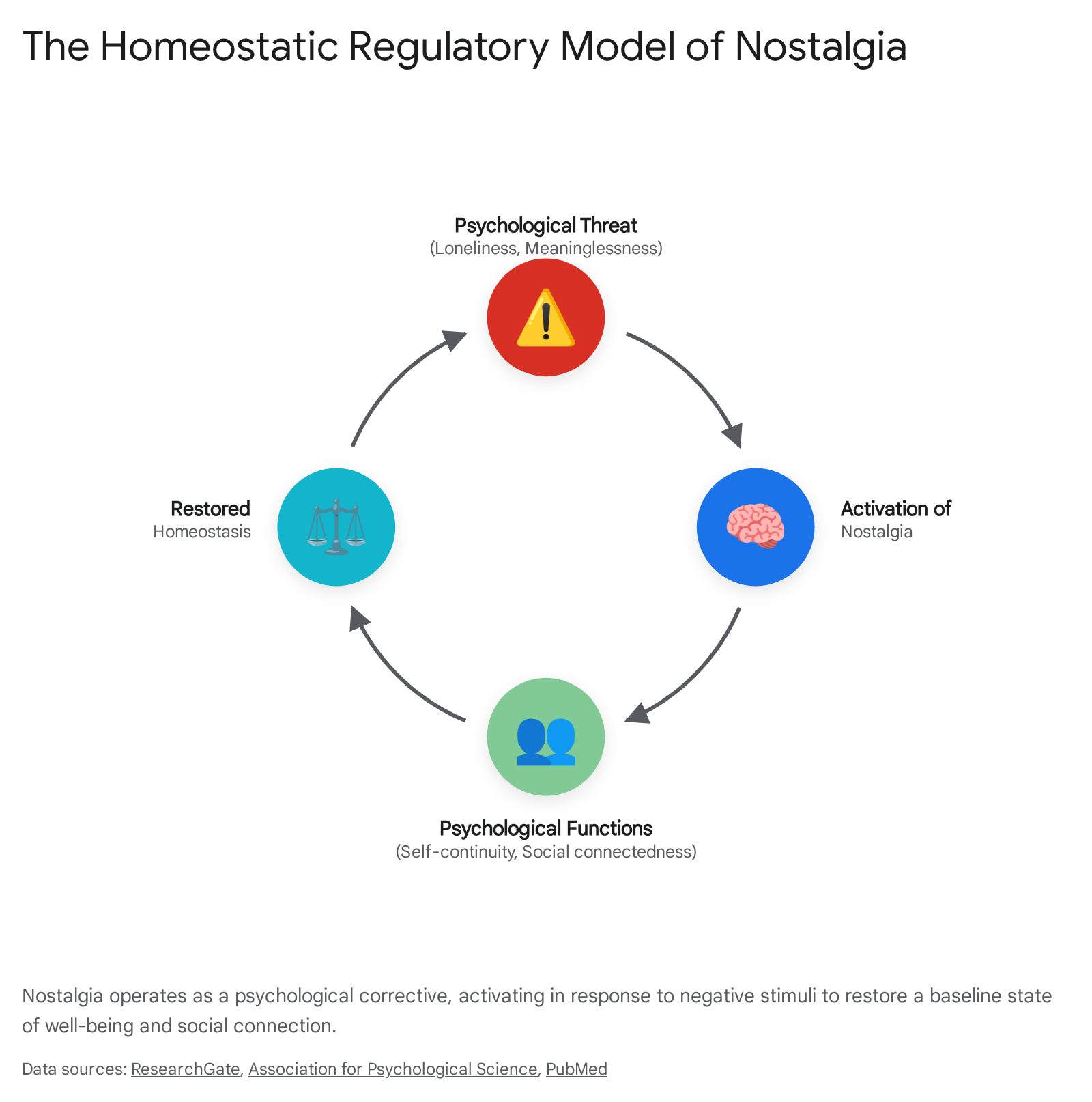
Modern psychological literature approaches nostalgia primarily through a homeostatic regulatory model. In this framework, nostalgia operates as an automated psychological corrective - a mechanism that activates to establish and maintain a relatively stable psychological equilibrium when an individual faces perturbations or adverse environmental conditions 22.
Triggers and the Correction of Psychological Threat
Nostalgia rarely occurs spontaneously without external or internal prompting; it is frequently triggered by specific discomforting states. Experimental evidence identifies negative affect, existential threat, and acute loneliness as the primary catalysts for nostalgic recall 9102223. When individuals feel socially isolated, or when they fear that their lives lack significance, they subconsciously recruit nostalgic memories to counteract these psychological deficits 92224.
As a homeostatic buffer, nostalgia mitigates the psychological damage of these threats. By affirming that one's life has historically contained meaningful moments and secure relationships, nostalgia quiets fears regarding mortality and insignificance 2525. It operates as a psychological resource that individuals can draw upon during life transitions, crises, or periods of high stress, effectively neutralizing the negative states that originally triggered the emotion 723.
Enhancement of Existential Meaning and Self-Continuity
A primary function of nostalgia is the reinforcement of self-continuity - the psychological perception of a stable, enduring connection between one's past and present self 82326. By repeatedly accessing fond memories, individuals weave a cohesive narrative identity. Nostalgia prevents the self-concept from fracturing during times of rapid change or social displacement, providing an inner sanctuary where identity remains intact 1218.
Coupled with self-continuity is the provision of existential meaning. Engaging in nostalgic reflection increases individuals' perceived meaning in life, global self-esteem, and general optimism 112627. The elevation in self-esteem and meaning allows individuals to view both their past and future more positively, ultimately driving approach-oriented behaviors and goal pursuit rather than avoidance 82628.
Fostering Social Connectedness and Prosocial Behavior
Despite taking place in the internal theater of the mind, nostalgia is an acutely social emotion. Research analyzing the content of nostalgic narratives finds that they almost exclusively feature the self as a central protagonist interacting with close friends, family, or partners during momentous life events, such as weddings, family vacations, or school milestones 8929.
When nostalgizing, the mind is peopled with significant attachment figures who are symbolically brought into the present 1228. Consequently, one of the most potent downstream effects of nostalgia is an elevation in social connectedness - a renewed sense of belonging and acceptance 11232729. This internal restoration of social bonds has tangible interpersonal consequences. Five successive experiments demonstrated that individuals who experience induced nostalgia show an increased likelihood of engaging in help-seeking behavior 727. Nostalgia also strengthens relational goals, intensifies empathy, and elevates prosocial and charitable behavior 72627. It serves to alleviate the immediate sting of loneliness by reminding the individual that they are capable of, and have historically possessed, deep social value.
Moderators of Nostalgic Efficacy
The psychological and behavioral consequences of nostalgia do not manifest uniformly across all populations or scenarios. A comprehensive 2023 meta-analysis compiling 90 effect sizes from 9,757 aggregate samples across 22 experimental studies confirmed that while nostalgia reliably enhances consumers' sense of pleasantness, self-continuity, and behavioral intentions, several key variables moderate these effects 3032.
| Moderating Variable | Condition Yielding Stronger Nostalgic Impact | Condition Yielding Weaker Nostalgic Impact |
|---|---|---|
| Nostalgia Activator | Episodic events (e.g., memory of a specific day) | Nostalgic objects (e.g., an antique item) |
| Scenario Realism | Realistic or highly plausible scenarios | Abstract or non-realistic scenarios |
| Priming Modality | Visual priming (e.g., photographs, video) | Textual priming (e.g., written narratives) |
| Gender Composition | Female-majority population samples | Male-majority population samples |
| Cultural Orientation | Short-term oriented cultures | Long-term oriented cultures |
The meta-analysis notably found no significant statistical variations in response based on the age of the participant (older versus younger adults), the type of nostalgic experience (personal versus collective), or the sample type (students versus non-students) 3032.
Cross-Cultural Manifestations and Variations
Historically, the bulk of psychological research on nostalgia relied heavily on Western, educated, industrialized, rich, and democratic populations 31. However, recent large-scale cross-cultural studies indicate that nostalgia is a pancultural phenomenon, though its specific triggers and operational dynamics vary according to local socioecological contexts.
Pancultural Prototypes
Large-scale investigations, such as a multi-continent study spanning 18 countries and 1,704 students, demonstrate striking cross-cultural agreement regarding the conceptual prototype of nostalgia 2532. Laypersons across the globe uniformly conceive of nostalgia as a bittersweet but predominantly positive emotion. Individuals universally rate central features - such as social relationships, self-relevance, fond memories, and a sense of warmth - as highly prototypical of nostalgia, while rating purely negative affect as peripheral 283233.
Across these distinct cultures, the core psychological functions of nostalgia remain consistent. Whether induced experimentally in Western Europe, the Middle East, South America, or East Asia, reflecting on a nostalgic memory reliably increases a participant's sense of social connectedness, self-continuity, and meaning in life compared to recalling an ordinary past event 232834. An integrative data analysis of 41 published experiments reinforced that, globally, nostalgia increases positive affect and ambivalent affect (the co-occurrence of positive and negative emotions), but does not independently drive negative affect 33.
Reevaluating Individualism and Collectivism
While the basic mechanism of nostalgia is universal, its orientation and intensity have been theorized to shift based on cultural dimensions, particularly individualism versus collectivism. Cultural psychologists have traditionally assumed a binary divide, placing Western societies on the individualistic spectrum and Eastern, African, and Latin American societies on the collectivistic spectrum 313536. Under this binary framework, researchers posited that in individualistic cultures, nostalgia is more frequently triggered by internal prompts (such as personal negative affect) and operates to foster personal self-esteem 33. Conversely, in collectivistic cultures, nostalgia was expected to center more heavily on communal experiences, group harmony, and shared traditions, serving primarily to foster social connectedness rather than individual identity 1133.
However, newer global data challenges the rigidity of this binary. A comprehensive study encompassing 102 countries and 88% of the world's population revealed that individualism correlates strongly with socioeconomic development rather than strict geographical divides 35. For example, the study found a mere 2.2-point difference on a 100-point scale of individualism between the United States and Japan - countries previously portrayed as cultural opposites 35. The data indicates that prosperous East Asian societies exhibit high individualism, whereas the most heavily collectivist societies are located in the Global South, including Bangladesh, Egypt, and Myanmar 35. Consequently, the operation of nostalgia in highly collectivist, deeply interdependent societies may be regulated by different cultural models of selfhood that emphasize loyalty to extended kin networks over personal autonomy, a nuance that early cross-cultural studies overlooked 3537.
Environmental and Socioeconomic Triggers
A 2024 study spanning 28 countries and 2,606 participants isolated how national wealth, life expectancy, and physical climate impact nostalgic dynamics 34. The study confirmed that nostalgia is experienced frequently worldwide, but it is more highly valued as a concept in more-developed countries 34. The mechanisms triggering nostalgia also shift based on the macro-environment:
- In more-developed countries, sensory stimuli, such as familiar scents or music, are the primary triggers of nostalgic states 34.
- In less-developed countries, social gatherings and communal interactions act as the dominant catalysts 34.
- In warmer climates, psychological threats and discomfort are significantly more likely to induce nostalgia as a coping mechanism 34.
Furthermore, in countries with lower baseline quality of living - defined by lower national life expectancy and overall life satisfaction - engaging in nostalgic recall causes a significantly higher spike in state satisfaction with life 34. Interestingly, in these less-developed nations, the act of recalling ordinary, non-nostalgic memories also confers some psychological benefits, which mathematically reduces the statistical effect size of nostalgia when compared directly to highly developed nations 34.
Typologies and Temporal Fluidity
Not all nostalgic experiences process the past identically. Depending on the intent of the individual or the collective group, nostalgia can manifest as an aesthetic appreciation of memory or as a rigid political framework. Furthermore, nostalgia is not exclusively bound to the past; it exhibits significant temporal fluidity.
Restorative Nostalgia
Cultural theorist Svetlana Boym developed an influential framework that bifurcates nostalgia into two distinct typologies: restorative and reflective 383940. Restorative nostalgia emphasizes nostos - the return home. It is characterized by an earnest, transhistorical attempt to reconstruct a lost era, a fractured homeland, or an idealized moral past 384041.
Individuals or groups operating under restorative nostalgia do not view their longing as a subjective emotional state; instead, they view their idealized past as absolute truth and absolute tradition 3844. This variant of nostalgia is literal and uncompromising. It seeks to patch up the gaps in historical memory to recreate a flawless, prelapsarian moment, refusing to acknowledge the contradictions of history 3940. Because it takes itself with utmost seriousness and attempts to conquer and spatialize time, restorative nostalgia frequently underpins national and religious revivals 3839. This form operates on two main narrative plots: the triumphant return to origins, and the conspiracy theory detailing who destroyed those origins 38. When weaponized collectively, unelected restorative nostalgia can breed extremism and outgroup exclusion, as individuals become willing to defend phantom homelands with paranoid determination 2938.
Reflective Nostalgia
Reflective nostalgia, conversely, thrives in algia - the aching or longing itself 384044. Rather than attempting to physically or politically rebuild a lost home, reflective nostalgia accepts that the past is irretrievable and perpetually delays the homecoming, dwelling in the longing wistfully and desperately 38394044.
This mode explores the ambivalences of human longing, savoring the shattered fragments of memory without demanding that they form a coherent, absolute truth 3839. Reflective nostalgia is oriented toward the individual narrative rather than collective political symbols. It allows for critical distance, meaning an individual can simultaneously miss the past while recognizing its flaws, contradictions, and ultimate inaccessibility 384144. Because it accommodates irony and humor, reflective nostalgia is generative and creative, treating the past not as a strict blueprint for the future, but as an aesthetic experience to be appreciated, much like a novel or a film 383940.
Future-Oriented Forms: Anticipatory and Anticipated Nostalgia
While traditionally studied as a past-oriented emotion, nostalgia also unfolds in future-oriented variants, demonstrating its temporal fluidity. Psychologists classify these into two distinct phenomena: anticipated nostalgia and anticipatory nostalgia 4243.
Anticipated nostalgia involves expecting to miss something in the future, while anticipatory nostalgia is the act of preemptively missing something before it is actually lost 43. This often occurs during significant life transitions, periods of emotional ambiguity, or in liminal spaces where an individual is aware that a current era is ending 43. For example, an individual might experience anticipatory nostalgia during a graduation ceremony or on the last day of a vacation, feeling the grief of loss while the event is still occurring 42. Research integrating virtual reality (VR) technologies has begun utilizing liminal spaces to elicit and study these future-oriented variants, suggesting that they engage unique prospective cognitive processes, such as episodic future thinking and mental simulation, separating them from purely memory-based paradigms 43.
Clinical Limitations and Maladaptive Processing
While broad consensus in modern psychology frames nostalgia as a positive, homeostatic resource, it possesses notable clinical limitations. Under specific psychological conditions, the regulatory mechanism misfires, trapping the individual in maladaptive cycles of grief, isolation, and emotional distress.
Nostalgic Depression and the Rumination Trap
Nostalgia becomes clinically problematic when it intersects with traits of chronic worry, resulting in what is informally termed "nostalgic depression" 25424445. In these instances, the nostalgic state devolves into rumination - a repetitive, intrusive thought pattern closely linked to clinical depression 2544.
When individuals experience spontaneous nostalgia following a stressful daily event, they may fall into the trap of unfavorable comparison. Instead of drawing comfort from the past, they measure their current, disappointing reality against an idealized, unattainable past 2544. If a person concludes that their best days are permanently behind them, the nostalgic memory sharpens feelings of regret, guilt, and existential emptiness 4245. Daily diary studies tracking natural fluctuations in mood over consecutive days indicate that spontaneous, daily states of nostalgia can actually predict increases in sadness, rumination, and decreases in feelings of peacefulness on subsequent days 2444. This reveals a psychological paradox: looking backward for comfort can reinforce emotional distress if the individual possesses a strong predisposition for worry 54244.
Amplification of Chronic Loneliness
Although experimental setups reliably show that induced nostalgia acts as an antidote to loneliness, real-world observational data suggests a more complex interaction. For individuals experiencing severe, chronic isolation, natural fluctuations of nostalgia may fail to buffer against loneliness and, instead, actively amplify it 2442.
When an individual lacks the agency or physical capacity to recreate past social connections - such as grieving a deceased loved one, experiencing mobility limitations in old age, or enduring pandemic-related lockdowns - reminiscing highlights the finality of that loss 454647. In these scenarios, nostalgia ceases to be a connective bridge and becomes a painful reminder of isolation. The contrast between a vibrant past and a restricted present can lead to withdrawal from current social activities and an exacerbation of depressive symptoms, indicating that the efficacy of nostalgia as a psychological buffer is highly dependent on the individual's current environmental context and baseline mental health 2445.
Digital Nostalgia and Algorithmic Curation
The rapid proliferation of digital technology and social media platforms has fundamentally altered the triggers, frequency, and cognitive processing of nostalgia. In the contemporary era, memory preservation is increasingly outsourced to technology, giving rise to "digital nostalgia" and novel forms of vicarious longing curated by machine learning.
The Behavioral Science of Algorithmic Campaigns
Historically, nostalgic reflection was an organic, self-directed process triggered by a chance encounter with a scent, a song, or an old photograph. Today, algorithmic curation engineers nostalgia artificially. Features such as Facebook's "On This Day", Google Photos' memory carousels, and Spotify Wrapped proactively resurface past content to capture user attention and extend platform engagement 48495051.
This engineered nostalgia leverages deep behavioral science principles to maintain user attention: * Quantitative Fixation: Campaigns like Spotify Wrapped validate users by quantifying their identity (e.g., total minutes listened, number of genres explored). This gamifies memory, satisfying human preferences for concrete, measurable data regarding their own behavior 495256. * Social Comparison and the Bandwagon Effect: By ranking listeners (e.g., awarding "Top 1% of fans" status), platforms create a sense of exclusivity and status. Formatting these metrics specifically for sharing on platforms like Instagram triggers a bandwagon effect, establishing participation as a social norm 5256. * Narrative Identity: Platforms package random data points into a cohesive, aesthetically pleasing narrative, helping users solidify their sense of self-continuity. This provides a socially acceptable context for individuals to publicly share their interests without fear of narcissistic judgment 56.
Curation Bias and the Distortion of Memory
While digital nostalgia can foster temporary joy and social connection, it possesses significant cognitive consequences. Artificial intelligence-driven curation optimizes for highly engaging, positive, or viral moments, which can lead to a severe distortion of personal history 4850.
The algorithmic erasure of mundane, neutral, or negative memories creates a false reality against which the user's present life is unfairly judged 4850. Furthermore, the compulsion to document experiences for digital platforms induces the "photo-taking impairment effect." Research indicates that individuals who constantly photograph experiences to share online offload memory formation to the device; consequently, their brains reduce the effort invested in encoding those moments naturally 50. They remember the act of taking and curating the photo rather than the sensory details of the event itself, weakening internal recall mechanisms and altering personal neuroplasticity over time 4850.
Anemoia and Vicarious Longing
A striking manifestation of digital-era longing is the emergence of "anemoia" - a profound nostalgia for a time, place, or historical period that the individual never personally experienced 53585460. Fueled by visually rich, algorithmically recommended content on platforms like Instagram and TikTok, younger demographics (such as Generation Z) frequently develop deep sentimental connections to idealized pasts, such as the 1990s or the "cottagecore" agrarian aesthetic 5355.
Current academic literature indicates a lack of empirical consensus on the exact mechanisms of anemoia, though theoretical frameworks suggest it is rooted in the fact that human memory is a reconstructive, creative simulation rather than an objective recording 1254. When exposed to rose-tinted media representations of the past, the brain can simulate a past it never lived, eliciting a genuine yearning 1254.
Studies indicate that anemoia functions similarly to traditional nostalgia, capable of improving mood for highly optimistic individuals by providing a form of psychological escapism 535856. However, anemoia also acts as a barometer of present dissatisfaction. When younger cohorts struggle with pandemic aftermaths, economic instability, or existential stress, they seek safe harbor in curated digital retro-aesthetics 535455. This demonstrates that looking backward remains a powerful, universally human coping strategy, even when the past being mourned is entirely fictitious.