
Michael Tushman's theory of structural organizational ambidexterity
The imperative for modern organizational survival rests on a fundamental paradox: the ability to exploit existing assets and capabilities for short-term efficiency while simultaneously exploring new technologies and markets for long-term viability. This dynamic, often referred to as the innovator's dilemma, requires organizations to host contradictory structures, processes, and cultures within the same corporate boundary. Michael Tushman and Charles O'Reilly advanced the concept of the ambidextrous organization to address this profound structural challenge. Their framework posits that sustained competitive advantage is achieved through structural ambidexterity, defined as the spatial and organizational separation of exploratory and exploitative units, bound together by a highly integrated senior executive team. The overarching objective of this theoretical model is to resolve the inherent tension between stability and agility, permitting organizations to operate in mature markets while pioneering disruptive innovations.
The Paradox of Exploration and Exploitation
The conceptual origins of organizational ambidexterity trace back to Robert Duncan in the 1970s, who initially identified the conflicting demands of innovation and efficiency, suggesting that organizations shift their structures over time to align with these dual requirements 12. However, the modern academic discourse on the subject is heavily anchored in James March's seminal 1991 framework, which formally delineated the concepts of exploration and exploitation as competing organizational learning modalities 23.
March defined exploitation as activities characterized by refinement, efficiency, selection, and execution. Exploitative activities generate highly predictable, near-term returns by optimizing current competencies and squeezing maximum margin from existing business models 34. Organizations engaging in exploitation rely on highly structured, routinized processes to eliminate variance and ensure quality. In contrast, exploration involves search, variation, risk-taking, experimentation, and discovery. Exploratory activities are inherently uncertain, often yielding long-term, highly variable returns, and are necessary for discovering discontinuous innovations that replace aging product life cycles 34.
Because these two modalities compete for the same scarce organizational resources - capital, talent, and executive attention - firms naturally gravitate toward exploitation. Exploitation offers clearer, immediate feedback loops and measurable financial success, which satisfies shareholder demands and traditional corporate performance metrics. Over time, this gravitation creates a phenomenon known as the competency trap or the success trap 45. In this scenario, an organization becomes highly efficient at operating in its current paradigm but entirely loses the capacity to adapt to discontinuous environmental shifts. The firm becomes a victim of its own optimization. Conversely, a firm that over-indexes on exploration may fall into a failure trap, endlessly experimenting with new concepts without ever achieving the operational economies of scale necessary to fund future initiatives 4.
O'Reilly and Tushman employ the metaphor of the Roman god Janus, who possessed two sets of eyes looking in opposite directions, to describe the cognitive and structural requirement for modern executives. Executives must constantly look backward to attend to the products and processes of the past, while gazing forward to prepare for the innovations that will define the future 6. Addressing this paradox is not merely a matter of strategic intent; it requires a deliberate architectural design that prevents the immediate demands of the core business from suffocating fragile, long-term innovations.
Modalities of Organizational Ambidexterity
To resolve the inherent tension between exploitation and exploration, organizational theorists have identified three primary archetypes of ambidexterity: sequential, contextual, and structural 678. Each model proposes a different mechanism for managing the allocation of resources and the resolution of internal conflicts.
Sequential ambidexterity, also referred to as temporal ambidexterity, involves an organization alternating its strategic focus between exploration and exploitation over time. Under this model, a firm might prioritize efficiency and cost-cutting during a stable economic period, optimizing its current product lines, and then rapidly reorganize to prioritize radical innovation during a market disruption or leadership change 89. While effective in environments with slow, predictable technological cycles, sequential ambidexterity struggles to address rapid, simultaneous technological disruptions where sequential cycling is simply too slow to capture emergent market share 2. Furthermore, constantly dismantling and rebuilding organizational structures to pivot between efficiency and innovation introduces severe operational friction and employee fatigue.
Contextual ambidexterity, developed largely by organizational scholars such as Gibson and Birkinshaw, argues against formal structural separation. Instead, it relies on building a behavioral capacity within the same business unit, allowing individual employees to use their own judgment to divide their time between alignment-focused tasks (exploitation) and adaptability-focused tasks (exploration) 210. This approach requires a highly supportive organizational culture characterized by stretch, discipline, trust, and psychological safety 1113. Companies that allow engineers a set percentage of their workweek to pursue independent, innovative projects are employing a form of contextual ambidexterity. The integration occurs at the individual level, making the organization highly agile and capable of continuous, incremental innovation. However, contextual ambidexterity is notoriously difficult to maintain, as the gravitational pull of immediate operational deadlines inevitably overrides exploratory time 1312.
Structural ambidexterity, championed by Tushman and O'Reilly, mandates the creation of distinct, physically and organizationally separate subunits. One unit is entirely dedicated to the exploitation of the core business, while the other is dedicated to exploring new domains. These units possess entirely different incentive structures, cultures, and operational processes, preventing the cross-contamination of metrics 1314. While contextual ambidexterity is highly effective for incremental innovation and continuous improvement, robust empirical research indicates that structural ambidexterity is critical when an organization attempts to pioneer disruptive, discontinuous innovations that threaten the core business model 1015. Disruptive innovation requires a completely different cost structure and value proposition, which cannot survive if evaluated by the financial metrics of the legacy business.
Architectural Design of Structural Ambidexterity
Structural ambidexterity fundamentally rejects the traditional contingency theory of differentiation and integration, which suggests that organizations should adopt a single structure that fits their primary environment 16. Instead, the theory relies on an orthogonal view of organizational design, arguing that high structural differentiation coupled with targeted integration at the highest levels of management is the only reliable method for managing paradoxes 1917.
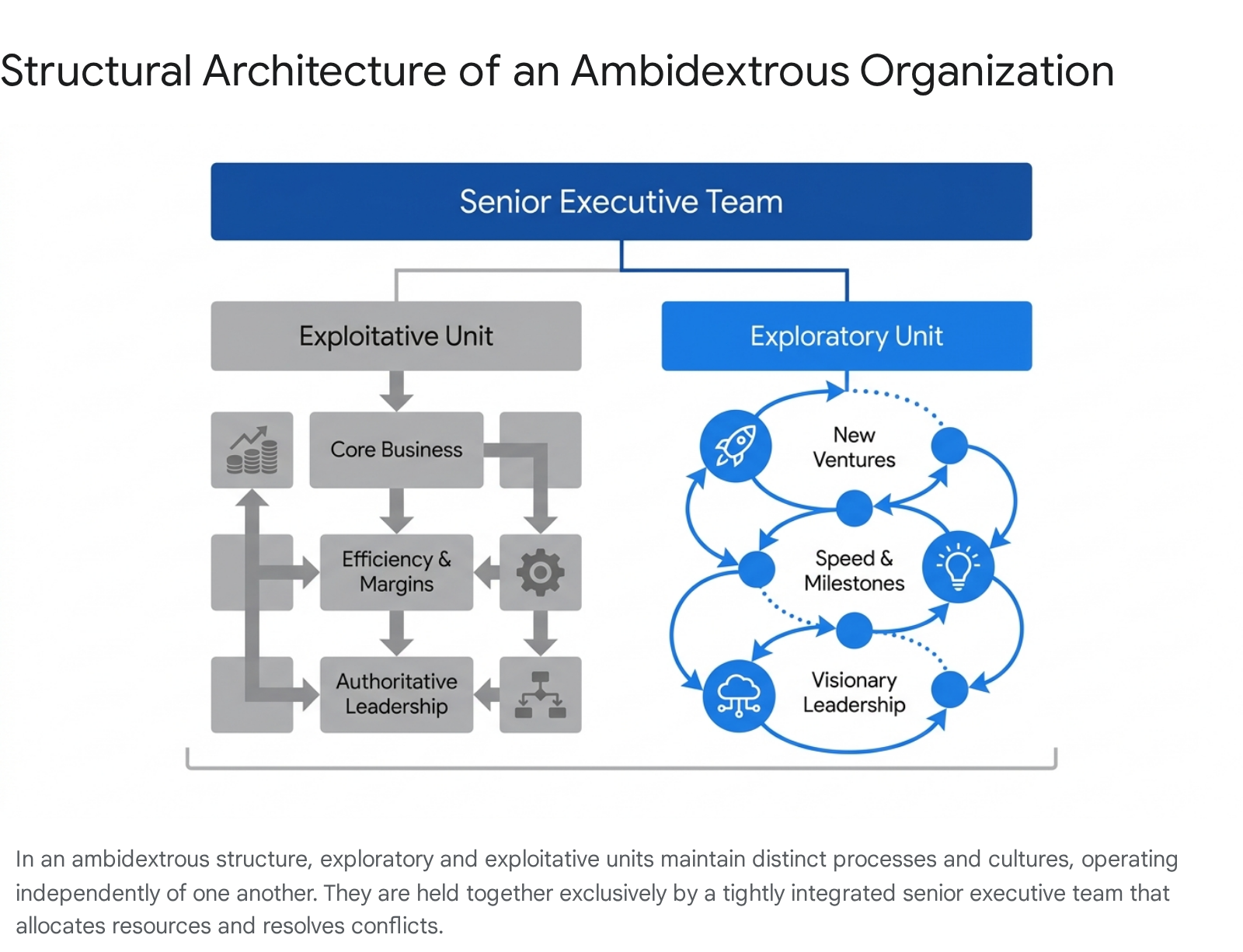
The foundational requirement of this blueprint is that exploratory and exploitative units must have bespoke alignments tailored to their specific market environments. Subjecting an exploratory venture to the strict performance metrics and risk aversion of the core business inevitably stifles breakthrough innovation, as nascent products rarely meet the margin requirements of mature cash cows. Conversely, subjecting the core manufacturing or operational business to the loose, experimental culture of a startup destroys efficiency and rapidly degrades profitability 618.
The Harvard Business Review analysis formally categorizes these required alignments across critical organizational dimensions, emphasizing that structure alone is insufficient without accompanying changes to culture, metrics, and leadership behaviors 18.
| Alignment Dimension | Exploitative Units | Exploratory Units |
|---|---|---|
| Primary Strategic Focus | Existing capabilities and mature markets | New opportunities and disruptive technologies |
| Metrics & Controls | Margins, productivity, efficiency, and profit | Milestones, growth, learning, and prototype iterations |
| Organizational Culture | Efficiency, low risk, quality, and process-driven | Risk-taking, speed, flexibility, and experimentation |
| Leadership Role | Authoritative and top-down | Visionary and highly involved |
| Approach to Risk | Risk-averse; focused on protecting the core | Risk-tolerant; focused on capturing new frontiers |
By establishing profound structural differentiation, organizations allow these disparate units to develop their own internally consistent competencies and systems without cross-contamination 1122. The physical separation serves as an organizational boundary, ensuring that the heavy bureaucracy, entrenched processes, and short-term financial pressures of the established business do not crush the nascent exploratory venture 1419.
Differentiation from Complex Organizational Forms
In management literature and practice, structural ambidexterity is frequently conflated with other complex organizational designs, such as cross-functional teams, matrix management, and corporate diversification. However, academic literature draws sharp distinctions between these structures, particularly regarding their utility in managing discontinuous innovation 1216.
Matrix management, an organizational form popularized in the 1970s among engineering contractors, focuses on optimizing resource allocation by breaking down functional silos 20. Employees in a matrix structure report to multiple managers, typically a functional head and a product or project lead 2526. While this increases flexibility and cross-disciplinary collaboration, it fundamentally operates within a unified corporate culture and is governed by unified performance metrics. Matrix management is notoriously complex, often leading to conflicting demands, power struggles, and decision-making paralysis, and it does not explicitly separate exploratory cultures from exploitative ones 2021.
Similarly, cross-functional teams involve employees from various departments collaborating on specific projects while remaining within their traditional functional reporting lines 1528. This structure is highly effective for incremental product improvements but consistently fails for disruptive innovation because team members remain beholden to the core business's metrics, compensation structures, and cultural norms 15. Breakthrough innovation requires structural independence to survive the early phases of development where financial returns are negative.
Corporate diversification represents a broader strategic maneuver where a firm expands into new products, markets, or industries to spread risk and seek new growth avenues 29. While an organization can diversify through external mechanisms such as mergers and acquisitions, diversification does not automatically equate to structural ambidexterity. A holding company may own diverse assets, but structural ambidexterity explicitly requires the simultaneous pursuit of exploration and exploitation within related operational domains, necessitating active leadership integration to leverage shared capabilities 1317.
| Organizational Design | Primary Mechanism and Authority Flow | Efficacy for Discontinuous Innovation |
|---|---|---|
| Cross-Functional Teams | Temporary collaboration across silos; functional reporting remains intact 1528. | Low. Teams remain culturally and financially bound by the metrics of the core business 15. |
| Matrix Management | Dual reporting lines designed to optimize existing resource sharing and flexibility 2526. | Low. Often results in power struggles and does not protect exploratory ventures from efficiency mandates 2021. |
| Corporate Diversification | Portfolio expansion into new markets, often via acquisition, to spread financial risk 29. | Variable. Does not inherently require the internal capacity to balance conflicting learning modalities 1317. |
| Structural Ambidexterity | Autonomous units with dedicated resources, bespoke cultures, and distinct KPIs 1314. | High. Specifically designed to incubate disruptive innovations by shielding them from the core business's immune system 815. |
Therefore, structural ambidexterity is a distinct architectural choice. It purposefully erects silos between the old and the new to protect the latter, rather than attempting to dissolve silos to create a homogeneous, collaborative environment 822.
Leadership Mechanisms and Conflict Resolution
The presence of highly differentiated units operating under opposing paradigms inevitably breeds intraorganizational conflict. Product teams may fight over budget allocations, traditional sales teams may refuse to sell unproven exploratory products, and core business managers may view the exploratory unit as a chaotic drain on overall profitability. Consequently, Tushman and O'Reilly assert that structural ambidexterity is fundamentally a leadership challenge rather than merely a structural one 13.
To prevent the organization from fracturing, the distinct units must be integrated at the highest level of management. This requires a tightly integrated senior executive team capable of managing the inherent contradictions of the dual structure 1623. Leadership in this context is viewed as a dynamic capability, wherein senior executives must be able to sense and seize new opportunities by continuously reallocating organizational assets 13.
Crucially, decisions regarding digital transformation, disruptive technologies, or the funding of new ventures cannot be delegated to middle management. Middle managers are heavily incentivized to protect the core business and optimize current margins; they lack the authority and the mandate to cannibalize existing product lines. Senior managers must personally provide the approval, investment, and top-level air cover for exploratory units to survive the inevitable internal resistance 13.
This requires executives to be consistently inconsistent in their management approach 18. They must act as rigorous, uncompromising cost-cutters when reviewing the performance of the exploitative unit, demanding efficiency and margin expansion. Simultaneously, they must act as tolerant, visionary venture capitalists when reviewing the exploratory unit, accepting failure as a necessary byproduct of learning and evaluating progress based on milestone achievement rather than quarterly profit 1823.
Targeted Integration and Linking Mechanisms
While the units are structurally separate, they cannot be entirely isolated. If an exploratory unit operates with complete autonomy and zero integration, it loses the competitive advantage of belonging to a larger, well-resourced corporation, rendering it no different than an external startup. Therefore, organizations must employ targeted integration to leverage shared assets - such as customer databases, manufacturing scale, proprietary technology, or brand equity - across the autonomous units 1319.
Achieving this delicate balance requires specific, deliberate leadership mechanisms. A common strategic intent and a shared set of core values are essential to hold the disparate units together. An overarching corporate vision is vital to legitimate the existence of both units, explaining to the core business why the exploratory unit is necessary for the firm's long-term survival, and reminding the exploratory unit of the legacy that funds their experimentation 13.
Furthermore, leaders must actively construct and manage interfaces between the old and new business domains. Interface management ensures that necessary knowledge transfer occurs without cross-contaminating cultures. For example, researchers note the use of high-level, daily editorial meetings at traditional media organizations as an interface to mediate resource and story allocation between legacy print units and emerging digital units 1319.
To foster cooperation at the executive tier, successful ambidextrous structures often abandon unit-specific performance bonuses for the senior team. Instead, they rely on a common incentive structure tied to the overall growth and performance of the entire corporation. This compensation design forces the leadership team to collaborate, overcome personal fiefdoms, and make the difficult trade-offs necessary to fund the future while maintaining the present 1832.
The Paradoxical Mindset
A critical component of this leadership framework is the cognitive ability to manage paradoxical intents. Leaders must abandon binary, either/or thinking and embrace a both/and philosophy 101324. This involves tension management - the psychological capacity to host multiple, contradictory organizational alignments without forcing them into a single, homogenized corporate culture to relieve the discomfort 1319.
When a senior team lacks this paradoxical mindset and attempts to resolve the tension by forcing uniform processes across the enterprise, the organization usually defaults to exploitation. The immediate financial gravity of the core business consumes the exploratory unit, starving it of specialized resources and ultimately causing the innovation effort to fail 45.
Tensions with Agile Methodologies and Scaled Agility
In contemporary management practice, the widespread adoption of Agile software development and Agile at Scale frameworks (such as SAFe or LeSS) has generated significant theoretical and practical friction with Tushman's structural ambidexterity model. While both paradigms seek to enhance organizational adaptability and responsiveness, their structural prescriptions differ profoundly 243425.
Agile methodologies prioritize iterative development, continuous feedback loops, decentralized decision-making, and stable, cross-functional product teams over temporary, siloed project structures 2627. Advocates of scaling Agile argue that the entire organization should be transformed to embrace these principles, actively dissolving traditional functional hierarchies and rigid planning cycles in favor of ubiquitous agility 2728.
This philosophy presents a direct conflict with the tenets of structural ambidexterity. Tushman and O'Reilly argue that ubiquitous agility is a flawed objective because certain parts of the business - specifically the exploitative core - must operate with hierarchical control, rigid standardization, and zero-defect tolerances to maximize efficiency 29. Attempting to force decentralized, exploratory Agile methodologies onto highly optimized, routine manufacturing, compliance, or back-office operational processes introduces unnecessary chaos, degrades quality, and erodes margins. Conversely, managing an exploratory software venture using traditional, rigid Waterfall or Six Sigma methodologies will invariably stifle speed and innovation 1030.
Researchers analyzing this conflict argue that Lean management and Agile methodologies are actually contradictory forces serving opposite goals. Lean drives exploitation by eliminating waste and variance to achieve efficiency, while Agile drives exploration by encouraging iteration and flexibility. Under a strict structural ambidextrous view, continuous improvement initiatives should be kept entirely separate from breakthrough innovation initiatives to prevent the metrics of one from contaminating the other 1027.
Bimodal IT as a Structural Compromise
To reconcile these methodological conflicts, particularly during large-scale digital transformations, many large enterprises have adopted the concept of Bimodal IT. This approach serves as a direct, technological manifestation of structural ambidexterity 2531.
In a Bimodal IT framework, the information technology function is formally divided into two distinct operating modes. Mode 1 focuses on predictability, reliability, and stability. It manages legacy systems, core infrastructure, and mission-critical systems of record using traditional, hierarchical governance, rigorous change management, and sequential development methods 2531. Mode 2 focuses on agility, speed, and innovation. It handles systems of engagement, customer-facing digital interfaces, and rapid prototyping using Agile frameworks, DevOps practices, and decentralized, autonomous governance 2531.
Bimodal IT explicitly acknowledges that structural separation is necessary because the governance mechanisms required to ensure the stability of a core banking system, for example, are fundamentally incompatible with the mechanisms required to rapidly iterate a mobile application. However, implementing Bimodal IT generates the classic ambidextrous challenges predicted by organizational theory: severe cultural friction between the two groups, disputes over budget allocation, and the profound technical difficulty of reintegrating agile, Mode 2 innovations back into the stable, Mode 1 core architecture 2231.
Achieving ambidextrous IT governance therefore requires combining traditional control mechanisms for exploitative activities with agile-adaptive mechanisms for exploratory ones, heavily mediated by strong relational governance and conflict resolution at the Chief Information Officer level 25.
Empirical Application: The Haier Group and Rendanheyi
The application of structural ambidexterity varies significantly across different geopolitical contexts, industry life cycles, and technological maturities. An analysis of global case studies reveals how structural separation is adapted in practice to manage complex market realities, pushing the boundaries of traditional management theory.
The Haier Group, a leading Chinese multinational home appliances manufacturer, provides one of the most radical and studied empirical cases of organizational ambidexterity 4232. Facing fierce global competition and the impending digital disruption of the Internet of Things (IoT), CEO Zhang Ruimin recognized that Haier's traditional, hierarchical structure - which historically excelled at exploitation, cost control, and manufacturing efficiency - was too sclerotic to innovate rapidly in a digitized consumer market 4244.
In 2005, Haier began implementing a revolutionary organizational model known as Rendanheyi. The term is a portmanteau where "Ren" refers to employees, "Dan" refers to user value, and "HeYi" denotes integration and unity 4232. The company systematically dismantled its middle management layers, restructuring its massive workforce of 80,000 employees into more than 4,000 self-managed micro-enterprises (MEs) 3244.
Under this model, each ME operates effectively as an independent startup. They possess the "three rights": the right to make independent strategic decisions, the right to hire and fire talent, and the right to distribute profit among themselves. This mechanism creates thousands of structurally separate exploratory units operating at the edge of the organization, directly interfacing with customers 3244. Furthermore, the traditional corporate salary structure was abolished and replaced with a "Paid by Users" paradigm, directly tying compensation to the value created for the end consumer rather than appraisal by a superior 32.
To maintain the necessary economies of scale inherent to a massive appliance manufacturer, these MEs rely on shared corporate platforms for manufacturing, supply chain logistics, and financing 33. While Haier's model embodies the core principles of structural ambidexterity - shielding exploratory ventures from legacy bureaucracy and granting them distinct operational metrics - it pushes the theory to its absolute limit. By decentralizing nearly the entire organization, Haier blurs the lines between structural and contextual ambidexterity. Instead of operating one massive exploitative unit and one distinct exploratory unit managed by an executive team, Haier functions as an open entrepreneurial ecosystem where exploration and exploitation occur simultaneously across a vast, dynamic network of autonomous nodes 3334.
Structural Ambidexterity in Non-Western Agri-Food Firms
In the context of emerging markets, structural ambidexterity is critical for navigating high levels of volatility, uncertainty, complexity, and ambiguity. A multi-case study examining 14 Latin American Born Global Firms (BGFs) in the agri-food sector, spanning operations in Argentina, Brazil, and Chile, demonstrates how non-Western firms leverage structural separation to sustain post-internationalization growth 354836.
These firms face a unique confluence of external challenges, including severe global commodity price volatility, chronic infrastructure deficits, shifting regulatory environments, and restricted access to capital 36. To survive and scale, these organizations implement ambidextrous structures to balance two distinct strategic objectives. The first objective is exploitation: maximizing the efficiency and yield of high-volume, traditional agricultural exports to secure stable, predictable revenue streams 4837. The second objective is exploration: creating dedicated, autonomous teams or subunits to explore customized, high-quality, or ethically branded products tailored to capture premium niche global markets 3548.
By structurally separating these efforts, Latin American BGFs facilitate critical risk diversification. If exploratory ventures into new international markets or untested sustainable product lines fail, the core exploitative export business remains insulated and financially secure 48. The research identified that this deliberate ambidextrous separation enhances international strategic agility, allowing the firms to pivot quickly in response to geopolitical disruptions, climate events, or global supply chain shocks 35. Furthermore, structural ambidexterity enables these firms to leverage their social networks and ethnic ties to enter foreign markets, utilizing dedicated exploratory teams to build relationships while exploitative units focus on fulfilling logistics 36.
Cross-Industry Disruptive Business Models
In mature Western industries, established incumbents frequently utilize structural ambidexterity to counter disruptive business models introduced by agile, digitally native startups. A comparative study analyzing legacy companies such as Voith in mechanical engineering and Klöckner & Co in steel trading illustrates the practical application and challenges of this theory in overcoming entrenched organizational inertia 838.
When Voith attempted to transition from traditional manufacturing to providing digital network solutions based on the Industrial Internet of Things (IIoT), the initiative encountered severe internal obstacles. The legacy engineering culture was deeply risk-averse, highly process-oriented, and focused on zero-defect manufacturing. The entrenched cognitive patterns of the core business actively resisted the adoption of iterative, agile software practices necessary for IIoT development 8.
To overcome this cultural and operational friction, Voith established Voith Digital Ventures (VDV) using a pure structural ambidexterity approach. By physically and organizationally separating VDV from the core mechanical engineering divisions, Voith shielded the new digital unit from the bureaucratic metrics, hierarchical reporting lines, and slow planning cycles of the traditional business. This allowed VDV to foster a fast-paced, entrepreneurial culture suited for software development.
However, the case study also highlights the primary risk of structural separation: the integration challenge. Initially, the VDV teams were too isolated from the parent organization. This excessive separation hindered their access to the parent company's critical resources, industry expertise, and established client relationships, limiting their ability to scale the new digital solutions 8. This empirical finding underscores Tushman and O'Reilly's core thesis: structural separation alone is insufficient and will likely lead to failure without deliberate, targeted integration mechanisms engineered by the senior leadership team 1319.
Managing Structural Ambidexterity in Global Supply Chains
Organizational ambidexterity extends beyond internal firm boundaries, such as R&D and product development, into the macro-level design of global supply chains. When faced with severe, unpredictable geopolitical disruptions - such as the COVID-19 pandemic, the US-China trade war, and Brexit - multinational enterprises must rapidly adapt their operational footprint to survive 6.
Recent research demonstrates that multinational firms develop supply chain structural ambidexterity to mitigate these external macro-economic shocks 6. To reconcile the conflicting goals of cost-efficiency and supply chain resilience, organizations execute structural separation across geographic boundaries.
Firms achieve this by reconfiguring supplier networks through dual-sourcing strategies. They exploit cost advantages by relying on high-volume, highly routinized suppliers located in low-wage economies for standard components. Simultaneously, they explore and contract new, highly agile suppliers located closer to target markets to handle non-routine tasks, customized components, and to ensure continuity during localized disruptions 6.
Furthermore, companies partition internal subunits across their global footprint. They designate specific business units or geographic hubs to focus entirely on the efficient, repetitive execution of procurement and distribution, while establishing parallel, autonomous supply chains to explore alternative manufacturing approaches and rapid go-to-market strategies 6. This external, cross-border application of the theory illustrates that the fundamental principles of structural separation and targeted executive integration are universally applicable. The framework is effective for managing the paradox of efficiency versus flexibility across complex global ecosystems, not just within internal corporate departments 637.
Conclusion
Michael Tushman and Charles O'Reilly's theory of structural ambidexterity remains a foundational paradigm for understanding how established organizations can survive discontinuous technological and market shifts. By explicitly separating exploratory units from the exploitative core, organizations bypass the paralyzing effects of competency traps, protect nascent innovations from premature financial scrutiny, and circumvent the inherent resistance of middle management. The architecture provides a mechanism to host contradictory cultures and operating models within a single corporate entity.
However, as empirical research and modern cross-industry case studies indicate, structural ambidexterity is neither a simple nor static solution. It requires an extraordinary cognitive and behavioral capacity from the senior executive team, who must manage the persistent tension of allocating resources across disparate units and actively mediate conflict without enforcing homogenization. The failure of many ambidextrous initiatives stems not from a lack of separation, but from a failure of targeted integration at the executive level.
Furthermore, the rise of ubiquitous Agile methodologies and radical decentralization models, such as Haier's Rendanheyi micro-enterprises, suggest that the future of organizational design may involve hybridizing strict structural boundaries with highly fluid, networked platforms. Ultimately, whether applied to internal software development via Bimodal IT, utilized by emerging market firms seeking global expansion, or engineered across multinational supply chains responding to geopolitical crises, the core principle of ambidexterity holds true. Organizations must rigorously defend their capacity to explore the uncertain future while ruthlessly optimizing the efficiency of the present, navigating the paradox of administration to ensure long-term survival.