
Measurement Reactivity and Response Bias in Consumer Feedback Surveys
Introduction to Measurement Reactivity in Consumer Behavior
The foundational assumption underlying traditional market research is that satisfaction surveys function as passive observational instruments, capable of extracting consumer sentiment without altering the underlying psychological state of the respondent. However, cognitive science and behavioral marketing literature demonstrate that this assumption is fundamentally flawed. The act of measuring an individual's attitudes, intentions, or satisfaction levels is not a neutral recording of data; it constitutes an active psychological intervention 1.
When consumers are prompted to evaluate a service, recall a past experience, or predict their future purchasing intentions, the survey mechanism activates specific cognitive pathways. This activation alters attitude accessibility, frames subsequent product interactions, and introduces structural response biases that fundamentally distort both the data collected and the actual post-review behavior of the consumer 12. The consequences of this measurement reactivity manifest in diverse ways, ranging from short-term spikes in purchase incidence to the long-term solidification of negative brand attitudes following service failures 345.
Consumer behavior theories, including the Expectation-Confirmation Theory and the Theory of Planned Behavior, suggest that repurchase intention is shaped by post-purchase satisfaction, perceived value, and brand trust 6. Surveys force respondents to cognitively evaluate these exact dimensions, bringing latent attitudes to the forefront of consciousness. Understanding the bidirectional relationship between survey administration and consumer behavior is critical for accurately interpreting market research. As organizations increasingly rely on continuous feedback loops and automated satisfaction metrics, researchers must account for how survey length, scale architecture, solicitation phrasing, and cultural context independently interact with human cognition. By synthesizing empirical data across multiple domains - including the question-behavior effect, the Net Promoter Score (NPS) methodology, cross-cultural response styles, and the psychology of negative feedback - this analysis delineates how feedback mechanisms reshape the consumer behavior they are designed to measure.
The Question-Behavior Effect and Mere Measurement
The phenomenon whereby the administration of a survey alters the subsequent behavior of the respondent is broadly documented in academic literature under two closely related constructs: the mere-measurement effect and the question-behavior effect (QBE). While frequently used interchangeably in broader business contexts, subtle theoretical distinctions exist between the two paradigms, both of which demonstrate that asking questions influences actions 78.
Distinguishing the Theoretical Frameworks
The mere-measurement effect typically describes changes in routine or non-normative consumer choices, such as purchasing a durable good or selecting a retail brand, resulting simply from being surveyed about purchase intentions 79. In these scenarios, the behavior carries little to no moral or social weight. Conversely, the question-behavior effect is more frequently applied to socially normative behaviors, such as voting, health screening adherence, sustainable purchasing, or dental flossing 81011.
In the context of the question-behavior effect, asking questions induces cognitive dissonance if the respondent's anticipated or actual behavior fails to align with societal expectations. For example, asking subjects about their intentions to engage in health-protective behaviors increases the performance of those behaviors, while simultaneously reducing the performance of health-risk behaviors 12. The mechanism relies on self-prediction; participants make future behavior predictions in line with socially desirable norms and subsequently act upon these predictions to maintain psychological consistency between their questionnaire responses and their real-world actions 1013.
Self-Generated Validity and Attitude Accessibility
The primary cognitive mechanism driving these behavioral alterations across both frameworks is self-generated validity. This process dictates that responding to survey questions changes subsequently measured judgments and behaviors by increasing the accessibility of latent attitudes 214. When a researcher asks a consumer if they intend to purchase a vehicle within the next six months, the consumer does not merely retrieve a pre-calculated probability from memory. Instead, the question forces the consumer to simulate the behavior, evaluate their current financial standing, and form a concrete intention. This cognitive rehearsal subconsciously primes the necessary behavioral pathways, rendering the individual significantly more likely to execute the purchase 115.
In experimental field settings, measuring purchase intent has been shown to increase the purchase rate of personal computers by up to 18% among surveyed panelists compared to a non-surveyed control group 7. Similarly, in a longitudinal study involving financial services, customers who completed a satisfaction survey subsequently opened significantly more accounts and generated higher profitability than an observationally equivalent control group that was not surveyed 7. The effects of this intervention are not fleeting; empirical evidence suggests that the behavioral alterations induced by mere measurement can persist for several months, and in some cases up to a year, before gradually decaying 516.
Unintended Consequences and Behavioral Reactance
While measurement reactivity often yields positive outcomes for the surveying organization (e.g., increased sales or compliance), it can also trigger unintended negative consequences. If a survey targets highly risky or undesirable behaviors, simply asking the questions can inadvertently normalize the behavior through ideomotor action, occasionally producing a boomerang effect where the undesirable behavior actually increases 1011. Furthermore, if respondents feel that a survey is overly prescriptive or threatens their freedom of choice, they may experience psychological reactance, engaging in self-guarding strategies that reinforce their resistance to the suggested behavior 10.
In routine consumer satisfaction contexts, surveying a highly dissatisfied customer forces them to cognitively rehearse their dissatisfaction. This repetitive processing of negative emotions can amplify the intensity of their grievance, potentially accelerating customer churn 1617. Consequently, the indiscriminate deployment of satisfaction surveys without regard to the customer's prior experiences can inadvertently damage the brand-consumer relationship.
Structural Methodologies and Administration Bias
The architectural design of a feedback mechanism - its length, the scalar formats it employs, and its mode of administration - dictates the quality of the data gathered and filters the demographic profile of the respondents. Traditional market research methodologies are increasingly scrutinized for their inability to capture authentic consumer sentiment without introducing severe structural biases.
Fatigue and Satisficing in Long-Form Surveys
Traditional long-form surveys, often characterized by extensive batteries of Likert-scale questions and repetitive grid matrices, inherently degrade data reliability. Extended questionnaires demand significant cognitive resources, forcing respondents into a state of survey fatigue 1819. As fatigue sets in, participants frequently abandon the questionnaire mid-way, resulting in high drop-out rates that skew the final sample toward respondents with unusually high intrinsic motivation or an excess of free time 2021.
For participants who choose to complete a lengthy survey despite fatigue, the quality of responses sharply declines due to satisficing - a heuristic strategy wherein respondents select the first acceptable option, provide straight-line responses across grids, or offer socially desirable answers to expedite completion 2122. The consequence is a dataset rich in volume but severely compromised in validity. Furthermore, long-form surveys inherently rely on recall bias; they force respondents to reconstruct past events from memory, a process highly susceptible to distortion, rather than capturing in-the-moment behavioral realities 23.
Methodological Vulnerabilities of the Net Promoter Score
To counteract the fatigue associated with long-form questionnaires, organizations have heavily adopted micro-surveys, most notably the Net Promoter Score (NPS). Introduced in 2003 as a single-question metric measuring the likelihood of recommending a brand, NPS typically boasts much higher completion rates than traditional surveys 2025. However, the underlying methodology of the NPS introduces its own distinct biases that severely distort the representation of consumer loyalty.
The NPS relies on an 11-point Likert scale (0 to 10), categorizing respondents into Detractors (0-6), Passives (7-8), and Promoters (9-10) 2524. This rigid categorization inherently misaligns with standardized statistical interpretations of neutral data points. For instance, a score of 6 is technically above the midpoint of the scale, yet NPS classifies it equivalently to a 0, labeling both as absolute Detractors 27. This threshold effect can result in dramatic swings in net scoring that overstate minor shifts in underlying consumer sentiment 25.
Furthermore, NPS surveys suffer from profound non-response bias. Industry data indicates that average NPS response rates hover between 4% and 13% 27. Within this self-selecting sample, the most likely responders are drawn heavily from the ranks of Promoters - customers who already possess high brand affinity. Conversely, Detractors, who are frustrated or apathetic, are the least likely to expend the effort required to provide feedback 27. Consequently, NPS frequently generates an artificially inflated positive bias, rendering it a potentially misleading benchmark for overall customer health if not paired with passive behavioral analytics.
Administration Mode Discrepancies
The modality through which a survey is administered also significantly alters the resulting data. Empirical comparisons between telephone-administered and web-based transactional surveys reveal striking discrepancies. In business-to-business environments, telephone surveys consistently yield substantially higher customer satisfaction and NPS scores than identical questionnaires administered via web forms 25.
This variance is primarily attributed to social desirability bias and scale-truncation effects 25. When interacting with a live human interviewer, respondents unconsciously suppress extreme negative evaluations to adhere to social norms of politeness, a phenomenon known as courtesy bias 2526. Conversely, anonymous digital interfaces strip away social pressure, permitting a more candid, and often more negative, expression of sentiment. Therefore, direct cross-company or longitudinal comparisons of survey data are invalid if the administration mode is not strictly controlled 25.
Cultural Influence on Rating Scale Responses
When satisfaction surveys are deployed across global markets, researchers frequently encounter cultural measurement bias. Human subjects do not respond passively to scalar stimuli; their interaction with a rating scale is mediated by the cultural values, epistemologies, and communication norms of their society 2627.
Failure to account for culturally bound response styles leads to flawed inferential statistics and erroneous international benchmarking 283233. If a global organization assesses retail performance without adjusting for these biases, they may mistakenly conclude that their operational execution in Latin America vastly outperforms their execution in East Asia, when the variance is entirely attributable to systemic differences in how those populations interact with rating scales 2829.
Three primary response styles systematically distort international survey data, summarized in the table below:
| Response Style | Behavioral Manifestation | Highly Associated Regions | Theoretical Cultural Drivers |
|---|---|---|---|
| Acquiescent Response Style (ARS) | Over-indexing on agreement; high positivity bias; reluctance to say "no." | Latin America, Middle East, specific Southeast Asian markets (e.g., Philippines). | High Power Distance; Collectivism; cultural emphasis on simpatía and maintaining in-group harmony 283530. |
| Extreme Response Style (ERS) | Heavy reliance on scale endpoints (highest or lowest possible scores). | Latin America, Middle East, Southern Europe (e.g., Italy, Spain). | High Uncertainty Avoidance; cultures permitting expressive emotional displays 262829303132. |
| Middle Response Style (MRS) | Selection of neutral or moderate scores; avoidance of extremes. | East Asia (e.g., Japan, South Korea, China). | Collectivism; low tolerance for confrontation; preference for equivocality and dialectical thinking 2832353233. |
Note: Demographics such as age, education level, and socioeconomic status also influence response styles within these regions, though national cultural characteristics account for a much higher proportion of the variance 223134.
To mitigate cultural measurement bias, researchers must employ sophisticated statistical adjustments, such as computing relative response indices or utilizing measurement invariance testing, rather than comparing raw mean scores at face value 272935. Furthermore, relying exclusively on Western, Educated, Industrialized, Rich, and Democratic (WEIRD) populations during the validation phase of survey instruments guarantees that the tools will misinterpret global data 27.
Psychological Mechanisms of Negative Feedback and Service Recovery
A critical intersection of survey bias and behavioral alteration occurs when organizations solicit feedback following a service failure. Dissatisfied customers utilize feedback channels not simply to transmit data, but to achieve specific psychological goals. The exact design of the feedback loop determines whether the survey mitigates the customer's frustration or solidifies their hostility toward the brand.
Venting, Double Deviation, and the Solidification of Dissatisfaction
When service failures occur, customers frequently experience feelings of betrayal, anger, and regret 3637. The primary motivation for leaving negative feedback is often the desire for emotional catharsis - a release of pent-up emotional tension through venting 17363738. However, the assumption that simply expressing anger inherently dissipates it is heavily challenged by behavioral psychology.
If an organization solicits negative feedback but fails to provide a satisfactory resolution, it triggers a phenomenon known as double deviation - a consecutive recovery failure that exponentially compounds the initial dissatisfaction 39. When a customer takes the time to articulate their anger in a survey and is met with silence or automated platitudes, the survey mechanism acts as a catalyst for brand avoidance and retaliatory negative word-of-mouth (NWOM) 4041. Research demonstrates that the negative effects of NWOM are significantly more impactful than the favorable effects of positive electronic word-of-mouth (eWOM) in influencing subsequent consumer attitudinal and behavioral responses 36.
Furthermore, the psychological process of continuous complaining can function as a learned behavior. Through positive reinforcement obtained by the psychological rewards of venting, or through peer validation in online review communities, customers can be conditioned to adopt illegitimate or aggressive complaint styles 42. Repeated use of venting as a maladaptive coping mechanism without the introduction of healthy problem-solving alternatives leads to the long-term solidification of inappropriate coping styles and sustained brand hatred 4344.
Rating-First vs. Review-First Mechanisms
The precise sequence in which a customer provides feedback dramatically alters their cognitive processing of a negative event. Digital platforms typically ask users to provide a numerical rating (e.g., a star rating) before writing an open-ended text review. This sequence introduces a severe anchoring effect 51.
If a consumer is prompted to assign a numerical rating while in a state of high emotional arousal immediately following a failure, their initial emotional reaction is rapidly solidified into an extreme numerical expression. This number then serves as a cognitive anchor 5145. During the subsequent review-writing phase, the individual filters their memory to justify the extreme score, engaging in heuristic processing that reinforces their hostility and reduces the likelihood of cognitive correction 51.
Conversely, when platforms employ a "review-first" architecture, the respondent is forced to construct a linguistic representation of the event before assigning a score. This process requires recalling, organizing, and integrating various facets of the experience 51. The act of generating a structured narrative promotes cognitive sensemaking, helping the customer to reappraise the service failure in a more analytical, less emotionally volatile manner 446. Longitudinal experiments demonstrate that surveys designed to induce sensemaking rather than mere emotional venting significantly attenuate customer revenge behaviors and facilitate natural psychological recovery 446.
Strategic Interventions and the Mere Measurement Plus Paradigm
Organizations can actively harness measurement reactivity to alter post-survey behavior positively. While standard satisfaction surveys can yield incremental gains in customer loyalty, a specific framework known as Mere Measurement Plus demonstrates that the strategic solicitation of specific feedback types significantly alters financial outcomes 47.
Field experiments indicate that when a survey begins with an open-ended prompt asking the customer to describe a positive aspect of their service encounter, it activates a powerful positivity bias. This initial positive solicitation frames the respondent's cognitive accessibility, making favorable memories more salient before they encounter standard quantitative rating scales 3747.
Customers who are exposed to this open-ended positive solicitation exhibit significantly higher subsequent purchase rates and aggregate spending compared to those who receive traditional closed-ended surveys.
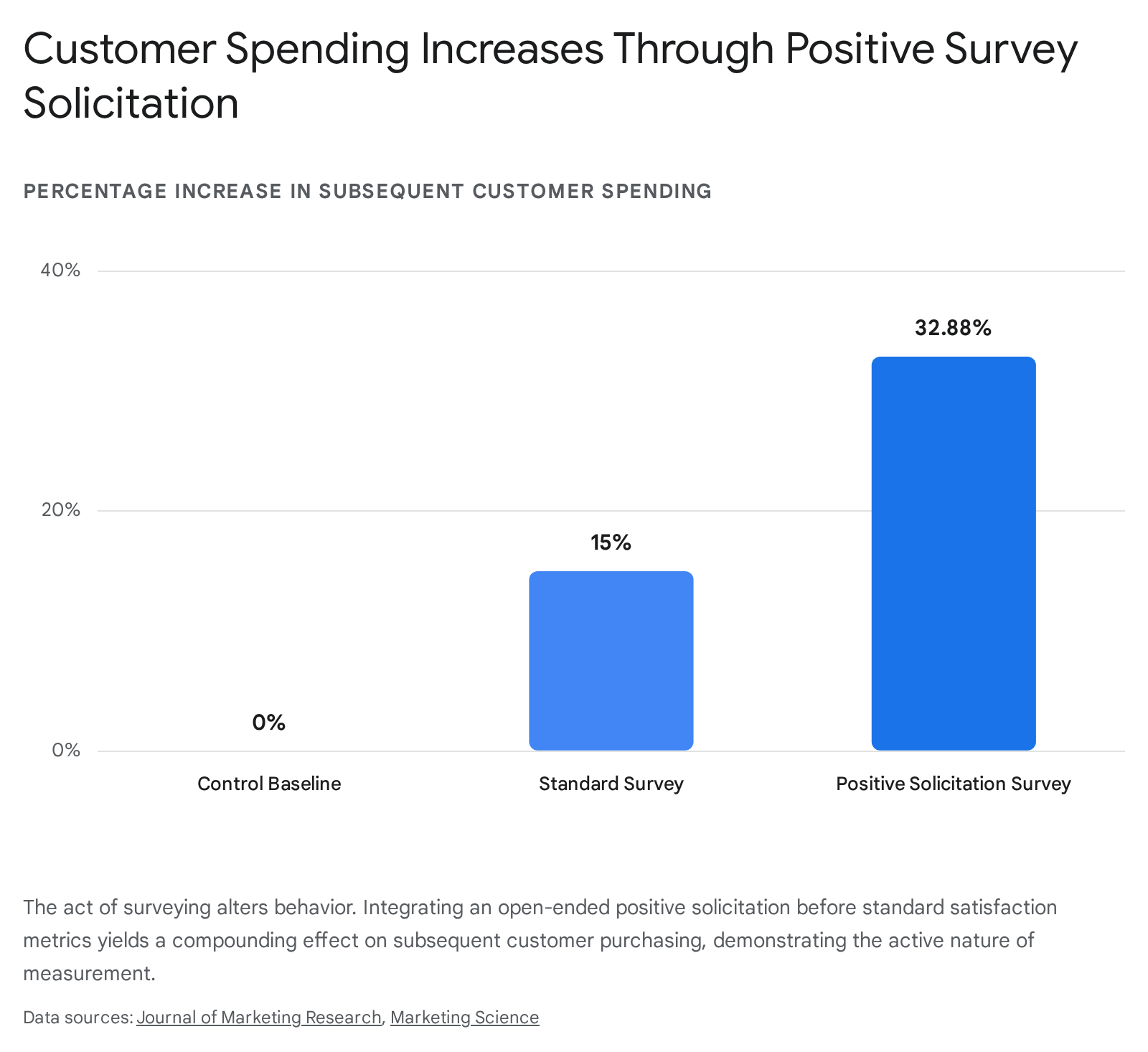
This proves that the architecture of the feedback loop directly engineers consumer loyalty, acting as an operational lever rather than a simple diagnostic tool 474849. The solicitation itself, combined with direct organizational response, functions as a mechanism of relationship building 349.
Transitioning to Behavioral Data Analytics
Given the profound biases introduced by survey fatigue, cultural response styles, and measurement reactivity, advanced market research is systematically shifting away from self-reported data toward behavioral telemetry.
Traditional surveys force researchers to rely on stated opinions, which frequently diverge from actual behavior 21. A consumer may claim in a focus group that they prioritize premium quality, yet point-of-sale data reveals they consistently select the lowest-priced alternative when making an actual purchase . Surveys capture hypothetical intent through the flawed lens of human memory, often resulting in socially desirable answers rather than empirical realities 2123.
Behavioral data analytics circumvent the question-behavior effect entirely by observing actions across multiple digital and physical touchpoints without active solicitation 215750. The table below contrasts the fundamental utility and limitations of both paradigms.
| Research Modality | Primary Focus | Strengths | Limitations |
|---|---|---|---|
| Quantitative Behavioral Analytics | Objective actions (What is happening?) | Highly scalable; eliminates recall bias; removes Hawthorne and mere-measurement effects 235750. | Lacks context; cannot explain underlying emotional or cognitive drivers (the "why") 5152. |
| Qualitative Micro-Surveys | Subjective motivation (Why is it happening?) | Extracts narrative reasoning; identifies friction points; captures emotional sentiment 205153. | Highly susceptible to response bias, satisficing, and measurement reactivity if poorly designed 1318. |
Tracking metrics such as daily active usage, session duration, scroll-depth, churn rates, and specific feature adoption provides a granular, objective view of customer preference 5253. By capturing micro-moments in real-time, behavioral tracking eliminates recall bias and negates the Hawthorne effect - provided the tracking is seamless and non-intrusive 2362.
However, quantitative behavioral data lacks contextual depth. A sudden spike in cart abandonment rates is visible in the telemetry, but the underlying emotional friction causing the abandonment remains hidden. Consequently, the most robust consumer research frameworks deploy a hybrid, multi-mode methodology. They rely on passive behavioral analytics to establish accurate, unbiased performance metrics, while deploying highly targeted, context-aware conversational surveys (designed to minimize mere-measurement distortion) exclusively to extract qualitative narratives and understand the underlying cognitive drivers of observed behaviors 2353.
Conclusion
Satisfaction surveys and feedback loops are not inert conduits for data collection; they are powerful psychological interventions that actively reshape the consumer landscape. The empirical evidence demonstrates that the mere act of measuring an intention alters attitude accessibility and fundamentally increases the probability that the measured behavior will occur. This measurement reactivity persists for months and significantly influences firm profitability, creating a landscape where observation inherently alters reality.
Simultaneously, the structural design of these feedback mechanisms introduces profound distortions. Lengthy questionnaires suffer from non-response and satisficing, while the ubiquitous Net Promoter Score masks complex sentiment behind rigid boundaries and positive response biases. When deployed internationally, these tools regularly conflate true performance disparities with deep-seated cultural response styles, penalizing regions prone to neutral responding while artificially inflating metrics in regions prone to extreme acquiescence.
Most critically, the solicitation of feedback following service failures holds the power to either resolve or calcify customer dissatisfaction. Surveys that demand immediate numerical ratings anchor negative emotions, whereas architectures that encourage narrative sensemaking or solicit open-ended positive reflections can attenuate revenge behaviors and foster loyalty. Ultimately, organizations that recognize surveys as active interventions can consciously design their feedback loops not merely to measure the market, but to systematically improve the post-review behavior of their consumers.