
Mere measurement effect on consumer purchase intentions
Introduction to the Phenomenon
The assumption that researchers can measure human intentions without simultaneously altering them has been fundamentally overturned by behavioral psychology and consumer research. In traditional market research, public policy analysis, and survey methodology, inquiries regarding a consumer's future actions - such as the likelihood of purchasing a vehicle, adopting a new software platform, or participating in a health screening - are typically viewed as neutral observational instruments. However, an extensive body of empirical literature demonstrates that the act of querying an individual's behavioral intentions acts as an active intervention that systematically modifies subsequent behavior. This phenomenon is most widely recognized in the consumer literature as the mere-measurement effect 123.
The origins of this concept can be traced to the broader psychological phenomenon known as the question-behavior effect (QBE) and the self-erasing error of prediction. Steven Sherman's foundational 1980 research demonstrated that when individuals are asked to predict their likelihood of performing a socially desirable behavior, they tend to over-predict their compliance. More importantly, the act of making this prediction subsequently causes them to actually perform the behavior at higher rates than a control group, rendering their initial prediction error self-erasing 145. This principle was later extended to voting behavior by Greenwald, Carnot, Beach, and Young in 1987, who found that simply asking citizens if they expected to vote increased actual voter turnout by approximately 25% 246.
The term "mere-measurement effect" was formally introduced to the marketing and consumer behavior lexicon by Vicki Morwitz, Eric Johnson, and David Schmittlein in 1993. Through a large-scale field study involving over 40,000 participants, they demonstrated that merely questioning consumers about their intentions to buy a car or a personal computer increased the actual purchase rates of those items by over 35% in the subsequent six months 146. In 2006, prominent researchers from both the consumer behavior and social psychology camps formally adopted the umbrella term "question-behavior effect" to merge the parallel streams of research on self-prophecy and mere measurement 7. The implications of this discovery indicate that surveys and intent-measurement tools do not simply reflect a pre-existing state of mind; they actively construct, amplify, and solidify behavioral trajectories in the marketplace.
Cognitive Mechanisms of Behavioral Change
To explain why simply answering a survey alters future purchasing behavior, researchers have proposed and tested several competing, yet occasionally overlapping, cognitive mechanisms. The mere-measurement effect is not considered a monolithic process, but rather a complex interaction between memory retrieval, attitude activation, processing fluency, and cognitive consistency.
Attitude Accessibility and Self-Generated Validity
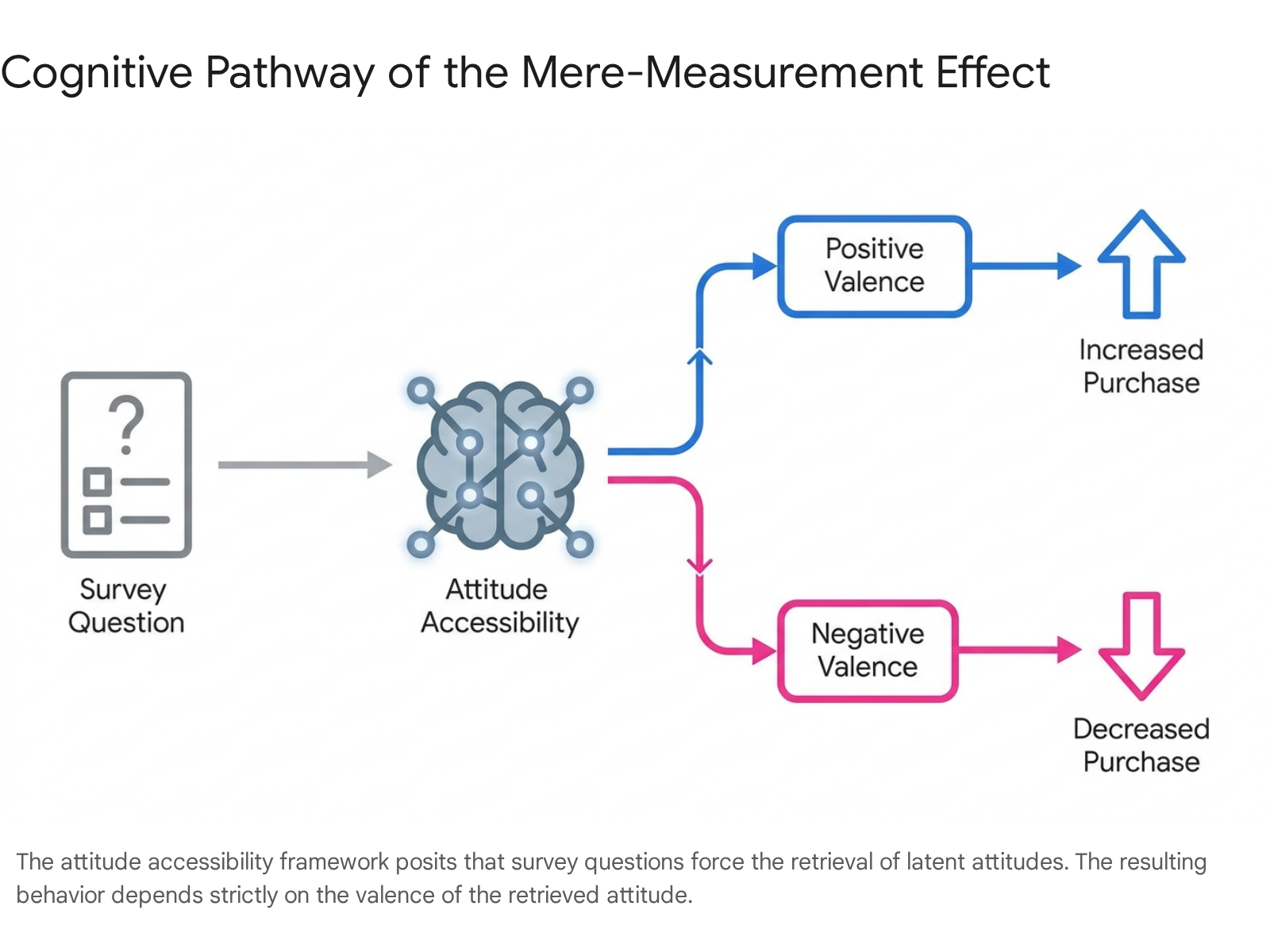
The most strongly supported explanation for the mere-measurement effect is the attitude accessibility hypothesis, rooted in the self-generated validity theory proposed by Feldman and Lynch in 1988. This framework posits that consumers do not typically hold perfectly formed, easily accessible purchase intentions for every product category at all times 28. When a market researcher asks a consumer about their intent to purchase a specific item, the consumer must actively construct a response. The cognitive effort required to form and articulate this response forces the consumer to retrieve latent feelings, memories, and evaluations regarding the product category 123.
By answering the question, the consumer elevates the accessibility of their pre-existing attitudes within their memory network. Consequently, when the consumer subsequently encounters the product in a real-world purchasing environment, the highly accessible attitude - brought to the forefront by the survey - disproportionately drives their decision-making. If the pre-existing attitude was positive, the increased accessibility directly increases the probability of purchase. The mere-measurement effect, in this view, operates by reinforcing the associative link between a consumer's underlying attitude and their eventual choice behavior 23.
Concept Polarization and Enhanced Label Accessibility
A related, complementary mechanism is the polarization hypothesis. When measuring intent, the cognitive work required to answer the survey may not simply bring existing attitudes to the surface, but actively polarize them 12. If a consumer leans slightly favorably toward a brand, answering a question about their likelihood to purchase it can cause them to reflect heavily on the positive attributes, solidifying and amplifying their initially mild preference into a strong, actionable intention. Fitzsimons and Morwitz suggested that while single measurements increase purchase rates, repeatedly questioning one's intent could theoretically polarize negative thoughts as well, potentially decreasing purchase rates depending on the valence of the product-related thoughts 12.
Furthermore, enhanced label accessibility explains how questioning increases the salience of specific brands within a category 13. When asked a broad category-level question such as, "Are you going to buy a new car?", the consumer naturally brings to mind the most heavily advertised or familiar car brands to contextualize the query. The survey inadvertently primes these specific brand labels, making them hyper-accessible. Thus, when the consumer eventually decides to make a purchase, they are statistically more likely to select the specific brand that came to mind during the survey, simply because it enjoys a higher cognitive retrieval fluency 36.
Cognitive Dissonance and Consistency Pressures
An alternative theoretical approach focuses on cognitive dissonance and personal norms, an area of research closely tied to the self-prophecy branch of the question-behavior effect. Once an individual formally states an intention - especially regarding a socially desirable behavior, such as voting, recycling, or engaging in healthy consumption - they establish a psychological commitment 91011. Human beings possess a strong intrinsic drive to maintain consistency between their stated beliefs and their actual behavior.
If a consumer states they intend to purchase a virtuous product, failing to follow through creates uncomfortable cognitive dissonance. To alleviate or avoid this dissonance, the consumer modifies their subsequent behavior to align with the survey response they provided 1112. While this mechanism is highly effective in explaining the question-behavior effect in the context of ethical, health, or socially normative choices, researchers note that attitude accessibility remains the primary driver for standard commercial and brand-level purchase intentions, where moral dissonance is less of a factor 1013.
Differentiation from Related Psychological Phenomena
To fully understand the mere-measurement effect, it is necessary to distinguish it from other cognitive biases and behavioral interventions that operate in similar domains. The literature frequently contrasts mere measurement with implementation intentions, framing effects, and the Hawthorne effect.
Comparison with Implementation Intentions
While the mere-measurement effect occurs when a simple behavioral intent question is asked (e.g., "Do you intend to buy a car?"), implementation intentions are explicit, detailed, and context-specific planning strategies. Developed extensively by Peter Gollwitzer, implementation intentions force the individual to articulate the exact parameters of their future behavior, often using "if-then" conditional phrasing (e.g., "If it is Saturday morning, then I will go to the dealership to buy a car") 1314.
Research indicates that while the mere-measurement effect operates largely via implicit attitude accessibility, implementation intentions require deliberate, conscious cognitive processing and yield stronger behavioral compliance for complex or difficult goals 1314. Mere measurement is essentially an unintentional byproduct of measurement, whereas implementation intentions are structured interventions designed specifically to bridge the intention-action gap. Interestingly, when the target behavior is a "vice" (e.g., consuming alcohol or eating junk food), the mere-measurement effect can sometimes inadvertently increase the vice behavior by making the positive implicit attitudes toward the vice more accessible. In contrast, assigning implementation intentions can override this effect, helping the consumer avoid the vice by providing a concrete plan for self-regulation 13.
Comparison with Framing Effects
The framing effect, pioneered by Tversky and Kahneman's prospect theory, occurs when the presentation of identical information alters decision-making based on whether it highlights positive gains or negative losses. Decisions influenced by the framing effect focus on the contextual packaging of the options presented 1516. According to researchers Levin, Schneider, and Gaeth, there are three main types of framing effects: risky choice framing, attribute framing (e.g., evaluating a product more favorably if it is framed as "80% fat-free" rather than "20% fat"), and goal framing 1517.
By contrast, the mere-measurement effect does not require the manipulation of the choice's attributes. The options themselves are not framed as gains or losses; rather, the simple administrative act of prompting the consumer to predict their future action initiates the behavioral change 115. Framing acts on the evaluation of an external object, whereas mere measurement acts on the accessibility of the consumer's internal memory and attitudes. Furthermore, researchers have identified that individuals who are highly involved or invested in an issue are less susceptible to framing effects, whereas the mere-measurement effect actively utilizes an individual's deep-seated attitudes 15.
Comparison with the Hawthorne Effect
The Hawthorne effect describes the phenomenon where individuals alter their behavior simply because they are aware they are being observed by researchers or management, originating from the factory productivity studies at Western Electric between 1924 and 1933 16. While both the Hawthorne effect and the mere-measurement effect involve behavioral changes induced by a research setting, their mechanisms differ entirely.
The Hawthorne effect relies on the real-time social pressure and surveillance of active observation during the execution of the task 16. The mere-measurement effect, conversely, occurs long after the researcher has departed; the behavioral change takes place in a natural market environment days, weeks, or months after the initial survey, driven by internal cognitive accessibility rather than external social monitoring 11617.
| Phenomenon | Primary Trigger | Core Psychological Mechanism | Locus of Influence | Intent of the Researcher |
|---|---|---|---|---|
| Mere-Measurement Effect | Asking a simple intent or prediction question. | Attitude accessibility and retrieval fluency. | Internal memory network. | Usually observational (unintended behavior change). |
| Implementation Intentions | Formulating specific "if-then" situational plans. | Conscious goal-setting and deliberate cognitive mapping. | Future situational cues. | Intentional behavioral intervention. |
| Framing Effect | Altering the descriptive context of options (gain vs. loss). | Loss aversion and asymmetric risk perception. | External evaluation of the object. | Persuasion or choice architecture. |
| Hawthorne Effect | Active, real-time observation of the subject. | Social desirability and performance monitoring. | Real-time social environment. | Usually observational (unintended behavior change). |
Empirical Evidence and Effect Magnitudes
The empirical validation of the mere-measurement effect spans multiple decades, utilizing both controlled laboratory settings and massive longitudinal field experiments. The magnitude of the effect varies based on the product category, the time elapsed, and the methodological rigor of the study, but it consistently demonstrates economic and statistical significance.
High-Involvement Consumer Goods
The seminal 1993 study by Morwitz, Johnson, and Schmittlein provided the foundational quantitative evidence for the mere-measurement effect in high-involvement consumer goods. Analyzing a nationally representative sample of over 40,000 consumers, the researchers found that asking participants whether they intended to purchase an automobile or a personal computer resulted in significantly greater purchase rates compared to a control group 134. Specifically, the group subjected to the mere-measurement survey exhibited an actual automobile purchase rate that was more than 35% higher than the baseline average over the subsequent six months 46. This massive shift in consumer behavior demonstrated that the effect was not limited to trivial laboratory choices, but extended to major financial commitments.
Relational Behaviors and Customer Satisfaction
Beyond initial purchase intentions, the mere-measurement effect profoundly influences ongoing relational behaviors, such as customer retention, churn reduction, and aggregate profitability. A highly cited field experiment by Dholakia and Morwitz in 2002 investigated the impact of customer satisfaction surveys within a large financial services firm 1017.
The researchers isolated a treatment group of 945 customers who participated in a standard, telephone-based satisfaction survey and compared them against a control group of 1,064 identical customers who were not surveyed. Both groups were withheld from the firm's direct marketing activities for a year after the survey. The results were stark. Tracking behaviors for a full year after the survey, the researchers found that the surveyed participants opened significantly more accounts (an average of 5.45 accounts compared to 3.39 for the control group). Furthermore, the surveyed group exhibited a defection (churn) rate that was less than half that of the control group (6.6% versus a substantially higher baseline) 1017. The study proved that the mere measurement of satisfaction accelerates the purchase cycle and enhances long-term profitability, with effects persisting and even compounding for up to 12 months post-survey.
Conversion Rate Optimization in Digital Services
The effect is highly observable in modern digital conversion rate optimization (CRO). A longitudinal field study by WebService.com isolated the conversion rates of users who were merely prompted to rate a service. The study revealed consistent positive conversion increases over time for the group that received the rating request compared to a strict control group. The data indicates a persistent uplift that does not rapidly decay over a fiscal quarter 18.
| Time Post-Intervention | Control Group Conversion Rate | Surveyed Group Conversion Rate | Statistical Significance |
|---|---|---|---|
| 30 Days | 11.79% | 12.25% | Significant (p = 0.041) |
| 60 Days | 12.27% | 12.79% | Significant (p = 0.022) |
| 90 Days | 13.28% | 13.84% | Significant (p = 0.016) |
While the absolute percentage point difference may appear modest (roughly half a percentage point), in scaling digital or subscription-based industries with user bases in the millions, a sustained uplift of this magnitude yields vast revenue implications. The mere act of soliciting user feedback results in a statistically significant and economically substantial increase in customer conversion 1821.
Broad Meta-Analytic Findings and Civic Behaviors
Extensive meta-analyses have quantified the average magnitude of the question-behavior effect across diverse contexts, encompassing voting, health screenings, recycling, and purchasing. A comprehensive meta-analysis by Wood, Spangenberg, and colleagues synthesized 116 published tests across various behaviors and calculated a small but robust positive overall effect size of $d = 0.24$ 1112. Multivariate analyses within this research indicated that effect sizes are generally larger for easy-to-perform behaviors and socially desirable domains.
In civic and health domains, the effect is observable but occasionally exhibits narrower margins in large-scale randomized controlled trials (RCTs). For instance, a study examining blood donor registration among 4,672 participants found that simply asking about intentions to give blood within the next six months yielded an 8.6% higher registration rate compared to a control group 22. A trial in the UK evaluating health check uptake in primary care across 12,459 participants found that sending a QBE questionnaire prior to standard invitations increased uptake by 1.43% (15.80% in the QBE group versus 14.41% in the standard group), a finding that approached but did not definitively cross the strict threshold for statistical significance established for that specific trial ($p = .070$) 1920. Nevertheless, systematic literature reviews of patient-reported outcomes (PROs) involving meta-analyses of thirteen different interventions report a significant overall risk ratio of 1.17, confirming that measurement alone has the potential to shape respondents' health behaviors for the better 21.
Directional Outcomes Based on Product and Attitude Valence
The behavioral changes induced by the mere-measurement effect are not uniformly positive. Because the underlying mechanism relies on the retrieval of existing attitudes, the direction of the behavioral shift is strictly dependent on the valence (positive or negative) of the consumer's pre-existing feelings toward the specific product or behavior 2.
Positive Attitudes and Brand Repurchase
When a consumer holds favorable attitudes toward a product category, asking them a general intention question (e.g., "Will you buy a car?") increases the accessibility of their preferred brands. Fitzsimons and Morwitz found that participants who currently used a specific brand within a category were highly likely to repurchase that exact brand if they were asked a general intent question 26. The question acts as a catalyst, reinforcing the existing positive relationship.
Fascinatingly, for consumers who do not currently own a product in the category, the mere-measurement effect drives them toward the most frequently advertised brands. Because heavy advertising creates latent accessibility, the survey question activates the most familiar brand labels in the consumer's mind, making them the default choice when an actual purchase scenario arises 6.
Negative Attitudes and Vice Behaviors
Conversely, if a consumer holds a negative or avoidance-based attitude toward a specific option, the mere-measurement effect will actively decrease their likelihood of choosing it. In a laboratory experiment involving snack foods, researchers found that when consumers held an accessible negative attitude toward a specific target option (e.g., a "Coffee Crisp" candy bar), asking a general intent question led to a decreased choice of that negative option compared to a control group 2. The measurement amplified the accessibility of the negative evaluation, thereby pushing the consumer further away from the brand.
The dynamics become more complex and potentially perilous when dealing with "vice" behaviors (e.g., eating junk food, skipping exercise, or illegal drug use). Vice behaviors often represent a conflict between an explicit negative attitude ("I know illegal drugs are bad") and an implicit positive attitude ("I enjoy the effects") 13. Research indicates that the mere-measurement effect often triggers automatic, implicit processes rather than deliberative ones. Consequently, asking people to predict their frequency of engaging in a vice behavior can paradoxically increase the behavior by making the underlying implicit temptations more accessible. A highly cited study by Spangenberg and colleagues found that asking respondents about their intentions to use illegal drugs actually increased their subsequent drug use compared to an unquestioned control group, shifting the behavior away from stated social norms 9.
Vice-Virtue Bundling and Anticipated Regret
Marketers frequently attempt to navigate these valences by creating vice-virtue bundles (e.g., combining a healthy ingredient with an unhealthy packaged food). Research indicates that consumers are more inclined to purchase vice-packaged food if it is bundled with a virtue ingredient, as the mere measurement of their health perceptions allows the "virtue" aspect to override the negative attitude associated with the vice 2223.
Additionally, survey frames that prompt anticipated regret - forcing the consumer to visualize the negative emotional outcome of failing to perform a virtuous behavior - can manipulate the attitude accessibility pathway. By eliciting counterfactual thinking (e.g., "What if I miss this cervical screening?"), the survey uses the fear of regret to spur positive action, effectively short-circuiting negative or apathetic attitudes 2425.
Cross-Cultural Variations in Behavioral Consistency
While the mere-measurement effect relies on fundamental human memory networks, its behavioral magnitude is heavily moderated by the cultural context of the consumer. The degree to which internal attitudes dictate external behavior is not a universal constant, but is highly dependent on cultural dimensions, most notably Geert Hofstede's continuum of individualism versus collectivism 26.
Individualism and Self-Expression Norms
In individualistic cultures - typically found in Western Europe and North America - the cultural framework emphasizes an independent self-construal. Individuals are socialized to value personal autonomy, self-expression, uniqueness, and internal consistency 272829. Because self-identity in these cultures is tightly linked to one's personal beliefs and choices, internal attitudes serve as the primary compass for behavior.
Consequently, interventions that rely on internal attitude accessibility, such as self-persuasion and the question-behavior effect, tend to be highly effective in individualistic societies 30. When an individualistic consumer is asked a survey question, the retrieved attitude faces minimal friction in translating to action. Meta-analyses of cognitive biases, including the better-than-average effect and self-prediction behaviors, confirm that effects relying on internal psychological states are significantly more pronounced in individualistic settings 31.
Collectivism and Situational Strength
In contrast, collectivist cultures - predominant in East Asia, Latin America, and parts of the Middle East - operate on an interdependent self-construal. Social behavior is governed less by isolated internal attitudes and more by group harmony, social expectations, and situational norms 2729. In these societies, situational strength is paramount; the external pressure to conform to organizational or societal roles often overrides individual intentions 3237.
Because of this rigid situational strength, the mere-measurement effect frequently demonstrates attenuated efficacy in collectivist cultures. Even if a survey successfully increases the accessibility of a consumer's personal attitude, that internal attitude may not manifest as a purchase or an action if it conflicts with the prevailing social context or group preference 3032. Research explicitly comparing persuasion interventions across nations found that directly presenting persuasive arguments (which establishes a clear external norm) was significantly more effective in Chinese cohorts, whereas self-generated persuasion (relying on internal cognitive networks) showed no such advantage and worked highly effectively in American cohorts 3033.
| Cultural Dimension | Self-Construal Focus | Primary Behavioral Driver | Impact of Mere-Measurement Effect |
|---|---|---|---|
| Individualistic Cultures (e.g., US, Western Europe) | Independent; focused on personal autonomy and distinctiveness. | Internal consistency; alignment of actions with personal attitudes. | High. Strong correlation between activated internal attitudes and subsequent individual purchase behavior. |
| Collectivistic Cultures (e.g., China, Japan, Latin America) | Interdependent; focused on group harmony and social roles. | Situational strength; adherence to group norms and external expectations. | Attenuated. Activated internal attitudes are frequently overridden if they conflict with external social context. |
Application in Digital Environments and Algorithmic Nudging
The mere-measurement effect has transitioned from an academic curiosity found in mailed questionnaires to a core strategy in modern digital marketing, user experience (UX) design, and platform engineering.
Micro-Surveys and Conversion Rate Optimization (CRO)
In contemporary digital environments, the lengthy, multi-page surveys used in historical field studies have been largely replaced by micro-surveys or intercept surveys. These are single-question prompts embedded directly into a mobile application or website interface at specific moments of the user journey (e.g., a modal popping up post-transaction asking, "How likely are you to use our service again?" or "What is stopping you from checking out today?") 394041.
From a Conversion Rate Optimization (CRO) perspective, these micro-surveys serve a dual purpose. Explicitly, they gather rapid customer feedback to identify user friction. Implicitly, and often more valuably, they weaponize the mere-measurement effect. By asking a user a targeted question at the point of action, the platform forces the user to actively retrieve their attitudes. If the user realizes they do not have a valid negative reason, the cognitive check clears the path to conversion. Furthermore, asking satisfaction questions immediately following a successful interaction maximizes the accessibility of positive attitudes, directly increasing digital adoption rates and cross-selling success 3941.
Algorithmic Nudging and Contextual Prompts
The integration of artificial intelligence (AI) has allowed the mere-measurement effect to be scaled via algorithmic nudging 3435. Unlike static surveys delivered uniformly to all customers, machine learning algorithms analyze behavioral data to deploy intent-measuring prompts at the precise moment a user is most susceptible to behavioral influence.
This creates a dynamic feedback loop. An AI system might recognize a user lingering on a high-value product page and proactively trigger a micro-survey asking about their preferences. This is not merely data collection; it is an algorithmic intervention designed to heighten product salience and force attitude accessibility 3436. While some researchers frame this as "liberating paternalism" - where systems help guide users toward choices aligned with their welfare - critics argue that deploying the mere-measurement effect via opaque algorithms constitutes an erosion of consumer autonomy. The user believes they are merely answering a helpful prompt, unaware that the interface is engineered to subliminally manipulate their subsequent transactional behavior by syncing the nudge to their exact cognitive state 3436.
A/B Testing and Control Group Methodologies
Accurately measuring the mere-measurement effect in the wild requires rigorous data science frameworks, primarily Randomized Controlled Trials (RCTs) or Conversion Lift Studies. Observational methodologies (such as Propensity Score Matching) often severely mis-estimate treatment lifts by a factor of three or more, because they fail to account for endogeneity - such as the fact that users who are online to see a survey are also more likely to convert organically 3738.
To prove the mere-measurement effect is occurring, analysts utilize a global control group. A randomly selected portion of the customer base (typically 5-10%) is deliberately withheld from receiving the survey or prompt. By comparing the conversion rate of the exposed group (Intent-to-Treat) against the unexposed control group, researchers can isolate the exact incremental lift caused purely by the measurement artifact, stripping away coincidental organic conversions 2137.
Unintended Consequences and Spillover Effects
The disruptive nature of the mere-measurement effect is not confined solely to those who complete surveys, nor is it constrained to purchasing outcomes. Measurement creates vast behavioral spillover effects across populations.
The Survey Effect for Non-Respondents (SEN)
Historically, researchers assumed that if a customer received a survey but chose not to answer it, their behavior remained unaffected. Recent research fundamentally challenges this. Studies investigating the "survey effect for non-respondents" (SEN) demonstrate that the mere act of receiving a survey invitation - and actively deciding not to participate - can alter a consumer's attitudes 39.
Experimental evidence suggests that companies' survey invitations can actually impair the attitudinal and behavioral loyalty of non-responding customers. This negative spillover occurs when the customer interprets their own non-response behavior as a diagnostic manifestation of a negative attitude toward the brand (e.g., "I must not care about this company if I won't take their survey"), rather than a situational factor like a lack of time. Thus, even ignored surveys act as behavioral interventions 39.
Measurement Reactivity in Healthcare
The implications of this effect extend beyond commercial consumption into public health and medicine. In clinical trials and healthcare settings, Patient-Reported Outcomes (PROs) are widely used to assess patient quality of life, symptom severity, and adherence to medical regimens. Systematic reviews have revealed that exposing patients to PRO questionnaires triggers a mere-measurement effect that alters their subsequent health behaviors and symptom perceptions 21.
Meta-analyses of PROs show a one-directional, positive, and significant overall risk ratio (RR 1.17) indicating that the act of responding to health surveys can actually improve patient behavior. Furthermore, studies on physical activity demonstrate that simple measurement instruments, such as pedometers or physical activity questionnaires, yield a standardized mean difference (SMD) of 0.21 in increasing activity simply through the act of measurement 40. This opens the door to deliberately "engineering" PROs not just as neutral clinical metrics, but as subtle, non-pharmacological interventions designed to improve patient compliance and lifestyle choices 21.
Ethical and Methodological Implications for Market Research
The robust existence of the mere-measurement effect creates profound epistemological and ethical paradoxes for the fields of market research, polling, and data science.
The Observer Effect in Survey Methodology
The bedrock assumption of statistical survey methodology is that the instrument used to measure reality should not systematically alter that reality. The mere-measurement effect proves that in the realm of human behavioral intent, this assumption is false. Surveys act as behavioral interventions. Because responding to questions changes subsequent measured judgments, researchers must confront the fact that they are manufacturing the demand they are attempting to forecast 1017.
Conflicts with Industry Ethical Guidelines
This reality places market researchers in direct conflict with foundational ethical guidelines. For example, the American Marketing Association (AMA) code of ethics explicitly mandates the strict segregation of market research from any form of sales, promotion, or opinion-influencing activity 6. However, if simply asking a cohort of consumers about their intent to buy a car organically increases car sales within that cohort by 35%, the survey is, by definition, an opinion-influencing and sales-generating activity. Organizations deploying massive brand health trackers, satisfaction micro-surveys, or intent polls are inadvertently acting as marketers, regardless of their stated scientific intent 6.
To maintain methodological integrity, analysts and forecasters must recalibrate their models. By understanding the mere-measurement effect, researchers can better understand the conditions under which their initial forecasts may be artificially biased upward, allowing them to develop appropriate mathematical adjustments to correct for survey-induced demand inflation 3. Ultimately, the literature proves conclusively that in the realm of consumer psychology, to measure an intention is to inextricably alter it.