
Product failure analysis using the Jobs to Be Done framework
The landscape of product development and innovation is characterized by persistently high attrition rates, with long-term historical data indicating that up to 95% of new consumer and enterprise products fail to achieve sustainable market success 12. Even conservative industry analyses peg the failure rate of new product launches between 70% and 80% 33. A comprehensive post-mortem review of 101 startup and product failures conducted by CB Insights isolated the primary variables driving these outcomes, finding that 42% of closures were directly attributable to a lack of market need 4576. This metric indicates that organizations routinely expend vast amounts of capital, engineering resources, and time building solutions that consumers do not fundamentally require.
Traditional product failure post-mortems typically focus on execution errors: poor software engineering, missed launch timelines, supply chain disruptions, pricing miscalculations, or ineffective top-of-funnel marketing campaigns 291011. However, evaluating product failures through the Jobs to Be Done (JTBD) framework fundamentally shifts the analytical lens. Popularized by Harvard Business School professor Clayton Christensen and operationalized by innovation practitioners such as Tony Ulwick, JTBD theory posits that consumers do not purchase products based on their own demographic characteristics or the product's feature lists. Instead, they "hire" products to make specific progress in a given circumstance 478910. When viewed through this paradigm, a product post-mortem ceases to be an autopsy of technical specifications and becomes a rigorous investigation into a mismatch between the built solution and the underlying functional, emotional, or social "job" the consumer was attempting to resolve 91117.
Theoretical Foundation of Customer Jobs
The Jobs to Be Done framework operates on the epistemological premise that innovation predictability increases dramatically when the unit of analysis shifts from the customer persona or the product attributes to the progress a customer is trying to make 41219. This desired progress is referred to as the "job." The origins of this perspective trace back to marketing professor Theodore Levitt, who famously noted that consumers do not want to buy a quarter-inch drill; they want a quarter-inch hole 81112.
The foundational illustration of this theory in modern practice is Christensen's "milkshake study." Researchers tasked with increasing milkshake sales initially segmented the market demographically and altered the product's flavor profile, which yielded no statistical improvement in sales 39. However, by observing purchasing contexts, they discovered that a significant portion of milkshakes were purchased before 8:30 a.m. by solo commuters. These consumers were not buying milkshakes because of demographic traits; they needed to "hire" a product that was easy to consume with one hand, lasted through a tedious 30-minute drive, and kept them satiated until lunch 341120. The milkshake was competing against bagels and bananas, not competing against other milkshakes.
A job encompasses three distinct and non-negotiable dimensions, and a failure to address any single dimension can render a product obsolete: 1. Functional: The practical, objective task the user aims to complete, such as cutting a piece of wood or transporting data from a local server to the cloud 921. 2. Emotional: The internal psychological state the user desires to achieve or maintain during or after the execution of the job, such as feeling secure, productive, or at peace 49192113. 3. Social: How the user wishes to be perceived by peers, colleagues, and society while utilizing the product, such as appearing successful, responsible, or technologically advanced 49192113.
When a product fails in the open market, the JTBD framework mandates that analysts formulate different retrospective questions. Rather than querying why the target demographic rejected the feature set, analysts must determine what existing workaround was already getting the job done better, or which specific dimension of the job the product actively hindered 24. The underlying job is highly stable over time; while the technological solutions evolve from cassette tapes to compact discs to digital streaming, the fundamental job of listening to recorded music on demand remains constant 8.
Retrospective Analysis Methodologies
Standard product development relies heavily on buyer personas, demographic segmentation, and competitive feature matrices 920. When products developed under these legacy paradigms fail, the resulting post-mortems often attribute the collapse to superficial symptoms. Teams might conclude that the user interface was inadequate, the pricing was uncompetitive, or the marketing budget was insufficient. This approach frequently yields false positives, prompting product managers to iteratively fix superficial elements rather than addressing a core lack of utility 11.
The JTBD-driven post-mortem relies instead on techniques such as "switch interviews" and retrospective job mapping 614. Analysts attempt to systematically deconstruct the "Field of Dreams" fallacy, which is the institutional assumption that if an innovative product is built, the market will naturally adopt it 527. By examining the circumstances of non-consumption and the alternative solutions customers defaulted to instead of the failed product, product teams can identify whether a product failed because the "job" itself did not exist, or because the product was a highly inefficient candidate for the hire 42415.
Analytical Framework Comparisons
The methodologies utilized in a post-mortem dictate the nature of the insights recovered. The distinction between a demographic analysis and a JTBD analysis is profound, fundamentally altering the diagnosis of a product failure.
| Analytical Dimension | Traditional Post-Mortem Inquiry | Jobs to Be Done Inquiry | Strategic Implication |
|---|---|---|---|
| Market Identification | Did the organization target the correct demographic persona (e.g., millennials, high-income earners)? | Did the organization accurately identify the contextual circumstances driving the need for progress? | Shifts the focus from static customer attributes to dynamic contextual needs 929. |
| Competitive Landscape | Did direct competitors offer superior features or undercut the pricing model? | What workarounds, manual processes, or non-traditional alternatives did the customer hire instead? | Recognizes indirect competition, such as basic spreadsheet software competing against specialized SaaS platforms 41230. |
| Value Proposition | Was the marketing messaging clear regarding product features and technical specifications? | Did the messaging align with the internal psychological narrative of the progress the user wanted to make? | Requires positioning to be based on user progress and outcomes, rather than technical functionality 1731. |
| Feature Utilization | Why did users fail to adopt the specific novel features the engineering team built? | Did the novel feature overserve a job step that the user considered low-priority or already satisfied? | Identifies systemic over-engineering and eliminates unnecessary feature bloat 16. |
| Failure Attribution | Was the market failure caused by a lack of brand awareness or poor user experience design? | Did the product introduce new frictions or anxieties that made the primary job harder to accomplish? | Focuses on net-progress and the active removal of consumption friction 17. |
Patterns of Functional Mismatch and Overengineering
By applying the JTBD framework to high-profile product failures, distinct patterns emerge across consumer and enterprise markets. Products rarely fail simply because they are technologically deficient; they fail because they misinterpret the functional bounds of the job, ignore the social constraints of the user, or mistake a technological capability for a customer need.
A dominant pattern in failed hardware and consumer goods is overengineering. Overengineering occurs when organizations build highly complex, capital-intensive solutions for functional jobs that are already adequately and cheaply served by simpler alternatives 11618. In JTBD terminology, the product attempts to automate or enhance job steps that the consumer either considers of low importance or finds already highly satisfied by current methods.
The Juicero press, launched in 2016 at a retail price point of $400, serves as a premier case study of this failure mode. The product was technically sophisticated, featuring high-force pressing mechanisms and Wi-Fi connectivity designed to ensure the proprietary juice packets were not expired 1. However, the post-mortem reality revealed that the core functional job - defined as "help me consume fresh, healthy juice quickly without the extensive cleaning required by a traditional juicer" - was entirely contained within the pre-chopped produce packets themselves. Consumers realized they could simply squeeze the packets by hand to extract the juice 15. Juicero failed because the complex hardware component did not meaningfully improve the execution of the job compared to human hands; it merely added exorbitant cost, physical footprint, and technical complexity.
Similarly, the Apple Newton, an early personal digital assistant launched in 1993, featured revolutionary handwriting recognition technology that was widely praised in technical circles. However, it lacked a coherent use case that resonated with the daily jobs of a broad audience 19. Apple successfully engineered a technological marvel but sold a gimmick rather than a solution to a specific consumer struggle. The functional job of organizing daily information was still far more efficiently handled by traditional pen and paper. The Newton's high price of $2,495 and inconsistent real-world performance introduced significantly more friction into the user's life than it eliminated 19.
The Outcome-Driven Innovation framework maps market opportunities on a Cartesian plane, plotting the customer's self-reported satisfaction with current solutions against the relative importance of the underlying outcome. This creates an Opportunity Landscape. Products that target needs in the 'Overserved' quadrant - characterized by high satisfaction but low importance - routinely fail due to overengineering. Conversely, true innovation requires targeting 'Underserved' needs, where importance is high but satisfaction remains low 7203720.
Another notable hardware failure, the Segway personal transporter, failed precisely because it existed in the overserved quadrant for pedestrian travel. It was a masterpiece of gyroscopic engineering, but the functional job of moving short distances in urban environments was already handled by walking or bicycling. The Segway solved a problem that consumers did not prioritize, representing technology innovation rather than customer value innovation 39.
Social and Emotional Job Failures
A profound pattern of product failure occurs when organizations engineer a solution that solves the functional job perfectly but completely fails to account for the social and emotional dimensions.
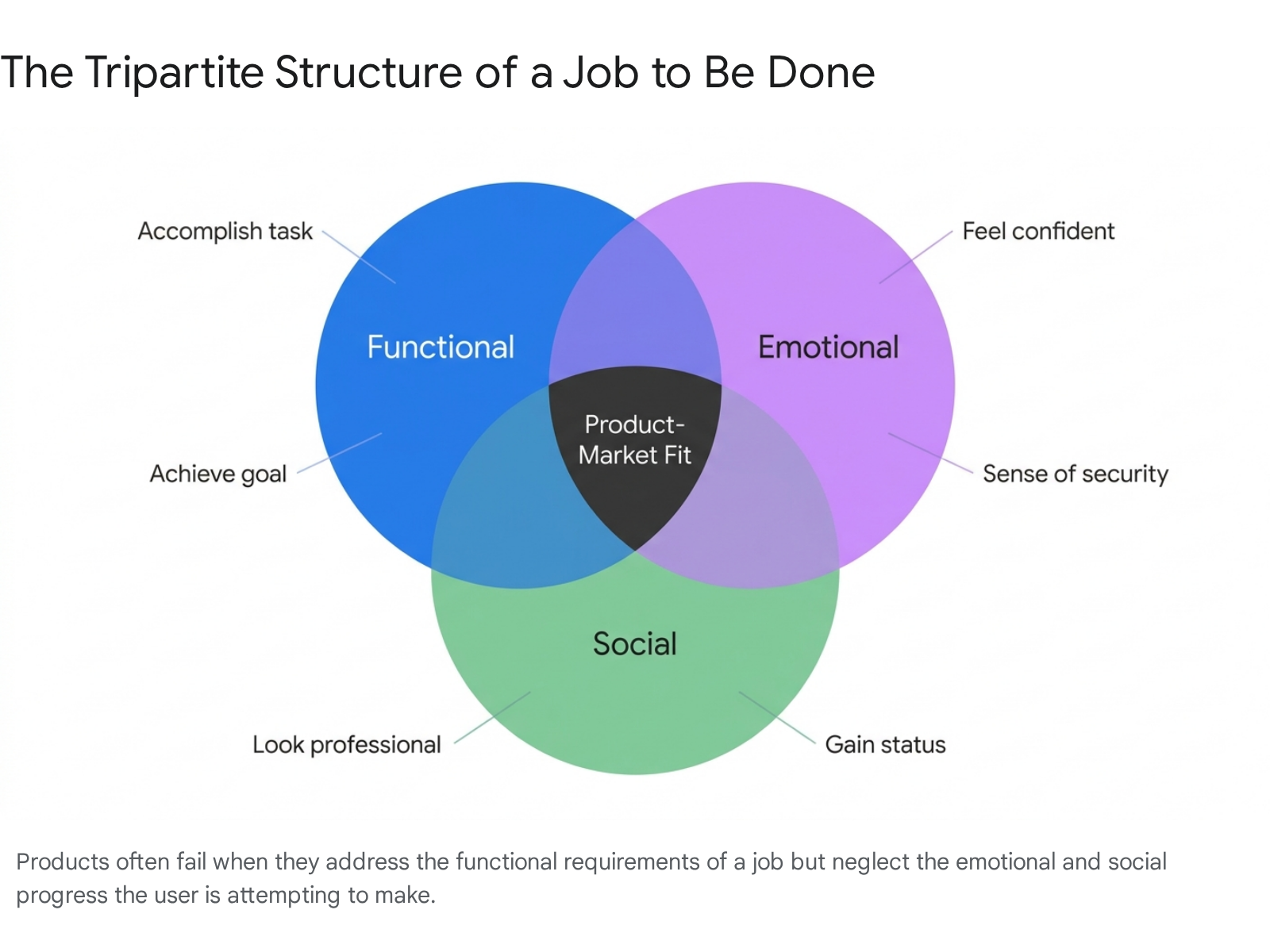
Human behavior dictates that consumers will actively reject products that damage their self-perception, lower their perceived status, or violate community norms, regardless of the functional efficiency or cost savings the product offers 4913.
The post-mortems of frugal innovations aimed at the "Base of the Pyramid" (BoP) market highlight this phenomenon explicitly. Tata Motors launched the Nano as the world's most affordable car, marketing it specifically to low-income families in emerging markets as a safer alternative to motorcycles 13. Functionally, the Nano was a triumph: it was inexpensive, weather-resistant, and capable of transporting a family of four. However, the product failed massively in the marketplace, suffering years of low sales before Tata Motors ultimately ceased production in 2018 13.
Using JTBD, analysts identified that the job of purchasing a vehicle in emerging markets is heavily weighted toward social and aspirational outcomes. Consumers hire a car not just for transport, but to signal upward mobility, financial success, and elevated status to their local community 13. By explicitly and publicly branding the Nano as the "cheap car for the poor," Tata Motors ensured that purchasing the vehicle actively undermined the customer's social job. Consumers preferred to stretch their financial limits to purchase used cars from established, aspirational brands rather than signal their poverty by driving a Nano 13. The exact same phenomenon doomed the Chotukool, a low-cost, battery-powered refrigerator. The functional job of cooling food was achieved, but low-income targets preferred premium brands that allowed them to feel a sense of achievement and societal participation 13.
Google Glass suffered a highly publicized failure driven largely by social job failure. While the wearable technology successfully executed complex functional jobs such as hands-free navigation and point-of-view recording, it completely violated the social contracts of everyday human interaction 119. The physical aesthetic of the device was widely considered awkward, failing the user's emotional job of looking presentable. More critically, the built-in, forward-facing camera created severe privacy concerns among the general public, causing wearers to be viewed with intense suspicion and hostility. The social cost of wearing the device in public vastly outweighed its functional utility, leading to its rapid withdrawal from the mainstream consumer market 119.
Contextual and Macroeconomic Misalignments
Jobs do not exist in a vacuum; they are heavily dependent on the specific cultural, geographic, and macroeconomic circumstances in which they are executed 4929. When multinational companies attempt to port a successful product or service into a new market without re-evaluating the contextual environment of the target demographic, failure is highly probable.
Walmart's expansion into Germany and Target's expansion into Canada serve as massive retail post-mortem case studies in contextual failure. Walmart attempted to implement its successful North American operating model - including deploying greeters at the front doors and utilizing clerks who bagged groceries for the customer - into the German market in 1997. However, the German cultural context dictated entirely different expectations regarding personal space, shopping efficiency, and retail interaction. The practice of smiling greeters made German shoppers highly uncomfortable, violating their emotional job of a private, efficient shopping experience 40. Furthermore, the regulatory environment regarding business hours and labor laws created insurmountable operational friction. Walmart exited the market at a cost of $1 billion because it failed to adapt to how the German consumer hired a grocery store 40.
Similarly, Home Depot failed to gain traction in China because corporate leadership misinterpreted the contextual job of home improvement. In Western markets, DIY (Do It Yourself) is often viewed as a hobby and a point of personal pride; the emotional job is feeling self-sufficient and capable. In China, however, newly emerging middle classes viewed manual labor as a sign of poverty and lower class status. For the Chinese consumer, the aspirational job was to hire professional contractors to perform the work, a model known as DIFM (Do It For Me) 40. Home Depot failed because the DIY job simply did not exist in the cultural context of their target demographic, rendering their massive warehouse retail model useless.
Structural and Business Model Failures in Enterprise Markets
In the Business-to-Business (B2B) and Software-as-a-Service (SaaS) sectors, the JTBD framework reveals failure patterns related to structural physics, unit economics, and severe stakeholder misalignment. Enterprise purchases are highly complex, involving an average of 6.8 distinct decision-makers 4. A product will systematically fail if it successfully solves the functional job for the end-user but fails the compliance or risk-mitigation job of the procurement officer or IT head 44121.
B2B buyers spend only 17% of their buying time meeting with potential suppliers; the remaining 83% is dedicated to internal research, consensus building, and comparing alternatives 4. A product must empower the internal champion to easily execute the job of explaining the product's return on investment to a skeptical CFO. In many enterprise post-mortems, the failure stems not from a lack of product utility, but from a failure to provide the champion with the narrative tools to navigate the internal corporate bureaucracy. This phenomenon is often referred to as the "CYA" (Cover Your Assets) job 21.
Disconnects Between Physics and Pricing
Furthermore, a product's underlying business model must logically align with the physical and computational constraints of the job it is attempting to execute. A post-mortem of Icon, an AI video generation startup, provides a stark example of structural failure. Icon offered unlimited AI video generation for a flat $39 per month SaaS subscription, intending to disrupt human marketing agencies that charged approximately $198 per user-generated content video 17.
However, the fundamental physics of the job - utilizing high-performance cloud GPU compute rendering - required linear, inescapable costs per second of video output. By offering flat-rate subscription pricing for a heavily compute-constrained job, aggressive usage by performance marketers resulted in deeply negative gross margins 17. The startup eventually had to pivot to a high-cost managed service tier ($1,000 to $3,000 per month) because the automated software could not autonomously deliver the final job without heavy human-in-the-loop engineering intervention to fix AI hallucinations 17. The failure was not due to poor marketing or lack of demand; it was a failure of first principles where the business model was mathematically disconnected from the cost structure required to execute the job 17.
Hardware and Manufacturing Constraints
In the hardware sector, failures often emerge when the physical realization of the product conflicts with the realities of mass production. A review of hardware startups reveals that products frequently fail because the initial design is fundamentally un-manufacturable at scale, or because founders fail to control product costs and gross margins 1018. Founders often overengineer prototypes with features that add immense supply chain complexity 16. In JTBD terms, the organization succeeds at solving the end-user's job but fails the internal business job of maintaining viable unit economics.
Quantitative Application of Customer Outcomes
While Jobs to Be Done provides the philosophical lens for understanding the root causes of failure, Tony Ulwick's Outcome-Driven Innovation (ODI) framework provides the quantitative methodology for executing a mathematical post-mortem and preventing future failures 73720. ODI converts the abstract, qualitative concept of a "job" into a measurable, continuous variable that can be statistically analyzed.
Strategyn, Ulwick's consulting firm, identifies three primary reasons product launches fail empirically: 1. The market does not actually desire the product's differentiating features as defined by the company. 2. The launch marketing fails to communicate the value to the market with enough clarity, focusing on specifications rather than outcomes. 3. The product does not provide sufficient net value to incentivize customers to overcome the high switching costs of abandoning their current solutions 2143.
Retrospective Job Mapping and Reverse Engineering
To conduct a post-mortem using the ODI methodology, analysts create a "Job Map." A Job Map is a chronological, universally applicable breakdown of every step required for a human to execute a core functional job, entirely divorced from any specific technology. The mapping ranges from defining what needs to be done, to gathering necessary inputs, executing the action, monitoring the process, and concluding the task 8372044.
For a failed product, analysts perform a systematic "Reverse Engineering" exercise 43. The failed product's stated features are translated into 30 to 40 highly precise "Desired Outcome Statements." Each statement is constructed with rigid syntax, taking the format of a direction of improvement, a metric of performance, an object of control, and a contextual clarifier 7372043. An example outcome statement for the failed Juicero press would be: "Minimize the time it takes to verify the expiration date of a juice packet before pressing."
These outcome statements are then surveyed against a statistically valid sample of the target market to measure two critical variables on a scale of 1 to 10: 1. Importance: How important is achieving this specific outcome to the customer? 2. Satisfaction: How satisfied is the customer with their current ability to achieve this outcome using existing solutions available in the market? 3745.
Through this mathematical rigor, the post-mortem moves from a subjective debate over aesthetics or marketing copy to an objective assessment of reality. If the ODI survey reveals that the novel features of the failed product mapped strictly to outcomes that were already highly satisfied (overserved) or deemed unimportant by the broad market, the root cause of the failure is confirmed: the organization built a technically proficient solution for a non-existent or irrelevant consumer struggle 204546.
Case Study in Commodity Repositioning
Conversely, this quantitative approach can be used to prevent failure in highly commoditized markets. A Fortune 500 Consumer Packaged Goods (CPG) brand manufacturing paper towels and diapers faced severe threat from low-cost private label alternatives 22. The category suffered from low consumer engagement, and the brand struggled to "premiumize" its offerings to justify higher price points 22.
By applying the ODI process, the brand broke down the consumer's jobs into discrete outcome statements and surveyed the market. The data revealed that there were hidden segments of consumers who possessed highly underserved needs that the current commodity market was ignoring 22. Rather than guessing which features to add, the brand refocused its research and development exclusively on these statistically validated unmet needs, successfully launching new global products and providing data-backed proof to retail partners to secure shelf space 22.
Systemic Prevention and Premortems
To counteract the inevitability of product failure, advanced organizations utilize the concept of the "premortem." Rather than waiting for a product to crash in the market, teams engage in prospective hindsight. A premortem assumes that the product has already failed spectacularly a year after launch, and tasks the team with identifying the root causes of that hypothetical failure 4849.
This methodology bypasses the cognitive bias of overconfidence. When teams are asked, "What could go wrong?", they often provide vague answers like "market challenges." However, when forced to explain an established hypothetical failure ("We just lost $50 million, why?"), the answers become highly specific 49. Premortems categorize failures into technical failures (e.g., Knight Capital Group losing $440 million in 45 minutes due to deploying untested code) and market failures (e.g., Bird Scooters expanding rapidly but failing due to fundamentally broken unit economics regarding hardware durability and charging logistics) 49. Integrating JTBD into the premortem process ensures that teams actively interrogate whether their proposed solution truly addresses a high-priority, underserved job before writing a single line of code or manufacturing a prototype.
Institutional Pitfalls in Framework Implementation
It is a critical meta-insight that the application of the Jobs to Be Done framework can itself fail within organizations, leading to flawed product development and ineffective post-mortems 31.
The Siloing of Insights
The most pervasive failure mode for JTBD initiatives is a profound lack of cross-functional involvement 31. JTBD research is frequently commissioned and owned exclusively by the marketing, consumer insights, or user research departments. When the research is completed, the insights are handed off over the proverbial wall to product managers and engineering teams who were completely absent during the discovery process 31.
Product teams, operating on agile methodologies that prioritize sprint velocity and feature shipment, often view abstract "job stories" as unactionable compared to concrete feature requests or bug fixes. If executive leadership views JTBD merely as an isolated research project rather than a strategic operating system that dictates resource allocation, the insights fail to influence the core product roadmap, and the organization defaults back to feature-centric building 3123.
The Trap of Over-Abstraction
While JTBD correctly steers teams away from rigid demographics, there is a distinct and dangerous risk of over-abstraction 2114. If a job is defined too broadly - for example, a fitness software company defining its core job as "improve human health" rather than "help me track progressive overload during a 45-minute gym session" - the insights become practically useless for software engineers and interface designers 21. The job must be defined at the correct level of granularity to identify precise friction points in the user journey.
Furthermore, teams repeatedly confuse the job with the solution they have built 14. When teams fall in love with their proprietary technology, they inadvertently write job statements that validate their specific product features rather than capturing the agnostic progress the user seeks. This confirmation bias ensures that the organization remains blind to disruptive threats from outside their immediate product category.
Conclusion
The high mortality rate of new innovations is rarely a pure engineering problem; it is fundamentally an epistemological issue regarding how organizations define value. Organizations routinely fail because they build robust solutions without a rigorous, empathetic understanding of the problem space. The Jobs to Be Done lens fundamentally reframes the traditional product post-mortem by forcing an organization to confront the stark reality of consumer motivation: products are hired to perform functional, emotional, and social jobs within highly specific contexts.
When patterns of failure are mapped across industries - from complex B2B SaaS platforms to frugal automotive innovations and consumer hardware - it becomes evident that success requires far more than technological capability. Products fail when they overengineer already satisfied needs, violate cultural and social expectations, or rely on business models disconnected from the physical and economic realities of the job. By integrating quantitative frameworks like Outcome-Driven Innovation into post-mortem analyses, organizations can reverse-engineer their failures, moving beyond subjective blame games to uncover objective, mathematical misalignments between what they built and what the market actually required. Ultimately, mastering the JTBD framework ensures that organizations cease competing on iterative feature parity and begin competing on meaningful customer progress.