
Demand-Side Innovation Canvases for Consumer Job Mapping
Innovation initiatives frequently experience high failure rates because organizations design products based on demographic profiles or existing technological capabilities rather than the underlying motivations of the consumer. This phenomenon, often termed supply-side innovation, focuses predominantly on what a company is capable of building rather than what a customer genuinely needs to accomplish within a specific context 123. In contrast, demand-side innovation seeks to understand the causal mechanisms behind consumer behavior, shifting the analytical lens from the product's features to the user's ultimate objectives.
At the center of this methodology is the Jobs to Be Done (JTBD) framework. Building upon Theodore Levitt's foundational assertion that consumers do not want a quarter-inch drill but rather a quarter-inch hole, JTBD operates on the premise that customers do not simply buy products; they "hire" them to make progress in a specific set of circumstances 45678. To operationalize this theory, practitioners utilize various demand-side innovation canvases and mapping techniques. By systematically deconstructing these customer jobs into functional, emotional, and social dimensions, product teams can construct a complete, predictive job map for a target consumer segment.
Methodological Interpretations of Jobs to Be Done
While the core premise of JTBD is widely accepted among innovation practitioners, the practical application of the theory has bifurcated over time into distinct methodological paradigms. These differing interpretations utilize different terminology, analytical frameworks, and visualization canvases. Understanding these variations is necessary for practitioners seeking to apply the correct strategic canvas to their specific product development processes 569.
The first primary interpretation is the Jobs-as-Progress paradigm, heavily promoted by Clayton Christensen, Bob Moesta, and Alan Klement. This model defines a job strictly as the progress an individual seeks to make in a specific circumstance 912. This interpretation views consumers as proactive and aspirational, fundamentally seeking self-betterment or a transformation of their current state 813. In this paradigm, a job is inherently tied to a situational "struggling moment." Customers only switch to a new product when their current solution fails to help them make adequate progress, generating enough frustration to overcome their natural aversion to change 2810. The primary application tools for this school of thought are the Demand-Side Sales approach and the switch interview methodology, which seek to reconstruct the exact timeline and psychological forces that caused a consumer to fire an incumbent product and hire a new one 111217.
Conversely, the Jobs-as-Activities paradigm, pioneered by Tony Ulwick and the consulting firm Strategyn, treats a job as a fundamental goal, task, or activity that a customer is attempting to execute 1314. This model forms the basis of Outcome-Driven Innovation (ODI). Ulwick's approach posits that jobs are stable, solution-agnostic processes that can be broken down into granular, measurable execution steps 13. In this paradigm, the analytical focus is placed less on the emotional narrative of switching and more on the quantitative optimization of the execution process itself 4. A successful innovation is defined as one that helps the customer get the job done faster, more predictably, or with higher output quality than competing alternatives 13.
While these models utilize different focal points, highly mature product organizations frequently synthesize them to cover different phases of the innovation lifecycle. Practitioners may use Moesta's demand-side frameworks to understand high-level emotional triggers and refine market positioning, while utilizing Ulwick's outcome-driven job maps to design the specific, step-by-step features of the resulting digital product 1522.
| Analytical Dimension | Jobs-as-Progress Paradigm | Jobs-as-Activities Paradigm |
|---|---|---|
| Primary Proponents | Clayton Christensen, Bob Moesta, Alan Klement 912 | Tony Ulwick, Strategyn 513 |
| Core Definition of a Job | The desire to make progress or achieve self-betterment in a specific, contextual circumstance 13. | A specific functional task, goal, or activity a user is trying to systematically accomplish 13. |
| Primary Unit of Analysis | The "Switch" moment and the underlying context of the customer's struggle 1116. | The sequential process steps and measurable desired outcomes . |
| Theoretical View of the Consumer | Aspirational, driven by socio-emotional forces, loss aversion, and the need for transformation 816. | Functional, seeking to execute necessary tasks as efficiently and reliably as possible . |
| Key Frameworks and Artifacts | Forces of Progress Canvas, Customer Purchasing Timeline, Switch Interviews 1117. | Universal Job Map, Opportunity Algorithm, Outcome-Based Segmentation 131819. |
| Optimal Strategic Application | Market strategy, brand positioning, messaging, and understanding the root causes of customer churn 1116. | Feature prioritization, user experience (UX) design, and operational process optimization 1314. |
The Demand-Side Innovation Canvas
To map out the target consumer segment's high-level decision-making process, practitioners utilizing the Jobs-as-Progress paradigm rely on the demand-side innovation canvas. This canvas isolates the psychological pressures that act upon a consumer during the evaluation of a product and charts those pressures across a chronological timeline 21128.
The Forces of Progress Model
Developed extensively by Bob Moesta and The Re-Wired Group, the Forces of Progress model identifies four distinct psychological pressures that dictate whether a consumer will successfully switch to a new product or abandon the purchase 111620.
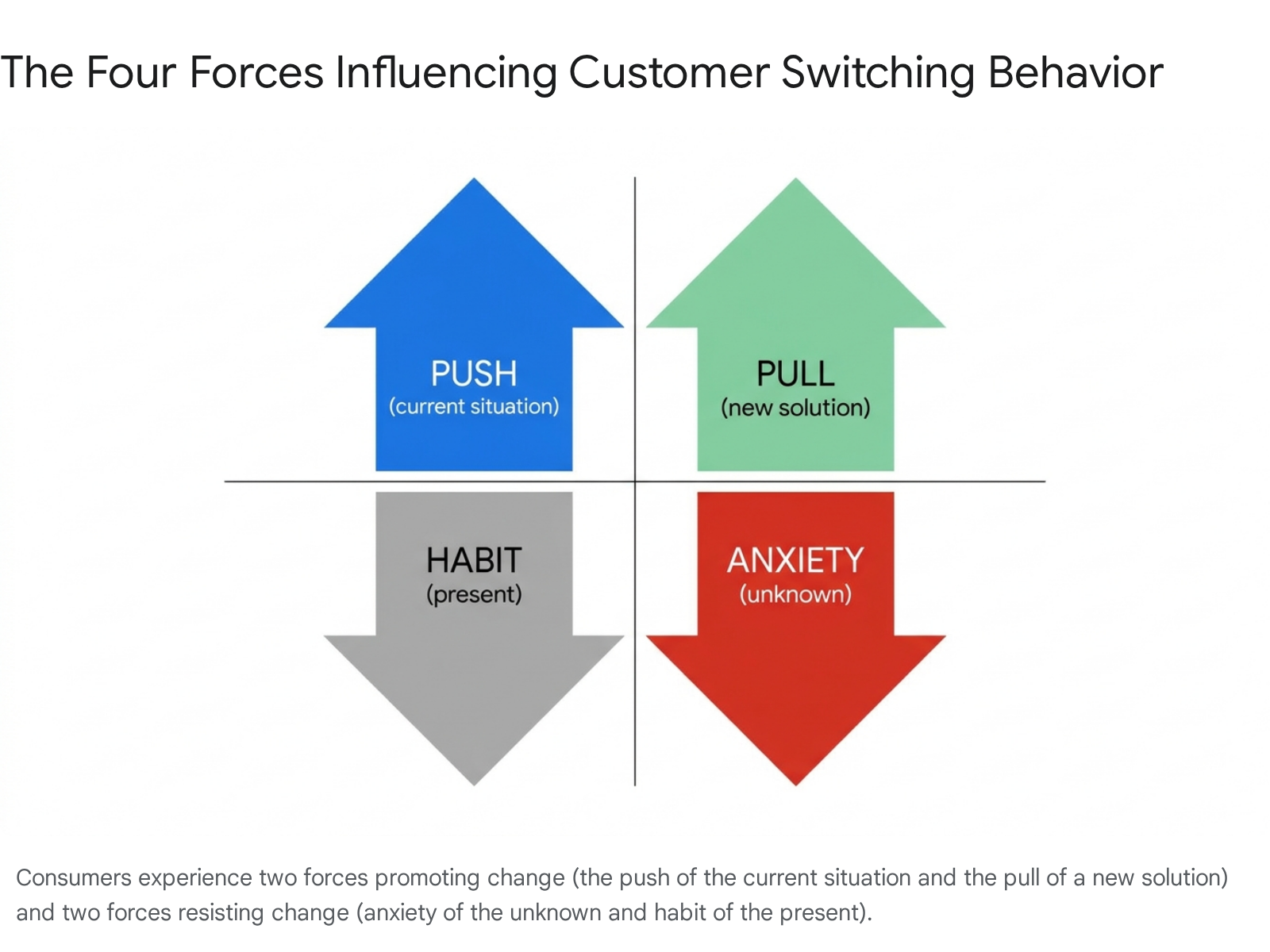
To accurately map consumer demand, a practitioner must conduct qualitative research to identify the specific variables populating each of these four quadrants.
The first force is the push of the current situation. This represents the struggling moment that initially destabilizes the consumer's status quo. It encompasses the frustrations, systemic inefficiencies, or sudden life changes that make the incumbent solution untenable. Customers rarely seek new products without a definitive trigger event that initiates this push; the absence of a struggle means there is no demand for innovation 81116.
The second force is the pull of the new solution. This serves as the magnetic appeal of the new product or service. It is driven by the marketing promise, the perceived functional benefits, and the customer's visualization of how their life or workflow will dramatically improve once the job is successfully completed using the new solution 1116.
The third force is the anxiety of the unknown, which actively resists change. This encompasses the customer's fear that the new product will not work as advertised, that it will be too difficult to learn, or that the financial and temporal switching costs will ultimately outweigh the benefits. Anxiety is deeply rooted in human loss aversion, acting as a psychological friction that can kill a sale even when the product is objectively superior 111620.
The fourth force is the habit of the present. This represents the powerful inertia of the status quo. Consumers are highly accustomed to their current workarounds, legacy systems, and existing behaviors. Even if a process is visibly flawed, the mere familiarity of the current method creates a powerful resistance to the adoption of new technologies 1120.
For a product to be successfully hired by the consumer, the combined psychological power of the push and the pull must significantly outweigh the combined resistance of anxiety and habit 1621. If the friction of the latter two forces remains dominant, the consumer will ultimately decide that the pain of switching is worse than the pain of their current struggle, resulting in non-consumption 1721.
Consumer Purchasing Timelines and Switch Interviews
The demand-side canvas maps these four forces across a specific chronological timeline, acknowledging that product adoption is a journey of escalating intent rather than an isolated, instantaneous event. The timeline typically consists of distinct, sequential phases that govern the customer's mental state.
The timeline begins with the "First Thought," which creates the initial mental space for a new solution, usually triggered by a specific incident where the current solution visibly fails 1117. During the subsequent "Passive Looking" phase, the consumer recognizes a nagging struggle but lacks the urgency, budget, or knowledge to pursue an immediate fix; they merely observe potential alternatives without intent to purchase 17. It is not until a secondary trigger occurs - elevating the pain of the struggle - that the consumer transitions into "Active Looking" and eventual decision-making 1117. The timeline concludes with the actual purchase, onboarding, and ongoing use, where the customer continually evaluates if the product is fulfilling the hired job 173132. By mapping specific marketing messaging and product features to exact phases of this timeline, organizations can efficiently allocate resources and intercept consumers at critical behavioral inflection points 17.
To populate this demand-side timeline, practitioners conduct specialized qualitative research known as switch interviews 41133. Rather than asking customers speculative questions about what features they might want in the future, practitioners act as investigative researchers, asking customers to reconstruct the exact timeline of a recent purchase 1133. The interviewer walks backward through the customer's timeline, identifying the specific day they realized the old solution was failing, the fragmented workarounds they hacked together in the interim, and the specific anxieties they experienced immediately prior to entering their credit card information 1117.
Practitioners are strongly advised to interview recent switchers - those who have adopted or abandoned a product within the last few months - to avoid memory decay. Older switches produce reconstructed, post-rationalized narratives rather than factual behavioral evidence 11. Furthermore, because a single interview only yields an isolated hypothesis, robust JTBD insights emerge only when researchers synthesize cohorts of eight to twelve switch interviews targeting the same core job, allowing them to identify stable patterns of causality 11.
The Universal Job Map Framework
While the demand-side canvas excels at explaining the psychological catalysts of a purchase, the Jobs-as-Activities paradigm offers a highly structured canvas for mapping exactly how a customer executes the job once the product is acquired. Introduced by Tony Ulwick and Lance Bettencourt in the Harvard Business Review, the Universal Job Map is a visual depiction of the core functional job deconstructed into its discrete, chronological process steps 192235.
A fundamental, non-negotiable rule of the Universal Job Map is that it must remain completely solution-agnostic 1836. It does not map the customer journey through a specific software interface, nor does it map the physical steps taken inside a specific retail store. Rather, it maps the ideal process flow the customer is attempting to achieve, independent of the technology being utilized 418. Whether a consumer is using a mechanical gramophone, an analog cassette tape, or a modern digital streaming service, the fundamental job of "listening to a specific piece of music" remains conceptually identical 23.
Execution Stages of the Job Map
Extensive research across hundreds of diverse industries has revealed that almost all functional jobs follow a universal, stable structure comprising eight distinct stages .
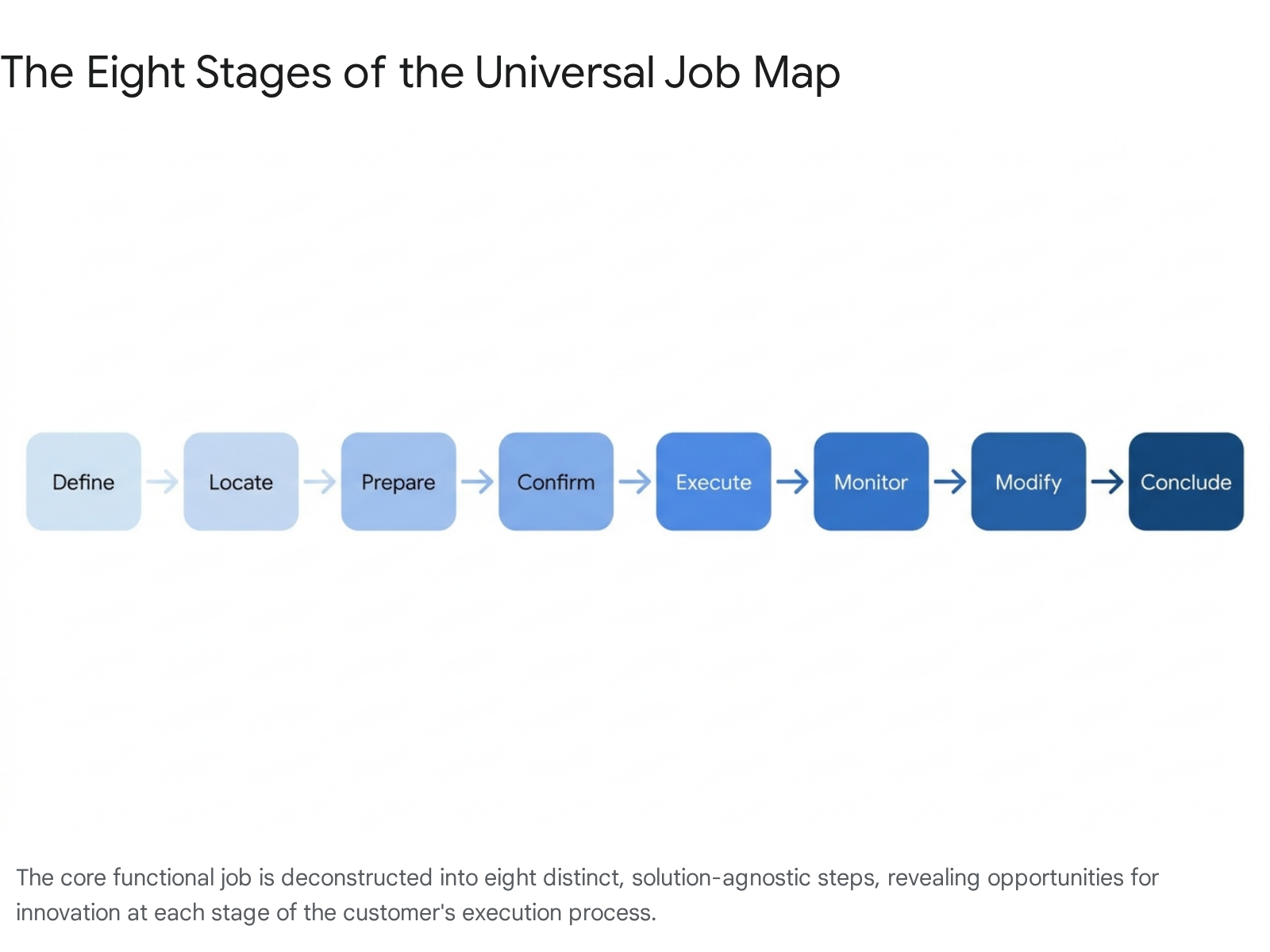
By analyzing a consumer segment through this eight-step map, practitioners can identify precise areas where the current market is underserved and target product development resources accordingly 183538.
| Job Map Stage | Definition of Customer Activity | Focus Area for Product Innovation |
|---|---|---|
| 1. Define | The customer determines their underlying objectives, establishes requirements, and plans their strategy for the job 182224. | Helping the user set accurate parameters, simplifying discovery, or reducing the cognitive load of early decision-making 1822. |
| 2. Locate | The customer gathers the necessary physical inputs, materials, or information required to eventually execute the job 182224. | Simplifying the discovery of resources, consolidating disparate tools, or automatically retrieving necessary data 1822. |
| 3. Prepare | The customer actively sets up the environment, organizes the gathered inputs, and arranges conditions for execution 182224. | Automating tedious setup processes, eliminating complex configuration barriers, or providing pre-built templates 1822. |
| 4. Confirm | The customer verifies that all preparations are correct and that conditions are optimal to safely proceed 1822. | Providing automated validation mechanisms, system checklists, or predictive risk assessments prior to launch 1822. |
| 5. Execute | The core operational step where the primary action is taken and the fundamental task is carried out 182224. | Ensuring high reliability, accelerating the speed of the core transaction, and preventing systemic failures 1822. |
| 6. Monitor | While executing, the customer tracks progress, system behavior, or changing environmental variables 182224. | Introducing real-time analytics, automated alerts, performance dashboards, or visibility enhancements 1822. |
| 7. Modify | Based on feedback gathered from the monitoring stage, the customer makes necessary adjustments to stay on track 182224. | Allowing for seamless course correction without restarting the process, or implementing auto-adjusting algorithms 1822. |
| 8. Conclude | The customer finishes the core task, assesses the final results, and prepares the environment for future iterations 182224. | Automating reporting, facilitating rapid tear-down, or integrating the final output into adjacent software systems 1822. |
Desired Outcomes and Opportunity Scoring
Once the Universal Job Map is constructed, practitioners do not immediately transition into brainstorming features or sketching user interfaces. Instead, they identify specific "desired outcomes" associated with each of the eight steps 1323. Desired outcomes are customer-defined performance metrics that objectively measure success, typically expressed as a direction of change regarding time, effort, risk, or yield. For example, a desired outcome in the "Confirm" stage might be stated as: "Minimize the time it takes to verify that all financial inputs are secure prior to execution" 132023.
A single core functional job map for a complex process can yield well over one hundred specific desired outcomes 13. To determine which features to build, organizations survey the target consumer segment to rate these outcomes quantitatively on two distinct axes: the importance of the outcome to the consumer, and their current satisfaction with existing market solutions 131920. Using an "opportunity algorithm" that mathematically weighs importance against satisfaction, practitioners can pinpoint the precise steps of the job map that are highly important yet poorly satisfied, thereby isolating the areas most ripe for disruptive innovation 131920.
Quantifying Emotional and Social Dimensions
A persistent limitation often cited regarding structured functional job mapping is a systemic overemphasis on utilitarian execution at the expense of deeper psychological drivers 3625. Products rarely exist in a purely functional vacuum; consumer behavior is deeply influenced by identity construction, peer status, and emotional resonance 4126. As a result, relying solely on functional steps can lead to technically perfect products that fail to generate market enthusiasm. A complete demand-side canvas must explicitly isolate functional, emotional, and social jobs 172728.
The classic illustration of this multidimensionality is the fast-food milkshake case study popularized by Christensen. When researchers attempted to improve milkshake sales by focusing on functional attributes - making them thicker, sweeter, or larger - sales remained stagnant 727. By observing behavior and conducting demand-side interviews, they discovered that commuters were "hiring" milkshakes not for their flavor, but for emotional and functional jobs: to relieve the sheer boredom of a long morning commute with an easy-to-hold snack that lasted precisely the duration of the drive 727.
Similarly, automotive manufacturers recognize that consumers purchasing a Mini Cooper or a luxury sports car are rarely doing so strictly for the functional job of point-to-point transportation. They are hiring the vehicle to fulfill a social job regarding status projection, and an emotional job regarding the feeling of uniqueness or control 412930.
| Job Layer | Definition and Scope | Key Examples in Consumer Markets |
|---|---|---|
| Functional Jobs | The practical, objective, and measurable tasks a person actively seeks to complete within a specific context 2627. | Repairing a torn rotator cuff, calculating corporate payroll, securely transferring funds, or cutting wood in a straight line 1327. |
| Emotional Jobs | The internal psychological state the customer wishes to achieve, or the negative state they wish to avoid, as a direct result of the purchase 262831. | Reducing financial anxiety, feeling secure and protected, experiencing nostalgia, or feeling a sense of personal confidence 262831. |
| Social Jobs | The external perception the customer wishes to curate and project to their surrounding environment 262831. | Appearing innovative to industry peers, being viewed as a responsible provider by family, or signaling high socioeconomic status 262831. |
Translating vague feelings into structured, measurable socio-emotional jobs is a significant challenge for market researchers. Traditional surveys often fail to capture root motivations because consumers struggle to articulate their subconscious emotional drivers 2930. Advanced practitioners overcome this by utilizing qualitative interviews or mobile ethnography - where users document their behaviors in real-time via smartphones - to generate an organic list of high-priority emotional factors 2730. These abstract feelings are then distilled into specific, emotion-linked tasks (e.g., "Help me feel distinct from the corporate mainstream") that can be quantitatively surveyed and prioritized alongside functional outcomes 2930.
Cultural Variations in Job Execution
When mapping consumer segments on a global scale, practitioners must account for severe cultural variations regarding what constitutes successful completion of social and emotional jobs 323334. The theoretical models of cross-cultural psychology, particularly the spectrum of Individualism versus Collectivism developed by researchers like Geert Hofstede, dictate how emotional satisfaction and social success are fundamentally defined by the consumer 323452.
In highly individualistic cultures - such as the United States, the United Kingdom, and Western Europe - consumers are socialized to prioritize autonomy, self-reliance, and personal achievement 325253. Consequently, the social jobs within these segments frequently revolve around standing out from the crowd, expressing a highly unique identity, or visibly demonstrating personal competitive success to peers 3235. Furthermore, research into positive emotion norms reveals that individualistic cultures place a significantly higher value on "high-arousal" positive feelings, such as overt excitement, pride, and enthusiasm 3637. Products mapped for these segments must satisfy emotional jobs tied to individual expressiveness and high-energy outcomes 3235.
Conversely, in collectivist cultures - encompassing many East Asian, Latin American, and African nations - the needs, goals, and harmony of the larger group supersede individual desires 323452. Consumers in these segments construct their identities around group interdependence, fulfilling established social roles, and maintaining relational stability 5253. Emotional norms in collectivist segments tend to heavily favor calm, "low-arousal" positive emotions and the avoidance of interpersonal friction 3637.
Because of these profound differences, a product feature that successfully satisfies a social job of "standing out" in a Western market may aggressively violate the social job of "maintaining group harmony" in an Eastern market 323453. Global product managers must therefore generate localized job maps that recalibrate the desired outcomes of social and emotional layers to match regional psychological baselines 3334.
Integrating Job Mapping with Agile Workflows
Despite the analytical rigor of the JTBD framework, translating high-level, upstream job canvases into the tactical, downstream execution of software engineering remains a persistent operational challenge 438. Modern product development is heavily dominated by Agile frameworks, Scrum methodologies, and rapid two-week sprint cycles 3839. Integrating broad consumer insights into iterative backlogs requires deliberate artifact translation to prevent the research from becoming purely theoretical 3859.
Limitations of Traditional User Stories and Personas
Traditional Agile product backlogs rely almost exclusively on User Stories, structurally formatted as: "As a [user persona], I want to [take an action], so that [I receive a benefit]." 3840. While this format excels at creating small, technically testable increments of code, it inherently presupposes a specific solution and assumes the underlying demographic persona is an accurate proxy for demand 40. For example, the user story "As a registered customer, I want to log in, so that I can view my dashboard" ignores the reality that no customer fundamentally wants to log in; the authentication process is merely an administrative barrier to their actual desired progress. By strictly following the user story, developers are incentivized to build complex login screens rather than exploring innovative, frictionless alternatives like passwordless entry or biometric authentication 40.
Similarly, relying purely on demographic personas can lead Agile teams astray. Traditional personas segment audiences by age, gender, income, or lifestyle. However, demographics are often poor predictors of actual buying behavior 4741. To return to the milkshake example, a 25-year-old construction worker and a 55-year-old corporate executive may both "hire" a fast-food milkshake for the exact same job on a Tuesday morning 1227. If the marketing team designs the product solely for the "Young Construction Worker" persona, they alienate half of the actual demand base.
Advanced practitioners do not view JTBD and personas as mutually exclusive; rather, they combine them into a unified strategy. JTBD defines the causal why (the progress sought and the job to be done), while personas provide the contextual who (the specific device the user is likely holding, their technological literacy, their accessibility constraints, and the tone of voice required for effective communication) 1262.
Job Stories and Opportunity Backlogs
To bridge the gap between JTBD research and Agile delivery, mature organizations replace or augment traditional User Stories with "Job Stories" and outcome-based Opportunity Backlogs 2038. A Job Story reframes the Agile requirement to focus purely on the struggling context and the desired outcome, deliberately stripped of specific feature assumptions. The structure typically follows: "When [specific situational context], I want to [motivation or progress sought], so I can [expected measurable outcome]." 4.
This reframing allows Agile engineering and design teams to maintain creative flexibility in how they solve the problem during a sprint, rather than acting as order-takers for a predefined feature 41. In this integrated model, the Universal Job Map serves as the overarching product roadmap. Epic-level initiatives are tied to optimizing specific stages of the job map (e.g., dedicating an entire quarter to improving the "Prepare" and "Confirm" stages of a software platform), and individual sprint goals are evaluated not by lines of code shipped, but by their ability to measurably move the needle on the customer's desired outcomes 42038.
Implementation Pitfalls in Enterprise Environments
While the theoretical synergy between Agile development and JTBD mapping is powerful, several anti-patterns routinely emerge when enterprises attempt to scale the methodology without adequate governance 203942.
The most common failure mode is mere feature translation without strategic re-prioritization. Product teams often retroactively apply JTBD terminology to an existing, bloated backlog of legacy features without actually changing their delivery priorities or having the discipline to abandon low-impact work 420. This creates a corporate facade of customer-centricity while the organization maintains a "feature factory" mentality, prioritizing rapid output over actual behavioral outcomes 2040.
Another frequent issue is over-segmentation. In their zeal to map the customer journey, researchers may attempt to define every minor micro-task as a unique Job to Be Done, diluting the strategic focus of the product. Practitioners must maintain discipline, keeping the core functional job elevated to a level where the associated outcomes materially impact adoption, retention, and business revenue 20.
Furthermore, the misuse of desired outcomes as strict performance targets is a severe anti-pattern. Using JTBD outcome metrics purely as key performance indicators (KPIs) to evaluate or punish engineering teams inevitably encourages the artificial manipulation of data - a phenomenon known as gaming the system. Desired outcome metrics should be utilized to facilitate rapid learning, evaluate the viability of competing prototypes, and adapt to shifting market conditions, not to dictate compensation 20.
Finally, JTBD initiatives frequently fail due to a lack of cross-functional buy-in. Deep job mapping research is often conducted and siloed within UX design or marketing departments. If the core engineering, sales, and executive leadership functions do not actively adopt the job map as a shared organizational language, the insights remain theoretical documents that fail to penetrate the actual product delivery cycle 385941.
The Impact of Artificial Intelligence on Job Mapping
As organizations navigate the latter half of the 2020s, the operational application of the JTBD framework is being fundamentally accelerated by rapid advancements in Artificial Intelligence (AI) and Large Language Models (LLMs) 436566. Historically, conducting rigorous switch interviews, mapping the 8-step execution flow, and quantitatively surveying desired outcomes required massive investments of time, specialized training, and expensive consulting capital, creating a barrier to entry for smaller firms 2067.
AI-Powered Qualitative Synthesis and Simulated Discovery
AI is currently being deployed by research teams to resolve the traditional bottleneck of qualitative data synthesis. Natural Language Processing (NLP) models can rapidly ingest and analyze thousands of hours of customer support transcripts, public user reviews, and recorded sales calls, extracting the underlying causal mechanisms that drive user behavior 436568. Rather than relying on human analysts to manually code qualitative interview transcripts for instances of push, pull, anxiety, and habit, appropriately tuned AI algorithms can identify these forces of progress at an unprecedented scale, significantly reducing time-to-insight 4365.
Furthermore, practitioners are utilizing generative AI as high-fidelity interview simulators. By interacting with advanced LLMs programmed with specific demographic constraints, behavioral prompts, and industry contexts, researchers can run simulated "practice interviews." This allows teams to discover initial high-level outcomes and anxieties, effectively stress-testing and narrowing the scope of their hypotheses before expending resources to engage actual human subjects 6744. This AI-assisted discovery phase allows product teams to map the functional and socio-emotional layers of a target segment with vastly improved efficiency 416768.
AI Product Management and SaaS Applications
The integration of AI capabilities and JTBD strategy is highly evident in the B2B Software as a Service (SaaS) sector, where the demand for specialized AI Product Managers has surged 3145717273. A prominent historical case study illustrating this alignment involves Intercom, a customer communications platform. Originally functioning as a broad, unfocused messaging tool, the company utilized rigorous JTBD research to realize that their diverse user base was actually "hiring" the software for fundamentally different jobs: onboarding new users, providing rapid real-time support, and boosting general marketing engagement 131. Instead of continuing to build generalized features that served no single job perfectly, Intercom made the strategic decision to split its platform into distinct products, each laser-focused on one specific Job to Be Done, accompanied by tailored pricing models. This alignment of product architecture to the customer's job map resulted in a five-fold increase in their customer base and a fifteen-fold increase in recurring revenue over 18 months 31.
Today, modern AI product managers use similar JTBD mapping techniques to govern the deployment of complex machine learning features within legacy enterprise platforms 6668. Rather than implementing generative AI merely for the sake of technological novelty - a classic supply-side push that often leads to low adoption - product managers map the customer's execution steps to identify exactly where AI can eliminate the most friction 6668. For instance, if a universal job map reveals that the "Locate" and "Prepare" stages of a data analyst's workflow are highly manual and prone to error, AI is deployed specifically at those nodes to automate data extraction and configuration. This ensures the technology is directly satisfying the customer's highest-priority desired outcome, linking the immense capabilities of artificial intelligence to genuine human progress 1868.
Conclusion
The Demand-Side Innovation Canvas and the Universal Job Map transform product development from a speculative, feature-obsessed exercise into a highly predictable science. By analyzing target markets not through the lens of static demographic attributes, but through the dynamic socio-emotional and functional progress that customers actively seek, organizations can uncover hidden pockets of demand and entirely reframe their competitive landscape.
Whether an organization is applying Bob Moesta's Forces of Progress to refine its market positioning and overcome deep-seated consumer anxieties, or leveraging Tony Ulwick's eight-step job map to ruthlessly optimize the granular execution of a daily task, the Jobs to Be Done framework forces a necessary alignment with customer reality. When these theoretical models are properly translated into Agile delivery systems - moving past the limitations of traditional user stories - and accelerated by modern AI analytics, they provide a comprehensive blueprint for value creation. Ultimately, these tools ensure that development teams cease building features that merely look impressive on an internal roadmap, and instead deliver precise, contextual solutions that customers will reliably hire to improve their lives.