
Outcome and context separation in the Jobs to Be Done progress vector
The Jobs to Be Done (JTBD) framework represents a fundamental paradigm shift in understanding consumer behavior, market dynamics, and product innovation. Rooted in the economic and marketing theories popularized by Theodore Levitt and Clayton Christensen, the framework moves away from demographic segmentation and product feature analysis, focusing instead on the underlying objectives individuals seek to accomplish 13. The central premise asserts that customers do not merely purchase products; rather, they "hire" solutions to transition from a suboptimal current state to a desired future state 23. The trajectory of this transition is conceptualized as the progress vector.
Understanding how this progress vector separates the functional, desired outcomes of the job executor from the situational and emotional context surrounding the decision is a critical challenge in modern innovation strategy. Theoretical interpretations of the JTBD framework handle this separation through divergent methodologies. Certain paradigms advocate for the strict isolation of functional outcomes to enable quantitative, metric-driven product development, arguing that emotional context introduces counterproductive variability . Other interpretations embrace the inherent entanglement of emotional, social, and situational drivers, mapping them as psychological forces that either fuel or impede the progress vector over a defined timeline 45.
This report provides an exhaustive analysis of the mechanics governing the progress vector. By evaluating structural models such as Outcome-Driven Innovation (ODI) and the Forces of Progress framework, this analysis delineates how organizations categorize, isolate, and integrate functional outcomes against the backdrop of human emotional and situational contexts.
Theoretical Bifurcation of the Progress Vector
The definition and practical application of the JTBD framework have evolved into two distinct theoretical models. These models fundamentally differ in their treatment of the progress vector, particularly regarding the separation of situational context from core functional objectives. Academic and industry literature generally categorizes these interpretations into "Jobs-As-Progress" and "Jobs-As-Activities" .
The Jobs-As-Progress theory, championed primarily by Clayton Christensen and Bob Moesta, asserts that a job is the progress an individual attempts to make within a highly specific circumstance 6. In this model, the "job" is intrinsically bound to an emotional or social struggle. Eliminating a functional struggle is not synonymous with progress; rather, progress is defined by the individual overcoming the struggle within their unique situational reality 712. This approach maintains that the emotional and situational context surrounding the decision to switch solutions cannot be stripped away without losing the fundamental catalyst for consumer behavior.
Conversely, the Jobs-As-Activities ideology, pioneered by Anthony Ulwick through the Outcome-Driven Innovation (ODI) methodology, approaches the job as a core functional task . Within this interpretation, emotional and social considerations are deliberately and systematically isolated from the core functional job to construct stable, universally applicable, and highly measurable units of analysis 13. This perspective posits that innovation is a science that requires objective performance metrics devoid of subjective emotional interference.
| Theoretical Model | Primary Proponents | Core Unit of Analysis | Treatment of Emotional Context | Primary Application |
|---|---|---|---|---|
| Jobs-As-Activities (ODI) | Anthony Ulwick | The core functional task or activity. | Strictly separated into distinct, secondary lists of emotional and social jobs. | Metric-driven product engineering, quantitative feature optimization, and market sizing 13. |
| Jobs-As-Progress (Demand-Side) | Clayton Christensen, Bob Moesta | The desire to overcome a circumstantial struggle. | Deeply integrated into the core analysis as primary forces that push and pull consumer behavior. | Understanding market switching behavior, behavioral psychology, and positioning strategy 36. |
Structural Isolation of Functional Outcomes
The Outcome-Driven Innovation (ODI) framework asserts that predictability in innovation requires the unit of analysis to be entirely stripped of subjective, fluctuating emotional and situational contexts . The methodology argues that while jobs naturally possess functional, emotional, and social dimensions, these elements must be defined in a mutually exclusive manner . Mixing these dimensions creates "hybrid" job statements that are impossible to accurately quantify, effectively destroying the ability to pinpoint exactly where a customer is underserved .
Defining the Core Functional Job
In the ODI methodology, the core functional job serves as the stable, long-term focal point around which all peripheral needs, including emotional and social aspirations, are anchored . Establishing this job requires absolute separation from the situational context in which it occurs. Practitioners are explicitly instructed to "define the job, not the situation" . By decoupling the job from the circumstance, the resulting job statement remains completely solution-agnostic. This ensures the job remains universally applicable across different geographic regions, demographics, and shifting competitive landscapes 8.
A properly structured core functional job statement focuses solely on the functional task. For example, a core functional job might be defined as "cut a piece of wood in a straight line" . According to strict ODI guidelines, this statement must remain devoid of adverbs or qualitative descriptors. Adding qualifiers such as "safely," "quickly," or "accurately" introduces desired outcomes, which must be captured separately . Adding emotional qualifiers conflates the functional objective with personal feelings, rendering the statement useless for quantitative analysis .
The Universal Job Map Methodology
To further isolate the functional mechanics of a job from its environmental context, the ODI framework employs the Universal Job Map. This analytical tool deconstructs the core functional job into eight discrete, sequential process steps 8. The mapping process explicitly avoids any description of the customer's journey, the purchase process, or the emotional state of the user . The objective is not to document what the customer is currently doing with an existing product (which constitutes a solution view), but rather what they are fundamentally attempting to accomplish irrespective of the tools at their disposal (the needs view) .
| Universal Job Map Step | Functional Definition | Industry Innovation Example |
|---|---|---|
| 1. Define | Determining functional goals and planning required resources. | Weight Watchers streamlining diet planning by offering a point system that eliminates complex calorie counting 8. |
| 2. Locate | Gathering necessary items, inputs, and information needed to perform the job. | U-Haul providing customers with prepackaged moving kits containing the exact number and types of boxes required 8. |
| 3. Prepare | Setting up the physical or digital environment to perform the job. | Bosch incorporating adjustable levers to its circular saws to instantly accommodate common bevel angles used by roofers 8. |
| 4. Confirm | Verifying readiness and ensuring conditions are optimal to perform the job. | Oracle's merchandising software confirming the optimal timing and level of retail store markdowns before execution 8. |
| 5. Execute | Carrying out the central task or core functional job. | Kimberly-Clark automating the circulation of heated water through patient warming blankets to prevent manual delays 8. |
| 6. Monitor | Assessing whether the job is progressing successfully toward the desired outcome. | Nike integrating sensors into footwear to continuously track running performance metrics without user intervention 8. |
| 7. Modify | Making necessary alterations to improve execution based on monitoring feedback. | Microsoft Word automatically identifying and correcting spelling errors in real-time during document creation 8. |
| 8. Conclude | Finishing the job, assessing final output, and preparing for future execution. | 3M developing specialized medical dressings that can be peeled off without damaging delicate skin upon completion of healing 8. |
Synthesizing Desired Outcome Statements
With the functional job mapping completely separated from emotional and situational context, the ODI framework translates user needs into "desired outcomes" 9. These outcomes act as precise, customer-defined performance metrics used to judge the successful execution of each step within the Universal Job Map 10.
To maintain analytical rigor, desired outcome statements are stripped of ambiguity and formatted using a highly specific linguistic syntax: the statement must include a direction of improvement, a performance metric (typically time or likelihood), an object of control, and a contextual clarifier . For instance, a listener attempting to manage digital music might desire to "minimize the time it takes to get the songs in a playlist" . This statement serves as a functional outcome metric completely devoid of emotional sentiment.
By defining between 50 to 150 of these measurable outcomes per market, companies construct an exhaustive matrix of functional demands 911. This matrix is then utilized in quantitative surveys to identify statistically significant gaps between the importance customers place on an outcome and their current satisfaction with available solutions 911.
The Opportunity Algorithm and Quantitative Prioritization
The ultimate manifestation of functional isolation in the JTBD framework is the ability to apply mathematical models to innovation prioritization. The Opportunity Algorithm ranks the potential of each desired outcome by calculating a specific formula: Opportunity equals Importance plus the maximum value of Importance minus Satisfaction, or zero if satisfaction exceeds importance 1112.
This formula requires surveyed customers to rate both importance and satisfaction on a standardized 1-to-10 scale 11. Because emotional and situational contexts are inherently subjective, transient, and difficult to consistently index across a broad population, isolating the functional metrics allows for reliable, reproducible quantitative validation 11. This mathematical approach shifts the paradigm of product development from an art reliant on qualitative intuition to a predictable, data-driven science.
Integration of Situational and Emotional Context
While the ODI methodology rigorously isolates functional outcomes to achieve mathematical precision, the alternative JTBD approach argues that human purchasing behavior is inextricably linked to situational and emotional context. In this model, championed heavily by Bob Moesta and the Re-Wired Group, the progress vector is not a sterile mathematical path of optimization, but rather a complex psychological battleground. Consumer choices frequently appear irrational when viewed purely through a functional lens, but become entirely logical and predictable once the emotional constraints and situational catalysts are fully mapped 13.
The Forces of Progress Framework
To analyze the contextual realities of the progress vector, Moesta developed the Forces of Progress diagram.
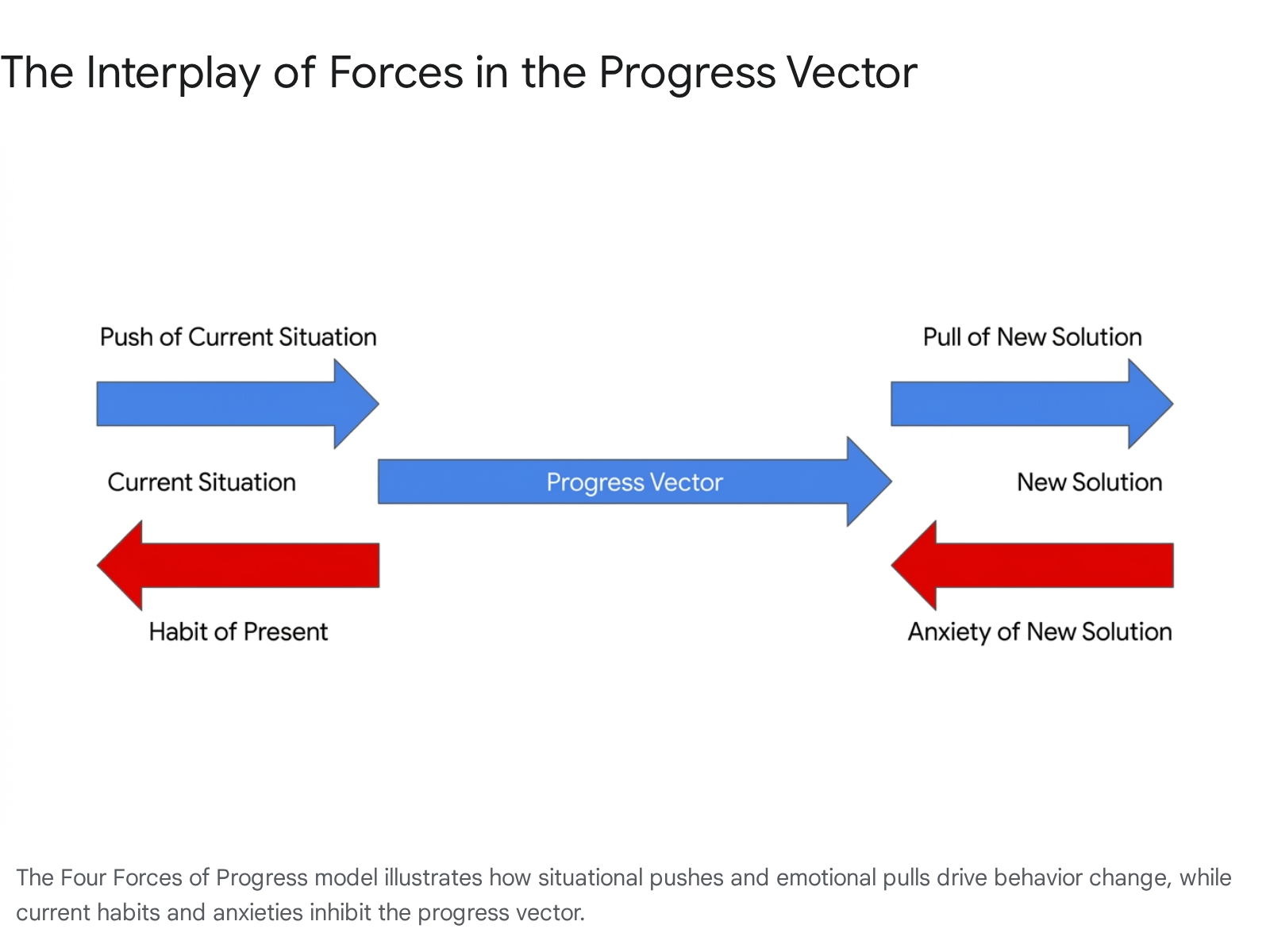
This framework categorizes the specific situational and emotional drivers that compel or block a user from transitioning from an existing solution to a new one 142324. These four psychological forces act simultaneously upon the consumer, generating tension that must be resolved for a transaction or behavioral shift to occur.
The first force is the Push of the Current Situation, which functions as the primary situational driver. This force encompasses the triggers, constraints, and frustrations inherent in the user's existing context that compel them to seek a change 515. The push force is highly situational; it represents the "struggling moment," such as a daily commute becoming unbearably tedious, a family outgrowing a home, or a software platform continuously crashing during peak hours 1316. Without a sufficient situational push, the progress vector cannot be initiated, regardless of how functionally superior or economically advantageous a new product might be 4.
The second force is the Pull of the New Solution, which acts as the primary emotional driver. The pull force involves the magnetism of a better future state. While it encompasses the functional promise of improved performance, it is heavily driven by reason and emotion regarding how the user imagines their life will improve 514. This includes the social motivation of how others will perceive them upon adopting the new solution, and the internal emotional motivation of how they will feel about themselves 7.
Acting against the progress vector is the Anxiety of the New Solution, serving as an emotional inhibitor. Even when functional outcomes are clear and the pull is strong, emotional anxieties severely impede progress. This force includes fears about the unknown, concerns regarding a steep learning curve, the financial risk of a mistake, and the potential for regret 514. Anxiety forces are categorized fundamentally by the emotional state of uncertainty and fear they induce within the user 14.
The final force is the Habit of the Present, functioning as a situational inhibitor. This force represents the allegiance to the current situation. It involves the emotional comfort of familiarity and the situational inertia of existing processes 5. It is the psychological resistance to altering behavior, even when the current behavior is consciously acknowledged as suboptimal 4. For the progress vector to result in a "switch" (the adoption of a new solution), the combined energy of the situational Push and emotional Pull forces must mathematically and psychologically exceed the combined resistance of the Anxiety and Habit forces 1718.
The Chronological Timeline of the Progress Vector
The contextual approach to JTBD also maps the progress vector chronologically. Rather than breaking down the job into functional execution steps - as seen in the Universal Job Map - this methodology maps the psychological and behavioral journey of the buyer over time 3.
| Phase | Description of User Psychology | Progress Vector Characteristic |
|---|---|---|
| First Thought | Creating space in the brain for a problem. Acknowledging a struggling moment. | The initial situational push breaks the stasis of existing habits 3. |
| Passive Looking | Learning, framing, and recognizing that alternatives exist without immediate action. | The user becomes receptive to the pull of new solutions, though action is delayed 3. |
| Active Looking | Framing trade-offs, ruling options in and out based on specific situational constraints. | The tension between the four forces heightens as specific solutions are evaluated 37. |
| Deciding | Connecting dots, getting group buy-in, and establishing clear expectations. | The Push and Pull forces definitively overcome Anxiety and Habit forces 3. |
| Onboarding | First use and immediate verification of the expected progress metrics. | Anxiety remains extremely high; the product must immediately validate the expected outcomes 3. |
| Ongoing Use | Building new habits and establishing a new baseline of normalcy. | The new solution becomes the established habit, completing the current progress vector and preparing for future struggling moments 3. |
Emotional and Social Dimensions as Primary Drivers
In the Forces of Progress framework, emotional and social jobs are not separated into distinct, secondary lists isolated from the functional core. Instead, they are deeply integrated into the progress vector itself. The social job defines how a person wants to be perceived in a given circumstance, while the emotional job dictates how they want to feel 19.
In markets where functional differentiation between products is marginal, the emotional and social components frequently act as the primary drivers of the progress vector 19. For example, the purchase of cosmetics is functionally about applying pigment to the skin, but the actual Job to Be Done is "aesthetic self-betterment" aimed at gaining social validation and romantic confidence 3. Attempting to isolate the functional job of applying makeup from the emotional context of self-esteem would yield fundamentally flawed market research. Similarly, Christensen's famous milkshake study revealed that morning commuters hired milkshakes not for their functional nutritional profile, but to alleviate the emotional boredom of a long drive while avoiding the situational messiness of traditional breakfast foods 203121.
Methodological Approaches to Separation and Integration
In practice, executing JTBD research requires organizations to navigate the tension between isolating outcomes for precision and understanding context for adoption. Practitioners employ vastly different methodologies depending on whether their goal is functional product optimization or understanding market switching behavior.
Quantitative Surveys and Outcome-Based Segmentation
To execute functional isolation, researchers utilizing the ODI methodology rely heavily on structured quantitative surveys. Once qualitative interviews yield the 50 to 150 desired outcomes across the Universal Job Map, statistically valid populations are surveyed 9. These surveys force respondents to rate the importance of each outcome and their satisfaction with current solutions 9.
This heavily structured data collection process relies on large sample sizes and advanced mathematical segmentation. The goal is to group customers strictly by their unmet functional needs, actively ignoring traditional demographic profiles, age cohorts, or psychographic tendencies . The result is an opportunity landscape that dictates exactly which functional features engineers should build next to capture market share 22.
The Switch Interview and Timeline Deconstruction
Conversely, to capture the emotional and situational context of the progress vector, researchers employ the "Switch Interview" 14. This qualitative technique focuses heavily on the exact timeline of a purchase decision, working backward to deconstruct the specific situational triggers and emotional states that influenced the user 14. Switch interviews are most effective when conducted shortly after the decision-point, ensuring the emotional state and situational constraints are still fresh in the customer's memory 14.
During these interviews, researchers operate similarly to investigative journalists. They do not ask customers what features they want in a product, as customers often lack the vocabulary to articulate innovative solutions 1634. Instead, researchers trace the sequence of events - the dominoes falling - that led the user to realize their current situation was untenable 1617. The objective is to identify the "struggling moment," as this moment serves as the fundamental catalyst for the progress vector 513. By tagging transcripts for specific beats, anxieties, and habit forces, teams can identify patterns in purchasing behavior that functional metrics alone cannot reveal 23.
Integrating AI and Mobile Ethnography
As the JTBD methodology evolves, researchers are deploying advanced tools to capture both functional needs and contextual realities. Mobile ethnography allows researchers to observe the progress vector in real-time. By prompting participants to capture moments via mobile devices when a need arises or a workaround is employed, researchers bypass the recall bias inherent in retrospective interviews 31. This technique vividly uncovers the emotional and social dimensions of jobs through participant expressions, tones, and physical surroundings 31.
Furthermore, Artificial Intelligence is increasingly utilized to bridge the gap between vast qualitative transcripts and structured functional models. Product teams employ AI not merely for process automation, but as a "thinking partner" to analyze unstructured switch interview data, isolate key desired outcomes, and identify hidden patterns in emotional friction across massive datasets 3637. When utilized responsibly, AI accelerates the translation of contextual struggles into prioritized functional metrics 24.
Academic Critiques and Methodological Limitations
While both approaches to the progress vector provide significant strategic advantages over traditional demographic market research, rigorous academic analysis and industry application reveal notable limitations. The attempt to perfectly separate functional outcomes from situational and emotional context introduces specific risks.
The Illusion of Pure Functional Isolation
A primary academic critique of the Outcome-Driven Innovation model is the assumption that customers can accurately, rationally, and consistently articulate their desired functional outcomes free from emotional bias and subconscious influence 3425. Research in behavioral economics and psychology indicates that sensory cues and emotional memories frequently override stated functional intentions.
This limitation was highlighted in a fast-food industry study utilizing the JTBD framework. Researchers found that while customers explicitly articulated a functional desired outcome of "eating healthy food," the sales of healthy sandwiches continually declined. The study revealed that actual purchasing behavior was driven by subconscious emotional associations with their preferred, traditional, and less healthy orders 25. The JTBD framework's reliance on stated functional needs failed entirely to capture the subconscious psychological factors dictating the progress vector, demonstrating that functional isolation can sometimes mask true behavioral drivers 25.
Furthermore, critics argue that the rigid syntax required for ODI outcome statements introduces methodological flaws 34. Forcing respondents to think in terms of "minimize" or "maximize" is highly unnatural 34. Customers do not inherently process their struggles in sterile metrics. Translating organic human frustration into rigidly structured statements introduces a significant risk of researchers inadvertently injecting their own interpretations and biases into the data, altering the original meaning of the customer's voice 34.
Survey Fatigue and Data Integrity Risks
The strict separation of outcomes in the ODI model requires exhaustive quantitative validation. Because an average functional job can contain over 100 desired outcomes, and respondents must rate each outcome on multiple dimensions (importance and satisfaction, frequently across multiple competing products), surveys can easily balloon to exceed 300 to 400 distinct questions 34.
Academic researchers highlight that this extreme cognitive load leads to severe survey fatigue. Confronted with massive matrices of functional metrics, respondents frequently stop evaluating the questions carefully and instead check boxes arbitrarily simply to complete the task and collect an incentive 34. Consequently, the mathematical precision promised by the Opportunity Algorithm may rest on fundamentally compromised data sets, generating a false sense of certainty regarding product development priorities 34.
Contextual Limitations in Complex Markets
The attempt to isolate the core functional job encounters severe structural friction when applied to complex markets, notably in business-to-business (B2B) environments and international expansion efforts.
Relational Dynamics in B2B Environments
In industrial and enterprise environments, purchasing decisions rarely involve a single job executor traversing a simple progress vector. Instead, B2B procurement involves a complex network of stakeholders, including end-users, technical evaluators, procurement officers, and budget-holding executives 19.
Each stakeholder within this matrix possesses a different progress vector, driven by divergent functional, social, and emotional jobs. While a systems engineer's primary functional job might be maximizing server uptime, the procurement officer's dominant emotional job is minimizing personal career risk, and the executive's social job is being perceived by the board as an industry innovator 19. An over-reliance on optimizing the functional outcomes of the end-user frequently results in product failure if the emotional anxieties and situational habits of the budget holder are not simultaneously addressed 1926. Advanced frameworks, such as the Value Integration Map, attempt to solve this by mapping both functional features and hidden emotional values across multiple stakeholder profiles 27.
| B2B Stakeholder | Primary Job Focus | Example JTBD Statement | Dominant Force Impacting the Progress Vector |
|---|---|---|---|
| End-User / Operator | Functional Execution | "Minimize the time required to retrieve archived operational data." | Push Force (Frustration with current inefficient workflows). |
| Technical Evaluator | System Integration | "Ensure seamless compatibility with existing legacy infrastructure." | Anxiety Force (Fear of implementation failure or technical debt). |
| Procurement Officer | Risk & Cost Mitigation | "Minimize the legal and financial risk associated with vendor onboarding." | Habit Force (Preference for established, safe vendor relationships). |
| Executive Board | Strategic Positioning | "Be perceived as modernizing operations to impress key shareholders." | Pull Force (Desire for social/professional prestige and market positioning). |
International Localization and High-Context Cultures
The separation of functional outcomes from environmental context also proves highly problematic when scaling products internationally. Jobs are heavily influenced by the legal, cultural, and localized context in which they are executed 42.
For example, the functional job of "automating email nurture sequences" carries vastly different contextual requirements globally. In the European Union, the situational context involves strict compliance with GDPR consent workflows; in the Asia-Pacific market, it may involve language-specific tokenization and complex local advertising codes 42. Treating the functional job as universally stable without deeply integrating the local situational context leads to severe compliance failures and diluted product-market fit 42. While over-localizing can unnecessarily increase operational costs, ignoring the high-context cultural nuances renders the purportedly stable functional outcomes entirely unachievable in practice 42.
Conclusion
The concept of the progress vector within the Jobs to Be Done framework provides a remarkably robust lens for understanding consumer motivation, yet its application reveals a fundamental methodological divide in modern innovation strategy.
By aggressively separating the core functional job from the situational and emotional context, frameworks such as Outcome-Driven Innovation enable a highly structured, mathematically rigorous approach to product development. This functional isolation allows organizations to break complex tasks down into universal steps and optimize specific performance metrics. This approach drastically reduces the guesswork associated with traditional feature-based innovation, providing engineering teams with clear, quantifiable targets.
However, the Forces of Progress framework demonstrates that the progress vector cannot be fully understood - nor can successful product adoption be guaranteed - without deeply integrating the messy realities of human psychology and situational constraints. Emotional anxieties, social aspirations, and the powerful inertia of existing habits exert immense gravitational forces on the consumer. As academic critiques and real-world implementation failures illustrate, optimizing functional outcomes provides little commercial value if the situational push is insufficient to break existing habits, or if the emotional anxieties of the user are ignored.
Ultimately, the most effective application of Jobs to Be Done requires a synthesis of these philosophies. Innovators must utilize functional isolation to engineer precise, high-performance solutions, while simultaneously mapping the emotional and situational forces to successfully guide the consumer along the progress vector from adoption to ongoing use.