
Jobs to Be Done versus customer personas for segmentation
The Evolution of Consumer Understanding
For decades, the foundation of market research, product development, and corporate strategy has rested upon the creation of the customer persona. Originating in software design and later adopted by marketing and product management disciplines, the persona was conceived as a tool to build empathy by humanizing the target audience. The assumption was that by understanding demographic profiles, psychographic traits, and generalized behaviors, organizations could predict what products a consumer would buy. However, as markets have become increasingly saturated and technological disruption has accelerated, the efficacy of defining markets by the static attributes of the buyer has come under intense academic and commercial scrutiny 12.
The Jobs to Be Done (JTBD) framework represents a fundamental paradigm shift in how organizations conceptualize consumer behavior. Tracing its philosophical roots to Harvard Business School professor Theodore Levitt's famous axiom - "People don't want to buy a quarter-inch drill. They want a quarter-inch hole" - the modern framework was pioneered by innovation consultant Tony Ulwick and later popularized by Harvard Business School professor Clayton Christensen 34. The framework operates on a profound premise: customers do not merely purchase products or services; they "hire" them to accomplish specific tasks or goals to make progress in their lives 437.
This theoretical lens argues that a market should not be defined by who the customer is, nor by the features of the product, but rather by the underlying progress the customer is attempting to make in a specific circumstance 4. By shifting the focal point of analysis from the consumer's identity to the consumer's objective, JTBD challenges the utility of traditional personas. It exposes the structural flaws in using static demographic profiles to predict dynamic purchasing decisions, offering instead a causal mechanism for innovation 110.
Structural Limitations of Traditional Personas
Traditional personas are research-based archetypes representing clusters of users with shared behaviors, demographics, and goals 5. A standard persona document typically features a fictional name, a stock photograph, age, occupation, income level, hobbies, and a list of generalized pain points. While these artifacts are widely used to align communication across corporate departments, they possess severe structural limitations when applied directly to product strategy and engineering prioritization 2.
The Illusion of Empathy and Actionability
A primary critique of traditional personas is that they frequently package assumptions as actionable insights 2. Product teams routinely spend weeks crafting polished persona decks - such as "Jessica, a 35-year-old urban professional who is tech-savvy" - only to find that these documents offer zero empirical guidance when deciding which software feature to build next 2. Fictional backstories create an illusion of understanding, allowing development teams to feel they have completed their discovery phase without actually uncovering the causal drivers of consumer choice 2.
Furthermore, personas often fail to dictate product decisions because they describe people rather than choices 2. When a product manager asks whether to build a new reporting dashboard or improve a mobile interface, referring to a demographic profile yields no definitive answer. The persona highlights who the user is, but it completely obscures the situational triggers that cause the user to abandon one solution and adopt another 16. Consequently, product planning meetings devolve into subjective debates over "what Jessica would like," rather than objective evaluations of behavioral evidence 2.
The Failure of Demographic Predictability
A core tenet of the JTBD critique is that demographics do not cause purchasing behavior. Two individuals who belong to entirely different demographic categories - for example, a 60-year-old retired mechanic and a 25-year-old freelance graphic designer - might both "hire" the exact same project management software to organize a home renovation 613. The job unifies their intent, rendering their demographic differences irrelevant to the product's functional design 6.
Conversely, two individuals with identical demographic profiles may purchase entirely different products because they are in different circumstances facing different objectives. Because traditional segmentation relies heavily on attributes like age, location, and income, it frequently misses the actual market boundaries 514. When companies segment their markets by demographics, they artificially restrict their competitive view, failing to recognize asymmetric competitors or substitute products that operate outside their traditional industry category but solve the exact same problem for the consumer 514. Research indicates that personas often remain static over time, failing to adapt to evolving market conditions, context, and the dynamic nature of consumer needs 1.
The Job as the Replacement Unit of Segmentation
To resolve the predictive failures of demographic personas, the Jobs to Be Done framework discards the individual consumer as the primary unit of analysis and replaces it with the "Job" 3.
Defining the Market Around the Job
Under the JTBD framework, a market is defined exclusively as a group of people and the core functional job they are trying to get done 3. This definition is inherently problem-centric rather than solution-centric or demographic-centric . By focusing on what people are trying to accomplish rather than on existing solutions, the market definition becomes a constant in the product-market fit equation .
Segmenting markets by the Job offers a distinct strategic advantage: a Job is stable over time 43. While technologies, delivery mechanisms, and competitors constantly evolve, the underlying objective remains fixed 3. For example, the job of "listening to music on the go" has remained constant for decades, even as the hired solutions evolved from cassette players to compact disc players, to MP3 players, and finally to cloud-based streaming applications 157. Similarly, the job of "safely carrying a laptop to work" persists regardless of the materials used to manufacture a backpack 17. By segmenting around the stable Job rather than the transient technology, companies secure a durable foundation for long-term strategy and avoid the trap of continually chasing fleeting technological trends 3.
The Multidimensionality of a Job
A Job is not merely a functional task; it is a complex behavioral requirement comprising three interconnected dimensions that must be solved simultaneously 4819:
- Functional Dimensions: The objective, practical task the customer seeks to accomplish (e.g., securely transferring a large financial file) 4.
- Emotional Dimensions: The internal psychological state the customer wishes to achieve or avoid while completing the task (e.g., feeling confident that the file cannot be intercepted, avoiding the anxiety of a data breach, feeling organized) 46.
- Social Dimensions: How the customer wishes to be perceived by peers, colleagues, or society while executing the task (e.g., appearing professional, competent, and technologically sophisticated to the receiving client) 46.
Traditional demographic segmentation often ignores the emotional and social dimensions entirely, focusing only on the functional utility. By using the Job as the unit of segmentation, organizations can map these three dimensions comprehensively, ensuring that product design addresses the psychological and social criteria that heavily influence final purchasing decisions 48.
Diverging Theoretical Models
As the JTBD framework has proliferated throughout the technology, marketing, and product management sectors, two distinct and occasionally conflicting interpretations have emerged. Understanding the scholarly schism between these two schools is critical for executing the methodology accurately, as they prescribe very different research approaches and innovation strategies 20.
The Jobs-as-Progress Model
The first school, championed by Clayton Christensen and Bob Moesta, is referred to as "Jobs-as-Progress" 20. This model is highly qualitative and deeply rooted in behavioral psychology. It defines a job as the progress an individual seeks in a given circumstance 4. The focus is entirely on the catalyst for change - the struggling moment - and the emotional and social forces that drive a consumer to alter their historical purchasing patterns .
The Jobs-as-Progress model operates on the philosophical premise that consumers do not want to "do work" with a product; they simply want the progress it delivers . Therefore, organizational efforts should focus on helping the consumer make that positive life change, ideally eliminating the need for the consumer to do any work at all . This methodology relies heavily on deep, qualitative "Switch" interviews - structured conversations designed to uncover the precise timeline and emotional triggers that led a consumer to abandon an old solution for a new one 42022.
The Jobs-as-Activities Model
The second school, pioneered by Tony Ulwick, is known as "Jobs-as-Activities" or the Outcome-Driven Innovation (ODI) framework 20. Ulwick's model views the job as a rigorous, universal process consisting of specific activities. It operates on the premise that consumers hire products to "do work" and execute tasks more efficiently . This model is an ideology and typology heavily reliant on mathematics, large-scale quantitative surveys, and precise performance metrics .
While Christensen's approach is conceptual, Ulwick's approach is highly structured, mapping every job across an eight-step "Universal Job Map": define, locate, prepare, confirm, execute, monitor, modify, and conclude . By breaking down the underlying process, organizations can mathematically identify which specific steps are most underserved by the current market 159.
| Feature | Jobs-as-Progress (Christensen / Moesta) | Jobs-as-Activities / ODI (Ulwick) |
|---|---|---|
| Core Definition | The progress an individual seeks in a specific circumstance to resolve a struggle 4. | A fundamental task or activity a customer is trying to accomplish 4. |
| Primary Methodology | Qualitative. Deep "Switch" interviews to uncover emotional and social forces 420. | Quantitative. Surveys measuring the importance and satisfaction of 100+ desired outcomes 159. |
| Key Analytical Tool | The Four Forces of Progress (Push, Pull, Habit, Anxiety) 19. | The Universal Job Map and the Opportunity Score algorithm 3. |
| View of the Consumer | Consumers desire progress and positive change, ideally without doing any actual "work" . | Consumers are rational actors seeking to execute a series of process steps more efficiently . |
| Strategic Application | Discovering new markets, understanding emotional drivers, reframing competitive landscapes 10. | Prioritizing product roadmaps, optimizing existing processes, executing data-driven strategy 15926. |
Mechanics of Outcome-Driven Innovation
Tony Ulwick's Outcome-Driven Innovation (ODI) methodology addresses one of the primary critiques of the JTBD framework: the difficulty of translating qualitative empathy into hard engineering requirements 159. ODI provides a six-step scientific process that transforms the theory of Jobs into a predictive, quantitative segmentation model 7.
In the ODI model, customer needs are defined as the specific, measurable metrics that customers use to judge the successful execution of a Job 37. A single core functional job can encompass over 100 of these specific "desired outcomes" 315. For example, when executing the job of "listening to music on the go," a desired outcome is not "a better speaker," but rather "minimize the time it takes to locate a specific song" or "minimize the likelihood of the audio skipping during physical movement."
Ulwick's methodology captures these desired outcomes and structures them into a survey instrument administered to a statistically valid representative sample of the market (typically between 180 and 3,000 customers) 15. Respondents rate each of the 100+ outcomes based on two variables: the importance of the outcome, and the customer's current level of satisfaction with existing solutions 159.
This data is processed using an algorithm to generate an "Opportunity Score" for every single outcome 9. The market is then segmented not by age or income, but by statistical clusters of people who share the same highly important, deeply unsatisfied outcomes 9. This rigorous, data-driven segmentation yields a reported 86% success rate in new product development - five times the industry average 39. It allows executives to allocate resources with mathematical precision, targeting only the outcomes that guarantee competitive differentiation 9.
The Mechanics of Consumer Switching Behavior
Whether utilizing the qualitative or quantitative branch of the framework, JTBD requires a mechanism to explain exactly when and why a consumer decides to switch from an established solution to a novel one. To address the causality of adoption, the framework utilizes the "Four Forces of Progress," an adaptation of Kurt Lewin's psychological force-field analysis 819.
The Four Forces model posits that every purchasing decision is a dynamic battle between emotional forces that generate demand and forces that reduce demand . A consumer will only "fire" their current solution and "hire" a new one if the promoting forces mathematically outweigh the blocking forces 2728.
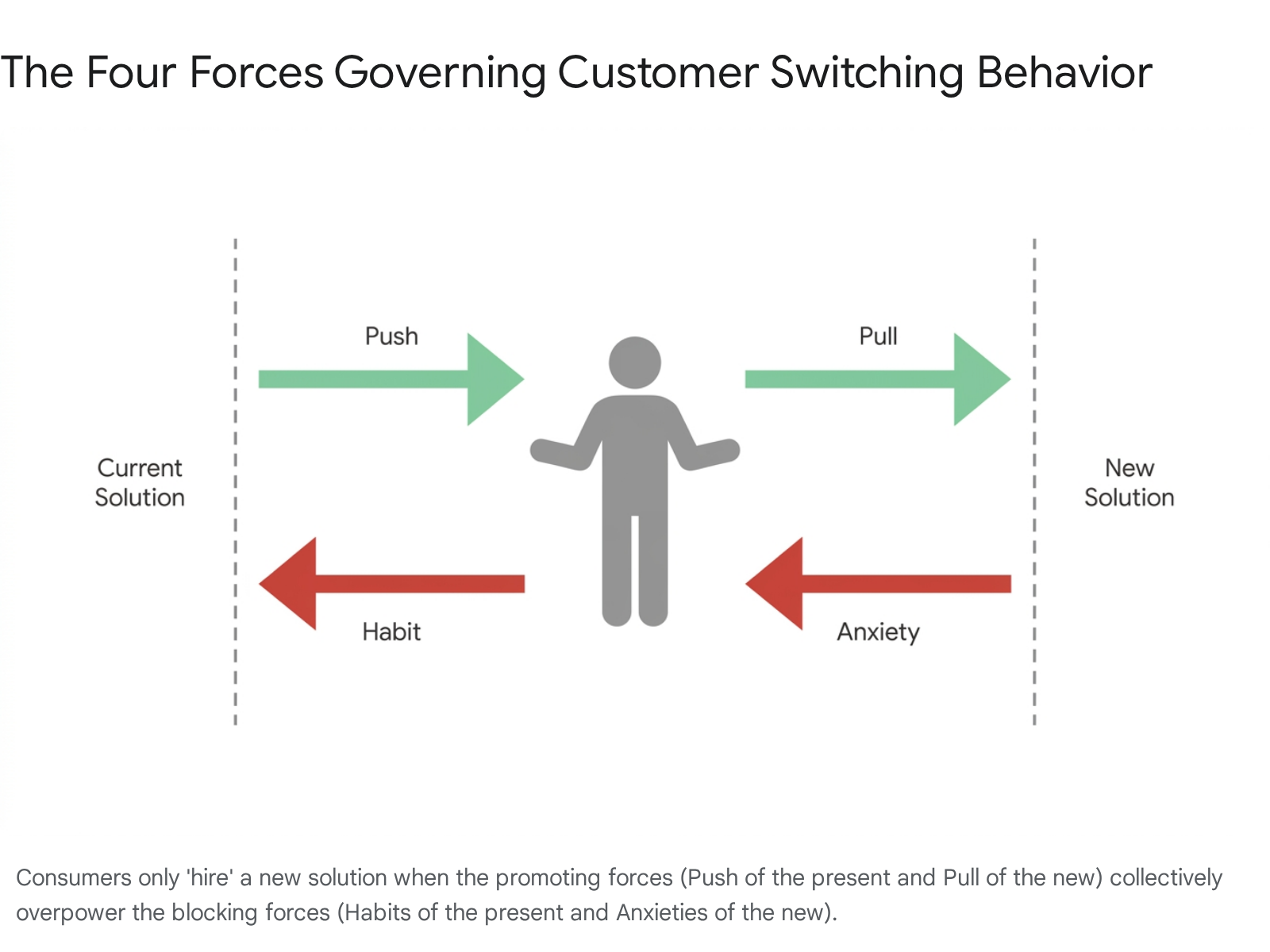
Promoting Forces
The promoting forces work together to generate the desire for change. They include:
- The Push of the Present: This is the pain, frustration, or limitation of the customer's current situation 82229. The "Push" acts as the engine of motivation; it represents the specific circumstances that create dissatisfaction 29. It is the "struggling moment" or the "straw that breaks the camel's back" that compels a consumer to actively seek alternatives 829.
- The Pull of the New: This represents the magnetism and allure of a better outcome 82229. The "Pull" is the promise of improved efficiency, elevated status, or a resolved struggle 829. It is the vision of a better life that directs the customer's motivation toward a specific new product or service 29.
Blocking Forces
The blocking forces work together to reduce demand, stalling adoption even when a superior product is available. They include:
- The Habit of the Present: This is the inertia of the status quo and the comfort found in familiarity 82930. Consumers are inherently resistant to change. Habit represents the comfort with existing workflows, the sunk costs of previous financial or emotional investments, and existing relationships 830.
- The Anxiety of the New: This encompasses all the fears, uncertainties, and perceived risks associated with adopting an unknown solution 82930. Anxiety forces include fears about hidden costs, implementation challenges, lack of self-efficacy (e.g., "Will I be able to learn this new interface?"), and the potential for post-purchase regret 830.
Traditional marketing strategies and persona designs over-index on amplifying the "Pull" through aggressive feature promotion and highlighting benefits 2830. The JTBD framework reveals that organizations must equally prioritize reducing "Anxiety" and breaking "Habits" to facilitate a switch 828. Providing money-back guarantees, seamless data migration tools, and frictionless onboarding are mechanisms specifically designed to neutralize the blocking forces 28.
Synthesis of Frameworks
Despite the theoretical friction between proponents of traditional personas and advocates of JTBD, contemporary product strategy increasingly relies on a hybrid approach 131. Organizations recognize that while JTBD is superior for identifying unmet needs and guiding feature development, personas remain highly effective for dictating brand tone, orchestrating communication channels, and fostering organizational empathy 45. Industry leaders, including the Nielsen Norman Group, argue that treating JTBD and personas as mutually exclusive methodologies is a false dichotomy 1432. Instead, the most sophisticated organizations synthesize the two to create "Job Personas" or "JTBD-infused Personas" 13133.
Separating Decisions from Communication
The hybrid model succeeds by clearly delineating the operational purpose of each framework 2. JTBD is utilized strictly as a decision tool 2. Product teams use job statements, situational contexts, and outcome metrics to determine what to build, how to prioritize the roadmap, and how to measure feature success 25. It answers the fundamental question of why the product exists and what constitutes a successful user experience.
Conversely, personas are utilized as communication and delivery tools 2. Once the Job is defined and the features are prioritized, personas are layered on top to describe the distinct groups of people who share that Job 25. Personas dictate how to write marketing copy, what tone of voice to use in customer support scripts, and which advertising platforms to utilize based on demographic preferences 25.
| Framework Focus | Traditional Persona | Jobs to Be Done (JTBD) | Hybrid "Job Persona" |
|---|---|---|---|
| Primary Question Answered | Who is the customer? 16 | Why does the customer act? 16 | Who is the customer, and what progress do they seek? 1 |
| Data Foundation | Demographics, psychographics, behaviors 1. | Contexts, struggling moments, desired outcomes 12. | Job-based segmentation layered with audience profiling 131. |
| Core Utility | Storytelling, marketing channel selection, empathy building 24. | Product roadmapping, prioritizing features, defining success metrics 25. | Aligning both product strategy and targeted marketing messaging 11331. |
| Evolution Over Time | Static; decays rapidly as trends shift 1. | Stable; jobs remain constant despite technological changes 43. | Dynamic; demographic outreach shifts while the core job remains stable 131. |
Constructing the Hybrid Framework
Creating a JTBD-infused persona requires reversing the traditional market research sequence. Rather than starting with demographic segmentation, organizations first segment their market based on the Jobs customers are trying to accomplish and the context in which those jobs arise 114. For example, a B2B project management software company might identify a core segment based on the job: "Streamlining cross-departmental financial reporting without administrative burden" 133.
Only after this job-based segment is established does the organization layer in demographic, psychographic, and behavioral profiling 131. This process ensures that the resulting persona - while still possessing a name, professional background, and preferred communication style - is anchored inextricably to a validated, causal motivation 14. This synthesis allows product developers to prioritize features based on the job, while marketing teams can tailor campaigns to the specific cultural and demographic nuances of the diverse audiences experiencing that same struggle 131.
Empirical Applications and Global Case Studies
The theoretical strength of the Jobs to Be Done framework is best validated through its execution in complex, real-world markets. Examining recent case studies across diverse geographies and industries reveals both the transformative power of the framework and the execution challenges inherent in its application.
The Stepstone Recruitment Transformation
A definitive example of organizational restructuring around JTBD is the 2024 case study of Stepstone, a global recruitment platform detailed in the Journal of Digital & Social Media Marketing 11. Faced with the limitations of a technology-driven, "inside-out" product development culture, Stepstone leveraged JTBD to shift toward a customer-centric, "outside-in" operational model 11.
The organization executed a rigorous research protocol. They conducted over 50 deep qualitative interviews to uncover the fundamental Jobs of job seekers, followed by a large-scale quantitative survey of over 9,000 users in the UK and Germany 11. This survey quantified unmet needs using over 200 specific "job metrics" (the criteria users employ to evaluate success) 11. By mapping importance against fulfillment, the company generated "Fever Curves" to identify the largest gaps in the market, which represented the best opportunities for innovation 11.
To prevent the research from becoming an isolated report, Stepstone trained over 120 internal champions to run JTBD workshops, fundamentally altering the company's product discovery process 11. This data-driven, scaled approach directly resulted in the launch of targeted innovations, such as a Cover-Letter Generator and a Virtual Interviewer 11. The Virtual Interviewer achieved a Net Promoter Score (NPS) of 70, with 60% of users strongly agreeing they would use the tool repeatedly, demonstrating the high efficacy of aligning product features directly with quantified unmet outcomes 11.
Financial Technology and Telemigration in Africa
In emerging markets, JTBD is reshaping the deployment of financial technologies (Fintech) by addressing deep infrastructural voids rather than superficial consumer preferences. Research published by Harvard Business School in 2024 highlights how African Fintech firms are utilizing digital innovation to solve specific, highly friction-laden Jobs for unbanked populations and digital workers 1213.
A critical job for the modern African digital worker (the "telemigrant") is "receiving cross-border payments efficiently without losing capital to exorbitant fees" 13. Traditional correspondent banks fail at this job, levying transaction fees averaging 8.7% to 12.6% of the transaction value 13. Furthermore, correspondent banking relationships in Africa declined by 23% between 2011 and 2022 due to regulatory compliance costs, making the Job even harder to complete 13.
Fintech startups, rather than focusing purely on the demographics of the unbanked, focused on the specific Job of managing currency complexity 13. Solutions like Gigbanc rapidly acquired tens of thousands of users by providing a mechanism for African telemigrants to efficiently manage multiple currencies 13. Research estimates that a 50% reduction in payment frictions alone could generate between 900,000 and 1.1 million telemigrant employment opportunities across Africa 13. By focusing on the functional Job rather than standard consumer personas, targeted fintech innovation in Africa is projected to drive revenues to roughly $65 billion by 2030 12.
The Godrej ChotuKool Refrigeration Project
The development of the Godrej ChotuKool in India serves as a masterclass in using JTBD to discover non-consumers, while simultaneously highlighting the perils of misinterpreting the target audience's blocking forces 1439. Godrej, a massive Indian appliance manufacturer, recognized that over 80% of rural Indian households did not own a refrigerator due to high costs and unreliable electricity 1439.
Rather than simply building a cheaper, smaller version of a standard compressor refrigerator - which traditional demographic analysis might suggest - the Godrej team utilized JTBD observation to understand the specific struggle 1439. Through ethnographic research, they discovered the job was not "store a week's worth of groceries." Because rural consumers lived migratory lives and bought food daily, the actual job was "keep a small amount of milk and leftovers cool for one to two days" 1439.
This realization led to the creation of the ChotuKool: a highly portable, top-opening, battery-operable cooler using thermoelectric cooling chips rather than a traditional compressor 1439. While lauded as a triumph of disruptive innovation and awarded multiple design prizes, the product initially struggled with its target rural demographic 39. The JTBD framework's "Four Forces" reveals why: Godrej severely underestimated the "Habit of the Present" and the "Anxiety of the New." Rural consumers were perfectly content with their existing solutions, such as using clay pots and shopping daily . The Push to switch was simply not strong enough to overcome the Anxiety of spending $50 on a novel appliance 39. Ultimately, the product found massive success by pivoting to a different demographic with the exact same Job: urban, affluent professionals who "hired" the ChotuKool as a portable lifestyle cooler for their cars, dorm rooms, and offices 3915.
Critiques and Structural Limitations
While the Jobs to Be Done framework provides robust causal predictability, it is not without scholarly and practical critique. Recognizing the boundaries of the theory is essential for rigorous operational application 1642.
The Blind Spot of Identity and Cultural Signaling
The most significant limitation of the JTBD framework is its struggle to account for identity-based, aspirational, or pure luxury purchases 16. JTBD excels at explaining utilitarian progress, but it falters when the primary driver of a purchase is social signaling or alignment with personal values 16.
For instance, a consumer purchasing a high-end luxury sports car is technically fulfilling the functional job of "transporting oneself from point A to point B." However, the true motivation is heavily anchored in signaling status, success, and personal identity to a peer group 16. While advanced JTBD practitioners attempt to categorize this under "social jobs," the highly subjective, emotional, and irrational nature of identity projection resists the clean, process-oriented mapping that methodologies like ODI require 16. Furthermore, JTBD often fails to help companies differentiate their products technically; it identifies the unmet need, but it does not prescribe the physical design or aesthetic qualities that will win the market 16.
The Execution Gap and Resource Intensity
A second major critique lies in the operational friction of implementing the framework 1742. Unlike traditional personas, which can often be drafted in a few days using existing CRM demographic data and stakeholder intuition, a proper JTBD analysis requires rigorous, time-consuming qualitative interviews and complex quantitative surveys 1742.
If organizations conduct the research but fail to alter their internal operational structures to match the findings, the initiative inevitably stalls 42. Many companies gather profound data on customer Jobs but lack a clear action plan to translate those functional needs into product roadmaps, resulting in a reversion to feature-centric development 42. Success requires deep cross-functional alignment and leadership buy-in to ensure the insights fundamentally alter the product pipeline 42.
Artificial Intelligence and Synthetic Personas
The historical tension between the qualitative depth of the Jobs to Be Done framework and the quantitative scale of demographic personas is currently being resolved by advancements in Large Language Models (LLMs) and Artificial Intelligence 43444546. Throughout 2024, 2025, and into 2026, the market research industry has witnessed the rapid operationalization of "Synthetic Personas" or "Synthetic Audiences" 45171849.
The Mechanics of Synthetic Audiences
Synthetic personas are dynamic, AI-generated digital twins of a target audience 4450.
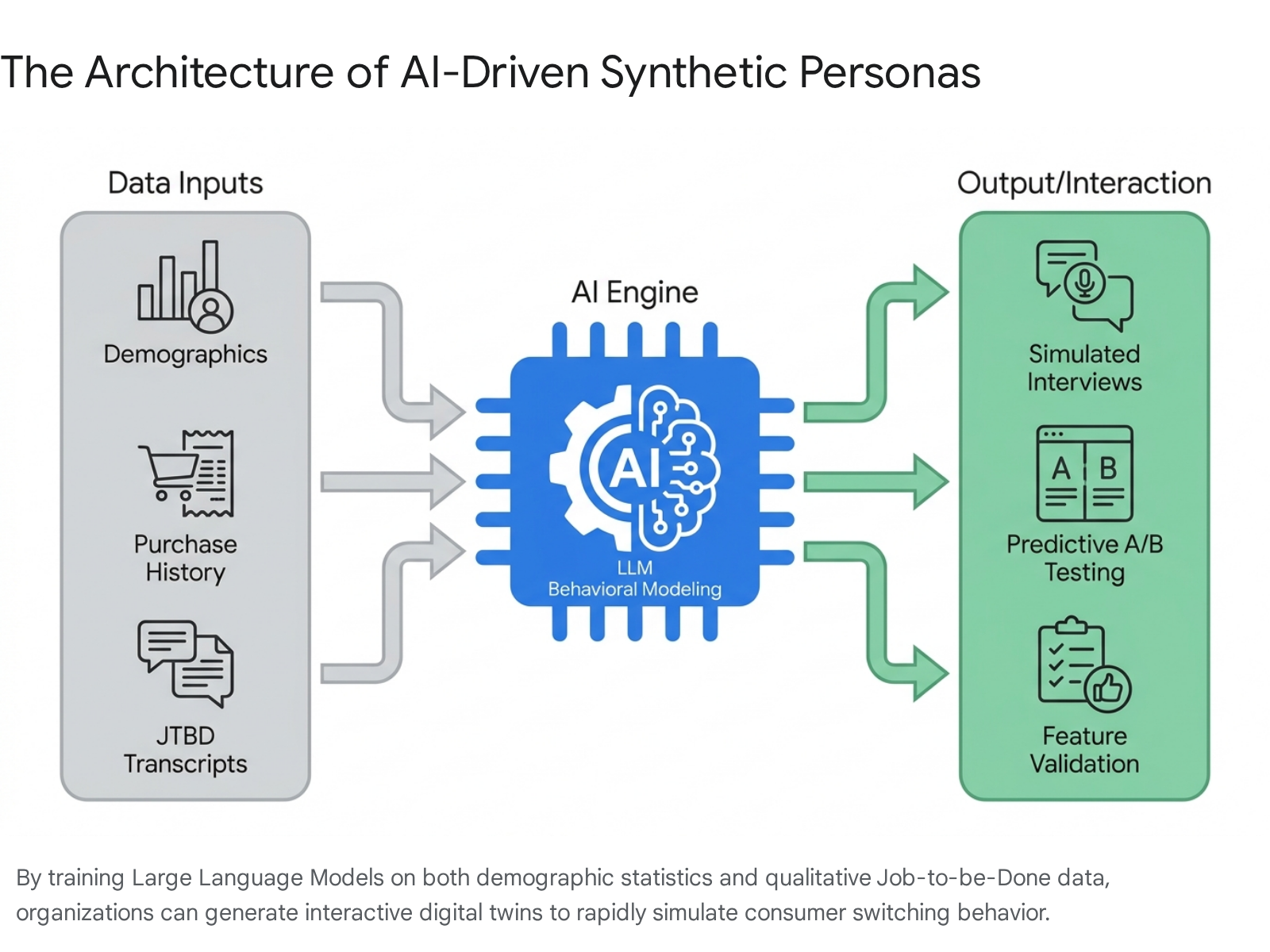
Rather than being static documents stored in a presentation deck, these models are trained on massive arrays of first-party and third-party data, including CRM records, historical survey responses, social media behavior, and qualitative interview transcripts 444950. By synthesizing this data, LLMs create virtual cohorts that possess the psychographic traits, purchasing habits, and emotional responses of real market segments 4449.
Unlike traditional personas, synthetic personas are interactive entities 4417. Product managers and marketers can interrogate these AI models in natural language, subjecting them to simulated interviews and focus groups 4450. Because they are grounded in vast datasets, these synthetic users can mimic human behavior and decision-making processes, identifying subtle pain points and desired outcomes that human researchers might overlook 1750.
Testing JTBD at Scale
The advent of synthetic personas directly addresses the primary critique of the JTBD framework: its immense resource intensity. Historically, identifying the Push, Pull, Habit, and Anxiety forces required weeks of labor-intensive "Switch" interviews 42051. Today, organizations can utilize autonomous AI agents to simulate these interviews instantly 4445. Researchers can ask synthetic personas about their struggling moments, their evaluation of competitive alternatives, and the specific metrics they use to judge a job's success 4950.
Crucially, these models allow for the instant, low-risk validation of product hypotheses 46. A product team can propose a new feature designed to solve an unmet Job and immediately run a simulation to see how a synthetic segment reacts to pricing changes, UX friction, or altered marketing messaging 46. Advanced evaluations of these systems have shown staggering results; in structured market testing, synthetic consumer data has achieved up to a 95% correlation with real human responses, reducing research costs by 70% and accelerating insight generation from months to hours 5219. A 2024 research paper by Google DeepMind and Stanford University reported building 1,052 generative agents using qualitative interviews, finding that the agents accurately matched human responses to the General Social Survey 20.
While researchers and practitioners emphasize that synthetic data should augment rather than entirely replace human engagement - particularly for highly unpredictable creative evaluations or sensitive social topics lacking empirical guardrails - the technology fundamentally alters the economics of market research 4420. It allows the rigorous, causal analysis demanded by the JTBD framework to be executed with the speed and scale previously reserved only for superficial demographic analysis, creating a competitive market advantage for organizations that successfully integrate these AI models 46205521.
Conclusion
The Jobs to Be Done framework dismantles the traditional reliance on demographic and psychographic personas by exposing a fundamental truth of commerce: consumers do not buy products because of their age, gender, or income; they hire products to make progress in specific circumstances. By replacing the individual consumer with the "Job" as the primary unit of segmentation, organizations can unlock a causal understanding of market dynamics that static profiles simply cannot provide.
Whether viewed through the qualitative lens of struggling moments and the Four Forces of Progress, or through the highly mathematical rigor of Outcome-Driven Innovation, JTBD forces organizations to adopt an outside-in, problem-centric methodology. While the framework historically presented severe execution challenges and required significant research investments, the emergence of hybrid "Job Personas" and AI-driven synthetic audiences has mitigated these constraints. By synthesizing behavioral causality with demographic context, and supercharging that synthesis with artificial intelligence, organizations can ensure that their innovation pipelines are aligned with the actual needs of the market, driving sustainable and predictable growth.