
Jobs to Be Done framework for product definition and competition
The landscape of product development and market strategy has historically been dominated by feature-centric paradigms and demographic segmentation. Organizations have traditionally defined products by their physical or digital attributes and analyzed competition through direct feature comparisons. The introduction of the Jobs to Be Done (JTBD) framework fundamentally disrupts these conventional methodologies. Originating from innovation research and popularized by academics and practitioners such as Clayton Christensen and Anthony Ulwick, the framework dictates that customers do not purchase products; rather, they "hire" them to make progress in specific, context-dependent circumstances 12334.
This research report provides an exhaustive analysis of how the Jobs to Be Done framework redefines the conceptualization of a product, alters the boundaries of competitive strategy, and drives modern software and enterprise innovation. It explores quantitative methodologies such as Outcome-Driven Innovation, behavioral models like the Four Forces of Progress, cross-cultural applications, and the limitations of the framework within luxury and identity-driven markets.
Theoretical Foundations of Jobs to Be Done
The Jobs to Be Done framework operates on the premise that human behavior is driven by a desire to achieve specific outcomes or resolve struggles in a given context 568. In this paradigm, a "job" represents the progress an individual or organization seeks to make. The framework explicitly separates the problem space (the job) from the solution space (the product or service) 78. Several core tenets underscore this theory, notably that people buy products to get a job done, that jobs are stable over time, and that success comes from making the job the fundamental unit of market analysis 78.
Dimensionality of Customer Jobs
A core principle of the framework is that jobs are rarely one-dimensional. To fully capture customer motivation, researchers categorize jobs into three interconnected dimensions. A product that successfully addresses the functional requirement but neglects the emotional or social dimensions often faces high churn rates or fails to achieve market penetration 12.
The first dimension is the functional job, which represents the practical, objective task a customer is trying to complete. Examples include transferring money, cutting a piece of wood in a straight line, or monitoring a patient's vital signs 113. The functional job is the focal point around which a market is defined.
The second dimension encompasses emotional jobs. This dimension explores how the customer wants to feel, or avoid feeling, while executing the functional task. Emotional jobs involve seeking peace of mind, feeling secure, maintaining personal confidence, or minimizing frustration 134. For example, a customer purchasing a complex financial software package is not just fulfilling the functional job of tracking revenue; they are fulfilling the emotional job of feeling in control of their business outcomes 314.
The third dimension involves social jobs, which dictate how the customer wants to be perceived by others during or after the execution of the task. This dimension encompasses status, professionalism, technological sophistication, or social belonging 181516. An individual purchasing a premium smartphone is fulfilling a functional job of communication, but they are simultaneously fulfilling a social job of appearing technologically advanced and socially relevant 1. Understanding the interplay of these three dimensions allows organizations to design holistic solutions that resonate with the end-user's deeper motivations 569.
Solution Agnosticism and Job Stability
A critical departure from traditional market research is the concept of solution agnosticism. The framework asserts that jobs are remarkably stable over time, while the solutions hired to complete them evolve rapidly due to technological advancement 781316. The underlying job of "listening to music on the go" has remained constant for decades. The solutions, however, have transitioned from portable radios to cassette players, to CD players, to MP3 players, and finally to streaming applications on smartphones 1318.
By defining markets around the stable job rather than the transient product, organizations can avoid the myopia that leads to technological disruption 1310. When a company views itself as a manufacturer of cassette players, it is highly vulnerable to digital disruption. When it views itself as a facilitator of portable audio entertainment, it is positioned to innovate and transition across technological epochs. This shift in perspective transforms product teams into genuine problem solvers rather than mere technology vendors 1316.
Methodologies for Identifying Customer Jobs
Translating abstract job statements into predictable product development requires rigorous methodological frameworks. While the concept of a "job" provides a philosophical foundation, practitioners rely on structured processes to deconstruct these jobs into actionable engineering and marketing requirements.
Outcome-Driven Innovation Methodology
Outcome-Driven Innovation (ODI) is a quantitative methodology developed by Anthony Ulwick that operationalizes the Jobs to Be Done theory. ODI relies on the principle that customers measure the successful execution of a job using specific, predictable metrics 131611. In this framework, customer needs are not vague preferences; they are defined as measurable outcomes.
Outcome statements in the ODI framework are constructed using a precise linguistic formula. Each statement includes a direction of improvement (e.g., minimize, maximize), a unit of measurement (e.g., time, likelihood, frequency), an object of control, and a specific contextual condition 18. For example, rather than a vague requirement like "make it faster," an outcome statement would be "minimize the time it takes to compare fares and finalize an itinerary when planning a trip" 16. A single core functional job may contain between 50 and 150 of these distinct outcome statements .
Once these outcomes are captured through qualitative research, the ODI process dictates a quantitative survey phase. A statistically valid population of target customers is surveyed to rate each outcome on two axes: its importance to the user, and the user's current level of satisfaction with existing solutions 1310. This data is used to calculate an "opportunity score." Outcomes that score high in importance but low in current satisfaction reveal underserved market segments and become the focal point for new product development 1023. Strategyn, the consulting firm behind ODI, claims this data-driven approach yields an 86% success rate in new product development, which they contrast with an estimated 17% industry average for traditional ideas-first innovation methodologies 13101213. While these precise figures are derived from proprietary internal studies covering 43 corporate clients rather than independent academic consensus, the principle of prioritizing unmet, measurable needs is widely integrated into modern product management practices 1213.
Job Mapping and Process Deconstruction
To accurately identify outcome metrics, practitioners employ a technique known as Job Mapping. A job map is fundamentally different from a traditional customer journey map or process map. While a journey map describes the chronological actions a customer takes with a specific company or product, a job map outlines the ideal, solution-agnostic steps required to execute the core functional job 813.
According to the universal job map framework, all jobs consist of eight fundamental steps. First, the user must define their objectives and plan the approach. Second, they must locate the necessary inputs or resources. Third, they prepare the environment or tools. Fourth, they confirm readiness. Fifth, they execute the core task. Sixth, they monitor progress and outcomes. Seventh, they make modifications if necessary. Finally, they conclude the job and resolve the process 813. By breaking a job down into these chronological phases, product teams can systematically identify where friction occurs and where users lack adequate tools, thereby uncovering opportunities for targeted innovation 81316.
Redefinition of Product Conceptualization
Under the Jobs to Be Done framework, the definition of a product shifts from a collection of technical specifications to a service mechanism designed to facilitate customer progress 2326. This transition requires organizations to rethink how they engineer features, measure success, and align internal teams.
Transition from Feature-Centric to Problem-Centric Design
Traditional product development frequently falls into the trap of feature saturation. In this paradigm, success is measured by the velocity of software delivery and the sheer volume of capabilities added to a platform, operating under the assumption that more features naturally equate to higher value 92714. The Jobs to Be Done framework enforces an outside-in perspective, stipulating that customers do not inherently desire features; they desire the outcomes those features enable 1215.
When a product is defined strictly as a vehicle for progress, feature prioritization is dictated entirely by the barriers preventing the customer from completing their job. If a proposed feature does not directly reduce the time, cost, or unpredictability of executing the core job, it is deemed extraneous, regardless of its technical sophistication 16. This lean, outcome-centric approach prevents product bloat and ensures that research and development resources are allocated exclusively to high-impact problem areas 214. Netflix provides a prominent example of this discipline; rather than chasing feature parity by adding live television or news broadcasts like its competitors, Netflix focused exclusively on features that aided content discovery and personalization, directly serving the core job of frictionless entertainment 14.
Comparison with Agile User Stories
In modern software development, the "User Story" is the standard mechanism for capturing requirements. Typically formatted as "As a [user type], I want to [perform action], so that [achieve benefit]," user stories are highly effective for tactical execution and sprint planning 93016. However, product strategists point out that user stories inherently embed assumptions about the solution, which can stifle true innovation 9.
For example, an educational technology company might write a user story stating, "As a student, I want to watch video lessons so that I can learn a new subject" 9. This phrasing artificially constrains the engineering and design teams by pre-supposing that video lessons are the optimal solution. A framework approach reframes this entirely: "When I am learning a new subject, I need a way to quickly grasp and retain key concepts so that I can apply them effectively" 9. This solution-agnostic framing opens the door to alternative, potentially superior solutions such as interactive assessments, AI-driven tutoring, or text-based summaries 9.
The optimal organizational workflow does not replace user stories with job statements; rather, it utilizes them sequentially. The differences in scope and application are outlined in the comparison below.
| Framework Characteristic | Jobs to Be Done Framework | Agile User Stories |
|---|---|---|
| Phase of Product Lifecycle | Early discovery, strategic planning, and market definition 63032. | Active design, development sprints, and tactical implementation 63032. |
| Core Orientation | Customer-centered and goal-oriented; examines the broader human context 632. | Product-centered and action-based; examines specific software interactions 632. |
| Level of Detail | High-level motivations, contexts, and desired progress metrics 6. | Granular interface interactions and specific functional requirements 630. |
| Solution Assumption | Strictly solution-agnostic to foster unconstrained innovation 716. | Inherently assumes a specific technological solution or interface element 916. |
By using the framework for the "What" and "Why" of product strategy, and user stories for the "How" of technical implementation, organizations bridge the gap between strategic intent and daily engineering output 63032.
Redefining Market Segmentation
Marketing and product strategies have historically relied on demographic segmentation (grouping users by age, gender, or income) and firmographic segmentation (grouping businesses by size or industry vertical) to identify target audiences 14162333. The Jobs to Be Done framework asserts that traditional segmentation methods are fundamentally flawed because they conflate correlation with causality 2326.
Limitations of Demographic and Firmographic Segmentation
The presence of a specific demographic trait does not cause a purchasing decision. Being a 35-year-old male in a specific income bracket does not inherently compel an individual to purchase a specific software product. Decisions are caused by the emergence of a struggle or a job that needs to be done 23. The framework asserts that segments should be defined by grouping customers who share the same unmet needs and prioritize the same desired outcomes, regardless of their demographic or firmographic profile 1523.
Relying on demographics creates an illusion of market order while masking internal heterogeneity. Two small-to-medium businesses within the same industry vertical might have vastly different priorities; one may prioritize rapid software integration, while another prioritizes aggressive cost reduction 23. Grouping them together based on their industry label dilutes product strategy and messaging 23. Furthermore, demographic profiles are static, whereas a single individual can migrate across different job-based segments depending on their immediate context .
Outcome-Based Market Segmentation
Outcome-based segmentation groups users according to the specific context that causes them to struggle with a job. A compelling historical illustration of this principle involves Motorola's mobile radio products division in the late 1990s. After years of segmenting their market by traditional industry verticals (such as utilities and public services), revenue growth stagnated due to massive behavioral variations within those verticals .
By applying outcome-based segmentation, Motorola realized the market was divided by situational context, not industry classification. One segment was defined by the need to communicate discreetly without being overheard, encompassing undercover police and private security personnel . A second segment was defined by the need for clear, uninterrupted communication in chaotic, life-threatening environments, encompassing firefighters and emergency medical responders . By optimizing radio hardware for these specific contextual jobs - adding specialized features for the underserved needs and stripping away extraneous components - Motorola successfully revitalized its product lines and achieved significant market growth .
Contexts Favoring Traditional Segmentation
Despite the predictive power of outcome-based grouping, traditional demographic and geographic segmentation methodologies are not entirely obsolete. Research and industry practice indicate that demographics remain superior or highly complementary in specific operational contexts. If a business is strictly location-dependent, such as a localized physical service, geographic segmentation takes precedence 17. Additionally, when executing targeted media buying and advertisement placement across digital networks, demographic and behavioral data are essential for operationalizing the broader job-based strategy 1718. Finally, in highly commoditized luxury markets where the product's value is explicitly tied to demographic exclusivity and societal signaling, demographic targeting remains a primary strategic lever 1737.
Competitive Strategy and Market Boundaries
Traditional competitive analysis relies on defining the market by rigid product categories and evaluating rivals through direct feature-by-feature comparison matrices 193940. The Jobs to Be Done framework fundamentally expands the definition of competition. If a product is hired to do a job, then the competition encompasses anything else the customer might hire to achieve the same progress, regardless of its technological architecture 51941.
Categorization of Broadened Competition
When viewing markets through a job-centric lens, competition is categorized by the degree to which an alternative addresses the desired outcome. This results in a broader, more accurate reflection of the threats and opportunities facing a product.
| Category of Competition | Definition and Market Mechanics | Industry Example |
|---|---|---|
| Direct Competition | Solutions that exist within the exact same product category and utilize identical technological methods to solve the user's problem 19. | Two distinct cloud-based project management SaaS platforms 1940. |
| Indirect Competition | Solutions that operate in entirely different industry categories but achieve the exact same functional goal for the consumer 19. | A subscription meal kit delivery service competing against a local grocery store 19. |
| Alternative Workarounds | Improvised, often manual approaches constructed by the user to solve the problem without adopting a dedicated commercial product 1939. | A complex network of interconnected spreadsheets used in place of a dedicated CRM system 1939. |
| Non-Consumption | The decision by the customer to do nothing, often because existing solutions are too complex, prohibitively expensive, or physically inaccessible 192043. | Rural populations lacking physical access to traditional banking infrastructure 2021. |
The Netflix Paradigm of Alternative Competition
A prominent cross-industry example of redefined competition is Netflix. Under traditional market analysis, Netflix's competitive set would be strictly limited to other premium video-on-demand services such as Hulu, Amazon Prime, and Disney+ 1445. However, Netflix's executive leadership, including Reed Hastings, explicitly adopted a broader perspective. By defining the customer's job as "relaxing and unwinding at the end of the day," Netflix recognized that its product competes against a finite amount of human leisure time 84546.
In this paradigm, the competition includes video games, reading, cooking dinner, socializing with friends, drinking wine, and crucially, human biology in the form of sleep 84546. This realization drove profound user experience innovations. By understanding that they were competing against the friction that might prompt a user to simply turn off the television and go to sleep, Netflix pioneered the auto-playing of the next episode and the release of entire seasons simultaneously (binge-watching) 46. This strategy effectively eliminated the decision-making friction between episodes, maximizing the capture of leisure time and cementing their early dominance in the streaming sector 4546.
Evaluation of Feature Comparison Matrices
Because the framework shifts the focal point from product attributes to customer progress, it severely undermines the utility of traditional feature comparison matrices in strategic planning 193940. Feature matrices operate under the false assumption that parity in functionality dictates parity in market success, reducing competitive strategy to a checklist exercise 4047.
This is frequently observed in enterprise software markets. For instance, two collaboration tools may possess identical technical features on paper - wikis, nested pages, and permission controls - yet one will dominate market share 40. The victor is rarely the platform with the longest feature checklist; it is the platform that reduces user friction, accelerates time-to-value, and addresses the emotional experience of the user 4047. A traditional analysis focuses exclusively on what the product has, whereas a job-centric competitive analysis focuses on what the customer actually achieves and how seamlessly they achieve it.
Psychology of Customer Switching Behavior
Understanding competitive dynamics requires understanding the underlying mechanics of how and why a customer transitions from a legacy solution to a new offering. Pioneered by researcher Bob Moesta, the "Four Forces of Progress" model maps the psychological, emotional, and practical vectors of a purchasing decision 484950.
The Four Forces of Progress Model
The model posits that switching behavior is governed by a tension between two enabling forces that promote change and two constraining forces that resist it 484950.
The first enabling force is the Push of the Current Situation. This encompasses the daily frustrations, struggles, and limitations of the customer's existing workaround or legacy product 4849. If the current solution is too expensive, unreliable, or outdated, this force repels the user away from the status quo. The second enabling force is the Pull of the New Solution. This represents the perceived benefits, the modern appeal, and the promised outcomes of the new product, acting as a magnet drawing the user toward adoption 4849.
Opposing these are the constraining forces. The first is the Habit of the Present. This force represents the profound inertia of existing behavior, the comfort of familiarity, and the emotional or financial sunk costs associated with the current way of doing things 4950. The second constraining force is the Anxiety of the New. This involves the fear of the unknown, the steep learning curve required to master a new tool, and the perceived risk that the new solution might fail, disrupt existing workflows, or result in lost data 4950.
For a company to successfully win competitive market share, the combined magnitude of the Push and Pull forces must significantly outweigh the Habit and Anxiety forces 4950.
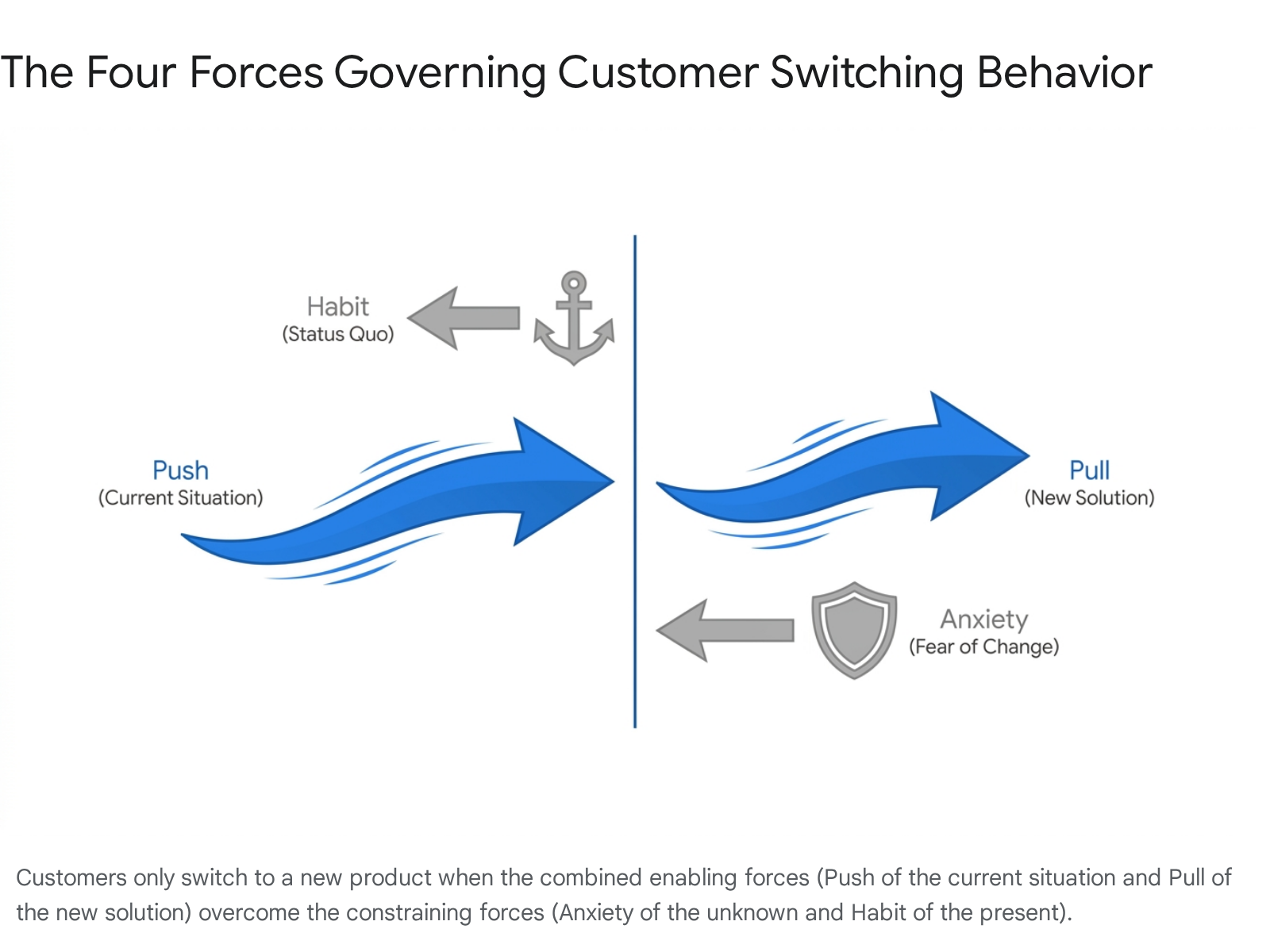
Many technologically superior products fail because product managers focus entirely on increasing the Pull - by adding more features to marketing materials - while entirely ignoring the profound Anxiety and Habit associated with enterprise software implementation or deep-seated consumer behaviors 4950.
Implementation of Switch Interviews
To accurately map these forces, practitioners utilize a qualitative research method known as the "Switch Interview." Unlike traditional focus groups or surveys that ask customers broad opinions or feature requests, a switch interview is a structured, narrative interrogation that reconstructs the precise timeline of a recent purchasing decision 484922.
The interviewer guides the customer from their first struggling moment, through passive and active searching, to the evaluation of alternatives, the exact moment of purchase, and into early product usage 49. Because human memory is anchored by recent events, focusing on a recent switch reveals the true causal mechanisms behind adoption. This timeline reconstruction routinely exposes hidden blockers, such as internal procurement anxieties or emotional triggers, that traditional usability testing completely misses 4950. By institutionalizing these interviews, organizations can transform fuzzy customer sentiment into reliable, actionable inputs for product design and sales enablement 4922.
Application in Emerging and Non-Western Markets
The efficacy of the framework is heavily reliant on an accurate understanding of the cultural, economic, and environmental context in which a job arises. When Western technology companies expand into emerging markets, assuming that jobs and success metrics are culturally universal often leads to severe strategic missteps 525323.
Financial Inclusion and Non-Consumption in Kenya
The launch of the mobile money service M-Pesa by Safaricom in Kenya in 2007 serves as a definitive case study of the framework applied in a developing economy. At the time, traditional banking institutions viewed the Kenyan market through a demographic lens. They saw an impoverished, highly rural population that lacked the capital necessary to justify the construction and maintenance of physical bank branches 21. They evaluated the market based on existing formal banking consumption and found it fundamentally unprofitable.
Safaricom, conversely, identified a massive, unaddressed job. Due to structural adjustment programs and shifting labor dynamics, there was a profound need for urban laborers to safely, cheaply, and reliably send money back to their unemployed relatives in rural villages 2124. Prior to M-Pesa, this job was accomplished through highly risky and informal workarounds, such as sending physical cash via bus drivers or relying on friends traveling to the same destination 2021.
M-Pesa solved this job by leveraging the existing, widespread infrastructure of mobile phones and local airtime resellers, entirely bypassing the need for physical bank branches 2024. By understanding that the core job was "secure, remote money transfer" rather than comprehensive wealth management, M-Pesa effectively captured a massive non-consumption market. To overcome the profound anxiety of trusting a digital system with vital funds, Safaricom leveraged its strong corporate telecommunications brand and ensured early adopters had immediate, flawless experiences 2021. The service eventually expanded to serve over 80% of Kenya's adult population, processing transactions equivalent to a significant portion of the nation's GDP and fundamentally altering the region's economic landscape 202456.
Ubiquitous Infrastructure and Super-Apps in Asia
In China and Southeast Asia, companies such as Tencent (WeChat), Alibaba (Alipay), and Grab utilized a job-centric approach to build "Super-Apps" that defy Western categorizations of standalone software 232526.
In the United States, early mobile payment initiatives struggled for rapid adoption because the existing solution - ubiquitous credit card infrastructure - served the functional job of transaction processing adequately well, resulting in high Habit forces and low Push forces 5326. In China, however, historical credit card penetration was remarkably low. The cash-based economy introduced massive friction, including counterfeit currency, lack of exact change, and physical security risks 2326. Alipay and WeChat Pay addressed the job of "trustworthy, frictionless exchange" by utilizing ubiquitous Quick Response (QR) codes. This approach required zero expensive point-of-sale hardware for street vendors and merchants, weaving digital payments seamlessly into the physical built environment 2326.
Similarly, Grab evolved from a simple ride-hailing application into a comprehensive digital ecosystem across Southeast Asia by identifying adjacent jobs within the same geographic constraints. Once Grab established a trusted digital wallet to solve the initial friction of paying drivers, it rapidly expanded to address food delivery, logistics, and micro-financial services, aligning its product roadmap directly with the localized, everyday challenges of its user base 25.
Cultural Misalignment and Market Entry Failures
Conversely, ignoring the deep cultural context of a job invariably leads to market failure. When the American cereal brand Kellogg's initially entered the Indian market, they attempted to sell cold, sweet cereals based on the Western functional job of "preparing a quick, convenient morning meal" 52.
However, the cultural context of an Indian breakfast is fundamentally different; it is traditionally a hot, savory, and substantial family meal 52. The job of serving breakfast in India involves deep social and emotional dimensions related to family care and tradition that a cold bowl of processed cereal completely failed to satisfy 52. Kellogg's marketing campaigns, which positioned the product as a premium Western offering, ignored the price-sensitivity and the true nature of the morning routine. To achieve eventual success, the company had to completely overhaul its strategy and product offerings to align with the local cultural interpretation of the job 52.
Transformation of Artificial Intelligence Software
As the global technology sector navigates the rapid expansion of artificial intelligence throughout 2024 - 2026, the framework is increasingly vital for distinguishing sustainable, high-value AI products from transient technological novelties 59276162.
Problem-First Artificial Intelligence Integration
During the initial wave of generative artificial intelligence, many SaaS companies adopted a technology-first approach. They appended generalized Large Language Models (LLMs) to their platforms without a clear strategic mandate, driven primarily by market hype 276162. This approach frequently resulted in "feature shock," where users were presented with open-ended chat interfaces but lacked a specific, urgent reason to integrate them into their daily workflows.
Current industry analysis indicates that the most successful AI implementations are those strictly governed by a problem-first, job-centric mindset 275963. Instead of deploying artificial intelligence for the sake of technological demonstration, mature organizations are targeting precise, high-friction workflows. A prime example is the Amazon Kindle platform, which introduced an AI-generated contextual recap feature 63. The underlying job for the user is not "read an AI summary"; the actual job is "regain narrative continuity when picking up a book series after a long hiatus" 63. The artificial intelligence operates quietly in the background, appearing contextually and requiring no prompt engineering from the user, thereby solving the job without interrupting the core reading experience 63.
Artificial Intelligence as an Automation of Whole Workflows
Artificial intelligence is fundamentally altering competitive boundaries by automating entire job workflows rather than simply facilitating individual tasks 6465. For instance, in software engineering, tools such as GitHub Copilot are now hired to do the job of "writing boilerplate code and basic test cases," directly competing with the traditional allocation of junior developer hours 646566.
In customer service and operations, AI agents are hired to definitively resolve first-line inquiries. This transforms the organizational unit of analysis from measuring the "productivity of the human support agent" to measuring the "end-to-end autonomous resolution of the customer's problem" 6265. As artificial intelligence absorbs these repetitive, rule-based jobs, human professionals must transition to roles that emphasize strategic oversight, complex judgment, and system design - tasks that cannot yet be fully automated 6768.
Furthermore, product managers and researchers are increasingly utilizing artificial intelligence to scale the discovery methodology itself. Advanced generative tools are being deployed to ingest and synthesize massive volumes of qualitative Voice of the Customer (VOC) data, identifying emergent themes and drafting outcome statements at unprecedented speeds 6970. However, researchers emphasize that while AI excels at rapid pattern recognition and data structuring, the nuanced extraction of deeply emotional and social jobs still requires significant human calibration, ethical oversight, and analytical judgment 7028.
Academic Critiques and Implementation Challenges
Despite its widespread commercial adoption and pedagogical presence in institutions like Harvard Business School, the framework is subject to academic critique. It possesses defined limitations that organizations must recognize to prevent strategic overreach.
Limitations in Luxury and Identity-Driven Markets
A primary critique of the methodology is its heavy focus on functional progress and rational problem-solving, which often fails to adequately capture the deep, identity-based needs that drive consumption in luxury and brand-driven markets 12.
While the framework acknowledges "social jobs," consumer psychology researchers argue that purchasing a luxury vehicle, haute couture fashion, or high-end art is not merely about signaling status - which can be classified as a job - but about an intrinsic, highly abstract expression of self-identity and alignment with brand heritage 12. In these scenarios, the emotional associations and subconscious cues triggered by brand equity operate largely outside the rational, outcome-oriented boundaries of the framework 1272. Consequently, relying exclusively on outcome-driven metrics in luxury sectors can inadvertently lead to the commoditization of the brand, as the framework struggles to quantify the irrational premium placed on history and prestige.
Perspectives from Innovation Management Literature
Within academic literature, particularly in journals such as the Journal of Product Innovation Management, highly structured implementations of innovation frameworks are occasionally criticized for lacking organizational agility 293031. In Highly Volatile, Uncertain, Complex, and Ambiguous (VUCA) environments, dedicating extensive time to capturing, mapping, and statistically weighting every theoretical outcome before initiating development can severely delay time-to-market 30.
Critics argue that while deeply understanding the job is undeniably essential, the rapid, iterative prototyping of solutions and continuous market feedback loops - as seen in Lean Startup methodologies - are necessary to navigate modern digital ecosystems where customer expectations are actively reshaped by emerging technologies 1030. The consensus suggests that outcome-driven methodologies are most effective when hybridized with agile execution models, preventing the framework from devolving into an overly rigid, waterfall-style planning phase 3032.
Organizational Friction and Cross-Functional Alignment
In practical application, the failure of the framework within a corporation is rarely due to theoretical flaws, but rather to systemic organizational implementation failures 33. Research initiatives often generate profound insights that remain tragically siloed within research, design, or marketing departments. When product engineering teams continue to be evaluated and compensated based on feature delivery velocity rather than outcome achievement, the insights are ultimately discarded in favor of executing pre-existing, technology-driven roadmaps 2933.
Furthermore, establishing a shared corporate language is notoriously difficult. The specific terminology of "jobs," "desired outcomes," and "forces of progress" must be aggressively reinforced by executive leadership. Without a clear action plan that explicitly connects qualitative job statements to quantitative Key Performance Indicators (KPIs) and cross-functional departmental objectives, the initiatives frequently devolve into interesting academic exercises that yield no tangible commercial value or growth 33. Executive buy-in is paramount; leaders must view the framework not as an isolated research project, but as the foundational architecture for the company's broader innovation and revenue strategy 33.