
Is the Loneliness Epidemic Actually Getting Worse
Loneliness is a profound, subjective feeling of disconnection that currently affects roughly half of U.S. adults and carries severe health risks comparable to smoking a dozen cigarettes a day. While the "epidemic" label correctly highlights a massive public health crisis, historical data suggests that overall rates of loneliness have evolved more gradually than the dramatic term implies. However, the demographics of isolation have shifted significantly, with Generation Z and young adults now reporting unprecedented levels of chronic loneliness compared to older generations.
What Is the Difference Between Loneliness and Social Isolation?
In public discussions about social health, the terms "loneliness" and "social isolation" are frequently used interchangeably. However, researchers, psychologists, and global health organizations draw a strict distinction between the two concepts. Understanding this difference is critical for evaluating whether society is genuinely becoming more disconnected and how to treat the problem.
Social isolation is an objective, measurable state that describes a person's level of social contact 112. It refers to the physical reality of having very few social relationships, minimal interaction with others, and a lack of integration into a community 13. A person living alone in a remote area, working entirely from home, and rarely speaking to neighbors is socially isolated. This state can be quantified by looking at the size of a person's social network and the frequency of their interactions 4.
Loneliness, by contrast, is a purely subjective emotion. It is defined as the distressing feeling that arises from a perceived gap between a person's desired level of social connection and their actual level of connection 145. Loneliness is a measure of the perceived quality and depth of relationships, rather than the raw quantity. A person can live with multiple roommates, possess a large social media following, and work in a bustling office environment, yet still feel intensely lonely because their interactions lack meaning, vulnerability, or a true sense of belonging 11. Conversely, an individual might live entirely alone, have only two close friends, and never experience a pang of loneliness because those few connections fully satisfy their emotional needs 34.
While the two states often overlap - prolonged social isolation frequently breeds loneliness, and chronic loneliness can cause individuals to withdraw further into isolation - they do not always move in tandem 24. People can experience different levels of social isolation and loneliness over their lifetime, moving in and out of these states as their personal circumstances change 24. In 2025, the World Health Organization (WHO) explicitly separated the two in its landmark global report, noting that while an individual might occasionally choose isolation for downtime or reflection, loneliness is never a desired state 245.
The Health Toll: Why Is It Called an Epidemic?
The term "loneliness epidemic" gained significant mainstream traction following a 2023 advisory from U.S. Surgeon General Dr. Vivek Murthy, who elevated the issue to a national public health crisis 678. The advisory noted that approximately half of U.S. adults experience loneliness, and the biological consequences of this disconnection are catastrophic for both individual longevity and the healthcare system 68.
The Biological Mechanism of Loneliness
Humans are evolutionarily wired for social connection. For early humans, being separated from the tribe meant a drastically increased risk of starvation or predation. Consequently, the human brain developed a pain response to isolation - loneliness - that is as primal and urgent as hunger or thirst 67. It is a biological signal designed to force an individual to seek out the safety of a group.
When modern social needs are unmet, the body remains in a state of chronic stress. Emotional pain activates the exact same stress responses in the body as physical pain 3. This elevated stress response produces cortisol, increases blood pressure, and triggers persistent inflammation 59. Over years and decades, this biological wear and tear wreaks havoc on the cardiovascular and neurological systems.
Quantifying the Physical Risks
The statistics surrounding the physical toll of loneliness are staggering, leading the medical community to treat it as a hazard on par with major substance abuse or metabolic disorders. Research equates the mortality risk of severe social isolation and loneliness to smoking up to 15 cigarettes a day 6811. Furthermore, chronic loneliness and isolation have been linked to a cascade of severe health outcomes: * A 50% increased risk of developing dementia 9. * A 31% independent increase in overall dementia risk, a 14% increase in Alzheimer's risk, and a 17% increase in vascular dementia risk, even after controlling for depression and objective social isolation 12. * A 29% higher risk of heart disease and a 32% higher risk of stroke 9. * Dramatically elevated rates of anxiety, depression, and premature death from all causes 1011.
A Global Crisis with Economic Consequences
This is not merely an American crisis. In June 2025, the WHO Commission on Social Connection released its flagship report, revealing that one in six people worldwide (approximately 17%) experience loneliness on a regular basis 51213. The WHO estimates that loneliness is responsible for roughly 871,000 deaths annually - amounting to nearly 100 deaths every single hour 1217.
Economically, the cost of lost productivity, increased healthcare utilization, emergency department visits, and long-term care demands is immense. Current estimates suggest that loneliness and isolation cost the U.S. economy around $400 billion annually, and account for up to 1.2% of the Gross Domestic Product (GDP) in countries like Spain 1214.
Who Is Feeling the Loneliest Today?
Historically, the prevailing cultural image of loneliness has been an elderly person living alone. While seniors are at an exceptionally high risk for the severe physical health consequences of objective social isolation - often driven by the loss of a spouse, mobility issues, sensory impairment, or cognitive decline - the subjective feeling of emotional loneliness is now heavily concentrated in the young 315.
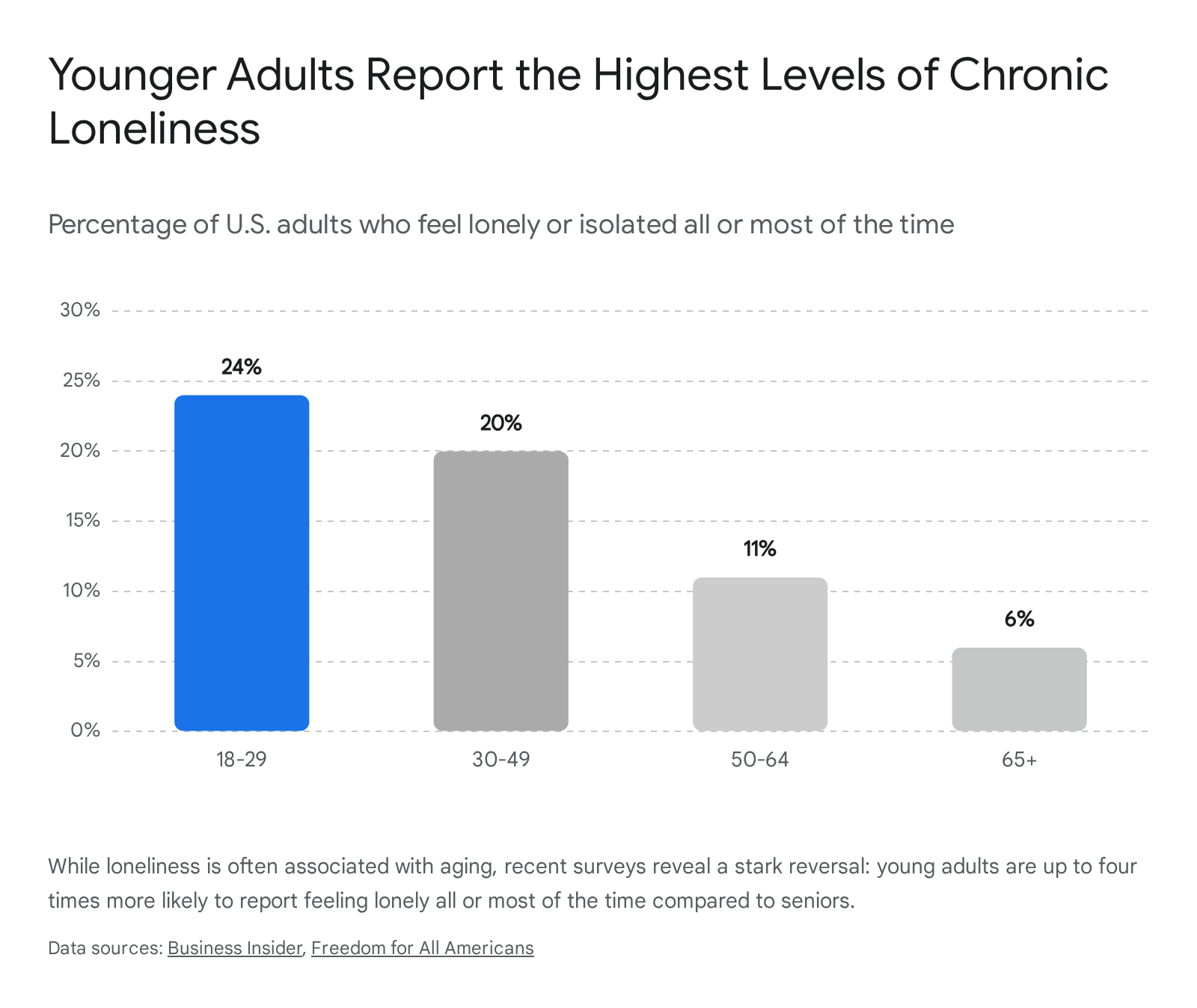
Generation Z (born roughly 1997 - 2012) and young Millennials have emerged as the loneliest generations in modern history 1621. Despite being "digital natives" who are constantly connected via smartphones, instant messaging, and social platforms, this hyper-connectivity often provides an illusion of closeness without the interpersonal depth required to satisfy human social needs 162217.
Multiple major health surveys consistently demonstrate this inverse relationship between age and loneliness. Below is a comparison of two recent major studies measuring the prevalence of loneliness across different age cohorts in the United States.
| Demographic Cohort | Cigna "Loneliness in America" (2025) 1621 | Pew Research Center (2024/2025) 2124 |
|---|---|---|
| Gen Z / Young Adults (18 - 29) | 67% classified as lonely | 24% feel lonely "all or most of the time" |
| Millennials / Adults (30 - 49) | 65% classified as lonely | 20% feel lonely "all or most of the time" |
| Gen X / Middle-Aged (50 - 64) | 60% classified as lonely | 11% feel lonely "all or most of the time" |
| Baby Boomers / Seniors (65+) | 44% classified as lonely | 6% feel lonely "all or most of the time" |
(Note: Differences in absolute percentages stem from differing survey methodologies; Cigna classifies overall loneliness based on a broader index of social connection, while Pew asks respondents to self-report feeling lonely "all or most of the time" as a strict measure of chronic isolation.)
Nuances in Demographics
While age is a major factor, loneliness does not spread evenly. Other highly vulnerable demographics include: * Caregivers: Unpaid caregivers, particularly those under the age of 45 caring for children or disabled adults, report exceptionally high rates of loneliness (72%), often due to the isolating nature of their daily responsibilities 1122. * Single and Unpartnered Adults: Eight percent of married Americans report feeling lonely all of the time, compared to a staggering 24% of those who are unpartnered 24. * Low-Income and Marginalized Groups: Financial strain limits opportunities for social engagement. In the U.S., individuals with household incomes below $60,000 are significantly more likely to experience loneliness than wealthier cohorts 1118. Furthermore, adults navigating multiple racial identities or belonging to the LGBTQ+ community frequently report higher levels of social disconnection 919.
Geography also plays a role in how loneliness manifests. For instance, a cross-national study comparing data from Europe, North America, and the Middle East found that the United States and the Netherlands were entirely unique in that middle-aged adults actually reported higher levels of loneliness than both adolescents and the elderly 20. In the U.S., this middle-aged loneliness spike was primarily driven by unemployment, poor health, and being unmarried during peak earning years 20. However, looking broadly across the globe, the WHO maintains that adolescents and young adults generally bear the highest burden of loneliness worldwide, especially in lower-income nations 512.
Is the Epidemic Actually Getting Worse Over Time?
The phrase "loneliness epidemic" implies a sudden, exponential outbreak - a modern crisis uniquely born of the 21st century. But is the modern world actually causing a massive, unprecedented spike in loneliness, or are we simply paying more attention to an ancient human condition?
The data presents a highly complex picture, and researchers fiercely debate the historical trajectory of the crisis.
The Objective Rise in Isolation
There is no question that the objective, structural fabric of society has changed. Over the past 60 years, the number of single-person households has doubled 67. Historical records tracking inhabitants across villages and cities in wealthy nations show that the prevalence of people living alone today is entirely unprecedented 21. In the early modern period through the 19th century, single-person households typically remained below 10%; today, in cities like Stockholm, nearly 60% of households consist of one person 21.
Furthermore, the nature of daily social interaction has thinned. Americans spent about 20 minutes a day interacting in person with friends in 2020, down drastically from 60 minutes a day nearly two decades earlier 6. Sociological studies utilizing the General Social Survey (GSS) have tracked a decline in "core discussion networks." Between 1985 and 2004, the average number of close confidants with whom Americans discussed important matters fell from 2.94 to 2.08, while the percentage of people reporting having zero close confidants nearly tripled to 25% 22.
The Academic Debate Over Subjective Loneliness
However, because living alone does not strictly dictate feeling lonely, the subjective data regarding a "spike" in loneliness is highly contested by sociologists and psychologists 21.
A highly publicized 2023 study by Kannan and Veazie analyzed the American Time Use Survey and claimed a sharp, alarming rise in social isolation between 2003 and 2020. Yet, when six independent research teams reanalyzed the exact same dataset, they found a very different story. The reanalysis revealed that the original study used deceptive visualizations with truncated Y-axes that visually exaggerated modest changes 23. The independent teams found that time spent alone between 2003 and 2019 increased by only about 24 minutes per day - an 8.4% increase over 17 years. The researchers argued this incredibly small effect size hardly justifies the alarmist "epidemic" framing, suggesting instead a slow evolution in social patterns rather than a sudden crisis 23.
Furthermore, historical data utilizing the gold-standard UCLA Loneliness Scale challenges the narrative of a continuous upward spike. The UCLA scale, developed in 1978, is the most widely used measure of loneliness in the world 24. Studies tracking American high school and college students across 48 samples from 1978 to 2012 actually found that subjective loneliness declined slightly over those decades 2526.
The Pandemic Shock and Global Trajectories
The COVID-19 lockdowns undoubtedly caused a massive, acute spike in loneliness that skewed recent data. Research indicated loneliness increased by 181% during the first wave of the pandemic as schools and workplaces abruptly shut their doors, severing daily community ties 634. Yet, recent longitudinal data suggests a societal recovery is underway. By 2024, feelings of social isolation among older adults aged 50 to 80 had declined steadily from their pandemic peak (56%), largely returning to pre-pandemic baselines (around 33%) 1827. The grim caveat is that this pre-pandemic baseline was already deeply problematic, meaning the crisis is chronic rather than acute 18.
While the U.S. debates the steepness of its trendlines, other nations show clearer historical shifts. A massive 2024 cross-temporal meta-analysis in Japan examined 81 peer-reviewed studies encompassing nearly 50,000 participants from 1983 to 2023 28. Using the UCLA Loneliness Scale, the researchers found a significant, steady increase in loneliness levels over the past 40 years 2829. This rise completely covaried with the growth of single-person households, declining marriage rates, and the rapid proliferation of internet use 2829.
What Is Causing the Modern Disconnection?
If loneliness is so widespread, what societal shifts are driving it? Researchers point to a confluence of technological, economic, and cultural factors that have fundamentally altered how humans interact.
The Social Media Paradox
It is a bitter irony that the most technologically connected generations in history are also the loneliest. While social media platforms offer the promise of global connection, they frequently deliver the opposite. Passive consumption of highly curated highlight reels amplifies feelings of inadequacy, exclusion, and social anxiety 1130. Social media often facilitates superficial connections that fail to provide the deep, meaningful interactions that humans crave 17. Furthermore, time spent scrolling online directly displaces hours that previous generations spent engaging in face-to-face, in-person interactions, which are biologically necessary for emotional regulation 6.
Delayed Milestones and Changing Family Dynamics
Traditional buffers against loneliness are occurring later in life, or not at all. With 86% of 18- to 24-year-olds unpartnered as of 2023, and young adults marrying increasingly later, a primary source of built-in companionship is absent for most of Generation Z 2439. Concurrently, societal emphasis on individualism, career mobility, and competition has led to individuals living further away from their extended families and childhood communities 17.
The Erosion of "Third Places" and Workplace Camaraderie
Sociologists frequently point to the decline of the "third place" - environments outside of home (the first place) and work (the second place) where people can gather informally, such as civic clubs, religious institutions, public parks, and neighborhood cafes 16. Over the past few decades, participation in community organizations and worship houses has steadily dropped 6.
Additionally, the rise of remote work has eroded workplace camaraderie. While offering unprecedented flexibility, working from home has replaced casual watercooler chats with highly scheduled, transactional video calls, eliminating the micro-interactions that historically anchored daily social life 711.
Global Government Responses and Solutions
Because loneliness has deep structural roots in urban design, digital communication, and macroeconomic trends, public health officials increasingly agree that individual therapy is insufficient. Systemic, community-level interventions are required, prompting several nations to codify loneliness as a matter of state policy.
The United Kingdom's Pioneering Strategy
The United Kingdom was the first nation to formally recognize loneliness as a structural issue, launching the world's first cross-government loneliness strategy and appointing a Minister for Loneliness in 2018 3132. Since its inception, the UK has invested nearly £80 million into tackling the crisis 32. This includes the "Know Your Neighbourhood Fund" to boost volunteering in disadvantaged areas, funding for community hubs, and national communications campaigns aimed at reducing the stigma surrounding loneliness 3233.
However, policy evaluation remains difficult. Critics in 2025 noted that early UK interventions heavily favored older demographics, prompting calls for a renewed 2025 strategy focused heavily on funding interventions for young adults under 34, embedding social connection into the national school curriculum, and encouraging businesses to prioritize workplace connection 43.
Japan's Comprehensive Legislation and the Hikikomori Crisis
Japan followed suit, deeply concerned by the uniquely Japanese phenomenon of hikikomori - an estimated 1.46 million individuals (roughly 2% of the population) who severely withdraw from society, staying in their homes for months or years at a time 14.
In April 2024, Japan enacted the Loneliness and Isolation Countermeasures Promotion Act, becoming the first country to pass a comprehensive law explicitly targeting loneliness across its entire population 1744. The act mandates that the national government create priority plans and urges local municipalities to establish regional support councils 34.
Despite the pioneering legal framework, early evaluations in 2025 and 2026 revealed significant hurdles. Only a tiny fraction (0.6%) of Japan's 1,741 municipalities had actually established the required regional councils, largely due to a lack of dedicated budget 44. Furthermore, national loneliness rates remained stubbornly flat at 39.3% a year after the law took effect, underscoring how difficult it is to legislate human connection from the top down 1744.
Does Social Prescribing Actually Work?
Within the healthcare sector, one of the most promising and rapidly expanding interventions is known as "social prescribing." Rather than treating the anxiety, depression, or physical ailments caused by loneliness with only pharmaceuticals, primary care doctors and dedicated "link workers" prescribe community-based activities 354748. A patient might receive a formal prescription to join a local choir, participate in a nature walking group, take art classes, or volunteer at an animal shelter 4836.
Social prescribing goes beyond the traditional biomedical model by addressing the social determinants of health directly 4837. By centering the patient's lived experience and non-medical needs, it shifts the focus from curative care to health promotion and community resilience 4837.
The early evidence for social prescribing is highly encouraging: * Improved Patient Well-being: Systematic reviews indicate positive individual impacts, with some programs reporting that up to 69% of participants felt less lonely after engagement 37. * Clinical Trial Success: A 2024 controlled evaluation found that over an 8-week period, socially prescribed participants showed statistically significant improvements in loneliness, psychological distress, and social trust compared to a control group receiving standard care 36. * Reduced Healthcare Strain: Loneliness drives massive healthcare utilization, as isolated individuals frequently visit doctors seeking baseline human interaction. Evaluations have shown social prescribing can reduce emergency department visits by up to 14% and significantly lower the frequency of general practitioner and social worker contacts 4837.
Despite the optimism, researchers offer a crucial caveat: social prescribing relies entirely on the existence of a robust, well-funded community infrastructure. You cannot socially prescribe a community garden, an arts program, or a senior fitness class if local funding for those programs has been cut or if the patient lacks the transportation to get there 1548. The success of social prescribing is inherently contingent on the health of the local community 48.
Bottom line
Loneliness is a profound public health threat that damages physical health, cardiovascular function, and cognitive longevity as severely as chronic smoking or obesity. While historical data suggests that the overall societal prevalence of loneliness has evolved gradually rather than erupting overnight, the burden has fundamentally shifted, concentrating heavily on Generation Z and young adults navigating a digitally hyper-connected but physically isolated world. Solving this crisis will require moving beyond individual blame and medicalization, treating social connection as a critical piece of public infrastructure through targeted investments in community spaces, social prescribing, and policies that foster in-person relationships.