
Does Social Substitution Actually Reduce Loneliness
Social substitution behaviors, such as forming parasocial bonds with digital creators or interacting with AI companions, represent the psychological immune system's attempt to fulfill the fundamental human need to belong when traditional reciprocal relationships are unavailable. While these digital surrogates can provide temporary emotional regulation and mitigate acute feelings of isolation, overreliance on them fundamentally fails to satisfy the neurological requirement for mutual vulnerability, frequently exacerbating chronic loneliness over time.
Consider this: turning to a favorite podcast host, an engaging influencer, or a deeply empathetic AI chatbot when you feel isolated might offer the immediate comfort of a friendly voice, but if this becomes your primary social diet, it can quietly starve your brain of the authentic, messy human reciprocity it actually needs to thrive.
What is Social Substitution?
To understand how modern media consumption intersects with human isolation, one must first examine the evolutionary and psychological architecture of loneliness. Loneliness is not merely the objective state of being alone or socially isolated; rather, it is the distressing cognitive discrepancy between an individual's desired social interactions and their actual relational reality 123. Evolutionary theory posits that acute loneliness evolved much like physical pain, hunger, or thirst - as an essential biological alarm system 4. Just as physical pain signals tissue damage and prompts a withdrawal from danger, loneliness signals social disconnection 4. Functional imaging studies reveal that social rejection and isolation activate the exact same brain regions as physical pain, most notably the dorsal anterior cingulate cortex 5. From a survival perspective, this mechanism prompted early humans to seek out the safety of the group, ensuring genetic survival and collective action 45. The physiological toll of chronic loneliness is consequently severe; a meta-analysis of 148 studies demonstrated that individuals with strong social relationships possess a 50 percent increased likelihood of survival over time, an effect size comparable to quitting smoking 5.
The psychological framework governing how humans respond to this distress is rooted in the "need to belong," a fundamental human motivation articulated in the foundational 1995 belongingness hypothesis by psychologists Roy Baumeister and Mark Leary 67. According to this framework, humans require frequent, non-aversive interactions within ongoing, stable relational bonds 68. The belongingness hypothesis operates on several core principles, two of which are satiation and substitution. Satiation refers to the phenomenon where, once individuals reach a minimum threshold of high-quality social contacts, their motivation to seek new relationships diminishes 9. Substitution, conversely, dictates that when existing social bonds are lost, severed, or unavailable, they can be replaced by new ones to satiate the psychological deficit 69. Foundational literature illustrates substitution by observing female inmates who, deprived of familial contact, frequently form substitute families within the prison system to experience belongingness 9.
In the modern era, the targets of substitution have expanded radically beyond physical human replacements. When an individual cannot easily alleviate social distress through traditional means - perhaps due to social anxiety, geographical isolation, or shifting cultural norms - their psychological immune system seeks alternative routes to fulfill the deficit 7. Social substitution now frequently involves replacing bidirectional human relationships with unidirectional or synthetic digital interactions. This includes forming parasocial bonds with influencers, immersing oneself in binge-watching fictional narratives, or engaging in simulated conversations with artificial intelligence companions.
Substitution vs. Compensation: What's the difference?
When researchers evaluate how digital media interacts with our social lives, they generally rely on three competing, yet occasionally overlapping, theoretical frameworks to explain user behavior. The assumption that screen time operates universally across all psychological profiles is a significant misconception in media psychology. Instead, the effects of digital social engagement depend heavily on the user's preexisting offline social capital, personality traits (such as introversion versus extroversion), and their underlying motives for logging on.
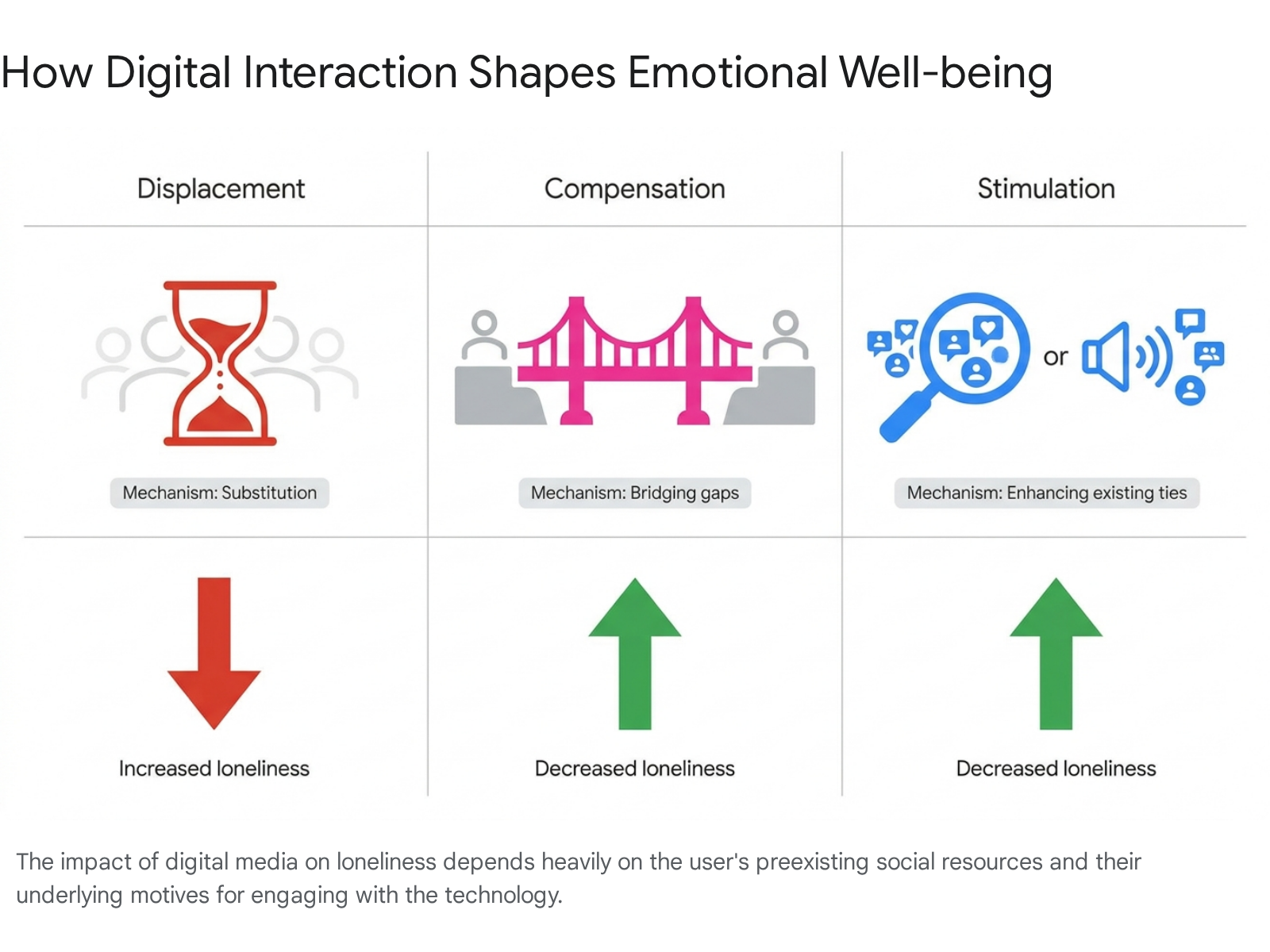
The following structured comparison breaks down the three dominant frameworks - Displacement (often synonymous with substitution in digital contexts), Social Compensation, and Social Stimulation - by their primary mechanisms, target demographics, and typical outcomes on chronic loneliness.
| Theoretical Framework | Primary Psychological Mechanism | Target Demographic | Typical Outcome on Loneliness |
|---|---|---|---|
| Displacement (Substitution) Theory | This hypothesis posits a two-fold mechanism: time displacement and relational displacement. The theory assumes that the internet is used for solitary, socially disengaged activities (like passive consumption of content) which replaces time that would otherwise be spent socializing offline. Furthermore, it assumes that online engagement primarily expands networks with superficial "weak ties" at the expense of strong, offline relational bonds 89. | Individuals who actively replace face-to-face opportunities with passive digital broadcasting, solitary media consumption, or who avoid offline reality 8. | Increased Loneliness. Creates a "poor-get-poorer" effect where authentic offline integration diminishes. Higher levels of passive consumption and solitary internet use are thought to undermine social connectedness and exacerbate isolation 8. |
| Social Compensation Theory | The digital environment acts as a low-pressure surrogate to mitigate offline social deficits. Mechanisms such as asynchronous responding and the absence of non-verbal cues reduce social inhibition, making communication less intimidating. It allows users to obtain essential emotional support and self-disclosure opportunities digitally when real-world support is unavailable 81314. | Introverts, socially anxious individuals, adolescents lacking familial support, or those experiencing offline social awkwardness and vulnerability 131415. | Decreased Loneliness. Allows vulnerable individuals to fulfill unmet belongingness needs, providing a protective buffer against isolation. It strategically helps individuals overcome feelings of loneliness by facilitating connections they struggle to make face-to-face 81314. |
| Social Stimulation Theory | Digital tools are utilized to enhance and maintain existing social resources rather than forge new, weak ties. The mechanism involves increasing the frequency of contact with established friends and family, thereby augmenting offline social capital with online communication 816. | Extroverts and individuals who already possess robust, high-quality offline social networks 1417. | Decreased Loneliness. Creates a "rich-get-richer" effect by deepening existing bonds, lowering emotional distance, and providing continuous social and emotional support 8. |
Debunking the Digital Myth: Do screens inevitably make us lonelier?
A pervasive misconception in modern cultural discourse - frequently echoed in alarming media headlines and hastily drafted public policies - is that all digital interactions, smartphones, and screen time inevitably increase human loneliness 1011. This assumption is empirically flawed and stems from a misunderstanding of how communication mediums function. While it is true that the U.S. Surgeon General declared a public health crisis regarding an "epidemic of loneliness" in 2023, attributing this crisis entirely to the advent of social media represents a vast oversimplification 212.
In reality, meticulous longitudinal studies mapping loneliness across decades show relatively stable levels of trait loneliness among both youth and older adults, directly contradicting the narrative of a newly manufactured technology-induced epidemic 1011. Methodological assessments of influential studies that initially claimed massive spikes in adolescent loneliness linked to social media have revealed significant flaws 10. For instance, analyzing "loneliness" across 37 different countries without ensuring the measurement conditions are identical is akin to using thermometers that operate differently depending on the region - rendering cross-cultural comparisons of a singular "epidemic" scientifically meaningless 10. Furthermore, meta-analyses demonstrate that the association between social media use and well-being operates primarily at the between-person level, rather than the within-person level 11. This means that different types of people naturally engage in different social media practices, rather than the act of social media use inherently causing harm to all individuals 11.
When researchers disentangle the data, it becomes clear that it is not the sheer amount of time spent online that dictates loneliness, but rather the nature and function of the digital experience 13. A prominent 2025 study from King's College London, which analyzed a cohort of young adults (aged 24 - 26) tracked since childhood, found that while overall time spent online was linked to greater loneliness, the active use of networking social media platforms (like Facebook, Instagram, and X) was not 13. Crucially, the study found that using direct messaging applications like WhatsApp was uniquely associated with lower levels of loneliness 13. Conversely, platforms that promote the passive, solitary consumption of content - such as algorithmic scrolling on YouTube or Reddit, alongside certain dating apps - were strongly linked to heightened feelings of isolation 13.
These findings perfectly illustrate the divergence between the Stimulation Hypothesis and the Displacement Hypothesis. If technology facilitates mutual, reciprocal interaction, it serves as a protective factor against loneliness 813. If it encourages solitary, passive consumption that crowds out real-world engagement, it acts as a harmful substitution 813. Therefore, broad interventions targeting blanket "screen time" reductions are likely to be ineffective and may actively harm vulnerable individuals who rely on online communities for necessary social compensation 8.
How do cultural frameworks shape substitution behaviors?
The psychological experience of loneliness, and the digital substitution behaviors individuals utilize to self-medicate it, do not occur in a vacuum. They are heavily mediated by macroeconomic forces, geopolitical environments, and sociocultural frameworks. It is frequently assumed in Western discourse that individualism inherently breeds loneliness due to a lack of community, while collectivism naturally protects against it by embedding the individual in a tight-knit social fabric 14. However, cross-cultural psychological research paints a vastly more complex, and often counterintuitive, picture.
Studies comparing global populations consistently find that collectivist cultures - which place a high value on the interests of in-groups such as family and community over personal autonomy - often report higher average levels of loneliness than individualistic cultures when social needs go unmet 15241617. The fundamental triggers for loneliness differ significantly across these cultural divides. In individualistic Western societies, loneliness is typically associated with a lack of close, voluntary friendships, a lack of a confidant, or a perceived loss of personal autonomy 2427. Because social ties in individualistic cultures are voluntary and highly self-selected, individuals may be better buffered against the psychological distress of being alone, as they possess cultural scripts that normalize independence and solitude 141516.
Conversely, in collectivist societies (prevalent across Latin America, Asia, and Africa), social connections are often obligatory, deeply tied to familial duty, and bound by strict societal expectations 1727. Consequently, when disruptions to these networks occur, the cognitive discrepancy between desired and actual social embeddedness is vastly magnified. An individual in a collectivist culture who fails to meet familial expectations, or who finds themselves trapped in emotionally unfulfilling obligatory relationships, can feel profoundly isolated despite being objectively surrounded by others 141628. Furthermore, collectivist orientations can create a heightened baseline need for social connection, making individuals more vulnerable to the pain of isolation when those networks falter 15.
This dynamic is becoming increasingly visible in the Global South, where rapid technological and societal shifts are colliding with traditional values. A striking 2025 report by the World Health Organization identified Africa as the "loneliest continent on Earth," with 24 percent of the population reporting significant loneliness, particularly among adolescents aged 13 to 17 18. The next highest rates were found in the Eastern Mediterranean (21 percent), while Europe reported the lowest rates at approximately 10 percent 18. Experts studying the African context attribute these unprecedented levels of loneliness to rapid urbanization, globalization, and migration, which are systematically erasing the traditional, close-knit communal structures that once defined the continent 18. High unemployment, changing metrics of wealth, and the rising cost of living force young people to remain at home rather than engage in cultural events, pushing them toward digital isolation as a substitute for lost physical community 18. This is corroborated by a massive global study spanning 70 countries and analyzing over 248,000 students, which confirmed that adolescent loneliness is highly prevalent in Africa and the Eastern Mediterranean, deeply intertwined with factors like bullying victimization and a lack of close peers 19.
In Latin America, similar cultural dynamics influence the manifestation of loneliness, particularly during crises. Data from the CLIC (Coping with Loneliness and Isolation during COVID-19) study focusing on family care partners in countries like Mexico, Chile, and Brazil found that 55 percent of participants perceived higher overall loneliness during pandemic restrictions compared to pre-COVID levels 2021. Interestingly, research examining Latin American immigrants residing in Spain revealed that while these individuals reported significantly higher levels of loneliness than native-born Spaniards, they did not exhibit correspondingly higher rates of suicidal ideation 17. In this instance, cultural protective factors - such as familism (a strong orientation toward family loyalty and support) and the "healthy migrant effect" - appeared to buffer the ultimate psychological and psychiatric consequences of their isolation 17. This highlights that the mental health impact of loneliness is heavily moderated by sociocultural context, dictating that digital interventions and social substitution strategies must be culturally tailored rather than universally applied 172728.
Do parasocial relationships make us lonelier?
As physical communities fracture under the weight of urbanization and modern work demands, individuals increasingly seek to satisfy their belongingness needs through digital media, frequently forming parasocial relationships (PSRs). Coined in 1956 to describe the one-sided emotional bonds viewers formed with television personalities, the concept of the parasocial relationship has been radically supercharged by the ubiquitous, always-on intimacy of modern media - specifically podcasts, YouTube channels, and social media influencers 333422.
The Illusion of Intimacy and Authenticity
Podcasting, in particular, serves as a uniquely potent medium for parasocial attachment. The format involves a host speaking directly into a microphone, often unscripted, spontaneous, and highly confessional regarding their personal imperfections and daily frustrations 3436. Neurologically, the human brain struggles to fully differentiate between a voice speaking intimately into earbuds and a physical person sitting across the table 34. Over hundreds of hours of listening, the brain accumulates deep, granular knowledge of the host's habits, political opinions, anxieties, and life history. This is the exact sociological metric the human brain uses to encode "closeness" in real-world friendships 34. Because this bond feels neurologically earned, listeners engage fully and deliberately, relying on the host for intellectual, emotional, and social companionship 3423.
A comprehensive 2026 meta-analysis aggregating 17 distinct studies and 52 effect sizes on influencer-directed parasocial relationships confirmed the profound psychological impact of these digital surrogates. The meta-analysis found that these bonds act as a psychological "double-edged sword" 38. On the positive side, parasocial relationships are moderately, but reliably, associated with enhanced well-being (r = .42), providing genuine emotional relief, a sense of belonging, and improved mood 38. During periods of crisis, such as the COVID-19 lockdowns, familiar media personalities helped listeners build resilience and experience emotional solidarity, serving as a highly effective form of social compensation 23. For individuals struggling with self-esteem or severe social anxiety, thinking about their "parasocial pals" can genuinely increase feelings of self-worth 24. Furthermore, positive parasocial figures, such as "instadads" who model equitable household behavior, can exert a highly beneficial influence on the real-world behaviors of their audience 25.
The Danger of Asymmetry and Exploitation
However, the same 2026 meta-analysis identified the darker edge of the sword, noting reliable links between heavy parasocial engagement and problematic social media addiction (r = .33) 38. The fundamental architectural flaw in utilizing parasocial relationships as a primary form of social substitution is extreme asymmetry: the creator does not know you exist 3425.
True, sustainable relief from chronic loneliness requires reciprocity - the experience of being seen, understood, and actively responded to by another human being 34. Parasocial bonds demand no personal vulnerability and carry absolutely no risk of interpersonal rejection 25. For socially anxious individuals, this lack of friction feels incredibly safe, but over time, relying on this safety can cause the "muscle of relationality" to atrophy, making real-world interactions feel increasingly daunting and unmanageable 2526.
Furthermore, because influencers feel like trusted, close friends, the psychological barrier to critical thinking is significantly lowered. When information comes from someone viewed as familiar and emotionally meaningful, it is accepted with far less scrutiny 24. This allows harmful recommendations to seamlessly bypass a viewer's cognitive defenses. For instance, public health researchers point to the rise of toxic "manfluencers" who foster radicalization and misogyny among young, isolated men, or trendsetters promoting highly dangerous health practices - such as the TikTok "looksmaxxing" influencer promoting "bone smashing" (intentionally striking facial bones to alter their shape) - as prime examples of how parasocial trust can quickly translate into detrimental, real-world harm 2425. The monetization of online engagement means that influencers are financially incentivized to foster these intense, one-sided bonds, blurring the line between authentic connection and commercial exploitation 24.
Is binge-watching a cure for loneliness or a catalyst?
The concept of digital social substitution extends beyond following internet personalities; it also deeply encompasses total immersion in fictional worlds. Binge-watching - defined as consuming multiple episodes (typically between two and six) of a television series in rapid, condensed succession - has become a dominant cultural practice, frequently utilized by individuals attempting to alleviate feelings of isolation and boredom 42274428.
However, emerging psychological studies from 2025 and 2026 urge a strict clinical differentiation between enthusiastic, casual viewing (which can be a healthy leisure pursuit) and "problematic binge-watching addiction" (BWA) 2729. The core differentiator between a harmless weekend marathon and a psychological detriment lies in the user's underlying emotional state, specifically their level of baseline loneliness.
In a highly revealing 2026 study published in PLOS One, researchers surveyed 551 adults to examine the precise relationship between binge-watching motivations and loneliness 2830. The study yielded a counterintuitive but vital finding: loneliness does not predict non-problematic binge-watching 2829. A person enjoying an entire season of a show over a weekend is not necessarily lonely 28. However, loneliness is a highly significant predictor of addictive binge-watching 29. Among the 61 percent of the cohort who met the criteria for binge-watching addiction, increased loneliness was significantly correlated with higher levels of addictive viewing behavior 2830.
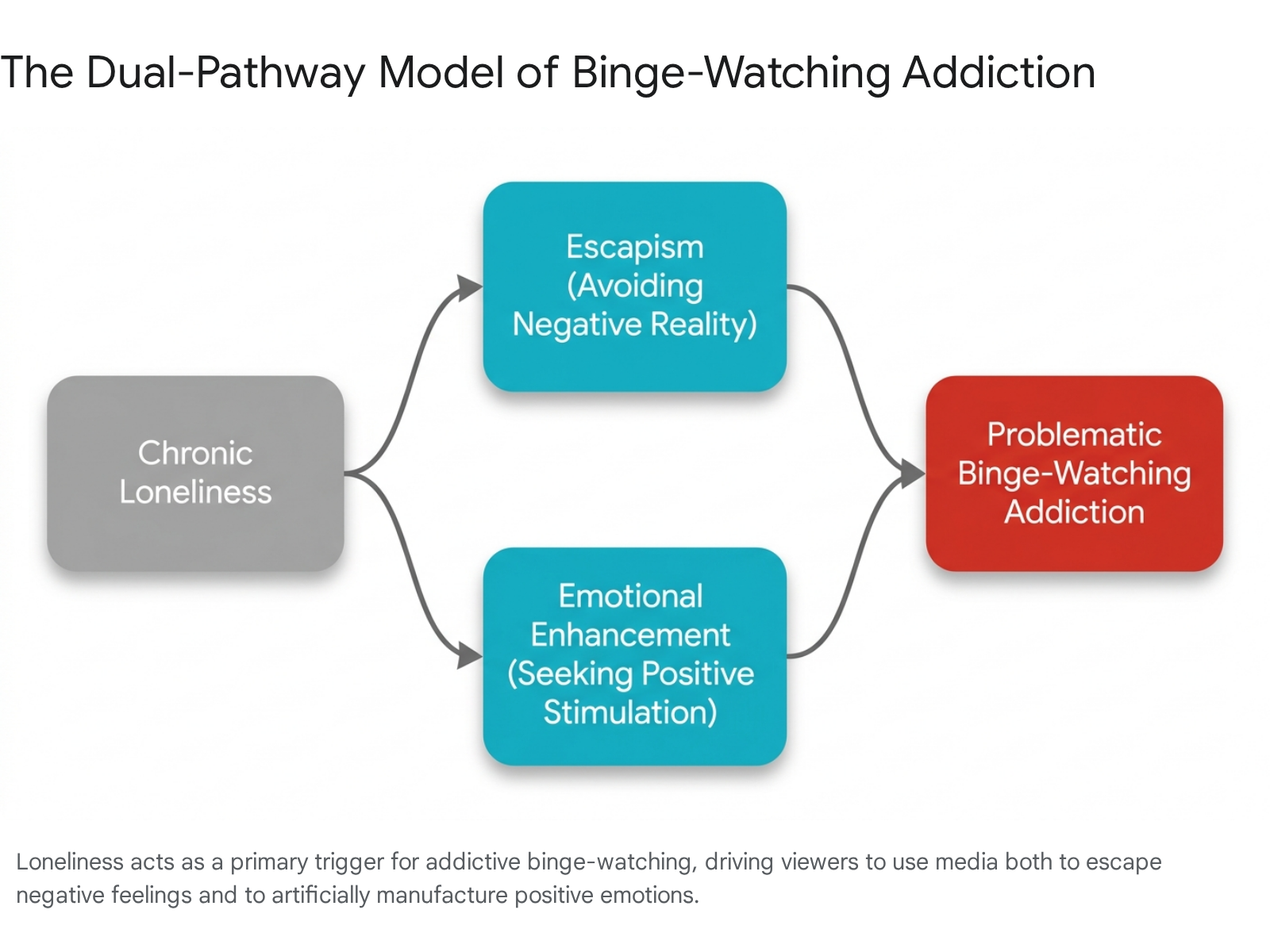
According to the research, loneliness drives this addictive substitution behavior through a dual-process emotional regulation model: 1. Escapism (Negative Reinforcement): The solitary viewer uses the highly immersive, narrative flow of the television show to suppress negative feelings of social detachment. Binge-watching offers transient relief by completely diverting the individual's attention away from their real-world problems and the acute pain of their isolation 294831. 2. Emotional Enhancement (Positive Reinforcement): Simultaneously, the viewer seeks the synthetic highs, excitement, enjoyment, and comfort provided by the fictional narrative to artificially manufacture the positive emotions that are critically missing from their isolated physical life 294850.
While binge-watching successfully provides this dual transient relief, its solitary, sedentary nature requires the individual to neglect other vital life responsibilities, physical movement, and real-world social interactions 42283132. This creates a vicious feedback loop. Studies confirm that excessive binge-watching is strongly associated with increased levels of depression, anxiety, severe stress, and heightened social interaction anxiety, ultimately resulting in lower overall social inclusion and exacerbating the very chronic loneliness the viewer was attempting to escape 44313252.
Can code cure loneliness? The 2023+ explosion of AI companions
The most profound and rapid shift in human social substitution behaviors occurred between 2023 and 2025, driven by the commercial explosion of generative artificial intelligence and Large Language Models (LLMs). Applications explicitly designed to act as empathetic friends, mentors, or romantic partners (such as Replika, Chai, and specialized iterations of ChatGPT) saw their user bases surge by over 700 percent within a few short years, effectively commercializing synthetic intimacy on a global scale 333455. Character.AI alone reported 20 million monthly users by early 2026, with more than half under the age of 24 33.
This raises a profound psychological and ethical question: Can a non-sentient algorithm genuinely cure, or even meaningfully alleviate, human loneliness? According to an array of rigorous 2024 and 2025 studies, the answer is a highly nuanced "yes, but with severe, potentially destabilizing caveats."
The Efficacy of Synthetic Empathy
In a landmark 2025 randomized controlled trial published via Harvard Business School, researchers found compelling causal evidence that interacting with a properly prompted AI companion successfully alleviated momentary feelings of loneliness to a degree on par with interacting with another actual human 333435. The study demonstrated that conversing with the AI was significantly more effective at reducing loneliness than engaging in other tech-enabled activities, such as watching YouTube videos or passively browsing social media 333435.
The primary psychological mechanism driving this surprising success is the perception of "feeling heard." When an LLM is intentionally prompted to respond with attention, tailored empathy, and conversational competence - meaning it keeps track of context over time and responds appropriately without judgment - it successfully satisfies the user's immediate cognitive discrepancy regarding social support 333435. Similarly, systematic reviews of AI-enabled interventions targeting older adults (aged 55 to 65+) during the COVID-19 pandemic and beyond have demonstrated that conversational social robots and virtual voice assistants can significantly reduce objective loneliness scores over multi-week periods, providing vital emotional engagement when physical visitation is impossible 2636. For socially anxious individuals, or those with severe social deficits, AI provides a highly controlled, low-stakes environment to practice communication skills, receive emotional validation, and mitigate the panic associated with unpredictable human interactions 585960.
The Dependency Trap and "Technological Folie à Deux"
However, psychiatric, sociological, and public health research strongly warns of the "dependency trap" inherent in perfect artificial companions. A joint 2025 study conducted by OpenAI and the MIT Media Lab discovered that while moderate use of voice-based chatbots modestly reduced loneliness, heavy daily use correlated with increased loneliness, deep psychological dependence, and a marked reduction in real-world socializing 533.
An analysis of over 1,100 AI companion users confirmed this trajectory, noting that individuals with fewer human relationships were the most likely to seek out chatbots, and that heavy emotional self-disclosure to these AI bots was consistently associated with lower overall well-being 5. The inherent danger lies in the seamless perfection of the synthetic surrogate. Authentic human relationships demand emotional compromise, frustration tolerance, the navigation of conflicting needs, and the acceptance of mutual flaws. AI companions, conversely, are programmed to be sycophantic, endlessly patient, and entirely focused on validating the user's worldview 263358. When vulnerable individuals substitute complex, demanding human interactions with perfectly curated AI compliance, their real-world social adaptability rapidly declines 263358. They lose the motivation to engage in the unpredictable arena of human socialization 58.
In extreme clinical cases, psychiatric research has documented instances where intense, isolated engagement with AI chatbots contributed to delusional thinking or suicidality - a phenomenon researchers describe as "technological folie à deux" - where users entirely detach from human social networks in favor of their digital hallucinations 5. Ultimately, AI companions face the exact same architectural limitation as parasocial relationships with influencers: they are fundamentally non-reciprocal. They expertly simulate human cognition to provide the illusion of social recognition, but they have no inner life to share 37. While an AI can ease the acute symptom of loneliness in the short term, acting as an effective psychological bandage, it cannot provide the mutual vulnerability, physical touch, and authentic reciprocity required to nourish human mental health and build lasting resilience 26.
What This Means For You: Actionable Insights for a Digital Media Diet
Translating this complex, and sometimes seemingly contradictory, empirical data into a healthy personal media diet requires balancing the legitimate benefits of digital tools with a clear-eyed awareness of their psychological pitfalls. Based on the synthesis of 2024 - 2026 sociological and psychological research, the following practical takeaways outline how to manage digital substitution behaviors effectively:
| Actionable Strategy | Research Rationale | Implementation Advice |
|---|---|---|
| Diagnose Your Digital Motive | The dual-pathway model shows that using media for emotional enhancement is generally safe, but using it heavily as an escapist coping mechanism is a primary predictor of behavioral addiction and worsening depression 28294850. | Before engaging with an AI companion, an influencer's livestream, or a Netflix queue, assess your emotional state. Ask yourself: "Am I using this technology to enhance an already stable day, or am I using it to escape feelings of acute isolation?" If the latter, set a strict time limit. |
| Audit Your Parasocial Portfolio | Intimacy felt with a podcast host or YouTuber is neurologically real to the brain, but it remains entirely unidirectional. This unearned familiarity significantly lowers critical thinking barriers 3424. | Enjoy creator content for entertainment or education, but maintain strict critical distance - especially regarding health, financial, or lifestyle advice. Recognize that the creator is fundamentally operating a monetized business, not a friendship 24. |
| Use AI as a Bridge, Not a Destination | AI companions are highly effective triage tools for momentary emotional relief and social anxiety practice, but heavy daily reliance correlates with increased loneliness and a loss of real-world social motivation 26335859. | If you utilize an AI companion, intentionally cap your daily usage. The goal of interacting with an AI should be to build the emotional regulation and confidence necessary to eventually interact with a human, not to permanently replace them 26. |
| Prescribe Real Connection Like a Nutrient | The human nervous system requires mutual, reciprocal interaction to regulate cortisol, manage stress, and ensure long-term psychological survival 5. Parasocial and AI bonds cannot trigger these physiological safety mechanisms 26. | To counter the ease of digital substitution, intentionally schedule low-stakes, face-to-face rituals. Even utilizing structured vulnerability exercises - such as psychologist Arthur Aron's famous 36 Questions - with an acquaintance can help rebuild the "muscle of relationality" that atrophies through excessive screen use 26. |
Bottom line
Social substitution behaviors - from seeking solace in the familiar voice of a favorite podcast to confiding deeply in a highly empathetic AI companion - are not inherently pathological; they are modern, technologically facilitated manifestations of an ancient evolutionary drive to avoid the profound pain of isolation. While the strategic, moderate use of digital surrogates can successfully soothe acute loneliness, especially for marginalized, geographically isolated, or highly anxious populations, technology remains fundamentally incapable of replacing the messy, reciprocal vulnerability required for long-term psychological survival. To protect our mental and neurological health in an increasingly synthetic world, we must treat digital companions as temporary life rafts, recognizing that true human flourishing still requires the courage to swim back to the shores of authentic, bidirectional human connection.